Tuesday, November 24, 2020

“A Mother’s Love” - The Lead Story from In Fields of Butterfly Flames by Steve Wade -2020


“A Mother’s Love” - The Lead Story from In Fields of Butterfly Flames   by  Steve Wade -2020


Gateway To Steve Wade on The Reading Life 


Website of Steve Wade 


A Wide Ranging Q and A Session With Steve Wade 


This is the sixth  short story by Steve Wade that has been featured on The Reading Life.  I first read his work during Irish Short Story Month Year Three in March of 2013.  I found his short story “The Land of the Ever Young” fully qualified to stand with the great occult fairy tales of Sheridan Le Fanu or Andrew Lang.


“The Land of the Ever Young" recreates and helps us understand the stories of fairies stealing human children and substituting changelings for them.  Part of the root of these stories comes from the famine years where people had to find ways to deal with the starvation of their children.  On another darker side, this story also  treats of the fact that one more hungry child could be the tipping point in a family on the edge of starvation that can  send everyone else into the grave.  


First and foremost 'The Land of the Ever Young" is a tremendous lot of fun to read.  Joseph Sheridan le Fanu or Andrew L)ang have no better stories than this.  I will tell enough of the plot to give you a feel for it but I want you to read this story without knowing too much about it.  


The other  stories covered show the extent and depth of Wade’s range. (Some of the stories can be read online at links found in my posts)


Today’s story way more than justifies my belief in the immense talent of Steve Wade.


“A Mother’s Love” is the lead story in Wade’s debut collection In Fields of Butterfly Flames and Other Stories.  There are 21 other stories in the collection.  Over the next few months I will be posting on a number of them.  


In “A Mothers Love” you are taken almost dragged into the mind set prevailing in a horrible family seen through the eyes of a wife and mother terribly out of touch with reality, trying to rationalize why her husband prefers sex with his daughter (who seems just entering early adolescence) to her.  She is in thrall to a religious ideology that cripples her thinking.  As I read on in this story you see the real face of evil.  Perhaps you might initially have some sympathy for her but this will not endure.  I will share a bit of Wade’s amazing prose to allow you to experience the dark feel of “A Mother’s Love”:


“Now working hand in hand with the Devil, the two conspired to draw in others for the sake of Mammon. Like swarms of flies they arrived, buzzing through my home, to gorge themselveson her oozing, naked flesh. Each evening, when the last of the swarm left, slaked and bloated, the pair of them unashamedly counted out their filthy lucre on the kitchen table. Theythen celebrated,the only way they knew how, atop the tableamong the pestilence-stricken notes and coins. You would have imagined that even the Devil must sometimes tire of excessive indulgence in fetid fornication.”


From the publisher


About the Author - Steve Wade’s award-winning short fiction has been widely published in literary magazines and anthologies. His work has been broadcast on national and regional radio. He has had stories short-listed for the Francis McManus Short Story Competitionand for the Hennessy Award. His stories have appeared in over fifty print publications, including Crannog, New Fables, and Aesthetica Creative Works Annual. His unpublished novel, On Hikers’ Hill was awarded First Prize in the abook2read.com competition, with Sir Tim Rice as the top judge. He has won First Prize in the Delvin Garradrimna Short Story Competition on a number of occasions. Winner of the Short Story category in the Write by the Sea writing competition 2019. His

short stories have been nominated for the PEN/O’Henry Award, and for the Pushcart Prize.


From the Author’s  introduction 


“The stories in this collection first appeared in anthologies and periodicals. Some of them have won prizes or have been placed in writing competitions. Ostracised by betrayal, isolated through indifference, gutted with guilt, or suffering from loss, the characters in these twenty-two stories are fractured and broken, some irreparably. In their struggle for acceptance, and their desperate search for meaning, they deny the past”


A very worthy edition to the reading list of all lovers of the short story.


Mel u


Monday, November 23, 2020

“Kate Crawford" A Short Story by John Lang-from Botany Bay-True Tales of Early Australia -1859


Website of Aussie Authors Reading Challenge 2020


“Kate Crawford" A Short Story by John Lang-from Botany Bay-True Tales of Early Australia -1859 


"Kate Crawford" by John Lang (1859, 10 pages)


John Lang (1816 to 1864) is Australia's first native born novelist with Two Clever by Half (1859).    Lang was  born in Sydney in New South Wales,  Australia.    His father was English and his mother was native born.   He attended Sydney College and while there produced a well respected translation of Horace's The First Satire.    After leaving Sydney College he went to England to attend Cambridge but was expelled for writing an article considered inappropriate (all  I can find on this).   After Cambridge he studied law at The Middle Temple in London.    He returned to Sydney after being admitted to the bar and married well.   In 1842 he and his wife moved to Calcutta, India.   He founded a very influential newspaper while there and later returned to England where he produced a good quantity of literary works, some of which were published in Charles Dickens's Household Words.


His only work of lasting fame (it is the only one found on Amazon) is  Botany Bay; or, True Tales of Early Australia.    This 1859 work is a collection of stories about the first convict colony in Australia.   Women were in very short supply in the convict colonies and any transported woman was in great demand by Crown officers of the  penal colony.    "Kate Crawford" is a work of short fiction which reads like journalism.     It is an exciting story of how Kate Crawford, a young English woman of 19 from a decent family got transported for 14 years for horse stealing, a hanging offense at the time.   This part of the story is interesting enough but "Kate Crawford" gets much more exciting as we see how women were treated aboard the transport ships:


“What Kate's sufferings must have been, when she was conscious of what was passing around her, it would, indeed, be difficult to describe. She had not only to bear the companionship of the three hundred degraded wretches who were her fellow--passengers, but to withstand the unseemly attentions of the Navy surgeon, who had charge of the convicts, and who had become enamoured of her extreme beauty. The captain of the vessel, also, fell desperately in love with her, and on several occasions proposed to marry her, abandon the sea, and settle in the colony”


   As a simple matter of fact,  most of the women were from very impoverished backgrounds and many were prostitutes at one point in their lives.   Kate is from a much higher social background than the average convict.    Once Kate arrives at the colony we quickly are treated to a very well done and credible account of her rise to riches.   In the process we learn a good bit about life in the early convict colonies.   


As you can see from the passage I quoted, the story is written in a simple direct fashion.    There are about ten other stories in the collection all of which can be read online at Project Gutenberg Australia.    The best informational resource on John Lang seems to be the entry in the wonderful Australian Dictionary of Biography.


Anyone interested in learning more about Australian convict history really needs to read The Fatal Shore by Robert Hughes.      


Sunday, November 22, 2020

Pelt and Other Stories by Catherine McNamara (2013)

World wide health issues have halted most global travel plans.  In the marvelous stories of Catherine McNamara we can continue our journeys, in great company.  


Catherine McNamara grew up in Sydney and studied visual communication and African and Asian Modern History before moving to Paris.

She worked in an embassy in pre-war Mogadishu and later lived in Accra, Ghana, where she co-managed a bar and art gallery. She moved to Italy ten years ago, where her jobs have included translating welding manuals and modelling shoes.

Catherine is the author of the erotic comedy The Divorced Lady’s Companion to Living in Italy (Indigo Dreams Publishing) and wrote the children’s book Nii Kwei’s Day (Frances Lincoln Publishing).

Pelt and Other Stories was a semi-finalist in the Hudson Prize 2011.

Posting on a collection of short stories is to me more challenging than posting on a novel.   Pelt and Other Stories by Catherine McNamara, her debut collection, is a very powerful, thoroughly captivating collection of stories most of which center on the post colonial world of central coastal West Africa. The  subtlies and levels of irony in these stories show a very great insight into how cross cultural encounters impact all parties.  The people in the stories range from European hotel owners in Ghana, famous art photographers, mistresses of Europeans, drivers, and village people.   The stories are mostly but not all set in West Africa.  One is set in the very worldly city of Sydney, some in Italy.   The stories are about 
relationships, McNamara knows white men can do things in West Africa that they cannot or will not
do back home.   The stories are miniature marvels in showing us the manifestation of orientalizing of the African not just by Europeans and Americans but by returned citizens.  The stories show us how hard it is to return home unchanged.   These stories are not about ignorant hateful prejudice.   McNamara is too knowing and intelligent for that.  They are about the very great difficulties of escaping from our deep conditioning, our unseen frames of reference.   The stories are also fun to read.  Lots of interesting things happen, there is some sex, women eyeballing each other, and a strong sense of humor and fun.  

I totally endorse this collection of short stories to all lovers of the form.  There are eighteen very diverse stories in the collection. I will talk briefly about several of them to help give potential readers a feel for the collection and help me increase my understanding of the stories.  I also include a few quotes so you can sample her marvelous prose.


"Pelt"

"Other girls say the same thing about their obroni men: when their old wives turn up they become little boys."

Set in Ghana, the title and lead story of Pelt and Other Stories, is told in the first person by a woman who progressed from working for a white man, an obroni, to being his mistress pregnant with his baby.   She lives in his house.  Up until now his wife has not been there for a long time.  The power in this story is in seeing how the local woman relates to the wife.  She knows the woman at least suspects her relationship with the man.   She is self conscious about her pregnancy.  When she notices the wife looking at her bloated breasts, she wants to tell her how her husband liked sucking on them.   She also knows the other women who work in the house will see she has fallen down in status now that the wife is on the scene.  There is a world in these magnificent lines:

"One of the girls – Comfort – asks me with a giggle what is to be prepared for lunch. Their assumption is that the real Madam has turned up, and I am just another hussy-made-good carrying a milky baby. No doubt this will be the speculation of the day".

There is much in this story that illuminates the sexual aspects of colonialism.  

"The Coptic Bride" 


"My mother adored Laila. Halfway through the afternoon she called to anoint me with her unqualified joy. I suspected it was hardly Laila she adored, but the prospect of a brown daughter-in-law and exotic grandchildren requiring the occasional visit to New York. Mother,"

Set in Sydney, Austraila, one of the world's most cosmopolitan of cities, a long absent son has just returned from Ethiopia with an Ethiopan fiancé, a Coptic bride to be.   Everyone in this very educated family is curious about her.   They discretely scrutinize and analyse her appearance and try to discern why the brother likes her. The story is really about orientalizing those different from us.  


"The Clock Tower"

"There was an answering service with the message in English, in Flemish and then in French, as was the way in this city. The English message said: Hello, you’ve reached Toby Vlaminck but I’ve taken off again. I’ll be in Ghana until November so I guess it’s not worth leaving a message unless it’s October twenty-something. Oh, and Didier’s still with M.S.F. in Rwanda"

"The Clock Tower" is a very interesting, closely observed story about how a too young to have this happen man adjusts when his wife and young son did of cancer within a three week period.   The man is acutely self-aware and is fascinating to follow his stream of consciousness.  

"Claudia Cardiales Flesh Colored Lips"

"Marina came in when he was eating grapes in front of an old Claudia Cardinale film. Unannounced, since last weekend had ended in a cloud of mutual, unrepenting bad will. Sebastien Tempels wanted to hear how she would get around it.
‘Her breasts look like a pair of Tupperware containers,’ she said as she tossed her bag."

I like this opening line as I see it as the sort of thing my wife would say if she walked in on me watching a Claudia Cardinale movie. I think younger readers not into Italian cinema may not know who she is so a pic is needed (OK I want a pic of her on my blog)


The story line of this well plotted work concerns the relationship of a medical student and his girl friend.it is a very subtle account of a complicated fragile reationship.

"Nathalie"

"But outside Nathalie looked so much older. The lines Mona had never noticed on her face had become grave and hard. Her eyelids were fallen, discoloured furrows below them, and the cheeks were those of a gaunt woman whose good health had been stolen. Mona was silent. Everything had been taken from them. This was the day that would never pass."


"Narhalie", like several of the other stories in the collection, centers on a person returning to their ancestral home after a long absence.  In the "The Coptic Bride" the city was Sydney, here it is Lome, the capital of and largest city in Togo.   Returning home is not easy.  It is often fraught with guilt, a struggle to return to old relationships with parents, siblings, and old friends.  Often people leave as one person and return as another seemingly more worldly and sophisticated idividual.  Things are not as they once were and maybe never will be.  These themes are very skillfully developed in this story.  I do not wish to spoil the plot of this story.  The close is very moving. 

"Gorgeous  Eyes"   

"I turn the book around to her. In her grasp it falls open on the page of a young Somali bride, modestly dressed, surrounded by pugnacious sisters.
‘Do you see?’ I say. ‘This book is a glossy celebration of Africa’s cruelty. That woman is about to be raped by her fifty-year-old groom. She has been circumcised by those women surrounding her. She will know pain for the rest of her life.’
My wife looks at me with horror. She shuts the book."

"Gorgeous Eyes" is narrated by the owner of a hotel on the west coast of Africa.    One of the dominant themes of the collection is about European spectatorship of Africa.   It is also about returning Africans trying to see their culture through the eyes of Europe.   This story is a brilliant account of orientalizing, of turning people into art objects.  As the story opens a well known "art" photographer arrives at the hotel.   She is there to take pictures of tribal people for high end coffee table books.  The portrayal of the photographer is very subtle.   We wonder about her intentions.   Is she a kind of parasite or is she a great artist cherishing a dying culture or is she both?   There are some very interesting plot turns in this powerful story. 

""innocent"

         "Innocent" is about a chauffeur of that name.   He works for an expat woman.   The story is set in in Sefwi Awiaso, Ghana.   In just a few pages we are shown how the driver is infantilized by his
employer, as if his biggest desire in life is to have a new pair of Peter Fonda sunglasses every year.
He has gotten a woman in his home village pregnant and his boss tells him to marry her.   The girl is 
sixteen.   She took an herbal drink that is reputed to cause a miscarriage but it did not work.  
Innocent fears if he does not marry the girl, her father will kill him.  The interest in this very
subtle story is in seeing the patronizing way Innocent is treated by his employer.  


I greatly enjoyed this collection and I recommend it without reservation.  I hope to read more of 
Authors work soon.


Catherine McNamara grew up in Sydney, ran away to Paris to write, and ended up in West Africa running a bar. She was an embassy secretary in pre-war Mogadishu, and has worked as an au pair, graphic designer, gallery manager, teacher, translator and shoe model. 

Praised by Hilary Mantel, her short story collection The Cartography of Others (May 2018, Unbound) was a Finalist in the People’s Book Prize 2019-20, was awarded Grand Prize in the Eyelands International Book Awards (Greece) and listed on the Literary Sofa’s Best of 2018 Reads. Her book Pelt and Other Stories (2013) was long-listed for the Frank O’Connor Award and semi-finalist in the Hudson Prize. Her short stories and flash fiction have been Pushcart-nominated and published widely in the U.K., Europe, U.S.A. and Australia. Her flash fiction collection Love Stories for Hectic People is out in autumn 2020. 

Catherine speaks Italian and French and lives in Veneto, Italy, where she hosts summer retreats for writers and artists in her African-art-filled farmhouse. She is an online writing mentor and coach


Author's  blog

Mel u

Saturday, November 21, 2020

“Grow Up” - A Short Story by Sylvia Petter - 2017 - included in her collection Back Burning from 2007


 “Grow Up” - A Short Story by Sylvia Petter - 2017 - included in her collection Back Burning  


You may read today’s story here


Website of The Aussie Reads 2020 Challenge


Website of Sylvia Petter 


“  I’m a grandmother now. Would you believe I’ve fallen in love? I ride rainbows with leprechauns, wear purple underwear. Somehow nobody seems to bother anymore. It suits me like that. I blow bubbles and raspberries wherever I choose and my world is full of indigo and cyclamen. My grandchildren understand me”.


I know from long years of experience and from reading posts by many others that lots of those deeply into the reading life first entered it as young children because the world of “grown ups” did not have that much appeal.   We mostly got on with our lives, worked, had long and short relationships, had children but still did not feel like real grown ups.  And why should we, their world sucks!


“Grow Up” by Sylvia Petter wonderfully takes us in a perfectly crafted short story into the life of a woman who always resisted when her parents, her husband and others told her to “grow up”.


We meet the narrator in elementary school where she first encounters Peter Pan.  She learns he could not only fly he never grew up.  At once she seizes on both ideas.  The story of Peter Pan becomes almost a mantra for her life.  Her mother often chides her “Grow Up”.  When she gets her first period and develops breasts she does not like either change She hears a neighbor tell her mother “my how Pamela is growing up”.


Pamela marries, has a child but still does not desire to be a real grown up.

Her husband tells her, “time for you to grow up”.  They part ways.


I loved the ending.


In this story we see how an encounter with a fictional person can shape your life more than real people.


“I am  an Australian, now based in Vienna, Austria.  I’m all over the place, a blob of mercury on a lab   floor, as my old writing boot camp sergeant, Alex Keegan, used to say. Born in Vienna, I grew up in Australia and after more than 25 years in the Geneva area, am now living in Vienna, Austria. I started writing fiction in 1993, and my poems, articles and stories have appeared in print and on the web.

I’ve attended workshops and writing conferences in Austria, Australia, Canada, France, Ireland, Spain, Switzerland, the UK and the US, and have done   correspondence courses through Humber College, Toronto. In 2009 I completed a PhD in Creative Writing at UNSW and am working on my second novel.

I was Co-Director Vienna of the 13th International Conference on the Short Story in English, Vienna, 2014.  A founding member of the Geneva Writers’ Group, I   am currently a member of IG Autorinnen Autoren and GAV, Vienna, Austria, and the Australian Society of Authors.”


From https://www.sylviapetter.com/about-me/


I will post on her forthcoming novel All the Beautiful Liars.


From the publisher


 ‍

‘A stylistically daring, hurricane-paced and genuinely impressive feat of the imagination’ – Billy O’Callaghan


As a child in Australia in the Fifties, Katrina Klain is taunted in the playground as a Nazi, long before she knows what the word means. Her German mother and her Austrian father seem to be ordinary people who simply ended up on the wrong side of history, but Katrina yearns to know more about her origins.

Leaving the New World behind as soon as she can, she heads to Vienna, where she imagines her Germanic name will no longer be a burden, armed with what turns out to be an inexhaustible list of questions. Is the sleazy uncle exiled to Spain a crook or a hero of the anti-Nazi resistance? Why does her father insist his brother is dead? And is her cousin in East Germany really a Stasi agent?

Decades later, during a long flight back to Australia, Katrina attempts to reassemble the pieces of the puzzle she has spent so long researching. In her dream-like version of an in-flight movie, a mysterious other-worldly guide seems to know – and have control over – her own future.

Told in a thrillingly inventive narrative style, Sylvia Petter’s debut novel is a powerful, pacy tale about making peace with the past, which also paints a richly evocative picture of Central Europe in the early decades after the war.


OUT JANUARY 2021. AVAILABLE FOR PRE-ORDER NOW


http://eye-books.com/books/all-the-beautiful-liars


Mel u


Friday, November 20, 2020

Emergency Skin by N. K. Jemisin - 2019 - Winner of the 2020 Hugo Award for Best Novelette.


 Emergency Skin by N. K. Jemisin - 2019 - Winner of the 2020 Hugo Award for Best Novelette.


K. Jemisin is one of, it not most, award winning Science Fiction writers of all time. She is the first author ever to win the genre’s most prestigious award, The Hugo Award for Best novel of the year in three consecutive years for her Broken Earth Trilogy.  


I’m glad that her Emergency Skin (reading time 45 minutes) can be read free by Amazon Prime members (or purchased as a Kindle for $1.95).  This is a very imaginative work with a marvelously realized future setting.


The Earth seemed headed for self destruction.  An elite group left for a distant location to continue humanity.  Now much time has gone by and

an explorer is being sent to report on the current state of the planet. Centuries have gone by and he is being prepared to encounter a ravaged place.  He finds something very unexpected.


So far I have read book one of The Broken Earth Trilogy and hope to finish it next year.  I have her full The Inheritance Trilogy and hope to also read that in 2021.


From the Author’s website 


N. K. Jemisin is the first author in the genre’s history to win three consecutive Best Novel Hugo Awards, for her Broken Earth trilogy. Her work has won the Nebula and Locus Awards. The first book in her current Great Cities trilogy, The City We Became, is a New York Times bestseller. Her speculative works range from fantasy to science fiction to the undefinable; her themes include resistance to oppression, the inseverability of the liminal, and the coolness of Stuff Blowing Up. She’s been an instructor for Clarion and Clarion West writing workshops. Among other critical work, she was formerly the speculative book reviewer at the New York Times. She is a MacArthur 2020 Genius Grant Fellow. In her spare time she’s a gamer and gardener, responsible for saving the world from Ozymandias, her dangerously intelligent ginger cat, and his destructive sidekick Magpie. Essays and fiction excerpts are available at nkjemisin.com.


Thursday, November 19, 2020

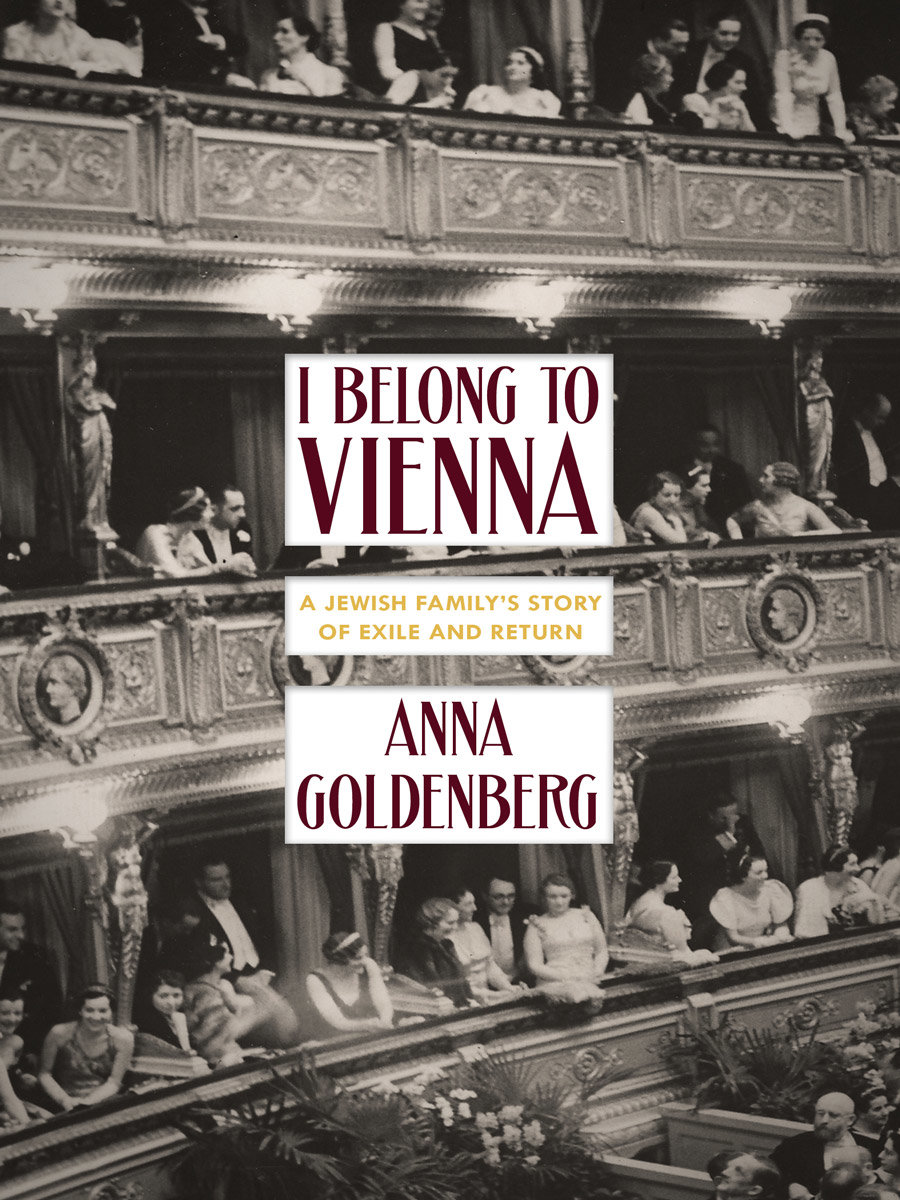
I Belong to Vienna: A Jewish Family’s Story of Exhile and Return by Anna Goldenberg - Translated from the German by Alta L. Price 2020


I Belong to Vienna:  A Jewish Family’s Story of Exhile and Return 

by Anna Goldenberg - Translated from the German by Alta L. Price 2020


First published in German in 2018 as Versteckte Jahre: Der Mann, der meinen Großvater rettete


There are quite a number of journey of discovery  memoirs by children and grandchildren of victims of the Holocaust.  I Belong to Vienna:  A Jewish Family’s Story of Exhile and Return by Anna Goldenberg is a very moving informative well narrated such work.


In Autumn of 1942 the author’s grandparents and one of her grandfathers were transported from Nazi controlled Vienna to the Theresienstadt Concentration Camp.  Their oldest grandchild Hans survives the war by hiding in an apartment in Vienna.  He does make it out to the municipal opera and library.  He comes to have a great passion for opera, one of the glories of the deep culture of Vienna even though he can buy only standing room tickets.  I smiled when I read about how he learned to reuse his tickets.  In America both he and his wife became doctors.


Both of her grandparents, but not her great grandparents, survived the war and moved to New York City.  Almost all surviving Austrian Jews wanted out of the country, once thought a safe haven during the Austro-Hungarian Empire, that totally turned on them.  It was not easy for a Jew to get out of Nazi controlled Vienna.  You had to give up almost everything you owned, secure a sponsor in America, and book passage.


The author was born in Vienna but moved to  in New York City in 2012 to study.  She feels driven to return, to trace her family’s time in Nazi Germany.  She tried to deal with the deep chasm of the magnificent past of Vienna and the barbaric city it became.  Goldenberg has given us a valuable addition to Holocaust studies.


From The Forward


“Absorbing … What distinguishes Goldenberg’s book from much of the vast library of Holocaust literature is its distance from the campaign to exterminate European Jewry. It is the story of a young woman’s attempt to make sense of history more than it is a direct evocation of the roundups, cattle cars, and gas chambers …  Will leave Americans fascinated by the cruelty and loyalty born in the city of Sigmund Freud, Gustav Mahler, and Anna Goldenberg.”

— The Forward


Anna Goldenberg is the author of I BELONG TO VIENNA. Born in 1989 in Vienna, she studied psychology at the University of Cambridge and journalism at Columbia University. Goldenberg worked at the Jewish newspaper The Forward in New York before returning to Vienna where she now writes as a journalist for various newspapers.


This work was published by New Vessal Press

newvessalpress.COM - a few minutes on their website Will likely add numerous works to your wish list.


Mel u


“Two Hanged Women" A Short Story by Henry Handel Richardson - 1929 - 8 Pages


 Website of Aussie Author Reading Challenge  2020


“Two Hanged Women" A Short Story by Henry Handel Richardson - 1929 - 8 Pages


   Henry Handel Richardson (pen name of Ethel Florence Lindsey Richardson) was born in Melbourne Australia in 1870. She died in 1946 of cancer. Her roots were Irish and English.   Her father was a successful doctor specializing in obstetrics who achieved some affluence through the purchasing of shares in gold mines.  Her paternal grandfather was born in Dublin.    At age 18 her mother took her to Europe to pursue musical studies.     She remained in Europe and England until 1912 when she returned briefly to Australia to research her family history.  She published her master work, The Fortunes of Richard Mahoney (1930).   It is a trilogy (over 1000 pages) and is set in the gold fields in mid Victorian Australia.      


Before posting on "Two Hanged Women" I should point out that Wikipedia in its article on her  says  that Henry Richardson should be considered a bisexual but the Australian National Dictionary of Biography explicitly says that is a pure conjecture unsupported by any concrete evidence.     She was married for many years and after her husband's death felt she  maintained daily contact with him through seances.   She was an ardent support of the suffragette movement.  


"Two Hanged Women" is a simple story that opens on a young couple out for a romantic walk along a shore. They see they are not alone so they begin to make loud kissing noises hoping it will run the intruders away.   It does work.   The man is surprised to see the other two people were women and he refers to them as just "two hanged women".      I did some quick research to see if  the expression "hanged women" might have a meaning unknown to me in Australian slang of the 1920s and 1930s.     A bit of quick research seems to indicate it just refers to two women "hanging out"-(being somewhere for no purpose).    If I am missing something here please correct me.


I really liked her prose style and the story line does seem to support the notion that the two women are lovers at least spiritually.    I want to quote a bit from the story so other can see if they might enjoy her work and also to allow some play to the notion that this story is about a lesbian relationship.


 "I’m afraid of him . . . when he looks like that. Once . . . when he kissed me . . . I could have died with the horror of it. His breath . . .his breath . . . and his mouth — like fruit pulp — and the black hairs on his wrists . . . and the way he looked — and . . . and everything! No, I can’t, I can’t . . . nothing will make me . . . I’d rather die twice over. But what am I to do? Mother’ll NEVER understand. Oh, why has it got to be like this? I want to be happy, like other girls, and to make her happy, too . . . and everything’s all wrong. You tell me, Betty darling, you help me, you’re older . . . you KNOW . . . and you can help me, if you will . . . if you only will!” And locking her arms round her friend she drove her face deeper into the warmth and darkness, as if, from the very fervour of her clasp, she could draw the aid and strength she needed.

Betty had sat silent, unyielding, her sole movement being to loosen her own arms from her sides and point her elbows outwards, to hinder them touching the arms that lay round her. But at this last appeal she melted; and gathering the young girl to her breast, she held her fast.— And so for long she continued to sit, her chin resting lightly on the fair hair, that was silky and downy as an infant’s, and gazing with sombre eyes over the stealthily heaving sea."


"Two Hanged Women" can be read here


Featured Post

Imperial Reckoning: The Untold Story of Britain’s Gulag in Kenya by Caroline Elkins - 2005 - 701 Pages

  Imperial Reckoning:     The Untold Story of Britain’s Gulag in Kenya by Caroline Elkins - 2005 - 701 Pages 2006 Pulitzer Prize Winner From...