Showing posts with label Ancient Readings. Show all posts

Thursday, December 15, 2022

The Persians by Aeschylus -479 B. C. E. -translated by James Romm - 2009- The Most Ancient of Dramas


 The Persians by Aeschylus -479 B. C. E. -translated by James Romm - 2016- The Most Ancient of any drama


An Ancient Times Project Work


  Aeschylus- 525 B. C. E. to 456 B.C. E. Only seven of his estimated 80 dramas survived.


This play is included in The Greek Plays: Sixteen Plays by Sophocles, Aeschylus and Euripides-Preface, general introduction, play introductions, and compilation copyright © 2016 by Mary Lefkowitz and James Romm


CAST OF CHARACTERS (IN ORDER OF APPEARANCE) CHORUS of Persian elders ATOSSA, queen of the Persians; mother of Xerxes; widow of Darius MESSENGER from the retreating Persian army GHOST OF DARIUS, former king of the Persians; father of Xerxes XERXES, king of Persia 


In his informative introduction to The Persians James Romm explains that Aeschylus and much of his audience had fought in the a seemingly miraculous Greek victory over the Persian navy at the island of Salamis, off the west coast of Attica. That victory, achieved despite long odds, had saved most of Greece, and especially Athens, from a fearsome choice between annihilation and subjection to the might of imperial Persia. 


The Persians is the final drama in a Trilogy, the first two works were lost. My research indicates it is one of the very few Greek dramas based on actual events.


The Persians most powerful segment to me is a very amazing account of the army assembled by the Persian Emperor Xerxes to conquer Greece. The play takes place in Susa, one of the capitals of the Persian Empire and opens with a chorus of old men of Susa, who are soon joined by the Queen Mother, Atossa, as they await news of her son King Xerxes' expedition against the Greeks. Expressing her anxiety Antossa feared this vast assembly of warriors would be destroyed by the Greeks under the leadership of Athens. Xerxes the Emperor escapes capture. His mother Atossa is harshly critical of her son, blaming his hubris for the death of many thousands of Persisns.


Contemporary scholars seem divided as to how one might view the play. Some see it as a celebration of the Greek victory others see compassion for the "warriors of Asia" sent to die in a war that meant nothing to them. 


At the tomb of her dead husband Darius, Atossa asks the chorus to summon his ghost: "Some remedy he knows, perhaps,/Knows ruin's cure". On learning of the Persian defeat, Darius condemns the hubris behind his son's decision to invade Greece. 


God's are depicted as favoring the Greeks but they demand obedience and punish those they find disrespect them.


Mel Ulm

The Reading Life 


Thursday, November 17, 2022

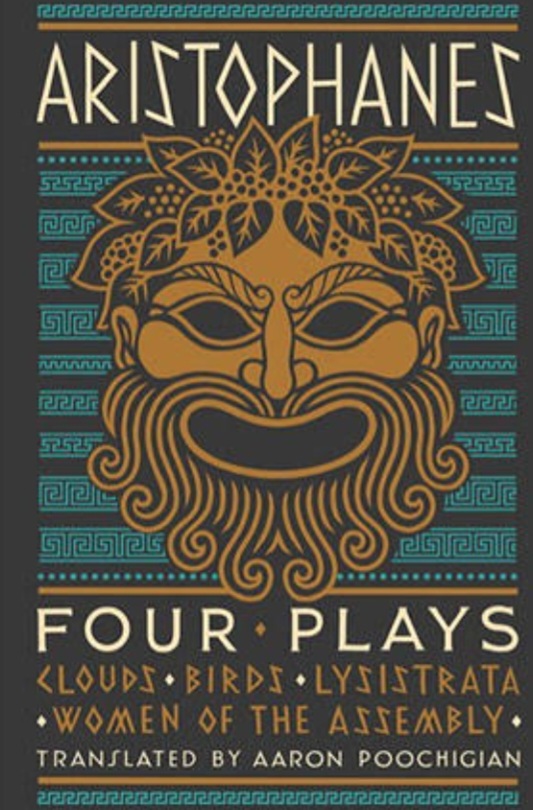
Women of the Assembly by Aristophenes- 392 BCE -Translated by Aaron Poochigian-2021


Born: 445 BC, Athens 

Died: 386 BC, Delphi


Last month I read his Lysistrata 

Lysistrata is by far the most famous ancient comedy. The central theme is that the women of Greece ban together refuse to have sex with their husbands or lovers unless the men restrain from all forms of warfare. There is very explicit sexual language. Some of the women complain that they cannot go without sex and talk about dildos. The husbands are very upset, they walk around with huge erections protruding from their tunics.

Women of the Assembly opens during a festival only for Women.  The women there agree to disguise them selves as men.  The plan is they will go to the Assembly and vote to turn the government of Athens over to Women.  They also want to do away with the notion of property, with marriages, nuclear families.  Sex is not confined to marriage.  If  a man wants to have sex with an attractive woman he must first have xex with an ugly one.  This way old or unattractive Women are not deprived of sex.

There are lengthy arguments about the soundness of these ideas.  Children will not have a designated father but will be a community responsibility.  There is debate about motivation for working if everything is owned in common.  Everyone is guaranteed an equal subsistence, no rich no poor. Slaves, not being citizens, are owned in common.

As in Poochigian's translation of Lysistrata, there is very  explicit language, that now would make the work at least R rated.  As I read this I wondered if this language was meant to shock the audience or was it just how people  in Athens in 351 BCE  talked?. Women are depicted as craving sex but tired of just being a vehicle for the penises of men. Older women resent younger women getting all the sex.

I found the debates interesting.  The depiction of women is kind of amusing.
A blog I have followed for many years, Wuthering Expectations, is doing a read through of all the surviving Greek Plays, a marvelous endeavor I wish I could have emulated.

If you are new to Aristophenes first read Lysistrata. I will in December read his Birds
ABOUT THE TRANSLATOR Aaron Poochigian earned a PhD in classics from the University of Minnesota and an MFA in poetry from Columbia University. He is the translator of, among other classical works, Sappho’s poetry (published under the title Stung with Love), Apollonius’s Jason and the Argonauts, and Euripides’s Bacchae, and has published two books of poetry—The Cosmic Purr and Manhattanite—and a novel-in-verse, Mr. Either/Or. His poems have appeared in such publications as Best American Poetry, the Paris Review, and Poetry. He lives in New York.

Tuesday, October 18, 2022

Lysistrata by Aristophenes - first preformed 411 BCE - translated by Aaron Poochigian - 2021


Lysistrata by Aristophenes - first preformed 411 BCE - translated by and with an Introduction by Aaron Poochigian - 2021


Born: 445 BC, Athens 

Died: 386 BC, Delphi


Lysistrata is by far the most famous ancient comedy.  The central theme is that the women of Greece ban together refuse to have sex with their husbands or lovers unless the men restrain from all forms of warfare.  There is very explicit sexual language.  Some of the women complain that they cannot go without sex and talk about dildos.  The husbands are very upset, they walk around with huge erections protruding from their tunics.


Lysistrata is the organizer of this sexual strike.  When asked what to do if your husband forces himself on you she says “just lay totally stiff, don’t grind back”.  Female actresses lift up each others tunics for inspection purposes, commenting on what they see.


The men are very upset insisting the women have no reason to complain about wars as they do not participate.  Lysistrata  explains that they lose sons and husbands in war.  All of the women involved are aristocratic though they live in a society where slaves out number the free.  A slave woman plays a minor role, and is  treated with no respect by her owner, Lysistrata.


From the play as the women take an oath to withhold sex:


“Hey there, Lampito, everyone, lay your hands upon the wine cup.One of you will repeat, for all, the terms of our agreement after me, and then the rest will swear to keep them once we’re done. No man, be he a lover or a husband . . . CALONICE: (stepping up as the representative for all the women) No man, be he a lover or a husband . . . LYSISTRATA: No man, be he a lover or a husband . . . LYSISTRATA: . . . shall come up to me with a boner. Say it! CALONICE: . . . shall come up to me with a boner. ​Ah! My knees are going to buckle, Lysistrata! LYSISTRATA: And I shall pass the time in celibacy”.


In what Aaron Poochigian says is very unusual in Ancient Greek Drama, there are two choruses, one of old men, one of old women. The old women play a big part in the action, seizing the treasury Athens needs to wage war.  The two choruses converse with each other about the sex strike as well as making comments to the audience.


There are three videos on YouTube of staged performances.  The actors are college students and to me they seemed overacting and the choruses did not seem very well done.  


A blog I have followed for many years, Wuthering Expectations, is doing a read through of all the surviving Greek Plays, a marvelous endeavor I wish I could have emulated.


There are three other comedies in the collection,  Birds, Women of the Assembly and Clouds.  I am hopeful I can read and post on them by the end of 2022.


ABOUT THE TRANSLATOR Aaron Poochigian earned a PhD in classics from the University of Minnesota and an MFA in poetry from Columbia University. He is the translator of, among other classical works, Sappho’s poetry (published under the title Stung with Love), Apollonius’s Jason and the Argonauts, and Euripides’s Bacchae, and has published two books of poetry—The Cosmic Purr and Manhattanite—and a novel-in-verse, Mr. Either/Or. His poems have appeared in such publications as Best American Poetry, the Paris Review, and Poetry. He lives in New York.


Mel Ulm

Thursday, February 3, 2011

The Bacchae by Euripides-True Blood and Greek Drama

The Bacchae by Euripides (405 BC, translated 1911 by Gilbert Murray)

This is my post for the Classics Circuit Ancient Greece Tour  (The full schedule can be found at the tour web page).


"And deep beneath the Maenad cry
His proud voice rings:
"Come, O ye Bacchae, come!"
As I read this work by one of the "big three" ancient Greek Dramatists (the other two being Sophocles and Aeschylus)   I knew it was a very high canon status work.    My reading of older literature in translation is largely done online and this limits me in most cases to older public domain translations.   There are no public libraries here in Manila and I need to keep some control on my book buying expenses.        I know in cases of translations of Greek dramas I am missing out on great new translations.  

My comments here will not be at all a general summing up of the play just a few sort of random observations stimulated by my reading.   (Wikipedia has good articles on Euripides (480 to 406-Athens) and The Bacchae.)

My first question as I read the play (read via Dailylit.com) was am I really having a reading experience anything like that of reading it in the original or am I reading an early 20th century English drama inspired by a Greek Drama?     The translator, Gilbert Murray (1866 to 1957) was born and spent his early years in New South Wales Australia.    At age 11 Murray's father died and he and his mother emigrated to the UK.   Murray studied the classics at Oxford.      He translated many classic Greek Dramas.    Most English speaking non Ancient Greek readers up until 1965 or so got there Greek Drama from Murray.     Sometimes people used to say that Constant Garnett made all of the great Russian writers sound the same.  Some say Murray did did the same thing to Greek Drama.     My conclusion here is I read more a early post-Victorian drama based on Greek roots than a Greek Drama.    My feeling on this is hard to explain or justify.   When I read the translations of Homer by Robert Fagles I felt I was reading a very old work.   I did not feel that way when I read this work.

Another Maiden_
Then streams the earth with milk, yea, streams
With wine and nectar of the bee,
And through the air dim perfume steams
Of Syrian frankincense; and He,
Our leader, from his thyrsus spray
A torchlight tosses high and higher,
A torchlight like a beacon-fire,
To waken all that faint and stray;
And sets them leaping as he sings,
His tresses rippling to the sky,
And deep beneath the Maenad cry
His proud voice rings:
"Come, O ye Bacchae, come!"

Are you a fan of the cable TV series True Blood?    I admit I am  and  I am looking forward to the next season.      The character in the series "Mary Anne" was a Maenad.   Maenads were the hand maidens of the God Dionysus.     In Euripides play Dionysus is a God who allows us to celebrate our irrational side, to give play to our darker less civilized instincts.    He is surrounded by a group of female followers who worship him.    Of course there are themes here suggesting Dionysus is to be taken as an eastern cult religion attempting to subvert the rational codes of the Greek and that the Maenads represent a latent fear of uncontrolled female impulses.

I thank Rebecca for her hard work in hosting the classics circuit.  I know my post is a bit unorthodox.

Mel u

Featured Post

Imperial Reckoning: The Untold Story of Britain’s Gulag in Kenya by Caroline Elkins - 2005 - 701 Pages

  Imperial Reckoning:     The Untold Story of Britain’s Gulag in Kenya by Caroline Elkins - 2005 - 701 Pages 2006 Pulitzer Prize Winner From...