Showing posts with label Mary Costello. Show all posts

Saturday, November 16, 2019

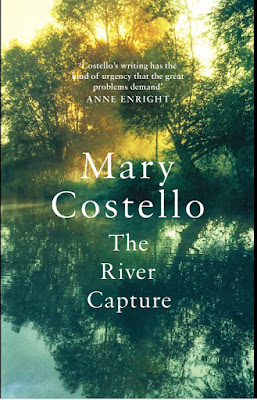
The River Capture by Mary Costello - 2019


Canongate - Publisher of The River Capture


My Q and A Session with Mary Costello 


In March of 2013 I read and posted upon Mary Costello's debut collection, The China Factory.  I am delighted to be today featuring her second novel, River Capture. Set mostly in Waterford, Ireland, the river is the Sullane.

The theoretical model behind my blog calls for me to focus on literary works about people who lead reading centered lives. River Crossing is a brilliant example of such a work. The central character Luke O'Brien is obsessed with Leopold Bloom from Ulysses.  He has just returned from Dublin where he was teaching Joyce.  He often reacts to passing events by wondering what Leopold Bloom would do under the same circumstances.  He seems to have both Ulysses and Portrait of the Artist as a Young Man so well internalized that segments enter his consciousness through out his day as involuntary memories.  He sees himself in terms of his relationship to Joyce and his work.  He has vague plans to write a book on Joyce now that he is back on the family farm.  There are lots of quotes from Joyce and even references to Richard Ellman's biography.

Luke is kind of at odds as what to do with his days.  Much of his time is spent visiting his Aunt Ellen, his only living relative besides a sister in Australia.  He seems slightly unhappy.

Luke has had a gay relationship as well as one with a woman, both way in the past but he thinks about them a lot.  He is lonely but he is used to that.  

One day a woman comes to his farm and asks him to adopt her uncle's dog. They gradually develop a relationship. Ruth brings a much needed element of chaos into Luke's life.

As the plot reaches about midpoint Luke's mind takes on an almost Joycean synsesis of human culture.  The language is exquisite.  

Irish romantic relationships are stereotypically portrayed as restrained, we see into and beyond that in the evolving relationship of Luke and Ruth.

This is very much a set in place story, deeply rooted in Ireland.

From the publisher

"Mary Costello lives in Galway. Her short story collection, The China Factory (2012), was nominated for the Guardian First Book Award and shortlisted for an Irish Book Award. Her first novel, Academy Street (2014), won the Irish Novel of the Year Award at the Irish Book Awards and was named overall Irish Book of the Year. It was serialised on BBC Radio 4’s Book at Bedtime and was shortlisted for the International Dublin Literary Award, the Costa First Novel Prize, the EU Prize for Literature and the Prix Littéraire des Ambassadeurs de la Francophonie en Irlande, and has been translated into several languages. The River Capture is her second novel."

Mel u

Saturday, June 8, 2013

"Barcelona" by Mary Costello (2013)

My Q and A with Mary Costello


I was very glad to see that Kevin Barry included a story by Mary Costello, author of  China Factory, in his just published collection, Town and Country - New Irish Short Stories.   I intend to read all of the twenty stories in the collection, thirteen of which are by new to me writers.    I previously posted on an excellent story by William Wall from the collection.

Frank O'Connor said the short story is the perfect form to explore loneliness, which can take a multitude of forms.    "Barcelona" is about an unmarried couple on vacation in Spain.  The woman wants to see the grave of Lorca, a poet killed by the fascists in the civil war.  I understood this as one of my goals in a recent trip to Ireland with my brother was to visit the grave of William Butler Yeats.

One very hard to bear at times form of loneliness comes from knowing that those you are seemingly closest to do not share your deepest concerns.  The woman in the story once had a relationship with a very troubled man who was deeply concerned about animal rights and suffering.   The woman shares these views even though her current boyfriend does not and almost mocks them.  Some of the images in this story are very vivid and may make you cringe a bit if you eat a meat centered diet.   The story goes back into the woman's past where she recalls her father, who took wonderful care of his animals, leading his cows to be slaughtered.   She sees the world as a great slaughter house.   There is much more to this wonderful story and I hope you will one day have the pleasure of reading it.

Mel u


Thursday, March 14, 2013

Mary Costello Q and A Session with the author of The China Factory


March 1 to March 31
A Reading Life Special Event
Mary Costello

The China Factory


I am very honored that Mary Costello, author of a very highly regarded collection of short stories, The China Factory (my post on it is here) has agreed to do a Question and Answer Session for Irish Short Story Month Year III.  

"This is a writer unafraid of the graveside, or the bedside, of filling the space of the story to the brim. Large events happen in small lives – people die, for a start, they fall in and out of love, they have children and affairs. The slow leaking of love out of a relationship is described in particular and terrible banality, as Costello's characters move about their ordinary rooms. There is a kind of immaculate suburban sadness in many of these tales."  from Anne Enright's review of The China Factory.

Author Data

Mary Costello, originally from Galway, lives in Dublin. Her early stories were published in New Irish Writing and she was short listed for a Hennessy Award.
Her first book, a collection of short stories entitledThe China Factory, was published in 2012 by Stinging Fly Press. The collection was nominated for theGuardian First Book Award (UK) and short listed for the Irish Book Awards. Her stories have been broadcast by BBC and RTE (Ireland) radio


  1. Who are some of the contemporary short story writers you admire? If you had to say, who do you regard as the three best ever short story writers?

My all-time favourite is Alice Munro. She has been a constant and is my single greatest influence. I also love James Salter- he has only written two collections but there’s a beautiful still luminosity to his stories. William Trevor, obviously, and John McGahern are favourites. The best three, mmm. Right now I’d have to say: Munro, Trevor, Salter. Because they are my favourites. This can change- though Munro’s position never does. If JM Coetzee were to write stories I think he’d be her only challenger. 


As regards contemporary writers I have always loved the Americans and still do, though in recent years I’ve felt the little tug of Europe. I love Judith Hermann’s collection ‘The Summer House, Later’ and the Swiss writer Peter Stamm’s stories. Our own Claire Keegan, too.  
One of the most memorable collections I read in recent years was Don Delillo’s ‘The Angel Esmeraldo’.


  1. Declan Kiberd has said the dominant theme of modern Irish literature is that of the weak or missing father? Do you think he is right and how does this, if it does, reveal itself in your work?

I don’t know. I don’t necessarily identify with that, nor do I see it in my own stories. What springs to mind immediately are the fathers in John McGahern’s and Edna O’Brien’s stories and novels, and those characters are sometimes harsh dominant fathers, which in a sense equates to missing fathers. And Joyce, of course. In terms of contemporary writers I’m not as cognisant of the weak or missing father theme. I think, as in all relationships in literature the father-child dynamic appears in many Irish literary works but I’m not certain it has a particularly dominant place

  1. When did you start writing?

I started writing when I was 22. I’d studied English in college but had never felt any impulse to write until then. I was working as a teacher and suddenly woke up to this urge. I wrote sporadically for years while working fulltime. Stories were and are probably the most necessary form for me, the most essential. I am working on a novel now but cannot ever imagine not writing short stories.


  1. How do you view Aosdána? Is it a great aid to the arts in Ireland or does it perpetuate closed elitism?
I think it’s very important. I’m not a member so I cannot say whether it perpetuates elitism. I think it provides a vital lifeline for so many artists – in all disciplines. The cnuas (annual grant) is a very modest sum but takes the pressure off, pays the rent, ensures economic survival for many. So many writers especially are forced to teach in order to eke out a living, and this takes a toll on their own writing, both in term of time and energy. Being elected to Aosdána must be a relief for anyone lucky enough to achieve it.

  1. Who do you regard as the first modern Irish short story writer?
James Joyce.

  1. Why have the Irish produced such a disproportionate to their population number of great writers?
That’s certainly the perception. The reason that’s often posited is that we have a strong oral tradition and this is true.  I think, in addition to that, we are primarily an introverted race. A reflective people too. We do have a reputation for song and music and drinking and while that kind of extroversion bursts out it is far rarer than and not at all as prevalent as our reputation implies. Mostly, I think, we look inwards; we get our energy from within. The landscape and climate, not to mention our history, our losses – the land and the language – may even influence this disposition.

  1. (Ok this may seem like a silly question but I pose it anyway-do you believe in Fairies?-this quote from Declan Kiberd sort of explains why I am asking this:
"One 1916 veteran recalled, in old age, his youthful conviction that the rebellion would “put an end to the rule of the fairies in Ireland”. In this it was notably unsuccessful: during the 1920s, a young student named Samuel Beckett reported seeing a fairy-man in the New Square of Trinity College Dublin; and two decades later a Galway woman, when asked by an American anthropologist whether she really believed in the “little people”, replied with terse sophistication: “I do not, sir – but they’re there."

I do not, sir – but they’re there. Yeats saw them on the strand at Rosses Point in Sligo. I’ve searched along that very strand but alas... I think Yeats’ receptivity to such forces was more refined and his mystical perceptions of a far great acuity than mine. As a child I heard stories from my parents’ and grandparents’ generations about people being led astray at night by fairies in fields, and washer women at wells, and white horses pulling hearses in the dead of night. And the sound of stone walls falling and the death-knock at the door. So maybe they’re there, the fairies, the spirits, the jinn. Maybe they’re still there in the collective imagination, but fading.

  1. How important is the Famine to the modern Irish psyche?
It’s bound to matter. It’s the greatest collective wound to your psyche. We’re not that many generations away from it, really. My grandmother was born early in the 20th C. She must have known people who lived through it- her own grandparents for instance. So I think: I knew her and she knew them. That’s a direct link. My mother’s childhood home was used as a famine hospital in the late 1840s before her family acquired it. Hundreds of people died there. Corpses were buried on the grounds. Local families starved on the roadside, eating grass. These scenes were repeated in parishes all over the west, all over the country. Such a wound inflicted on a nation must lodge in the collective memory, must surely be embedded in our genetic blueprint. Maybe the pain is still manifesting itself in ways we are barely conscious of.  Artists, writers, musicians perhaps sublimate it and represent it in artistic forms. They go deep and bring it to consciousness.
  1. Do you think poets have a social role to play in contemporary Ireland or are they pure artists writing for themselves and a few peers?
I’m cautious about attaching the word ‘pure’ to anyone or anything. But yes, the latter rather than the former is the view I’d hold. There should be no obligation on any artist to perform or play a role in any society. Theirs should not be prescriptive. That would be a form of censorship, control. Whatever creative impulse is innate in the poet needs to be free to emerge organically, of its own volition. Eliot, Rilke, Yeats, Ted Hughes... all the great poets were at the bidding of the writing, of the Muse. Not of the society. I think they were attuned and alert to forces below and beyond the external reality – again perhaps to the workings of the collective unconscious – and they paid heed to these and drew out important poetry, important art, for the rest of us. In that sense they serve society but they do so on their own terms. No artist should do the bidding of anyone or be charged with any social role or required to comment on anything.

  1. Do you prefer e-reading or traditional books?
I don’t have an e-book. I often write in the margins of my books, annotate them with comments and things that strike me. The more I like a book, the more written upon it is. Some, I’ve ruined! But I do like to revisit them, sometimes years later, and reread that marginalia ... and I am returned to the experience of first reading them and re-feel their intensity. I wouldn’t like to be without this.

  1. If you could time travel for 30 days (and be rich and safe) where would you go and why?
I would travel back to 1960’s New York City. I am entirely in thrall to that place and that time. In all likelihood I have imbued it with an aura and a quality and a romanticism that is probably in great need of correction. But still, I want to wear the clothes, be a 60’s girl in a summer dress, hear the music streaming down from windows to the sidewalk, hang out in parks, diners, cinemas, watch the meals rotating on the last of the Automats. Feel the buzz and excitement of a fast moving society, in flux, in change. Track the skyscrapers rising from gaps in the street. You see, I have it bad.

  1. Best Literary Festival you have so far attended?
There are so many festivals, great ones, every year in Ireland. Seeing JM Coetzee at Listowel Writers’ Week in Co. Kerry in 2006 was a high point. Galway’s Cúirt Festival is always a joy. Yes, Cúirt.


End of Q and A

My great thanks to Mary Costello for taking the time to respond to my Q and A.

You can learn more about her work on the webpage of her publisher, The Stinging Fly


Writing.ie has a very good article on The China Factory placement on the long list for The Guardian First Book Award.

I look forward to reading much more by Mary Costello in the years to come.

Mel u


Tuesday, October 9, 2012

The China Factory by Mary Costello

The China Factory by Mary Costello (2012, 153 pages)-a collection of short stories


The China Factory, a collection of short stories by Mary Costello published by The Stinging Fly has garnered great praise in the literary world.   It was listed for the first Guardian  book award and is being treated as a potential classic collection of short stories by all print and blog world commentators.     Literary frame might have come to her overnight but the stories were many years in the making.  I will say as my preliminary note that it was time well spent.  I think that this  collection will join the classics of Irish short stories, a very elite company of the greatest  writers.   


As I normally do in posting on collections of short stories, I will post on six of the twelve stories in The China Factory.  Many people who write about collections of short stories (I hate the term "book review") indulge in generalizations about the stories without giving their readers any real sense of what the stories are like.  To me it shows more respect to the artist to post on their individual stories and then try to explain what you see as possible common elements in the stories and offer some suggestions as to why you admire the work.  Taking a lesson from Walter Pater, I try to write appreciations of what I read.  In the case of Mary Costello, this is quite easy.

"The China Factory" (16 pages)


"The sight of a bible in a hotel room now, or a drunk in a doorway, or even my mother setting down her china cups, over even King Kong, all called Gus to mind"

The title story in the collection is a wonderful work about ties to your past, about guilt on leaving it behind, about life in an Irish factory and about the intrusion of violence and death into the lives of ordinary people, assuming contra to the facts that there are any ordinary people in Ireland.   It is a tale of cruelty and kindness, the banalities of life interrupted by a Flannery O'Connor like sacred moment of transfixing terror.  It is a story of a young woman who loves the reading life and how it has shaped her life, how it has helped her to escape the cycle of factory work and isolated and connected her as a person.  The story opens on a seventeen year old woman's first day on the job in a factory that makes china plates and such, mostly for the tourist trade.   The narrator starts out in the lowest position in the factory, a sponger whose job it is to clean the plates before they are decorated.   We see what is like to work in the factory.  Most of the people working there are from families all whom work in factories and such. We see the girl, different from the others because of her love of books (we will see this mentioned again in the stories of Costello) learning to get along with others in the factory and we are a bit happy when she seems to be doing well.  There is a lot in this story and I do not desire to tell too much of the plot.  Every day she rides to work with an older man who also works  there.     The other women at the factory tease her because he smells terrible and looks worse.  He will transcend them all before the story is over.  The narrator has a secret she kept from the factory when she was hired, she is just doing this until she goes to college, unlike most she has a hope for more.   There is sudden violence and a senseless death in this story caused maybe by excessive drinking (lots of drinking in the Irish short story, way more than you see in short stories from India or the Philippines.)   There is a segment in the story, readers will know what I mean, that made me think of Flannery O'Connor, though the story is not as overtly theological as O'Connor.    I will boldly say I think Flannery O'Connor would have liked this story.  I know I did.   In the quote from the story we have the basics of the Irish short story, the bible, mother, drinking and memories of the past.   This story is a great work of art that would repay repeat readings very well.  I read it three times.

"Things I See" (11 pages)

"Beside him, with my pale skin and fair hair, I am like an insignificant underground animal, looking out at him through weak eyes".

"Things I See" is a powerful story about a woman who is a spectator of her own perceptions and thoughts.   She reflects on her thoughts as much as the object of her thoughts.  The story, told in the first person, begins with the woman thinking about herself listening to the familiar sounds of her husband downstairs in the morning doing his routine.   The wife works and her husband stays at home with the children.  She enjoys knowing in her mind just what he is doing.   I thought I know my own wonderful wife sometimes thinks of my routine activities and it somehow brings her pleasure to be able to recall them.  Costello has captured these feelings wonderfully.   The woman's reflections on her husband and their children are beautiful and deeply felt.   The woman is very observing of the physicality of her husband, his strong arms and long torso.  She very much loves a man she supports.   He is also darker than her so we enter into areas of why this matters so much, why does being pale make her feel insignificant.   Something very sad and shameful happens in this story but I will not relay it.  Married people  will find a lot to think about in this story, I certainly did.

"This Falling Sickness"  (12 pages)

"Flocks of seagulls circled and shrieked above the graves as the mourners gathered close'".

Death must love the Irish.    Not just any kind of death, not your death of old age but crazy violent senseless events where the ordinary course of lives is destroyed in a moment.  Two people die in "This Falling Sickness".   It is told in the third person and is about a woman in her second marriage trying to deal with the news that her first husband was just killed in a mountain climbing accident.   This amazing story has a lot to tell us how memories of past relationship infect our existing one.

"And Who Will Pay Charon" (11 pages)

"All my life music and books have been the refuge of my mind, the means of striving towards something pure and absolute and sublime.    

This very interesting story evokes death before we even begin to read it.  Unlike most of the other stories, it is told in the first person by a man in his sixties.   The opening lines intrigued me.  "I heard she was out".   We wonder who she is and what she is out off, a prison or a mental hospital, we quickly learn she has been hidden away for years by her family, coming out only when her people died..  .   We sense the man once had a relationship with her but when he attempts to talk with him she has no memory of him.  The man often thinks about what he might have missed by never marrying or  having children.   He also wonders what he escaped from.  His aunt dies and leaves him a house.  As the man goes back in his memory we see his long loneliness is related to the woman who he seems to have had a relationship with.  Costello slowly unfolds all this for us and we have to be active readers to construct the past.   The man does not have a bad life, he is a teacher of the classics, he makes little trips, fixes his meals and listens to music.  As he thinks back on his teaching career, he wonders if he ever made a difference in the lives of his students.  One day he sees a funeral procession, half a dozen cars, and he asks who it is for.   It was for the woman, she is called odd and we learn her brother found her dead in her bed.  He  goes to her house in a very moving scene where a whole life comes down to some left debris.  He reads in the paper of meaningless deaths of climbers (this the second reference to climbers being killed in an accident in these stories, is this to be seen as an Icarus reference) and of a horrible murder and rape of a woman.   This powerful story, there is much more in it than I have mentioned, is about the ever present closeness of death.  He thinks back on Homer and the Greek gods and he seems to close out on a reflection on the futility of the divine.

"The Sewing Room"  (13 pages)

"Tears Fall on her hands.   She hears the faint hiss of the lamp.  She looks around at the walls.  Eventually her heart beat slows.   There is no reponse, there will be no response, just the long wait in the rooms, and the sea sighing in the distance"

Death haunts these stories, memories of the death of others and a contemplation of our own.   What joys there are in these stories are small ones.   This story about a woman getting ready to go to a dinner in honor of her retirement from many years as a teacher.  Her passion is for sewing, developed since her brother Manus died seven years ago.   She never married, there is a terrible secret at the heart of this story. There is no sex without guilt in Ireland.       There is terrible sadness in this story.   The woman knows there will be lots of her old students there telling stories about her classes and she also knows she probably will not recall any of them.   She quite does not want to even go to the event.

There are six more stories in this great collection, each one a superb work of art.  I hope to post again on this collection in 2013 during The Irish Quarter III event which hopefully will begin March 1, 2013 and will run from one to six months.

There are very well deserved glowing print reviews of this collection. It is acutely observed, the prose is of great beauty with an almost orphic quality.   The people  in these stories lead very ordinary lives.   Much like the great Sherwood Anderson , Costello sees the deep pathos in the lives of seemingly unremarkable people. It is not just kings who lead tragic lives.  There is great sadness in these stories and I think  they are very rooted in the tradition of the Irish short story.

I endorse The China Factory to any and all who love the story story.  If you read it this year you perhaps can one day loook back and say you saw it as a classic the year it was published.

There is a very interesting interview with Mary Costello here in which she tells us something of her background, the history of the stories, and shares with us the names of her favorite writers.

This collection was published by The Stinging Fly.  You can learn more about it and read some of her stories online on their web page.

Mary Costello is originally from East Galway and now lives in Dublin. Her stories have been anthologised and published in New Irish Writing and in The Stinging Fly.

Mel u
The Reading Life
@thereadinglife


Featured Post

Imperial Reckoning: The Untold Story of Britain’s Gulag in Kenya by Caroline Elkins - 2005 - 701 Pages

  Imperial Reckoning:     The Untold Story of Britain’s Gulag in Kenya by Caroline Elkins - 2005 - 701 Pages 2006 Pulitzer Prize Winner From...