Showing posts with label Iréne Némirovsky. Show all posts

Tuesday, August 25, 2015

"The Dinner" by Clarice Lispector. (1954) - Iréne Némirovsky and Clarice Lispector My 2015 Literary Crushes


"What matters is the magnetic love she inspires in those susceptible to her. For them, Clarice is one of the great emotional experiences of their lives. But her glamour is dangerous. “Be careful with Clarice,” a friend told a reader decades ago. “It’s not literature. It’s witchcraft.” Benjamin Moser


The Complete Short Stories of Clarice Lipsector, published August, 2015, translated by Katrina Dodson, edited and introduced by Benjamin Moser 


My Prior Posts on Clarice Lispector 


(Iréne Némirovsky 1903 to 1942).                            (Clarice Lispector 1920 to 1977)                


"But I am still a man. Whenever they betrayed or murdered me, whenever someone leaves forever, or I lost the best of what I still had, or when I found out that I am going to die—I do not eat. I am not yet this power, this structure, this ruin. I push away the plate, reject meat and its blood"  from "The Dinner" by Clarice Lispector.

So far this year I have developed two very strong literary crushes, one began on March 15 when I read the first published short story of Clarice Lispector, "The Triumph".  Just as Benjamin Moser warned,  her stories and her life have guest a spell over me, I see the witchcraft in her work.  My other crush is on Iréne Némirovsky.  I am now reading my way through her works.  There are common traits to both women.  Both were of Eastern European Jewish heritage.  Lispector's family fled in near poverty the Ukraine to escape terrible anti-Semitic programs settling in Recife in North Eastern Brazil when Lispector was very young.  Némirovsky's family fled the Kiev area of Russia after the revolution.  Her father was very rich and they moved to Paris.  Both writers made use of the language of their home country.  You can see deeply the impact of their cultural heritage from Jewish backgrounds in their work.   Both died before they should have, Lispector of ovarian cancer and Némirovsky in a German concentration camp at age forty.  I know this is selfish, but Némirovsky wrote about a novel a year and I deeply blame the Germans  for cheating me out of thirty novels.  Lispector's mother died young as a consequence of injuries sustained when she was raped in pogram in the Ukraine.  This loss had a life time impact on her.  


I have completed my first read through of The Complete Short Stories of Clarice Lispector and posted on a few of the stories.  I predicted in March on The Threshold Short Story Forum that this book would be at least the short story in translation event of the year and massive main stream print coverage has shown I was right in my prediction.  I think many short story people will count reading her stories as a very major reading life event.  I also read her novel, many consider it her masterwork, The Passion According to G. R.  Then I read Benjamin Moser's superb biography, Why This World A Biography of Clarice Lispector which I highly recommend.  

Lispector is a very "philosophical writer", Moser has stated she is the most important Jewish  writer since Kafka.  When I first read this I thought, "please spare me the literary hyperbole" but now I agree.
Moser helped me see Spinoza, the Yiddish tradition, and medieval Kabbalism in Lispector.  


The Dinner" reminded me a bit of Katherine Mansfield's early story "German Meat".  Lispector greatly admired the stories of Mansfield and had a deep empathy for her troubled too short life.  As the story opens our narrator is having dinner in a restaurant.  The narrator sees a man about sixty take a table, a powerful looking man of gravity.  He orders steak.  As the narrator observes him eating, he begins to feel almost nauseous.  The man is in no way inherently disgusting.  It his too fleshly embodiment and his fixation on his food that somehow revolts the narrator.  "The Dinner" is also a socially aware story, as is all her work.  The waiter knows he is the sort of man who will tip well so he is catered too in a toadying fashion.  At the close of the story the narrator tries to rise above his own nausea at his trapped in a body angst as seen in the closing lines of the story:

"But I am still a man. Whenever they betrayed or murdered me, whenever someone leaves forever, or I lost the best of what I still had, or when I found out that I am going to die—I do not eat. I am not yet this power, this structure, this ruin. I push away the plate, reject meat and its blood".


Sunday, August 23, 2015

Jezebel by Iréne Némirovsky (1936, translated by Sandra Smith, 2010)


I offer my great thanks to Max for the gift card which allowed me to read this book.


Many great writers have died under cruel barbaric circumstances. I am, for reasons not entirely clear to me, very impacted by the knowledge that Iréne Némirovsky died at age forty in Auschwitz.   


Like most of her readers, my literary love affair with Iréne Némirovsky (1902 to 1942) began when I read her acknowledged by all master work Suite Francaise.  I then read her most autobiographical novel, The Wine of Solitude.  Next I read her very interesting David Golder centering on a White Russian family living in Paris.  From there I moved on to a very fun and wickedly funny novella about a teenage girl's revenge on her mother (Iréne Némirovsky did have "mother issues"), The Ball.  I also read her The Courilof Affair and Snow in Autumn, both deal with White Russians living in Paris.

Jezebel is a work of great psychological penetration.  Jezebel is, of course, a biblical adulterous, branded by history as a whore, a stealer of husbands.  Gladys Eyesenach, the lead character in Jezebel, is first presented to us at age sixty, on trial for mudering her twenty year old lover in a fit of jealousy.  The opening chapters shows us the trial, the various witnesses for and against Gladys and most of all Gladys herself.  At sixty, still possessesing significant sexual appeal and a decadent kind of beauty.  She is very wealthy, from her late husband.  

I do not want to at all spoil this powerful book for other Némirovsky lovers who have not got to it yet, but it presents a brilliant picture of a woman you are sure to hate.  It shows us a corrupt society where women internalize the idea that they are of value only as long as they are attractive and young.  There is a terrible conlict between Gladys and her daughter climaxing in a scene painful to read.  Némirovsky can write very visually and this scene will leap out for your throat.  We follow Glady's liife as she ages and is taken over by a fear she will lose her power over men.  We meet lots of interesting characters. I think this must be one of the first works of fiction in which the procedures for an abortion are openly talked about.  

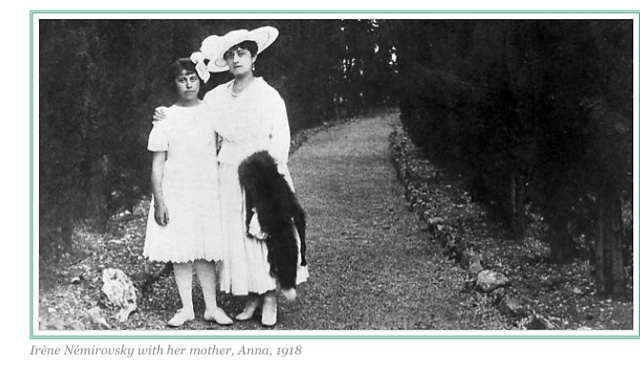
The biographers tell us that Némirovsky's mother was a cruel woman, a terrible mother.   

Jezebel is a very powerful work.  My advice is first read Suite Francaise then ponder a read through of Némirovsky's oeuvre.  

I have begun her novel The Fires of Autumn.

Mel u

Friday, August 14, 2015

"Dimanche" by Iréne Némirovsky ("Sunday", 1934, translated by Bridget Patterssen, 2000)


Like most of her readers, my literary love affair with Iréne Némirovsky (1902 to 1942) began when I read her acknowledged by all master work Suite Francaise.  I then read her most autobiographical novel, The Wine of Solitude.  Next I read her very interesting David Golder centering on a White Russian family living in Paris.  From there I moved on to a very fun and wickedly funny novella about a teenage girl's revenge on her mother (Iréne Némirovsky did have "mother issues"), The Ball.  I also read her The Courilof Affair and Snow in Autumn, both deal with White Russians living in Paris.

"Dimanche" ("Sunday") is my first venture into her short stories.  (1934 is my best guess on the publication year, if you have the correct information please let me know.). It is a beautiful story about the complex relationship of a young woman, maybe twenty, just beginning to experience love and sexuality, and her mother.  It set within an affluent Parisian family.  The dynamics of the story turns on each the way the mother and daughter view each other.  The daughter is having her first affair.  The daughter sees the mother, maybe forty, as aged past the point where passion can motivate her.  The mother sees her daughter as in a fairy tale world.

"Dimanche" is a beautiful story.  I look forward to read more of her work.

I read this by downloading a sample of the Kindle edition of Dimanche and Other Stories by Iréne Némirovsky.  

Mel u


Tuesday, August 11, 2015

Snow in Autumn by Iréne Némirovsky (1931, translated by Sandra Smith)


I owe my great thanks to Max u for the gift card which allowed me to read this work. 


"She was dead. Her little body floated for a moment, like a bundle of rags, before disappearing from sight, swallowed up by the shadowy Seine."  From Snows of Autumn 

Snows of Autumn (reading time under an hour) is perhaps the most moving most poignant of the six works of Iréne Némirovsky's (1902 to 1942) I have so far read.  I am new to Némirovsky, I just last month first read her Suite Francaise, where I guess most everyone starts.  

Snows of Autumn is set in very late Czarist Russia.  The central of the narrative is an elderly woman who has worked for the last fifty one years as a servant to a family of Aristocrats.  Her life revolves around the great house in which they live.  As the story opens, the two sons of the family are of to join the White Russian Army in combat against the Bolesivicks.  The woman recalls the men as babies and fears for them.  They tell her not to worry as they are quite confident of an easy victory over the Bolesivicks.  Of course we know this is not going to happen.

The family flees Russia for Paris where there is a sizable White Russian community.  Némirovsky does a marvelous job describing the families adoption to their new home.  The old servant lady rarely leaves the small apartment in which they live.  The family begins to lose the old conservative ways of Russia and adopt a freer Parisian life style.  The servant longs for the old days.  

The ending is terribly sad, it has a terrible beauty that can nearly overwhlem if you open yourself to it..  


I will next read her novel, Jezebel and then Fires of Autumn. As much as I can I will read her in full.

Please share your feelings on Némirovsky with us.  

Mel u


The Courilof Affair by Iréne Némirovsky (1933, translated by Sandra Smith)


I offer my great thanks to Max u for providing me with a gift card that allowed me to read this book


Like most of her readers, my literary love affair with Iréne Némirovsky began when I read her acknowledged by all master work Suite Francaise.  I then read her most autobiographical novel, The Wine of Solitude.  Next I read her very interesting David Golder centering on a White Russian family living in Paris.  From there I moved on to a very fun and wickedly funny novella about a teenage girl's revenge on her mother (Iréne Némirovsky did have "mother issues"), The Ball.

Today I will talk briefly on her novel The Courilof Affair.  It is the story of a pre-Russian revolutionionary terrorist who in 1903 participated in the murder of a Czarist official.  He is telling his story in a Cafe in Nice.    The Courilof Affair almost feels like a work that Joseph Conrad could have written.  One of the great strengths of Némirovsky is that she can show how good and evil struggle for mastery in her characters.  We feel sympathy for the murderous lead character and we see the strengths and weakness that lead him to be an Ancient Mariner old at fifty telling his story over and over.

The novel goes into lots of interesting details about life in Russia in 1903.  As I read on it is hard to see how the murder of this official will help anyone.  It was fascinating to see Némirovsky depiction of the importance of female terrorists to the anti-Czarist cause.  

The Courilof Affair is very much worth reading.  Those who know her only through her Suite Francaise will be delighted to see her write about her homeland, Russia.

I am now reading her novella, The Snows of Autumn, centeried on an elderly woman who has worked as a house servant for a Russian aristocratic family for fifty-one years.


Mel u

Monday, July 27, 2015

The Wine of Solitude by Iréne Némirovsky (1935, translated by Sandra Smith, 2011) A Post for Paris in July # 6)

My great thanks to Max u for the Amazon Gift Card that allowed me to read this book 


French Dining in The Trinoma Mall in Quezon City


Paris in July # 6. , hosted by Tamarra of Thyme for Tea, a blog I have followed for years,is one of my favorite book blog events.  It covers much more than literature and there are lots of wonderful participant posts online.

Paris in July # 6. has motivated me to read some very interesting works.

1.  "Baum, Gabriel, 1935" by Mavis Gilbert - A wonderful set in Paris short story

2.  "Two Friends" by Guy de Maupassant- Paris in July # 6. Requires reading de Maupassant!

3.  "Mildred Larson" by George Moore- What Paris Meant to the Irish

4.  "The Parisian Stage" by Henry James - an illuminating essay

5.  "The Man Who Could Walk Through Walls" by Marcel Aymé- a new to me writer I will return to

6.   Lovers at the Chameleon Club, Paris, 1932 by Francine Prose - interesting 

7.  Shocking Paris Soutine, Chagall and the Outlaw Art of Montaparrne by Stanley Meisler-a 
     Well done account of Yiddish emigre artists in Paris

8.  Short Stories about Cats by Three Classic French authors 

9.  Suite Francaise by Iréne Némirovsky- a true masterwork. Paris under the Germans

10.  The End of Evil Ways by Honoré de Balzac

11.  Mademoiselle Coco Chanel and the Pulse of History by Rhonda K. Garelick- brilliant bio.

12.  The Horla by Guy de Maupassant, translated by Sandra Smith

13.  "A Peice of Bread" by Francois Coppee 


In the spirit of Paris in July # 6. I wrote this post in The French Baker Cafe in Trinoma Mall in Quezon City.  The mall is huge on top of huge with I guess 100 dining options.  My favorite casual place is The French Baker Cafe. The staff are very nice and the food is decent.  It has macaroons and artesian bread but nothing too fancy.. You can get a decent lunch for under $5.00.   I also saw a pastry shop with a French name which I have not seen before.  


The Wine of Solitude is considered the most autobiographical of the novels of Iréne Némirovsky.  It begins in a city in the Ukraine, probably Kiev where Némirovsky was born in 1903 and lived with her parents until the family moved to Paris. Her father was a wealthy banker with close ties to Tsarist powers so it as deemed prudent to leave the country.  Most of the novel deals with the female lead character adjusting to changes she does not quite understand and her perpetual difficulties with her mother, a recurring theme in Némirovsky's work.  She has a teenage romance but it could be better developed.  She blames her mother for the family having to move, they first go to Finland, stay there a year or so then about seventy five percent through the novel the wind up in Paris.

The Wine of Solitude is, as I see it now, a work for Némirovsky lovers, I count myself one now.

I am in possession of four other works by Némirovsky as I hope to read them soon.

Mel u

Saturday, July 25, 2015

"The Ball" by Iréne Némirovsky (1930, 40 pages, translated by Sandra Smith) - A Post for Paris in July # 6


Paris in July # 6. , hosted by Tamarra of Thyme for Tea, a blog I have followed for years,cd is one of my favorite book blog events.  It covers much more than literature and there are lots of wonderful participant posts online.

Paris in July # 6. has motivated me to read some very interesting works.

1.  "Baum, Gabriel, 1935" by Mavis Gilbert - A wonderful set in Paris short story

2.  "Two Friends" by Guy de Maupassant- Paris in July # 6. Requires reading de Maupassant!

3.  "Mildred Larson" by George Moore- What Paris Meant to the Irish

4.  "The Parisian Stage" by Henry James - an illuminating essay

5.  "The Man Who Could Walk Through Walls" by Marcel Aymé- a new to me writer I will return to

6.   Lovers at the Chameleon Club, Paris, 1932 by Francine Prose - interesting 

7.  Shocking Paris Soutine, Chagall and the Outlaw Art of Montaparrne by Stanley Meisler-a 
     Well done account of Yiddish emigre artists in Paris

8.  Short Stories about Cats by Three Classic French authors 

9.  Suite Francaise by Iréne Némirovsky- a true masterwork. Paris under the Germans

10.  The End of Evil Ways by Honoré de Balzac - A look at Paris Justice, 1839

11.  Mademoiselle Coco Chanel and the Pulse of History by Rhonda K. Garelick

12.  David Golder by Iréne Némirovsky (A White Russian Family in Paris) 


One of the great things about book blog events like Paris in July # 6 is discovering new to you writers you wish you had known of long ago.   The event motivated me to at last read Suite Francaise by Iréne Némirovsky, a world class literary treasure.  Once I read this knew I wanted to read much more of her work and learn about her life.  My preliminary research indicated she had a near hatred for her mother.  When Némirovsky was arrested and sent to Auschwitz to be executed because she was Jewish her children were hidden for the duration of the war.  After the war ended, they went to visit their grandmother, Némirovsky's mother.  Their grandmother would not answer the door.  She told her grandchildren through the closed door that they needed to go to an orphanage.  

                      You can, it seems to me, almost feel how much both dislike being close


"The Ball" is a delightful story about a fourteen year old girl taking her revenge on her cold uncaring mother.   It is a very funny story, full of social satire.  It also shows how cruelty and coldness to our children can come back to haunt us.  As the story opens a married couple, at the initiative of the wife, are planning their first high society ball.  The husband not long ago became rich through speculation in the stock market.  The wife plans to invite 200 guests.  The invitations and envelopes must be hand written so she allows her daughter to stay up late to help.  An English nanny takes care of the girl and seems closer to her than her mother.  The daughter asks to go to the ball.  The mother at first says "no".  She does not want people to know she has a fourteen year old daughter then she says she can come for thirty minutes.

The household is in a frenzy, the could not care less servants are driven to prepare.  The invitations are given to the nanny to mail.  The wife gets nervous as no R S V Ps come in.  

I don't want to spoil the close.  The daughter gets her revenge in a great way, she shows her own cruelty toward the nanny.  You will love what happens at the ball.  

"The Ball" was a great pleasure to read, very funny at times and acutely observant of family relationships.

I have also completed her considered most autobiographical novel, The Wine of Solitude and hope to post on it soon.


Thursday, July 23, 2015

David Golder by Iréne Némirovsky (1929, translated by Sandra Smith) A Post for Paris in July # 6


White Russians In Paris 1920


Paris in July # 6. , hosted by Tamarra of Thyme for Tea, a blog I have followed for years,and is one of my favorite book blog events.  It covers much more than literature and there are lots of wonderful participant posts online.


A question for participants  before I Start my Post

Who do you regard as the three most culturally important Parisians of the 20th century?

My picks  are Marcel Proust, Jean Paul Sarte, and Coco Chanel

David Golder centers on a Jewish White Rusśian businessman living in Paris with his wife and adult daughter.  They left Russia due to the revolution, the father was able to transfer some of his money out of Russia.  (This mirrors the life of Iréne Némirovsky).  The novel begins with Golder learning a longtime business associate has killed himself after financial reversals involving an attempt to buy rights in a Soviet oil field.  Golder is also involved with this and faces possible financial ruin.  Enter his wife Gloria who cares only about the luxury life style she is accustomed to and his daughter, Joyce, who gives him attention (I winced a bit when I learned his daughter called him "Daddy" only when she wanted money, I have three daughters 17, 19, and 21 and have experienced this) only when she wants money to fuel her social life.  Joyce is an expert "chain puller" and David's wife accuses him of caring much more about Joyce than her.  The wife and daughter are, as Claire Mussul says in her introduction, just one deminsional,characters.  There is a terrible secret his wife will throw in Golder's face.  He ends up going back to Russia to manage a goldmine.  There is a very interesting and moving  close.


By far first read Suite Francaise then decide if you want to read more Némirovsky.  I have on my E Reader five more of her works and hope to read them in short order.


Mel u

Saturday, July 18, 2015

Suite Francaise by Irène Némirovsky (first published in French, 2004, translated by Sandra Smith, 2006, written 1941 to 1942 - A Post for Paris in July # 6


I offer my great thanks to Max u for the gift of an Amazon Gift Card that allowed me to read this wonderful book


Paris in July # 6. , hosted by Tamarra of Thyme for Tea, a blog I have followed for years, is one of my favorite book blog events.  It covers much more than literature and there are lots of wonderful participant posts online.


Paris in July # 6. has motivated me to read some very interesting works.

1.  "Baum, Gabriel, 1935" by Mavis Gilbert - A wonderful set in Paris short story

2.  "Two Friends" by Guy de Maupassant- Paris in July # 6. Requires reading de Maupassant!

3.  "Mildred Larson" by George Moore- What Paris Meant to the Irish

4.  "The Parisian Stage" by Henry James - an illuminating essay

5.  "The Man Who Could Walk Through Walls" by Marcel Aymé- a new to me writer I will return to

6.   Lovers at the Chameleon Club, Paris, 1932 by Francine Prose - interesting 

7.  Shocking Paris Soutine, Chagall and the Outlaw Art of Montaparrne by Stanley Meisler-a 
     Well done account of Yiddish emigre artists in Paris

8.  Short Stories about Cats by Three Classic French authors - 


I am very grateful to Tamara of Thyme for Tea for hosting Paris in July # 6 and providing me with the motivation to read a truly great novel set in France during 1940, Suite Francaise by Iréne Némirovsky.
Némirovsky was born in Kiev in 1903, into an aristocratic Jewish family.  She died in Auschwitz, Poland in a concentration camp on August 17, 1942.  (There is an excellent short article here Jewish Woman's Encyclopedia article on Iréne Némirovsky )

The back story of the publication of Suite Francaise is very interesting.  Her daughters  kept the manuscript secret for 56 years.  It was published for the first time in 2004 and in translation by Sandra Smith in 2006.  The work we have is the first two parts of a planned five part work.  After the death of the author one of her daughters  found the manuscript and thought it would be diary to painful to read.  When she was preparing her mother's papers for donation, 55 years later, she looked at what is now Suite Francaise and submitted it for publication.  

As the novel opens we see Paris in a state of panic brought on by the approaching German army.  The narrative is very intense.   Némirovsky lets us she how a few different households are dealing with the crisis.  Anyone who can plans to flee the city.  The author in just a few paragraphs illuminates decades of family and social history in her portraits of Parisians.  There is just so much to admire in Suite Francaise, so many moments of beauty, truth and brilliance.  

As the novel progresses we are in a small town in the country.  There are hilarious biting scenes of social satire as the local aristocrats desperately want to hold on to their status even though many have Germans billeted in their homes.   The residents of the town reluctantly begin to see humanity in the Germans even though they feel they should hate them.  There are exciting dramatic events and the characters are perfectly drawn.

Suite Francaise is a brilliant panorama of French society in 1940.  It is also a world class literary treasure.  

I have already acquired five other works by Némirovsky, all translated by Sandra Smith, and hope to read them soon.  I have already begun her first published work David Golder.


Mel u

Featured Post

Imperial Reckoning: The Untold Story of Britain’s Gulag in Kenya by Caroline Elkins - 2005 - 701 Pages

  Imperial Reckoning:     The Untold Story of Britain’s Gulag in Kenya by Caroline Elkins - 2005 - 701 Pages 2006 Pulitzer Prize Winner From...