Showing posts with label Hans Fallada. Show all posts

Wednesday, November 13, 2019

Nightmare in Berlin by Hans Fallada - 1947 - translated from German by Allan Blunden 2016


German Literature Month November 2019


During German Literature Month in 2015 i read two novels by Hans Falada, Wolf Among Wolves and Every Man Dies Alone.  Promo Levi said Every Man Dies Alone was the greatest work on life in Nazi Germany.  In 2016 I read his A Small Circus, in 2018 Once a Jail Bird (Fallada spent several years in jail).

Nightmare in Berlin was his final novel, set in Berlin starting with the arrival of Russian troops in Berlin.  From this point it follows lives of a married couple as they try to restore their pre-war life.

Nightmare in Berlin is closely based on his life with his wife in the closing days of the war and a year or so on.  Like the lead character, Doll (ok the name irritated me), Fallada was made mayor of a small town by Russians and his wife was a heroin user.
Doll encounters lots of ex-Nazi party members but nobody will admit they liked Hitler.  Doll and his wife return to Berlin but there old apartment is occupied by others.  They seek medical help in a broken down system.  Everyone in the book desperately wants American cigarettes. Everybody drinks heavily and seeks drugs to dull the pain.

Berlin truly is a nightmare City.  Everyone is constantly hungry, everyone is crooked.  

The Review in The Guardian said this was a very poorly translated book. The reviewer laughs at the work of the translator.

Start Fallada with Everyman Dies Alone then decide if you want to read more.


Bio Data from Melville House

“Before WWII, German writer Hans Fallada's novels were international bestsellers, on a par with those of his countrymen Thoman Mann and Herman Hesse. In America, Hollywood even turned his first big novel, Little Man, What Now? into a major motion picture

Learning the movie was made by a Jewish producer, however, the Nazis blocked Fallada's work from foreign rights sales, and began to pay him closer attention. When he refused to join the Nazi party he was arrested by the Gestapo--who eventually released him, but thereafter regularly summoned him for "discussions" of his work.


However, unlike Mann, Hesse, and others, Fallada refused to flee to safety, even when his British publisher, George Putnam, sent a private boat to rescue him. The pressure took its toll on Fallada, and he resorted increasingly to drugs and alcohol for relief. Not long after Goebbels ordered him to write an anti-Semitic novel he snapped and found himself imprisoned in an asylum for the "criminally insane"--considered a death sentence under Nazi rule. To forestall the inevitable, he pretended to write the assignment for Goebbels, while actually composing three encrypted books--including his tour de force novel The Drinker--in such dense code that they were not deciphered until long after his death.

Fallada outlasted the Reich and was freed at war's end. But he was a shattered man. To help him recover by putting him to work, Fallada's publisher gave him the Gestapo file of a simple, working-class couple who had resisted the Nazis. Inspired, Fallada completed Every Man Dies Alone in just twenty-four days.”

Mel u
Ambrosia Bousweau 

Thursday, November 1, 2018

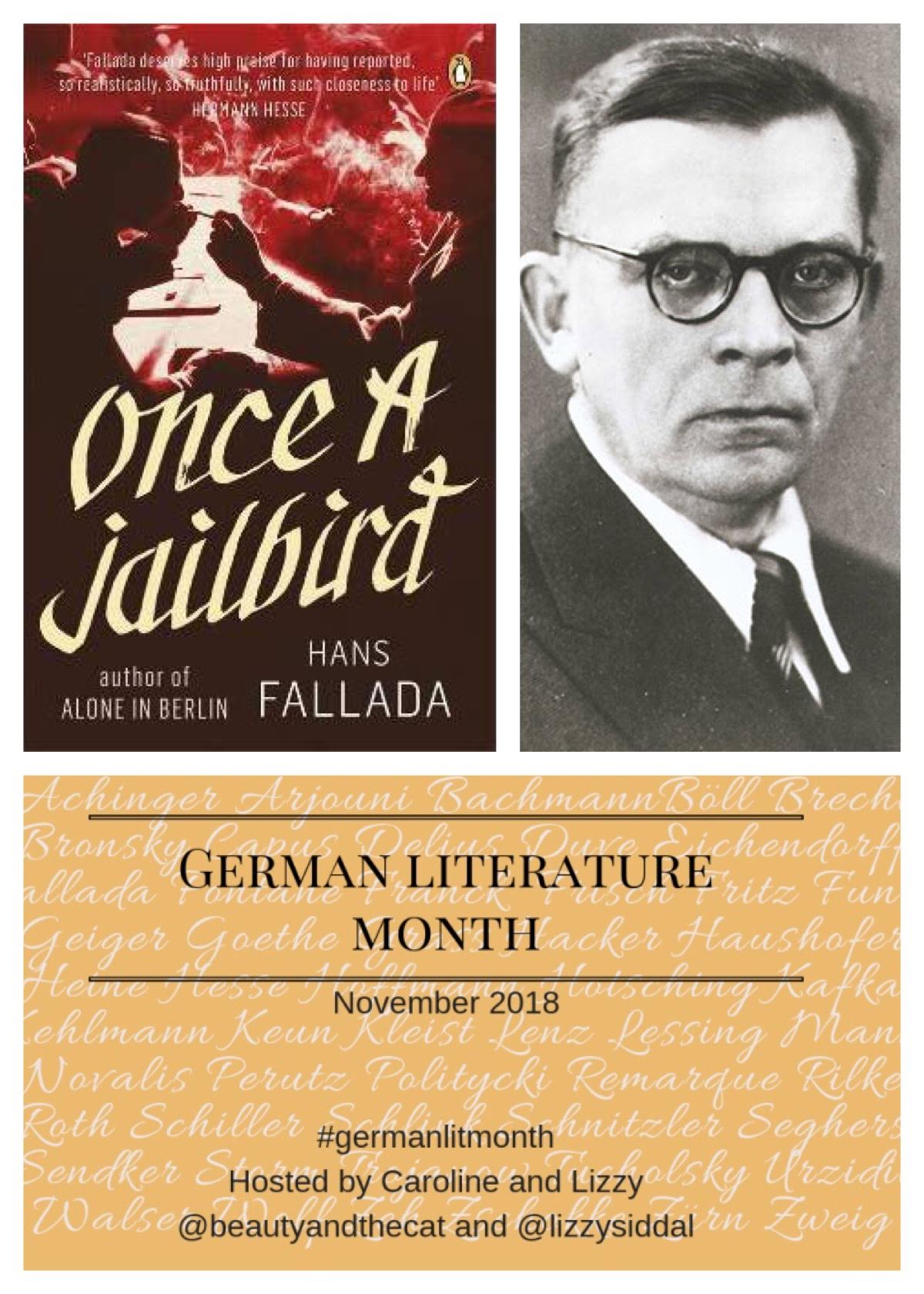
Once a Jailbird: A Novel by Hans Fallada - 1934 - translated from German 2014 by Eric Sutton


German Literature Month

Once a Jailbird: A Novel by Hans Fallada - 1934 - translated from German 2014 by Eric Sutton 

Born 1893 Greifswald, Germany 

Died 1947 Berlin

I am glad to be initiating my participation in German Literature Month Eight with     a novel by Hans Fallada.  This is the fourth work by Fallada to be featured on The Reading Life, all during a German Literature Month.  In 2015 I posted on two of his novels.  A Small Circus is centered on just that. Wolf Among Wolves is a grand sweeping panorama of society in Weimar Germany (1919 to 1933).  Some call it the Vanity Fair of the era. In 2016 I read his consensus masterwork, Every Man Dies Alone.  Primo Levi said it was the best presentation of life in Nazi Germany.  It is the best by far of the four Fallada books I have read.   For sure start Fallada there.

 Once a Jailbird is set toward the end of the Weimar Era (1919 to 1933), we meet our central character, Klaus, as he is finishing up a five year prison term for embezzlement.  We learn quite a bit about what life was like in the prison.  Klaus was a three star prisoner, awarded more privileges for good behavior.  He keeps his cell very clean and he works diligently at the piece work the prison assigns him.  He will be paid for this work upon release.  He has only a few days to go.  The warden, not too bad a person, asks him his plans.  His parents are passed and his brother in law will not help him. He was an experienced typist before he was arrested and hopes to get a job doing that.  He wants to move to Hamburg where no one knows him.  The warden refers him to a service that houses ex-convicts and the unemployed and luckily runs a business typing addresses on envelopes. He finds the money he thought he was getting, maybe three months living expenses, will be paid him through the manager of the home.  When he objects the warden tells him it is for his own good to prevent him from squandering his money

Of course after five years he wants a woman, they call them girls, and this being The crashed German economy the streets are full of cheap women.  He soon wants a real girlfriend, some decent food, some drink, and to make money.

Fallada devotes a lot of time to showing us how ex convicts were taken advantage off, cheated and of course looked down upon.  Klaus meets lots of shady characters.  He and eight others decide to start their own typing business after discovering they were being ripped off by their employer.  Of course it starts out well but......

No one wants to trust him.  We hear the refrain “once a jailbird” quite a few times.  Klaus sometimes wishes he was back in jail where at least he got food and had no rent.

Fallada gives a vivid picture of life on the mean streets of Weimar Hamburg.  There are lots of interesting people.

Once a Jail Bird was an enjoyable read for me.  

There are several more Fallada novels available as Kindles and I hope to read one in German Literature Month in 2019.

I purchased the Kindle edition on a flash sale for $1.95.  It is back up to $11.95.  My guess is it will go back on sale soon and I don’t endorse this book to those I do not know at the full price.  


Bio Data from Melville House
Before WWII, German writer Hans Fallada's novels were international bestsellers, on a par with those of his countrymen Thoman Mann and Herman Hesse. In America, Hollywood even turned his first big novel, Little Man, What Now? into a major motion picture

Learning the movie was made by a Jewish producer, however, the Nazis blocked Fallada's work from foreign rights sales, and began to pay him closer attention. When he refused to join the Nazi party he was arrested by the Gestapo--who eventually released him, but thereafter regularly summoned him for "discussions" of his work.

However, unlike Mann, Hesse, and others, Fallada refused to flee to safety, even when his British publisher, George Putnam, sent a private boat to rescue him. The pressure took its toll on Fallada, and he resorted increasingly to drugs and alcohol for relief. Not long after Goebbels ordered him to write an anti-Semitic novel he snapped and found himself imprisoned in an asylum for the "criminally insane"--considered a death sentence under Nazi rule. To forestall the inevitable, he pretended to write the assignment for Goebbels, while actually composing three encrypted books--including his tour de force novel The Drinker--in such dense code that they were not deciphered until long after his death.

Fallada outlasted the Reich and was freed at war's end. But he was a shattered man. To help him recover by putting him to work, Fallada's publisher gave him the Gestapo file of a simple, working-class couple who had resisted the Nazis. Inspired, Fallada completed Every Man Dies Alone in just twenty-four days.

Mel u


Saturday, November 5, 2016

A Small Circus A Novel by Hans Fallada (1931, translated by Michael Hoffman, 2012)


This will be the fifth year The Reading Life has participated in German Literature Month.  This event is one  of the reason it is great to be part of the international book blog community.  Last year I was motivated to read world class literary works by writers like Thomas Mann, Hermann Broch, Stefan Zweig, Hermann Hesse as well as lesser know treasures.  I learned a lot from the many very erudite posts by coparticipants and from those by our very generous hosts Caroline of Beauty is a Sleeping Cat and Lizzy of Lizzy's Literary Life.  You will find excellent reading suggestions and planned events on their blog.  To participate all you have to do is to post on any work originally written in German and put your link on the event blog.  

My Readings For German Literature VI November 2016

1.  The Glass Bead Game by Hermann Hesse

2.  Royal Highness by Thomas Mann

3. A Small Circus by Hans Fallada


Last year during Germany Literature Month in November, 2015 I read and posted on two novels by Hans Fallada (1893 to 1947)  Wolf Among Wolves and We All Die Alone.  

Wolf Among Wolves is often called The Vanity Fair of the Weimer Republic.  It is a long book with lots of characters.  Primo Levi said We All Die Alone is the best book ever written about life in Nazi Germany.  We All Die Alone is among the best novels I have ever read.  The characters are beautifully realized, the plot is very exciting.  You feel the fear of daily life in Nazi Germany.  After reading this I wanted for sure to read more by Fallada so I turned to Wolf Among Wolves.  I was disappointed by this book, maybe my expectations were too high but I did find the characters especially well developed or interesting.  If this had been my first book by Fallada I think it would have been my last and I would have missed out on We All Die Alone.  Anyway I liked this book so much I decided to read all his translated novels, a total of six, in the hope that maybe one was even better than We All Die Alone.  I was also motivated by a strong interest in life in Weimier and Nazi Germany.  


I am glad I read A Small Circus A Novel.  It is interesting and depicts a lot of the political strife in Germany that opened the door for the Nazis to rise to power but it is far from the quality of We All Die Alone.  The characters are not well developed and the plot about the small news paper began to wear me down. It will take an act of faith but I will try to one day read his other three novels. 


From the publisher's webpage


Before WWII, German writer Hans Fallada's novels were international bestsellers, on a par with those of his countrymen Thoman Mann and Herman Hesse. In America, Hollywood even turned his first big novel, Little Man, What Now? into a major motion picture

Learning the movie was made by a Jewish producer, however, the Nazis blocked Fallada's work from foreign rights sales, and began to pay him closer attention. When he refused to join the Nazi party he was arrested by the Gestapo--who eventually released him, but thereafter regularly summoned him for "discussions" of his work.

However, unlike Mann, Hesse, and others, Fallada refused to flee to safety, even when his British publisher, George Putnam, sent a private boat to rescue him. The pressure took its toll on Fallada, and he resorted increasingly to drugs and alcohol for relief. Not long after Goebbels ordered him to write an anti-Semitic novel he snapped and found himself imprisoned in an asylum for the "criminally insane"--considered a death sentence under Nazi rule. To forestall the inevitable, he pretended to write the assignment for Goebbels, while actually composing three encrypted books--including his tour de force novel The Drinker--in such dense code that they were not deciphered until long after his death.

Mel ü

Saturday, May 21, 2016

More Lives than One A Biography of Hans Fallada by Jenny Williams

I offer my great thanks to Max u for the Amazon Gift Card that allowed me to read this book.

More Lives than One A Biography of Hans Fallada by Jenny Williams was first published in 1998, then republished in 2012 with substantial revisions


We Die Alone (Also translated as Alone in Berlin) by Hans Fallada, 1893 to 1947, is a great novel, brilliantly depicting life in Berlin during the rule of the Nazis as the war as winding down.  Primo Levi said it was the best depiction of life in the era ever written.  Fallada has recently come back into favor due to new translations of a number of his novels.  I have read also his Wolf Among Wolves, commonly called the Vanity Fair of the Weimer Republic and A Small Circus, set in a small German town in the days just before the Nazis came to power.  

Rudolph Ditzen, the real name of Hans Fallada, was born into an affluent but not truly rich family.  As Jenny Williams shows us in her well done biography, Fallada had a troubled youth.  For years he was an alcoholic and a morphine addict, in an out of treatment centers and prison, for embezzlement and for a bizzare murder suicide duel.  He tried several times to break from his addictions and was sucessful for long periods.  He obtained a good job, especially for one who loved books and the reading life as did Fallada.  Fallada worked for a well know publisher as a book reviewer.  He was a rapid writer and began to write articles, short stories and novels.  His family always provided Fallada and his wife with an allowance.  He hit the jack pot when his novel Little Man What Now, 1932,  became a best seller in Germany after which it was translated into numerous languages.  It became a selection of the American  Book of the Month Club and was made into a movie by Hollywood.  This success enabled him to to spend the rest of his life as a professional writer.  German literature from 1933 to 1945 when the war ended, was regulated by Nazi bureaus. Censors were normally not terribly bright or cultured and Fallada learned how to work within the rules without totally giving up his integrity.


Many leading German writers and intellectuals left Germany.  Hans Fallada decided to stay and learned to work within the acceptable guidelines.  Joseph Goebells, Nazi called him" a very talented fellow".  Fallafa was not a Nazi, just a man who wanted to live by writing novels and stories.  He began again to escape into alcohol and morphine when he could not accept the horrors of Nazi rule. 

  After the war ended, he lived in the Russian area of control in Berlin, he had some difficulties and was briefly in a mental,hospital.  Once he got out he wrote his master work, We All Die Alone in just 24 days.  He died at fifty, taken to an early grave by his demons.


Jenny Williams has done a good job laying out the facts of Fallada's life.  She lets us see how hyper inflation made life so challenging in Germany.  

Only those already interested in Fallada will read this book and that is how it should be.  

JENNY WILLIAMS is Senior Lecturer in German at Dublin City University

Mel u

Saturday, November 21, 2015

Wolf Among Wolves by Hans Fallada. (1937, translated by Phillip Owens, 810 pages)


I offer my great thanks to Max ü for proving me with the Amazon gift card that allowed me to read Wolf Among Wolves.


I am estatic to once again be able to Participate in German Literature Month, elegantly and lovingly hosted by Lizzi's Literary Live and Beauty is a Sleeping Cat. This is my fourth year as a participant.   On the host blogs you will find the particularities of the event but the basic idea is to read literature first written in German (translated or not) and share your thoughts.  I began accumulating works for the event soon after the event ended last year and I began reading for it in mid-September.  


Works Read for G L V So Far

1.  Every Man Dies Alone by Hans Fallada. A brilliant recreation of life in Nazi Germany. 

2.  Ostend, Stefan Zweig, Joseph Roth and the Summer Before the End by Volker Weidermann. A fascinating social history 

3.  Buddenbrook Ths Decline of a Family by Thomas Mann.  Must reading 

4.  "The Governess" by Stefan Zweig

5.  Demian:  The Story of Emil Sinclair's Youth by Herman Hesse.  Read the major works first.

6.  The Tanners by Robert Walser. a serious work of art

7. The Hotel Years Wandering Between the Wars by Joseph Hoffman, a brilliant collection of feuilletons translated and introduced by Michael Hoffman

8.  "The Dandelioln" by Wolfgang Borchert. 

9.   "The Foundling" by Heinrich Von Kleist

10.  "A Conversation Concerning Legs" by Alfred Lichenstein 

11.  A Homage to Paul Celan

12.  "The Criminal" by Veza Canetti 

13.  Rebellion by Joseph Roth. Between the wars

14.  The Death of Virgil by Hermann Broch - an amazing work of art

15.  The Artificial Silk Girl by Irmgard Keun.  Sex and the City redone in the Weimer Republic  


At the start of German Literature Month V I read Every Man Dies Alone by Henry Fallada.  Primo Levi called it the best book ever written on Nazi Germany.  I loved it and accept the author's pronouncement that he produced a work of genius.  It is consistently very exciting.  

Wolf Among Wolves, a longer book, focuses on the impact of the hyper-inflation in Germany in the years after WW One.  The German Mark went from four to the dollar to four billion to the dollar.  The thrifty German middle class saw the savings of a life time wiped out.  Those who had debts  to pay greatly benefited from the inflation.  

The story follows the fate of three German war veterans.  It focuses a lot on a young man who struggles to support his girl friend working as a professional gambler while living in Berlin.  Germany's defeat in the war has destroyed the pride of the country.  Heroin and cocaine are the drugs of choice.   Prostitution is rampant, many an ex soldier is portrayed as turning tricks for foreigners with American dollars come to,the city for the rampant vice.  Police and government officials are all on the make.  We receive frequent announcements of the fall of the mark.  There was a time when a savings of ten thousand marks was enough for a comfortable retirement.  Fallada lets us see how crushing the inflation was on the very thrift oriented German middle class.  The poor had to,struggle terribly just to survive.  Many of the rich had reserved in dollars or pounds.

Fallada vividly portrays the period.  You can see how hyper inflation made the Germans vulnerable to an ideology which blamed their miseries on the Jews.  There are lots of interesting scenes.  In one very interesting case we witness a mortgage being converted from payments in marks to payment in bread.
Gangsters gain control of society.  


Bio Data from Melville House
Before WWII, German writer Hans Fallada's novels were international bestsellers, on a par with those of his countrymen Thoman Mann and Herman Hesse. In America, Hollywood even turned his first big novel, Little Man, What Now? into a major motion picture

Learning the movie was made by a Jewish producer, however, the Nazis blocked Fallada's work from foreign rights sales, and began to pay him closer attention. When he refused to join the Nazi party he was arrested by the Gestapo--who eventually released him, but thereafter regularly summoned him for "discussions" of his work.

However, unlike Mann, Hesse, and others, Fallada refused to flee to safety, even when his British publisher, George Putnam, sent a private boat to rescue him. The pressure took its toll on Fallada, and he resorted increasingly to drugs and alcohol for relief. Not long after Goebbels ordered him to write an anti-Semitic novel he snapped and found himself imprisoned in an asylum for the "criminally insane"--considered a death sentence under Nazi rule. To forestall the inevitable, he pretended to write the assignment for Goebbels, while actually composing three encrypted books--including his tour de force novel The Drinker--in such dense code that they were not deciphered until long after his death.

Fallada outlasted the Reich and was freed at war's end. But he was a shattered man. To help him recover by putting him to work, Fallada's publisher gave him the Gestapo file of a simple, working-class couple who had resisted the Nazis. Inspired, Fallada completed Every Man Dies Alone in just twenty-four days.
Wolf Among Wolves  is thoroughly entertaining. The characters are very well done.  I would suggest that those new to,Fallafa ffirst read Every Man Dies Alone. The next of Fallada's book i shall read is A Small Circus.  
I hope others will share their experiences with Fallada and other novels depicting Weimer Germany share their experiences.

Mel ü


Sunday, November 1, 2015

Every Man Dies Alone by Hans Fallada (1947, translated by Michael Hoffman, 2009)

"Every Man dies Alone is the greatest book on the Nazis ever written" - Primo Levi


I am estatic to once again be able to Participate in German Literature Month, elegantly and lovingly hosted by Lizzi's Literary Live and Beauty is a Sleeping Cat. This is my fourth year as a participant.   On the host blogs you will find the particularities of the event but the basic idea is to read literature first written in German (translated or not) and share your thoughts.  I began accumulating works for the event soon after the event ended last year and I began reading for it in mid-September.  


One of the things that makes the reading life of such high worth is discovering new to you writers.  There have been times when knowing there are many writers of genius, wisdom, power and beauty, living and long dead, waiting for me to read for the first time is one of the things that kept me looking forward to the future.  As my first work for German Literature Month 2015, I am so happy to have read Every Man Dies Alone by Hans Fallada (1893 to 1947-as a personal note which impacted me a lot, he died 25 days after I was born. Maybe I am honored to have briefly shared the earth with him).

Every Man Dies Alone was written in two months in 1946.  Fallada told his wife when he finished that he had  he had written a work of genius and he was right.  The story centers on a very ordinary German couple, the Quangels, the husband is a foreman at a furniture factory.  He has never read. a book, never late in thirty years for work and rigidly enforces the factory discipline.  His wife,
Anna is the  paradigmatic   German house Frau, with no opinions of her own.  They have one son, their only child, drafted into the German army and fighting on the Eastern Front.  One day they get a form notice saying their son died as a hero serving the Furher and the Fatherland.  The couple's world is shattered.  Shocking the husband to the depth of his being, the wife screams at him, "I hope you are happy now that our son has died for your Furher".  The man can barely respond, uttering probably the first political statement he has ever made, "He is not my Furher".  Two weeks later the husbands writers the first of over two hundred anti-Nazi post cards. He tells his wife he is going to leave the post card in a public building.  His wife is at first horrified by this, knowing if they are caught they will be executed.

"And what was he proposing? Nothing at all, something so ridiculously small, something absolutely in his character, something discreet, out of the way, something that wouldn’t interfere with his peace and quiet. Postcards with slogans against the Führer and the Party, against the war, for the information of his fellow men, that was all.......Then he picked up the pen, and said softly but clearly, “The first sentence of our first card will read: ‘Mother! The Führer has murdered my son.”

Soon every Sunday, sometimes midweek also, he is dropping the cards all over Berlin.  Most who find them at once take them to the police for fear they might have been observed picking it up and be thought to be the author of the card.  Soon a minor Gestapo detective is given the assignment of finding who is leaving the cards.  He goes about the search very systematically, mapping all the spots where the cards are left and coming up with totally wrong conclusions about the kind of person the card writer must be.  We meet lots of great minor characters, including just brilliantly done Gestapo higher ups, of whom the detective is terrified.  Everybody is  scared of the allied bombs, the Gestapo, being turned in by others for food rewards, and of being cold and hungry.      

We see the steps the couple takes to avoid detection and we hold our breath on some close calls.  No one suspects Herr Quangel as  he is so plodding, so
 dull, and rule bound even when evidence against him begins to mount up.

I don't want to tell the profoundly moving close of the story.  I read somewhere that Every Man Dies Alone is about the banality of goodness, how goodness can just be ordinary.  

The novel brilliantly depicts life for ordinary Germans in World War Two.  We see how more and more people have to pretend they support what they know is an absurd lost cause. No one can trust anyone hardly with his true feelings on the war. We see how painful it is to drink acorn coffee, to have no pork.  One card said "Adolph, give us back our pork".  

There are scenes of horrible cruelty.  I almost felt sorry for the Gestapo detective when he was beaten and imprisoned when his superior threw a fit over the card writers not being found.  

The ending is crushingly sad, very moving.  There are decent people in this world, a retired Judge in the Quangel's building shelters a Jewish woman.  While in prison Quengel has two cell mates, one was a conductor of the Betlin Philharmonic, deeply cultured.  He gets food from outside and shares it.  He has a few books and he offers to let Quangel read them but he basically said he has never read a book all his life and he sees no point in starting now.  The other was reduced to an animal.


From the web page of Melville House


This rediscovered masterpiece, lost after World War II, was translated for the first time into English in 2009 by Melville House and became one of the most acclaimed books of the year.
It presents a rich detailed portrait of life in Berlin under the Nazis and tells a sweeping saga of one working-class couple who decides to take a stand against the Nazis when their only son is killed at the front. With nothing but their grief and each other against the awesome power of the Reich, they launch a simple, clandestine resistance campaign that soon has enraged Gestapo on their trail, and a world of terrified neighbors and cynical snitches ready to turn them in.
In the end, it’s more than an edge-of-your-seat thriller, more than a moving romance, even more than literature of the highest order-it’s a deeply moving story of two people who stand up for what’s right, and for each other.

I have a copy of his Wolf Among Wolves and will post on it soon.  It is described as The Vanity Fair or War and Peace of the Weimer Republic.  At over 800 pages I cannot wait to read it.  

Please share your experience with Fallada or other WW Two era German writers with us. 

Bio Data from Melville House
Before WWII, German writer Hans Fallada's novels were international bestsellers, on a par with those of his countrymen Thoman Mann and Herman Hesse. In America, Hollywood even turned his first big novel, Little Man, What Now? into a major motion picture

Learning the movie was made by a Jewish producer, however, the Nazis blocked Fallada's work from foreign rights sales, and began to pay him closer attention. When he refused to join the Nazi party he was arrested by the Gestapo--who eventually released him, but thereafter regularly summoned him for "discussions" of his work.

However, unlike Mann, Hesse, and others, Fallada refused to flee to safety, even when his British publisher, George Putnam, sent a private boat to rescue him. The pressure took its toll on Fallada, and he resorted increasingly to drugs and alcohol for relief. Not long after Goebbels ordered him to write an anti-Semitic novel he snapped and found himself imprisoned in an asylum for the "criminally insane"--considered a death sentence under Nazi rule. To forestall the inevitable, he pretended to write the assignment for Goebbels, while actually composing three encrypted books--including his tour de force novel The Drinker--in such dense code that they were not deciphered until long after his death.

Fallada outlasted the Reich and was freed at war's end. But he was a shattered man. To help him recover by putting him to work, Fallada's publisher gave him the Gestapo file of a simple, working-class couple who had resisted the Nazis. Inspired, Fallada completed Every Man Dies Alone in just twenty-four days.

He died in February 1947, just weeks before the book's publication.

I am currently reading his Wolf Among Wolves
Mel ü


Featured Post

Imperial Reckoning: The Untold Story of Britain’s Gulag in Kenya by Caroline Elkins - 2005 - 701 Pages

  Imperial Reckoning:     The Untold Story of Britain’s Gulag in Kenya by Caroline Elkins - 2005 - 701 Pages 2006 Pulitzer Prize Winner From...