Showing posts with label Kafka. Show all posts

Wednesday, November 29, 2017

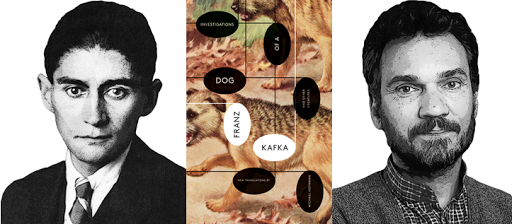
“Investigations of a Dog” - A Short Story by Franz Kafka - 1922 - translated by Michael Hoffman - 2016


German Literature Month, November, 2017 on The Reading Life


  1. “You’d Have Larvae Too” by Nora Wagener, 2016
  2. Vertigo by W. G. Sebald, 1990
  3. The Last Weynfeldt by Martin Suter, 2006
  4. “An Earthquake in Chile” by Heinrich Von Kleist, 1809
  5. Who is Martha? by Marjana Gaponenko, 2012
  6. “The Legal Haziness of Marriage” by Olga Grjasnowa, 2015
  7. “Aladdin, COB” by Isabelle Lehn, 2015
  8. “The Last Bell” by Johannes Urzidil, 1968
  9. The Rings of Saturn by W. G. Sebald, 1995
  10. Late Fame by Arthur Schnitzler, written 1892, published 2016
  11. Blood Brothers by Ernst Haffner, 1933
  12. Berlin Alexanderplatz by Alfred Döblin, 1929
  13. Confessions of a Murderer by Joseph Roth, 1936
  14.   “Compulsion” by Stefan Zweig,  1929
  15. “Borderlands”by Johannes Urzidil, 1956 (no post)
  16. “A School Boy’s Diary” by Robert Walser, 1910 (no post
  17. Austerlitz by W. G. Sebald, 2001, Second Reading 
  18. “The Duchess of Albanera” by Johannes Urzidil, 1965


  1. Gigli by Irmgard Keun, 1931
  2. Gay Berlin -Birth of a Modern Identity by Robert Beachy, 2014 *
  3. “Ernst in Civilian Clothes” by Mavis Gallant, 1963 *
  4. “Germans at Meat” by Katherine Mansfield, 1908 *
  5. Casanova’s Homecoming by Arthur Schnitzler, 1918
  6. “Investigations of a Dog” by Franz Kafka, 1922

Items with an * are my English language supplements to German Literature Month
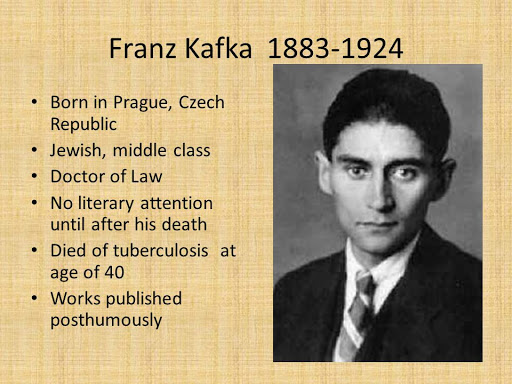


This will be our last post for this year’s German Literature Month, other than the closing post.  I first read Kafka about fifty years ago.  I read his short story “The Hunger Artist”, I can partially recall the plot.  This was, I am pretty sure, the first piece of translated into English German fiction I had yet read.  I have since I began The Reading Life read or reread most of his major works.  I was delighted to be recently given a collection of  Kafka short stories, new translated by the multi-award winning Michael Hoffmsn containing lots of new to me works.  

“Investigations of a Dog”, the title story of the collection was a lot of fun.  I do think many people almost take Kafka’s work  too much as an obscure to all but a tiny elite master text.  People allow themselves to be intimidated.  Much of his work is funny and can be enjoyed by anyone with an open mind.  In this story, a long interior monologue by a middle aged smaller than average dog, we are treated to interesting observations on science, religion, government, relationships and much more as the Dog tries to figure out the meaning of life.  Of course food is at the  center  of his life. Everything is very convincingly done from the dog’s point of view.  There are deep levels of meaning in the  story, I think, a commentary on Society but it can be read just for the fun of accepting a dog’s thinking.

Euphemia B. Rodsengraz
The Reading Life 


Monday, December 7, 2015

The Castle by Franz Kafka. (1926)


November last year I read as part of my participation in German Literature Month Franz's Kafka's The Trial which I found greatly intriguing.  Over my blogging history I have read most of his major works of short fiction.  I did not complete his unfinished novel The Castle in time for German Literature  Month this year.  It was probably me but I did not really find The Castle interesting as The Trial.  The Trial was also unfinished but the plot line was complete where that of The Castle was not. 

I am not much  inclined to repeat the plot.  The main purpose of this post is just to journalize my reading experience.  Like The Trial it can be seen as a commentary on dealing with beauracrats, and above all the absurdity of modern life.  One aspect of  Kafka most of those new to his work will be surprised to discover is how funny he can be.  

The Castle has gone through several published versions. It was put together for publication by the executor of Kafka's estate Max Bohr. 

For homework help seekers, Wikepedia has a good article.

I am glad I have at last read this book. 


Mel u

Sunday, November 3, 2013

"The Judgement" by Franz Kafka 1912


I am very happy to be once again participating in German Literature Month.   Last year I read and posted on short stories by a number of Romantic Era German writers.  In the link below you will find lots of great reading ideas.  Caroline and Lizzy's only real rule is the work must be originally written in German.


The hosts are hoping this year to have an even balance of male to female authors as in prior years it had been very male author dominated. They have a schedule (but you are free to post on  any German work).  Here is the official announcement:

Official Annoucement from The Host of German Literature Month
Caroline and I are delighted to be making this announcement and we hope you’re happy to hear it. The tweets of others as early as January of this year looking forward to German Literature Month convinced us it just had to happen. And so your wishes have come true. This time, however, we are issuing a challenge.
GLM I and II were resounding successes and we want GLM III to follow suit. One thing has concerned us though. Why were the lady writers so grossly under-represented? Only 22% of the authors read in GLM I, reducing to 19% in GLM II, were female. We want to redress that balance. Now we’re not going all Orange prize on you. We don’t want to exclude the great male authors in German(-language) literature. But we are structuring the month so that there are times to focus in on the ladies.
We would, therefore, like the structure of German Literature Month III to look like this.
Week 1: 1-7.11 Ladies Week
Week 2: 8-14.11 Gents Week
Week 3: 15-21.11 Ladies Week
Week 4: 22-28.11 Gents Week
Weekend 29-30.11 Read as you please
Read anything you want: any format, any genre. As long as the works were originally written in German and are reviewed during November, they count for GLM III. The ideal female:male author ratio at the end of the month would be 50:50.
We will also have two readalongs:
7.11 Lizzy will lead a discussion of a title to be determined by public vote. A post will follow shortly with voting options. In the meantime if there’s a title you wish to suggest, written by a female (it will be ladies’ week after all), please leave a comment.
29.11 Caroline will lead a War and Literature discussion of Hans Keilson’s Death of the Adversary.
This year I hope to read in addition to The Tin Drum-
All Quiet on the Western Front by Erich Maria Remarque -completed 
The Death of Virgil by Herman Broch
Austerlitz by W. G. Sebald.
I have a collection of old translations of Romantic Era Germsn short stories and I may read more of them.    I will also look to see what is in the forthcoming Best European Fiction 2014 Anthology. I will also look at German language Swiss and Austrian stories I have in anthologies on my IPad from prior years of this series.  I am eagerly looking forward to reading the posts the event will generate and expanding my limited knowledge of German literature.  I urge my readers to consider participating. 


Fiction world wide, especially in Europe, was changed forever by the short stories and unfinished novels of Franz Kafka.  I have posted on several of them.  There is no more important short story than "The Metamorphesis".  I am very find myself of the amazing story, "The Penal Colony".  The core of Kafka's work is a few of his short stories, among them "The Judgement".  As one can imagine, it is a strange story open to many readings.   There are two on stage characters, a man and his elderly father.  The son is composing a letter to his friend that moved to Russia years ago to start a business.  It was successful at first but now the friend struggles, remains a bachelor isolated in a foreign country.  He has lost all his roots in his birth country and never formed them in Russia.  The son just sends him idol gossip. The father, perhaps he is in the opening stages of Alzheimer's Disease, tells him that he has also been writing the friend while simultaneously suggesting the friend does not exist.  

This is a very packed brief story.  I read some accounts of the meaning of the story.  Most see it as an allegorical story about the nature of judgement interpreted theologically.  I see this.  I prefer to see it as a story of a man driven to despair by his relationship with his father who is a master of "the guilt trip".

You can easily find this story online.   

Franz Kafka (German pronunciation: [ˈfʀants ˈkafka]) was one of the major fiction writers of the 20th century. He was born to a middle-class German-speaking Jewish family in Prague, Bohemia (presently the Czech Republic), Austria–Hungary. His unique body of writing—much of which is incomplete and which was mainly published posthumously—is considered to be among the most influential in Western literature.


His stories include The Metamorphosis (1912) and In the Penal Colony (1914), while his novels are The Trial (1925), The Castle (1926) and Amerika (1927).


Kafka learned German as his first language, but he was also fluent in Czech. Later, Kafka acquired some knowledge of French language and culture; one of his favorite authors was Flaubert.  From Goodreads.  


Tuesday, October 2, 2012

"A Country Doctor" by Franz Kafka

"A Country Doctor" by Franz Kafka (1919, 5 pages)

Banned Books Week
September 30 to October 6


This week I will be observing Banned Books week in two ways.  One by posting a series of five guests posts authored by well known writers on their favorite banned books and secondly by posting on some short stories by authors whose work has been banned.

 Franz Kafka's work was banned for many years in his birth country Czechoslovakia as decadent and depraved.   In 1989 he was finally given the honor in his home country he deserved.    In 2007 his work was banned from schools in Poland.  During the reign of the Nazis in Germany, his work was banned as "appearing to be too Jewish".  He was also banned during much of the period of the Soviet Union in Russia.  

Franz Kafka (1883 to 1924-Prague) is one of the dominating figures of world literature.   Even writers who have never read any of his works  are very influenced by his surreal plots of people  trapped by absurdities.

   How many times have you read an article in which a writer was described as "Kafkaesque"?    My suggestion is that instead of reading all these imitators we read more of the real thing.  Lots of Kafka's many short  stories, some in brand new translations, can be read for free online (I will provide a link at the end of the post).   I have previously posted on two of  his most famous short work of fiction.  One is  sure one of the most influential short stories of all times, "The Metamorphoses"  and also his amazing story, a bit longer, "The Penal Colony".   Both of these works are very great works of art.   I know a lot of people, as I once did, dismiss short stories as a "lightweight" literary form but I do not think anyone who has read these two Kafka stories would say that.   They are not hard force yourself to read works because they are assigned in a class stories (if they were I would say so) but they are part of the canon of the short story and they are actually quite thrilling to experience.

"A Country Doctor" is a strange (no surprise with that) story about the attempt of a country doctor to save  the life of a sick young boy.  In the middle of the night he needs to go on a ten mile trip to the boy but his horse died the previous day.  Just as he despairs over what to do, a mysterious horse groom appears and offers him two horses to pull his carriage.   The groom looks at the doctor's young housekeeper Rosa with clear intentions of molesting her once the doctor leaves, he forces a kiss on her as soon as he sees her.   The doctor suggests the groom go with him but he wants to stay behind, telling the doctor he will slow down his journey.   The doctor knows he can possibly save the boy but the price may be letting Rosa get raped.   He arrives at the house of the sick boy at an amazing rate of speed.

Once there he sees the boy is terribly sick looking but he can find no cause until he is shown a horrible wound in the boy's side.   He cannot understand what the family is saying to him, as if he were in another world where the language is not German but all else is the same.   The family,the reason is not clear, force the doctor to undress and get in bed with the boy.   The doctor leaves and now the horses  are too exhausted to carry him so he has to walk home through through the snow covered countryside.  

You can read this and lots more Kafka online here

Mel u
The Reading Life
@thereadinglife

Saturday, March 3, 2012

In The Penal Colony by Franz Kafka -eNotated by Jens Kruse

The eNotated In The Penal Colony by Franz Kafka, 1914 with an introduction and eNotes by Jens Kruse, 2011


A Great Example of How to Do
Value Added Classic E-Books


In The Penal Colony by Franz Kafka (1883 to 1924, Prague) is a short novella (some would see it as a long short story) set on an unnamed penal colony of a European nation.  A man identified only as "The Traveler" is there to witness an execution done with a very unusual machine.  (I have posted previously on Kafka's "The Metamorphosis" and there is some background information on him in that post).   

As a general rule I do not advise buying e-books of literature that are in the public domain.   Very rarely or really close to never does one get any added value in such e-books.   I am very happy to say that a eNotated Classics has found a way to really add to our experience and understanding.   I will talk a bit about why I like the additional value added features that come with the book then I will just make a few remarks about the work itself so readers of my blog can see if the work might interest them.   Kafka as a writer stands near the very top of the canon.

There is an excellent non-academic introduction by Professor Jen Kruse.   By "nonacademic" I do not mean "Kafka for Dummies".   What I mean is that it is not devoted to refuting the views of other professors but rather is a serious attempt to advance our understanding of Kafka's importance and of the story in particular.   Kruse provides an interesting account of the love life of Kafka and suggests how this might have influenced his work.    He explains why the work of Kafka is so central to the modern novel.   There are also some interesting photographs and the cover art is perfect.

Recently I purchased the first book in the just published Annotated Parade's End by Ford Madox Ford with notes and introduction by the great Ford scholar Max Saunders.   The notes are in fact spot on brilliant and so helpful.   There is one big problem with the book.  The notes are all in footnotes and the print is at most this big, maybe smaller, in the notes.   To me this makes the work almost worthless.  I understand if they made the notes a readable size the book would be much more expensive but as far as I can see the publisher has turned what should have been a true treasure of a book for lovers of  Parade's End such as I into something I am sorry I bought.   

In The eNotated In The Penal Colony  whenever there is a note in the work it is not in tiny print in a foot note, you simply click on the text which is colored red to let you know there is a note and it takes you there and another click takes you back.

This edition would be perfect for class room instructions.   Every paragraph is assigned a number which I can also see as very helpful for making references to E books as page numbers are less relevant for Kindle books.

As I was reading In The Penal Colony I could not help but think of the 1973 movie Papillon set on the infamous French penal colony, Devil's Island starring Steve McQueen and Dustin Hoffman.   

As you might guess, the story is many layered and open ended in its meaning.  (If you want just an account of the plot, check here.)    It is open to political, religious and philosophical readings.   There is a very interesting  machine at the heart of the story.   It kills condemned prisoners over a twelve hour period by inscribing their crime with tiny needles on their body.   The method of execution is exceedingly painful and has been a big source of controversy among those in charge of the colony.   

One think Kruse said in his very well done notes startled me with his brilliance and obvious truth while providing me with a "how did I miss that moment" when he said that in a way the story is about how what we read inscribes itself on our bodies and our lives.   

Here is the official biography of Professor Kruse

Jens Kruse, born in Hamburg, Germany, was educated there and in the United States where he received his Ph.D. degree in Comparative Literature from the University of California in Los Angeles in 1982.


Mr. Kruse joined Wellesley College faculty in 1983. He teaches both German language and literature at all levels of the curriculum and has repeatedly been Chair of the German Department and served as Associate Dean of the College from 1992 until 1999. He is the author of books on Goethe and Kafka and articles on these authors and related topics.
He is working on further eNotated editions of works by Kafka and Goethe, such as The Trial and The Sorrows of Young Werther.

On the web page of eNotated Classics there is a very good explanation of how the edition works and looks.   

I am glad to be able to endorse The eNotated In The Penal Colony by Franz Kafka, 1914 with an introduction and eNotes by Jens Kruse, as for sure worth buying for anyone who wants to get a good understanding of the work.   I think it would be a great instructional vehicle for high school and college students.   


Mel u

Tuesday, June 8, 2010

"The Metamorphosis" by Franz Kafka and "Lectures on Literature-The Metamorphosis" by Vladimir Nabokov

"The Metamorphosis" by Franz Kafka (1915, 45 pages, read on Dailylit.com-trans. not given)

"Franz Kafka's -The Metamorphosis"-lecture by Vladimir Nabokov-in his Lectures on Literature (published 1980 but from lectures written around 1953, 32 pages)

As I was finishing up "The Metamorphosis" by Franz Kafka (1883 to 1924-Prague) I found to my great surprise both volumes of Lectures on Literature by Vladimir Nabokov (1899 to 1978-St Petersburg, Russia)  on sale in a mall near me.   These volumes are based on lectures given by Nabokov during his teaching career (1940 to 1958) at various American universities.   Volume one covers works by Dickens, Joyce, Austin, Stevenson, Proust and Franz's Kafka's "The Metamorphosis".  Volume two covers Russian Literature.   The sale of his books came to liberate him from the need to teach.   (Lolita, Pale Fire, etc).  


When I began to explore the world of the short story I began to do numerous searches on Google relating to "world's best, most famous, most important short story, etc".    On every list "The Metamorphosis" was near the top.   It well might be the most important or influential short story of the 20th century (at most I think it is second to James Joyce"s "The Dead"-I will post on that soon).       I see no need to repeat the plot.

    What I was very struck with in this story is how much it is about the entrapment of family life.    As I got into the story I began to feel more sympathy for Gregor for the dreadful life he lived than for the transformation that over took him.   I began to wonder if it was a strange wish fulfilment dream.    Maybe turning into a giant insect was preferable to him than continuing on with a meaningless life.     I also noted that somehow Gregor in his willingness to support his parasitic family had taken the meaning from their lives.    The interpretations one could put on this story are near endless.   "The Metamorphosis" is  really a holy text of modernism.

As I read Nabokov's lecture on the story I tried to imagine how terribly intimidating he must have seemed to   college students in America in the 1940s and 1950s.   (There is a really good video on YouTube of  the actor Christopher Plummer playing Nabokov lecturing in one of his classes).    I do not presume to paraphrase him-he still intimidates!  One of his central points to his students is to open yourself up to respond to the work you are reading.   To look at it with your own eyes.   He tells us do not assume what you heard about a famous work is right.   He used his extensive entomological background to proof that the common as taught in school notion that Gregor was transformed into a roach is wrong.   He even included detailed drawings to show us just what type of insect Gregor had become.    As I knew it would be, the lecture is beautifully written and totally brilliant.   He does make use of some dubious rhetorical style in his treatment of views he opposes or writers he looks down on.   He states his own view magnificently then he simply declares from Olympus that anyone who thinks other than he does is a tasteless unintelligent bore.   I laughed out loud when he said Thomas Mann was like a dwarf in comparison to Kafka without any justification at all (as I thought about it I wondered if the college students in his class had even heard of Thomas Mann).   His teaching style was evidently quite theatrical.     I think many who read his lectures (or watch  the video which I hope you will) will wish as I did that they could have had such a great  teacher so into the reading life.   I loved it in his opening lecture when he said literature is superior to all other art forms and requires more of the full human capacity to respond to than music or painting.

"The Metamorphosis" is really a "must read" literary work.     There are numerous places you can reads it for free online.   It is not hard or difficult to read.    Everyday we see reviews of writers who are described as "Kafkaesque".    The next time you read such a description stop there and read the original.   I will read two other of his short stories and post on them soon, "The Hunger Artist" and "The Penal Colony".   I hope to read Pale Fire soon.

If anyone has any suggestion as to short stories I might like please leave them in  comment.   Thanks

Mel u

Featured Post

Imperial Reckoning: The Untold Story of Britain’s Gulag in Kenya by Caroline Elkins - 2005 - 701 Pages

  Imperial Reckoning:     The Untold Story of Britain’s Gulag in Kenya by Caroline Elkins - 2005 - 701 Pages 2006 Pulitzer Prize Winner From...