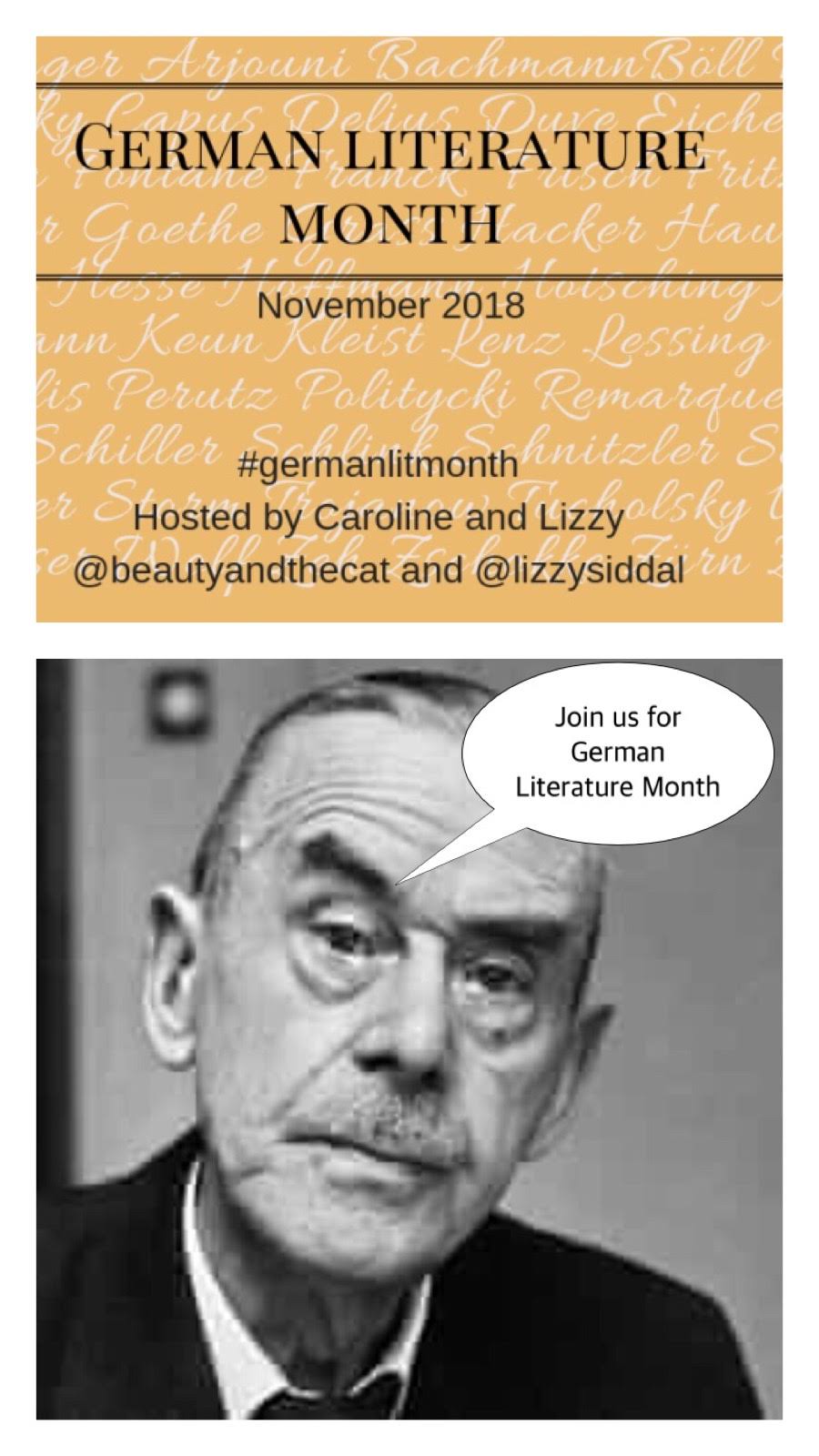
Showing posts with label Thomas Mann. Show all posts

Tuesday, November 7, 2023

"Louisey” (“Luischen” in German-published in 1900 - A Short Story by Thomas Mann- translated from the German by Damion Searls - 2023


 German Literature Month is hosted by Lizzy’s Literary Life

https://lizzysiddal2.wordpress.com/2023/09/22/announcing-german-literature-month-xiii/

This is my 12th year of  Participation in this great international event.

This year movies by German directors are a part of the event.

Works I have so far featured for German Literature XIII 

1.  Chaotic World and Childhood SorrowsA Short Story by Thomas Mann - 1924

2. Aguirre, the Wrath of God - A Film- Directed by Werner Herzog- 1972 

3. Triumph of the Will - A Film Directed by Leni Riefenstahl- 1936

4. The Blue Angel- A 1930 Film Directed by Joseph Sternberg 

Today I am featuring Thomas Mann’s first published short story, " Louisey", initially published in 1900.  The story line struck me as if it would be appropriate for an expression era German film, heavily melodramatic with a shocking conclusion.

In the small, stifling town of Lübeck, nestled amidst the rolling hills and dense forests of northern Germany, lived a peculiar couple named Jacob and Anna Margite Rosa Amelia Jacoby. Their marriage, an oddity even in the realm of human relationships, was a perplexing puzzle to all who knew them. Some whispered of a love match gone sour, while others speculated about a hidden arrangement of convenience. Regardless of the truth, the Jacobs' union was a spectacle of contradictions, a comedy of errors played out behind the closed doors of their grand townhouse.


Jacob Jacoby, a man of portly stature and perpetually furrowed brow, was a respected attorney, known for his sharp intellect and unwavering dedication to the law. Anna Margite Rosa Amelia Jacoby, on the other hand, was a vivacious socialite, a whirlwind of laughter and charm, always seeking the next thrill or amusement. Their personalities were like oil and water, their interests as different as night and day. Yet, they remained bound together, their lives intertwined in a web of unspoken resentments and unspoken desires.


Their home, a grand edifice of red brick and ornate carvings, reflected the duality of their existence. The front rooms, adorned with fine furniture and exquisite works of art, exuded an air of sophistication and refinement. But behind the closed doors of their private quarters, the atmosphere was altogether different. Their bedrooms were worlds apart, Jacob's a studious haven of books and papers, Anna's a boudoir of frills and trinkets.


Their marriage was a sham, a pretense maintained for appearances' sake. Jacob, a man of convention and propriety, was content with the façade of a respectable union, while Anna, ever the rebel, chafed against the constraints of their loveless partnership. She sought solace in the arms of others, her affairs as numerous as the stars in the night sky.


Their daughter, Louisey, a child of remarkable beauty and intelligence, was the sole witness to their charade. She observed their interactions with a quiet detachment, her large, dark eyes absorbing the silent drama unfolding before her. Louisey was a paradox, a blend of her parents' contrasting natures. She possessed her father's sharp intellect and her mother's vivacious charm, but she also harbored a deep-seated melancholy that mirrored the emptiness of her parents' lives.


One summer evening, as the sun cast long shadows across the cobblestone streets of Lübeck, Anna Margite Rosa Amelia Jacoby threw a grand garden party. The town's elite gathered in their backyard, sipping champagne and exchanging pleasantries, oblivious to the turmoil simmering beneath the surface.


Louisey wandered through the crowd, a solitary figure amidst the revelry. She overheard snatches of conversations, whispers of her mother's indiscretions, and felt a surge of anger and resentment. She confronted her mother, their voices rising above the din of the party, their words like daggers piercing the façade of their family's carefully constructed illusion.


The party ended abruptly, the guests departing with hurried goodbyes, their faces etched with shock and disapproval. Jacob, his face pale with humiliation, retreated to his study, while Anna Margite Rosa Amelia Jacoby stormed off to her room.


Later that night, as the town lay silent under a blanket of stars, Louisey found herself drawn to her mother's room. She stood outside the door, listening to the muffled sobs coming from within. She felt a pang of sympathy for her mother, recognizing the loneliness and desperation that fueled her reckless behavior.


In that moment of shared vulnerability, Louisey made a decision. She would no longer be a silent observer to her parents' misery. She would intervene, somehow, some way, to break the chains that bound them to a life of unfulfilled dreams and unrequited love.

I leave the very dramatic conclusion Untold.

I hope to post upon at least one more new to me work by Thomas Mann this month 


Thursday, November 2, 2023

"Chaotic World and Childhood Sorrows" A Short Story by Thomas Mann - 1924 - Translated from the German by Damien Searls 2023 - My Plans for German Literature Month XIII - November 2023


 German Literature Month is hosted by Lizzy’s Literary Life

https://lizzysiddal2.wordpress.com/2023/09/22/announcing-german-literature-month-xiii/

This will be my 12th year of participation in German Literature Month 


Ordinarily the only rule is that the book must be originally published in German but Lizzy has relaxed this for one week of the challenge to allow for authors whose native tongue was/is German, but who chose/choose to write in an adopted language

This year I hope to posts on two short stories as well as a novel  by Thomas Mann,  The Holy Sinner. I have also a new translation of his The Magic Mountain and if I can work it in I hope to reread this.  I also hope to feature works by Joseph Roth and Stefan Zweig, two authors I have featured in prior years.  My nephew will be preforming in a drama by Bertolt Brecht and I hope to read some of his plays,

 My first post for German Literature XIII will be on 
"Chaotic World and Childhood Sorrows"  A Short Story by Thomas Mann - 1924 - Translated from the German by Damien Searls 2023

Thomas Mann


Born - June 6, 1875 - in the free city of Lubeck


1905 - marries Katia Pringsheim. From a very wealthy non- practicing Jewish family. They have six children. 


Buddenbrooks - 1901


Death in Venice - 1912


The Magic Mountain- 1924


1929 - wins Nobel Prize


1933- in response to the rise in power of Adolph Hitler the family moves to Switzerland 


1939 - moves to USA - teachin
g at Princeton University 


In 1942 the family relocates to Los Angeles, where there is a substantial German Émigrés community, in which
 has a leadership role , helping any in need.


1947 - Doctor Faustus 


August 12, 1955 - dies in Switzerland while on vacation 

From Damien Searls introduction:

“Chaotic World and Childhood"
 is in my view Mann’s best story—it was Hemingway’s favorite, too, for whatever that’s worth. I think it belongs up there with James Joyce’s “The Dead” and anything you want to name by Gallant or Munro or Chekhov at the very top of the canon of short fiction, but it is never, to my knowledge, singled out as such."

I really liked this story.  The account of children in affluent family is both poignant and hilarious.

I urge anyone wishing to expand the visibility of their website or to learn about new to them German writers to Participate in German Literature XIhttps://lizzysiddal2.wordpress.com/2023/09/22/announcing-german-literature-month-xiii/II 

Mel Ulm 


Wednesday, October 6, 2021

The Magician: A Novel by Colm Toibin - 2021


The Magician:A Novel  by Colm Toibin - 2021 - 510 pages


I first read and posted on Colm Toibin in March of 2012.  Since then I have featured his work 15 times including novels, short stories and literary histories.  I loved his novel  on the London years, The Master, of Henry James and was very eager to read his latest novel, The Magician, based on the life of Thomas Mann.  The Magician brought Mann totally to life for me, as it has done for almost all readers.  It will help  if you have read Mann’s major works, or at least Death in Venice.  Not so much to follow The Magician but to appreciate the great challenge in basing a novel on his work. Toibin helped me understand how Mann created his great literature, the tremendous work and cultural depth behind them.


Thomas Mann


Born - June 6, 1875 - in the free city of Lubeck


1905 - marries Katia Pringsheim. From a very wealthy non- practicing Jewish family.  They have six children. Their lives are meticulously covered  in The Magician 


Buddenbrooks - 1901


Death in Venice - 1912


The Magic Mountain- 1924


1929 - wins Nobel Prize


1933- in response to the rise in power of Adolph Hitler the family moves to Switzerland 


1939 - moves to USA - teaching at Princeton University 


In 1942 the family relocates to Los Angeles, where there is a substantial German Émigrés community. He has a leadership role , helping many in need.


1947 - Doctor Faustus 


August 12, 1955 - dies in the Netherlands while on vacation 


The Magician begins in 1898 at the Mann household in Lubeck.  We meet his parents.  His mother is Brazilian, his father a wealthy German businessman.  We are pushed to wonder how a Brazilian mother impacted Mann.  One of the major themes of this book is the treatment of Mann’s homosexuality which very much not acceptable.  We wonder if a non-Germanic mother of dark beauty somehow impacted his sexual development.  Toibin depicts several same sex encounters of Mann’s.  Mann liked “beautiful boys”.  His gay sexual relationships were not enduring and were strictly physical.


His first novel, an amazing work for a 25 year old, Buddenbrooks, was considered by many readers as based on his family.  His father was miffed by it. As portrayed by Toibin, Mann wanted to marry Katia to become a part of her family.  He does develop a very close relationship with her.  A close friend had feared he would not be able to father children but he obviously did.


As Hitler became increasingly popular in Germany the international community and Germans who feared his doctrines wanted Mann to speak out against him.  Mann at first could not believe someone as atrocious as Hitler could win over Germany.  Mann could not accept initially that the country of Goethe and so many great philosophers and musicians could want to be ruled by Nazis.  He also at first did not want sales of his books blocked in Germany.


His brother Heinrich was very vocal in opposing the Nazis.  His wife’s family had to flea Germany for Switzerland once the Nazis began rounding up Jews.  They lost a lot of their money.  


The Mann family had numerous tragedies including multiple suicides.  The Mann children did not have easy lives even though their parents supported them throughout their life.


The book follows Mann over fifty plus years.  He was deeply into music and German literature.  


His time in America was fascinating.  At Princeton he socialized with Einstein.  He was always wealthy.  He built a wonderful home in Los Angeles.


There is just so much in this book.  This is a masterful account of how great art originates.


I will give Colm Toibin a final word 


“Colm Tóibín: He, in ways, was a ghost in his own life. He was silent in his study and he would come into the house and someone else would always be making the noise. And he had six noisy children. Thomas Mann was never someone out late at night. That never interested him. He lived a very sedate life. He was deeply domestic. He did not have close friends. He did not have a peer group. Once he married, he stayed home. So that the excitement in the book is all happening around him. He’s watching it. He’s resisting it. He’s nourished by it. But it’s not as though he himself is making the noise.”


I offer my great thanks to Max u for the Amazon gift card that allowed me to acquire The Magician.


Monday, November 5, 2018

Doctor Faustus The Life of the German Composer Adrian Leverkuhn As Told by a Friend by Thomas Mann - 1948 - translated from The German by Joseph Wood


German Literature Month Eight - Links to Reviews and More

The Reading Life Greater Germania Gateway


Thomas Mann on The Reading Life


Read so far during 
German Literature Month Eight 

  1. Once a Jailbird by Hans Fallada - 1947


 2.    The Loser by Thomas Bernhard - 1988

  1. Doctor Fausus by Thomas Mann - 1948

Thomas Mann

Born June 6, 1875


Buddenbrooks - 1901

Magic Mountain - 1924

Awarded Nobel Prize 1929

1939 - moves to U.S.A


1944 - Becomes U.S.A citizen

He never again lived in Germany but he made frequent post war visits 

Doctor Faustus is the fifth work by Thomas Mann upon which I have posted.  During prior German Literature Months read Buddenbrooks, Magic Mountain, Death in 

Venice and Royal Highness.

This year I read a work long on my list, Doctor Faustus.  I must first observe that The Vintage Press Kindle edition is an error riddled mess showing contempt for consumers.  In the bio included of Mann, one of hundreds of issues, he is described as the author of “Suddenbrooks”.   It appears it was scanned into a Kindle format but never even looked at 

before it was placed on Amazon.

My mental state now is somewhat low.  If you need home work help on this Wikipedia has a good article.  I am glad I read this book and was elated when I got to the end.

I liked his reflections on Germany a lot.  


Wednesday, November 4, 2015

Buddenbrook The Decline of a Family by Thomas Mann (1900, translated byJoseph E. Woods, 1993)

My great thanks to Max ü for the Amazon gift card that allowed me to read this book. 


I am estatic to once again be able to Participate in German Literature Month, elegantly and lovingly hosted by Lizzi's Literary Live and Beauty is a Sleeping Cat. This is my fourth year as a participant.   On the host blogs you will find the particularities of the event but the basic idea is to read literature first written in German (translated or not) and share your thoughts.  I began accumulating works for the event soon after the event ended last year and I began reading for it in mid-September.  


Works Read for G L V So Far

1.  Every Man Dies Alone by Hans Fallada. A brilliant recreation of life in Nazi Germany. 

2.  Ostend, Stefan Zweig, Joseph Roth and the Summer Before the End by Volker Weidermann. A fascinating social history 


Buddenbrook is a grand flowering of the tradition of realism in the European novel.  I see it, as do many, as among the greatest novels of all time.  I have previously read and posted on Mann's best known novel, The Magic Mountain, his novella Death in Venice and one of his short stories.  It took  about 200 pages of the 732 for me to be fully drawn into the life of the Buddenbrook family but by midpoint was completely mesmerized by this wonderful novel.  

Buddenbrook is the story of four generations of a wealthy North German merchant family.  There are a lot of wonderful thinks to like about this novel.  The people are all beautifully developed, they change overtime and are influenced by events and each other.  Each character is very well described.  There is a lot to be learned about German society.  There is a, to give an example, a very exciting scene set in 1848 where a mob of citizens tries to over throw the social structure.  In one brilliant small detail, one of the maids of the Buddenbrook family tells her mistress that soon their roles will be reversed and Madame Buudenbrook will soon be doing her laundry.  Needless to say she is fired at once. 


Here are some of the characters.  After the death of his father, his grandfather started the firm, Thomas Buddenbrook runs the business and is the head of the family.  His mother has a powerful influence on him.  We see her overtime become more and more drawn to the teachings of the church.  The oldest daughter, called Tony, is very interesting.  She is forced into marriage with an older man she hates.  This ends in divorce, quite a scandal at the time.  She moves home with her daughter Erika.  We will follow her life for thirty more years.  There is the younger brother Christian.  Unlike Thomas and their father, he is not really interested in business.  He goes to work in Valpariso for a longtime, returning for the funeral of their father.  The estate is divided between the two brothers, Tony, and another sister that plays a less important role. Thomas is to run the business.  Christopher loves the theater, and is a familiar of the demimonde world.  He has lots of vague sounding illness.  It is agreed he will work in the office of the company, handling the English correspondenence.  He does not like working there and Thomas and he end up having a terrible very well done fight and Christian leaves the firm.  

     From the movie

If you like descriptions of food, then you will find a lot to like in Buddenbrook.  There are wonderful minor characters.  Toward the close there is a long section devoted to the school whereThomas  Bruudenbrook's son goes whch is just perfect.  I really felt I was there.  The son is a musical prodigy, lmore fey than a young Buddenbrook boy should be, his father finds him a disappointment.  

Death is a constant companion of the Buddenbrook family.  

There is much more in this rich novel that I have touched on.  

This is a truly great novel. It has been several years since I read The Magic Mountain so I cannot really say which one I prefer.  

I completed this book on September 20 but decided to delaying posting on it for German Literature Month V.

I hope also to read Mann's Doctor Faustus, also translated by the award winning Joseph Wood and time permitting reread The Magic Mountain.  

I hope those who have read this or other works by Thomas Mann will share their experience with us.

Have you seen the movie? 


Mel ü

Tuesday, February 14, 2012

Death In Venice by Thomas Mann

Death in Venice by Thomas Mann (1912, sixty pages)

Last year I read and was totally overwhelmed by the power and depth behind Thomas Mann's (1875 to 1955-Germany) The Magic Mountain.   It as if all of European culture were almost summed up in one work.    When I saw Ally from Snow Feathers and Dolce Bellezza were jointly hosting an event this month, February in Venice,  in which participants are asked to read books about or set in Venice I knew at once I wanted to read Death in Venice this month.  

The story is about a writer of highly regarded literary works who feels his creativity needs the stimulation that a trip to Venice has often brought him in the past so he books sea passage from Germany to Venice.   Shortly after his arrival in Venice, the author sees a stunningly beautiful young man of fourteen and develops and obsessive interest in him that may in fact be the results of the central character's latent homosexuality producing an erotic fixation on an idealized never to be realized love object.

Gustav von Aschenbach is a man of extreme refinement totally dedicated to his art.    He is held in the highest esteem in German cultural circles.   On the boat trip to Venice the author is somehow repulsed by a man about his age with a party of much younger man who is trying to act as if he were young.   I got the feeling this was an allusion to the other man being gay and this revolted Aschenbach.    Of course those most revolted by a life style other than their own are often acting out of fear of their own hidden impulses.

The author begins to follow the young man and his family all over Venice so he can see the boy.   He finds it necessary to speak of his fixation on the boy through the filter of the views on beauty expressed in Plato's Phaderus.   There are some very interesting comments on theories in the dialogue and I think I will have to reread this dialogue soon (it has been decades since I read any Plato).

I do not wish to tell more of the plot.    There are big themes, as one would expect, in this work.   The question as to whether or not Aschebach is a latent homosexual pedophile is central to the book.

I would endorse this book to anyone who likes a novel of ideas.   If you do not like works in which characters reflect in a fairly high level fashion on abstruse philosophical issues then Death in Venice might not work for you.    I really enjoyed this work a lot.   I must say I thought the ending was really brilliant and deeply ironic.   I think this book would repay well repeated readings.   Venice is beautifully described in many passages of Death in Venice.

Please share your experience with a Thomas Mann with us.


Mel u


Wednesday, November 23, 2011

Thomas Mann and Hermann Hesse Short Stories by Two German Nobel Prize Winners

"Infant Prodigy" by Thomas Mann (1903, 5 pages)
"Within and Without" by Herman Hesse (1920, 9 pages)


When I saw that  Lizzy's Literary Life was having a November event  devoted to reading and posting on German literature I knew I wanted to participate.  Today I am posting on short stories by two of the Greatest German writers of the 20th century, Thomas Mann and Hermann Hesse.       

On November 5, I read "Germelshausen" by Friedrich Gerstacker (1816 to 1872-Hamburg, Germany).  It is  a very interesting fun to read short story from which the plot  of Brigadoon was lifted.

Gerstacker is a minor writer, pretty much forgotten but for this one story.   Thomas Mann (1875 to 1955) and Hermann Hesse (1877 to 1962), both Nobel Prize winners, are towering cultural icons best known for novels but both wrote a number of well regarded short stories.  

I will just post briefly on the two stories so readers can get an idea of them.

Thomas Mann (there is additional information on my post on his most famous work, The Magic Mountain) won the Nobel Prize  in 1929.   Mann fled Germany in 1933 when Hitler came to power.   He moved to the United States in 1939.   

"An Infant Prodigy" (1903) is one of Mann's earliest published works.    Told in the third person it is the story of a piano concert by an eight year old boy who is considered a musical prodigy of great talent.    It is very interesting in that we see how various members of the audience view him and relate to their experience of his music and we see how the boy feels about his own playing and the people that come to see him.  It is a good story and worth reading.

You can read the story here (I have no translator information for the story.)


Hermann Hesse won the Nobel Prize in 1946.   (I wonder what political message might have been intended by the giving this prize to a German right after the war).   He is most famous now for two of his novels, Steppenwolf (1927) and Siddharta (1922).   I have seen a number of book blog posts on Siddhartha.   During the 1960s Hesse's work was very in vogue with the "counter-culture" of the time for its seeming repudiation of the shallow values of the west.   I read at one time pretty much all of his translated novels.  During WWII Hesse remained silent.    His work was eventually banned from publication by the Nazis.

One of the dominant themes of Hesse's work is the divide between science and rationality versus magic and spirituality.  

"Within and Without" very much captures a lot of the main themes of Hesse.   The story is about a man whose whole is devoted to the pursuit of knowledge.   By that he means knowledge based only on science and logic.   He was aware that there are other kinds of knowledge.   He tolerate religion as it is the accepted thing to do among scientists in his society.   He hates what he calls superstition and any belief in anything that science and logic do not support.   Of course as the story proceeds events will radically undercut his world view.   He hates the then fashionable idea that science was just one of many ways of organizing and explaining our experience with no more validity than any of the others.   He hates all forms of mystical cults.  

One day he goes to visit a friend of his who he always felt was a total believer in science and logic.   He is horrified to see his friend has a saying on his wall that epitomizes all that the man does not believe in.   "Nothing is without, nothing is within, for what is without is within".   To him this is the worst kind of mystical thinking inspired by "decadent" eastern forces trying to undermine the culture of his country by attacking it at the very basis for thought.    As we can guess, he undergoes some heavy changes.   

I have no translator information for this story.   It does feel very much like one of his novels and captures a lot of his themes.   I guess I would recommend Hesse neophytes start with Siddhartha  (It is quite short and easy to read and there is even a movie based on it.   It is an example of Orientalizing India thought).   From there if you like it I would read Steppenwolf then maybe The Glass Bead game.    Hesse was once a super trendy writer but maybe less so now.   


Mel u

Sunday, September 25, 2011

The Magic Mountain by Thomas Mann

The Magic Mountain by Thomas Mann (1924, 720 pages)

"Only the exhaustive can be truly interesting".  

"This is one of those works that changed the shape and
possibilities of European literature. It is a masterwork, unlike
any other. It is also, if we learn to read it on its own terms, a
delight, comic and profound, a new form of language, a new
way of seeing."  A. S. Byatt

The Magic Mountain by Thomas Mann (1875 to 1955-Germany-Nobel Prize 1929) is one of the major works of 20th century European literature.    It has been on my to be read list ever since I first learned of it as a young teenager when I read Clifton Fadiman's The Lifetime Reading Plan.   It is a huge, I must say it, mountain of a book that does its best to capture the full spectrum of knowledge, philosophical attitudes and culture found in Europe in the opening decades of the 20th Century.   

Thomas Mann left Germany for Switzerland in 1933 when Hitler came to power.  In 1939 he moved to the USA, teaching at Princeton.   In 1944, while living in California, he became a USA citizen.   He was married and had six children.

The story opens around 1910.   A young man, Hans Castrop is about to enter his career in the shipbuilding business but first he wants to make a two week visit to his cousin staying high up in the mountains at a sanatorium for the cure and housing of affluent people with tuberculous.    There are all sorts of people from lots of countries there.   Sadly it turns out he has consumption (as TB was once called in a kind of hiding from death euphemism).   He ends up spending seven years there.   While staying there he has extensive conversations with characters that are representative of the major competing philosophies of the time.   He also receives an extensive education in many cultural and scientific matters.   Magic Mountain is really almost an encyclopedic work from which one could nearly reconstruct the knowledge of Europe in the first decades of the 20th century.    It also gives is a good look at the business side of the treatment of tuberculous and at times it did seem the institute was keeping people, maybe even Hans, there primarily to make money from them.

The words from Mann's preface to the book let us see what he was aspiring to in The Magic Mountain.


The exaggerated pastness of our narrative is due to its taking place before the epoch when a certain crisis shattered its way through life and consciousness and left a deep chasm behind. It takes place—or, rather, deliberately to avoid the present tense, it took place, and had taken place—in the long ago, in the old days, the days of the world before the Great War, in the beginning of which so much began that has scarcely yet left off beginning. Yes, it took place before that; yet not so long before...


We shall tell it at length, thoroughly, in detail—for when did a narrative seem too long or too short by reason of the actual time or space it took up? We do not fear being called meticulous, inclining as we do to the view that only the exhaustive can be truly interesting.

Some might exchange the word "exhausting" for "exhaustive" but this really is a fascinating work for those of us who like novels that turn on ideas.

There are some interesting kind of quirks in  the book.  Mann does not portray Russians in at all flattering way, treating them almost as sinister orientals speaking a "guttural language" and representing a degenerate phrase in Oswald Spengler's cycles of civilizations.    The Russians seems to always sit to together at their own tables at meals.  I can see why Vladimir Nabokov did not speak highly of Mann at times.    Meals, by the way, were quite spectacular affairs and I admit I would not mind being a guest for a couple of weeks as everything is totally taken care of for the patients.

The Magic Mountain is a wonderful, very rich  book.   It ends on a note of futility as Hans now that his years on the mountain have transformed into a person of real cultural depth is going to be drafted to fight in WWI, probably to be killed in a  senseless war.

The Magic Mountain is a complex work of art full of layer upon layer of meanings and deep irony.   I profited a lot from reading A. S. Byatt's introduction to the book (in another edition than the one I read).

The edition I read was translated by Helen Tracy T. Lowe-Porter who had exclusive rights to translate Mann for many years and first made his work available to readers of English.   This edition of the translation was first published in 1927.

You can read Byatt's  essay HERE.

I am glad I finally read The Magic Mountain.  

Mel u


Featured Post

Imperial Reckoning: The Untold Story of Britain’s Gulag in Kenya by Caroline Elkins - 2005 - 701 Pages

  Imperial Reckoning:     The Untold Story of Britain’s Gulag in Kenya by Caroline Elkins - 2005 - 701 Pages 2006 Pulitzer Prize Winner From...