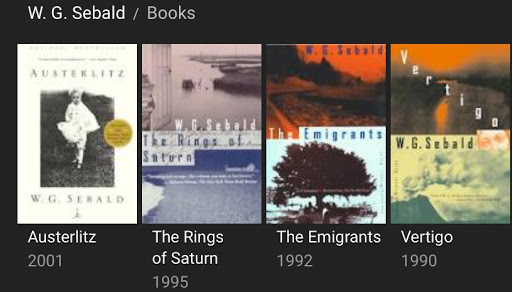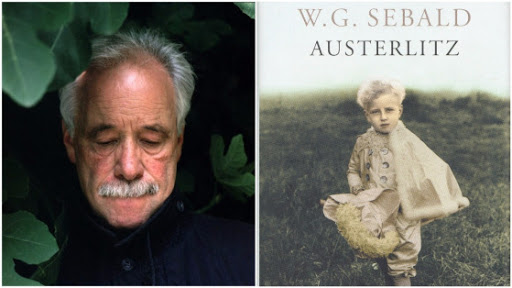
Showing posts with label W. G. Sebald. Show all posts

Wednesday, November 22, 2017

Austerlitz by W. G. Sebald - 2001 - translated from German by Anthea Bell


“Curiously enough, one cannot read a book; one can only reread it. A good reader, a major reader, and active and creative reader is a rereader.” Vladimir Nabokov

Prussia, the ruler of Germany, was always an enemy of the intellect, of books, of the Book of Books—that is, the Bible—of Jews and Christians, of humanism and Europe. Hitler’s Third Reich is only so alarming to the rest of Europe because it sets itself to put into action what was always the Prussian project anyway: to burn the books, to murder the Jews, and to revise Christianity."  Joseph Roth, 1933"


Works I Have So Far Read for German Literature Month, November, 2017

  1. “You’d Have Larvae Too” by Nora Wagener, 2016
  2. Vertigo by W. G. Sebald, 1990
  3. The Last Weynfeldt by Martin Suter, 2006
  4. “An Earthquake in Chile” by Heinrich Von Kleist, 1809
  5. Who is Martha? by Marjana Gaponenko, 2012
  6. “The Legal Haziness of Marriage” by Olga Grjasnowa, 2015
  7. “Aladdin, COB” by Isabelle Lehn, 2015
  8. “The Last Bell” by Johannes Urzidil, 1968
  9. The Rings of Saturn by W. G. Sebald, 1995
  10. Late Fame by Arthur Schnitzler, written 1892, published 2016
  11. Blood Brothers by Ernst Haffner, 1933
  12. Berlin Alexanderplatz by Alfred Döblin, 1929
  13. Confessions of a Murderer by Joseph Roth, 1936
  14.   “Compulsion” by Stefan Zweig,  1929
  15. “Borderlands”by Johannes Urzidil, 1956 (no post)
  16. “A School Boy’s Diary” by Robert Walser, 1910 (no post
  17. Austerlitz by W. G. Sebald, 2001, Second Reading 


If ever a book way over repaid my rereading it was Austerlitz by W. G. I first read this, my first encounter with Sebald, during German Literature Month in November 2013.  I think one needs to devote serious time to learning How to read his unconventional novels.  Since November 2013 I read and posted upon his three earlier novels.  YouTube has several videos of academic lectures on Sebald.   Some were very good.  Some focus on his place in Holocaust Literature, some deal with his photographs, his treatment of memory, and his unique narrative methods.

German Literature Month is winding down and I have a number of more works I hope to read before month end.  I Will just touch upon some few matters that struck me.  

I really liked the numerous references to Balzac.  I am currently working my way through his Comedie Humaine and I was thrilled to see the reference to his work.  This is very much a book about two men deeply into the reading life.

I enjoyed the descriptions of Prague and Paris.  I greatly relished the conversations between Austerlitz and the narrator.   

Austerlitz is a great work of art.  I hope to reread all of Sebald next year.  

Mel u


Friday, November 10, 2017

The Rings of Saturn by W. G. Sebald - 1995- translated by Michael Hulmes


Official Announcement for German Literature Month

Greater Germania on The Reading Life


Works I Have So Far Read for German Literature Month, November, 2017

  1. “You’d Have Larvae Too” by Nora Wagener, 2016
  2. Vertigo by W. G. Sebald, 1990
  3. The Last Weynfeldt by Martin Suter, 2006
  4. “An Earthquake in Chile” by Heinrich Von Kleist, 1809
  5. Who is Martha? by Marjana Gaponenko, 2012
  6. “The Legal Haziness of Marriage” by Olga Grjasnowa, 2015
  7. “Aladdin, COB” by Isabelle Lehn, 2015
  8. “The Last Bell” by Johannes Urzidil, 1968
  9. The Rings of Saturn by W. G. Sebald, 1995

W. G. Sebald was born Winfried George Maximillian Sebald in Wertach im Allgäu, in the Bavarian Alps in 1944. From 1975 he taught at the University of East Anglia, became Professor of German in 1986, and was the first director of the British Centre for Translation. He won the Berlin Literature, Literatur Nord, and Mörike Prizes, as well as the Johannes Bobrowski medal, plus the Los Angeles Times Book Award for Fiction (The Rings of Saturn). New Directions was the first to publish his book here: The Rings of Saturn, The Emigrants, and Vertigo. He died in an automobile accident in Norfolk, England, near his home in Norwich in East Anglia, England, on December 14, 2001. . From The website of New Directions Press.

The Rings of Saturn is the fourth novel by W. G. Sebald I have read.  I have now, for better or worse, read all his fiction.   I wish very much there were more. I felt I somehow related to this work more than the others.  Upon reflection I think this maybe because Sebald has such a unique narrative method that I needed to gradually learn how to read his work.  I also read several essays and listened to lectures about Sebald on Youtube.  

I am getting behind in my postings so I will just post a few impressions of the work.  This is a novel masquerading as an account of a walk about the narrator did in England.   As he walks he reflects on the things he sees, his memories of historical events somehow connected to the path of his walk.  To me it seems much of his thoughts were focused on cycles of corruption and decay hidden under something very different.  

I found the Work entirely fascinating.  I admit I was shaken up a bit by his reflections on sugar and art:

“In their heyday, said de Jong, the Dutch invested chiefly in cities, while the English put their money into country estates. That evening in the bar, we talked till last orders were called about the rise and decline of the two nations and about the curiously close relationship that existed, until well into the twentieth century, between the history of sugar and the history of art. For long periods of time there was little scope for an ostentatious display of accumulated wealth, and consequently the enormous profits that accrued to the few families who grew and traded in sugar cane were largely lavished on the building, furnishing and maintenance of magnificent country residences and stately town houses. It was Cornelis de Jong who drew my attention to the fact that many important museums, such as the Mauritshuis in The Hague or the Tate Gallery in confectioner to the Viennese court, which Empress Maria Theresia, so it is said, devoured in one of her recurrent bouts of melancholy.”

Sugar plantations employed huge numbers of slaves.  Under brutal conditions, the average life expectancy of a slave was two years.  The great art of Europe arose from this misery.  I saw the cosmic truth in this.  Beauty, art, culture, great treasures, magnificent buildings in London, Amsterdam arose from misery.  I wondered how this connects to Literature.  

Mel u


Thursday, November 10, 2016

The Emigrants by W. G. Sebald (1992)


My Readings For German Literature VI November 2016

1.  The Glass Bead Game by Hermann Hesse

2.  Royal Highness by Thomas Mann

3. A Small Circus by Hans Fallada

4.  Rosshalde by Hermann Hesse

5.  "Did He Do It" by. Stefan Zweig

6.  Journey Into the Past by Stefan Zweig (s cond reading, no post, posted on in Nov 2015)

7.  The Emigrants by W. G. Sebald

W. G. Sebald is considered one of the greatest post World War Two German language novelists.  During German Language Month in November 2013 I posted upon his novel Austerlitz.  

The Emigrants centers on the post WWII lives of four elderly Jewish men who have moved from Germany to either England or the USA after the war.  We follow there seemingly separate lives and we see the lasting impact of the Holocaust.

Those in need of a detailed account of the novel will find it on Wikepedia. 


      1944 to 2001

The Emigrants deserves a much more detailed post than I have done.

Ambrosia Boussweau 

Saturday, November 16, 2013

Austerlitz by W. G. Sebald 2001


I first acquired Austerlitz by W. G. Sebald in October of last year with the intention of reading it during German Literature Month II, in November, 2012.  I never got around to it last year but now I have.  W. G. Sebald is considered one of the post World War II masters of the German novel.    Of necessity, before I purchase a book I read the Amazon reviews and blog posts from people I know.   I know it might be better in many cases to not be pre-influenced by others opinions but I need to have a good prospect of liking a book before I buy it.  (There are no public libraries in the South Asia mega city that is my home.). Thus I knew the basic plot of Austerlitz before starting the book.  In this case, I think I lost out on the pleasure of trying to understand what was going on in the novel.   There are really only two important characters in Austerlitz.  Jacques Austerlitz, by profession an architectural historian, and his unnamed acquaintance with whom he maintains and often interrupted conversation spanning from 1967 to 1997.  As the narrative unfolds we learn that Austrtlitz was one of many children taken from Praque before WWII to England for safety.   Austerlitz did not become aware of this until he was an adult.  We see Austerlitz trying to put together his history from fragments of memory.  He ends up going to Praque to try uncover his past.  

Sebold lets us see Austetlitz discover that his parents were Jewish.  He is brought to think about the horrors of the Nazi occupation. 

There are many magnifently things in Austerlitz.  I liked his frequent catalogues and I greatly enjoyed the many photographs.  This is a very powerful work.  I hope to read more works by Sebald in 2014, hopefully one for German Literature IV.


I am really glad I decided to once again participate in 
German Literature Month November 2013.  I thank Caroline and Lizzy for hosting this great reading event.


So far I have read and posted on these works, all but Kafka are new to me writers. 
The Tin Drum-by Gunther Grass
"The Judgement" by Franz Kafka
All Quiet on the Western Front by Erich Maria Remarque -very powerful war novel 
"A Letter from an Unknown Woman" by Stefan Zweig. 
The Death of the Adversary by Hans Klein - a work of genius
"The Job Application" by Robert Walser 
Chess Game by Stefan Zweig-I will read much more of his work
"The Battle of Sempach" by Robert Walser
I have also listed to podcasts of "Basta" and "Frau Wilkes" by Robert Walser
The March of Radetsky by Joseph Roth I hope to read all his work

Memoirs of an Anti-Semite by Gregor von Rezzori amazing work of art.

"Flypaper" by Robert Musil

"Mendel the Bibliophile" by Stefan Zweig - I totally love this story.

"The Dead are Silent" by Arthur Schnitzler an entertaining work from 1907

"There Will Be Action" by Heinrich Boll a very good short story by Nobel Prize Winner

Transit by Anne Seghars 1942 very much worth reading

The World of Yesterday by Stefan Zweig - an elegy to a lost culture. 1942


Featured Post

Imperial Reckoning: The Untold Story of Britain’s Gulag in Kenya by Caroline Elkins - 2005 - 701 Pages

  Imperial Reckoning:     The Untold Story of Britain’s Gulag in Kenya by Caroline Elkins - 2005 - 701 Pages 2006 Pulitzer Prize Winner From...