Showing posts with label Aristophenes. Show all posts

Thursday, December 22, 2022

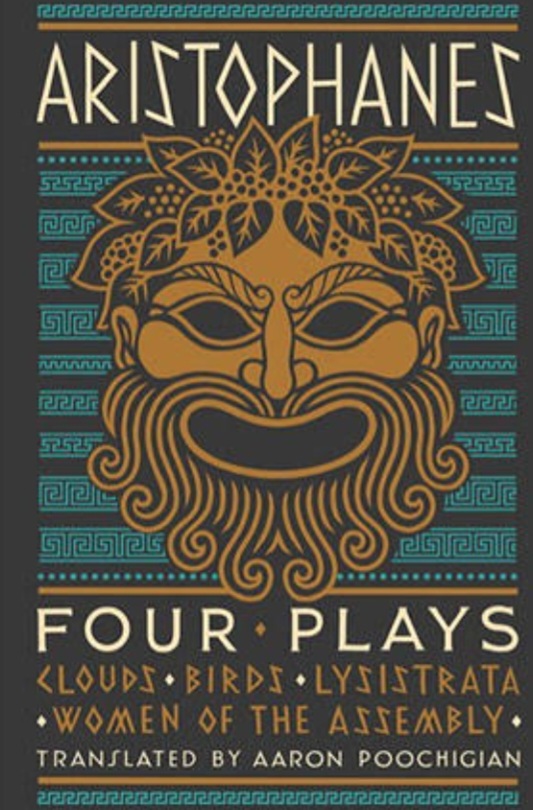
Clouds- A Comedy by Aristophenes-First Produced 423 B.C.E.- translated by Aaron Poochigian- 2021


 Clouds- A Comedy by Aristophenes-First Produced 423 B.C.E.- translated by Aaron Poochigian- 2021 


An Ancient Reads Work.


Aristophanes, (born c. 450 BCE—died c. 388 BCE), 


Emily Wilson's Review of Aaron Poochigian Collection of four comedies by Aristophenes- A Marvelous Introduction to the Comedies of Aristophenes - at Emilyrcwilson.com


This is the fourth comedy by Aristophenes I have so read. Prior to this I have posted on Lysistrata, his most famous work, Birds and Women of the Assembly. These works are included in Aaron Poochigan's collection.


In his introduction Poochigan says that Clouds, unlike the other three plays focuses on one person and his attempt to improve his financial situation. (But similarly to Lysistrata and Women of the Assembly, strap on dildos are a big factor. Here is my suggestion for a Dissertation- "Dildos in Classical Drama").


Characters 


Socrates, the philosopher who runs The Thinkery[9]

Strepsiades, student who joins The Thinkery

Pheidippides, his son

Chaerephon, disciple of Socrates

The Clouds, who form the chorus

Chorus Leader

Slave

Students

First Student

Wrong Argument

Right Argument

First Creditor

Second Creditor

Witness

Xanthias


As the play opens Strepsiades is in bed but he cannot sleep because he is very stressed by the debts he has run up to support son's, Pheidippides betting on horse races. Strepsiades tells the audience that his wife, from a wealthy clan, encourages the son Pheidippides in his interest in horses as it is regarded as a hobby for aristocrats. Strepsiades's creditors keep adding on interest and are now threatening to sue him which could cause him to lose all he owns.  


Strepsiades tries to get his son to enroll in an academy run by Socrates, The Thinkery, in which young men are taught to win arguments. When his spoiled son refuses he enrolls himself even though he is way older than the other students. It seems that the students are expected to allow their instructors to work them over with strepon dildos. All Strepsiades wants to do is learn how to refute the true claims of his creditors when he appears in court.


Wikipedia has a decent article laying out the plot. Strepsiades learns of the absurd doctrines taught at the school. Clouds is a savage attack on the perceived by Aristophenes decay of Athenian morality caused by Socrates.  

Sunday, December 4, 2022

Birds by Aristophenes- A Comedy- first preformed 414 BCE- translated by Aaron Poochigian- 2021 - plus a new Project Begins, Ancient Readings


 Since the start of The Reading Life in July of 2009 I have employed Reading Life Projects to help me structure the blog. My first two projects were on Japanese Literature and Katherine Mansfield. I now have projects on Irish Short Stories, early Australian Literature among others. Projects also give blog visitors a sense of what can be found on The Reading Life. Once I begin a project it is permanent.


Today I am initiating The Ancient Readings Project encompassing Literature from Sumeria, Greece, India, China, Rome as well as historical narratives on this era.


As of now I have as potential works for the projects, six plays by Senaca, eleven comedies by Aristophenes, New translations of Gilgamesh, Ovid, The Illiad by Homer, Virgil's Aneid as well as plays by Sophocles, Euripides and Aeschylus. Hopefully I will be able to acquire modern translations of The Vedas and Buddhist Sutras. Perhaps portions of The Old Testament can be included. This is for me an ambitious project. (I am limited to works available as Kindle Editions)


"Not only was Aristophanes one of the greatest poets of antiquity but, in the words of Lempriere’s Classical Dictionary, “the greatest comic dramatist in world literature: by his side Molière seems dull and Shakespeare clownish.” - From New Translations of the Complete Plays by Paul Roche 


Aristophenes wrote 44 plays, as documented by Paul Roche, but only 11 survive still. Prior to today I have posted on two of his works. These are Lysistrata, his most famous work, and Women of the Assembly. Both these comedies have focus on the sex lives of Athenian women in very explicit language. Birds is very different.


The first work to be included going forward is Birds by Aristophenes.


Birds was first preformed in 414 BCE at Dionysius where it won second place. It is the longest of the 11 surviving works. Set in the wilderness outside of Athens, Pisthetaerus, an Athenian, persuades the birds in the area to form a great city in the sky, reclaiming their ancient place as Gods. 


Wikipedia has a decent plot summary so I will forgo that. I liked the satire of Athenian society, the way the birds were given personalities fitting their species. No doubt ornithologists would enjoy deciding which species are represented. Birds is a deep mockery of Greece's myth based religion.


I will next read his play Clouds.


Mel Ulm

Thursday, November 17, 2022

Women of the Assembly by Aristophenes- 392 BCE -Translated by Aaron Poochigian-2021


Born: 445 BC, Athens 

Died: 386 BC, Delphi


Last month I read his Lysistrata 

Lysistrata is by far the most famous ancient comedy. The central theme is that the women of Greece ban together refuse to have sex with their husbands or lovers unless the men restrain from all forms of warfare. There is very explicit sexual language. Some of the women complain that they cannot go without sex and talk about dildos. The husbands are very upset, they walk around with huge erections protruding from their tunics.

Women of the Assembly opens during a festival only for Women.  The women there agree to disguise them selves as men.  The plan is they will go to the Assembly and vote to turn the government of Athens over to Women.  They also want to do away with the notion of property, with marriages, nuclear families.  Sex is not confined to marriage.  If  a man wants to have sex with an attractive woman he must first have xex with an ugly one.  This way old or unattractive Women are not deprived of sex.

There are lengthy arguments about the soundness of these ideas.  Children will not have a designated father but will be a community responsibility.  There is debate about motivation for working if everything is owned in common.  Everyone is guaranteed an equal subsistence, no rich no poor. Slaves, not being citizens, are owned in common.

As in Poochigian's translation of Lysistrata, there is very  explicit language, that now would make the work at least R rated.  As I read this I wondered if this language was meant to shock the audience or was it just how people  in Athens in 351 BCE  talked?. Women are depicted as craving sex but tired of just being a vehicle for the penises of men. Older women resent younger women getting all the sex.

I found the debates interesting.  The depiction of women is kind of amusing.
A blog I have followed for many years, Wuthering Expectations, is doing a read through of all the surviving Greek Plays, a marvelous endeavor I wish I could have emulated.

If you are new to Aristophenes first read Lysistrata. I will in December read his Birds
ABOUT THE TRANSLATOR Aaron Poochigian earned a PhD in classics from the University of Minnesota and an MFA in poetry from Columbia University. He is the translator of, among other classical works, Sappho’s poetry (published under the title Stung with Love), Apollonius’s Jason and the Argonauts, and Euripides’s Bacchae, and has published two books of poetry—The Cosmic Purr and Manhattanite—and a novel-in-verse, Mr. Either/Or. His poems have appeared in such publications as Best American Poetry, the Paris Review, and Poetry. He lives in New York.

Tuesday, October 18, 2022

Lysistrata by Aristophenes - first preformed 411 BCE - translated by Aaron Poochigian - 2021


Lysistrata by Aristophenes - first preformed 411 BCE - translated by and with an Introduction by Aaron Poochigian - 2021


Born: 445 BC, Athens 

Died: 386 BC, Delphi


Lysistrata is by far the most famous ancient comedy.  The central theme is that the women of Greece ban together refuse to have sex with their husbands or lovers unless the men restrain from all forms of warfare.  There is very explicit sexual language.  Some of the women complain that they cannot go without sex and talk about dildos.  The husbands are very upset, they walk around with huge erections protruding from their tunics.


Lysistrata is the organizer of this sexual strike.  When asked what to do if your husband forces himself on you she says “just lay totally stiff, don’t grind back”.  Female actresses lift up each others tunics for inspection purposes, commenting on what they see.


The men are very upset insisting the women have no reason to complain about wars as they do not participate.  Lysistrata  explains that they lose sons and husbands in war.  All of the women involved are aristocratic though they live in a society where slaves out number the free.  A slave woman plays a minor role, and is  treated with no respect by her owner, Lysistrata.


From the play as the women take an oath to withhold sex:


“Hey there, Lampito, everyone, lay your hands upon the wine cup.One of you will repeat, for all, the terms of our agreement after me, and then the rest will swear to keep them once we’re done. No man, be he a lover or a husband . . . CALONICE: (stepping up as the representative for all the women) No man, be he a lover or a husband . . . LYSISTRATA: No man, be he a lover or a husband . . . LYSISTRATA: . . . shall come up to me with a boner. Say it! CALONICE: . . . shall come up to me with a boner. ​Ah! My knees are going to buckle, Lysistrata! LYSISTRATA: And I shall pass the time in celibacy”.


In what Aaron Poochigian says is very unusual in Ancient Greek Drama, there are two choruses, one of old men, one of old women. The old women play a big part in the action, seizing the treasury Athens needs to wage war.  The two choruses converse with each other about the sex strike as well as making comments to the audience.


There are three videos on YouTube of staged performances.  The actors are college students and to me they seemed overacting and the choruses did not seem very well done.  


A blog I have followed for many years, Wuthering Expectations, is doing a read through of all the surviving Greek Plays, a marvelous endeavor I wish I could have emulated.


There are three other comedies in the collection,  Birds, Women of the Assembly and Clouds.  I am hopeful I can read and post on them by the end of 2022.


ABOUT THE TRANSLATOR Aaron Poochigian earned a PhD in classics from the University of Minnesota and an MFA in poetry from Columbia University. He is the translator of, among other classical works, Sappho’s poetry (published under the title Stung with Love), Apollonius’s Jason and the Argonauts, and Euripides’s Bacchae, and has published two books of poetry—The Cosmic Purr and Manhattanite—and a novel-in-verse, Mr. Either/Or. His poems have appeared in such publications as Best American Poetry, the Paris Review, and Poetry. He lives in New York.


Mel Ulm

Featured Post

Imperial Reckoning: The Untold Story of Britain’s Gulag in Kenya by Caroline Elkins - 2005 - 701 Pages

  Imperial Reckoning:     The Untold Story of Britain’s Gulag in Kenya by Caroline Elkins - 2005 - 701 Pages 2006 Pulitzer Prize Winner From...