Showing posts with label Margaret Atwood. Show all posts

Monday, March 20, 2023

"My Evil Mother" - A Short Story by Margaret Atwood - 2023- included in her new collection Old Babes in the Wood

"My Evil Mother" - A Short Story by Margaret Atwood- 2023- included in her new collection Old Babes in the Woods


I acquired this wonderful story as a Kindle Single for $0.99

This has been a good month for short stories so far, two classic works by Issac Singer and now a brand new story by Margaret Atwood.

As the story begins the teenage narrator is mad at her mother for telling her she must end her relationship ship with her boyfriend. The father is long gone, what happened to him is left vague. The mother has income but it seems to come from other women who employ her to cast spells. As time ago on, the story takes us to where the daughter rebellious 15 year old daughter. The mother seems increasingly convinced she is a witch of sorts. We see the parental roles reversing.


There is a lot to ponder here. Is the mother using the idea she has occult powers to give herself status? Does the delusion pass along to the daughter?


This story was a lot of fun to read


https://margaretatwood.ca/ has lots of info


Mel Ulm


Tuesday, November 2, 2021

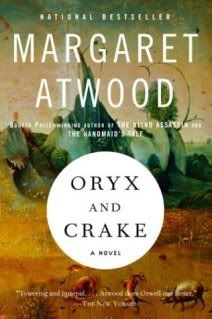
Oryx and Crake by Margaret Atwood - 2003 - 468 Pages


Oryx and Crake by Margaret Atwood - 2003 - 468 Pages 


Margaret Atwood Month- hosted by Buried in Print. November 2021


I am happy to once again participate in Margaret Atwood Month.


Some might find this book a little much.    Some might find it a little silly.  Some people are going to stop reading this book well before midpoint.    I think you have to enjoy post apocalyptic fiction and be happy to read a book and enjoy the beauty of the language without stressing too much over whether or not you have clear cognitive understanding of the plot action.     I really enjoyed the book for the skill with which Atwood constructed an alternative future earth.     The language of the book is very creative and imaginative.    There are lots of new earth creatures running around, lots of dangers and maybe a delight or two. If  Vienna sausages  made of soy beans that have been in the can twenty years after the expiration date sound like a great treat to you then you will be at home in the world of this novel.    One advice I would give new entrants into this world is to forget about having a pet dog!.    


Oryx and Crake is part one of a planned trilogy.    The Year of the Flood (2009) is part two and part three has yet, as far as I know, to be written.   There is no sense of a cliff-hanger at the end of Oryz and Crake.     What the books have in common is that they are set in the same alternative future.   I have a copy of The Year of the Flood and hope to read it soon.    If you are looking for a first Atwood, then I would say read The Handmaid's Tale.  If you like that a lot and you like speculative fiction (meaning fiction set in a world based on Earth but altered somehow) then give Oryx  and Crake a shot.    


Wednesday, November 18, 2020

“The Man From Mars" A short story by Margaret Atwood - 1977 - A Post in Observation of her 81st Birthday


“The Man From Mars" A short story by Margaret Atwood - 1977


“Margaret Atwood Reading Month is hosted by me and Naomi at Consumed by Ink, inspired by decades of our reading Margaret Atwood’s words.

From Sunday, November 1st to Monday, November 30th we’ll be reading Margaret Atwood, and we invite you to join in! (And, don’t forget, the 18th is Margaret Atwood’s 81st birthday. We’ll be celebrating with books, quotes, and cake!) “ from Buried in Print 


This is my second post for Margaret Atwood Reading Month, my first was on her novel The Penelopiad.


  "The Man From Mars" is the first of Margaret Atwood’s short stories I have yet read.  I really liked it a lot.  It is told in the first person by Christine, a Canadian college student.  She is a "big boned" athletic woman studying political science.  Her father has an important government job so she feels she can probably secure a government position.  One day on campus an odd, shabbily dressed Asian man approaches her and strikes up a conversation.  She senses there is something wrong with him and reluctantly agrees to give him her name.  Christine is not as pretty as her two sisters and most men she meets through tennis or the debating society see her as "one of the guys".  The man calls her house and her mother, maybe relieved Christine seems to have a suiter,  suggests he come to tea one day and he invites himself next Thursday.   He begins to stalk her.  Her father calls the police who take extra care with the case because of his position. There is a lot in this story and I don't want to spoil it for potential readers by telling more of the plot.   The ending is really interesting.  


This is a story about how expectations become prophecies, about how a woman's look can fix her future, about cultural clashes and complacency and much more.


I hope to work in one more work by Margaret Atwood this month.


I read this in the excellent anthology pictured below. 


“Margaret Atwood Reading Month is hosted by me and Naomi at Consumed by Ink, inspired by decades of our reading Margaret Atwood’s words.

From Sunday, November 1st to Monday, November 30th we’ll be reading Margaret Atwood, and we invite you to join in! (And, don’t forget, the 18th is Margaret Atwood’s 81st birthday. We’ll be celebrating with books, quotes, and cake!) “ from Buried in Print 


This is my second post for Margaret Atwood Reading Month, my first was on her novel The Penelopiad.


  "The Man From Mars" is the first of Margaret Atwood’s short stories I have yet read.  I really liked it a lot.  It is told in the first person by Christine, a Canadian college student.  She is a "big boned" athletic woman studying political science.  Her father has an important government job so she feels she can probably secure a government position.  One day on campus an odd, shabbily dressed Asian man approaches her and strikes up a conversation.  She senses there is something wrong with him and reluctantly agrees to give him her name.  Christine is not as pretty as her two sisters and most men she meets through tennis or the debating society see her as "one of the guys".  The man calls her house and her mother, maybe relieved Christine seems to have a suiter,  suggests he come to tea one day and he invites himself next Thursday.   He begins to stalk her.  Her father calls the police who take extra care with the case because of his position. There is a lot in this story and I don't want to spoil it for potential readers by telling more of the plot.   The ending is really interesting.  


This is a story about how expectations become prophecies, about how a woman's look can fix her future, about cultural clashes and complacency and much more.


I hope to work in one more work by Margaret Atwood this month.


I read this in the excellent anthology pictured below.

Monday, November 2, 2020

The Penelopiad" by Margaret Atwood - 2005 - 198 Pages


 “ Margaret Atwood Reading Month is hosted by me and Naomi at Consumed by Ink, inspired by decades of our reading Margaret Atwood’s words.

From Sunday, November 1st to Monday, November 30th we’ll be reading Margaret Atwood, and we invite you to join in! (And, don’t forget, the 18th is Margaret Atwood’s 81st birthday. We’ll be celebrating with books, quotes, and cake!) “ from Buried in Print 


The Penelopiad" by Margaret Atwood - 2005 - 198 Pages 


This is the first of what will be at least two works I will read as my participation in Margaret Atwood Month - November 2020


The Penelopiad by Margaret Atwood (2005, 198 pages)


This tale of privileged rich versus abused masses is a perfect commentary on the world today.


Everyone knows about Odysseus, the central character of the Odyssey.   He married Penelope, cousin of Helen, when she was 15.       The Odyssey is considered, among many other things, to be perhaps the first  the story of the use of human intelligence to deal  with and solve problems.   Odysseus was the king of a minor country in ancient Greece.  In an arranged marriage that was basically a business deal he married  the then 15 year old Penelope, cousin of Helen.    The Penelopiad is  told from the point of view of Penelope with her maids as a kind of Greek Choir commenting on the story.    It has been a long time since I  studied Greek Drama but the Chorus is sort of allowed to say the unsay-able, to tell the audience the "real story".


Penelope is none to happy about going to Ithaca, Odysseus's kingdom as it is a remote backward place compared to the home of her father, King  of Sparta.    She is only 15 and her maids have given her very confusing accounts of what will happen on the wedding night.   She is consumed by jealousy over the beauty of her cousin Helen.   She leaves Sparta with Odysseus and take up residence in the palace at Ithaca.    She has brought along one of her maids, a slave of course, for company.   The slave soon dies.    Penelope and Odysseus develop a close relationship.   She has issues with her mother in law who does not want to lose her position as the most important woman in her son's life.  There is an old maid, another slave, who in her youth wet nursed Odysseus, who really runs the house hold.   When ever Penelope tries to do anything or learn anything about running the household the head maid tells her basically "don't worry your pretty head about this just contemplate what fancy clothes you want to wear tonight".    


A son is born of the union, Telemachus.   The event is celebrated as a wondrous happening and all care is given to the son and the mother.   The maids see it a bit differently.


“For his birth was longed-for and feasted, as

ours births were not.

His mother presented a princeling.   Our various mothers

Spawned merely, lambed, farrowed, littered..

We were animal young, to be disposed of at will,

Sold, drowned in the well, traded, used, discarded when bloomless.”


One of the chapters is entitled "Helen Ruined My Life".   A prince of Troy, Paris, a notorious womanizer and his brother are on a state visit to Sparta.  Odysseus has sworn loyalty to the king of Sparta.   Paris seduced Helen, sounds like an easy thing to do as Penelope lays out her super vain character, and takes her back to Troy with him.   The king of Sparta declares  war  on Troy when Paris will not return her.   Odysseus leaves to fight at Troy.    The war lasts ten years.   The Trojan horse was the idea of Odysseus.   The trip back to Ithica takes ten years.    During these twenty years Penelope learns to run the kingdom.   She learns everything from bargaining with other kingdoms to how to raise swine.   Her son Telemachus grows to be a teenager and become rebellious.    She has no idea if Odysseus lives or not.   Sometimes she hears news of him.   Some times she hears he has been eaten by a monster, then next week she will hear he is living with a Goddess on an exotic island.    In the mean time an army of suitors for the presumed widow descend on Ithaca.   They begin to deplete the resources of the kingdom.  Penelope picks her 12 favorite maids, young girls who have been her slaves since birth, to spy on the suitors.   Some of them end up being raped by the suitors.  


Rape is defined in the world the maids are in as having sex with a slave woman without permission of her master.   Rape was a crime against the property of the male owner of the slave women, not against them.    It was common for visiting dignitaries to be given female company but any contact without permission is a great insult to the master or mistress of the slaves.   Some of them end up in love with the suitors and some remain loyal to Penelope.   We see Penelope begin to assert herself for  the first time.    We see how women are seen as property.   We hear the suitors, many in their late teens and early twenties, joke about the prospect of sleeping with Penelope.   The basic idea is marry her and do what you must then you get all her property and can have all the slave girls you want.  Penelope at first had  a hard time ordering the slaves about.   Her mother likewise had problems with directing the work of slaves but was not above killing them when they annoyed her.    


Penelope becomes a shrewd household manager and begins to intervene in the running of the country.   Her mother had taught her to behave like water, the water that will wear down a stone.   A lot of the story is taken up with class conflict.   When Telemachus sprains a leg numerous doctors are called in.  When a slave child is ill a business decision is made whether to drown him in the well or spend the funds to try to cure him.    The worse enemy of the attractive slave maids turns out to be the once beautiful but now aged former wet nurse of Odysseus.   Most people know the basic story of Odysseus and I do not want to give away much of the plot action.


The story is told from the world of the dead where Penelope and Helen both now reside.   A very funny scene occurs when Helen takes a public bath in order to show off her body to the men in the underworld.   Penelope says what is the point they cannot do anything now but Helen says she is just being kind to them.    


The Penelopiad shows Penelope growing from a totally helpless 15 year old to a woman of 35 with many capabilities.   She must still act like she is deferring to men.   When Odysseus returns (this is not a spoiler as it is on the back cover of the book and many will know it anyway) he kills the suitors and slaughters the maids.    Why he feels he has the right to slaughter the maids brings out the central feminist themes of the book.   Just like as in The Handmaiden's Tale, there is a incredibly clever change of narrative mode in which the maids give a lecture to a modern audience of male Anthropologists which is an explicitly feminist reinterpretation of the life of the maids and their death.   It has to be read with an ear for irony, not as a statement of dogma.


I am not sure if I like this or The Handmaid's Tale more.    The Penelopiad is easy to read and a lot of fun.   I would really say read both of them.   I am very glad I read these books.   The Penelopiad is a very creative interpretation  of the Myth of Odysseus.   It is funny, perceptive, the chorus of the maids is a superb  device and is a great account of class differences among women in a world in which all women were property.    Even the treatment of Helen shows a woman using her looks to get what she wants.   She seems a slave to her own vanity which is validated for her by the number of men killed in her name.   That vanity is  the vanity of  a woman who gets all their self worth from the admiration of men.   Her husband did not start the Trojan war because he missed Helen but because his property was stolen.   


I look forward to seeing what develops during Margaret Atwood Month.


Mel u


Saturday, November 6, 2010

Oryx and Crake by Margaret Atwood

Oryx and Crake by Margaret Atwood  (2003, 426 pages)

Oryz and Crake by Margaret Atwood  (1939, Canada) is the fourth  of her works that I have read and posted on so far.   I first read The Handmaid's Tale which like almost everyone else I loved.     Then I read her retake on the story of Odysseus from the point of view of his left at home wife, The Penelopiad.    I liked it a really lot but most bloggers were mixed in their reaction to it.     I then moved  onto one of her "normal" works of fiction, Cat's Eye.   I thought it was OK but had it been my first Atwood I would probably have waited a while to read more of her work.   
Oryz and Crake will not be every one's post apocalyptic  genetically engineered cup of  root bark tea.    We hope the tea will help us fight off the virus, released by accident from a research lab,  that has killed off almost all of humanity.     We found the ingredients scavenging through what was once a great city.     I agree with Mrs B of the Literary Stew who says it may be better to not know too much about this book and the world it depicts before you plunge into it.    E. L. Fay of This Book and I Could Be Friends has done a wonderful post on the book in which she explains enough of the plot action that will allow one to see if the book might interest them.

Some might find this book a little much.    Some might find it a little silly.  Some people are going to stop reading this book well before midpoint.    I think you have to enjoy post apocalyptic fiction and be happy to read a book and enjoy the beauty of the language without stressing too much over whether or not you have clear cognitive understanding of the plot action.     I really enjoyed the book for the skill with which Atwood constructed an alternative future earth.     The language of the book is very creative and imaginative.    There are lots of new earth creatures running around, lots of dangers and maybe a delight or two. If  Vienna sausages  made of soy beans that have been in the can twenty years after the expiration date sound like a great treat to you then you will be at home in the world of this novel.    One advice I would give new entrants into this world is to forget about having a pet dog!.    Oryz and Crake is part one of a planned trilogy.    The Year of the Flood (2009) is part two and part three has yet, as far as I know, to be written.   There is no sense of a cliff-hanger at the end of Oryz and Crake.     What the books have in common is that they are set in the same alternative future.   I have a copy of The Year of the Flood and hope to read it soon.    If you are looking for a first Atwood, then I would say read The Handmaid's Tale.  If you like that a lot and you like speculative fiction (meaning fiction set in a world based on Earth but altered somehow) then give Oryz and Crake a shot.    Before you read the book I also suggest you read the posts of Mrs B and E. L. Fay to get a further idea of what the book is like.  

Mel u

Sunday, December 20, 2009

"Cat's Eye" by Margaret Atwood

Cat's Eye (1988, 565 pages) is the third novel by Margaret Atwood that I have read.   My first of her works was The Handmaiden's Tale which I liked a lot for the  dystopic vision of a future America and the finely crafted alternative universe the book offers.   I then read The Penelopiad a retelling of the story of Odysseus from the point of view of his left behind wife Penelope.    In the recent 43rd Bookworms Carnival there were four reviews of The Penelopiad, mine among them.   Of four reviewers, I seemed to have liked the book the most.  I like the concept of the retelling of myths in the Canongate's Myth Series of books.    I wanted to read a 3rd Atwood before the year ended.   Readers in Manila do not always have as many options as those in some other countries.   There are no public libraries, Amazon.com charges too much to ship and the Bookdepository will not ship here at all.   We have many big beautiful ultramodern book stores in which you can always find lots of wonderful books.   However, if you want to go to a store and find all 20 or so of Atwood's books for sale you are out of luck.    Anyway I really wanted to read her Oryx and Crake.   I could find only The Blind Assassin and Cat's Eye.

Cat's Eye is a story mostly about the childhood memories of a woman who as an adult is a highly regarded artist.   The story is told in the first person from her perspective.   The strongest part of the book to me was in its showing how childhood experiences shape a person in ways few of us will ever really understand.   It makes very good use of different ways of viewing remembered experiences.   It is also the story of friendship of young girls and a story of awaking sexuality.   The narrator is partially at least, unreliable and we have to take an active role in figuring out what really happened.    It is well written.   I would not say it is as beautifully written as say a work of Kristy Gunn or Jeannette Winterson might be.   I would characterize this as a clever book by a very creative writer.  

I will eagerly read her two Dystopic tales and will try Alias Grace if I come upon it.   

Mel u


Thursday, November 19, 2009

"The Handmaid's Tale" by Margaret Atwood


The Handmaid's Tale (1985, 389 pages) is the first work by Margaret Atwood that I have read.    It is in the genre of the dystopian novel. It is about an alternative future in which a church group has taken over the United States, which they rename "Gilead".   The setting is the late 20th century in what used to be Cambridge Massachusetts.  

The narrator of our story, which begins right before the church take over, is married to Luke.   She and Luke had an affair while Luke was married to another woman.  Luke divorced his wife and married Offred and the two of them have a three year old daughter.   One day she goes to use her ATM type device and it will not work.   The clerk in the store tells her that it is saying invalid account number.   She is indignant and says she will call her bank.   When she gets to her job at the library she calls the bank over and over for hours but she cannot get through.   Her very nervous male boss calls the all female work force to a meeting.   Everyone is being fired as of now.   All libraries in Gilead are to be closed.   When she gets home she finds out that it has been declared illegal for women to have bank accounts.   Their balances are to be transferred to their husbands or fathers.   If they have no husband or father the government will keep the money.   Women should never have worked in the first place.   This is explained as a blessing to the women as they will no longer have to burden their minds about money.    From now on it will be illegal for women to have jobs, read or for female children to receive any sort of education.   This is all presented as a wonderful lifting of burdens by the very paternal government.   Luke vanishes one day.   Her child is taken from her as only children born in a first marriage may stay with their parents.  Divorce, birth control and abortions are strictly illegal.   In order that children may be born in a religiously proper fashion, no pain killers of any kind are allowed at child birth

Women can only be in certain roles in society.   This is explained to them as a wonderful thing and woe unto a woman who does not love these ideas.

The highest status position is that of Wife of a government official.   There is a shortage of men in Gilead due to the very large number killed off in the civil war that the church take over produced.    High status males, called Commanders, are allowed to set up grand households.   Below Wife is  the position of Econowife.   That refers to a woman who may marry a lower status male but has to do all the house work herself and must have her children herself.   Next we have the position of Handmaiden.   There is a very low birth rate in Gilead, far below the replacement rate.   This is in part because atomic bombs were dropped on parts of the USA that resisted the church take over and radiation caused massive sterility as well as a very high portion of genetic defects.   Handmaiden's job is to have sex once a month with their Commander.  The wife is present and has a degrading  role to play.  The handmaiden wears a cloth bag over her head so she cannot see the Commander and to prevent any hint that this is a personal encounter.   Wives tend to hate handmaidens though it is illegal for them to directly kill them.   If someone does not fit into this new society or shows any sign of lack of enthusiasm for the new way of life they can be sent to what is called "The Colonies".   The colonies are those parts of the USA that did not accept the new government.   They were laid waste by atomic blasts.   Workers are send their to clean up the damage and bury millions of dead bodies.   Because of the radioactivity, the disease brought on by the unburied corpses that are everywhere and the extreme envirnmental degradation life expectancy in the colonies is three years.   That is also where the food is grown for Gilead, which may account for the low birth rates and the very high rate of severe birth defects.   Even though abortion is punishable by death defective babies, called "Shredders", are destroyed at birth.    Below the status of Handmaiden is the Martha who is a household servant that is not allowed to have children or marry.   Like the Romans and the Nazis, the rulers of Gilead know that subject people are best controlled on a day to day basis by their own kind.   The work of monitoring the women is done by Aunts, all of whom carry cattle prods on their belts and are fond of telling the women how lucky they are that there is no longer any degrading pornography, that they no longer have to strain their minds with decision making, that they no longer need fear rape  and that they are protected by their wonderful Commander.   If a woman does not agree fast enough she gets the cattle prod and worse maybe will be sent to the colonies.   We only learn gradually how the society works and how it came into place.   Everything is narrated by the handmaiden and she has access only to limited information, after all she is not even allowed to read any more.   Women cannot trust each other as they are trained to inform on negative thinkers.  The informant is showing herself to be a worthy daughter of the Republic of Gilead.   Men have various roles to play also.   Everyone but a Commander, who is also watched, has to wear a uniform based on their role in society.   If a Handmaiden fails to have a child in six years, she is rotated every two years to a new Commander, she is sent to the colonies.   Any child she has, as long as it is not a shredder, will be raised by the Wife or another family.   Once she has had a child and done her six years she can even dream of becoming an Aunt.   If she fails to have a child, most of the men have very low fertility rates, she is sent to the colonies.  

Gilead is beautifully realized and I at once believed it could exist.   There are a lot of questions that one will have in mind about how Gilead works but remember the story is told in the first person by a handmaiden who can ask no questions and is forbidden to read.   The Aunts tell the women  it will be easier on girls born in Gilead as they  will not have the burden of confused thoughts that the foolish custom of allowing women to be educated caused.   Now the women have no worries,  no decisions to  make, no children to rear (maybe Econowives raise their own children but we do not learn much about them or the Marthas), and a wonderful government to take care of them and protect them.   Of course every woman tells all she meets that she is so grateful for the changes.

This is the background in which the Handmaiden's Tale unfolds.  People being people not everything is really perfect in this paradise.   The unfolding of the story is wonderfully clever and imaginative.   Shocking and brutal things will happen but there is hope and the human spirit is far from defeated.    We will get to know the local Commander, his wife, some of the other women.   A commander can have multiple Marthas.   Barriers break down, the women compare notes and some strange relationships develop.   I was very taken when I saw the joy of the handmaiden when she got the chance to read some magazines.   Most preGilead magazines and books have, of course, been burned.  

The Handmaiden's Tale does a marvelous job creating an alternative future.   The characters are very well developed.    Anyone who has ever worked for a large corporation will see at once coworkers who would have made great Aunts.   The Handmaiden's Tale reminded me more of Brave New World than 1984.   To me, it stands with them as cautionary stories of the first order.   It is also very entertaining, fast paced and just a great story.   I have not relayed much of the actual plot line as it is so clever I do not want to spoil it for anyone.  

The Handmaiden's Tale seems like it was almost written with the Women Unbound Challenge in mind.   It is easy to follow and understand.   It is beautifully written.     I found myself completely taken into The Republic of Gilead. I hope my three daughters never have to live there.  It shows how women can be and often are their own  oppressors. It shows how people sell themselves for small worthless things.  It tells us something important about the reading life.   Dictators always try to stop The Reading Life.   A diverse range of  free reading has never ever been encouraged under any totalitarian regime, from the Romans on down to the days of Pot Pal in Cambodia where wearing glasses could get you executed.   The ending was a complete surprise and I loved how the book was closed.      She as written over thirty books so if anyone has any suggestions as to my second Atwood please post them.  

Mel u

Featured Post

Imperial Reckoning: The Untold Story of Britain’s Gulag in Kenya by Caroline Elkins - 2005 - 701 Pages

  Imperial Reckoning:     The Untold Story of Britain’s Gulag in Kenya by Caroline Elkins - 2005 - 701 Pages 2006 Pulitzer Prize Winner From...