Wednesday, October 8, 2014

Colonel Chambert by Honore de Balzac (1832, a novella component of The Human Comedy)


Several movies have been made from Honore de Balzac's  Colonel Chambert.  It does have an exciting plots with lots of twists and turns.   The estimated reading time is sixty minutes and I found it a well spent hour.  

Colonel Chambert was declared dead years ago, killed while serving his hero Napolean.  He was found under a dead horse seemingly passed away and he was thrown in a pit for mass burial.  He awoke and dug his way out but the army declared him dead and gave his wife a widow's pension.

Like a number of other Balzac works, the story is structured in part as if one person is telling a tale to another. In this case Colonel Chambert is telling his story to a lawyer. He wants his death claim reversed and he wants promotion to general and he wants a pension.  His wife remarried long ago and has all his money. He wants his money back and he wants to, perhaps, reclaim his wife.


The plot is a lot of fun so I won't tell it. In a very funny opening segment we sit in as the law clerks make fun of the clients.  We learn a good big about the business of being an attorney.  The characters are well developed.  We see the colonel's extreme devotion to Napolean and his contempt for French society. We learn something shocking about his pretending to be high society wife and her new husband and the ending of the story is harsh.

"Colonel Chambert" is very much worth reading. It is fun and exciting and perhaps a bit melodramatic but that is ok.  I read an old public domain translation by Clara Bell.  


17 of 91

Mel u

Monday, October 6, 2014

Middlemarch A Study of a Provincial Town by George Eliot (1871 to 1872)

"What do I think of Middlemarch? asked the great American poet Emily Dickinson. "What do I think of glory?" And Virginia Woolf called it "The magnificent book, which with all its imperfections, is one of the few English books written for grown-up people". Many of what Woolf thought were imperfections are in fact strengths. It is possible to argue that Middlemarch is the greatest English novel."  A. S. Byatt


Middlemarch by Gerorge Eliot (1819 to 1880, England) is universally regarded as one of the greatest novels of all times, perhaps the pinnacle of the Victorian novel.  I am so glad to have at last read this magnificent work.   I recently learned that Eliot was among Proust's favorite English writers. In an article in The Guardian by A. S. Byatt she says that Eliot learned much from Balzac and I can see that.  I think it may help in understanding this novel to have been married for a longtime.  Book bloggers often talk about whether a book is part of the canon or not. ( I think the notion of a literary canon was first created by American professors at Columbia and Harvard but the meaning of the term has expanded way beyond that and has or was a subject of dispute among academics.). No one could deny Middlemarch a place near the top of the canon.   It is a must read classic for all literary autodidacts.  

I will just make a few random observations on the book (for homework help seekers, just go to Wikepedia and copy the whole article on Middlemarch and turn it in as your work).

I think it is important to see it as the full title would have us do, as a study of a small town in the Midlands of England in around 1830 to 1832.  It is a portrait of life in the imaginary town of Middlemarch.    It is intensely focused on marriages, the place of women in society, the importance of the clergy, and social structure. There are deep themes about the nature of love.  It  focuses on relatively affluent, upper middle class people, more on women than men   It does not rise to the highest levels of society like Proust and Zola and it does not take us into the lives of the very poor like Dickens or Hardy (meaning most people at the time) or the decadent rich.  There are no brothels or factories, no opera parties, no famous artists or courtesans. Eliot is a very close observer of a particular segment of society.    Balzac soars higher and sinks lower in his depictions of life.  There are didactic narrative  intrusions but if Tolstoy can do it so can Eliot.

It is an exciting book, you want to see what will happen next.  There are lots of minor characters and several plot lines.   

Please share your experience with Eliot with us.

My post on Silas Marner


I hope to read The Mill on the Floss in 2015.  Proust loved it.  


Sunday, October 5, 2014

"Twofold" by S. Y. Agnon (1939, first time in English, translated by Jeffrey Saks in observation of Yom Kippur)


"The gabbai honored whomever he chose to honor with opening the ark before the beginning of each pizmon (prayer). The honorees screwed up their faces with a look of self-importance and walked up to the Holy Ark. The shoes on their feet shone like their clean-shaven chins. Their little sons and daughters stood in awe as they gazed at their fathers, who quickly opened the ark that others had just closed. When most of the congregation had gone out, but one pizmon remained in the machzor, the gabbai honored even me with the opening of the ark." From "Twofold"

An excellant detailed article on S. Y. Agnon


Tablet-A New Read on Jewish Life, an excellant resource on all issues related to Jewish culture and Isreal, has just published, in honor of Yom Kippur, the first ever Engish translation of a story by S.Y. Agnon.  The story was wriiten in 1939 and was translated by Jeffrey Saks. Agnon was born in the Ukraine in 1888 and died in Jerusalem in 1970.  He won the Nobel Prize in 1966 and is widely considered one of the most significant modern writers in Hebrew.  Much of his work focuses on the conflicts people find in living in the world in accord with Jewish teachings.  


"Twofold" is set in 1939 in Jerusalem on the high holy day of Yom Kippur.  A man is in the temple performing the requisite rituals and praying.  He begins to think back on observations of the day back in Galacia when he was a young boy.   He recalls his father in the temple. Often the places of honor in the ceremonies are most given to the richest.   He thinks back on the ritualistic garments and their import. We can see the impact of the involuntary and willed memories of the narrator on his this day experience of Yom Kippur.  We see how ancient tradition strengthens him and connects him.

I am glad to have read by first work by S. Y. Agnon.

You can read this story here


Jeffrey Saks is the editor of The Toby Press Edition of the English language edition of the works of Agnon, forthcoming in 2015.   I look forward to this greatly. 


Saturday, October 4, 2014

"Opa-Locka" by Laura Van den Berg (2012, from The Isle of Youth, a 2014 O. Henry Prize Story)


I was very happy to find a story by Laura Van den Berg, from her collection The Isle of Youth, included in The O Henry Prize Stories 2014 anthology.  "Opa Locka" is a story of a very sad dysfunctional family.   Set in a part of Miami a long way from the glitter and glamour of South Beach, it focuses on two sisters.  Their mother is on a six month around the world cruise, their father just disappeared long ago.  One of the sisters did six months in jail for breaking into and robbing houses. They have started a dectective agency.  When we meet them they are on a "stake out", trying to prove a man is cheating on his wife.  I felt like I was along for the ride.  The author does an excellant job making the dysfunctional family very real.  We listen to them talk about why their father deserted them. We wonder but never learn how the mother paid for the very expensive cruise. I don't want to tell to much of the plot. The author has shed light on a dark world.  This is a very good story and I look forward to reading more of her work.


From the author's web page


Laura van den Berg was raised in Florida and earned her M.F.A. at Emerson College. Her first collection of stories, What the World Will Look Like When All the Water Leaves Us (Dzanc Books, 2009), was a Barnes & Noble “Discover Great New Writers” selection. Her stories have appeared in Conjunctions, The Kenyon Review, American Short Fiction, Ploughshares, Glimmer Train, One Story, and have been anthologized inThe Best American Short Stories, The Best American Mystery Stories, The O. Henry Prize Stories, The Best American Nonrequired Reading, and the Pushcart Prize XXIV. She is the recipient of scholarships and fellowships from the Bread Loaf Writers’ Conference, the Sewanee Writers’ Conferences, Ragdale, and the Virginia Center for the Creative Arts.LauraReading

She has taught creative writing at Grub Street, Gettysburg College, as the 2009-2010 Emerging Writer Lecturer, the Gilman School, as the 2010-2011 Tickner Fellow, Goucher College, Johns Hopkins University, the Maryland Institute College of Art, George Washington University, and in the M.F.A. programs at Emerson College and Warren Wilson. She is the 2014-2015 Faculty Fellow in Fiction at Colby College.

Her second collection of stories, The Isle of Youth, was published by Farrar, Straus & Giroux in November 2013. The Isle of Youth was named a “Best Book of 2013″ by over a dozen outlets, including NPR, The Boston Globe, and O, The Oprah Magazine, was a finalist for the Frank O’Connor Award, and received the Rosenthal Family Foundation Award from the American Academy of Arts & Letters. Both Laura’s collections were longlisted for The Story Prize and shortlisted for the Frank O’Connor International Short Story Award.


Thursday, October 2, 2014

"The Eyes Have It" by Ruskin Bond (1982)


Ruskin Bond (born 1934, Kasauli, India) was born in India.  His parents were both English, his father an officer in the British Army.  When he was four his parents divorced.  His father returned to England and Bond remained in India with his mother who remarried an Indian.  Bond was educated in Indian schools and adopted into a Hindu family.   He has written over 300 short stories, numerous essays and novellas and 30 children's books.   

"The Eyes Have It" (at the close of the post I will tell you how you can read this story) is set on a train in India, like a lot of other very good short stories.  It would not be out of place in an anthology of children's short stories but it certainly will delight adults.  The story is narrated by a visually impaired, not fully blind, young man.  He can see other people but cannot really discern their features. 
He notices a woman entering his compartment and hears her parents checking very careful that she is comfortable and secure before leaving her.  As the train moves out he speaks to her and she she did not know he was also in the compartment. He cannot really see what she looks like but he is intrigued by your voice. As she gets up to leave at her stop another man joins the compartment. The narrator asks him to describe the woman.  (Spoiler alert).  The man tells him the woman is quite beautiful. He says her most striking feature is her eyes.  She is totally blind.  Shades of O. Henry here.  

This story was fun to read. Some might see the ending as a bit smaltzy and maybe it is but it was moving and I felt like I was on the train.

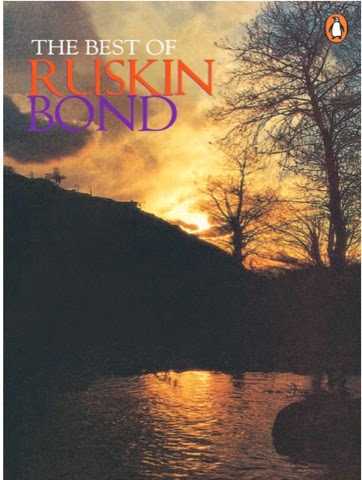
You can read this story in full in the Kindle sample of The Best of Ruskin Bond.

I have several of his stories in anthologies of Indian short stories and hope to read more of his work.


An excellant interview with Ruskin Bond in The Hindustan Times can be found here, including more information on his illustrious career.


Mel u

Wednesday, October 1, 2014

Morwenna Holman- Author of Heaton- A Guest Post on Spirit Writing.


Today I am very proud to present a guest post by Morwenna J. Holman.  She is the author of Heaton and Westerdale.  Westerdale which was written when she was visited by the spirit of Emily Bronte.  Many artists have felt inspirations from spirit visits.  Such visitations are depicted in the most ancient texts and art about the creative process.  Sometimes  when reading most intensely I have felt something akin to a spirit visitation.  

Morwenna is a remarkable person and I offer her my great thanks for sharing her insights on spirit writing with us.


About Morwenna Holman 


“I am a spirit writer, communing with the departed to write stories of their lives which are lost in the mists of time. I try to bring them to life again and capture the drama which existed at that point in time.


I am a committed vegan and am dedicated to the welfare of animals, especially cats which I rescue. Hence trying to sell these novels in order to provide a cattery for the abandoned cats of Morley, West Yorkshire, where I live.  My hobbies are walking and healthy living and I try to educate people on the holistic treatment of their cats.


Suffering from a lifelong depression and anxiety makes taking on the emotions of these departed spirits difficult and often upsetting but they always come with so much love I never feel alone.”


Inline images 2Inline images 1


My Experience as a ‘Spirit Writer’


Morwenna Holman is a ‘spirit writer’, which means her novels are dictated to her by spirits, “communing with the departed to write stories of their lives which are lost in the mists of time.”  


Her first novel, Westerdale, was published in 2013, a story she wrote in her teens, when she said she was visited by the spirit of Emily Bronte.


Her latest novel, Heaton, is a prequel to Westerdale and is available now.


Morwenna sells her books in an effort to raise vital funds for Morley Holistic Cat Rescue. The charity desperately needs a new cattery for the many abandoned felines it deals with.


Although I expect every Spirit Writer has their own techniques that are individual to them, the ultimate desire is to create a passive uncluttered mind through which theSpirit can make contact.


It is much like retuning a radio when you prepare your mind to receive guidance, and the outer world must be turned off as far as possible. It is not very conducive tothe Spirit if you start adding up all the calories you have eaten today when they are trying to convey the outline of their life story!


With continual practice, however, I find the outer world does fade and I am not conscious of it unless something dramatic happens like a loud knock at the door. I usually turn off all phones and put some relaxing music on before I begin. I used to meditate to bring a calm state of mind but now I find that that is unnecessary, although many Spirit Writers still do it.


Certainly I still my mind and empty it of all thought thenconcentrate on my breathingcounting my breaths until they slow right down. When this happens I take my consciousness up into my third eye. This is the space between my eyebrows and is where our psychic power lies. This is where the re-tuning comes in as I turn from the material world around me to the inner world within my soul.


Once I feel my energy collected in my third eye, a sensation a bit like that floating feeling you get just before you fall asleep, I ask inwardly if any spirits would like to make contact. If I am writing with a particular spirit at the time then I will use their name, eg "CordeliaDeane - are you there and happy to communicate with me?" This is always said out loud. Sometimes the spiritssimply aren't around and you just have to accept that. Equally they may make contact with me, saying that they wish to commune but for whatever reason I cannot.There is a definite mutual respect.


Sometimes this re-tuning can take a while and often it is several minutes before contact is established. I close my eyes throughout this whole procedure but after a good link is established I can open my eyes and start to write what they are telling me. I must remain very passive throughout the initial contact period, just as a Spiritual Healer does when channeling spiritual energy to use forhealing. After contact is made it can all get really lively and my mind is then in an active stage, listening to the spirit's voice which is always felt in the centre of the forehead, in the third eye. Usually they will confirm their name and start the two-way conversation with the simple word, "Blessings".


Then comes the fun as they recount the latest activities in the story they are relating to me and I type or write it and they give their comments. I always speak out loud to the spirit so my inner voice can use all of its energy to concentrate on what they are saying. I have seen it written that the spirits are controlling your mind but I do not agree with this because I always feel in total control and able to get out of the communication if I so wish.


Often in a sensitive individual like myself the emotions of the spirit recounting a particularly tragic storymanifest themselves physically, and many is the time I write with tears streaming down my face! The spirit usually sends me pictures of what happened and exactly what the characters look like so I can describe them in detail and, if I was an artist, I could draw them too. All this is quite tiring as often after an hour or so of communing there is the feeling of "holding" the spiritual frequency and then I know it is time to break the contact and rest. All this can be very draining and I rarely do more than one hour a day because of it. I am alsodisabled and often ill. It requires both physical and mental stability and health to spirit write.


Occasionally I have overstepped the mark with writing as when I attempted to put down the last tragic chapter ofRainharrow. This was a feat that left me in tears for weeks due to the intensity of the last few pages from the perspective of absorbing the three characters' feelings - all of them in despair, mental anxiety or physical illness. My stomach ached for Cathy, my heart raced for Edwin and my mind buckled under the anxiety and fear Paul felt.


Being a lover of the 1800s I always ask for spirit from that era to talk to me, much as a dentist deals with teeth and a chiropodist with feet I immerse myself in those past ages because I know I can write in that classical style and hopefully do justice to the tale I am told.


I would say being a Spirit Writer is the most amazing part of my life but it is also one of the hardest and I hope that people world-wide are touched and entertained by these stories from days gone by. 


Heaton is available now from Amazon andFeedARead


End of Guest Post


I strongly endorse Morwenna's writings and I have the greatest respect for her work with cats.


I hope to do a Q and A with her soon.


"Dinosaurs On Other Planets" by Danielle McLaughlin (from The New Yorker, September 15, 2014)


Ethel Rohan's Guest Post on Danielle McLaughlin


My Q and A with Danielle McLaughlin

I have been following the literary career of Danielle McLaughlin for almost there years now. She has very kindly participated in a wide ranging very informative Q and A session which anyone interested in the short story should read.  I have posted on three of her short stories.   One of the very rewarding aspects of blogging on contemporary writers is seeing them gain increasing recognition for their talents.  For a short story writer being published in The New Yorker Is about as good as it gets.  I was very happy to find Danielle's story "Dinosaurs On Other Planets" in the September 15th issue.   It is the title story of a collection of her short stories being published next year by The Stinging Fly.  The Stinging Fly is Ireland's leading literary journal and a world class publication of high quality short stories and poetry.   They launched the career of Kevin Barry and published the 2014 Frank O'Connor Prize Best Short Story collection winner Young Skins by Colin Barry.  

One of my purposes here is to let my readers know that this story can be read online. (I will include a link at the close of the post.)  "Dinosaurs On Other Planets" is set in rural Ireland.  In just a few pages Danielle does a masterful job of letting us see many years of family dynamics.  One of the things one sees through out Irish literature is the treatment of the surface emotional reticence of the Irish.   You can see this in Dubliners and Patrick Kavanagh's majestic poem, "The Great Hunger".  "Dinosaurs On Other Planets" is in this great tradition.   The story is set at the home of a long married couple.  The wife is fifty one, the husband much older.  He is retired and spends a lot of time wood working.   They have not slept together for a year and their living in London now adult daughter's bedroom is where the husband now sleeps.


The daughter is coming with her son and her new boyfriend for a visit.  The parents don't want her or their grandson to know they are estranged.  There is no hate, the passion, if there ever was much, is gone.  I don't want to reveal more of the plot.  I think you will enjoy finding out what the story has to do with dinosaurs on other planets, I did.

Declain  Kiberd has said the dominant theme of modern Irish literature is that of the weak or missing Irish father.  In my opinion this story exemplifies this.  Danielle talks about this in her Q and A.

You can find the story here 


I greatly enjoyed reading this story and I am avidly looking forward to her collection.  

Danielle McLaughlin lives in County Cork, Ireland. Her stories have appeared or are forthcoming in The Stinging Fly, The Salt Anthology of New Writing 2013, Willesden Herald New Short Stories 7, The Long Story Short, The Irish Times, The Burning Bush 2, Inktears, Southword, 
Crannóg, Hollybough, on the RTE TEN website, on RTE Radio and in various anthologies. She has won a number of prizes for short fiction, including the Writing Spirit Award for Fiction 2010, The From the Well Short Story Competition 2012, The William Trevor/Elizabeth Bowen International Short Story Competition 2012, the Willesden Herald Short Story Competition 2012-2013 and the Merriman Short Story Competition in memory of Maeve Binchy.


Featured Post

Imperial Reckoning: The Untold Story of Britain’s Gulag in Kenya by Caroline Elkins - 2005 - 701 Pages

  Imperial Reckoning:     The Untold Story of Britain’s Gulag in Kenya by Caroline Elkins - 2005 - 701 Pages 2006 Pulitzer Prize Winner From...