Saturday, January 16, 2016

"Miss Grief" and Other Stories Constance Fenimore Woolson edited by Anne Boyd Rioux with a Forward by Colm Toibin (Forthcoming February 2016)


Contains a good short bio and a list of her works.


Any day I discover a new to me writer whose first work I read makes me want to read all their work is not an entirely bad day.   My most recent "discoveries" are Iréne Némirovsky and Clarice Lispector.  After reading  "Miss Grief" I am close to adding Constance Fenimore Woolson (1840 to 1894, USA, her grand uncle was James Fenimore Cooper) to my read all I can list.

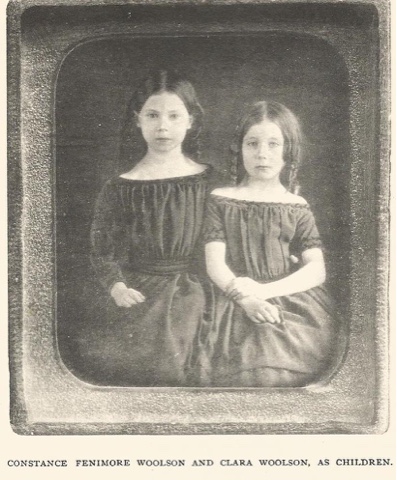
Drawing on the very insightful historically informed introduction of Rioux, Woolson was born in 1840 in Cleveland, Ohio and died in 1894 from a fall from a third story window in Venice, Italy.  She wrote five novels, the post popular was Anne what way out sold at the time Henry Jame's Portrait of a Lady.  James and Woolson were friends, both Toibin and Woolson talk about the influence of James and their relationship.  Woolson never married, having lost a man she loved to another woman in her younger days.  She was raised in a cultured enviorment, encouraged to read Dickens, and, as Rioux tells us, and I saw it clearly in Anne, was very influenced by Eliot.  

Her writing live can be roughly divided into three periods.  From around 1870 to 1875 she wrote stories centering on the American Great Lakes region, where she grew up.  From late 1875 to 1879, she and her mother spent much time in the American south and her stories center in this region.  When her mother died she moved to Europe, spending most of her time in Italy.  It is here she developed her relationship with James.  

Woolson, in her life very popular, quickly faded to obscurity where she still largely lingers.  I hope so much Rioux's collection and her biography (I will post on it soon, after I reread it) revitalize her readership.  I did a book blog search and found very few posts on her but mine.  


When I saw a collection of her short stories offered to reviewers on Edelweiss I decided to request it largely because Colm Toibin contributed the foreword. I based this on my love for his novel on Henry James, The Master.    I was embarrassed as I read the foreword and introduction to learn she was at one time one of America's best selling authors,as  I had never heard of her.   I learned she faded from public view and was only currently mentioned by and large because of her long term friendship with Henry James.  James lived for a while in a villa Woolson rented in Florence.  Toibin and Anne Boyd Rioux make a lot of interesting observations about the use James might have made of their relationship in Portrait of a Lady and a few of his short stories.  The fioreward and introduction are really well done.

The anthology of her short stories is truly  a first rate production.  Every story is  introduced  and full details on the publication history of the stories is provided.  (One of my bet literary peeves centers on collections of short anthologies that do not include first publication data.)

I will talk in enough detail on the stories to give readers a sense of the great range of her talents. 

I strongly endorse this collection to all lovers of the short story and urge all teachers of American literature to add Woolson to the ciriculum.  

"Miss Grief" is set in Florence.  An older slightly impoverished looking woman begins making daily visits to the home of a very sucessful American writer.  He thinks she is probably an antique dealer or collector. He keeps avoiding her, having his butler tell her he is not in.  Finally he relents and it turns out she has written something  she wants him to read.  He reluctantly agrees and she insists she will come back in a few days for his reactions.  He sees lots of faults with the work but he is deeply impressed by the sheer depth of her creation. When she returns he tells her of changes she should make in the work.  He tells her if she follows his suggestions, he will submit it to his editor for possible publication.  She adamantly refuses to his great surprise.   She begins, in the company of what he takes to be her maid, to visit regularly.  He reads more of her work and is amazed.  He tries himself to rewrite her work but he finds he cannot change it without the work falling apart.

I will leave the close unspoiled.  It is very interesting, sad and moving.

Part of the power of the story is in the very brilliant    way the relationship between Miss Grief, which is actually a mispronouncing of her name, and the male author is depicted.  Of course as I read it I found it hard not to see the writer as Henry James.

"The Florentine Experiment"

Woolson's short stories are set, with one exception in this anthology, either in the American Great Lakes region where she grew up, in the American south, or in Italy where she spent the last years of her life, as Rioux elegantly details in her wonderful introduction.


"The Floretine Experiment, first  appeared in Harper's Magazine in 1880'and was included in the collection Dorothy and other Italian Stories and is included in this collection. 

I think Riioux has captured this story in her introduction:

"It also reflects Woolson’s interest in James’s writing, for in it she consciously set out to write the type of story at which he was considered to excel—the society tale in which the talk is more important than the plot and in which, she felt, manner was placed above matter."

It does reflect the great talent of Woolson to be able to write a story like this as well as others like "Solomon", "Miss Grief" and "Saint Claire Flats" which are complete unique in style.  The dialogue is very good and the backdrop of art saturated Florence is well utilized.

"St. Claire Flats"

This might be my favorite of her stories.

"Saint Claire Flats" is set in a very marshy area of the Saint Claire Lake area near Detroit, Michigan.


Flats are a very marshy, normally with water not deep enough for big boats.  They are, or in those days were ideal habitats for very abundant fish and birds.  They were often visited by sports fisherman and duck hunters.

The story centers in part on two men from Cleveland come to the flats to fish.


The story starts out marvelously with very beautiful nearly lyrical descriptions of the rushes, the birds and the water.  I really felt and wished I was there.  There is talkof a canal that will be built that will greatly damage the flats, destroying the habitat.  The work is in a powerful way the story of the destruction of the American natural environment for the sake of commerce and money.    The men need to leave the big paddle boat, Woolson describes the boat trip perfectly, as well as Mark Twain.  

Compressing a good bit, the two fishermen are directed to a small island in the flats where they are told they can be boarded while fishing and hunting the area.  The opening of the story is beautiful but nothing prepared me be taken by Woolson deeply into a very dark strain of American culture through the words spoken by the man and wife who live on the island.  This story alone makes buying Miss Grief and Other Stories necessary.  It would, I think, make a wonderful class room story in American schools.  I think in order to really "get" this story you need an understanding of the American concept of Manifest Destiny and an overview of the westward expansion of the country from the Atlantic coast. You also would benefit from an understanding of the part chiliastic religious thought played in American society in the period in frontier areas.

Like the other stories I have read, there are two sets of people in the story, "tourists" from main stream society and near outcasts, stranger seeming people into whose world they temporarily intrude.  I thought for a good while as to whether or not to try to tell the "plot" and I decided not to do so.  

I will instead quote a few of the remarks made by the man on the island, a visionary who feels he is in direct contact with God.  I will say the depiction of the relationship of the couple is just so deep, so complex as to be a great wonder of American literature.  

"“What seek ye here?” continued the shadow. “Rest!” replied Raymond. “Hunting and fishing!” I added. “Ye will find more than rest,” said the voice, ignoring me altogether (I am often ignored in this way),—“more than rest, if ye stay long enough, and learn of the hidden treasures. Are you willing to seek for them?” “Certainly!” said Raymond. “Where shall we dig?” “I speak not of earthly digging, young man. Will you give me the charge of your souls?”  Spoken by the husband as they enter the house on the marsh island.

"“I am not Mrs.; I am called Roxana,” replied the woman, busying herself at the hearth. “Ah, you are then the sister of Waiting Samuel, I presume?” “No, I am his wife, fast enough; we were married by the minister twenty years ago. But that was before Samuel had seen any visions.” “Does he see visions?” “Yes, almost every day.” “Do you see them, also?” “O no; I’m not like Samuel. He has great gifts, Samuel has! The visions told us to come here; we used to live away down in Maine.” “Indeed! That was a long journey!” “Yes! And we didn’t come straight either. We’d get to one place and stop, and I’d think we were going to stay, and just get things comfortable, when Samuel would see another vision, and we’d have to start on. We wandered in that way two or three years, but at last we got here, and something in the Flats seemed to suit the spirits, and they let us stay.” The story of how Roxanna and Samuels got to the flats where they work hard but have a good life. 


There is an incredible description of a meal Roxana serves her guests.  You will love it.


"“Do you believe in these visions, madam?” asked Raymond, as we left the table, and seated ourselves in front of the dying fire. “Yes,” said Roxana; emphasis was unnecessary,—of course she believed. “How often do they come?” “Almost every day there is a spiritual presence, but it does not always speak. They come and hold long conversations in the winter, when there is nothing else to do; that, I think, is very kind of them, for in the summer Samuel can fish, and his time is more occupied. There were fishermen in the Bible, you know; it is a holy calling.” “Does Samuel ever go over to the mainland?” “No, he never leaves the Flats. I do all the business; take over the fish, and buy the supplies. I bought all our cattle,” said Roxana, with pride. “I poled them away over here on a raft, one by one, when they were little things.” “Where do you pasture them?” “Here, on the island; there are only a few acres, to be sure; but I can cut boat-loads of the best feed within a stone’s throw. If we only had a little more solid ground! But this island is almost the only solid piece in the Flats.”

The narrator returns to the flats many years later.   The close of the story is mysterious heartbreaking.  Roxana and Samuel will remain with those who give this story the respect it deserves for a very long time.  

This story is a great work of art 

"Soloman"

"Soloman" is a heartbreakingly sad story about a man who never found his way as an artist, living his life out doing the terrible drudgery of working as a coal miner in Ohio for a community of German immigrants.  I am sensing a theme in Woolson of Protestant versus Catholic cultures but it is way too early in my venture into the oeuvre of Woolson to talk about this. In this story she also, just like  in  "Sister Saint Claire" deploys  visiting tourists, in this story to the Zoar community of Germans. In a sense even in "Miss Grief" Woolson employs at the least cultural tourists. 

 It helps a lot to understand this story if you know a bit about the back story of Zoar, Ohio.  (Woolson's stories are great motivators to learn new things, a big pleasure for me.)


The community was founded by Germans in 1817 seeking freedom to practice their religion. By 1877, having kept the architectural styling of a German village from the early 19th century, it had become an attraction for curious visitors from Cleveland and elsewhere in the vicinity. There were hotels and business and such catering to visitors.  The community still exists (per their very well done webpage they have about 200 residents still living in the old ways) and is designated as an American Historical Place of Importance.  Below is a picture, I think, of the hotel where the toursists ladies from Cleveland stayed when they visited Zoar.  You can book a room on the town webpage! 


Below is an image of residents of Zoar at harvest time at about the time of the story.


To compress the action of the story, which I don't desire to trivialize by retelling the plot, the tourist ladies go to the home of a man who works for the Zoar community,in their coal mine , and his wife.  They discover many paintings the man has done over the years of his wife.  He tried for a long time to make a living as an artist but failed.  You can see his spirit is nearly broken by the overwhelming sadness  and emptiness of his life.

  The relationship of man and wife is strained, odd and very hard for me to articulate.  Sometimes it seems the wife has contempt for her husband for his failure as an artist and sometimes I felt a great love.  A dog plays a central role. The artist says little but is very gratified when the ladies ask to see all his work.  In the many paintings they sense an untaught passion and a raw artistic power that nearly overpowers the one tourist lady who has studied art.  

Happy endings are, it seems so far, in short supply in the stories of Woolson and I was almost moved to tears by the deadly close of "Soloman".  This is a story that will haunt and deeply impact anyone who wanted to be an artist, a writer but gave it up  and knows in her or his twilight years that with a few simple changes what  they could have been but now understands  they never will materialize what they could have been. It is partially about the sadness of learning what you should have been to late in life, to knowing your spirit is too broken now to really matter.

The prose style of Woolson is really unique.  

"Rodman the Keeper"

Roman the Keeper" is a truly great short story.

As I learned in Rioux's introduction to the story, it is set in a Union (Northen States) Civil War cemetrary like the one in Salisbury, North Carolina.  Emotions still ran very deep in the defeated South against northerners.  Rodman was a soldier for the North in the war.  He advanced to the rank of Colonel and suffered serious wounds.   During the war he lost his fiancé, his family and afterwards his money.  He accepted a job as the keeper, manager, of the cemetrary as he wanted solitude and he somehow sought atonement for the massive war deaths.  Woolson does a just wonderful job of slowly bringing Rodman to greater and greater realization.

The area is isolated.  Rodman stops at the well at a nearby house, he thinks it is abandoned and is shocked to find a sick man there.  He was a confederate soldier and they bond over their common experiences.   He sees the man has only the simplest foods so he brings him dinner.  Compressing a lot, he meets the man's only living relative, his younger female cousin.  There is a lot of real depth and brilliance in the depictions of the characters.  I don't want to give away too much.  Some very politically correct readers may rankle at how ex-slaves are portrayed in the story but those were the ways of the times.

"Sister Saint Luke"


There are five people in the story.  Keith and Carrington are two friends who have come together from the north to enjoy the wildness of the area and get away from the cold, tourists.  The other characters include Pedro, a descendent so of the Minorcan colonists who had come long ago in a group of 1300 or so from Greece, as indentured servants,  I Goggled the Minorcans and was fascinated to learn some very interesting Florida history.  I admit I was impressed that pre-Internet Woolson knew this aspect of local history.  To me this shows the real respect Woolson has for her subjects.  Never in this story do I feel the what could have been made backwoods Florida characters treated in a fashion that tries to reduce their full humanity.  We also meet Melvyna, she came from the north to be a private duty nurse and stay there when her patient died.  She ended up marrying Pedro.  I really liked the depiction of their marriage.  They live on Pelican Island and keep the lighthouse there.  Keith and Carrington are staying there a while and they also meet an ex-nun, Sister St Luke who also stays there.


Melvyna is a strong self reliant woman living in a place where you have to know how to take care of your self and your family.  She and Pedro have a good, it seems, relationship.  Buried in the storyline is no doubt a commentary on the differences of the attitudes toward life of Catholic Pedro, his name is no accident, and  Protestant Mevyna of tough "Yankee" stock.  Sister Saint Luke is an interesting person, it seems somehow she was left at a nunnery at an early age and put out once she became an adult.  She is a bit child like, longing to return to the security of the nunnery.  The characters of Keith and Carrington are not quite as well developed but from their actions and words we get to know them.  They are both decent men.

There are beautiful descriptions of the area.  There is a powerful storm.  The description of the flock of 100s of Pelicans makes me so wish I could time travel to see it.  


Exciting things happen toward the close of the story which I will leave for others to enjoy discovering as I very much did.

I really enjoyed reading this story.  I have a special interest in Florida history and that made the story resonate greatly with me.  

In her very well done introduction to Miss Grief and other Stories Anne Boyd Rioux mentions two other set in Florida short stories and I hope to read them both very soon.  

There is a lot of depth in this story, issues about cultural contrast buried in a passing remark.  It is also flat out a lot of fun to read.

"In Sloane Street"

"In Sloane Street", her only story set in England is described by Toibin as a work showing her skill at writing a story closely observing emotions in a small setting in the manner of Henry James.  He says it is her best story in the collection.  I found the characters discussion of art and the work of George Eliof fascinating.  

This anthology should be studied by anyone contemplating editing a volume of short stories.  Rioux deeply knows Woolson, works from an academic background and helped me understand not such Woolson but the business side of American literary life.  

I have added Woolson to my read all I can list.  Woolson is an amazingly versatile writer. I thank Rioux for introducing me to her. 

I strongly endorse this book for all lovers of the short story, maybe especially Americanx.  I hope teachers will add her work to the ciriculum and suggest all librarians acquire this work.

Rioux does not belong in the shadow of Henry James and I hope Rioux's books help her reemerge.  These stories are tremendously enjoyable and exemplfy short story art at a very high level. 

I will soon, I hope be doing a Q and A Session with Rioux and will post on her biography of Woolson, also forthcoming in February. 
 

I hope later in the year to do post sort of comparing her to other writers whose work I love, Iréne Nemirovsky and Clarice Lispector.

Anne Boyd Rioux is a professor at the University of New Orleans and the author of Constance Fenimore Woolson: The Portrait of a Lady Novelist, forthcoming from W. W. Norton.


Mel u


Tuesday, January 12, 2016

Vanity Fair by William Thackeray. 1848


Vanity Fair by William Thackeray first was added to my to be read list in the long ago when I read Clifton Fadiman's description of it in his Lifetime Reading List.  He praised it for its panoramic view of British society and the creation of perhaps the original literary bad girl, Rebecca Sharp.  In November of last year I read a book described by the publisher as "The Vanity Fair of the Weimer Republic, Wolf Among Wolves by Hans Fallada.  I decided the time had at last come to read Vanity Fair.

I am not inclined to retell the plot, Wikepedia has a good summery those trying to avoid reading the book can utilize. I will just talk a bit about my reactions and what I liked   about the work.  

Becky and her life time friend and cocenter of the novel, Amelia Smedley are both just graduating from a finishing school.  Becky was a charity student, her mother was a second rate opera singer and her father a gambler, her best friend Amelia was from a wealthy family.  Upon graduation the school owner was in the habit of giving girls copies of Doctor Johnson's dictionary.  I was totally flabbergasted when Becky   threw her copy out of the window of the coach taking her away.  I saw this as Thackeray's  first salvo fired at the pretensions of English society.  I laughed out loud, something I rarely do reading a book written over 150 years ago.  

Becky is looking to raise her status in life through the proper employment of her considerable charms.  There are more twists and turns in the plot than in a road through the mountains of Baguio.  Everybody but Amelia has a bad side, in some characters that is their only side.   Lots of exciting, tragic, and some pleasant things happen.  The book was first published serially so Thackeray had to end chapters leaving the readers waiting eagerly  for the next episode.
.

One thing I really liked about the novel was the treatment of the impact of the wars against Napolean as seen from the perspective of the English upper class where officer ranks were purchased.  Additionally I really enjoyed and was not expecting the accounts of British life in India.  

Vanity Fair is long at close to 1000 pages but I think Thackeray needed this length for  his portrait of British society.  He also makes frequent remarks about the characters which exhibited great insight.  He speaks directly to the reader and I liked his remarks a lot. Fadiman described Thackeray as "a worldly wise clubman" and this seems accurate to me. I found the book got more interesting as I read in and learned more about the world of Becky and Amelia.  The longer I read on the more I liked the novel. 


Vanity Fair belongs on the life time list of all serious literary autodidacts.  It is often listed as one of the hundred best novels in the world.  I am very happy to have at last read this classic.

I hope those more experienced in Thackeray might suggest others of his novels I might read or should I just stop with Vanity Fair?

How is the movie, I hoped to find it on Netflix but did not. 


 Mel u

Sunday, January 10, 2016

Montaigne by Stefan Zweig (first published in 1960, published in 2015 in translation by Will Stone, from Pushkin Press)


"As others strain for eminent positions and to gain influence, celebrity, he labours only for himself. He has entrenched himself in his tower, he has raised the wall of his thousand books between himself and the clamour."


"Arguably the most important encounter, and the one whose implications remain hitherto unsung, especially in the English-speaking world, occurred in the autumn of 1941, in Petrópolis, Brazil, when, at the eleventh hour, Zweig discovered one Michel de Montaigne. For it was here in the spartan bungalow perched above the jungle, where the Zweigs were to spend the last pensive months of their lives, that Stefan, exploring the damp cellar soon after arrival, stumbled upon a “dusty old edition” of Montaigne’s famous Essais. The seemingly random discovery, “einen grossen Fund”, as he excitedly called it later in a letter to his ex-wife Friderike von Winternitz, proved a fateful intercession, and the sudden all-encompassing focus on Montaigne would eclipse competing works in progress during Zweig’s final months. More than any literary seduction, the stricken exile, so bereft of comradeship, was spiritually rewarded with a new-found friend, a fraternal counsellor speaking from a distance of four centuries, whose example chimed with Zweig’s ever more powerful inward convictions concerning personal freedom in the face of tyranny and the absolute necessity to remain true to oneself." From the introduction by Will Stone

The back story of this work is just amazing.  Zweig and his second wife have left Europe, stopping inNew York City, to move permanently to Petrópolis, Brazil.  He felt the Europe he loved, that of the  halcyon days of the Austro-Hungarian Empire was gong to be forever destroyed by the barbarism of the Nazis.   He felt in Petróplois, close to Rio de Jeniro, he had found a retreat.  The world as he knew it and had a place was in his mind coming permanently to an end. In one of the greatest bits of literary serendipity of which I have heard, in the basement of the house he is renting he finds a copy of the essays of the great French writer Montaine.  He had never really previously read Montaine and begins to totally throw himself into the essays and the thoughts of Montaine.  (1532 to 1592, considered the originator of the essay as a literary art form). Much of the work of Montaine is based on cultivating your self through intensive and extensive reading.  Born into moderate wealth, for yeR he lived in a tower he had bui,t on his property, surrounded by 1000s of books.  Both Zweig and Montaine are paradigms of The Reading Life.   


Montaine had no lidelogy, no doctrines he advocated.  He lived largely by and through his reading.  He had a wife and children but rarely wrote about them.  He withdrew from the world, refused the political positions his rank brought him, withdrawing within his tower. 

"never mind the world! You cannot change it, or improve anything. Focus on yourself, save in yourself what can be saved. Build as the others destroy, strive to remain sane in the deluge of madness. Close yourself off. Construct your own world."

These thoughts below are as powerful now as they were in 1580 when they were written or 1939 when Zweig first read them

"Only the contemptuous stand in the way of freedom, and Montaigne despises nothing more than “la frénésie”,* the violent madness of those dictators of the spirit who crave with supreme arrogance and vanity to impose on the world their “glad tidings” as the sole and indisputable truth, and for whom the blood of hundreds of thousands of men is as nothing in the fanatical pursuit of their cause. This then is Montaigne’s attitude in the face of life, and as with all freethinkers it comes back to tolerance. He who demands freedom of thought for himself recognizes the same right for all men, and no one respected this tenet better than Montaigne."

I am grateful to Pushkin Press for publishing so much of Zweig in translation. 


This is a serious and elegant book. 

Mel u


Wednesday, January 6, 2016

"The Death of an Indian" a short story by Khishori Charan Das. (1957)


One of my reading hopes for this year is to read a large number of the short stories in the seven anthologies of Indian Subcontinent short stories in my collection.  I firmly believe in a multicultural approach to the literary universe, feeling one cannot understand literary works of one culture in isolation from others.  No culture has literary roots older than that of the Subcontinent.

Most of the stories I will post on for this project cannot be found online but all are available in Kindle collections of short stories. All of the stories in The Reading Life Guide to Getting Started in the Indian Short Story can be found online.

"The Death of an Indian" is about an Indian family living for three years in Washington D.C. While the husband works for the Indian embassy.  The couple has two children.  As the story opens the wife and kids are badgering the husband to give them money so they can take advantage of sales.  The wife tries to shaker her husband by talking about how the wives of other embassy employees have nicer clothes than she does. She is also pressuring him to by a car, saying almost all the other Indiand in Washington have a vehicle.  The wife feels isolated, wives do not mix much in embassy functions. The weatherman predicts snow, something no one in the fami,y has ever seen.   The man gets word a coworker at the embassy has passed away.  The story closes with a view of the events at the funeral.  The widow, in a shocking to most decision, refuses to return to India to live among her in laws.  All in all a decent story for sure worth your time. 


KISHORI CHARAN DAS 


Born on 1st March 1924 in Khatbin Sahi of Cuttack city Sri Das is a versatile genius and a distinct talent in Oriya story literature. In this permissive society when depression, doubt predominates the society, one can be relieved of his pain, if he reads Kishori Charan’s Story. He was proficient in experimenting and analyzing the present state of the society, he has become successful by writing stories on different states of mind of a person. He has made a close view to the present state of mind of the person and basing upon that he has constructed his edifice of stories. In 1969 for his story book MANIHARA he was adorned with Orissa Sahitya Akademi Award. Subsequently in 1974 he received the Jhankar Award of Prajatantra Prachar Samiti. In 1976, he was adorned with Kendra Sahitya Akademi Award for his story book THAKURA GHARA. In 1986, he was also bestowed with the presitigious Sarala Award for his story book ‘BHINNA PAUNSHA’. His story collections include  He left for his heavenly abode on 17.8.2004.


Mel u

Tuesday, January 5, 2016

New England Bound Slavery and Colonization in Early America by Wendy Warren (2016 forthcoming, nonfiction)


Lory of Emerald City Book Review is hosting a brilliant year long event, Reading New England in which participants are asked to post on literary works  set in New England or nonfiction relating to the area.  She has given us a lot of great suggestions and has organized the event around reading themes for each month.  To participate all you have to do is read and post on one New England related book and link it up on Reading New England Home Page.  Lory has given this a lot of thought and I think a lot of wonderful posts will come from participants.

New England was first settled by those seeking the freedom to practice religion their way.  It should be noted that this does not mean they wanted full freedom for all to worship or not as they pleased.  It meant they wanted a community where they could impose their own beliefs on all, where witches could be burned, the land of aboriginal inhabitants taken and people could be held in slavery.
New England developed into the home of America's first homegrown great writers and thinkers.  


Recently I was offered a review copy of a forthcoming book that looked tailor made for the challenge, New England Bound Slavery and Colonization in Early America by Wendy Warren. 


In American schools students are taught that slaves were held in the south, the Confederate States but New England was slave free.  At the time of the American Civil War (1861 to 1865) this was largely, not entirely though, true.  This was not out of moral superiority but arose from economic factors.  
Warren does a very good job of explaining the role of slaves in the New England economy.  Most slaves were owned by families who had at most a few slaves, not the vast numbers in the south and the West Indians.  New England was not suited to large scale plantation holdings. She also details the use of Indians as slaves, another matter not covered in most classes and standard histories. Huge numbers of Indians were enslaved.  Warren gives a brief overview of the slave trade from Africa to England.   She explains how African slaves were required for American to have begun.  There is a deep paradox that a country who trumpets freedom was built on slaves. After reading Warren's book you will see American history in a different way.  It should be noted that Brazil had many more slaves than America, Slaveholding was a common practice in Africa, Indian tribes had slaves, slaves were common in Europe.  I mention this to place the themes of this book in global perspective. 


Slaves in New England formed family bonds, one of the great tragedies for a slave  was to be sold away from his family.  Owners wanted slaves to multiply, if your mother was a slave then the child was also.  The  puritanical structures of the culture of New England seemed to have prevented the massive sexual abuse of slaves found elsewhere as a man found guilty of having sex with a female slave could be severely punished.

The biggest theme or main point of this book is to establish the slave owning connection of New England to the sugar plantations of the West Indies.  A slave in the West Indies had on average one to two years of life expectancy from the harsh conditions, the diseases and the terrible frequency of accidents.  Making sugar was a very dangerous business and slaves paid this price.  Warren explains that many of the West Indian Sugar plantations were owned by New England business men.  The plantations bought supplies from New England and merchants from New England sold sugar to improve their holdings, buy more slaves to grow more sugar in turn requiring more merchandise and supplies from New England. I was, for example, surprised to learn slaves in the West Indies were fed largely on putrefied fish from New England fleets.

Warren talks illuminatingly about the intrinsic connection between slavery and colonization.  Without slaves New England would not have been a viable colony.  Colonization and slavery have always been a pair, Warren makes it very clear how America originated as a slave state.  

Bound for New England is a very well written book.  I learned a lot from it.  Just remember as you read works by authors from New England, they are writing on the graves of millions of silenced voices who might have produced great literature in dozens of African languages.   

I recommend this book very highly to all interested in American history and think it should be required reading for those teaching American history.  

It was good to see the link between New England and the West Indies, learn about the  enslavement  Indians, over all the preferred slave was one of African descent born in America, and see the importance of slavery to the very start of America so clearly delineated.

Mel u

From the Publisher's release 

The most important work on seventeenth-century New England in a generation. 

In the tradition of Edmund S. Morgan, whose American Slavery, American Freedom revolutionized colonial history, a new generation of historians is fundamentally rewriting America’s beginnings. Nowhere is this more evident than in Wendy Warren’s explosive New England Bound, which reclaims the lives of so many long-forgotten enslaved Africans and Native Americans in the seventeenth century. Based on new evidence, Warren links the growth of the northern colonies to the Atlantic slave trade, demonstrating how New England’s economy derived its vitality from the profusion of slave-trading ships coursing through its ports. Warren documents how Indians were systematically sold into slavery in the West Indies and reveals how colonial families like the Winthrops were motivated not only by religious freedom but also by their slave-trading investments. New England Bound punctures the myth of a shining “City on a Hill,” forcefully demonstrating that the history of American slavery can no longer confine itself to the nineteenth-century South.
down Contributor Bio(s)
Wendy Warren received her PhD in history from Yale University and is currently an assistant professor in the Department of History at Princeton University. She lives in New Jersey.


Monday, January 4, 2016

Plans and Hope for 2016 for The Reading Life


I hope this year to complete my read through of the 91 elements in Honore de Balzac's monumental The Human Comedy.  I have read all of the most famous works.  You can tell some of his works were written at a speed fueled by the caffeine in a dozen Red Bulls but every work has at least a few wonderful descriptions.  I have twenty works still waiting to be read.  Serious autodidacts should consider this project.


I hope to reread Proust, starting with Wayne Carter's revision of the first two volumes of the translation of C. K. Scott Moncireff.  I also hope to read Moncireff's translations of Stendhal's The Red and the Black and The Charter House of Parma.  


I have seven anthologies of Indian short stories containing at least seventy five short stories by highly re
regarded  writers I have not yet read and hope to post on many of them this year.  


I am increasingly fascinated by the extreme cultural depth of writers from the old Austro Hungarian Empire.  For sure I will continue reading more of their work.  As of now I am reading Montaine by Stefan Zweig.  


I will continue my read through of the works of Clarice Lispector, Constance Fenimore Woolson and Iréne Nemirovsky.  


Ok quiz, which one in this family picture is Clarice? 


In March I will revise Irish short story month, a completely marvelous and inexhaustible reading life area.   

January 27 is International Holocaust Remebrance Day and I hope to post, one I have already done, on several Holocaust themed works that week.  I urge all book bloggers world wide to consider observing this day.  The Holocaust was for sure a war on lovers of learning and the reading life.  Throughout the year I will be posting on Holocaust related works.  The attacks in Paris can be directly traced to the Holocaust.


I hope to discover lots of great New to me writers, to read old classics I wish I would have read very long ago.

I will continue reading  nonfiction, more short stories, Yiddish, Japanese literature.

My blog has kept me going during dark times, I urge all book bloggers to continue on in the Holy Game of Book Blogging.  I hope one day now young book bloggers can look back on fifty years of their reading life.


I hope to do more Q and A sessions,  if anything is of lasting value on my blog it is my 100 plus q and A sessions.  I think anyone who took the trouble to read all these sessions would be amazed by the depths of the responses.  


Mel u
Ambrosia Boussweau 


Friday, January 1, 2016

The Reading Life Review - 2015 A Look Back


I offer my great thanks to Max u for the Amazon Gift Cards he provided me in 2015


In the long ago, Clifton Fadiman helped launch my reading life, I hope his daughter does not mind me using this wonderful quote.

As of this morning, The Reading Life has had 3,826,966 page views.  There are 2803 posts. I have 4116 Twitter followers.  The top home countries for visitors were The United States, The Philippines, India, Germany, France, The United Kingdom, the Ukraine, and the Netherlands.  By far the top visitor city of residence continues to be the Metro Manila area.  The top American state was California.  The top post of the year was on a short story about the impact of the partition of India on women, "Lajanti" by Raginder Singh Bedi, generating over 40,000 pages views  following the premier of a TV series inspired by the story.  My high one day readership was 41,612, the lowest was 852.

In 2015 I read for the first time short stories and novels by three writers i have added to my keep reading all my life list.  I also enjoyed reading excellent biographies of each of these writers that significantly increased my understanding of lives and work.


In March I devoted much of my reading to the Irish Short Story.


I am currently reading through the 91 works in Balzac's The Comedie Humaine, i have 17 to go


During German Literature Month I continued to read more of two old friends, Stefan Zweig and Joseph Roth and greatly enjoyed my first two reads of Hans Fallada.


I am very into older Indian short stories.


Review Policy.

A big fringe benefit of book blogging is review books.  I only accept digital books for review.  If I accept a review book it means I am interesting in looking at it.


I am very into Yiddish literature and Holocaust related works.  

I thank all who have visited my blog.  I greatly appreciate all of the very insightful comments left by my wonderful readers.

I will soon a post on my hopes and plans for 2016

I am open to suggestions, joint ventures and to theme related guest posts.

Ambrosia Boussweau kindly agreed to become The European Director of The Reading Life.

Mel u

Featured Post

Imperial Reckoning: The Untold Story of Britain’s Gulag in Kenya by Caroline Elkins - 2005 - 701 Pages

  Imperial Reckoning:     The Untold Story of Britain’s Gulag in Kenya by Caroline Elkins - 2005 - 701 Pages 2006 Pulitzer Prize Winner From...