Saturday, November 21, 2015

Wolf Among Wolves by Hans Fallada. (1937, translated by Phillip Owens, 810 pages)


I offer my great thanks to Max ü for proving me with the Amazon gift card that allowed me to read Wolf Among Wolves.


I am estatic to once again be able to Participate in German Literature Month, elegantly and lovingly hosted by Lizzi's Literary Live and Beauty is a Sleeping Cat. This is my fourth year as a participant.   On the host blogs you will find the particularities of the event but the basic idea is to read literature first written in German (translated or not) and share your thoughts.  I began accumulating works for the event soon after the event ended last year and I began reading for it in mid-September.  


Works Read for G L V So Far

1.  Every Man Dies Alone by Hans Fallada. A brilliant recreation of life in Nazi Germany. 

2.  Ostend, Stefan Zweig, Joseph Roth and the Summer Before the End by Volker Weidermann. A fascinating social history 

3.  Buddenbrook Ths Decline of a Family by Thomas Mann.  Must reading 

4.  "The Governess" by Stefan Zweig

5.  Demian:  The Story of Emil Sinclair's Youth by Herman Hesse.  Read the major works first.

6.  The Tanners by Robert Walser. a serious work of art

7. The Hotel Years Wandering Between the Wars by Joseph Hoffman, a brilliant collection of feuilletons translated and introduced by Michael Hoffman

8.  "The Dandelioln" by Wolfgang Borchert. 

9.   "The Foundling" by Heinrich Von Kleist

10.  "A Conversation Concerning Legs" by Alfred Lichenstein 

11.  A Homage to Paul Celan

12.  "The Criminal" by Veza Canetti 

13.  Rebellion by Joseph Roth. Between the wars

14.  The Death of Virgil by Hermann Broch - an amazing work of art

15.  The Artificial Silk Girl by Irmgard Keun.  Sex and the City redone in the Weimer Republic  


At the start of German Literature Month V I read Every Man Dies Alone by Henry Fallada.  Primo Levi called it the best book ever written on Nazi Germany.  I loved it and accept the author's pronouncement that he produced a work of genius.  It is consistently very exciting.  

Wolf Among Wolves, a longer book, focuses on the impact of the hyper-inflation in Germany in the years after WW One.  The German Mark went from four to the dollar to four billion to the dollar.  The thrifty German middle class saw the savings of a life time wiped out.  Those who had debts  to pay greatly benefited from the inflation.  

The story follows the fate of three German war veterans.  It focuses a lot on a young man who struggles to support his girl friend working as a professional gambler while living in Berlin.  Germany's defeat in the war has destroyed the pride of the country.  Heroin and cocaine are the drugs of choice.   Prostitution is rampant, many an ex soldier is portrayed as turning tricks for foreigners with American dollars come to,the city for the rampant vice.  Police and government officials are all on the make.  We receive frequent announcements of the fall of the mark.  There was a time when a savings of ten thousand marks was enough for a comfortable retirement.  Fallada lets us see how crushing the inflation was on the very thrift oriented German middle class.  The poor had to,struggle terribly just to survive.  Many of the rich had reserved in dollars or pounds.

Fallada vividly portrays the period.  You can see how hyper inflation made the Germans vulnerable to an ideology which blamed their miseries on the Jews.  There are lots of interesting scenes.  In one very interesting case we witness a mortgage being converted from payments in marks to payment in bread.
Gangsters gain control of society.  


Bio Data from Melville House
Before WWII, German writer Hans Fallada's novels were international bestsellers, on a par with those of his countrymen Thoman Mann and Herman Hesse. In America, Hollywood even turned his first big novel, Little Man, What Now? into a major motion picture

Learning the movie was made by a Jewish producer, however, the Nazis blocked Fallada's work from foreign rights sales, and began to pay him closer attention. When he refused to join the Nazi party he was arrested by the Gestapo--who eventually released him, but thereafter regularly summoned him for "discussions" of his work.

However, unlike Mann, Hesse, and others, Fallada refused to flee to safety, even when his British publisher, George Putnam, sent a private boat to rescue him. The pressure took its toll on Fallada, and he resorted increasingly to drugs and alcohol for relief. Not long after Goebbels ordered him to write an anti-Semitic novel he snapped and found himself imprisoned in an asylum for the "criminally insane"--considered a death sentence under Nazi rule. To forestall the inevitable, he pretended to write the assignment for Goebbels, while actually composing three encrypted books--including his tour de force novel The Drinker--in such dense code that they were not deciphered until long after his death.

Fallada outlasted the Reich and was freed at war's end. But he was a shattered man. To help him recover by putting him to work, Fallada's publisher gave him the Gestapo file of a simple, working-class couple who had resisted the Nazis. Inspired, Fallada completed Every Man Dies Alone in just twenty-four days.
Wolf Among Wolves  is thoroughly entertaining. The characters are very well done.  I would suggest that those new to,Fallafa ffirst read Every Man Dies Alone. The next of Fallada's book i shall read is A Small Circus.  
I hope others will share their experiences with Fallada and other novels depicting Weimer Germany share their experiences.

Mel ü


Thursday, November 19, 2015

The Artificial Silk Girl by Irmgard Keun (1933)

..


I am estatic to once again be able to Participate in German Literature Month, elegantly and lovingly hosted by Lizzi's Literary Live and Beauty is a Sleeping Cat. This is my fourth year as a participant.   On the host blogs you will find the particularities of the event but the basic idea is to read literature first written in German (translated or not) and share your thoughts.  I began accumulating works for the event soon after the event ended last year and I began reading for it in mid-September.  


Works Read for G L V So Far

1.  Every Man Dies Alone by Hans Fallada. A brilliant recreation of life in Nazi Germany. 

2.  Ostend, Stefan Zweig, Joseph Roth and the Summer Before the End by Volker Weidermann. A fascinating social history 

3.  Buddenbrook Ths Decline of a Family by Thomas Mann.  Must reading 

4.  "The Governess" by Stefan Zweig

5.  Demian:  The Story of Emil Sinclair's Youth by Herman Hesse.  Read the major works first.

6.  The Tanners by Robert Walser. a serious work of art

7. The Hotel Years Wandering Between the Wars by Joseph Hoffman, a brilliant collection of feuilletons translated and introduced by Michael Hoffman

8.  "The Dandelioln" by Wolfgang Borchert. 

9.   "The Foundling" by Heinrich Von Kleist

10.  "A Conversation Concerning Legs" by Alfred Lichenstein 

11.  A Homage to Paul Celan

12.  "The Criminal" by Veza Canetti 

13.  Rebellion by Joseph Roth

14.  The Death of Virgil by Hermann Broch - an amazing work of art


Ever since I read Ostend, Stefan Zweig, Joseph Roth and the Summer Before the End by Volker Weidermann earlier this month in which he talked about German writers on holiday in Ostend, Beligum I knew I needed to read a work by Irmgard Keun.  In this work I learned of the romance between Irmgzrd and Joseph Roth.  To me Roth came across as trying to turn her into an enabler for his alcoholism.  


Irmgard Keun (born 1905 in Berlin, died Cologne 1982) is widely considered the best female novelist of the Late 1930s in Germany.  Her work was banned as subversive by the Gestapo for her satirical portrayal of the impact of hyper-inflation and the creeping evil embodied in the rise of Nazi Germany which brought on a destruction of much of normal morality. She actually was crazy/brave enough to sue the Gestspo for banning her work, of course she lost.  Some have  calledher work "Sex and the City Berlin style circa 1935".  


The story is narrated by twenty year old Doris, her father is an  alcoholic, her mother was "hot in her day".  Doris world as a typist, living in a small town.  She has to fend off the advances of her boss while still making him think she might give in to his dubious charms.  He ends up firing her with a one month severance.  She gives part of the money to her mother, she lives at home and leaves for the big city of Berlin, figuring she can live off her charms.  Doris is fascinated by Berlin.  She is on a man hunt, Hoping for a suger daddy.  Gradually she is overtaken by the miasma of corruption creeping over Berlin and dates turn into tricks.   

The Artificial Silk Girl is not a "heavy read" like The Death of Virgil or a work of genius like We all Die Alone by Hans Fallada but for sure it gave me a feel of what it must have been like to be broke, young, female, pretty and without a family or any real friends in the early days of Nazi Germany.   Slowly it becomes a city of whores, johns, pimps and assorted passeers by on Alexanderplatz. 


IRMGARD KEUN (1905–1982) was born in Berlin and raised in Cologne, where she studied to be an actress. However, reputedly inspired by a meeting with Alfred Döblin, author of Berlin Alexanderplatz, she turned to writing, and became an instant sensation with her first novel, Gigli: One of Us, published in 1931 when she was just twenty-six. A year later, her second novel, The Artificial Silk Girl, was an even bigger bestseller. The rising Nazi party censured Keun, however, and her books were included in the infamous “burning of the books” in 1933. After being arrested and interrogated by the Gestapo, Keun left her husband and escaped Germany. While wandering in exile, Keun conducted an eighteen-month affair with the writer Joseph Roth and finished After Midnight, published in 1937. In 1940 Keun staged her suicide and, under a false identity, re-entered Germany, where she lived in hiding until the end of the war. Her work was rediscovered in the late seventies, reviving her reputation in Germany. She died in 1982.  


There are two other translated works of Keun available as Kindle editions and I hope to read them one day.  

I hope those with experience with novels written about the Nazi years by Germans will share their experience with us.

Mel ü

Tuesday, November 17, 2015

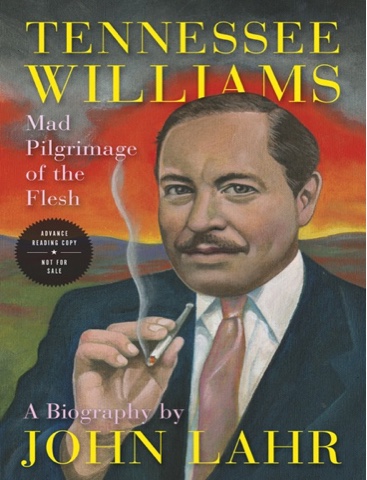
Tennessee Williams Mad Pilgrimage of the Flesh A Biography by John Lahr. (2015, 784 pages)


John Lahr's Tennessee Williams The Mad Pilgrimage of the Flesh is a great biography, bringing the American playwright to life for us, and what a life it was!  John Lahr, senior theater critic for The New Yorker for many years, has an in depth knowledge of the American stage.  

Tennessee Williams (born 1911 in Columbus,Mississippi, died in New York City in 1983) was a tremendously sucessful  playwright.  Among his most famous plays, all produced on Broadway and made  into movies for which he produced the screen play were his first The Glass Managerie, A Street Car Named Desire, Sweet Bird of Youth, A Cat on a Hot Tin Roof and The Night of the Iguna.  Williams became very rich from his plays.  He also wrote two novels, and a number of short stories and poems. Lahr quotes a good bit from his poems.

(Any reason to post this pic on my blog works for me.  Elizabeth Taylor and Richard Burton starred in the movie version of The Night of the Iguana.)

Lahr's book does not follow a chronological structure but we do leave it with a complete overview of his life.   We first meet Williams just before the opening of his first play.   Lahr made me feel I was back stage, where the drama was at least as high as it was on stage.

Williams comes from a  dysfunctional Southern Gothic family straight out of a William Faulkner novel.  Lahr shows us how his family impacted the plays.  Much of the book is devoted to his sex and romantic life.  He had a few early relationships with women but soon enthusiastically accepted his homosexuality.  Living in a time before AIDS took much of the fun out having sex with random strangers met on the streets of big cities all over the world, Williams, quoting Lahr, "Binged on boys".  We are with him cruising the bars and streets in New Orleans, London, New York.  Rome was his favorite hunting ground.  One of the things I liked about Williams and Lahr's presentation of him was that he felt joy in his sexuality, not shame in a time before Gay liberation movements. 

Lahr goes into a lot of backstage details.  Williams knew lots of the famous and infamous of the theatrical world.  Lahr talks about a number of actors and actresses of the period.  He details tne heavy usage of alcohol and amphetamines by Williams.  Williams was surrounded by enablers that helped him indulge in his destructive proclivities in exchange for a share in the life style of a hyper wealthy celebrity.  Williams had a number of longer term relationships both most seemed close to gold diggers to me.  

If you are interested in the American theater circa 1945 to 1975, you will greatly profit from this book.  It is also a valuable edition to American gay studies.  The prose style is lyrically beautiful.  I closed the book really liking this flawed man and looking forward to seeing his movies on cable now that I have read Lahr's book.  It is an information rich work.  Reading it was a pure pleasure.  

Tennessee Williams Mad Pilgrimage of the Flesh is a total must for theater buffs.  

I was given a review copy of this book. 


Maria St. Just was Williams "personal assistant" for years, here performing one of her main functions.

Mel u


Monday, November 16, 2015

After the Circus by Patrick Modiano (2015)


If there is a world capital of The Reading Life World it is Paris- Ambrosia Boussweau 


After the Circus  is my first encounter with the work of Patrick Modiano, the 2014 Nobel Prize Winner in Literature.  Paris is the setting and the heart of this novel.  Set in the 1960s, it is structured as a man relaying his experiences of many years ago.  The story lines begins with him recalling his international by the Paris police, suspicious over persons he has allegedly been reported talking with.  He sees a young woman a bit older than he, he is eighteen at the time, being questioned.  

There are a lot of mysteries in After the Circus.  The man lives in an apartment with an older man, a friend of his father.  The father evidently had to leave Paris and currently lives in Switzerland.  We never learn why he had to leave.  The young man and the few years older woman form a relationship of sorts.  Who she really is and why the police were so interested in her are a great mystery. 

I think I most enjoyed the descriptions of the city, the elegant Parisians, the interesting little restaurants, and the minor characters who come and go.

I was given a review copy of this book.

I enjoyed After the Circus a lot and will be reading more of the author's work.

Ambrosia Boussweau  


Patrick Modiano, winner of the 2014 Nobel Prize for literature and an internationally beloved novelist, has been honored with an array of prizes, including the 2010 Prix mondial Cino Del Duca by the Institut de France for lifetime achievement and the 2012 Austrian State Prize for European Literature. He lives in Paris. Mark Polizzotti has translated more than forty books from the French and is director of the publications program at The Metropolitan Museum of Art, New York. - from webpage of the publisher, Yale University Press

The Death of Virgil by Hermann Broch (1945, translated by Jean Star Vetermeyer)

"The Death of Virgil represents the only genuine technical advance in fiction since Ulysses" - George Steiner in Language and Silence


"Prussia, the ruler of Germany, was always an enemy of the intellect, of books, of the Book of Books—that is, the Bible—of Jews and Christians, of humanism and Europe. Hitler’s Third Reich is only so alarming to the rest of Europe because it sets itself to put into action what was always the Prussian project anyway: to burn the books, to murder the Jews, and to revise Christianity."  Joseph Roth, 1933"


I am estatic to once again be able to Participate in German Literature Month, elegantly and lovingly hosted by Lizzi's Literary Live and Beauty is a Sleeping Cat. This is my fourth year as a participant.   On the host blogs you will find the particularities of the event but the basic idea is to read literature first written in German (translated or not) and share your thoughts.  I began accumulating works for the event soon after the event ended last year and I began reading for it in mid-September.  


Works Read for G L V So Far

1.  Every Man Dies Alone by Hans Fallada. A brilliant recreation of life in Nazi Germany. 

2.  Ostend, Stefan Zweig, Joseph Roth and the Summer Before the End by Volker Weidermann. A fascinating social history 

3.  Buddenbrook Ths Decline of a Family by Thomas Mann.  Must reading 

4.  "The Governess" by Stefan Zweig

5.  Demian:  The Story of Emil Sinclair's Youth by Herman Hesse.  Read the major works first.

6.  The Tanners by Robert Walser. a serious work of art

7. The Hotel Years Wandering Between the Wars by Joseph Hoffman, a brilliant collection of feuilletons translated and introduced by Michael Hoffman

8.  "The Dandelioln" by Wolfgang Borchert. 

9.   "The Foundling" by Heinrich Von Kleist

10.  "A Conversation Concerning Legs" by Alfred Lichenstein 

11.  A Homage to Paul Celan

12.  "The Criminal" by Veza Canetti 

13.  Rebellion by Joseph Roth


Last November during GL IV I read Hermann Broch's great between the wars trilogy, The Sleepwalkers.

(Broch was born in Vienna in 1886, he was briefly imprisoned by the Nazis as a subversive, upon release from a concentration camp he moved to the USA, his last years were spent researching mass psychology at Yale, he died in 1951. Virgil was born 70BC and died in 19BC)

The Death of Virgil is one of the most amazing novels I have ever read.  It is one of the great works of Modernism.  It is largely the stream of consciousness of the Poet Virgil during his last eighteen hours before his death.  It is also an amazing recreation of the Roman social world and cosmology.  As the novel opens Virgil is disembarking from a boat on his way to the Imperial palace of the Emperor Augustus.  Broch makes us feel we are there, he makes us not just understand it with our minds but somehow forces the experience into our own consciousness.  We see how dependent Rome was on slaves, how the existence of a slave class was taken for granted.  It has to be seen as partially a political comment on Germany. I felt I was being carried through the city of Rime on a sedan chair gapping at the wonders and horrors of the city, taking my right to be carried for granted.

The work is really a giant prose poem, simply an amazing work of high art.  Broch worked very closely with the translator to achieve as much verisimilitude in the English prose as possible.  Some of the sentences go on for pages.


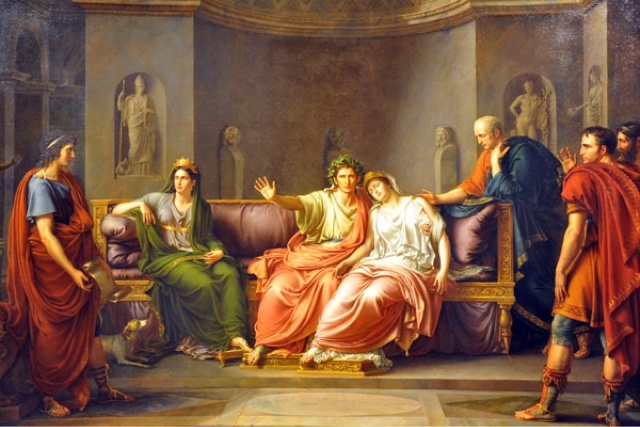
Virgil reading The Aeneid to Augustus, by Jean-Baptiste Wicar.

The death of Virgil deals with the very nature of art, poetry and literature.  Virgil has brought the manuscript of The Aeneid with him.  He wants it to be burned before he dies.  There is an extensive conversation, or more probably the partial hallucination of conversations, Virgil has with Augustus over why he wants his book burned.  He also has memories of Plotia, a woman he loved.  Mingled with this are images from Roman religion.  My post read research indicates Broch was drawing on theories of Carl Jung on the collective unconscious and was drawing on iideas from this theory. 

As I read the deeper and darker hallunicinatory aspects of Virgil's stream of consciousness devoted to Roman theories on the creation of I had an involuntary memory of murals depicting the creation of the cosmos I was mesmerized by at Anghor Wat.  Each reader will find her own connection if they open their minds wide enough.

There are long wide ranging conversations with the Emperor Augustus, his use for The Aeneid was largely political. The conversations are at least in part creations of the mind of Virgil.  Virgil knows he is dying and his mind is spinning a way from superficial rationality.  

I would recommend you read this work not slowly trying to understand every reference but quickly, letting the work flow without restraint as deeply as you can allow it into your consciousness. If Jungian readings are viable, at some point it will connect with your own aspect of the universal subconsciousness.   As you read, do not try to make literal sense of the story line.  

In reading this it helps to have a basic understanding of Roman culture and to have read at least The Aeneid.  I read The Aeneid maybe fiveteen years ago.  I began the epic poem thinking well this is an important work I need to read and ended being stunned by the power of the work.  


My great thanks to Max ü for providing me with the Amazon gift card that allowed me to read The Death of Virgil.

Mel ü

Sunday, November 15, 2015

Rebellion by Joseph Roth (1924, translated by Michael Hoffman

My great thanks to Max ü for tne gift card that allowed me to read this book


I am estatic to once again be able to Participate in German Literature Month, elegantly and lovingly hosted by Lizzi's Literary Live and Beauty is a Sleeping Cat. This is my fourth year as a participant.   On the host blogs you will find the particularities of the event but the basic idea is to read literature first written in German (translated or not) and share your thoughts.  I began accumulating works for the event soon after the event ended last year and I began reading for it in mid-September.  


Works Read for G L V So Far

1.  Every Man Dies Alone by Hans Fallada. A brilliant recreation of life in Nazi Germany. 

2.  Ostend, Stefan Zweig, Joseph Roth and the Summer Before the End by Volker Weidermann. A fascinating social history 

3.  Buddenbrook Ths Decline of a Family by Thomas Mann.  Must reading 

4.  "The Governess" by Stefan Zweig

5.  Demian:  The Story of Emil Sinclair's Youth by Herman Hesse.  Read the major works first.

6.  The Tanners by Robert Walser. a serious work of art

7. The Hotel Years Wandering Between the Wars by Joseph Hoffman, a brilliant collection of feuilletons translated and introduced by Michael Hoffman

8.  "The Dandelioln" by Wolfgang Borchert. 

9.   "The Foundling" by Heinrich Von Kleist

10.  "A Conversation Concerning Legs" by Alfred Lichenstein 

11.  "The Criminal" by Veza Canetti


Earlier in the month I posted on a collection of essays by Joseph Roth assembled, introduced and translated by Michael Hoffman, Hotel  Years.  Rebellion was one of the earliest of Roth's sixteen novels.  Roth was too smart to be a simple ideologue, it is hard to pin down his ideas but he hated fascism and he loved his conception of old Vienna under Emperor Franz Joseph.

Rebellion is a brief work, 121 pages in my edition.  It focuses largely on one man, a veteran of World War One who lost a leg in the conflict.   He gets a license to operate a "hurdy gurdy", a musical instrument on wheels.  Operation of this was restricted to wounded veterans who rolled them around town seeking donations.   He meets a widow and takes up with her.  The relationship between him and the widow is very well done and lets us see how the massive killing of men impacted the matrimonial market.  He moves into her place, he buys a donkey to pull the cart and all is going well.  Then he gets in a fight with a police officer, and ends up in jail.

The story follows his fate.  It reads like a kind of dark Gogol influenced fable.   In it are many reflections on the nature of government and the law.   

Rebellion is a work for those who have already read and appreciated his more famous works like The Zandesky March, The Emperor's Tomb, Job, Leviathan and one of my very favorite Roth works, Hotel Savoy. 


Mel ü

Saturday, November 14, 2015

Paris - A Day of Great Evil and Sadness


It breaks my heart to be watching the CNN news from Paris.  So crushingly sad  that malignant forces of pure ignorance did this to the home of Proust, Balzac, Iréne Nemirovsky, Balzac, Hugo and thousands of other great writers.  

I am blessed with many Parisian readers, I hope they are all safe.

Long after the terrorists are dead and forgotten Paris will remain the cultural capital of the world.

Mel u
Ambrosia Boussweau 


Featured Post

Imperial Reckoning: The Untold Story of Britain’s Gulag in Kenya by Caroline Elkins - 2005 - 701 Pages

  Imperial Reckoning:     The Untold Story of Britain’s Gulag in Kenya by Caroline Elkins - 2005 - 701 Pages 2006 Pulitzer Prize Winner From...