"The Monkey's Paw" by W. W. Jacobs (1902, 7 pages)
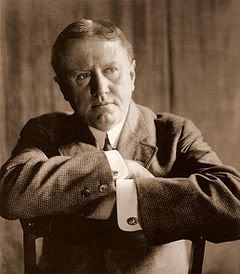
I wanted to start the day out with a story by a new to me author. In my attempt to edify myself regarding short stories I have looked a lot of "best short stories" lists. I have seen "The Monkey's Paw" by W. W. Jacobs on several lists. Being completely unfamiliar with this author, I did some quick pre-read research. William Wymark Jacobs (1863 to 1943-London) was in his day a famous writer of short stories for the popular magazine market. He also wrote stage adoptions for a number of his short stories. His father worked the docks in London's East Side. Jacobs worked for a few years as a clerk in the Postal Savings Bank but was basically a professional writer.
Jacobs subject matter was largely the people of London's East Side. It was an area of immigrants, sailors on shore leave, brothels (Hogarth's drawings of the streets of London were inspired by the East Side), poverty, crime and danger. To comfortable people who composed the book buying pubic in 1902 The East Side had an exotic let's go slumming kind of feel. Imagine the scene in the movie, My Fair Lady where Professor Henry Higgins first meets Eliza Dolittle and I think we have an idea of the East Side in popular culture.
"The Monkey's Paw" is very well written. As the story opens Mr and Mrs White are conversing with an old friend of the family, Sergeant Morris, recently returned from long service in the British Army in London. The Whites live with their adult son who is at work at his factory job. The Sergeant gives them a dried monkey's paw which he says an Indian holy man has given the power to grant three wishes. As he leaves he advises them to be very careful in using it as the last wish of the prior person to use the monkey's paw was for his own death. (The Sergeant never used it.)
Of course the Whites cannot resist using it. They debate what to do and the wife prevails with her suggestion that they ask for 200 Pounds (my quick research says this is about a year's pay for a factory worker in the U. K. in 1900-please correct me if I am way off on this). Of course we think there will be a terrible prize to be paid for the granting of the wish and we are right. I will tell a bit more of the plot than I normally do so you can get the flavor of the story. There is a knock on the door. It is a man in a suit dressed way above the standards of the East Side neighborhood the White reside in. The man is a representative of the factory where their son works. He has terrible news. Their son was caught in machinery at work and killed. The factory disavows all responsibility but gives the Whites 200 pounds to compensate them for the death of their son. Jacobs does a great job of showing us how the death of the son, their only child who survived to adulthood, affects the Whites and their marriage.
There are two wishes left and I do not want to tell more of the plot than I have. "The Monkey's Paw" is a very entertaining short story and I am glad I took the time to read it. I think it could be taught to students 12 and above.
It can be read online here
Mel u
Tuesday, January 25, 2011
Sunday, January 23, 2011
One Hundred Years of Solitude by Gabriel Garcia Marquez
A few years ago I read most of the translated novels of Gabriel Marquez, stopping before I read his most famous work, One Hundred Years of Solitude. I recently read and posted on three of his short stories, all of which I really liked.
Gabriel Garcia Marquez (1928, Columbia) is a very important 20th century author. He won the Nobel Prize in 1982. Nearly all of Latin American literature stands in his shadow, including Roberto Bolano. Much of the literature of what some call "The Third World" is very derivative from the work of Marquez. For sure this is true of the writers of the Philippines. He brought into currency "Magical Realism" as a literary category. Some see "Magical Realism" as also an anti-colonial literary device and I kind of see this also. Here is how Wikipedia defines "Magic Realism":
magical realism is an aesthetic style or genre of fiction in which magical elements are blended into a realistic atmosphere in order to access a deeper understanding of reality. These magical elements are explained like normal occurrences that are presented in a straightforward manner which allows the "real" and the "fantastic" to be accepted in the same stream of thought.Have you ever hesitated or just not read a book that logically you should based on your reading history and interests just because you were somehow put off by the tremendous hype on the book? I think that is the reason I did not years ago read One Hundred Years of Solitude. On the back cover of the edition I have there is a quote from William Kennedy's New York Times Book Review article in which he says that One Hundred Years of Solitude is "the first piece of literature since the book of Genesis that should be required reading for the entire human race".
I really do not feel a need to say a lot about this book as all sorts of posts can be found on it. My entry will be just a short reading note. I think this book should be read because of its huge influence. It also sort of gives us a feel for the crazy history of Latin America (or really any country run by capricious leaders) and Columbia in particular. There are lots of very imaginative characters and events in the book. I would say the book is fun as long as one is OK with Magic Realism which I am. Once you catch on that Marquez is kind of recreating the history of the human race it is fun to see the work develop. Marquez is a very good writer. Some of the stories and set pieces in One Hundred Years of Solitude are brilliant. There is real wisdom in this book. Should it be required reading for the whole human race? No, I am sorry I do not see this in the book.
Harold Bloom has it on his list of canon status works. I am glad I have now read this book, partially so I can see what the hype was all about and partially for its huge cultural influence. I can for sure see a major influence on Roberto Bolano. It is included in the 1997 edition of Clifton Fadiman's Life Time Reading Plan and was not even yet published when the first edition came out in 1960.
Mel u
Friday, January 21, 2011
"The Tell Tale Heart" by Edgar Alan Poe
"The Tell Tale Heart" by Edgar Alan Poe (1843, 5 pages)-Short Stories in The Life Time Reading Plan
Edgar Alan Poe (1809 to 1849-USA) would have been 202 years old on January 19. Yesterday I was looking over the works listed in Clifton Fadiman's The Life Time Reading Plan (1960), a book that has meant a great deal to me for many years. There are only four authors listed for their short stories, Franz Kafka, Nathaniel Hawthorne, Ernest Hemingway and Edgar Alan Poe. (Herman Melville's "Bartleby the Scriviner" is also listed and I completely agree with that.) ( I think James Joyce, Anton Chehkov, Guy du Mauspassant, and Katherine Mansfield and maybe Gogol should be added to the list and I would be OK with the dropping of Hemingway.) Fadiman says Poe pretty much created the "horror story" and the "detective story" genre. Many of the characters in his stories are right at the border between sanity and insanity. He is very much a Gothic writer.
I have previously posted on Poe's "The Mask of the Red Death". "The Tell Tale Heart" is on the surface a simpler tale. The first person narrator and central character of the story knows he (might be a she for all we are told) is perhaps losing his mind. The central character is somehow being driven mad by an old man that he lives with who he thinks is somehow giving him a "vulture eye". He decided to save his sanity he must murder the old man. He then dismembers the body of the old man and hides it under the floor boards of the house. I do not want to give away more of the plot of this story as it is very well told and quite exciting. Poe does a great job of making us see the world through the eyes of the narrator. It is beautifully written.
"The Tale of the Tell Tale Heart" can be read online (all of his stories can be read online). It is a fun story from a canon status writer. In five minutes you can experience a classic short story.
Mel u
Edgar Alan Poe (1809 to 1849-USA) would have been 202 years old on January 19. Yesterday I was looking over the works listed in Clifton Fadiman's The Life Time Reading Plan (1960), a book that has meant a great deal to me for many years. There are only four authors listed for their short stories, Franz Kafka, Nathaniel Hawthorne, Ernest Hemingway and Edgar Alan Poe. (Herman Melville's "Bartleby the Scriviner" is also listed and I completely agree with that.) ( I think James Joyce, Anton Chehkov, Guy du Mauspassant, and Katherine Mansfield and maybe Gogol should be added to the list and I would be OK with the dropping of Hemingway.) Fadiman says Poe pretty much created the "horror story" and the "detective story" genre. Many of the characters in his stories are right at the border between sanity and insanity. He is very much a Gothic writer.
I have previously posted on Poe's "The Mask of the Red Death". "The Tell Tale Heart" is on the surface a simpler tale. The first person narrator and central character of the story knows he (might be a she for all we are told) is perhaps losing his mind. The central character is somehow being driven mad by an old man that he lives with who he thinks is somehow giving him a "vulture eye". He decided to save his sanity he must murder the old man. He then dismembers the body of the old man and hides it under the floor boards of the house. I do not want to give away more of the plot of this story as it is very well told and quite exciting. Poe does a great job of making us see the world through the eyes of the narrator. It is beautifully written.
"The Tale of the Tell Tale Heart" can be read online (all of his stories can be read online). It is a fun story from a canon status writer. In five minutes you can experience a classic short story.
Mel u
Thursday, January 20, 2011
Welcome all Literary Book Blog Hoppers-Jan 20 to Jan 23
To me the Literary Book Blog Hop is a great event. I read and post on mostly classics, short stories, Asian Fiction and what I see as literary novels.
"Greetings to All Hoppers" Charles-coeditor of The Reading Life
|
I will follow back all who follow me and return all visits. Please leave a comment if you decide to follow my blog so I can return the follow.-thanks
Let me know how you like my new header collage-how many of the people in the collage can you identify?-Thanks-Charles
Every week the Literary Book Blog asks that participants answer a question-here is the very interesting question for this week.
Discuss a work of literary merit that you hated when you were made to read it in school or university. Why did you dislike it?
This is not an easy question for me to answer. It has been a very long time since I have been in school and when I was in my school years I did not do what I did not want to do. For better or worse if I hated a book I did not read it. I recall being bored by Pilgrim's Progress when I first read it but on a rereading years latter I saw the power of the work, or at least some of it.
Mel u
"Ransom of Red Chief" by O Henry-USA/UK-Short Story Shoot Out-Round 2
![]() |
| Saki-UK-1870-1916 |
Round Two- Trans-Atlantic Battle of the Twist Ending Short Stories from the 1910s
O Henry representing the USA versus Saki representing the UK
![]() |
| O Henry-USA-1862-1910 |
O Henry (his real name was William Porter-1862-1910-USA) is one of the most popular American writers of short stories. His stories are famous for twist or surprise endings. His stories are meant as good natured entertainment that almost anyone can appreciate. The style is simple and straightforward and I did get the feeling O Henry had fun writing them.
O Henry's father was a doctor but in those days this did not mean what it does today. O Henry's mother died when he was three, Saki's mother died when he was two. O Henry died at 48, Saki at 46. Both got their professional starts as newspaper writers. Both lived out side their home countries for a time. O Henry left the USA to hide from the police (he came back and turned himself in when he heard his wife was dying) and Saki went to Burma to work for the British police force! O Henry struggled in a good part of his life to support himself and his family. Saki came from a well off family and never suffered any financial anxieties. O Henry spent five years in prison for embezzlement from a bank for which he worked as a teller. He began to write seriously while in prison. Upon release he began to publish one story a week and ending up with over 300 stories. O Henry married twice (he was a widower). Saki never married. O Henry had to make his own way in life and selling his short stories was a big part of how he made his living. Saki was born in comfortable circumstances, not fabulously wealthy by any means but certainly he never had to sell his stories to pay the rent.
I am pretty sure ""Ransom of Red Chief" is the second most still read of O Henry's stories, with "Gift of the Magi" being number one. As the story opens Bill and Sam, two fugitives from the law hiding out in the Deep South of the USA are trying to come up with a way to get $2,000 so they can use it to create a swindle involving fraudulent land sales. They decide to kidnap the son of a local citizen, a man known for sharp financial dealings. (The story is from a period when kidnapping for ransom was not seen as often a prelude to murder. The famous kidnapping and murder of the son of the aviator Charles Lindbergh took place in 1932.) The boy, known by his nickname of "Red Chief" does not know he has been kidnapped, he thinks he is on a camping trip and that Bill and Sam are local rubes his father hired to look after him for a few days. Bill and Sam are not at all violent and it turns out they are in more danger from the antics of Red Chief than he is from them.
I do not want to tell more of the plot as it is a lot of fun. (Teachers should note that there is a use of a term that is very unacceptable today in the story. This would perhaps make it unacceptable for class room usage in some political climates. It does seem a bit mean spirited as it is used in the narrative of the story, not in conversation of the characters. It is possible also some may find the use of the name "Red Chief" as politically incorrect. These issues do not change the literary merit of the story, it is just something for teachers to consider. In terms of content this story could be taught to 5th graders and up, I think).
Of the two writers I like Saki best. The stories of O Henry are fun and well written in an anybody can read style. I just prefer the prose style of Saki. Saki's stories have more of an ironic tone and seem to involve more of a social satire. This, of course, does not make them better! The people in the stories of Saki seem more educated and better off economically than those in the stories of O Henry. In the stories of O Henry, fate seems to play a trick on the characters whereas in the stories of Saki one of the characters seem to provide the twist ending.
"The Ransom of Red Chief" can be read online.
Mel U
Wednesday, January 19, 2011
"The Tragic Love of Two Enemies" by Ihara Saikaku-
The Reading Life Japanese Literature Project
In the tradition of the Samurai a young apprentice warrior was expected to serve the needs, including sexual, of his master. There was no shame in this and just as in Sparta warriors often developed extreme bonds for each other.
"The Tragic Love of Two Enemies" is a short work that tells us a lot about the Samurai code. As the story opens the Shogun of the province through one of his ministers has ordered a page, Senpatji Akanashi, to kill his courtier Shingokei Dizaki. Senpatji asks why and he is told it is because the Shogun wants it done.
Senpatji returned to his apartment depressed at having to kill Shingokei, who was one of his best friends. Nevertheless, he went to his friend's house that night, and after a short conversation, killed him, announcing afterward, "This is the command of my master." Shingokei's slaves even tried to seize the murderer, but Senpatji calmed them, saying, "I've acted upon my master's orders, and just as I must obey him, so you must obey him."The widow of Shingokei is inconsolable. The widow cannot obey her impulse to kill herself as she is pregnant. In time she gives up her passions (her father was a distinguished Samurai) and moved far away and supported herself and her son with needle craft. In time Senpatji displease the Shugun and he is exiled. Fourteen years have gone by and by accident he meets the widow of the woman he killed. At first the widow does not realize he is the killer of her husband. I do not wish to tell more of this story as it is really quite touching. There is a love story here but it is not between the killer and the widow. It is between the killer and the teenage son of the man he killed at the orders of the shogun. The boy feels no hatred toward the killer of his father as it was all dictated by the Samurai code of absolute obedience.
The story can be read online
Mel u
"What Do You See, Madam" by Djuna Barnes
" If Helen of Troy could have been seen eating peppermints out of a paper bag, it is highly probable that her admirers would have been an entirely different class." Djuna Barnes
I was looking at a very interesting and new to me web page this morning, Modernist Women. It has great pictures of Woolf, Mansfield, Rhys, Bowen and numerous other writers, among them Djuna Barnes.
My second question to myself was (after I wondered how to pronounce her first name) what qualified her to be listed among the great women writers of the 20th century. Of course I Googled her.
I was happy to see that the winter 2005 issue of Lodestar Quarterly had one of her short stories online. "What Do You See, Madam" is about the back stage life of a dancer New York City in the roaring 1920s:
The Bowery, which is no place at all for virtue or duplicity, had seen Mamie try on her first fit of sulks and her first stay laces. They knew then that her pattern was Juno, her heritage Joseph, and her ambition jade. At the age of ten she had learned to interpret Oscar Wilde.
Mamie grew up in the theaters of New York city and had no illusions as to why men came to see her dance the role of Salome. Unfortunately the Board of Decency has been advised that her performances may cross the line! As the story opens the board is on their way to see her do a private show just for them. I will not tell more of the plot here.
"What Do You See, Madam" has some good lines.
When she passed the boundaries of decency, it was a full run for your money; when she went up in smoke, those original little pasty pans of Egypt became chimney pots.It is worth the time it takes to read it. I am glad I was able to sample her work. She is for sure a GLBT icon right below Collete and Wilde.
If you have read other works by Djuna Barnes, please leave your experience in a comment.
Mel u
Subscribe to:
Posts (Atom)
Featured Post
Imperial Reckoning: The Untold Story of Britain’s Gulag in Kenya by Caroline Elkins - 2005 - 701 Pages
Imperial Reckoning: The Untold Story of Britain’s Gulag in Kenya by Caroline Elkins - 2005 - 701 Pages 2006 Pulitzer Prize Winner From...
-
Buriedinprint.com This year, Buried in Print, a marvelous blog I have followed for over ten years,is doing a read through of the short sto...
-
Book Blogger Appreciation Week Sept 13 to Sept 17-2010-Giveaway- Katherine Wish by Linda Lappin Leave a comment to win! Open to all f...
-
My Posts on the literature and history of the Philippines Francisco Arcellana (1916 to 2002) was a highly regarded poet, essayist, crit...