Wednesday, December 18, 2019

Beautiful Place by Amanthi Harris - 2019 - 560 pages


The plot line centers on a young Sri Lanka woman, Padma.  After an unsuccessful try at university she now lives and manages a luxurious villa, hosting a stream of foreign guests. The property is owned by an Austrian expat, a very successful architect, living in Sri Lanka.   He adapted her when she was quite young from her abusive but lurking in the background still father, Sonny.  Going to Sri Lanka is not a casual holiday for Europeans or Americans.  Often villa guests see themselves on a kind of spiritual guest, hoping to achieve a spiritual ephifany from the temples.  Of course European visitors are intrigued by the thought of a sexual encounter with for them "an exotic woman from the East".   The extreme wealth disparity of the country and the under valuing of female children has created many venues for prostitutes. This should be seen as but another pernicious legacy of colonialism.


Setting the novel in a luxury guest villa means the clientele are affluent.  As a structural device it enables Harris to bring new characters on stage for the single Padma to encounter. Seeing her and the guests size each other up was great fun.

Harris depicts the lush tropical beauty of Sri Lanka, for sure I would love to sample the curries she describes and sit on the beach reading something like A Journey to the East by Hermann Hesse.

We get to know a good bit about Padma's father Sonny who shows up looking for money.  The nearby village is replete with thugs (a term borrowed from Hindi long ago) drug peddlers, crooked local 
politicians, relatives wanting to spy on Padma, some to ask her for money and Aunts wanting her properly married.


Many in the local area are jealous of Padma's easily acquired wealth.  A friend of Gebhardt, a European practitioner of Yogi and the author of a less than flattering book on Sri Lanka (Harris introduces the history and divided politics of the island through quotes from his book- a very nice touch, he adds some drama to the plot.

Padma's family wants to exploit her.  There is more to Gebhardt than meets the eye.  I really liked the slow way Harris develops her characters.  Everyone in Beautiful Place is at least interesting and real.  The atmosphere, pervasive poverty, long periods of ethnic conflicts introduces a sinister underlayer to the beauty Harris so skillfully presents.

From Salt Publishing

Amanthi Harris was born in Sri Lanka and grew up in London. She studied Fine Art at Central St Martins and has degrees in Law and Chemistry from Bristol University. Her novella Lantern Evening won the Gatehouse Press New Fictions Prize 2016 and is published by Gatehouse Press (2017). Her short stories have been published by Serpent’s Tail and broadcast on BBC Radio 4 as Afternoon Readings.

I greatly enjoyed and was very much drawn into Beautiful Place.  I hope to follow the work of Ananthi Harris for many years.

Mel u


'


Thursday, December 12, 2019

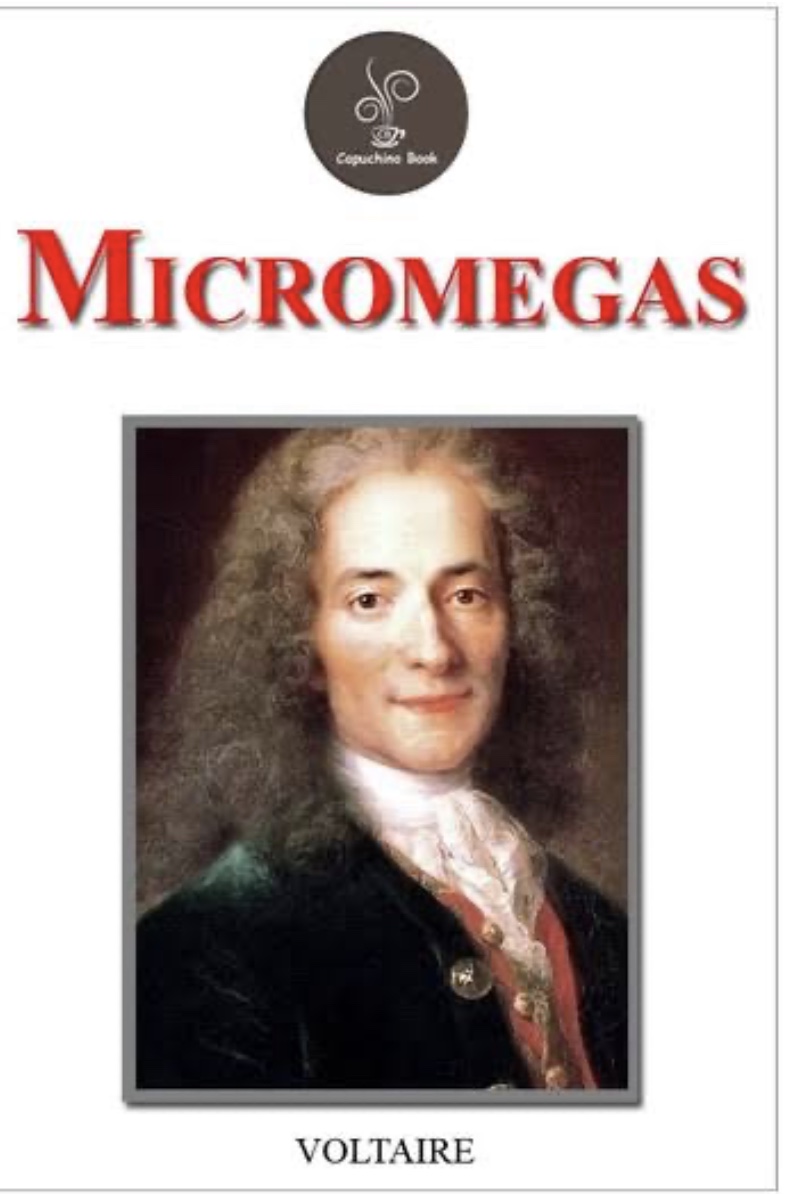
Micromégas - A Short Story by Voltaire - 1752 - An Early Work of Science Fiction


November 11, 1694 - Paris

May 30, 1778 - Paris

Last month I read and posted on a work of great fame as well as personal importance to me, Candide by Voltaire. I first read this work in 1964, lead by a reference to it in The Lifetime Reading Plan by Clifton Fadiman.  Candide was my first read of a classic and before I read Fadiman's wonderful guide I never knew there was such a thing!  I reread Fadiman's section on Voltaire.  In addition to Candide, he suggests Letters to the English and two works that are close to short stories in format, Zadig, which I read long ago and will reread next month and today's work Micromégas.

In a time when the world was being transformed by global exploration, stories of travels to strange lands were popular in 17th century Europe.  Educated people were captiva by storied of people encountered by exploration parties, living so very differently than Europeans.  Gulliver's Travels, 1726, is a famous example.  Fadiman suggests Micromégas may have been inspired by that work but I don't know if Voltaire read that or just knew of it second hand.  

Micromégas, just a few pages, is about a fantastically large being from another world.  It is structured as a conversation between a being from Saturn and  Micromegas. Voltaire knew Saturn had a ring and five then discovered moons. We learn that Micromegas will 
live over a million years and is about 100,000 Kilometers tall.  
He tells the academic from Saturn he has met beings that live 100 million years and have many times the 72 senses of a being from Saturn. Of course the life spans of humans are puny in comparison and we have only five senses.  Underlying this is the no doubt completely unacceptable to the clerics of France notion that God created many worlds much better than Earth.

Micromégas is a fun fast read.

Mel u


Monday, December 9, 2019

A Rich Brew How Cafés Created Modern Jewish Culture by Shachar Pinsker - 20


A Rich Brew
How Cafés Created Modern Jewish Culture by Shachar M. Pinsker


Finalist, 2018 National Jewish Book Award for Modern Jewish Thought and Experience, presented by the Jewish Book Council

Winner, 2019 Jordan Schnitzer Book Award, in the Jewish Literature and Linguistics Category, given by the Association for Jewish Studies

I wanted to read this book as soon as I heard about it in an E mail from The National Jewish Book Council.  My favourite story by Stefan Zweig, "Mendel the Bibliophile" is set in a Jewish cafe in Vienna.  For sure I wanted to learn about the role of cafes in the development of Jewish modernarity, the theme of Pinsker's  book.
Sadly for me the Kindle edition was priced at $29.40 so I just added it to my Amazon Wish List.  I regularly monitor the list for price drops and when I saw it was being offered for $1.95 I at once hit "purchase now". (The price still holds today, a great value.). 

Anyone into Yiddish Literature and the culture of Ashkenzi Jews will be very glad they read this book.  The work opens with an account, the time period covered is roughly 1850 to 1950, of how Jewish men came to find in cafes and Jewish delis a new "home away from home".

The cafe culture in six cities is explored.  There are chapters on Odessa, portrayed as a city with a shady reputation, Warsaw and Vienna cafes were centers of intellectual, political and philosophical debate, in Berlin the shadow of what will come haunts us.  Many Eastern European Jews moved to New York City. Pinsker explains the tremendous proliferation of Yiddish publications, theater in New York City.  Immigrants wanted a place to hang out with a feel of home. The last city covered is Tel Aviv.

Jewish cafes were originally all male, the sexes did not casually socialize together.  Over time female writers and intellectuals came to be be accepted.

I really enjoyed all the illustrative references to Yiddish and Hebrew language literature.  One of my very favorite works of Yiddish literature, The Letters of Menakhem-Mendl and Sheyne-Sheyndl  by Sholem Aleichem is referenced numerous times. This book has a special place in the history of my blog.  Seven years ago Yale University Press gave me the nine volume Yale Yiddish Library.  The Letters of Menakhem-Mendl and Sheyne-Sheyndl was the first work of Yiddish literature I have read.  I have been reading in the field ever since.  Pinsker refers to events in the letters numerous times.  I would recommend this book just on the strength of the literary references alone to those with a strong interest in Jewish history and culture.

He closes the book with an account of cafes in our time.  

I thank Professor Pinsker  for this elegantly structured highly edifying book.  

From the website of Shachar  Pinskar

https://sites.lsa.umich.edu/shacharpinsker/

I am a literary scholar and cultural historian with specialization in multilingual modern Jewish culture in Palestine/Israel, Europe, and America. I have a joint appointment at the department of Middle East Studies and the Frankel Center for Judaic Studies at the University of Michigan.
I am the author of two award winning books, A Rich Brew: How Cafés Created Modern Jewish Culture (NYU Press , 2018),  and Literary Passports: The Making of Modernism Hebrew Fiction in Europe(Stanford, 2011). My third book (in progress) is A Silent Language? Yiddish in Israeli Literature. 

Sunday, December 8, 2019

The American Sphinx: The Character of Thomas Jefferson by Joseph. Ellis -1997


The American Sphinx: The Character of Thomas Jefferson by Joseph. Ellis -1997

Thomas Jefferson

April 13, 1743 - Sheffield, Virginia

July 4, 1776 - Declaration of Independence published, Jefferson was the primary author.

Term  Third as President of the USA
March 4, 1801 to March 4, 1809

July 4, 1826 - Monticello, Virginia

Joseph Ellis presents Jefferson as a very complex man, open to numerous interpretations.  In his opening chapter he details how widely divergent American political factions have claimed him as an icon.

His biggest contribution to the future of the USA while president was the Louisiana Purchase which nearly doubled the territory of the country.  The biggest stain on his character was his attitude toward slavery.  Ellis tries to explain why the man who wrote the most elegant affirmation of the natural rights ever did not just own slaves but could be very harsh.  He had, Ellis details the proof of this,  a slave mistress on whom he fathered children.  As Ellis details, owners had full sexual access to their property, a child by a slave woman and an owner was a slave.  Slave women could not say no.  

Ellis details the complicated legal steps Jefferson tried to take to make it look like he wanted to end slavery.  He was very concerned about what would be fate of 1.5 million freed slaves. He saw the white race as superior.  Here is a direct quote from Jefferson: Notes on the State of Virginia: “they secrete less by the kidnies, and more by the glands of the skin, which gives them a very strong and disagreeable odour.” Once out of office, he basically abandoned his probably in bad faith anti-slavery talk.

Jefferson was highly cultured, undoubtedly brilliant.  Ellis tries to show the full man.

I am currently reading The American Slave Coast: A History of the Slave Breeding Industry by Ned and Constance Sublette.  They treat and explain in a fashion that convinces me that Jefferson's anti-slavery rhetoric was designed to make him wealthier, they see him as deliberately lying where Ellis presents him as self deceiving, believing his own rhetoric.  This quote from their book is very revealing of his character: "When Jefferson’s slaves got too old to work, he routinely cut their rations in half."

Ellis also goes into his hatred for Alexander Hamilton.

Jefferson championed a vision of a bucolic America, run by plantation owners with a very limited federal government where Hamilton, who was very anti-slavery, wanted a strong central government. Jefferson had people spread rumours that Hamilton was in the pay of foreign countries and embezzled from the Treasury.  These were lies and probably Jefferson knew this.  Hamilton did have an extra-marital affair and Jefferson's allies made sure this was made public news.  His vice president killed Hamilton in a duel.

Jefferson was a poor public speaker and his second term as president is considered by most historians as a disaster.

Jefferson never took part in military action during the war.  Ellis goes into the controversy still undecided as to whether he feld in a cowardly fashion when the British army entered Virginia, of which he was governor. Her certainly could have fought.

Once out of office Jefferson moved  to his estate at Monticello.  Ellis details what a poor business manager he was, he inherited significant wealth but ended up having to sell many of his slaves to pay a portion of his debts.  He did start a nail factory run by teenage slaves which was a success. He was always physically fit and a good horse rider. He liked fine wine, good food and loved books.


Joseph John Ellis is an American historian whose work focuses on the lives and times of the founders of the United States of America. American Sphinx: The Character of Thomas Jefferson won a National Book Award and Founding Brothers: The Revolutionary Generation won the 2001 Pulitzer Prize for History


Friday, December 6, 2019

A People’s History of the American Revolution - How Common People Shaped and Fought for Independence by Ray Raphael - 2001


A People’s History of the American Revolution
How Common People Shaped and Fought for Independence by Ray Raphael - 2001

"The Best Single-Volume history of the American Revolution I have read" - Howard Zinn

An Autodidact Corner Selection


July 4, 1776 - The Declaration of Independence Signed, authored by Thomas Jefferson, second president of the USA

October 11, 1781 - The British Surrender at Yorktown, ending combat

September 3, 1783 - Treaty of Paris Signed in which England ratified American Independence.  The USA was granted all land east of the Mississippi River but for Florida.  The American negotiators and signers were John Adams, Benjamin Franklin, John Jay, and Henry Laurens.

Most books on the American Revolution Era focus on the famous men of the period.  Recently I read biographies of George Washington and Alexander Hamilton by Ron Chernow and a work on Benjamin Franklin's time as America's minister plenipotentiary to France by Stacey Schiff.  American school children, or at least they were decades ago, were told about how the founding fathers won the war.  As to why Americans wanted to break away from England, we were told about the tea party. The leaders, called the Founding Fathers,  had and still do have an almost mythological status.  

There  was no mention of slavery or the American Indians.  In fact virtually nothing was said about the life of common people.  

Ray Raphael's A People's History of the American Revolution tells the story of ordinary Americans.  We learn who signed up to fight.  It was largely young men from poor families, often lured in by a bonus and a promise of more after the war.  People married young in those days and started bigger than now families.  Most soldiers were farmers or agriculture workers.  No one signed up for more than a year.  Raphael shows us how the families of soldiers coped.  Many women became camp followers.  There were no provisions for widows and orphans.

Raphael tells us a lot about particular people, lots of details on rank and file soldiers.  There are sections on the impact of the war on women from non-elite families, on the lives of Americans loyal to England.  Both sides recruited Indian tribes  to join their side.  Most tribal groups aided the British, often being paid for scalps.  Indeginous people saw the Americans as invading enemies and the British played on this.  After the war I learned from Raphael that this turned most Americans against Indians.

The original sin of America was slavery.  The British told enslaved persons to join them and fight for their freedom.  They were also told in large numbers that if they fought for the revolution they would be freed and given land after the war.  Of course these were mostly lies on both sides.

All teachers of American history need to read this book.

From Rayraphael.com


Over the last two decades Ray Raphael has emerged as one of our leading writers on the birth of the United States. In 2001 his acclaimed People’s History of the American Revolution widened history’s lens to include those not generally present in tales of our nation’s founding. In 2002 The First American Revolution: Before Lexington and Concord led to marked rethinking about the Revolution’s beginnings in academic circles. In 2004 Founding Myths: Stories that Hide Our Patriotic Past established new standards for future renderings of our nation’s birth. In 2009 he incorporated his work into an original synthesis featuring seven diverse characters, Founders: The People Who Brought You a Nation, and in 2011 he was asked to create another broad synthesis for a different audience: The Complete Idiot’s Guide to the Founding Fathers and the Birth of Our Nation. Also in 2011, with Gary B. Nash and Alfred F. Young, he co-edited a book of biographical essays from 22 noted scholars, Revolutionary Founders: Rebels, Radicals, and Reformers in the Making of the Nation. Recently he has focused on the historical context of the Constitution. Mr. President: How and Why the Founders Created a Chief Executive was published in 2012 and Constitutional Myths: What We Get Wrong and How to Get It Right in 2013. In 2015, with his wife Marie, he coauthored The Spirit of ’74: How the American Revolution Began. In 2017, spurred by the hit musical Hamilton!, Barnes & Noble asked Ray and Marie to provide a biography of Alexander Hamilton for a general readership: Hamilton: Founding Father. Also in 2017, Vintage (Penguin/Random House) asked Ray to provide an updated annotation of the Constitution: The U. S. Constitution: Explained—Clause-by-Clause—For Every American Today.

I hope to read more of his work.


Thursday, December 5, 2019

What’s the Meaning of Hanukkah? - A Short Story by Mende l. Moykher-Sforim - translated from Yiddish by Ri J. Turner


January 2, 1836 - Kapyl, Belarus

December 8, 1917 - Odessa, Ukraine

Shalom Aleichem called him "The Grandfather of Yiddish Literature"

As the story opens one man tells his friend he has experienced a Hanukkah miracle, his friend tells him he is talking nonsense, Hanukkah is a celebration of an historic miracle, not one person's private event.

The argument is really fun to read,. I want to share enough to give you a feel for the rhythm of the prose.
"What’s the point of arguing with a beys-medresh old-timer? As far as you’re concerned, we, today’s Jews, aren’t Jews at all, and you house-of-study bookworms from the olden days have some kind of contract with the Master of the Universe, an exclusive claim to yidishkeyt.”
“Nothing you’re saying, Ignatz, is in the least connected to the story that I mean to tell you. By the way, today’s not the right moment for such quarrels. We have better things to do—throw together a card game, eat latkes, and spend time with the crowd. That’s why I invited you over, my good fellow—but seeing as the other guests haven’t arrived yet, and you brought up this touchy subject, well—I’ll just have to give you a thorough answer. You understand, we’re all Jews, whether observant or maskilim, God-fearing or secular. I, for example, ‘dwelt in the tents of Shem’ from earliest childhood, in kheyder, in yeshive, whereas you went to ‘school’ and don’t yet know the meaning of ‘the yoke of Torah,’ yet nevertheless we’re both Jews. So what’s the difference between us? Yidishkeyt engraved itself in my heart, in my mind, and in each of my 248 limbs. I, and those like me, have a special appreciation for Jewish custom—it’s in our bones, whether we know it or not. Even if we stray, even if we convert—God forbid!—we’ll never forget the feel of yidishkeyt. But when it comes to someone like you—someone who never ‘immersed himself with Torah and devotion,’ a bal-tshuve, a newly observant Jew who didn’t bear the yoke of yidishkeyt until long after childhood—you simply can’t appreciate the true flavor of a Jewish custom, a Jewish commandment, even if you’re docile and good and perform every action with the greatest fervor.”
“Oh, go on, Shmuel; you and your nonsense! That’s nothing more than what the idlers say behind the oven in the house of study, bleating and philosophizing whether or not anyone is listening. No one’s yet proved any of it.”

The man talks about his memories of observations of the holiday when he was a young, his father and others would debate the meaning of the holiday:

"“And what did they talk about? The matter at hand, of course. Every few minutes, a question could be heard above the clamor: ‘What’s the meaning of Hanukkah?’ They wrinkled their brows, scrunched up their faces, bit the tips of their beards—but they couldn’t answer the question! One of the fellows stood up, quoted something from the Talmud, developed his argument, added new bits of evidence, interpreted it all with enthusiasm, and showed great perspicacity. From all those fine, convoluted speeches, I understood only one thing: the Gentiles polluted all the oil in the Temple, and when the Hasmoneans overpowered them and drove them out, only one small jug of oil sealed with the high priest’s seal was left. That jug should have lasted for only one day, but a miracle took place, and the light kept burning for eight full days."

The ending surprised me and I am not comfortable thinking I fully understood the closing lines. 


I am grateful to Ri J. Turner for allowing me to read this story.  I look forward to reading more of her work

Ri J. Turner is currently an M.A. student in the Department of Yiddish at Hebrew University in Jerusalem. She is a three-time alumna of the Uriel Weinreich Summer Program at the YIVO Institute in New York, and was a Translation Fellow of the Yiddish Book Center in Amherst, MA, in 2014. Her translations and original writing have appeared, in English and in Yiddish, in The Forward, Afn Shvel and Pakn Treger.

Mel u


Monday, December 2, 2019

War at the End of the World: Douglas MacArthur and the Forgotten Fight For New Guinea, 1942-1945 Book by James P Duffy - 2016 - p 488


Rampage MacArthur, Yamashita and The Battle of Manila by James M. Scott - 2018, 640 Pages  


Last December in consultation with Max u, it was decided that there should be an annual post in observation of our Father's December 2, 1914 birthday.

Our Father served four years in the United States Army during World War Two.  He was a junior officer serving under General Douglas MacArthur.  He was stationed in New Guinea and shortly after the war in the Philippines.  For the initial observation last year I posted on a wonderful book, Rampage MacArthur, Yamashita and The Battle of Manila by James M. Scott .  Shortly after I posted, the author, a great speaker, did a book tour in Manila.  My wife and I attended one of his talks. Afterwards we had a lovely conversation with Mr. Scott.

The talk was held at Ateneo University and the many students there seemed very interested.  

This year I came upon a perfect book for the second annual birthday observation, War at the End of the World: Douglas MacArthur and the Forgotten Fight For New Guinea, 1942-1945 Book by James P Duffy.  


Background and Time Table for World War Two in New Guinea. Based on War at the End of the World: Douglas MacArthur and the Forgotten Fight For New Guinea, 1942-1945 Book by James P Duffy

December 7, 1941 - Japan attacks USA naval base at Pearl Harbor -President Franklin Roosevelt declares War on Japan

New Guinea was a prime target for The Japanese High Command.
The island could be used as a base to bomb and eventually Invade poorly defended at start of war Australia.  Japan also very badly needed the natural resources of the Dutch East Indies and with control of New Guinea they would have badly needed oil and rubber.

USA Military Operations in New Guinea
January 23, 1942 to August 1945 when Japanese forces largely surrendered.

Administration of New Guinea was divided into three zones

Dates of Japanese Invasions

Australian Zone Invaded January 23, 1942

Papua New Guinea- March 8, 1942

Western New Guinea - Part of Dutch East Indies -March 29, 1942

June 3 to June 7, 1942. Japanese Navy suffers crippling defeat at the Battle of Midway.  This made it much harder for them to defend, supply and reinforce their bases in New Guinea.  The Americans were both lucky and brilliant.  The Japanese lost four aircraft carriers. Airpower was vital in the campaign for New Guinea.  The American forces soon had total air superiority, launching massive bombing raids on Japanese positions.  

The dominant goal of MacArthur was to retake the 
Philippines from the Japanese.  In a very interesting segment Duffy explained that MacArthur originally planned to say not "I have returned" but "We have".  It was felt that the people of the Philippines had more personal faith in him than in the US Army which many felt had abandoned them to the cruel Japanese.

MacArthur landed on Letye Island on October 24, 1944, on January 3, 1945 the USA military launches a major invasion in Luzon.  

By this point the remaining Japanese in New Guinea were starving and dying in large numbers from disease.  MacArthur knew the Japanese in New Guinea had no chance so he felt secure in leaving a smaller force of Australians, Americans and native troop to wipe them out. Duffy detailed how the Japanese used natives as slave labor.  When the time came, The Papua Home Guard played a significant role in the near total extermination of the Japanese, whom they totally hated.

Combat in New Guinea  continued until August 1945. Duffy lists the Japanese companies and their commanders as they surrendered to the allied forces.

Duffy says around 200,000 Japanese died in New Guinea, many more from disease than through combat.  He estimates about 7000 Australians as well as 7000 Americans died.  I was disappointed he provided no estimate on losses of New Guinea Combat Forces  and natives.  He does strongly salute their courage and loyalty.

War at the End of the World: Douglas MacArthur and the Forgotten Fight For New Guinea, 1942-1945 Book by James P Duffy provides us with detailed very interesting portraits of the major leaders among the Americans, Australians and Japanese.

Of course General Douglas MacArthur is center stage.  He emerged as a brilliant strategist, a keen judge of character,  capable of great charm when he wished, completely committed to retaking the Philippines.  Duffy lets us see his interactions with other high ranking officers.

Duffy vividly describes the terrible conditions on New Guinea.
Moonson rains kept the ground wet and produced what soldiers called a "green bell on earth". There were rugged mountains, torrential rivers, mosquitoes and flies every where combined with a steam bath heat to produce an environment as dangerous as the enemy, for both sides.  Forty percent of Americans there caught malaria, as did our Father.

New Guinea was Japan's first defeat.  At the time Americans thought Japan could be defeated only by an invasion of the country. New Guinea was seen as the first step.

Even though of course I knew the allied powers would win, Duffy turned the story into an exciting narrative.

About James P. Duffy
James P. Duffy is the author of over a dozen previous books, most on military history. His World War II titles include The Sinking of the Laconia and the U-Boat War, Target America, and Hitler's Secret Pirate Fleet. He has also written on the American Civil War and the rulers of Imperial Russia. He resides with his family in New Jersey..from Amazon

Anyone interested in World War Two will enjoy and learn from this book.

Mel u


Featured Post

Imperial Reckoning: The Untold Story of Britain’s Gulag in Kenya by Caroline Elkins - 2005 - 701 Pages

  Imperial Reckoning:     The Untold Story of Britain’s Gulag in Kenya by Caroline Elkins - 2005 - 701 Pages 2006 Pulitzer Prize Winner From...