Showing posts sorted by relevance for query Sebastian Barry. Sort by date Show all posts

Wednesday, November 14, 2012

The Secret Scripture by Sebastian Barry

The Secret Scripture by Sebastian Barry  (2008, 332 pages, 270 KB)

The Irish Quarter


"For my mother never made miniature legends of her life, and was singularly without stories, though I am sure there were things there to tell as good as my father's"


Sebastian Barry is one of Ireland's most distinguished contemporary writers.    He has  been short listed for the Man Book Prize.  His novels are set in County Sligo.  The Secret Scripture was my first work by Barry and it certainly will not be my last.   

The novel tells the story of a 100 year old woman who has been confined for decades in a Sligo mental hospital.   In her youth she was considered the most beautiful woman in Sligo.   As I read this story I was glad I knew that women were, at one time in Ireland,  sometimes placed in mental hospitals for adultery or because they were considered promiscuous.  Men were not so treated.  She lived through a very turbulent period in Irish history.   

There are two narrators in this work, their stories were in counterpoint to each other.  One of the narrators is the woman and the other is the doctor who is director of the mental hospital.    She was a patient there when he started working there long ago.    There is a lot to be learned about the sexual morals of Ireland in the period from this novel.    The doctor is faced with a big problem.    The state run mental hospital is closing down and he has to decide which of the patients are mentally fit to be returned to the community.  One of his biggest concerns is what to do with the 100 year old woman who has been in the mental hospital for sixty years.  He begins to have long  conversations with Roseanne McNulty and he sees she is very intelligent, well read and he can find no reason she should ever have been in the mental hospital in the first place.   Gradually through the two narratives we learn the life history of the patient and it is a heart breaking one.  As we read the diary of the patient we learn of a father who died very young and a mother who withdrew into herself after his death.   Declan Kiberd has stated that the central theme of Irish fiction is the weak or missing father and The Secret Scripture by Sebastian Barry deals brilliantly with this theme.    

There is much, for me anyway, to be learned from this novel about life in Ireland.   It is hard for an outsider to understand the tremendous hate that Irish Catholics and Protestants have for each other.

The Secret Scripture is brilliantly written, some of the passages were simply amazing in their depth and beauty.   I recommend this novel without reservation.   

Author Bio 

Sebastian Barry was born in Dublin in 1955. His plays include Boss Grady's Boys (1988), The Steward of Christendom (1995), Our Lady of Sligo (1998), The Pride of Parnell Street (2007),Tales of Ballycumber (2009) and Andersen's English (2010). His novels include The Whereabouts of Eneas McNulty (1998), Annie Dunne (2002), A Long Long Way (2005) and The Secret Scripture (2008) and On Canaan's Side(2011).
"I would like to see them try
to put me in a mental hospital!"
-Carmilla
He has won, among other awards, the Irish-America Fund Literary Award, the Christopher Ewart-Biggs Prize, the London Critics' Circle Award and the Kerry Group Irish Fiction Prize. A Long Long Way, which was also shortlisted for the Man Booker Prize and the Dublin International Impac Prize, was the Dublin: One City One Book choice for 2007. The Secret Scripture won the Costa Book of the Year Award, the Irish Book Awards Best Novel, the Independent Booksellers Prize and the James Tait Black Memorial Prize. It was shortlisted for the Man Booker Prize, the Kerry Group Irish Fiction Award and the Christopher Ewart-Biggs Award.
Sebastian Barry lives in Wicklow with his wife and three children.
Please share your experience with Barry with us.
I am asking for suggestions for 21st century novels by Irish authors, set in Ireland and available as eBooks

Mel u.


Sunday, September 2, 2018

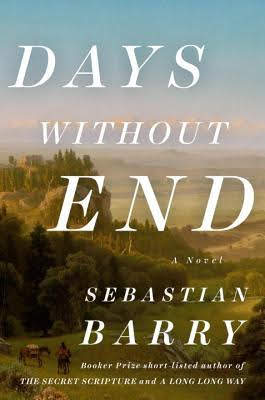
Days Without End by Sebastian Barry - 2016


My Post on The Secret Scripture by Sebastian Barry

I offer thanks to Max u for The Amazon Gift Card that allowed me to read Days Without End.

Almost seven years ago I read and posted on a novel by Sebastian Barry, The Secret Scripture.  At the close of my post i said I hoped to read more of his work soon.  Maybe soon come and gone a good while ago but I very much enjoyed this second venture. (I was prompted to buy this because a promotional E mail letter to which I subscribe advised me the Kindle edition was marked down from $12.95 to $1.95.  I checked just now and that is still the price.)

We meet the narrator of the story in the American West.  He is maybe 13 and it is around 1855. He left County Sligo in Ireland on a Coffin Ship after all his family died in the famine.  He has hooked up with another young man.  They are offered work in show put on for miners.  They play girls.  Nothing bad happens to them, they are very sucessful.  However in a couple of years they are just to old for their roles.  They join an army unit charged with keeping the Indians under control.  Much of excitement of the novel centers around battles with Indian tribes as well as combat action in The American Civil War.  

Irish are everywhere.  Most all are refugees from the terrible famines.  Irish fight on both sides in the Civil War.  This is very much an immigrants story.

We follow the two Boys up to around age forty.  They see terrible things.  There are lots of interesting minor characters and an intriguing romance.  

Days Without End lets us see the violence in The American West.  We are brought to reflect on similarities to attitude of the English toward the Irish, powerful men far away viewed both as little more than vermin.

The narrator retains his humanity in spite of the barbaric violence he was involved in, killing to survive in battle and on the road.  The battle scenes are very vivid.  

Post Civil War America was a wasteland.  There is hapiness, joy and real love in Days Without End.  Slavery is part of the background.

At $1.75 I endorse it to all fans of historical fiction set in the American West, the Irish involvement made it more fun for me.  It kept my attention with lots of cliffhangers and delightful small details.


Wednesday, March 26, 2014

The Temporary Gentleman by Sebastian Barry (2014)


I

The Temporary Gentleman is  story of the life of an Irishman who serves as an officer in the British Army during World War Two, hence making him a temporary gentleman.  This is the second book by Barry I have had the great pleasure of reading.  Last November I read and posted on his set partially in a Sligo mental hospital, The Secret Scripture.  Maybe by a slight margin I preferred The Temporary Gentleman but for sure I endorse reading both of them. 

John "Jack" McNulty is in Accra, Ghana, 1957, working as an observer for the United Nations.   He is desperately trying to write his life story.  He was a bomb disposal officer during WWII and since then had worked as an observer for the U.N, mostly in Ghana.  The Temporary Gentleman is another story of the Irishman as a weak and missing father, both he and the love of his life, wife and mother of his neglected children are badly addicted to alcohol.  The character of the wife, Mai from Sligo, is at the heart of the novel.  Jack's love for her coupled with his inability to understand her, are masterfully shown to us.  She is a tragic character, her life destroyed by alcohol.  

To me, The Temporary Gentleman is very much a post colonial novel about the weak father, about lives destroyed by drink, about Irish perceptions of another post colonial world in Ghana.  Jack orientalizes the residents of Ghana with whom he has contact, much as the English did the Irish. 
I hope to reread this book one day.


I was given a free review copy of this book.

Mel u

Monday, March 31, 2014

March 2014 - A Look at the month on The Reading Life


March was dominated by the forth year of Irish Short Story Month.  (I will continue with that in April). Several authors contributed excellent Q and A sessions and short stories. I am very grateful to them.   More are coming.

Books I posted on

1.  Guermantes Way by Marcel Proust
2.  They Were Found Wanting by Milkos Banfky.
3.  The Temporary Gentleman by Sebastian Barry
4.  Censors at Work:  How States Shape Literature by Robert Darnton
5.  Penelope Fitzgerald - A Life by Hermione Lee
6.  Out of the Ruins by Sue Guiney.

Books I read but did not post on
1.  Emma by Jane Austin.
Plus two books on improving your writing style in fiction
2.  The First Draft by John Casey
3. A Life in Sentences by Jenny Davidson 


I also continued reading  more short stories.

My blog has 3288 Twitter Followers.  In March I had 102,572 hits, since inception, 2,567,815. There are 2127 published posts.  

Top Countries are
USA 
Phillipines 
India
UK
France.

Most viewed posts  continues to be those on older short stories from the Philipines, followed by posts on Katherine Mansfield and R. K. Narayan.

I offer my humble thanks to all commentators and contributors. I thank the authors and publishers for the free books.  

Mel u. 


Monday, October 1, 2018

The Reading Life Review - September 2018

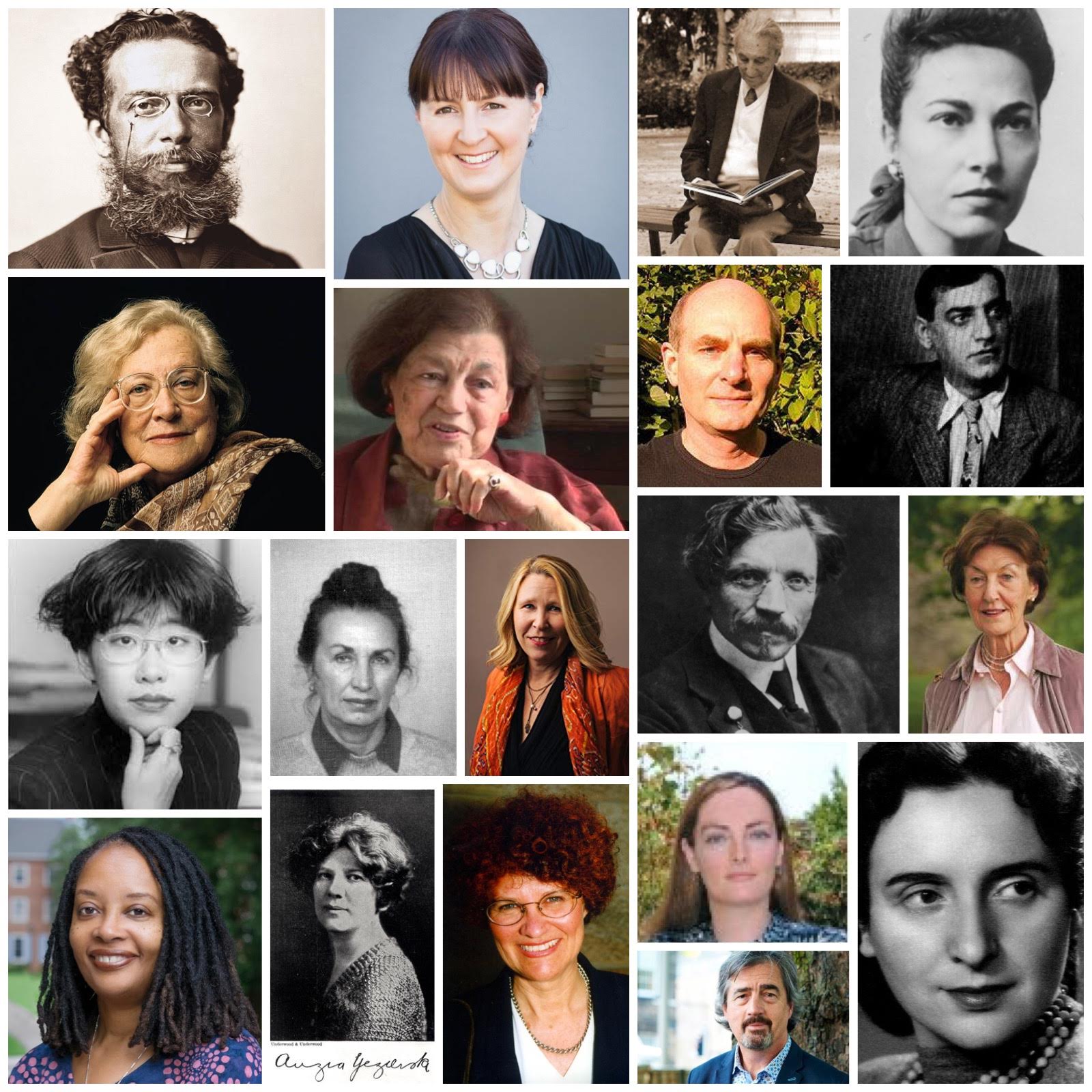
September Authors 


By Rows, left to right

Row One

  1. Machado de Assis -  Brazil - by consensus leading author, chronicler of Rio de Janeiro in the early 20th century

  1. Orla McAlinden - Ireland - Author of The Flight of the Wren, an amazing debut novel as well as an award winning collection of short stories, The Accidental Wife

  1. Abraham Karpinowitz - born Vilna, Lithuania, spends WW Two in Russia, in 1949 he moves to Israel.  Best remembered for his stories about Vilna.  Wrote in Yiddish 

  1. Blume Lempel - born in the Ukraine, moves to Paris for then years, then in 1939 to New York City. Author of many great short stories.  She was fluent in English, Russian and French but she wrote in Yiddish to defy those who would destroy Jewish Culture.

Row 2 

  1. Ida Fink. - born in Poland, after WW Two moves to Israel.  Prolific writer in Yiddish

  1. Mavis Gallant - Born in Canada, moved at age 28 to France

  1. Peter Chapman- born in London, author Bananas: How the United Fruit Company Shaped the World. A must read for autodidactics

  1. Ephraim Kaganovski (variations on spelling)- born Warsaw, spends Seven years in Post Revolutionary Russia then moves to Paris.  Best remembered for his stories about Warsaw Between The Wars. Wrote in Yiddish 

Row Three

  1. Banana Yoshimoto - Japan. Prolific author

  1. Rosa Palatnik - born in Lublin, Poland - after a stay in France moved to Rio de Janeiro. She was a very prolifc Yiddish language author.

  1. Nina Lichtenstein - Denmark, author Seraphadic Women’s Voices: Out of North Africa.  New book Destined to be a classic

  1. Sholem Aleichem- born in the Ukraine, then Russia, died in New York City. By far most famous now Yiddish writer.  His work was the source for Fiddler On the Roof.  I hope to begin reading much more of his work soon.

  1. Shirley Hazzard. Born Australia, world traveler, died in New York City. Author The Great Fire, Transit of Venus and much more 


Row Four

  1. Valerie Boyd - U.S.A - author of very good bio on Nora Zeale Hurston

  1. Anzia Yezierska.- born in Poland, with her family as a child moves to New York State.  Very successful writer, sold a novel to Hollywood and became a screen writer.  Wrote in English 

  1. Kate Grenville - Australia- author seven novels including the Secret River Trilogy, wonderful novels about early Australia 

  1. Elizabeth McDonald.  Ireland. Author of marvelous Short Stories 

  1. Sebastian Barry. Ireland. Highly regarded author.

  1. Chava Rosenfarb (9 February 1923 – 30 January 2011) (Polish: Chawa Rosenfarb, Yiddish: חוה ראָזענפֿאַרב‎) was a Holocaust survivor and Jewish-Canadian author of Yiddish poetry and novels, a major contributor to post-World War II Yiddish Literature. Rosenfarb began writing poetry at the age of eight. Moved to Toronto after WW Two.   You will see her again.

Featured were 6 men and 13 women.

Eight are living, 11 not so much.

Half were featured on my blog for the first time.

Birth Countries 

Poland 6
Ireland 3
Ukraine 2
Australia 2
Canada 1
U.S.A 1
Japan 1
Denmark 1
Lithuania 1
Brazil 1

Because of the anti-immigrant hysteria gripping the U.S.A and much of Europe. I have begun to track Immigration by authors i feature.

All nine of the Yiddish language writers featured immigrated. Move or die were their options. 

Mavis Gallant and Shirley Hazzard left their homelands for their own reasons.


Blog Stats

Page views to date

5,399,641

There are 3416 posts online.  

Top visitor countries

U.S.A, The Philippines, India, Germany, Canada, Russia, Indonesia, France and the Ukraine 

Books I read but did not post upon.

  1. Exile at Last:Selected Poems by Chava Rosenfarb 

  1. The New Joys of Yiddish by Leo Rosten

  1. Born to Kvetch:Yiddish Language and Culture in All its Moods by Michael Wex

  1. One for the Books by Joe Queenan 

  1. Seraphadic Women’s Voices: Out of North Africa. By Nina Lichtenstein


Future Plans.  I will be doing a post on my reading plans for the next few months soon.


I offer my thanks to Max u for his kind provision of Amazon Gift Cards

To those who leave comments, you help keep me going.


Tuesday, September 1, 2020

My Hopes and Plans for Novels for The Next Six Months


 In order to motivate myself to keep looking Forward in Life I have made a list of some novels I hope to read over The next six months.i Will track my results periodically and add new works as I finish some.

I Will do seperate posts on my plans for non-fiction and possibly one on Short stories.

There is no significanance to place in The list.


Novels I hope to read in The next six months

Life in the Trees by HANYA YANAGIHARA

A Little Life:  A Novel by HANYA YANAGIHARA

Recognitions by William Gaddis

The Yiddish Policemen’s Union by Michael Chabon

Hungry Tide by Amitav Ghosh

The House of the Seven Gables by William Hawthorne

Darkness and Day by Ivy Compton-Burnett

The Man Without Qualities by Robert Musil

Four novels by Marilyn Robinson

All the Beautiful Liars by Sylvia Petter

The Annotated Lolita by Vladimir Nabokov

Sepharad by Antonio Muñoz Molina

People of the Book by Geraldine Brooks

The Mancini Family by Natalie Ginsburg

White is for Witching by Helen Oyeyemi

Days Without End by Sebastian Barry

The Dragon Riders of Pern (a trilogy) by Anne McGafffrey

Five Novels by Elizabeth Taylor

At Mrs Lippinrte’s 1945 her first
A wealth of Roses 1949
The Sleeping Beauty 1953
The Soul of Kindness 1964
Blaming 1976. Published posthumously

 
Ancillary Justice by Ann Leckie

Mary Ann by Daphne du Maurier

The Glassblowers by Daphne du Maurier

If Beale Street Could Talk by James Baldwin

Lempriere’s Dictionary by Lawrence Norfolk

The Virgin in The Garden by A. S. Byatt

The Diary of a Provencial Lady by E. M. Delafield

Moby Dick by Hermann Melville

The Commissarat of Enlightenment by Kenneth Kalfus

The Human Voice by Penelope Fitzgerald

Savage Poets by Roberto Bolano

The Secret Lives of the Four Wives by Lola Shoneyin

The Riders of Gor by John Norman

In Polish Woods by Joseph Opatoshu

Cain and Abel by Gregor Rezzori

The People of Godlbozhits by Leyb R. Ashkin

Motke The Thief by Sholem Asch


Monday, November 19, 2012

Fox, Swallow, Scarecrow by Eilis Ni Dhuibhne

Fox, Swallow, Scarecrow by Eilis Ni Dhuibhne   (2008, 354 pages)

The Irish Quarter

"The problem with Alex, she reasoned, was that he was just too masculine.  Masculine men could not understand any point of view except their own.  Single-minded, they had developed blinkered vision millions of years ago to sharpen their hunting skills".   

Fox, Swallow, Scarecrow by Eilis Ni Dhuibhne is a wonderful work of art, incredibly funny and sad in places, and a work of a  sensibility refined to a very high level.   It is the story of Anna Sweeny, a woman married to a rich man who loves her but does not pay her a lot of attention with one son who starts an affair with a single man.   The story is overtly modeled on Anna Karenina, there are quotes from this at the start Fox, Swallow, Scarecrow.   Fox, Swallow, Scarecrow is so brilliant it actually helped me understand Tolstoy a bit more (I am glad I recently read Anna Karenina). In the hands of a less talented writer to model a novel on Anna Karenina would be a travesty, OK it would be stupid and Fox, Swallow, and Scarecrow is as far from stupid as it gets!   

Anna Sweeny is working on a novel.   Her husband is riding the back of the Celtic Tiger and much of her time is taken up with literary parties.  I have been partially focusing on Irish literature for about a year and a half now so I had fun trying to figure out who the fictional authors in the novel are supposed to be in real life. I knew one was Sebastian Barry whose Secret Scriptures I recently read.   I know there were a lot of references I did not get.   I really liked this aspect of the novel a lot.   I felt like I was there for the launch parties and I felt what it was like to be a literary agent or a poet in Ireland.  Everyone in the literary world depicted in this novel is trying to ever so subtlety put down everyone else.   There are a few super stars and everyone else is trying not to be jealous and of course no literary artist would want anything as pedestrian as to be the next J. K. Rowling (who appears at a book launching).  

There are characters that will remind you at once of the main persons in Anna Karenina and we get to see how they live. In a touch so heavy handed it is hilarious, one of the characters is named "Leo" and there is even a homeless tramp who reads Tolstoy.   If you have read the novel I know you gasped when you saw what you at first thought the tramp did with War and Peace.   Leo works on programs to reduce the deaths by auto accident in Ireland.  He does something just flat out crazy on a train one day and it comes back to haunt him.   I really liked that segment of the novel.  

There is a lot to be learned about Ireland in this novel.   We see the different neighborhoods of Dublin, we ride on the trains and buses, we take the expressways,  we see the many subtle class distinctions at work.  There are also lots of wonderful literary references in the novel, besides those to Tolstoy.   There are lots of references to Irish folklore also.   

On every page there are amazing beautifully written sentences.   This is an amazing novel and I feel bad as I know I cannot do justice to it.  

I loved this book.

I have previously posted on her brilliant short story "Trespass"

Author Data


Éilís Ní Dhuibhne (1954, Dublin) is the author of eight novels, four in English and four in Irish.    She has a PdD from The National University of Ireland, focusing on the work of Chaucer as part of an oral tradition.    She has taught at the University College Dublin and was for many years a curator at The National library in Dublin.   She also teaches creative writing.   Her novel, The Dancers Dancing, was short listed for the 2000 Orange Prize.      She is very dedicated to preserving and promoting the Irish literary tradition.    

I hope to very soon read her The Dancers Dancing and some more of her short stories.


Mel u


Tuesday, September 13, 2016

New Ways to Kill Your Mother Writers and their Families by Colm Toibin (2012)


Colm Toibin (1953, Ireland) is one of my favorite writers of fiction.  I especially liked his novel based on the London years of Henry James, The Master and Brooklyn.  Additionally I learned a good bit from his non fiction work, Lady Gregory's Tooth Brush.  I have posted on these works and several of his short stories.  Additionally I have read several of his short pieces on Henry James. When I was notified a collection of his literary essays, Nine Ways to Kill Your Mother Writers and Their Familes was on sale as a kindle for $3.95 happily made the purchase. 

Among the Irish writers covered are Yeats, Synge, Joyce, Beckett, Sebastian Barry, Roddy Doyle and Hugo Hamilton.  There is very interesting chapters on Jane Austin and Henry James on the importance of aunts.  Conflicts brought on by the difficulties their families had accepting their sexuality feature Hart Crane,Tennessee Williams and Thomas Mann.  There are two chapters devoted to James Baldwin.  Borges and John Cheever are also featured.

I learned something from each of the essays.  The chapter on Synge and Yeats will reshape my vision of Irish literature.

I  much enjoyed this book and endorse it too all interested  in the subject matter.  The families of writers have many of the same issues non literary families have which gives the book greater interest.

Mel u

Thursday, March 27, 2014

"The Sound of Swallows" by Shauna Gilligan, PhD (from The Stinging Fly, Spring, 2014)


""They've gone and what's left of them is made of twigs and mud: nests empty and useless".


I first became acquainted with the work of Shauna Gilligan during Irish Short Story Month Year Two.  since then I have posted on a number of her short stories and her wonderful debut novel, Happiness Comes From Nowhere.  At her suggestion I first began to read the work of Desmond Hogan and she did a very illuminating post on him for my blog.  She has also done a very interesting and informative Q and A I urge all to read.  

Today I want to post briefly on her very powerful short story, "The Sound of Swallows" which can be found in the Spring 2014 issue of The Stinging Fly.  The Stinging Fly is a leading world class publisher of literary works.  

As I read on in Irish literature I see more and more, of course people see what they can and want to see, certain pervasive themes recurring over and over.  An obsession with, almost a love, for death, not so much one's own, but that of those we love.  Only when a person is dead does the fluidity of our experience of them come to an end.  I also see a fascination with cycles of futility, recurring pain and loss whose only value maybe in the wisdom gained from observing them.  I also see a strong pattern of works depicting the impact of repressed emotions blocking relationships growing beyond limited starts, relationships that long term bring mostly pain. I also see as a strong theme that of the weak or missing father married to a smothering mother.  I see, learning from Edward Said and his disciple Declan Kiberd, a working out of the legacy of colonialism. These are not just old ideas from long ago. I read this week Sebastian Barry's forthcoming novel, The Temporary Gentleman and these themes dominate it.     All of this can be seen in Gilligan's five page "The Sound of Swallows".

The story is being published today in The Stinging Fly.  I am not inclined too much to recap the plot but I will just talk a bit about how it exemplifies the themes I have spoken about above and numerous times.  The story covers some twenty years in the life of the woman narrating the story. First her father dies from cancer at which point her mother throws her temporarily out of the house, only to become dependent on the daughter.  The narrator had a mildly sexual relationship with another woman, Maribel when in her late teens.  The narrator conceives a child in a one night encounter with what seems a very decent man to whom she gave a false phone number.  The man is forced into the role of unknown missing father in the life of the child.  Then her mother dies. After a twenty year hiatus, she moved it seems to Denver, Maribel returns.  The narrator tries to see in her the beauty she once had.  Beauty lost is one of Ireland's grand themes.   The ending is profoundly sad.  The close powerfully sums up the themes I have ruminated upon.

my q and a with Shauna Gilligan 


My post on Happiness Comes from Nowhere


I hope to read much more of Gilligan.  I strongly endorse her novel, which I think may become a classic. 

Mel u


Featured Post

Imperial Reckoning: The Untold Story of Britain’s Gulag in Kenya by Caroline Elkins - 2005 - 701 Pages

  Imperial Reckoning:     The Untold Story of Britain’s Gulag in Kenya by Caroline Elkins - 2005 - 701 Pages 2006 Pulitzer Prize Winner From...