Showing posts with label Amanthi Harris. Show all posts

Wednesday, December 18, 2019

Beautiful Place by Amanthi Harris - 2019 - 560 pages


The plot line centers on a young Sri Lanka woman, Padma.  After an unsuccessful try at university she now lives and manages a luxurious villa, hosting a stream of foreign guests. The property is owned by an Austrian expat, a very successful architect, living in Sri Lanka.   He adapted her when she was quite young from her abusive but lurking in the background still father, Sonny.  Going to Sri Lanka is not a casual holiday for Europeans or Americans.  Often villa guests see themselves on a kind of spiritual guest, hoping to achieve a spiritual ephifany from the temples.  Of course European visitors are intrigued by the thought of a sexual encounter with for them "an exotic woman from the East".   The extreme wealth disparity of the country and the under valuing of female children has created many venues for prostitutes. This should be seen as but another pernicious legacy of colonialism.


Setting the novel in a luxury guest villa means the clientele are affluent.  As a structural device it enables Harris to bring new characters on stage for the single Padma to encounter. Seeing her and the guests size each other up was great fun.

Harris depicts the lush tropical beauty of Sri Lanka, for sure I would love to sample the curries she describes and sit on the beach reading something like A Journey to the East by Hermann Hesse.

We get to know a good bit about Padma's father Sonny who shows up looking for money.  The nearby village is replete with thugs (a term borrowed from Hindi long ago) drug peddlers, crooked local 
politicians, relatives wanting to spy on Padma, some to ask her for money and Aunts wanting her properly married.


Many in the local area are jealous of Padma's easily acquired wealth.  A friend of Gebhardt, a European practitioner of Yogi and the author of a less than flattering book on Sri Lanka (Harris introduces the history and divided politics of the island through quotes from his book- a very nice touch, he adds some drama to the plot.

Padma's family wants to exploit her.  There is more to Gebhardt than meets the eye.  I really liked the slow way Harris develops her characters.  Everyone in Beautiful Place is at least interesting and real.  The atmosphere, pervasive poverty, long periods of ethnic conflicts introduces a sinister underlayer to the beauty Harris so skillfully presents.

From Salt Publishing

Amanthi Harris was born in Sri Lanka and grew up in London. She studied Fine Art at Central St Martins and has degrees in Law and Chemistry from Bristol University. Her novella Lantern Evening won the Gatehouse Press New Fictions Prize 2016 and is published by Gatehouse Press (2017). Her short stories have been published by Serpent’s Tail and broadcast on BBC Radio 4 as Afternoon Readings.

I greatly enjoyed and was very much drawn into Beautiful Place.  I hope to follow the work of Ananthi Harris for many years.

Mel u


'


Monday, March 25, 2019

Outside - A Short Story by Amanthi Harris - published in Lighthouse - A Journal of New Writing - Issue 18, Winter 2018 to 2019


Outside - A Short Story by Amanthi Harris - published in Lighthouse - A Journal of New Writing - Issue 18, Winter 2018 to 2019

I have been reading  Amanthi Harris for sometime now.  I am always happy to have the opportunity to expand my reading of her work.  Of the two short stories and a novella I have read, two are about a young woman of Sri Lankan heritage living now in London with her very traditional parents while adjusting to English life.  One story is set in Sri Lanka.  The relationships of the young women  with their parents, especially their mothers, are strained  by the English men they are involved with.  Their parents want strictly Sri Lankan grandchildren!

In today's delightful story a young college woman, Maya, has come in from the outside, back home from college.

I loved the very sensory rich opening lines:


"Outside disappeared when the door closed, as you were taking off your coat in the hallway in the warmth, with the smell of fried curry-leaves and roasting black pepper and the scent of cloves; and the steam from the kitchen misted the windows with their sagging nets of lace flowers, the petals just prickled with mildew. Outside was where Maya lived now. They had sent her - sent her where they could never go, to pry behind old stone walls, to pass through ancient oak doors into panelled halls to reap the rewards of their labours and bring back what she learned.

She had returned with nothing, only altered, full of stories of new friends, of new vistas glimpsed and opening for her. She had grown loud-voiced and giant, her shyness gone, talking on the phone with her new friends, laughing without restraint, revelling in her brazenness. Her parents listened pained to the mention of men - one in particular whose call each day she waited for. He had invited her to a party in a city far away, a party they had forbidden her to attend.
‘Let’s have a dinner party,’ she told her mother, Lila. ‘What for?’
‘It’s weird doing nothing on a Saturday night.’"

Maya has new friends now, she "sees their wealth, comfort, and rootedness,the calm of their entitlement and wanted this"

Dan, the boy Maya likes, is having a party the same night but her parents will not allow her to go.  Maya makes a radical suggestion:


"there was no reason to eat in different rooms, the men sitting down all over the house talking cricket and the women in the kitchen stirring pots, eating between serving the men. Lila didn’t reply, reading over the shopping list.
‘Wine? You drink wine now?’ she demanded. ‘You’re drinking alcohol and running around with men? Very nice. We sent you to University to study."

Maya's mother tells her men will think she is easy.

The family member guests begin to arrive, about ten people.  Chief among them is Uncle Bobby her father's brother.   Bobby had a reputation as a "Playboy" before he finally settled down and married.  A debate breaks out over  whether or not University life has been a bad influence on Maya.  Uncle Bobby tells everyone he thinks she needs and deserves to expand her world.  

I as shocked by the ending, though not as much as Maya was!  

I really liked "Outside", lots of marvelous descriptions of food.  (The very last thing an immigrant will give up willingly is their food, clothes, religion, language all go first in the acculturation process.) 

As I read this story about generational tensions  yesterday, my 76 year old mother in law, 25 year old daughter and wife were at the kitchen table enjoying very traditional foods brought back from a visit to family property in way rural northern Philippines.  The family is intensely close but far from drama free.  The conversations and relationships depicted in "Outside" rang very true for me.


Amanthi Harris was born in Sri Lanka and grew up in London. She studied Fine Art at Central St Martins and has degrees in Law and Chemistry from Bristol University.

Her novel BEAUTIFUL PLACE will be published by Salt (September 2019). LANTERN EVENING, a novella, won the Gatehouse Press New Fictions Prize 2016 and was published by Gatehouse Press (2017). Her short stories have been published by Serpent’s Tail and broadcast on BBC Radio 4 as Afternoon Readings. She also runs StoryHug, an ACE funded storytelling, art and writing project.

www.amanthiharris.com

www.saltpublishing.com/products/beautiful-place-9781784631932
www.gatehousepress.com/shop/new-fictions/lantern-evening/


Outside - A Short Story by Amanthi Harris - published in Lighthouse - A Journal of New Writing - Issue 18, Winter 2018 to 2019

This issue of Lighthouse- A Journal of New Writing has a very interesting mix of short stories, poetry, artwork, and commentary from a diverse group of writers.  

I am very much looking forward to her debut novel, Beautiful Place coming in September this year.  I hope to follow her work for a long time.

Be sure to check out her website to see her enchanted  art work.  

This story is included in our Stories by South Asian  Women project.

Mel u
Oleander  Bousweau


Friday, April 13, 2018

“Rock Temple”. - A Short Story by Amanthi Harris- 2012, in Five Degrees


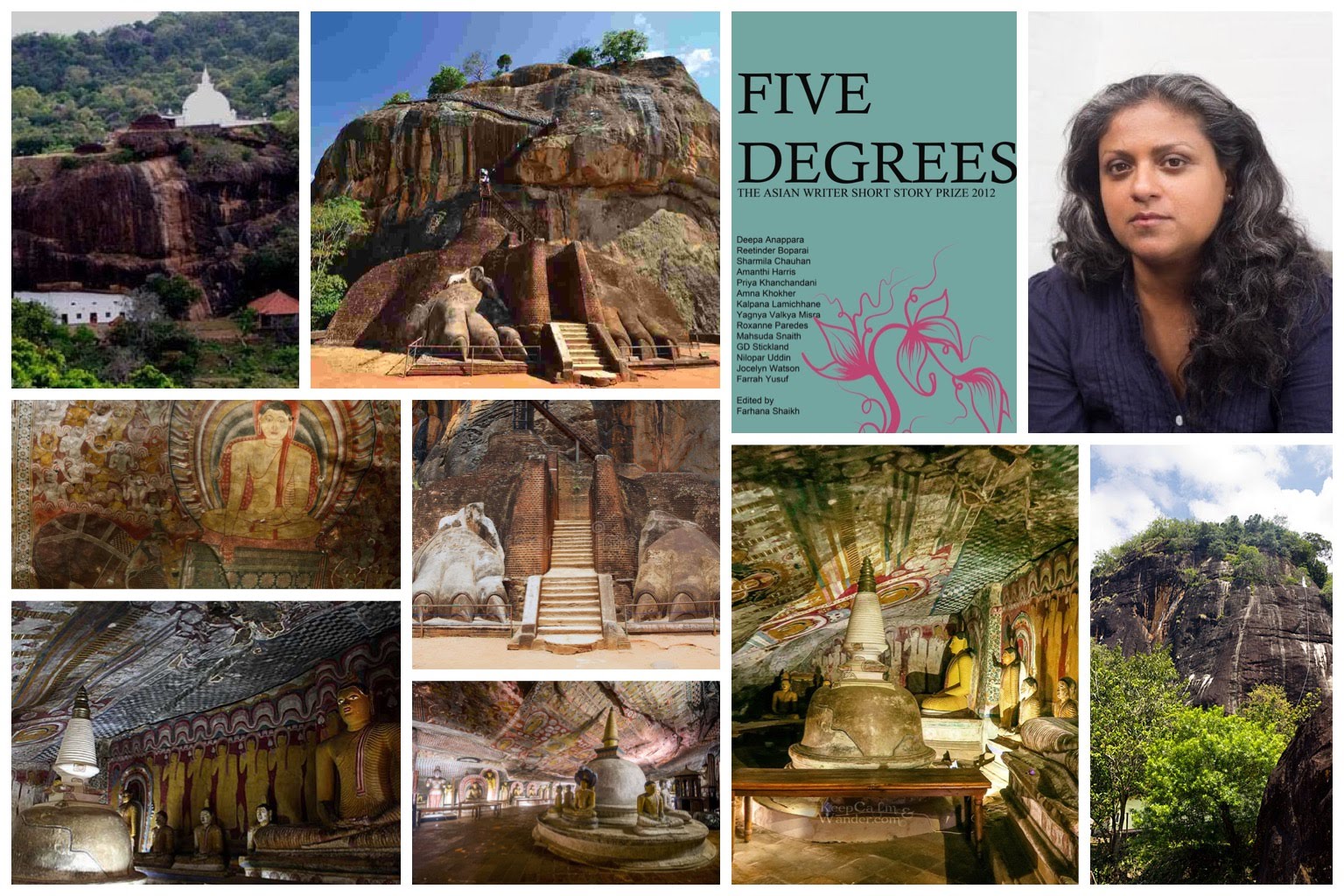
The collages images are of UNESCO World Heritage Cave Temples in Sri Lanka.  The most spectacular is The Dambula Cave Temple, constructed initially about 100 BCE. In addition to being of great historical importance importance they are pilgrim sites.  “Rock Temple” takes place on a visit to a rock temple.  The images hopefully will give us a better feel for the events in the story.  For sure they made want to take my wife on a trip to Sri Lanka.

As “Rock Temple” opens a couple, not married are in Sri Lanka. The woman is Sinhalese,  the man English.  They are visiting her parents.  Her mother is very vocal about her disapproval of their relationship, suggesting her daughter is degrading her values by sleeping with the man before marriage.  She compares her to a white girl.

The couple are on their way to visit a Rock Temple.  This does involve a lot of walking and the woman thinks the man is insisting they go just to annoy her.  She suggests he is unhappy with her for not being as sexually free as western women he has known. He insists he wants to go.

Normally when she goes on an excursion in Sri Lanka, they stay at trendy resorts.  They hire a driver to take them. When they get there it is vey calm and serene not full of people with gadgets.  It is like a trip back to simpler times.

The site is overwhelmingly beautiful.  The Temple is structured in five cave levels.  The first view of the exquisite art work and the array of statues of the Buddha would nearly overwhelm me and I think many others.

As they advance higher in the Temple we learn a priest, friends of the family since the woman was a child has been made to live way up in the Temple as a punishment for some kept hushed up sin.  The priest seems a man of wisdom and kindness.  He can see the love in the couples relationship.  Unlike her mother, he does not judge them.

“Rock Temple” is a very interesting story. I look forward to following Harris’s literary and artistic career for years to come.  This is the third story of Harris upon which I have posted.  I see her as a very talented and perceptive writer.


“I was born in Sri Lanka and  grew up in Colombo. Later I moved to London where I have been ever since, with an escape now and then to Paris and to Sint Truiden in Belgium, to Goa and Cornwall and currently the Sierra Nevada mountains in Spain where I am on sabbatical.

“I studied Chemistry then Law at Bristol University, and far more usefully, Fine Art at Central St Martins. I’ve been a terrible trainee solicitor, a very bored editor of law books and a blissfully contented bookseller, writing and making art along the way. I’ve had short stories published, one of which, Red Sari is taught in schools in Sweden and I have also had stories commissioned for and broadcast on BBC Radio 4 as Afternoon Readings. I won the Gatehouse Press New Fictions Prize 2016 with my novella Lantern Evening which is published by Gatehouse Press.

I have a Fine Art practice using drawing, painting and 3D and am with the V22 artist collective.
I also run StoryHug an Arts Council England funded project using art and stories to inspire creativity and community.” From the author

Mel u


Sunday, March 11, 2018

“Red Sari”. - A Short Story by Amanthi Harris - 2004


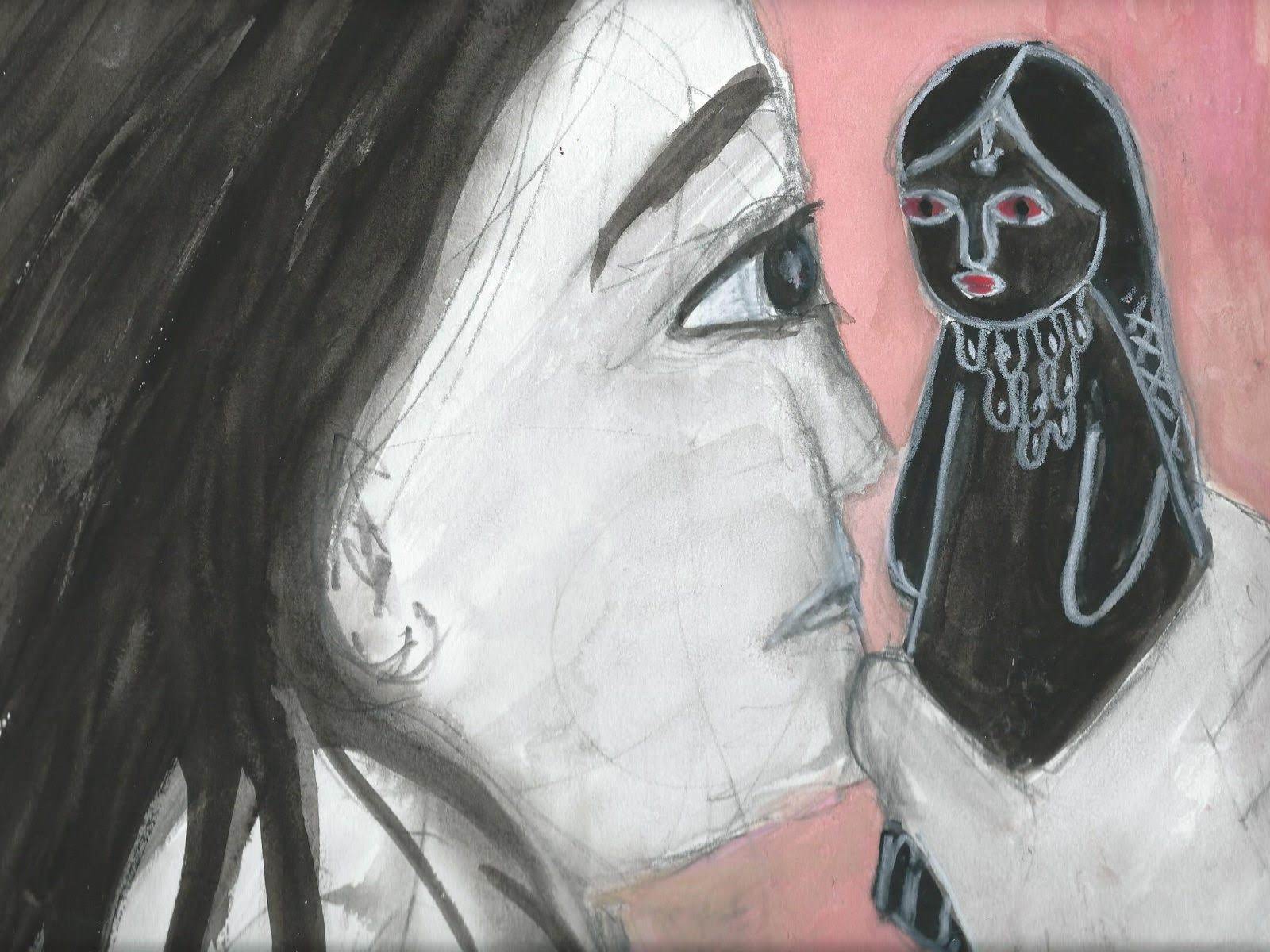
Website of Amanthi Harris. Included are Images of her Exquiste Art Work


I dedicate this post to the people of Sri Lanka with the hope their country can find the peace they deserve.

Last month I posted upon the award winning novella Lantern Evening by Amanthi Harris.  Today I feature one of her early Short Stories, “Red Sari”. Both works center on a young woman from Sri Lanka who now lives with her parents in London.  In both stories Harris develops very subtly the relationship between the domineering mother who wants to follow the traditions of Sri Lanka and her daughter, trying to assert her independence.

As “Red Sari” opens the daughter, getting married soon to a man not of her heritage, probably English, Mother thinly hides her disappointment, is admiring a dress in one of those glossy bridal magazines.  Her mother insists she must get married in a sari, as tradition dictates.

Soon they go wedding day shopping, in a section of London that almost recreates an Indian shopping district. Harris made me feel I was there.  They stop for a snack and cold drink in a place the mother says “has everything from back home”.  Sri Lanka is politically and culturally a very divided country.  The patrons quietly look each other over trying to decide what “side” everyone is on. 

Harris paints a wonderful picture 

“Winter arrived and I went with my mother to look at saris and jewellery for weddings, to a part of town like a town in India , but with Debenhams and Argos , and Tesco and an Iceland . Squat men walked hunched through the streets, jackets zipped to their chins, and women pushed prams, carried shopping, held umbrellas up against the December drizzle. Old women tottered in sandals and woollen socks, duffle coats tight over sari frills that splashed with rain and mud from the pavement. Among them my mother and I walked, damp clinging to us, a dark grey sky unshifting above. We were headed for a sari shop that was recommended by someone my mother knew, but we stopped first at a canteen selling bhajis, puris, samosas, jellabies and even the rose- pink faluda drink that had been her favourite once.
‘They have everything here now,’ my mother observed.
We went around the counter and chose and sat down to eat, but it seemed strange to have no air conditioning, no sun outside, no squall of horns, no roar of traffic, no coconut trees against a blue sky above the shops. The faluda frothed in her glass, bubbled pink from the red jelly sweetness at the bottom. I almost saw her then, in cafés in Colombo with her cousins and friends, and how she and I might have been able to talk together as she had with them. She sat now, looking around her at the people in the canteen, looking them over carefully, table after table. And the people looked at her”

(Many affluent people from Sri Lanka have left the country because of violence between Muslim and Buddhist factions.  In today’s Washington Post I found the government has declared a state of emergency due to recent sectarian violence.)


They first stop in at a jewellery store but they leave without  a purchase.  The mother says the groom does not even know he is supposed to buy the wedding jewellery.  

The next shop is a cloth store where they will buy material for the Sari, against the wishes of the daughter who wants to be married in the dress from the magazine.

The daughter and mother quarrel over the material but the daughter gives in. 

I really liked this scene in the cloth shop.

“I can’t wear this,’ I said.
My mother turned to the chorus and rolled her eyes.
‘It’s not me,’ I said again.
The women looked at me and seemed to be waiting, as if more was needed as explanation.
‘I don’t like it,’ I said, and a particular type of pause, of something final, settled between us all.
‘This is what happens,’ my mother sighed. She shook her head. The women watched her, listened, breathing softly, their eyes expectant.
‘Back home they would not argue, no?’ my mother said.
The women nodded. They did not look at me, only glanced away, and then at each other. I caught the eye of one who seemed to be the youngest; I caught her just as she was staring into my face as if I was something she had never seen. I glared at her and at all of them. Couldn’t they see what I looked like? I didn’t look right. How could I get married looking like that?
The pitted-cheeked woman’s red lips pursed.
‘You should try to please your mother, no?’ she said coldly”

I will leave the very enjoyable ending untold.  You can purchase on Amazon the anthology in which it it is published Kin:New Writings by Black and Asian Women, edited by Karen McCarthy.

“Red Sari” packs a lot into five pages, family dynamics, immigration issues, bridal jitters and more.  You can see her skill as a visual artist manifesting itself in her fiction.  

Next month I will post on another story by Amanthi Harris, this time one set in Sri Lanka. 

“I was born in Sri Lanka and  grew up in Colombo. Later I moved to London where I have been ever since, with an escape now and then to Paris and to Sint Truiden in Belgium, to Goa and Cornwall and currently the Sierra Nevada mountains in Spain where I am on sabbatical.

“I studied Chemistry then Law at Bristol University, and far more usefully, Fine Art at Central St Martins. I’ve been a terrible trainee solicitor, a very bored editor of law books and a blissfully contented bookseller, writing and making art along the way. I’ve had short stories published, one of which, Red Sari is taught in schools in Sweden and I have also had stories commissioned for and broadcast on BBC Radio 4 as Afternoon Readings. I won the Gatehouse Press New Fictions Prize 2016 with my novella Lantern Evening which is published by Gatehouse Press.

I have a Fine Art practice using drawing, painting and 3D and am with the V22 artist collective.
I also run StoryHug an Arts Council England funded project using art and stories to inspire creativity and community.” From the author

Mel u


Featured Post

Imperial Reckoning: The Untold Story of Britain’s Gulag in Kenya by Caroline Elkins - 2005 - 701 Pages

  Imperial Reckoning:     The Untold Story of Britain’s Gulag in Kenya by Caroline Elkins - 2005 - 701 Pages 2006 Pulitzer Prize Winner From...