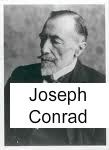
Showing posts with label Conrad. Show all posts

Thursday, November 10, 2011

"Secret Sharer" by Joseph Conrad

"Secret Sharer" by Joseph Conrad (1912, 28 pages)

I have recently posted on two short works of fiction by Joseph Conrad  (1857 to 1924).  He was born in Poland but became a British citizen and is considered one of the greatest of English novelists. In the long ago, I read most of his major novels, in the last year I have read his "The Lagoon" and his very famous The Heart of Darkness.   I ended up doing two posts on The Heart of Darkness, the second one was a follow up to some great comments from readers.   


I am reading through all of the short stories in a wonderful 1947 anthology of short stories my cousin Bonnie kindly gave me.   It has been in the family since publication so the book means a lot to me.  There are a lot of wonderful stories by new to me authors and I have posted on some of them.   "Secret Sharer" was one of the stories included in the collection.   


"The Secret Sharer" is a very weird hard to put a meaning on story, or at least it was for me.  There are two main characters in the story.   The captain of a ship at sea is one of them.   He is  newly appointed and does not know much about the crew or the ship.   The second main character is a man who swims naked up to the ship while it is far from sea.   The captain is the only one who sees the man and he takes him into has cabin and hides him.   He finds out the man has murdered a man on a ship and jumped overboard to escape.   The captain keeps him hidden in his cabin for several days.   He even endangers the ship to help the man escape.


The mystery in this story is why the captain does what he does.     Maybe it is wrong to look for a profound meaning in this story, maybe it is just a very well done story of the sea.  


You can find almost all of Conrad's fiction online.  


The next Conrad work I read will probably be "Amy Foster".


Mel u


Monday, August 22, 2011

Two Vision of Heart of Darkness-Is it deeply racist or a powerful exploration of the roots of racism?

A Follow Up Post 


"An Image of Africa:   Racism in Conrad's Heart of Darkness"  by Chinua Achebe (1977, Massachusetts Review, 1977, 10 pages)


 Culture and Imperialism -Two Visions in the Heart of Darkness by Edward Said   (1993, 9 pages)

Edward Said versus Chinua Achebe


"Joseph Conrad was a thoroughgoing racist."   Chinua Achebe
And the question is whether a novel which celebrates this dehumanization, which depersonalizes a portion of the human race, can be called a great work of art. My answer is: No, it cannot. (from Achebe's essay)


"Heart of Darkness cannot be just been treated as a straightforward recital of Marlow's Adventures, it is a dramatization of  Marlow himself, the former adventurer in colonial regions, telling his story to a group of British listeners in a particular time in a specific space..,.what Conrad does is to show us what Marlow does is contingent, acted out for a set of like-minded British hearers, and limited to that situation"-Edward Said in Culture and Imperialism -Two Visions in the Heart of Darkness


This post is kind of a follow up to the really great very insightful comments that were made on my brief post on Joseph Conrad's The Heart of Darkness.    In my post I said, which I now concede was not accurate, that Heart of Darkness is often now simply dismissed as a racist work.   In fact it turns out, as I learned from research stimulated by the comments of Amateur Reader, it is the debate over this issue that has in fact increased the readership for Conrad.   If he were alive today, Conrad would owe his critics a share of his royalties!   This issue has, I think, a larger culture import as seeing Conrad as racist opens the door to an attack on the whole notion of a literary canon if we concede this very high status work is racist to the core.   

I think Edward Said is right and Chinua Achebe is wrong.   (I will assume here that readers of this post-assuming there are any, of course!- are familiar with the racial slurs and terms used in Heart of Darkness.)   I think where Achebe misses the point of the work (I know it sounds very arrogant to say that but if I said it is Said who is wrong it would also sound arrogant) is when he says that Conrad in The Heart of Darkness provides us with no way to step back or outside of the account of Marlow of Africa.   I think Amateur Reader hit it on the head, as usual, when he said "Marlow is a world-class ironist. Is he indulging in received ideas, or parodying them?".


As Said remarks (almost wrote as Said said) this is a narrative for an audience of English business men, people that Marlow needs to please.   I found the further Marlow went into the Congo the more ironical he became.    This is in part because he has no frame of reference to deal with his experience directly so he must distance himself from it with irony.    Marlow wants his story to be exciting and to be what his audience, his bosses, want to hear.   


One of the interesting aspects of Heart of Darkness which I think does show orientalising elements in the book is in the treatment of the Africa woman who was the mistress of Kurtz, per Achebe.   (It is also interesting that Achebe uses a loaded term like "mistress" to describe the woman, why cannot she simply be as a English woman would, be a girl friend or even a wife?)   


In Orientalism (see my post on this book for some background on the concepts) Said says the European saw-and still see-non-European women as sexually exotic, almost like temple prostitutes.   This is how the woman in Heart of Darkness comes across.   Marlow wonders what amazing things she has done to captivate Kurtz.


There are a lot of good points in Achebe essay.   To me one best point is kind of an attack on "liberals" readers of Heart of Darkness who with the best of intentions say Africa is just a backdrop for Marlow to display his attitudes and have his vision of the horror of the darkness.   He says the fact that Conrad could use a whole contitnent and especially the Belgian Congo as  backdrop show his deep seated sense of European superiority.   


I think the failure of insight of Achebe and others who see this book as racist is their inability to step back from the narrator.   I think by the fact that Conrad frames the narrative as he does he is explicitly setting up a "step back" frame for his readers.    


Fred in his very insightful comments said he did not see the justication for this remark I made in my first post


"The narrator of the story does make use of degrading racial terms for the people of the areas, describes them in a fashion that show he things less of their cognitive capacities than he does of Europeans, and sees their very darkness as indicative of an evil quality within them."


Achebe's essay has lots of examples of this including suggestions that the narrator sees the speech of the natives as babbling not a full language.   


I know this may seem a harsh remark, but I think part of the reason Heart of Darkness is often called a racist work is the need of teachers to have something to say about the book that a broad range of students can relate to.   


As always I greatly thank those who take the time to comment on my posts.    If you think I am wrong on something, just tell me otherwise I will presist on in my error.


Please feel free to share your thoughts with us 


Mel u

Sunday, August 21, 2011

Heart of Darkness by Joseph Conrad and "Two Visions in Heart of Darkness" by Edward Said

Heart of Darkness" by Joseph Conrad (1902)
"Two Visions in Heart of Darkness"  by Edward Said (1993)


Heart of Darkness is one of Joseph Conrad's (1857 to 1924-born Poland  but considered an English writer) most famous works.   It is considered a very high status canon work but of late there has been a tendency to attempt to dismiss it as racist   (Of course we have big questions lurking in the background here-can we like and admire a work of art whose values we do not approve?)    I am really not inclined to post a lot about the style or the story.   The prose is impeccable.   It cries out to be  read slowly.    

The story is set in the Belgian Congo, seen of some of the most horrible abuses of colonialism.    The narrator of the story does make use of degrading racial terms for the people of the areas, describes them in a fashion that show he things less of their cognitive capacities than he does of Europeans, and sees their very darkness as indicative of an evil quality within them.    The narrator in Kenzaburo Oe's short story about an African American pilot taken captive by rural Japanese during WWII does the same sort of thing.    Does this mean Oe is a racist?   

I really thing the best service I can provide readers of this very powerful story is just to advise them to read Edward Said's treatment of that question in his book Culture and Imperialism.     

Here is a link to Said on Heart of Darkness.   For background information on the operative concepts of Edward Said see my post on his big book, Orientalism.


Mel u


Wednesday, June 30, 2010

"The Lagoon" By Joseph Conrad

"The Lagoon" by Joseph Conrad (1896-11 pages)


I wanted to do as my next short story post a work by a new to The Reading Life author.    Of course there are 1000s of options so I was kind of looking for sign of some sort to guide me.   I got two of them.   On East of The Web:Short Stories one of the featured stories this week is  "The Lagoon" by Joseph Conrad. (1857 to 1924-born in Poland but became British citizen in 1886)   I have read some  of the major Conrad novels like Lord Jim, Nostromo and his novella Heart of Darkness but I have never read one of his short stories.    My second omen came in the form of a blog entry from the Katherine Mansfield Society blog in which they post a rhapsodical paean from Mansfield on Conrad:

it is, perhaps, a peculiar responsive sensitiveness to the significance of everything, down to the slightest detail that has a place in his vision. Even in the sober low-toned beginning the author succeeds in conveying a warning as of an approaching storm; it is as though the silence was made to bear a mysterious implication. And in this heightened, quickened state of awareness we are made conscious of his passionate insistence upon the importance of extracting from the moment every drop of life that it contains, wherewith to nourish his adventure.
I am currently reading Ford Madox Ford's great (though highly eccentric book) The March of Literature.    When I complete this book (835 pages) I will try to say why I like it so much and why I think it is as near must reading as a history of literature can be but for now I will just say that on any writer he covers I will give him the respect of thinking through what Ford says on them.    Ford and Conrad were close personal friends and collaborated on several novels.    Here is part of what Ford says about Conrad:
He was the most consummate, the most engrossed, the most practical, the most common-sensible and the most absolutely passionate man-of-action become conscious man of letters that this writer has ever known, read or conceived of.
"The Lagoon" is set in the riverine  jungles of Malaysia.   It is a story of love and betrayal.  Arsat, the teller of the story, kidnaps the woman he loves from the household of the Rajah where she is a bound servant.   His brother goes with him to help them escape the troops of the Rajah which come in pursuit of them.   In the course of the perusal the boat of the Rajah's men overtakes them as they are on the river bank.   Not to give away more of the plot but there is a terrible betrayal that shapes the life of the surviving brother.

There a number of  thematic readings one could impose on "The Lagoon".   It is about the inability of love to beat death, about the colonial experience of the western man to whom Arsat tells his story, about movement versus stillness, and the pervasive power of guilt.   As I read the story of the two brothers stealing the servant of the Rajah and the Rajah's pursuit of her I thought of The Iliad.     The prose of Conrad (his native language was Polish) is slow moving and may feel a bit  lugubrious to many, I think.  His prose at times sounds like English as if it might have been written  by Sophocles or perhaps another great sailor, Odysseus:

A white eagle rose over it with a slanting and ponderous flight, reached the clear sunshine and appeared dazzlingly brilliant for a moment, then soaring higher, became a dark and motionless speck before it vanished into the blue as if it had left the earth for ever
"The Lagoon" can be read online here.  

If anyone has any suggestions as to short stories I might like please leave a comment.  


Mel u

Featured Post

Imperial Reckoning: The Untold Story of Britain’s Gulag in Kenya by Caroline Elkins - 2005 - 701 Pages

  Imperial Reckoning:     The Untold Story of Britain’s Gulag in Kenya by Caroline Elkins - 2005 - 701 Pages 2006 Pulitzer Prize Winner From...