Showing posts with label Sholom Aleichem. Show all posts

Sunday, October 21, 2018

“On Account of a Hat”. - A Short Story by Sholom Aleichem- 1913


The Official Sholom Aleichem Website- Your First Resource


“On Account of a Hat”. -  A Short Story by Sholem Aleichem- 1913


1859 Born in The Ukraine, then part of the Russian Empire

1916 Dies in New York City, then part of The U.S.A.  His funeral is attended by 250,000

To most people, certainly me a few years ago, Yiddish writers were divided into two categories, Sholom Aleichem and a bunch of authors I have never heard about who I would never have read were it not for Yale University Press giving me a full set of The Yale Yiddish Library.  These nine volumes, introduced by top authorities in Yiddish Studies, include some of the great classics.
Among the works were two totally marvelous novels  by Sholom Aleichem.  All of the works were pre-Holocaust, written in Eastern Europe and Russia.  All were by men.  As Yiddish speakers left Europe, mostly to NYC then Toronto and Montréal women writers like Blume Lempel and Chava Rosenfarb began publishing in Yiddish.  I have talked a bit about the history of Yiddish Literature (running from around 1875 to maybe 2004 with the passing of the last of the emigrated writers) in prior posts.) My perception is most seriously into Yiddish Literature, a huge treasure trove of Short Stories, are “heritage readers” seeking ties with the world of their ancestors in Eastern Europe.  Behind it is also a powerful message to those who would destroy Jewish Culture, you lose, we win.  I read in this area because it is an incredibly wonderful literature.  The stories range from heart breaking to funnier than a Mel Brooks movie.  Yiddish scholarship has very strong support and thanks to the internet, and maybe especially The Yiddish Book Center, interest is increasing. Leonard Nimoy hosts on YouTube a series of readings of Yiddish Short Stories, including today’s story, “On Account of a Hat”.

Leonard Nimoy says this is one of the best of the hundred of short stories by Sholom Aleichem and who can argue with the voice of Mr. Spock.  (I can visualize Mr. Spock quoting from a Yiddish story to a bewildered Doctor McCoy.)

The main character is a small time land broker.  Passover is approaching and he has been away from home working on some deals.  He sends a telegraph to his wife saying, “I will be home for Passover, without doubt”.  The story is told by the developer as if he were telling it to Sholom Aleichem as a material for a story.  

He gets to the nearest railroad station.  As he waits for the train he sits next to a sleeping man in a uniform, a high ranking personage of some sort, for sure a goyem.  He puts down his hat for a minute then when he reaches to 
pick it up the official’s hat was blown next to his by a wind and he accidentally put on the wrong hat, marking him as a high ranking Tsarist official.


When he goes to get in the third class cabin the conductor sees the hat and insists he will be placed in first class.  At first the man is a bit uncomfortable 
as he is the only Jew there but he enjoys the ride.  He wonders how the others in the cabin would feel if they knew they were riding with a Jew.  Once he gets to his town people call him “your excellency” and defer to him. Once he gets home his wife says something like, “who are you fooling with that stupid hat?”.  

The ending is a classic.  I will leave it for others to discover.

Sholem Aleichem, the pseudonym of a Russified Jewish intellectual named Solomon Rabinovitz (1859–1916), created many of the most enduring works of modern Yiddish fiction. Born in Pereyaslav, Ukraine, he received a traditional education and lived in Kiev and Odessa before immigrating to New York City. Upon his death in 1916, the New York Times published a front-page obituary, memorializing him as “the Jewish Mark Twain.” More than 100,000 people attended his funeral procession, making it the largest New York City had ever seen. His humorous representations of the rhythms of Yiddish-speaking Eastern European Jewish life have had a lasting influence on modern Jewish literary traditions... From The Yiddish Book Center




Monday, October 8, 2018

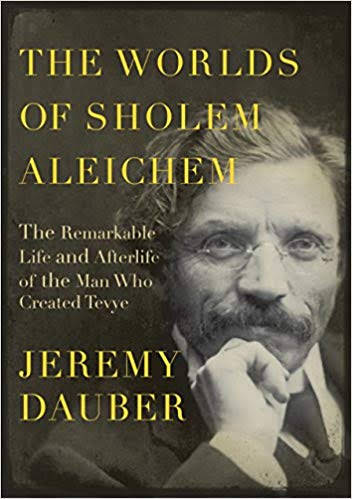
THE WORLDS OF SHOLEM ALEICHEM The Remarkable Life and Afterlife of the Man Who Created Tevye by Jeremy Dauber - 2013


THE WORLDS OF SHOLEM ALEICHEM The Remarkable Life and Afterlife of the Man Who Created Tevye by Jeremy Dauber - 2013

This is the first ever comprehensive biography of Sholem Aleichem, one of the greatest short story writers.

1859 Born in The Ukraine, then part of the Russian Empire

1916 Dies in New York City, then part of The U.S.A.  His funeral is attended by 250,000

To most people, certainly me a few years ago, Yiddish writers were divided into two categories, Sholom Aleichem and a bunch of authors I have never heard about who i would never have read were it not for Yale University Press giving me a full set of The Yale Yiddish Library.  These nine volumes, introduced by top authorities in Yiddish Studies, include some of the great classics.
Among the works were two totally marvelous novels  by Sholom Aleichem.  All of the works were pre-Holocaust, written in Eastern Europe and Russia.  All were by men.  As Yiddish speakers left Europe, mostly to NYC then Toronto and Montréal women writers like Blume Lempel and Chava Rosenfarb began publishing in Yiddish.  I have talked a bit about the history of Yiddish Literature (running from around 1875 to maybe 2004 with the passing of the last of the emigrated writers) in prior posts.  My perception is most seriously into Yiddish Literature, a huge treasure trove of Short Stories, are “heritage readers” seeking ties with the world of their ancestors in Eastern Europe.  Behind it is also a powerful message to those who would destroy Jewish Culture, you lose, we win.  I read in this area because it is an incredibly wonderful literature.  The stories range from heart breaking to funnier than a Mel Brooks movie.  Yiddish scholarship has very strong support and thanks to the internet, and maybe especially The Yiddish Book Center, interest is rapidly growing.  YouTube has lots of good videos and readings of stories.

Anyway Sholom Aleichem is by far now most known Yiddish writer.  He is most famous from the movie Fiddler on the Roof based on his Tevye Cycle, centering on a Russian dairyman and his relationship with his daughters.  So far I have read only one story in the series, “Chava”.  For sure I agree with those who see it as great literature, perhaps high art.  

THE WORLDS OF SHOLEM ALEICHEM The Remarkable Life and Afterlife of the Man Who Created Tevye by Jeremy Dauber is a very delightful literary biography.  Dauber very much brings Sholom Aleichem to life.  He presents the Life of the author almost as if were a Yiddish novel.  Every chapter title refers to him as “our hero”.  Dauber does a wonderful job of blending cultural history, an account of a very event filled life along with commentary about his writings, stories, novels, and plays.  He skillfully shows us how his life experiences influenced his work.

Sholom Aleichem married rich, lost a fortune, at times he made very good money from his works.

Dauber helped me understand the economics of the Yiddish Publishing in the period.  Aleichem was not just a writer, for a while he published a journal and he when he could supported other writers.  We follow him as he moves around in Russia, inspite of Tsarist sponsored anti-Semetic laws and pograms, Aleichem never lost his fondness for Russia, travels all over Poland, then onto New York City.  He idolized Charles Dickens and like him he turned to lectures and Public readings to support his family.  We see a very complex publishing business in NYC and Warsaw, some publishers were honest and generous, some published his work without permission or compensation.  In a good year he made about, in 2018 money, $125,000.  

Aleichem in his final years was a super star of the huge New York City and Warsaw Yiddish world.  Toward the end of his life efforts were initiated by major main stream publishers to go big time with English translations of his work. 

Dauber treats us to ten accounts of the impact of his work, from right after his death up to the story behind the production of the plays and then the Fiddler on     the Roof movie.  I wished he could have basked in the glory.  


Sholem Aleichem, the pseudonym of a Russified Jewish intellectual named Solomon Rabinovitz (1859–1916), created many of the most enduring works of modern Yiddish fiction. Born in Pereyaslav, Ukraine, he received a traditional education and lived in Kiev and Odessa before immigrating to New York City. Upon his death in 1916, the New York Times published a front-page obituary, memorializing him as “the Jewish Mark Twain.” More than 100,000 people attended his funeral procession, making it the largest New York City had ever seen. His humorous representations of the rhythms of Yiddish-speaking Eastern European Jewish life have had a lasting influence on modern Jewish literary traditions... From The Yiddish Book Center

JEREMY DAUBER is a professor of Yiddish literature at Columbia University, where he also serves as director of its Institute for Israel and Jewish Studies and teaches in the American Studies program. His previous books include In the Demon’s Bedroom: Yiddish Literature and the Early Modern and Antonio’s Devils: Writers of the Jewish Enlightenment and the Birth of Modern Hebrew and Yiddish Literature. He lives in New York City. From Penguin Books.

I give my total endorsement to this book.  If you are into Yiddish Literature you will be fascinated.  If you are not yet a reader, maybe if you are lucky and open to new experiences you will be started on a  life time reading experience in Yiddish Literature.


A great resource


Featured Post

Imperial Reckoning: The Untold Story of Britain’s Gulag in Kenya by Caroline Elkins - 2005 - 701 Pages

  Imperial Reckoning:     The Untold Story of Britain’s Gulag in Kenya by Caroline Elkins - 2005 - 701 Pages 2006 Pulitzer Prize Winner From...