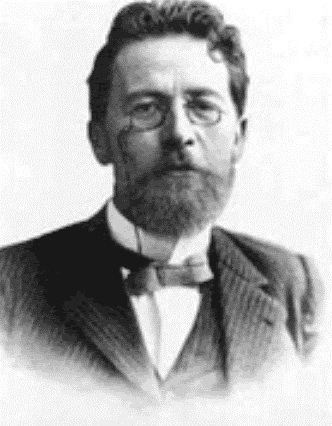
At Christmas Time
By Anton Chekhov
Translated by Mariam Fell 1915 -
"WHAT shall I write?" asked Yegor, dipping his pen in the ink.
Vasilissa had not seen her daughter for four years. Efimia had gone away to St. Petersburg with her husband after her wedding, had written two letters, and then had vanished as if the earth had engulfed her, not a word nor a sound had come from her since. So now, whether the aged mother was milking the cow at daybreak, or lighting the stove, or dozing at night, the tenor of her thoughts was always the same: "How is Efimia? Is she alive and well?" She wanted to send her a letter, but the old father could not write, and there was no one whom they could ask to write it for them.
But now Christmas had come, and Vasilissa could endure the silence no longer. She went to the tavern to see Yegor, the innkeeper's wife's brother, who had done nothing but sit idly at home in the tavern since he had come back from military service, but of whom people said that he wrote the most beautiful letters, if only one paid him enough. Vasilissa talked with the cook at the tavern, and with the innkeeper's wife, and finally with Yegor himself, and at last they agreed on a price of fifteen copecks.
So now, on the second day of the Christmas festival, Yegor was sitting at a table in the inn kitchen with a pen in his hand. Vasilissa was standing in front of him, plunged in thought, with a look of care and sorrow on her face. Her husband, Peter, a tall, gaunt old man with a bald, brown head, had accompanied her. He was staring steadily in front of him like a blind man; a pan of pork that was frying on the stove was sizzling and puffing, and seeming to say: "Hush, hush, hush!" The kitchen was hot and close.
"What shall I write?" Yegor asked again.
"What's that?" asked Vasilissa, looking at him angrily and suspiciously. "Don't hurry me! You are writing this letter for money, not for love! Now then, begin. To our esteemed son-in-law, Andrei Khrisanfltch, and our only and beloved daughter Efimia, we send greetings and love, and the everlasting blessing of their parents."
"All right, fire away!"
"We wish them a happy Christmas. We are alive and well, and we wish the same for you in the name of God, our Father in heaven--our Father in heaven--"
Vasilissa stopped to think, and exchanged glances with the old man.
"We wish the same for you in the name of God, our Father in Heaven--" she repeated and burst into tears.
That was all she could say. Yet she had thought, as she had lain awake thinking night after night, that ten letters could not contain all she wanted to say. Much water had flowed into the sea since their daughter had gone away with her husband, and the old people had been as lonely as orphans, sighing sadly in the night hours, as if they had buried their child. How many things had happened in the village in all these years! How many people had married, how many had died! How long the winters had been, and how long the nights!
"My, but it's hot!" exclaimed Yegor, unbuttoning his waistcoat. "The temperature must be seventy! Well, what next?" he asked.
The old people answered nothing.
"What is your son-in-law's profession?"
"He used to be a soldier, brother; you know that," replied the old man in a feeble voice. "He went into military service at the same time you did. He used to be a soldier, but now he is in a hospital where a doctor treats sick people with water. He is the door-keeper there."
"You can see it written here," said the old woman, taking a letter out of her handkerchief. "We got this from Efimia a long, long time ago. She may not be alive now."
Yegor reflected a moment, and then began to write swiftly.
"Fate has ordained you for the military profession," he wrote, "therefore we recommend you to look into the articles on disciplinary punishment and penal laws of the war department, and to find there the laws of civilisation for members of that department."
When this was written he read it aloud whilst Vasilissa thought of how she would like to write that there had been a famine last year, and that their flour had not even lasted until Christmas, so that they had been obliged to sell their cow; that the old man was often ill, and must soon surrender his soul to God; that they needed money--but how could she put all this into words? What should she say first and what last?
"Turn your attention to the fifth volume of military definitions," Yegor wrote. "The word soldier is a general appellation, a distinguishing term. Both the commander-in-chief of an army and the last infantryman in the ranks are alike called soldiers--"
The old man's lips moved and he said in a low voice:
"I should like to see my little grandchildren!"
"What grandchildren?" asked the old woman crossly. "Perhaps there are no grandchildren."
"No grandchildren? But perhaps there are! Who knows?"
"And from this you may deduce," Yegor hurried on, "which is an internal, and which is a foreign enemy. Our greatest internal enemy is Bacehus--"
The pen scraped and scratched, and drew long, curly lines like fish-hooks across the paper. Yegor wrote at full speed and underlined each sentence two or three times. He was sitting on a stool with his legs stretched far apart under the table, a fat, lusty creature with a fiery nape and the face of a bulldog. He was the very essence of coarse, arrogant, stiff-necked vulgarity, proud to have been born and bred in a pot-house, and Vasilissa well knew how vulgar he was, but could not find words to express it, and could only glare angrily and suspiciously at him. Her head ached from the sound of his voice and his unintelligible words, and from the oppressive heat of the room, and her mind was confused. She could neither think nor speak, and could only stand and wait for Yegor's pen to stop scratching. But the old man was looking at the writer with unbounded confidence in his eyes. He trusted his old woman who had brought him here, he trusted Yegor, and, when he had spoken of the hydropathic establishment just now, his face had shown that he trusted that, and the healing power of its waters.
When the letter was written, Yegor got up and read it aloud from beginning to end. The old man understood not a word, but he nodded his head confidingly, and said:
"Very good. It runs smoothly. Thank you kindly, it is very good."
They laid three five-copeck pieces on the table and went out. The old man walked away staring straight ahead of him like a blind man, and a look of utmost confidence lay in his eyes, but Vasilissa, as she left the tavern, struck at a dog in her path and exclaimed angrily:
"Ugh--the plague!"
All that night the old woman lay awake full of restless thoughts, and at dawn she rose, said her prayers, and walked eleven miles to the station to post the letter.
II
Doctor Moselweiser's hydropathic establishment was open on New Year's Day as usual; the only difference was that Andrei Khrisaufitch, the doorkeeper, was wearing unusually shiny boots and a uniform trimmed with new gold braid, and that he wished every one who came in a happy New Year.
It was morning. Andrei was standing at the door reading a paper. At ten o'clock precisely an old general came in who was one of the regular visitors of the establishment. Behind him came the postman. Andrei took the general's cloak, and said:
"A happy New Year to your Excellency!"
"Thank you, friend, the same to you!"
And as he mounted the stairs the general nodded toward a closed door and asked, as he did every day, always forgetting the answer:
"And what is there in there?"
"A room for massage, your Excellency."
When the general's footsteps had died away, Andrei looked over the letters and found one addressed to him. He opened it, read a few lines, and then, still looking at his newspaper, sauntered toward the little room down-stairs at the end of a passage where he and his family lived. His wife Efimia was sitting on the bed feeding a baby, her oldest boy was standing at her knee with his curly head in her lap, and a third child was lying asleep on the bed.
Andrei entered their little room, and handed the letter to his wife, saying:
"This must be from the village."
Then he went out again, without raising his eyes from his newspaper, and stopped in the passage not far from the door. He heard Efimia read the first lines in a trembling voice. She could go no farther, but these were enough. Tears streamed from her eyes and she threw her arms round her eldest child and began talking to him and covering him with kisses. It was hard to tell whether she was laughing or crying.
"This is from granny and granddaddy," she cried-- "from the village--oh, Queen of Heaven!-- Oh! holy saints! The roofs are piled with snow there now--and the trees are white, oh, so white! The little children are out coasting on their dear little sleddies--and granddaddy darling, with his dear bald head is sitting by the big, old, warm stove, and the little brown doggie--oh, my precious chickabiddies--"
Andrei remembered as he listened to her that his wife had given him letters at three or four different times, and had asked him to send them to the village, but important business had always interfered, and the letters had remained lying about unposted.
"And the little white hares are skipping about in the fields now--" sobbed Efimia, embracing her boy with streaming eyes. "Granddaddy dear is so kind and good, and granny is so kind and so full of pity. People's hearts are soft and warm in the village-- There is a little church there, and the men sing in the choir. Oh, take us away from here, Queen of Heaven! Intercede for us, merciful mother!"
Andrei returned to his room to smoke until the next patient should come in, and Efimia suddenly grew still and wiped her eyes; only her lips quivered. She was afraid of him, oh, so afraid! She quaked and shuddered at every look and every footstep of his, and never dared to open her mouth in his presence.
Andrei lit a cigarette, but at that moment a bell rang up-stairs. He put out his cigarette, and assuming a very solemn expression, hurried to the front door.
The old general, rosy and fresh from his bath, was descending the stairs.
"And what is there in there?" he asked, pointing to a closed door.
Andrei drew himself up at attention, and answered in a loud voice:
"The hot douche, your Excellency."
I hope you enjoyed this story. Tommorow I hope to post on a really fun Christmas story by Saki.
Showing posts with label Chekhov. Show all posts
Sunday, December 21, 2014
"At Christmas Time" by Anton Chekhov. 1900 (includes the full story)
Mel ü has asked me to take over The Reading Life until at least next year. I will be featuring a few classic Christmas stories, among other things.
"At Christmas Time" is set in Russia in 1900. I am somewhat familiar with this milieu through wintering on the Black Sea with Moma at one of Felix's palaces while Felix and Uncle Ruffy were touring Japan with Nicholas. To dispell any scandal mongers, yes my mother was once in service to the Maharani of Ragapour until she met my father Sheridan Boussweau, but that is a story for another day.
"At Christmas Time" is a very moving masterfully compressed short story that perfectly expresses the emotion of separation at Christmas and the depth of family bonds. As the story opens an older woman is telling her husband how much she misses her daughter whom she has not heard from for many years, ever since she married and moved away. She does not even know if she has grandchildren. Her and husband are illiterate but they know of a man who for a fee is known to write an elegant epistle. They go to the man and the old woman pours her heart out to him, telling him what she wants to say. She is in a panic as her heart is overflowing with what she wants to tell her daughter. Instead of actually listening the writer just sends a sort of form letter in which he says all is fine. When he learns the daughters husband is a security guard he includes really pompous and pointless career advice for military men even though he is not in the army.
In the second part of the story we see the daughter overwhelmed with emotion upon the arrival of the letter. She seems to fear her husband. In one heartbreaking line we learn the daughter had given her husband several letters over the years to her parents for him to mail, she thought they no longer cared about her as they never answered them, but in truth he did not want to spend the money for postage to mail them.
Chekhov compresses years of pain and longing in just a few pages.
I present to you the full story
Monday, January 7, 2013
Two Short Stories in Honor of Christmas in The Russian Orthodox Church
"A Russian Christmas Party" by Leo Tolstoy (1880, 12 pages)
"At Christmas Time" by Anton Chekhov (1904, 5 pages)
Leo Tolstoy (1828 to 1910) is universally considered the greatest novelist of all times. He also wrote a lot of very good short stories. "A Russian Christmas Party" is about just like what it sounds like it would be. It is a realistic slice of life showing the events, people and activities at a country Christmas party among what seem to be lower gentry provincial Russia. I left this story feeling like I had been to the party. Sometimes I think the only reason Tolstoy's work is not listed in greatest of all short story lists is that people are overpowered by the reading of his great novels and do not proceed on to his shorter works.
"At Christmas Time" by Anton Chekhov (1904, 5 pages)
In Honor of Eastern Orthodox Christmas Observations
Christmas Stories by Two Russian Masters
My guess is that if you did a survey as to why the birth of Jesus is observed on December 25 most would give the obvious answer that it was because that is the day on which he was born. In historical fact it is celebrated on that day because in the fourth century church leaders picked that date because it is nine months after the Roman winter solstice. I wondered why Christmas was observed by Ethiopian, Latvian, and Russian Orthodox Churches on January 6 or 7th rather than December 25. A bit of research found the answer for me. In 45 BC the Roman Empire adopted the Julian Calender and until 1582 when a degree by Pope Gregory VIII adopted a new calender it set the date for Christmas as Jan 6 or 7. It appears the Julian Calender was 11 minutes off in the times from one vernal equinox to the next. Easter was set in conjunction with the vernal equinox so this was causing instability in the liturgical calender. By 1758 the Julian Calender set Easter 10 days ahead based on synchronizing it with the vernal equinox. So it was mandated that the Calender be moved back by ten days. Eastern Orthodox churches which had early split from the Catholic Church did not adopt the Gregorian calender for liturgical purposes (though everyone uses it for practical reasons) so Christmas kept as was Jan 6 to the 7th in the mind of believers in the various Eastern Orthodox churches. This was and still is a matter of great importance to strict followers of the doctrines of the Eastern Orthodox Christian faiths. And this is why lots of people celebrate Christmas (Christ's Mass) on Jan 6 or 7th.
Anton Chekhov (1860 to 1904) has the undisputed title of World's Greatest Short Story Writer, with about 600 in his oeuvre. "At Christmas Time" is not one of his more famous story but it is very much a typical Chekhov short story and is a wonderful work of art. It is set in a small village. An older married couple are talking about their only child, a daughter. She married a soldier and he took her away and they have not heard anything about or from her for many years. They do not even know if they have grandchildren or not. This very moving story is about what happens when they hire the village scribe to send a series of ten letters to her daughter and her husband, they do know where she lives at least. The story shows the consequences for the parents as well as for the daughter and son-in-law. In just a very few pages Chekhov compresses many years.
Leo Tolstoy (1828 to 1910) is universally considered the greatest novelist of all times. He also wrote a lot of very good short stories. "A Russian Christmas Party" is about just like what it sounds like it would be. It is a realistic slice of life showing the events, people and activities at a country Christmas party among what seem to be lower gentry provincial Russia. I left this story feeling like I had been to the party. Sometimes I think the only reason Tolstoy's work is not listed in greatest of all short story lists is that people are overpowered by the reading of his great novels and do not proceed on to his shorter works.
This month on The Short Story Initiative hosted by Nancy C of A Simple Clockwork the theme is Russian short stories. This post is part of that event.
Monday, July 23, 2012
Anton Chekhov's First Short Story "Rapture"
"Rapture" by Anton Chekhov (1882, 6 pages, translated by Peter Russell, 2011)
There are only three more or less undisputed literary best of titles. Shakespeare is the best playwright, Tolstoy's War and Peace is the best novel and Anton Chekhov (1860 to 1904, Russia) takes the title of world's greatest short story writer. I have now decided to start another Reading Life Project, the short stories of Anton Chekhov. I will read through them in chronological order. I read yesterday "Rapture", Chekhov's very first short story.
As the story begins a wild and scruffy looking young man runs wildly into his parents apartment. His parents are alarmed by how excited he is and ask him what is wrong. He begins to wave a newspaper around says that now everyone in Russian will know his name. He is so excited he cannot contain himself and runs all over the apartment telling his siblings how famous he was going to be. Of course like any parent would, his are now going crazy wanting to know what he has done. He tells his father he thought only celebrities have articles in the paper about them. The poor father looks toward an icon and crosses himself he is so stressed now! The young man, who still has not told them what happened, tells his mother to save the paper so they can always recall this day.
His father begins reading the article aloud and it starts out saying the son was observed leaving a public house in a drunken state. He falls down and causes a bad accident in which he gets a blow to the head (which may explain why he is acting so crazy) from tripping and falling in front of a horse cab. The horse dragged a sledge over him. This is his big moment! The story ends with him running out to let the neighbors know of his great fame. I really enjoyed reading this story and it was exciting to see the start of the writing career of the world's greatest short story writer.
I also want to take this opportunity to be sure that my readers are aware of a wonderful electronic edition of the Complete Works of Anton Chekhov recently released by Delphi Classics. It contains all the short stories and novellas, his one novel, The Shooting Party, all of his plays, his complete letters and his notebooks. The short stories are indexed both in chronological order and alphabetical. There is an active table of contents. For those who like the idea of reading everything by an author, the Delphi editions are perfect. I think researchers and students would find the ability to search all of an author's works for key terms very useful. The volume contains some very well done information on Chekhov and some interesting photographs. The translations are a mix of Constant Garnett (Chekhov is often considered her best work) and others, including some brand new ones. I think a mix of translators is a very good idea.
You can learn more about Delphi Classics Edition on their webpage. For $2.99 you can have a complete edition of the works of Anton Chekhov
Mel u
There are only three more or less undisputed literary best of titles. Shakespeare is the best playwright, Tolstoy's War and Peace is the best novel and Anton Chekhov (1860 to 1904, Russia) takes the title of world's greatest short story writer. I have now decided to start another Reading Life Project, the short stories of Anton Chekhov. I will read through them in chronological order. I read yesterday "Rapture", Chekhov's very first short story.
As the story begins a wild and scruffy looking young man runs wildly into his parents apartment. His parents are alarmed by how excited he is and ask him what is wrong. He begins to wave a newspaper around says that now everyone in Russian will know his name. He is so excited he cannot contain himself and runs all over the apartment telling his siblings how famous he was going to be. Of course like any parent would, his are now going crazy wanting to know what he has done. He tells his father he thought only celebrities have articles in the paper about them. The poor father looks toward an icon and crosses himself he is so stressed now! The young man, who still has not told them what happened, tells his mother to save the paper so they can always recall this day.
His father begins reading the article aloud and it starts out saying the son was observed leaving a public house in a drunken state. He falls down and causes a bad accident in which he gets a blow to the head (which may explain why he is acting so crazy) from tripping and falling in front of a horse cab. The horse dragged a sledge over him. This is his big moment! The story ends with him running out to let the neighbors know of his great fame. I really enjoyed reading this story and it was exciting to see the start of the writing career of the world's greatest short story writer.
I also want to take this opportunity to be sure that my readers are aware of a wonderful electronic edition of the Complete Works of Anton Chekhov recently released by Delphi Classics. It contains all the short stories and novellas, his one novel, The Shooting Party, all of his plays, his complete letters and his notebooks. The short stories are indexed both in chronological order and alphabetical. There is an active table of contents. For those who like the idea of reading everything by an author, the Delphi editions are perfect. I think researchers and students would find the ability to search all of an author's works for key terms very useful. The volume contains some very well done information on Chekhov and some interesting photographs. The translations are a mix of Constant Garnett (Chekhov is often considered her best work) and others, including some brand new ones. I think a mix of translators is a very good idea.
You can learn more about Delphi Classics Edition on their webpage. For $2.99 you can have a complete edition of the works of Anton Chekhov
Mel u
Friday, April 6, 2012
"The Bishop" by Anton Chekhov The Most Irish of Chekhov's Stories
"The Bishop" by Anton Chekhov (1902, 16 pages)
March 11 to July 1
Stories about Priests
April 1 to April 6
Please consider joining us for this event.
"The Bishop" is a final affirmation of Chekhov's faith in life-lonely and sad, immeasurably sad, but beautiful beyond the power of the greatest artist to tell. Frank O'Connor
Anton Chekhov-1860 to 1904
From now until the end finally comes for Irish Short Story Week Year Two on July 1 (no more extensions) we will be having as our guests some of the greatest of the world's short stories authors. In order to be invited you do have to have an "Irish Connection" of some kind. Guests will stay on until the final event virtual party on July 2 at Dunsanny Castle. Thanks to the power of magic realism they will arrive in Dublin by the modes of transportation in their times and all those who need them will be provided translators and each guest will have a generous per expense account.
There are only really three claims for best of in the literary world that are undisputed. Shakespeare is the best playwright, War and Peace is the best novel and Anton Chekhov (1860 to 1904-Russia) is the greatest short story writer who ever lived. Frank O'Connor's took as his masters in the short story Chekhov and another Russian, Ivan Turgenev (we are working on getting him and Gustav Flaubert to come together). He taught a generation of Irish Short Story Writers to love Chekhov. James Joyce famously said O'Connor was doing for Ireland what Chekhov did for Russia.
Chekhov will arrive in London via Steamship from St Petersburg. He will spend a few days in London then proceed also by steamship to Dublin where he will be met at the docks by George Moore and William Carelton. The first order of business is a stop for some Jameson.
In The Best of Frank O'Connor edited and with commentary by Julius Barnes we are told that O'Connor said that "The Bishop", one of Chekhov's last stories, is virtually indistinguishable from an Irish short story.
The bishop in the story is of course Russian Orthodox.
"The Bishop" in the story is very sick. He is used to being called "Your Grace" and his manner really does not admit of exceptions to this. One of the themes of Chekhov is thk breaking down of false personalities through trauma. People become what they are. The bishops elderly mother comes to see him as her little boy under the skin of the bishop. It is somehow crushing to see the mother call her dying son "Your Eminence". As they both come to a realization as to what will soon happen the mother begins to call him by the words of childhood endearment that he longs to hear but cannot even admit this need to himself.
You can read "The Bishop"-translated by Costance Garnett-here
Here in the Philippines we believe that Manny Pacquiano is pound for pound the world's great greatest boxer ever. I often think that word for word, Anton Chekhov is the world's greatest writer.
I am pretty sure Ivan Turgenev will arrive in a day or so and will share with us his wonderful work "Father Alexyei's Story. Frank O'Connor in The Lonely Voice said two of Turgenev's short stories were the best of all time. Ford Madox Ford said his short fiction were among the greatest of all cultural treasures. Gustav Flaubert and Guy de Maupassant are hopefully coming with them, with Turgenev, of course, paying the costs of the trip. Flaubert wrote some wonderful short stories but not enough to be an active participant in our event. He will be here for the party on July 2.
Who would you like to see be invited as a guest for Irish Short Story Week?
The next mini-event will be four days of "Nobel Prize Winners Only Please", with George Bernard Shaw, William Butler Yeats, Samuel Beckett and a guest from India, Rabindranth Tagore with a very strong connection to Irish Literary Culture.
Mel u
Wednesday, September 21, 2011
The Cherry Orchard by Anton Chekhov
The Cherry Orchard by Anton Chekhov (1904, translated by Julian West)
My Prior Posts on Chekhov
The Cherry Orchard is the last of Anton Chekhov's (1860 to 1904-Russia) plays and in fact one of his very last works. Many regard it as among his best work. I first heard of it many years ago when I read as a teenager The Lifetime Reading Plan by Clifton Fadiman. I have posted a number of times on Chekhov so I will be quite brief in my comments on The Cherry Orchard.
The play is set on the estate of an aristocratic woman. The pride of her estate and the whole region is the beautiful cherry orchard on the property. The owner of the estate, a widow, has been living in France for the last five years, ever since her young son drowned. News reaches her daughter that her mother has tried to kill herself so she and her governess go to bring her back to the estate.
When the widow arrives back on her estate she finds a very bad situation. It is about to be sold at public auction for unpaid debts. A former serf on the estate, now a successful merchant devises a plan, and it sounded like a very good one to me. Sell of parcels of the estate for the construction of houses or summer cottages. This will allow all the debts to be paid and the family to stay on the estate. The only problem is the cherry orchard must be cut down. The widow will not allow this.
In the final act, the former surf is jubilantly announcing that he has bought the estate on which is father, grandfather and himself were once serfs, little more than slaves. The family has no real idea what they will do other than perhaps live with relatives.
The Cherry Orchard is about a society in transition. The old order is crumbling and in clinging to the past which allow it to be destroyed.
Historically, serfs were freed in 1861. Serfs were allowed to become merchants and a new class began to arise. Once many estate owners lost their free labor of the serfs, they could no longer run run them at a profit.
The Cherry Orchard is very well worth reading. It is a canon status work for sure. You can easily find it online.
I hope to read Three Sisters soon.
Mel u
My Prior Posts on Chekhov
The Cherry Orchard is the last of Anton Chekhov's (1860 to 1904-Russia) plays and in fact one of his very last works. Many regard it as among his best work. I first heard of it many years ago when I read as a teenager The Lifetime Reading Plan by Clifton Fadiman. I have posted a number of times on Chekhov so I will be quite brief in my comments on The Cherry Orchard. When the widow arrives back on her estate she finds a very bad situation. It is about to be sold at public auction for unpaid debts. A former serf on the estate, now a successful merchant devises a plan, and it sounded like a very good one to me. Sell of parcels of the estate for the construction of houses or summer cottages. This will allow all the debts to be paid and the family to stay on the estate. The only problem is the cherry orchard must be cut down. The widow will not allow this.
In the final act, the former surf is jubilantly announcing that he has bought the estate on which is father, grandfather and himself were once serfs, little more than slaves. The family has no real idea what they will do other than perhaps live with relatives.
The Cherry Orchard is about a society in transition. The old order is crumbling and in clinging to the past which allow it to be destroyed.
Historically, serfs were freed in 1861. Serfs were allowed to become merchants and a new class began to arise. Once many estate owners lost their free labor of the serfs, they could no longer run run them at a profit.
The Cherry Orchard is very well worth reading. It is a canon status work for sure. You can easily find it online.
I hope to read Three Sisters soon.
Mel u
Tuesday, September 13, 2011
"Ward 6" by Anton Chekhov
"Ward 6" by Anton Chekhov (1892, 56 pages, translated by Constance Garnett)
Welcome to BBAW Day Two
Reader's Suggestion Day
Today is interview posting day at BBAW. In 2009 I did an interview exchange but I did not do one in 2010 or this year. This does not mean I am ignoring BBAW today. In fact I am having my own mini-event, "Reader's Suggestion Day", where I am posting on three short stories I probably would never have read were it not for a suggestion from my readers. Earlier today I posted on two short stories about the Partition of India that readers from India suggested I read.
"Ward 6" by Anton Chekhov (1860 to 1904-Russia) was suggested to me by Amateur Reader of Wuthering Expectations. Amateur Reader has been a great source of reading ideas to me for the last two years.
"Ward 6" is a very dark work. It is set in a hospital in the Russian provinces during the 1890s. Ward 6 is the psychiatric section, it houses five patients. The story begins with a brilliant and quite darkly funny description of these five residents, one might call them inmates. The ward is overseen by a very rough porter who is not above beating his charges. We learn how a highly educated man, Ivan Gromov drove himself to madness and wound up in the hospital.
The doctor never really wanted to be a doctor, he wanted to be a priest, and he is getting increasingly unhappy with his work and life in general. He became a doctor to please his father. At first he tries to have conversations with his friend the postmaster but he does not find him "intellectual" enough. The doctor is very well read in literature and philosophy and he begins to have deep conversations with his patient, Ivan Gromov. The doctor seems to be losing his own grip on reality and a staff hearing is held on his mental fitness for work. The doctor is very insulted by this meeting and he takes a trip to Moscow with his friend the postmaster but it does not help. He becomes increasingly despairing and can find no value in life. (There are some really well done conversations about Stoicism in "Ward 6".) On his return he is tricked into visiting Ward 6 and when he gets ready to leave, finds he is locked in. He begins to reflect on the irony of this. He is beaten by the warder and he dies of a stroke the next day.
"Ward 6" is considered among the very best of Chekhov's work. There is nothing "cheerful" or "uplifting" about this story. It is a brilliant look at the mind of one man at his edge. It is also very interesting for the insight it gives us into the the medical system in late Czarist Russia.
The next Chekhov work I post on will probably be his drama, "The Cherry Orchard".
Amateur Reader has a very interesting post on Chekhov in which he lists his consensus best works.
Everytime I read Chekhov I tell myself I have to read much more of his work.
What is your favorite Chekhov work?
Do you have a favorite short story a reader of your blog suggested to you?
You can read "Ward Six" online HERE.
Mel u
Wednesday, August 17, 2011
The Seagull by Anton Chekhov
The Seagull by Anton Chekhov (1896, translated by Constant Garnett)
Chekhov's First Major Drama
In addition to being the consensus world's greatest short story writer, Anton Chekhov (1860-1904-Russian-there is some background information on him in my prior posts) had a major influence on the development of the modern theater. He wrote four major plays. Last week I posted on his Uncle Vanya, which I greatly enjoyed. I am going to keep this post very short as a lot of what I said about Uncle Vanya applies well to The Seagull (and also I am getting backed up in my reviews!)
As Chekhov has only four major dramas it makes sense to read them in order of first performance. Also The Seagull seems somewhat autobiographical as one of the characters is a short story writer.
There are four main characters in The Seagull. The play is about their relationships and their conversations about the nature of acting and writing. One of the character is a young woman trying to become an actress. Another is a still attractive but past her glory days actress and her adult son, an artistically self conscious playwright. The most interesting character was a famous short story writer who does not feel his work represents the kind of art he can produce. There are some very interesting long conversations about the nature of acting and writing that almost seem like Chekhov talking to us directly.
I read The Seagull at Dailylit.com. You can easily find it online lots of places.
I hope to read his Three Sisters and The Cherry Orchard soon.
Mel u
Mel u
Thursday, August 11, 2011
Uncle Vanya by Anton Chekhov
Uncle Yanya by Anton Chekhov (1899, a play in four acts)
My Prior Chekhov Posts
I always have the same thought in mind when I finish a work by Anton Chekhov (1860-1904-Russia, physician, probably best short story writer of all time-there is some background information on him in my prior posts). That thought is that I have to read much more of his work soon. Here in the Philippines we like to say that "pound for pound" Manny Pacquiao is the world's greatest boxer then maybe Chekhov word for word is the world's greatest writer.
Uncle Yanya is the first of his dramatic works that I have read. I decided to read it pretty much on impulse when I was browsing through the selections at Dailylit.com. I am very glad I did and have now put his other three major plays on my TBR list.
The play opens on a country estate. The conversation in the opening act begins with a discussion of how bored the doctor for the area is with his life. There are only nine characters so it is not that hard to keep them straight and each one has there own conversational style. We have the estate owner, a bored country doctor, a retired professor and his beautiful second wife, his daughter (the same age as his wife) and Uncle Vanya and a few others.
The drama in the play comes from the reaction of the characters to the retired professor. He is either a great genius or a typical academic time server depending on who is talking. There are some very interesting conversations with and about the beautiful young wife of the professor as to whether or not she can really love her much older husband.
The ending is tragic.
Uncle Vanya is a harsh look at sadness in the lives of the characters. It is about boredom. The characters in the play do speak in a way one would expect those in a Russian drama to speak.
There is no translator credit given for this work by Dailylit.com, maybe it is by Constant Garnett.
I really endorse this for anyone into his short stories or novellas. I would love to see it preformed. I think if it was you first exposure to his work you for sure would want to read more (unless you found the ending too bleak).
Please share your experience with Russian drama with us. The next play I will read will be Ghosts by Ibsen.
Mel u
No it is not Gillligan's Island set in the Steppes of Russia in the time of the Czar Nicholas II
My Prior Chekhov Posts
I always have the same thought in mind when I finish a work by Anton Chekhov (1860-1904-Russia, physician, probably best short story writer of all time-there is some background information on him in my prior posts). That thought is that I have to read much more of his work soon. Here in the Philippines we like to say that "pound for pound" Manny Pacquiao is the world's greatest boxer then maybe Chekhov word for word is the world's greatest writer.
Uncle Yanya is the first of his dramatic works that I have read. I decided to read it pretty much on impulse when I was browsing through the selections at Dailylit.com. I am very glad I did and have now put his other three major plays on my TBR list.
The play opens on a country estate. The conversation in the opening act begins with a discussion of how bored the doctor for the area is with his life. There are only nine characters so it is not that hard to keep them straight and each one has there own conversational style. We have the estate owner, a bored country doctor, a retired professor and his beautiful second wife, his daughter (the same age as his wife) and Uncle Vanya and a few others.
The drama in the play comes from the reaction of the characters to the retired professor. He is either a great genius or a typical academic time server depending on who is talking. There are some very interesting conversations with and about the beautiful young wife of the professor as to whether or not she can really love her much older husband.
The ending is tragic.
Uncle Vanya is a harsh look at sadness in the lives of the characters. It is about boredom. The characters in the play do speak in a way one would expect those in a Russian drama to speak.
There is no translator credit given for this work by Dailylit.com, maybe it is by Constant Garnett.
I really endorse this for anyone into his short stories or novellas. I would love to see it preformed. I think if it was you first exposure to his work you for sure would want to read more (unless you found the ending too bleak).
Please share your experience with Russian drama with us. The next play I will read will be Ghosts by Ibsen.
Mel u
Wednesday, June 22, 2011
Stories by Anton Chekhov, O. Henry, and Raymond Carver-
"Misfortune" by Anton Chekhov (1885, 16 pages, translated by Constant Garnett)
"Nobody Said Anything" by Raymond Carver (1988, 12 pages)
"A Municipal Report" by O. Henry (1909, 19 pages)
"Nobody Said Anything" by Raymond Carver (1988, 12 pages)
"A Municipal Report" by O. Henry (1909, 19 pages)
This morning I want to briefly post on three very different short stories by writers considered among the greatest of all short story writers.
Almost everyday I check out East of the Web:Short Stories to see what has been selected as the short story of the day. Normally they have one story from a high status author and one story that may not be real well known. They often have new stories as well. It was here I first discovered Katherine Mansfield. If you have some time to read and cannot think what to read, you might check out this web page. One of their stories of the day yesterday was "A Municipal Report" by O. Henry (1862-1910-USA-There is some background information on him in my prior posts on O. Henry.) I saw it was 19 pages and I at first thought that I did not want to read a 19 page story just to find out what the surprise ending might be. Then I recalled Jhumpa Lahiri had said he was one of the geniuses of the short story. I did some quick research and saw this story is often considered O. Henry's masterpiece. I hate to gush too much but this story is a quantum leap better than his other work. It is a work of genius that belongs among the world's best short stories. If all of O Henry's stories were this powerful nobody would think it was odd or patronizing to include him with Chekhov and Carver as a master of the short story. This story is about a traveling representative for a publishing house on his way to Nashville to renegotiate a contract with one of their authors. The characters in this story are whole people, not the semi-cartoon like characters in the other stories by O. Henry I have read. The characters are beautifully realized. There are some surprises in this story-maybe four of them-I loved them all. I know a lot of people are not going to be willing to read a 19 page O. Henry story, I almost did not. In my after read research I read that people say that if O. Henry was not a bit lazy and did not have to please magazine editors, then this is the kind of story he really was meant to write.
You can read "A Municipal Report" HERE
"Nobody Said Anything" by Raymond Carver (USA, 1938-1988-his very last short story was about the death of Anton Chekhov-it is flat out brilliant) is included in a collection of his short stories (32 in all) Where I'm Calling From" which contains many of his best stories. In the last few years of his life Carver reread the short stories of Chekhov and many say that this experience pushed Carver into a richer vein. (There is some background information on Carver in my prior posts). There is one thing in this story that surprised me-no one drinks in it! This story is about two brothers, their mother, their father (might be long time step-father) and a boy the older son meets when he goes fishing. There is also a woman in the story who picks up the older of the boys from the road and gives him a ride while he fantasies she will give him more than that. Carver is really good at adolescent sex fantasies. This is a great story. Carver shows what can be done with the short story form. I was kindly given an e-book of Where I'm Calling From by a very generous reader in New Delhi and will be reading and posting in at least a minimal way on the 29 stories in the collection I have not yet read.
Nearly everyone into the genre says Anton Chekhov (1860-1904-Russia) is among if not the very best short story writer in the world. (There is some background information on him in my prior posts on him.) "Misfortune" is an acutely observed story about a man in love with or with a sexual obsession for the wife of a friend. The real brilliance of the story is in the depiction of the wife and her reactions at various states in the relationship.
You can read "Misfortune" here.
All of these stories are very much worth your time. If you are really into the short story and kind of look down on O Henry (OK I did before today) and can read only one of these three stories today, then please read his and come back and tell me what you think please!
If you are hoping to be short listed for the 2012 Caine Prize award, read all the Carver you can. If you confine yourself only to the greatest of literature, then read the Chekhov story.
Mel u
You can read "A Municipal Report" HERE
"Nobody Said Anything" by Raymond Carver (USA, 1938-1988-his very last short story was about the death of Anton Chekhov-it is flat out brilliant) is included in a collection of his short stories (32 in all) Where I'm Calling From" which contains many of his best stories. In the last few years of his life Carver reread the short stories of Chekhov and many say that this experience pushed Carver into a richer vein. (There is some background information on Carver in my prior posts). There is one thing in this story that surprised me-no one drinks in it! This story is about two brothers, their mother, their father (might be long time step-father) and a boy the older son meets when he goes fishing. There is also a woman in the story who picks up the older of the boys from the road and gives him a ride while he fantasies she will give him more than that. Carver is really good at adolescent sex fantasies. This is a great story. Carver shows what can be done with the short story form. I was kindly given an e-book of Where I'm Calling From by a very generous reader in New Delhi and will be reading and posting in at least a minimal way on the 29 stories in the collection I have not yet read.
Nearly everyone into the genre says Anton Chekhov (1860-1904-Russia) is among if not the very best short story writer in the world. (There is some background information on him in my prior posts on him.) "Misfortune" is an acutely observed story about a man in love with or with a sexual obsession for the wife of a friend. The real brilliance of the story is in the depiction of the wife and her reactions at various states in the relationship.
You can read "Misfortune" here.
All of these stories are very much worth your time. If you are really into the short story and kind of look down on O Henry (OK I did before today) and can read only one of these three stories today, then please read his and come back and tell me what you think please!
If you are hoping to be short listed for the 2012 Caine Prize award, read all the Carver you can. If you confine yourself only to the greatest of literature, then read the Chekhov story.
Mel u
Friday, May 27, 2011
Anton Chekhov-Two Stories from 1886-Virginia Woolf-"The Russian Point of View"
"The Husband" by Anton Chekhov (1886, 4 pages)
"The Chorus Girl" by Anton Chekhov (1886, 5 pages)
"The Russian Point of View" by Virginia Woolf (1925, 4 pages-essay)
The Reading Life Virginia Woolf Project
Every time I read a work by Anton Chekhov (1860 to 1904-Russia) I tell myself I need to read more of his work. (So far I have posted on two of his short stories and one of his short novels, My Life.) He has a good claim to the title "world's best short story author". Frank O'Connor devotes a chapter to Chekhov in his The Lonely Voice-A Study of the Short Story. I plan to return to Chekhov soon and look at the stories O'Connor talks about. Today I just want to talk briefly about two of his short stories from 1886 and an essay by Virginia Woolf on the major Russian writers.
"The Husband" and "The Chorus Girl" have some important similarities. Both stories are about marital infidelity and the reactions of the victimized spouses. In "The Husband" a wife may not actually commit adultery but she clearly behaves in a way that it outside the bounds of proper wifely behavior. In "The Chorus Girl" a husband does commit adultery with a chorus girl. In both stories Chekhov shows us how guilt is used to punish straying spouses.
"The Husband" is centered in a small town in Czarist Russia. Something very exciting is going to happen soon. A military regiment will be staying in the town for a while. The tavern owners, food suppliers, drink merchants, and brothels all know they will make a lot of money. All of the women of the town (single and married) are very excited over a big party that has been announced. The wife in the story has been married a few years but she still feels she is attractive. She goes to the party with no intention but to have a good time and one must admit have her sense of self worth validated by having the young soldiers show interest in her. On the dance floor she feels more beautiful than she has for years. Her husband goes to the party looking for her. He drags her out and we see the terrible consequences that the husband's condemnation has on the wife. The wife is not a fully innocent party. As the story closes we know she will pay a life long price for one evening of good times.
You can read "The Husband" HERE
"The Chorus Girl" is a very interesting study in the uses of guilt to manipulate people and the penalties the wronged can extract from those who stray from conventional morality. Chorus girls in the 1880s were sort of the exotic dancers of their day. Even if nothing happens, no husband wants to have to explain to his wife what his relationship with a chorus girl might be. Married women assume chorus girls are gold diggers if not out right prostitutes and treat them that way. This is really a brilliantly told story. In just a few pages it has clear exposition of the lives of the characters, it has drama (a married man is having an affair with a chorus girl) and it has a big development when his wife confronts the chorus girl. The wife demands to know what presents he has given her and how much money she has received from her husband. The wife will not allow herself to believe it when the chorus girl tells her she has real feelings for the husband and has never been paid at all. Maybe what happens next is sad or maybe it is poetic justice but you will have to read this great story to find out.
"The Chorus Girl" can be read HERE
In her 1925 essay included in her The Common Reader, "The Russian Point of View" Virginia Woolf talks about Tolstoy, Dostoevsky, and Chekhov. (She does not mention Turgenev.) I really do not feel comfortable paraphrasing Woolf. She gives us a brilliant account of the power of each of the three great Russian writers. Dostoevsky for his capture of the soul, Tolstoy for his panoramic creations and his great sanity and Chekhov (she spells it Tchekov") for his minute observations and incredibility subtle observations and his creation of whole worlds in a few pages.
You can read her essay HERE
Both of these stories center on guilt. In just a few pages they bring marriages in the provinces of Czarist Russia to life for us. More than this, even if you have no idea when or where the stories take place, you will still feel their power.
No translated by credit is given for the stories but I think it is Constance Garnett.
Do you have a favorite Chekhov story?
Mel u
"The Chorus Girl" by Anton Chekhov (1886, 5 pages)
"The Russian Point of View" by Virginia Woolf (1925, 4 pages-essay)
The Reading Life Virginia Woolf Project
Every time I read a work by Anton Chekhov (1860 to 1904-Russia) I tell myself I need to read more of his work. (So far I have posted on two of his short stories and one of his short novels, My Life.) He has a good claim to the title "world's best short story author". Frank O'Connor devotes a chapter to Chekhov in his The Lonely Voice-A Study of the Short Story. I plan to return to Chekhov soon and look at the stories O'Connor talks about. Today I just want to talk briefly about two of his short stories from 1886 and an essay by Virginia Woolf on the major Russian writers.
"The Husband" and "The Chorus Girl" have some important similarities. Both stories are about marital infidelity and the reactions of the victimized spouses. In "The Husband" a wife may not actually commit adultery but she clearly behaves in a way that it outside the bounds of proper wifely behavior. In "The Chorus Girl" a husband does commit adultery with a chorus girl. In both stories Chekhov shows us how guilt is used to punish straying spouses.
"The Husband" is centered in a small town in Czarist Russia. Something very exciting is going to happen soon. A military regiment will be staying in the town for a while. The tavern owners, food suppliers, drink merchants, and brothels all know they will make a lot of money. All of the women of the town (single and married) are very excited over a big party that has been announced. The wife in the story has been married a few years but she still feels she is attractive. She goes to the party with no intention but to have a good time and one must admit have her sense of self worth validated by having the young soldiers show interest in her. On the dance floor she feels more beautiful than she has for years. Her husband goes to the party looking for her. He drags her out and we see the terrible consequences that the husband's condemnation has on the wife. The wife is not a fully innocent party. As the story closes we know she will pay a life long price for one evening of good times.
You can read "The Husband" HERE
"The Chorus Girl" is a very interesting study in the uses of guilt to manipulate people and the penalties the wronged can extract from those who stray from conventional morality. Chorus girls in the 1880s were sort of the exotic dancers of their day. Even if nothing happens, no husband wants to have to explain to his wife what his relationship with a chorus girl might be. Married women assume chorus girls are gold diggers if not out right prostitutes and treat them that way. This is really a brilliantly told story. In just a few pages it has clear exposition of the lives of the characters, it has drama (a married man is having an affair with a chorus girl) and it has a big development when his wife confronts the chorus girl. The wife demands to know what presents he has given her and how much money she has received from her husband. The wife will not allow herself to believe it when the chorus girl tells her she has real feelings for the husband and has never been paid at all. Maybe what happens next is sad or maybe it is poetic justice but you will have to read this great story to find out.
"The Chorus Girl" can be read HERE
In her 1925 essay included in her The Common Reader, "The Russian Point of View" Virginia Woolf talks about Tolstoy, Dostoevsky, and Chekhov. (She does not mention Turgenev.) I really do not feel comfortable paraphrasing Woolf. She gives us a brilliant account of the power of each of the three great Russian writers. Dostoevsky for his capture of the soul, Tolstoy for his panoramic creations and his great sanity and Chekhov (she spells it Tchekov") for his minute observations and incredibility subtle observations and his creation of whole worlds in a few pages.
You can read her essay HERE
Both of these stories center on guilt. In just a few pages they bring marriages in the provinces of Czarist Russia to life for us. More than this, even if you have no idea when or where the stories take place, you will still feel their power.
No translated by credit is given for the stories but I think it is Constance Garnett.
Do you have a favorite Chekhov story?
Mel u
Thursday, May 19, 2011
"Misery" by Anton Chekhov versus "The Life of Ma Parker" by Katherine Mansfield
"Misery" by Anton Chekhov (1886, 5 pages, translated by Constant Garnett)
"The Life of Ma Parker" by Katherine Mansfield (1921, 4 pages)-a second look
A Look at One of Tolstoy's Favorite Chekhov Stories
and
How wrong is Frank O'Connor
about Katherine Mansfield?
How wrong is Frank O'Connor
about Katherine Mansfield?
Frank O'Connor in The Lonely Voice: A Study of the Short Story says some things about Katherine Mansfield that seem, I read them a second time, very nasty, homophobic, sexist and just flat out stupid. Ordinarily I just dismiss such views but O'Connor is too brilliant to really allow me to do that. O'Connor writing in his 1960 lectures (published in 1961) says of Mansfield
"Most of her work seems to me to be that of a clever, spoiled, malicious woman. Though I know nothing that would suggest she had any homosexual experiences, the assertiveness, malice, and even destructiveness in her life and work make me wonder whether she hadn't"
Speaking of Mansfield's numerous relationships with men he says "but the idea of experience by which she justified them is a typical expedient of a woman with a homosexual streak who envies men and attributes their imagined superiority to the greater freedom with which they satisfy their sexual appetites".
He says Mansfield has the worldliness of permanent adolescence...that she is always writing about her amorous orgies..there is one quality that is always missing in almost everything she wrote and that is "heart". He says Mansfield has no more a feel for the poor than Dickens does. He says to Mansfield the lower classes are merely people with improper pronunciations.
Frank O'Connor says, and no one would argue with this, that Mansfield was heavily influenced by Chekhov (1860 to 1904-Russia.) Mansfield may well have in one case taken the plot of an at the time untranslated Chekhov story and used the plot lines to create her own story without giving Chekhov credit. Mansfield scholars say there is proof of this and I accept it. I do not see it as a "big deal" though in a perfect world such things should not happen. O'Connor jumps from this one fact to assuming that any Mansfield story that in any way resembled a Chekhov story is basically a lifted plot.
"Misery" was one of Leo Tolstoy's favorite Chekhov stories. O'Connor says it is among his very best stories. I really found it a powerful look at the very deep sadness in the life of a Russian horse cab driver. As the story opens the cab driver has just picked up a fare. As he drives he tries to tell his customer (being able to afford a horse cab already sets you out as having a bit of money) that his son, all he had in life, has very recently died. His passenger basically says :"Oh too bad but watch how you are driving". His next passengers are three young men out for a night on the town. In a really masterful scene which helped me see a bit of the greatness of Chekhov, the young men knowingly offer him an unfair fee for their proposed cab ride and he accepts it. The young men are abusive to him throughout the ride. We know he has always been abused by his customers. He needs badly to talk to someone about his son's death. The three men, death is so remote to the young, could not care less and basically tell him to mind the road and not to blather on. At the end of the story, he tells his horse what has happened.
"The Life of Ma Parker" by Katherine Mansfield (1888 to 1923-New Zealand) (I posted on it in October, 2010) is about a seemingly ancient maid doing her once a week cleaning job in the house of a what is called a "literary gentlemen". (I am sure this gentlemen is probably meant as a jibe at someone in Mansfield's life but I do not know who-If you do please leave a comment or e mail me.) Ma Parker (as everyone calls her) her was sent into service at 14 as scullery maid to a cruel cook, had 12 children half of whom died as children, and a life of hard work cleaning up after others. I do not see how O'Connor can say Mansfield knew nothing or felt nothing for the poor. (Maybe O'Connor knew her father was the chairmen of the Bank of New Zealand and just saw Mansfield as poor little rich girl playing at artistic poverty-maybe he was jealous of her as by 1960 her readership far exceeded his own). After reading the story for a second time I would now change my post on it a bit but basically I stand by what I said last year. There are other stories like "A Cup of Tea" that amply show that Mansfield could portray the poor without condescension. As to O'Connor's claim that the stories of Mansfield do not at all deal with members of "submerged groups" this seems almost blind. Many of Mansfield's stories are about a single woman without great means trying to live in a country or a place that is not her home. The fact that Mansfield had a way out of her poverty if she wanted it is probably why O'Connor feels her stories are inauthentic. I think O'Connor goes too far in wanting an author to somehow earn the right to produce their stories by their own life. It is as if one cannot write a story set in a war if one has not been in a war.
O'Connor also makes the common mistake of seeing her work as somehow reaching an artistic peak just before she died. This is just reverse literary engineering. It was interesting to learn from O'Connor how the literary world viewed Mansfield's husband John Middleton Murry. O'Connor does love some of Mansfield's work (I know I am myself going to be prejudiced against anyone who says anything bad about Katherine Mansfield so I try to discount my feelings) and says "The Prelude" is among the best short stories ever written.
I totally endorse both of these stories. You can ponder the claim that Mansfield lifted her plot from "Misery".
You can read "Misery" HERE
There is a link to "The Life of Ma Parker" in my post on it.
I know I need to read much more Chekhov and I hope to over the next 12 months.
Please feel free to leave a comment about my opening question.
O'Connor is a brilliant expositor of the short story, especially when it is by a writer of the type he is comfortable with. It is kind of a sad irony to me that O'Connor focuses so much on "submerged groups" in his analysis of the short story but so full of prejudice against Jews and women who dare to assert themselves
People are a product of their times. Still I find it hard to imagine in 1960 in Stanford University in California people did not feel inclined to walk out on him.
I still endorse the reading of The Lonely Voice-A Study in the Short Story. Parts of it are really brilliant and inspired me to read on and on in the short story. I learned a lot from his book even though I think he is very wrong about much of what he says about Mansfield. I think O'Connor even though he was lecturing in 1960 was thinking in 1930.
OK enough bashing-if anyone has read this far please say hello!
Mel u
O'Connor also makes the common mistake of seeing her work as somehow reaching an artistic peak just before she died. This is just reverse literary engineering. It was interesting to learn from O'Connor how the literary world viewed Mansfield's husband John Middleton Murry. O'Connor does love some of Mansfield's work (I know I am myself going to be prejudiced against anyone who says anything bad about Katherine Mansfield so I try to discount my feelings) and says "The Prelude" is among the best short stories ever written.
I totally endorse both of these stories. You can ponder the claim that Mansfield lifted her plot from "Misery".
You can read "Misery" HERE
There is a link to "The Life of Ma Parker" in my post on it.
I know I need to read much more Chekhov and I hope to over the next 12 months.
Please feel free to leave a comment about my opening question.
O'Connor is a brilliant expositor of the short story, especially when it is by a writer of the type he is comfortable with. It is kind of a sad irony to me that O'Connor focuses so much on "submerged groups" in his analysis of the short story but so full of prejudice against Jews and women who dare to assert themselves
People are a product of their times. Still I find it hard to imagine in 1960 in Stanford University in California people did not feel inclined to walk out on him.
I still endorse the reading of The Lonely Voice-A Study in the Short Story. Parts of it are really brilliant and inspired me to read on and on in the short story. I learned a lot from his book even though I think he is very wrong about much of what he says about Mansfield. I think O'Connor even though he was lecturing in 1960 was thinking in 1930.
OK enough bashing-if anyone has read this far please say hello!
Mel u
Sunday, April 11, 2010
"A Doctor's Visit" by Anton Chekhov
"A Doctor's Visit" By Anton Chekhov (15 pages)-read on line at Dailylit.com
I have recently begun to overcome my life time aversion to short stories. My first answer as to why I do not like short stories is that they are "too short". By this I mean I want my reading to take me to another world sometimes and short stories did not seem able to do that by the very nature of the form. I have found what is for me a great way to read short stories by a number of authors. That is through Dailylit.com. This is a very well known and highly regarded web page that provides, for free (you will need to register so they can have an E mail address) a great many literary works as well as a large number of non-fiction selections. They will E mail you every day about 3 to 5 minutes of the work you have subscribed to (if you ask they will send the next section at once and you can also get the story in your Google Reader). I do not really think I am inclined to read a very long work this way but it is great for short stories. They have as one of their new selection in the short story category "Classic Shorts: Eight Stories for the Summer". Here are the selections
A Doctor's Visit by Anton Chekhov
A Respectable Woman by Kate Chopin
The Jelly-Bean by F. Scott Fitzgerald
The Yellow Wallpaper by Charlotte Perkins Gilman
Bartleby the Scrivener by Herman Melville
The Pit and the Pendulum by Edgar Allan Poe
Ivan the Fool by Leo Tolstoy
Author! by P. G. WodehouseOf these stories, I have recently posted on Bartleby the Scrivener. I have so far never read anything by Kate Chopin, Charlotte Gilman, or P. G. Wodehouse . I will be rereading and probably posting on all these stories in the near future.
"A Doctor's Visit" by Anton Chekhov (1860 to 1904) seems for sure to be a Constant Garnett Translation. (All of her translations are now in the public domain and her translation of Chekhov -considered her best work-can all be found on line) is the story of the visit of a Doctor who lives near Moscow to see the daughter of a very well of widow who owns a huge factory employing 1000s. The daughter has an general complaint of not feeling well. She cannot articulate exactly what is wrong. The Doctor finds nothing physically wrong with her. He finds out the factory doctor is treating her and he tells the Widow there is nothing seriously wrong with her daughter and the factory doctor can handle it. He prepares to leave and the Widow insists that he stay for the night. (Remember this is Russia late 19th century so the request is normal). The power in this story is in the stream of consciousness of Doctor.
The Widow and her daughter have become very wealthy and live a life of luxury through the labors of the factory workers. The Widow thinks the factory workers (near serfs in many cases) are quite happy as they have festivals and such for them periodically. She can in no sense identify with the workers, this is a marvelous bit of pure Chekhov in which the Doctor reflects on the relationship of the Widow to the factory workers
"There is something baffling in it, of course . . ." he thought, looking at the crimson windows.
Fifteen hundred or two thousand workpeople are working without rest in unhealthy surroundings, making bad cotton goods, living on the verge of starvation, and only waking from this nightmare at rare intervals in the tavern; a hundred people act as overseers, and the whole life of that hundred is spent in imposing fines, in abuse, in injustice, and only two or three so-called owners enjoy the profits, though they don't work at all, and despise the wretched cotton. But what are the profits, and how do they enjoy them? Madame Lyalikov and her daughter are unhappy--it makes one wretched to look at them; the only one who enjoys her life is Christina Dmitryevna, a stupid, middle-aged maiden lady in pince-nez."
He comes to see the complaint of the daughter, of marriageable age and the Doctor feels the lack of a husband may be part of her problem, as caused by her guilt over the slavery of the factory workers with the end only of enriching her and her mother. The Doctor sees her as new generation of rich Russian beginning to see the injustices in their society. Chekhov is the master of the small detail and this short story does really create a world we can enter.
The theoretical focus of my blog is the literary treatment of people whose lives are at least partially centered on reading. The daughter in this story read all the time. The daughter tells us this about her Reading Life:
"I am lonely. I have a mother; I love her, but, all the same, I am lonely. That's how it happens to be. . . . Lonely people read a great deal, but say little and hear little. Life for them is mysterious; they are mystics and often see the devil where he is not. Lermontov's Tamara was lonely and she saw the devil."
This is something to think about. Maybe we will agree in part at least.
Chekhov is considered one of the great master of the short story. He also wrote some plays and novellas. I read last year his novella My Life. Chekhov was a medical doctor and a number of his stories center on doctors. He was known for giving a great deal of free medical care to the poor.
Monday, November 2, 2009
"My Life" by Anton Chekhov-November Novella Challenge
I began to look through my books on hand to see what I could read for the challenge. I wanted to pick something worthy of the challenge. At first I thought I would read Hard Boiled by one of my favorite Japanese writers, Banana Yoshimoto as I wanted to read it soon and I could include it among my reviews for the Japanese Literature 3 Challenge. I decided I should give this new challenge the respect of dedicating a work to it only. I saw The Complete Short Novels of Anton Chekhov, translated by Richard Peavear and Larissa Volokhonsky (2005-Vintage Press-originals from 1888 to 1896). In early in 2008 I read two novellas from this collection. "The Steppes" is a simply wonderful account of a journey across the great steepes of late 19th century Russian by a young noble boy of 12 or so who is being escorted to a boarding school by two of the family servants. The trip is very long. All sorts of dangers are encountered and imagined. We really get the feel of just how huge the Russian steppes must have felt to those who traveled through them in the late 19th century. We also see class struggles, stay at some pretty scary inns, eat some very strange to me food, and feel some real fear at night in he total blackness of the steppes. I also read "The Story of an Unknown Man", a very sharply observed study in bad faith about a man who becomes a servant on a rich family so he can spy on them to aid those wishing to overthrow the Czarist system.
Once I read these lines at the opening of "My Life" in which he describes his early job experience I knew I would enjoy reading it.
As the story begins Misail, the son of an architect from a noble family in small town Russia in the 1890s decided, to the horror of his father, that it is morally imperative that he become a laborer. His father threatens to disown him for this. In the introduction to the collection Richard Prevear says that the story can be seen as in part a reaction to Tolstoy's belief that the true virtue of Russia resided in its peasants.
The story is told in the first person by Misail. We see the real difficulties he has in moving from the life of a pampered son of a noble man to the life of a common laborer. As he adjusts he discovers that the corruption which so offended him in the upper echelons of society are mirrored at its lowest levels. The noble worker might be seen as a myth believed in by sons of noblemen whose leisure time to reflect is built on the backs of the very peasants they idealize, without every knowing one. There are some philosophical and political debates between characters in My Life however they do not go on forever. The conversations in the work are long enough to be interesting but not long enough to lose credibility as an actual conversation between real people.
We get a good look at life in small town Russia as Misail goes through a number of jobs. (He is not very good at holding onto a job.) He has romances with three very different women. His father tries to scare him back to respectability with the Czarist secret police. We get to know his sister. We learn how painting contracts were completed and how one got a job as a clerk on the railroad. The characters are well done and the narrative is well paced. The narrator is not a complaining son of a noble. Maybe his decision was not the right one but he makes the best of it and gets on with his life.
I liked this novella a lot. There are no very long meditative interludes, no thirty pages conversations about the meaning of life ( I am not saying these things are bad and in the right hands they are great but we do not always feel like them!). My Life is not Russian Lit Lite. It is a work of art that will pay us back well for the time we invest in it. To me it is classic work of literature that all can enjoy.
Mel u
Subscribe to:
Posts (Atom)
Featured Post
Imperial Reckoning: The Untold Story of Britain’s Gulag in Kenya by Caroline Elkins - 2005 - 701 Pages
Imperial Reckoning: The Untold Story of Britain’s Gulag in Kenya by Caroline Elkins - 2005 - 701 Pages 2006 Pulitzer Prize Winner From...
-
Buriedinprint.com This year, Buried in Print, a marvelous blog I have followed for over ten years,is doing a read through of the short sto...
-
Book Blogger Appreciation Week Sept 13 to Sept 17-2010-Giveaway- Katherine Wish by Linda Lappin Leave a comment to win! Open to all f...
-
Nothing Can Destroy the Faith and Strength of the people of the Philippines -Mel u, November 10, 2013- comments welcome. "How My B...


.jpg)