Short Stories of the Indian Subcontinent
A Reading Life Project
 Amrita Pritam
1919 to 2005
"And then it occurred to Raji that writing a poem was like stealing an apple from Eden. Adam stole and apple and lost his paradise forever. A man who writes a poem may keep his mind, but a part of his mind is forever banished from this world."
There is no literary culture with roots older than that of India. I will always admire Edmund Burke for telling the English that they had no right to govern a region whose culture is much older than theirs. Some of the writers featured will be internationally famous, such as Salmon Rushdie, Saadat Manto, and R. K. Narayan but most of the writers I post on will be authors on whom there are no prior book blog posts. There are numerous books and academic conferences devoted to exploring the colonial experiences of India and Ireland and I will look these stories partially as post colonial literature. My main purpose here is just to open myself up to a lot more new to me writers and in this case most will be new to anyone outside of serious literary circles in the region. Where I can I will provide links to the stories I post on but this will not always be possible.
1919 to 2005
My posts on Indian Short Stories are endorsed by The Economic Times of India
"And then it occurred to Raji that writing a poem was like stealing an apple from Eden. Adam stole and apple and lost his paradise forever. A man who writes a poem may keep his mind, but a part of his mind is forever banished from this world."
There is no literary culture with roots older than that of India. I will always admire Edmund Burke for telling the English that they had no right to govern a region whose culture is much older than theirs. Some of the writers featured will be internationally famous, such as Salmon Rushdie, Saadat Manto, and R. K. Narayan but most of the writers I post on will be authors on whom there are no prior book blog posts. There are numerous books and academic conferences devoted to exploring the colonial experiences of India and Ireland and I will look these stories partially as post colonial literature. My main purpose here is just to open myself up to a lot more new to me writers and in this case most will be new to anyone outside of serious literary circles in the region. Where I can I will provide links to the stories I post on but this will not always be possible.
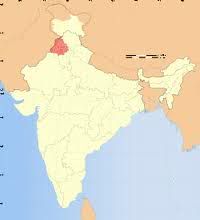
Amrita Pritam (1919-2005-She was born in Pakistan) is considered the first prominent Punjabi woman writer. She wrote poems, essays, novels and short stories. Her work is highly regarded in both India and Pakistan. Punjab before the partition of India was in Northwestern India. There is now a Punjab state in both Pakistan and India. The Punjab region is home to some of the world's oldest civilizations. There are around 100,000,000 million speakers of Punjabi today. Some of the worst impact of the partition of India was felt by the Punjabi people whose homeland was divided up by Pakistan and India. When India was partitioned Pritam moved from Lahore in what is now Pakistan to India. She was of the Sikh faith and this is why she moved to India. She won many literary awards and is known as the voice for Punjabi women. She married and divorced. She worked for several years for all India Radio and edited for 33 years a literary magazine. She was also fluent and wrote in Hindi. Toward the end of her life she became a follower of Bhagwan Shree Rajneesh, an internationally known spiritual teacher.
"The Birth of a Poem" is a very beautiful story that enters into the creative processes behind the writing of a poem. The story begins with the poet staring at a blank sheet of paper. He thinks of the words of Sartre "When I write I try to capture a certain beauty in a web of despair". Raji, the poet, tells himself that he tries to capture despair in a web of beauty. Raji can find no despair in his heart. I love this line "He felt like a vigilante in a cemetery". Ravi tries to ponder the origins of poems, they are like earthworms, born of hot soil and out of heated minds. Raji thinks on and on regarding the nature of poetry. He needs to find something or someone that can agitate him deep enough to produce a soil from which poetry could arise. He finds it in a lust for his wife's fourteen year sister. (I think we need to be less judgemental in our reaction to older men and young girls in reading older short stories from the Indian subcontinent as women were considered marriageable at 14 and old maids at 21.)
"The Birth of a Poem" is a very interesting story for its account of the creative process. I read it in
Best Indian Short Stories, Vol 1,edited by Khushwant Singh. As far as I know it cannot be read online.
Mel u
The Reading Life
@thereadinglife
Mel u
The Reading Life
@thereadinglife