Showing posts with label Maeve Brennan. Show all posts

Friday, March 27, 2020

A Snowy Night on West Forty-Ninth Street by Maeve Brennan


March 1 to March 31
A Guest Post by Elizabeth MacDonald
author of
A House of Cards

on
"A Snowy Night on West Forty-Ninth Street"  by Maeve Brennan 

If you are interested in participating in Irish Short Story Month, please e mail me.

I first became acquainted with the work of Elizabeth MacDonald when I read her brilliant collection of short stories, A House of Cards.  A House of  Cards  was listed for the Frank O'Connor Prize in 2007.   It is a beautiful work set mostly in the Tuscany region of Italy. 


author bio


Elizabeth MacDonald was born in Dublin, where she studied Italian and Music at UCD. In 2001 she completed the M.Phil in creative and Music at UCD. In 2001 she completed the M.Phil in creative writing at Trinity College, Dublin. She teaches English at the University of Pisa, where she lives with her husband and son. Her translations of the short stories of Liam O'Flaherty were the first in Italy. She has translated the poetry of Dermot Healy, Seamus Heaney, Brendan Kennelly, Dennis O’Driscoll, George Szirtes, Derek Mahon, and Old Irish nature poetry. She has a special interest is the poetry of Mario Luzi. Her translations have appeared in  many journals, including Modern Poetry in Translation, Poetry Ireland Review, The Cork Liteary Review andSoglie. A House of Cards was first published by Pillar Press in 2006 and a second edition will be published by Portia Publishing later this year.
“This is a tender, understated and beautiful collection of stories that will leave you longing for more. ” Emma Walsh, The Irish Book Review.  

Today she has favored us with her thoughts on the work of another great Irish woman writer, who like herself, spent much of her life outside of Ireland, Maeve Brennan.


A Snowy Night on West Forty-Ninth Street
by Maeve Brennan
(taken from ‘The Rose Garden’)

Reading this story is like being able to enter into a painting by Hopper, one of those late night scenarios with people in their solitude etched against a background of hotel rooms or diners. The narrator opens the story with a detail, it has snowed, and then tells us where we are – Broadway. The detail is in the past tense, while the setting is in the present. This juxtaposition is maintained for the whole story, giving it an otherworldly dimension as, like the snow hovering over the city, it fluctuates between a narrated event and the universality of experience:

It snowed all night last night, and the dawn, which came not as a brightening but as a gray and silent awakening, showed the city vague and passive as a convalescent under light fields of snow that fell quickly and steadily from an expressionless heaven.


The narrator then tells us that the area where she (I’m presuming it’s a ‘she’) lives near Broadway “seems to be a gigantic storehouse of stage flats and stage props that are stacked together as economically as possible and being put to use until something more substantial can be built, something that will last.”

This sets the tone of quiet regret that permeates the story, an over-riding sense of impermanence, a solitude so immense that it reduces one to invisibility:

… there are times, looking from the window of the hotel where I live at present, on West Forty-Ninth Street, when I think that my hotel and all of us here on this street are behind the world instead of in it.


Waiting in the wings of existence. But something stirs her as she looks at the snow-covered city and she heads out to her usual restaurant, the Étoile, for dinner. She shows us the macrocosm of the city, then reduces the visual to the area around Broadway, and finally she settles us in with her to the microcosm of the almost empty, snow-bound restaurant.
There is an elderly Frenchman who comes to be able to listen to and speak French; Robert, a waiter; Leo, the Dutch bartender; Mees Katie, the French owner’s daughter; three businessmen from the suburbs, stranded in town; Michel, another foreigner, who imports foreign movies; a newcomer, the stout middle-aged Mrs. Dolan; Betty, a young woman who has moved to New York; and the shadowy, reticent narrator.
Whether the characters are there by chance or because they are regulars, none of them really knows anyone else. They move self-consciously within the restricted space of the restaurant, saying lines to each other in a vain attempt to while away some time and stave off the loneliness. None of them really seems inclined to move beyond the superficial, each in his or her own way, rebuffing more meaningful contact. The narrator remains at a remove even from this impoverished form of communication, noting with a certain approval the silence that falls between Mrs. Dolan and Betty: through it they move beyond the shame of the gaping need for company that manifests in vacuous chatter. The silence forms an intangible bond between them.
The theatrical metaphor is continued especially with Michel, who is partial to making an entrance and even more dramatic exits. He plays his part, recites his lines, while flitting between Mees Katie, Mrs. Dolan and Betty. But his most important communication is with the telephone, for business matters.
Eventually the narrator returns to her empty hotel room. And here, in the hushed darkness of a snowy night in New York, the Joycean note is becomes clear. Miss Kate and Miss Julia’s Christmas party has been given an ascetic New York setting in the Étoile with Mees Katie, and the snow “that was falling on every part of the dark central plain, on the treeless hills, falling softly on the Bog of Allen and, farther westward, softly falling into the dark mutinous Shannon waves”, now falls on this city of giant skyscrapers. The narrator looks out her window at the foggy skyline, her eye passes over what is visible and invisible under the covering of snow, buildings reduced to geometric forms, the street emptied of people - everything transfigured in this shroud of snowy silence:
I pushed open the window. The cold air rushed in, but no noise. What sound there was was drugged, as though I were a hundred floors above the street instead of only eleven floors. The wind had died down, and the snow fell thickly, falling in large, calm flakes.

End of Guest Post

My great thanks to Elizabeth MacDonald for sharing her thoughts on Maeve Brennan with us.

My posts on Maeve Brennan are here

Mel u


Saturday, November 24, 2018

“Balzac’s Favourite Food” - by Maeve Brennan - from The New Yorker - included in The Long Winded Lady- Notes from The New Yorker


Gateway to Maeve Brennan on The Reading Life


January 6, 1917.  - Dublin

November 1, 1993.  New York City

“A feuilleton is best described by what it isn't. It isn't news. It isn't the metro report. The opposite of an editorial, a feuilleton is descriptive, philosophical, meandering and poetically inclined. Though the word is French, the form reached its apogee in fin-de-siècle Vienna. An early master, Alfred Polgar, said, ''Life is too short for literature, too transitory for lingering description . . . too psychopathic for psychology, too fictitious for novels.'” Jeffrey Eugenides

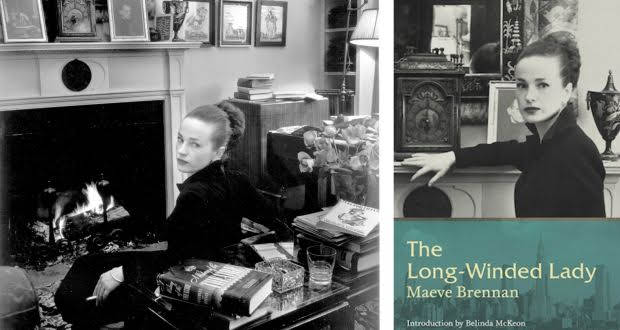
Maeve Brennan's life should have been a fairy tale of one happy and exciting day followed by another.  It was not.

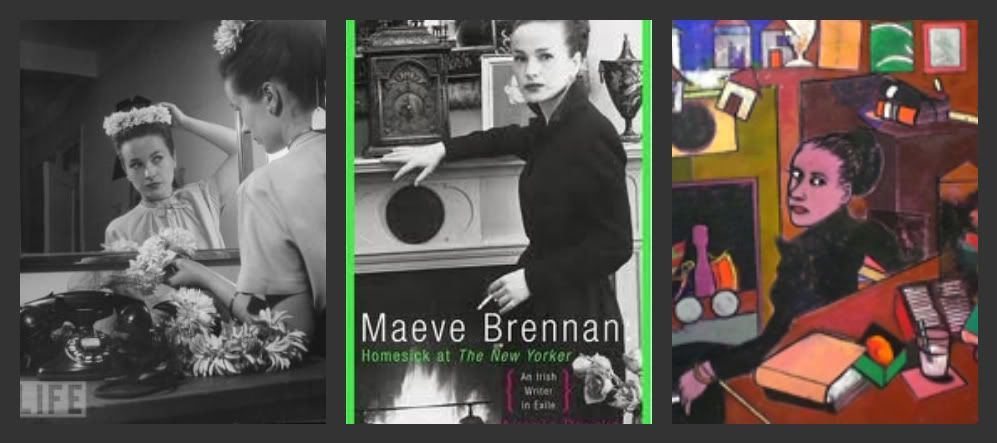
Brennan's father was the first Irish Ambassador to the United States.   Her father fought for freedom from British rule in  the Irish War for Independence.     The British imprisoned him for a while.    Brennan and her family lived in Washington DC until 1944 when her father returned to Ireland.   She stayed on in the US and moved to New York City where she got a job writing copy for Harper's Bazaar.   She also wrote a society column for an Irish publication.     She began to write occasional articles for The New Yorker.    In 1949 she was offered a job on the staff of the magazine.   She was incredibly beautiful, very intelligent, witty, petite, always perfectly dressed and made up.   She moved about frequently and had extravagant tastes.    Some people feel she was the inspiration for Holly Golightly, the lead character in Truman Capote's Breakfast at Tiffany's (1958).   In the 1960s people began to observe that she was now beginning to appear unkempt.    In the 1970s Brennan became paranoid and was an alcoholic.    She began to drift in and out of reality and was hospitalized   several times.    She ended up living either in transit hotels or in the ladies room at the offices of The New Yorker.   (I also read William Maxwell's introduction to one of her collections of short stories published posthumously and learned that to its great credit the magazine had secured for her a place where she could stay and be fed but she rarely went there.)    In  the 1980s she all but disappears.   She died in 1993 in the Lawrence hospital, a  ward of the state.    As I read this I could not help but be reminded of Jean Rhys but I think the story of Brennan is more tragic in that Rhys partially recovered from her years of darkness and was seen as a great writer while still alive.

The Long Winded Lady - Notes from The New Yorker is composed of the contents of her 1969 collection of that name plus ten additional works added for the posthumous 1998 edition.  

To call them essays seems somehow inappropriate.  Using a word i learned in a café in Vienna in early 1930s, i think they should be described as feuilletons.  Joseph Roth, who would have fallen for Brennan, is a master of this art.  Maybe  the days when such pieces can be published in mass journalism is over. 

My main and nearly my only reason for this post is I want Maeve Brennan on The Reading Life, in these dark ignorance worshipping times.  

I decided to begin my exploration of collection with a piece entitled “Balzac’s Favourite Food”.  I have been working my way his La Comédie Humaine so this seem a natural starting place.  It is about a visit to a book store,  in the days when book sellers loved books.  Brennan’s elegante prose is just a joy:

“The afternoon was a slow one, and the city was amiable and groggy —no complaints that I could hear. Such a siesta mood is remarkable in New York City and, in the very middle of the city, strange. It was a mysterious occasion and a lighthearted one, as though all the citizens had just been given their seasonal allotment of time and had found that they had enough and to spare —plenty of time, more than they ever would have imagined. In the bookshop, all was calm. You might have been far away, in some much older city, browsing alongside the antiquarians. The pace was intent and unhurried as the customers meandered among the works of Henry James and Rex Stout and Françoise Mallet-Joris and Ivan Turgenev and Agatha Christie and the rest, more and more names turning up in front of my eyes as I stood looking. I had already collected all I intended to buy —five books under my arm —and I was looking through another book, one I cannot remember the name of, and I was reading a description of Balzac’s favorite food. What he liked best was plain bread covered with sardines that he had mashed into a paste and mixed with something. What was it Balzac mixed into his sardine paste? I was just looking back to find out, reading it all again and thinking how delicious it sounded, when my ears were insulted by hard voices screeching right outside the door —people making remarks about the books in the window. “Hey, Marilyn Monroe has been reduced!” a man’s voice shouted. “Five seventy-five to one ninety-two!”

The Long Winded Lady is available as a Kindle for $1.95


Wednesday, July 15, 2015

"The Holy Terror" - Maeve Brennan's First Short Story (1950) - The Reading Life Maeve Brennan Project Commences


I offer my great thanks to Max u for providing me with a gift card that made this project possible. 


There are numerous ways to approach the incredibly vast short story universe.  One way is to read kind of at random and I have done some of that.  Another way is to pick out a writer whose short stories interest you and read extensively.  I have in the last few years read the complete short stories of Katherine Mansfield (in the published corpus), Eudora Welty, Elizabeth Bowen, Ernest Hemingway, and Flannery O'Connor.  Most recently I read and was blown away by the forthcoming collection of the complete short stories of Clarice Lispector.  In order to commence a short story project I need to have as my reading source an E Book.  I have begun to reread Katherine Mansfield.  There is no time limit on a project and my interest in these writers is permanent.  

Today I decided to commence Ths Reading Life Maeve Brennan Project.  Her published body of work, most of her stories and articles first appeared in The New Yorker, is under a 1000 pages so I hope to read her in full.  The Rose Garden is a posthumous collection that includes stories set in her birth country Ireland and stories placed in New York City.


I first encountered  the work of Maeve Brennan during Irish Short Story Month I in 2011 when I listened to a wonderful podcast of of the story on the webpage of The New Yorker in which Roddy Doyle reads the story.   During Irish Short Story Month Year II in 2012 I posted on a truly great cat story, set in her adopted home town of New York City, "Bianca, I Can See You".

Maeve Brennan's life should have been a perfect fairy tale of happiness.   There is a fey beauty in her face but I also see fear and a dark hunger.   

Brennan's father was the first Irish Ambassador to the United States.   Her father fought for freedom from British rule in  the Irish War for Independence.     The British imprisoned him for a while.    Brennan and her family lived in Washington DC until 1944 when her father returned to Ireland.   She stayed on in the US and moved to New York City where she got a job writing copy for Harper's Bazaar.   She also wrote a society column for an Irish publication.     She began to write occasional articles for The New Yorker.    In 1949 she was offered a job on the staff of the magazine.   She was incredibly beautiful, very intelligent, witty, petite, always perfectly dressed and made up.   She moved about frequently and had extravagant tastes.    Some people feel she was the inspiration for Holly Golightly, the lead character in Truman Capote's Breakfast at Tiffany's (1958).   In the 1960s people began to observe that she was now beginning to appear unkempt.    In the 1970s Brennan became paranoid and was an alcoholic.    She began to drift in and out of reality and was hospitalized   several times.    She ended up living either in transit hotels or in the ladies room at the offices of The New Yorker.   (I also read William Maxwell's introduction to one of her collections of short stories published posthumously and learned that to its great credit the magazine had secured for her a place where she could stay and be fed but she rarely went there.)    In  the 1980s she all but disappears.   She died in 1993 in the Lawrence hospital, a  ward of the state.    As I read this I could not help but be reminded of Jean Rhys but I think the story of Brennan is more tragic in that Rhys partially recovered from her years of darkness and was seen as a great writer while still alive. 

"The Holy Terror", 1950, is her first published short story.  I loved it and I bet the readers of The New Yorker who were the initial readers did too.   The central character is Mary Ramsey.  Mary is the attendent in the ladies' rest room at the Royal Hotel in Dublin.  She was acerbic and sharp tounged which made her an "Irish character" to the American guests.  She has been in her job for more than twenty five years.  She was the queen of her realm, terrorizing the rest of the staff.  Unlike most staff, she had a small room and got free food.  But nothing last forever and the new assistant manager, the very chic Miss Williams decides Mary needs to share the restroom, and the decent tips, with a new employee.  Needless to say Mary is not happy.  She goes to the manager to complain and ends up telling him about all the bad things the other employees do, from stealing to sex with guests.  Plus she falsely tells the manager Miss Williams bad mouths him at every opportunity, wanting to take his position.  I won't tell more of this beautifully rendered story.

Brennan brought Mary Ramsey and the world of the Royal Dublin Ladies' Room totally to life for me.

Please share your favorite Maeve Brennan stories with us.  

Mel u

Wednesday, March 5, 2014

"An Attack of Hunger" ; by Maeve Brennan (1998, from Springs of Affection)


Event Resources  Everyone Is Invited to Join Us for Irish Short Story Month Year Four

Ways to Participate-do a post on your blog and let me know about it-I will keep a master list and I will publicize your post and blog.

If you are an Irish author and would like to be featured, please contact me.   There are several options open.

If you would like to do a guest post on my blog on anything related to Irish short stories, contact me.


Maeve Brennan 
Dublin


I first encountered  the work of Maeve Brennan during Irish Short Story Month I in 2011 when I listened to a wonderful podcast of of the story on the webpage of The New Yorker in which Roddy Doyle reads the story.   During Irish Short Story Month Year II in 2012 I posted on a truly wonderful cat story, set in her adopted home town of New York City, "Bianca, I Can See You".

Maeve Brennan's life should have been a perfect fairy tale of happiness.   There is a fey beauty in her face but I also see fear and a dark hunger.   

Brennan's father was the first Irish Ambassador to the United States.   Her father fought for freedom from British rule in  the Irish War for Independence.     The British imprisoned him for a while.    Brennan and her family lived in Washington DC until 1944 when her father returned to Ireland.   She stayed on in the US and moved to New York City where she got a job writing copy for Harper's Bazaar.   She also wrote a society column for an Irish publication.     She began to write occasional articles for The New Yorker.    In 1949 she was offered a job on the staff of the magazine.   She was incredibly beautiful, very intelligent, witty, petite, always perfectly dressed and made up.   She moved about frequently and had extravagant tastes.    Some people feel she was the inspiration for Holly Golightly, the lead character in Truman Capote's Breakfast at Tiffany's (1958).   In the 1960s people began to observe that she was now beginning to appear unkempt.    In the 1970s Brennan became paranoid and was an alcoholic.    She began to drift in and out of reality and was hospitalized   several times.    She ended up living either in transit hotels or in the ladies room at the offices of The New Yorker.   (I also read William Maxwell's introduction to one of her collections of short stories published posthumously and learned that to its great credit the magazine had secured for her a place where she could stay and be fed but she rarely went there.)    In  the 1980s she all but disappears.   She died in 1993 in the Lawrence hospital, a  ward of the state.    As I read this I could not help but be reminded of Jean Rhys but I think the story of Brennan is more tragic in that Rhys partially recovered from her years of darkness and was seen as a great writer while still alive. 

I really love the stories by Brennan I have had the great pleasure of reading.  Her own story is heartbreaking.  

"An Attack of Hunger" is pure unrelieved sadness.  It reminded me of Patrick Kavanagh's deeply beautiful poem "The Great Hunger".  One of the things I have seen in the Irish literary works I have read is a sense of a deeply pervasive sadness somehow caused by pervasive emotional restraint.  You can see this in stories from the masters like Joyce and John McGrath down to works published this year.  There is a hunger for love, a human connection that Irish culture seems to make it very hard to achieve.  
Expressing of emotion is often seen as weakness and happens only in extreme moments.  

I spoke last year about the idea that one of the pervasive themes of Irish literature is that of the weak or missing father.   In my 75 Q and A sessions I asked everyone about this issue.  The responses ranged from yes it is one of the dominant themes to no not at all.  Sometimes, maybe often in the Irish short story, a father can be physically present but emotionally absent.  

"An Attack of Hunger" deals directly with issues related to the Irish father and the emotional constraints in the Irish family.  I will advise readers this is as a terribly moving sad story.   As you read it, I think your perceptions will expand.  One begins to wonder if behind the supposed weak or missing father, is a smothering mother who somehow uses her son as the total object of her affections.  In the process she ends up perpetuating a cycle of weakness.  She pushes her husband away and in so doing reduces his own sense of manhood and fatherhood. 

There are only two on stage persons in this story, a married couple.  They have only one child.   He has left the home to be a priest.  The marriage has evolved into a cold near emotionally voided marriage.  The man gives the woman her household money every Friday.  She runs the house from a sense of duty.  All of her thoughts are on her son, John.  She recalls how the two of them, in her mind, were somehow united against the coldness of the father.  She still cannot believe he abandoned her to go in the priesthood.  She feels totally alone.  Everyday is the same.  Then there is a terrible fight in which she walks out.  I do not want to tell more of the plot as I hope you will read it.  At the close you may find yourself unsure what to think of the situation.  It is not as simple as we might have thought.  

The ending is just so moving, so sad in its projection of years of pain and emptiness.  

I read this story in The Granta Book of the Irish Short Story edited  by Anne Enright.

Please share your experience with Maeve Brennan with us.


Wednesday, March 13, 2013

"The Lie" by Maeve Brennan

"The Lie" From Springs of Affection:  Stories of Dublin 


Year III  March 1 to March 31


Maeve Brennan 
Dublin


I first read the work of Maeve Brennan during Irish Short Story Month I in 2011 when I listened to a wonderful podcast of of the story on the webpage of The New Yorker in which Roddy Doyle reads the story.   During Irish Short Story Month Year II in 2012 I posted on a truly wonderful cat story, set in her adopted home town of New York City, "Bianca, I Can See You".

Maeve Brennan's life should have been a perfect fairy tale of happiness.   There is a fey beauty in her face but I also see fear and a dark hunger.   


Brennan's life should have been a fairy tale of one happy and exciting day followed by another.  It was not.

Brennan's father was the first Irish Ambassador to the United States.   Her father fought for freedom from British rule in  the Irish War for Independence.     The British imprisoned him for a while.    Brennan and her family lived in Washington DC until 1944 when her father returned to Ireland.   She stayed on in the US and moved to New York City where she got a job writing copy for Harper's Bazaar.   She also wrote a society column for an Irish publication.     She began to write occasional articles for The New Yorker.    In 1949 she was offered a job on the staff of the magazine.   She was incredibly beautiful, very intelligent, witty, petite, always perfectly dressed and made up.   She moved about frequently and had extravagant tastes.    Some people feel she was the inspiration for Holly Golightly, the lead character in Truman Capote's Breakfast at Tiffany's (1958).   In the 1960s people began to observe that she was now beginning to appear unkempt.    In the 1970s Brennan became paranoid and was an alcoholic.    She began to drift in and out of reality and was hospitalized   several times.    She ended up living either in transit hotels or in the ladies room at the offices of The New Yorker.   (I also read William Maxwell's introduction to one of her collections of short stories published posthumously and learned that to its great credit the magazine had secured for her a place where she could stay and be fed but she rarely went there.)    In  the 1980s she all but disappears.   She died in 1993 in the Lawrence hospital, a  ward of the state.    As I read this I could not help but be reminded of Jean Rhys but I think the story of Brennan is more tragic in that Rhys partially recovered from her years of darkness and was seen as a great writer while still alive. 

"The Lie  (it was first published in The New Yorker and then reprinted in a posthomous collection of her stories, Springs of Affection:  Dublin Stories in 1998) is a story that begins on day a seven year old girl takes her first confession.  There are several well known short stories by Irish writers that deal with confessions but none are any better than this one and none let us really understand what confession can mean to a seven year old, and her mother.  On the day set for her first confession when her and her mother arrive there is a long line of girls waiting to confess.  The priest sees her and asks the mother if this is her first confession.   He then takes her to be the first person to confess to day, shocking all the other girls and their mothers.   At first the girl has no idea what sins she can confess to her then the priest gently prompts her with questions like :were you disobedient?"  He assigns her three Hail Marys.   I hate to tell to much of this story.   The girl goes to confession on a regular basis, always assigned the same mild penance as she has no real sins.   Then she commits an intentional act of deceit and cruelty directed at her baby brother when her mother will not let her sit in her lap.   

Brennan does a brilliant job in making us understand this experience from the point of view of the seven year old girl and her mother also.   

If you do a Google Book Search on her you will find this story online along with several of her other  works.  


A post on your favorite or your first encounter with one of her short stories would be a very good guest post!


Mel u

Sunday, May 13, 2012

"I See You, Bianca" by Maeve Brennan

"I See You, Bianca" by Maeve Brennan  (1960, 12 pages)

The Irish Quarter:  A Celebration of the Irish Short Story
March 11 to July 1


Maeve Brennan
1917 to 1993
A Truly Great Writer


Please consider joining us for this event.     Everything you need to participate is in the resources page, including links to 1000s of short stories, from brand new ones to stories now in the public domain.   Guests posts are also welcome.   

Prize offered by John Walsh, author of Border Lines-A free copy to a participant in the event.  Just send me an e mail if you wish to be entered in the drawing.   


Brennan's life should have been a fairy tale of one happy and exciting day followed by another.  It was not.

Brennan's father was the first Irish Ambassador to the United States.   Her father fought for freedom from British rule in  the Irish War for Independence.     The British imprisoned him for a while.    Brennan and her family lived in Washington DC until 1944 when her father returned to Ireland.   She stayed on in the US and moved to New York City where she got a job writing copy for Harper's Bazaar.   She also wrote a society column for an Irish publication.     She began to write occasional articles for The New Yorker.    In 1949 she was offered a job on the staff of the magazine.   She was incredibly beautiful, very intelligent, witty, petite, always perfectly dressed and made up.   She moved about frequently and had extravagant tastes.    Some people feel she was the inspiration for Holly Golightly, the lead character in Truman Capote's Breakfast at Tiffany's (1958).   In the 1960s people began to observe that she was now beginning to appear unkempt.    In the 1970s Brennan became paranoid and was an alcoholic.    She began to drift in and out of reality and was hospitalized   several times.    She ended up living either in transit hotels or in the ladies room at the offices of The New Yorker.   (I also read William Maxwell's introduction to one of her collections of short stories published posthumously and learned that to its great credit the magazine had secured for her a place where she could stay and be fed but she rarely went there.)    In  the 1980s she all but disappears.   She died in 1993 in the Lawrence hospital, a  ward of the state.    As I read this I could not help but be reminded of Jean Rhys but I think the story of Brennan is more tragic in that Rhys partially recovered from her years of darkness and was seen as a great writer while still alive. 

During Irish Short Story Week Year Two on March 19, 2001 I posted on Maeve Brennan's wonderful short story "Christmas Eve".  (There is a link in this post where you can listen to a podcast of the story, the reader is Roddy Doyle.)   I liked that story but I totally love "I See You, Bianca".   If you love cats, and I hate to say this, but Maeve Brennan was a cat of a woman and for me this is a very high praise and I think lovers of Brennan will get it, you are going to love this story.   It is just so beautiful, yet it does not care whether you like it or not.

I read the story in Wonderful Town:  New York Stories from the New Yorker Magazine.  As far as I know, it cannot be read online.   It also appears in a posthumous collection of her short stories, The Rose Garden.    The story is narrated by a woman living  in a New York City brownstone apartment.   She starts out by  talking about her feelings about New York City.   She tells us about  the apartment which she makes totally real for us with her wonderful descriptive power.   The story turns magic when she begins talking about her cat, Bianca.   Maybe Brennan has reached a point already where she prefers the company  of cats to people, I can sometimes relate, but she totally captures the essence of catness in this story.

I have not told much of the plot of this story.  This is in part as I do not want to spoil the story for others and also I know most will not be able to read the story.   

This post is more a tribute to Brennan than an attempt to analyse the story.


Please share your experience with Brennan with us.

Mel u


Saturday, March 19, 2011

"Christmas Eve" by Maeve Brennan-Irish Short Stories Week

"Christmas Eve"  By Maeve Brennan (1972-Podcast-25 minutes)


The New Yorker
Day Six
Maeve Brennan

"Christmas Eve" by Maeve Brennan (Dublin-1917 to 1993) is just a wonderful story about a family on Christmas Eve.     I love this story so much I have already listened to the podcast of the story four times.   (The reader is Roddy Doyle.   Brennan was his second cousin and she lived with his family for a while.   He has an perfect accent for this story.)

After hearing the story, I read the Wikipedia article on her.     I will retell her life a bit as I think it is worth knowing and tells us something about  the millions of Irish who left Ireland never to return but never really found another home.   

Brennan's life should have been a fairy tale of one happy and exciting day followed by another.  It was not.

Brennan's father was the first Irish Ambassador to the United States.   Her father fought for freedom from British rule in  the Irish War for Independence.     The British imprisoned him for a while.    Brennan and her family lived in Washington DC until 1944 when her father returned to Ireland.   She stayed on in the US and moved to New York City where she got a job writing copy for Harper's Bazaar.   She also wrote a society column for an Irish publication.     She began to write occasional articles for The New Yorker.    In 1949 she was offered a job on the staff of the magazine.   She was incredibly beautiful, very intelligent, witty, petite, always perfectly dressed and made up.   She moved about frequently and had extravagant tastes.    Some people feel she was the inspiration for Holly Golightly, the lead character in Truman Capote's Breakfast at Tiffany's (1958).   In the 1960s people began to observe that she was now beginning to appear unkempt.    In the 1970s Brennan became paranoid and was an alcoholic.    She began to drift in and out of reality and was hospitalized   several times.    She ended up living either in transit hotels or in the ladies room at the offices of The New Yorker.   (I also read William Maxwell's introduction to one of her collections of short stories published posthumously and learned that to its great credit the magazine had secured for her a place where she could stay and be fed but she rarely went there.)    In  the 1980s she all but disappears.   She died in 1993 in the Lawrence hospital, a  ward of the state.    As I read this I could not help but be reminded of Jean Rhys but I think the story of Brennan is more tragic in that Rhys partially recovered from her years of darkness and was seen as a great writer while still alive.

"Christmas Eve"   is a very supple simply told in almost a child like way story (though it a daemon child as might be found in an Irish fairy tale) about a family on Christmas Eve.   The father has just gotten home from work.   The mother is preparing the house for tomorrow.   The young children are concerned with being sure there is a snack left out for Father Christmas.   The parents each have their own room.   The reason for this is that the father's job (we do not learn what it is) sometimes keeps him out late and he does not want to disturb his wife.    Or so they say but really each is quite happy to have their own room.    Somehow I could relate when I heard the father was happy he could have his books in his room with him.   Parts of the story are very moving.   When the parents kiss each other under the mistletoe plant, the children cheer  them on for more.  The parents are a bit embarrassed and pull apart.   This is a world of restrained emotions.   There are some wonderful touches in the story.   I really liked what the wife says about her cats and her dog.   "Christmas Eve" should be listed among the very best Christmas short stories of all time.


Google books has six or so of her stories online in their previews of her two short story collections.   I will go back and read them soon.    William Maxwell said her longest story, "Springs of Affection" should be included among the great short stories of the century.

PODCAST HERE


Resources for the Week
It is not to late to participate.  Just post on one Irish short story and link it to me in a comment anywhere on my blog.   I will keep the week open for a few days to let people join in before I do the master post.

Thanks VERY much to all those who have joined in.   I will say this has worked out better than I had ever hoped and I plan, providence willing, to make this an annual Reading Life event.

Mel u

Featured Post

Imperial Reckoning: The Untold Story of Britain’s Gulag in Kenya by Caroline Elkins - 2005 - 701 Pages

  Imperial Reckoning:     The Untold Story of Britain’s Gulag in Kenya by Caroline Elkins - 2005 - 701 Pages 2006 Pulitzer Prize Winner From...