Showing posts with label Ethel Rohan. Show all posts

Sunday, June 13, 2021

“Wilde” - A Short Story by Ethel Rohan from her collection, In the Event of Contact - 2021


Wilde” - A Short Story by Ethel Rohan from her collection, In the Event of Contact - 2021


 To those wanting The Reading Life bottom line on this collection,buy it.


The Gateway to Ethel Rohan on The Reading Life 


Website of Ethel Rohan - includes a detailed list of her publications


I first began following the work of Ethel Rohan March 13, 2012.  Since then I have posted eleven times on her works.  She also kindly contributed a guest post and participated in a Q and A session.  Obviously I hold her in great esteem.  You can see my feelings in this selection from an old post.


My thoughts on first reading Ethel Rohan, from March 2013


“Last year I read a story, "Beast and the Bear" by Ethel Rohan, a totally new to me at the time  writer.    I read it during Emerging Irish Women Writers Week.   I never expected to read a story during this week that I would end up regarding as belonging with the greatest short stories of all time.  I read it four times in a row I was so amazed.   Since I read that story for the first time, I have read, I estimate, at least 1000 other short stories including most of the consensus best short stories in the world.  After reading "Beast and the Bear"  again yesterday and this morning I am completely convinced it should already be counted among the world's greatest short stories.  I was in fact so shocked by the power of this story that I wanted to be sure I was not overreacting.  I sent a fellow book blogger whose taste I know to be exquisite and educated through decades of reading short stories and she said only the very best short stories she had ever read, she is noted authority on Virginia Woolf, could compare to it.   I know this sounds hyperbolic but it is how I feel.  I do not lightly say a short story written by an author I had never heard of the day before I read it belongs with the work of the greatest of short story writers but that is my opinion.  In a way I felt a sense of satisfaction in that I am open enough in my perceptions and judgments to be able to make such an assertion.”


There are thirteen stories included with In the Event of Contact 


I decided my initial post would be on a story entitled “Wilde”.  Oscar Wilde fascinated me at age 13 and still does.  Also The statue of Oscar Wilde in his museum in Dublin plays a big part in The story.  I am fondly reminded  of a literary tourism visit I made a few years ago to Dublin with Max u to The Oscar Wilde Museum.


This story is narrated by a late Middle aged woman. A long time ago she moved to Chicago.  Now she is divorced and back alone on her annual visit to Dublin.  Rohan has written other stories sbout adult children coping with dysfunctional parents and the lingering impact and involuntary memories this produces. The narrator recalls her father had a long lasting relationship with Mary, who existed only to him.  As the narrotor explores Dublin, she finds her self in front of a statue of Oscar Wilde.  The spot is swarming with tourists.  Somehow Wilde then accompanies her on her walk, has coffee with her and converses using his famous sayings. He ends up next to her in her posh hotel, gone Without a word of goodbye when she awakes..  She recalls her  doctor told her not to drink while on anti-depressents and she wonders is she going the way of her father.


This is a marvelous story sbout coming home, fear ing   Madness and the power of Iconic literary figures to haunt those under their spell.


In Inventing Ireland:  The Literature of the Modern Nation by Declan Kiberd says a dominant theme of modern Irish literature is the weak or missing father.  For sure this story deeply explores this matter.


I Will be posting on more stories included with In Case of Contact soon.


Her website has a detailed bio.


Mel u

Monday, October 26, 2020

At the Side of the Road’ - a short story by Ethel Rohan. - from From issue #4: spring/summer 2017 Banshee Press


At the Side of the Road’ - a short story by  Ethel Rohan. - from From issue #4: spring/summer 2017 Banshee Press 


The Gateway to Ethel Rohan on The Reading Life 


Website of Ethel Rohan - includes a detailed list of her publications


You may read today’s story here


I first began following the work of Ethel Rohan March 13, 2012.  Since then I have posted eleven times on her works.  She also kindly contributed a guest post and participated in a Q and A session.  Obviously I hold her in great esteem.  You can see my feelings in this selection from an old post.


My thoughts on Ethel Rohan, from March 2014


“Last year I read a story, "Beast and the Bear" by Ethel Rohan, a totally new to me at the time  writer.    I read it during Emerging Irish Women Writers Week.   I never expected to read a story during this week that I would end up regarding as belonging with the greatest short stories of all time.  I read it four times in a row I was so amazed.   Since I read that story for the first time, I have read, I estimate, at least 1000 other short stories including most of the consensus best short stories in the world.  After reading "Beast and the Bear"  again yesterday and this morning I am completely convinced it should already be counted among the world's greatest short stories.  I was in fact so shocked by the power of this story that I wanted to be sure I was not overreacting.  I sent a fellow book blogger whose taste I know to be exquisite and educated through decades of reading short stories and she said only the very best short stories she had ever read, she is noted authority on Virginia Woolf, could compare to it.   I know this sounds hyperbolic but it is how I feel.  I do not lightly say a short story written by an author I had never heard of the day before I read it belongs with the work of the greatest of short story writers but that is my opinion.  In a way I felt a sense of satisfaction in that I am open enough in my perceptions and judgments to be able to make such an assertion.”


Since I wrote this Rohan has published three collections of short stories, a memoir about Dublin and a highly reviewed debut novel, The Weight of Him.


My purpose today is to let my readers know another Ethel Rohan short story maybe read online and to keep a record of my readings of her work.


In just a few sentences we learn a lot about the subject of the story:


“Cissie Murray sold Wexford potatoes and strawberries by the dual carriageway, under a grey-white awning she pretended was a fancy marquee. For every hundred cars that passed, maybe one stopped. Meanwhile, Cissie held hard to her phone—texting friends, playing games, and bopping to music with frantic rhythms. For this, Dan Topher paid her thirty euro a day. 

This Friday, Cissie had forgotten her phone at home. She felt clammy and irritated, her hands, her head, having little to do. For hours she hummed songs to herself, watched greenflies race over the strawberries, and haggled with a few customers, all wanting something for nothing.”


Of course a young woman standing beside the road all day has to be wary of attracting the attention of men wanting  something more than potatoes or strawberries.  It was fun to see her ward of one man with a golf club, we admire her fierce pluckiness.


We learn a bit about her family, her past relationships and go on what at first seems like it might be a movie day date which goes badly.


We see Cissie’s expectations are not very high.  Like many in the often set in Ireland short stories of Rohan, it deals with the life of a woman struggling to get along in a challenging environment.


I am greatly looking forward to reading Ethel Rohan’s fourth collection of Short Stories, In The Event of Contact, forthcoming in the spring of 2021.


“In the Event of Contact chronicles characters profoundly affected by physical connection, or its lack. Among them, a scrappy teen vies to be the next Sherlock Holmes; an immigrant daughter must defend her decision to remain childless; a guilt-ridden woman is haunted by the disappearance of her childhood friend; a cantankerous crossing guard celebrates getting run over by a truck; an embattled priest with dementia determines to perform a heroic, redemptive act, if he can only remember how; and an aspirational, angst-ridden mother captains the skies.


Amidst backgrounds of trespass and absence, the indelible characters of In the Event of Contact seek renewed belief in themselves, recovery, and humanity.”  From Goodreads.


Mel u


Wednesday, May 30, 2018

“The Great Blue Open”. - A Short Story by Ethel Rohan, August 12,2017


The Great Blue Open” by Ethel Rohan

Ethel Rohan on The Reading Life - included is a very interesting Q and A session, my posts on her work and a post by Ethel Rohan

Ethel Rohan’s Website


My main purpose today is to make sure all into quality short stories have the link to a recent story by Ethel Rohan published in the Irish Times, “The Great Blue Open”.

My thoughts on Ethel Rohan, from March 2014

“Last year I read a story, "Beast and the Bear" by Ethel Rohan, a totally new to me at the time  writer.    I read it during Emerging Irish Women Writers Week.   I never expected to read a story during this week that I would end up regarding as belonging with the greatest short stories of all time.  I read it four times in a row I was so amazed.   Since I read that story for the first time, I have read, I estimate, at least 1000 other short stories including most of the consensus best short stories in the world.  After reading "Beast and the Bear"  again yesterday and this morning I am completely convinced it should already be counted among the world's greatest short stories.  I was in fact so shocked by the power of this story that I wanted to be sure I was not overreacting.  I sent a fellow book blogger whose taste I know to be exquisite and educated through decades of reading short stories and she said only the very best short stories she had ever read, she is noted lauthority on Virginia Woolf, could compare to it.   I know this sounds hyperbolic but it is how I feel.  I do not lightly say a short story written by an author I had never heard of the day before I read it belongs with the work of the greatest of short story writers but that is my opinion.  In a way I felt a sense of satisfaction in that I am open enough in my perceptions and judgments to be able to make such an assertion.”

Since I wrote this Rohan has published three collections of short stories, a memoir about Dublin and a highly reviewed debut novel, The Weight of Him.

Today’s story opens in a Dublin park.  A young mother is pushing one of her daughters on a swing.  Then something is wrong

““Higher,” Sorcha begs. I put everything I have into my next push and right as my arms extend I am gripped by pelvic cramps and spurt blood. Sorcha complains that I’ve stopped pushing her, but then realises something is wrong. She jumps from the swing, calling to her older sister.

Maeve runs toward me, her little face creased with panic. Despite being the eldest, she is our nervous child, afraid of monsters in her pillow, bacteria eating her flesh, her bellybutton popping open, and everything else her imagination serves up to terrorise her. My uterus contracts again and a large, warm clot leaves me. The gelatinous blood streaks down my bare calves in much the same red as the king swan’s beak. I feel like I’m emptying. Feel like it won’t stop.
The heavy bleeding persists over the next several days. I grasp at benign explanations – early menopause or harmless fibroids – anything to defer an invasive exam and possibly sinister results. My husband, Damien, insists I go to the doctor and get myself sorted.”

Rohan does a very good job letting us inside the mind of the narrator.  Her doctor takes a biopsy, it will be a few days before the results come back.  As you would imagine these are long stressing days.  The narrator begins to think about her mother.  She was a wonderful cook.  Her never realised dream in life was to start a restaurant.  Her fate, unknown the narrator does not want to die with her own dream unrealised.

Rohan brings the family to life.  It was fun to listen in on her conversation, she is a solicitor, with a difficult client.  Her husband seems a decent man.

The ending, which I will leave unspoiled was emotionally gratifying and moving.

I will be soon posting on her novel and will continue following her career.

Any fan of short stories will enjoy “The Great Blue Open”.


From the author’s website 


“Ethel Rohan’s writing often centers on the body—its joys, secrets, memory, urges, splendor, and horrors. When she writes, she’s stolen away.
Rohan’s first novel, The Weight of Him, published from St. Martin’s Press (US) and Atlantic Books (UK) in 2017. The Weight of Him won a Northern California Publishers and Authors’ (NCPA) Award and a Silver Nautilus Award, was shortlisted for the Reading Women Award, won the inaugural Plumeri Fellowship, and was named an Amazon Best Book, among other distinctions.
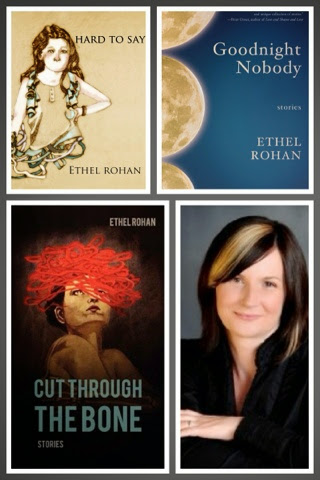
She is also the author of two story collections, Goodnight Nobody and Cut Through the Bone, the former longlisted for The Edge Hill Prize and the latter longlisted for The Story Prize. She wrote, too, the award-winning chapbook Hard to Say (PANK, Editor Roxane Gay) and the award-winning e-memoir single, Out of Dublin (Shebooks, Editor Laura Fraser).
Rohan was longlisted for The Sunday Times EFG Short Story Award, winner of the Bryan MacMahon Short Story Award, and shortlisted for the CUIRT, Roberts, and Bristol Short Story Prizes. Her work has appeared in The New York Times, World Literature Today, PEN America, The Washington Post, Tin House Online, The Irish Times, and GUERNICA, among many others. She has reviewed books for New York Journal of Books, and elsewhere.
Her stories have also published in various anthologies including Without You: Living With Loss (Ballpoint Press, 2018); Reading the Future: New Writing from Ireland (Arlen House, 2018; THE LINEUP: 20 Provocative Women Writers (Black Lawrence Press, 2015); Winesburg, Indiana (Indiana University Press, 2015); DRIVEL: Deliciously Bad Writing by Your Favorite Authors (Penguin: Perigee, 2014). She is also a contributor and associate editor to the anthology Flash Fiction International (W.W. Norton, 2015).
Rohan has taught writing or was a featured author at Listowel Writers’ Week, Belfast Book Festival, The London Short Story Festival; The Abroad Writers’ Conference; Los Gatos-Listowel Writers’ Week; the Frank O’Connor International Short Story Festival, Book Passage Corte Madera; San Francisco State University; San Francisco Writers’ Grotto; San Francisco Writers’ Conference; Green Mountain Writers’ Conference; among others. Born and raised in Dublin, Ireland, Rohan lives in San Francisco where she received her MFA in fiction from Mills College and is a member of San Francisco Writers’ Grotto.”

From the author’s Website 


Mel u


Friday, May 23, 2014

Out of Dublin - A Memoir by Ethel Rohan (2014)


I have been avidly reading the work of Ethel Rohan ever since I first encountered her work during Irish Short Story Month in March 2012.  I have posted on numerous of her powerful deeply felt, very moving stories, done a Q and A with her, and she kindly wrote a guest post for my blog.  I greatly admire her work and talent and am convinced if someone does an Irish Short Story Month in twenty years her work will be among the by default must includes. Many things can happen in the career of a writer but I can easily see Ethel Rohan one day included among the great short story writers of the world. 

 Lately I have done some word count analyses of collections of short stories of Katherine Mansfield, Eudora Welty, Ernest Hemingway and other writers. (My study based on this was published in The Journal of The Katherine Mansfield Society, 2013.) In this I took key terms and compared them across writers to see if it reveals the core concerns of the writers.  The results startled me.  I did a similar study of the collections of short stories of Rohan (using the other writers I have studied as my comparative base) and her stories show way out of the norm use of the terms "Mother" and "Death".
Katherine Mansfield showed very much the same disparities.   I mostly read short stories as individual works but sometimes I wish to see into the deeper reaches of the psyche of an author.  I realize and respect those who follow the teachings of Roland Barthes and Susan Sontag and repudiate such things but they cannot prove their methods are superior to other ways and I think they know this.

Out of Dublin focuses on the relationship of Ethel Rohan and her parents, focusing on her return trips from San Francisco to Dublin when she was sent word by one of her sisters that their mother was dying. Rohan shares with us her feelings about her mother and the impact her mother's maternal failings had on her and her family.  She talks about her relationship with her father.   She is very open about the destructive impact of alcohol on her family.  To me I am so glad to have read this as it helps me better understand her work.  I greatly respect the honesty and courage manifested in this work.

You can learn more about this book and the work of Ethel Rohan on her very well done webpage


Sunday, March 23, 2014

"I Love You" by Ethel Rohan (2013, from Goodnight Nobody)


"I Love You" is the 14th of 30 stories in Goodnight Nobody by Ethel Rohan.  It a very said very poignant story about a lonely older woman, barely holding on to contact with reality.  It made me thing of a great short story, "Miss Brill".  It is a brief story centering on a fifty year old woman who has always built her life around her pets, she has out lived them all but for a gopher turtle which has disappeared. 

She finds an advertisement for a place that says it places monkeys in carefully selected homes.  The man on phone asks her many questions and then congratulated her and told her she is a suitable host for a monkey.  He takes her credit card information and tells her the monkey will arrive at Los Angeles International Airport by Air Freight in seven days.  He gives her all the information she needs to claim her monkey.  She tells a coworker she is getting a monkey, the coworker tells her she heard of a woman killed by her pet chimpanzee.  The woman says she doesn't like people because they have language.  On the big day, no monkey shows up at LAX and the 800 number is disconnected.  There is a small glimmer of a happy ending which I will leave untold,  Just another story of a half misfit trying to find love in a sad world.

  
"Feel free to join me for ISSM4" - Carmilla


Tuesday, March 18, 2014

"Baby" by Ethel Rohan (2013, from Goodnight Nobody)


"He was always felt afraid of babies, of a family, worried he would fail as spectacularly as his father had" - from "Baby"


I am more and more leaning toward not reviewing as a whole collections of short stories.  In many maybe most cases, the stories are not written toward being part of a collection.  I have have reading Ethel Rohan for over two years now (you can find my posts on her work with background information by following the link at the bottom of this page.). I do for sure see a set of common concerns in her stories and I have talked about that.  There are thirty or so stories in her latest collection, Goodnight Nobody.  I have already posted on the first story in the collection, "Baby" is the third story.  My main purpose in these posts is to help myself understand and recall her stories.  I am quite confident that if someone does an Irish Short Story Month in 2034, Rohan will be a must include writer.I am also kind of seeing if her stories fit some of my ideas about the distinctive qualities of Irish Short Stories.

"Baby" opens in the house of a bachelor, shortly after a party.   Somebody has given him a strange slightly creepy gift, an "instant baby".  All you have to do is put it in water for a while.  All the guests are gone.  He is not sure who among the guests left it but he figured it was his ex who came with her new boyfriend, much younger than him, of course.  He puts the baby in water and the next day it is huge.  He calls his buddy over to look at it.  He says it must be some sort of comment from his ex on his inability to commit.  There is no real plot, they ended up more or less forgetting about the baby while they down some beers.  

I will post on at least fifteen stories from Goodnight Nobody.  


Friday, March 14, 2014

"Major Drill" by Ethel Rohan (2013, Lead Story in Goodnight Nobody)


I have been following the literary career of Ethel Rohan avidly ever since I first read her amazing story "Beast and the Bear" during ISSM in 2012.  I consider this story to be among the very greatest of all short stories (I have read most all of the consensus best stories) times.  I admit I was shocked at the time as I never thought I would read a story by a writer I had never heard of the day before and be so blown away by it.  I have read it numerous times since then and I still feel the same. I have sent it to people all around the world whose literary taste i respect and all loved it.   I have previously posted on a number of other Rohan's stories, and she kindly did a guest post and a wonderful Q and A for prior ISSM events.  

There are thirty short stories in her latest collection of short stories, Goodnight Nobody.  For sure I will read them all and I will post on some, maybe all of them.  Part of my reason for this is that writing about a literary works helps place it deeper into my consciousness and helps me recall and understand it.  Many of her stories are set in Ireland, but not all.  Some of my posts will be short, some long.  I have a lot I want to cover during this year's ISSM.  A short post in no way is a value judgement.

"Major Drill" is set in Ireland.  A young man, probably in his late teens, has just told his father he has signed up for The Irish Home Guard.  The father ridicules him and tells him the Home Guard is a joke, who are they protecting Ireland from.  The son was, it seems, talked into joining up by and old friend, after all they do get paid and the ladies do like a man in uniform.  We are there during drill practice and meet your typical bully boy drill instructor.   We see the boy's getting some play from the girls in the bars and we go along during a war game.

The very real fun of this story is being there at the guards and seeing the boy take his first steps to independence by joining the guard against the wishes of the father.  Toward the end, I sort of thought the father was secretly proud of his boy.


My Q and A with Ethel Rohan

From Author Web Site

Ethel Rohan is the author of two story collections, Goodnight Nobody and Cut Through the Bone, the latter named a 2010 Notable Story Collection by The Story Prize. She is also the author of the chapbook, Hard to Say. Her e-book, a short memoir titled His Heartbeat in my Hand, is forthcoming from Shebooks in 2014.

Winner of the 2013 Bryan MacMahon Short Story Award, her work has or will appear in The New York TimesWorld Literature TodayPEN America, Tin House Online, The Irish Times, BREVITY MagazinePost Road Magazine, and The Rumpus, among many others. She has reviewed books for New York Journal of Books, HTMLGiant, and elsewhere.

She has guest-lectured and/or taught writing at Book Passage, San Francisco State University, the San Francisco Writers’ Grotto, and the Frank O’Connor International Short Story Festival, among others. Most recently, she served on faculty alongside the Pulitzer Prize-winning authors Jane Smiley, Edward Humes, and Robert Olen Butler, and more, at the winter 2013 Abroad Writers’ Conference in Lismore Castle, Ireland.

She received her MFA in fiction from Mills College, CA, 2004. Raised in Dublin, Ireland, Ethel Rohan now lives in San Francisco where she is a member of The Writers’ Grotto and PEN American Center.

Mel u


Friday, July 5, 2013

"Goodnight Nobody" by Ethel Rohan


"Goodnight Nobody"
Ethel Rohan
Dublin


"He leaned back into his driver's seat, closed his eyes, and waited to feel something for the dead man".

I am always happy anytime Ethel Rohan publishes a new short short.   I have posted on two of her collections of short stories, several of her stories and she has contributed a guest post as well as a very illuminating Q and A session.  I am very convinced that if someone does an Irish Short Story Month 25 years from now for sure Rohan will be by default included.    I admit I like to imagine someone finding my first posts on her work decades from now and wondering who Mel u was that saw the potential for greatness in the work of Rohan.   I know this may seem hyperbolic to some but it is how I feel.

"Goodnight Nobody" is a short work about what happens when a San Francisco garbage man finds, for the first time in his thirty years on the job, a dead body in a dumpster.    The man looks in the dumpster twice to be sure he was right,  yes it is the body of a sixty year old or so homeless man.    Of course he calls the police and his boss.   He is moved to think of the last corpse he saw.  It was the body of his wife of thirty-three years.   While he waits for the police to do their inspections, he think of hi years with his wife and of his visits to her grave.   He goes back to the dead man and regrets he can feel nothing for him and is a bit ashamed of himself when he realizes if it was a pretty young girl he would feel something for her.

There is a lot in this very moving story.

You can read this story here.

Ethel Rohan is the author of two story collections, Goodnight Nobody (forthcoming Queen’s Ferry Press, September, 2013) and Cut Through the Bone (Dark Sky Books), the latter named a 2010 Notable Story Collection by The Story Prize. She is also the author of a chapbook, Hard to Say (PANK, 2011). Winner of the 2013 Bryan MacMahon Short Story Award, her work has or will appear in the New York Times, World Literature Today, Tin House Online, The Irish Times, Sou’wester, Post Road Magazine, and The Rumpus, among many others. She reviews books for New York Journal of Books and sometimes elsewhere.
Mel u

Thursday, March 21, 2013

Ethel Rohan A Question and Answer Session with the author of Hard to Say and Cut Trough the Bone


March 1 to March 31
A Question and Answer Session with
Ethel Rohan
Dublin


I am  very happy and honored  to be able to share with readers of my a blog a Q & A session with Ethel Rohan, a writer I first read last year during Irish Short Story Week Year Two last year.  I have been following her work ever since then and will continue to do so permanently.  She is an immensely talented writer.

Last year I read a story, "Beast and the Bear" by Ethel Rohan, a totally new to me at the time  writer.    I read it during Emerging Irish Women Writers Week.   I never expected to read a story during this week that I would end up regarding as belonging with the greatest short stories of all time.  I read it four times in a row I was so amazed.   Since I read that story for the first time, I have read, I estimate, at least 1000 other short stories including most of the consensus best short stories in the world.  After reading "Beast and the Bear"  again yesterday and this morning I am completely convinced it should already be counted among the world's greatest short stories.  I was in fact so shocked by the power of this story that I wanted to be sure I was not overreacting.  I sent a fellow book blogger whose taste I know to be exquisite and educated through decades of reading short stories and she said only the very best short stories she had ever read, she is an authority on Virginia Woolf, could compare to it.   I know this sounds hyperbolic but it is how I feel.  I do not lightly say a short story written by an author I had never heard of the day before I read it belongs with the work of the greatest of short story writers but that is my opinion.  In a way I felt a sense of satisfaction in that I am open enough in my perceptions and judgments to be able to make such an assertion.


Since then I have followed the work of Rohan.  I have posted on a few of her short stories and on her very haunting collection Hard to Say and on her Cut Through the Bone was the first work I posted on for ISSM3  She also wrote a guest post on my blog last year about an emerging Irish writer she, and now I admire, Danielle McLaughlin


Q and A with Ethel Rohan

1. Who are some of the contemporary short story writers you admire? If you had to say, who do you regard as the three best ever short story writers?

How to even qualify the three best ever short story writers? It’s impossible. As for contemporary writers, I’m besotted with Karen Russell’s stellar writing skills and stunning imagination, in particular her new story collection, Vampires in the Lemon Grove. Bonnie Jo Campbell’s story collection American Salvage lives on in my head and heart, as has Mary Costello’s The China Factory.


2.  I have read lots of Indian and American short stories in addition to Irish, and alcohol plays a much bigger part in the Irish stories. How should an outsider take this and what does it say about Irish culture?

There’s truth to every stereotype. Stories are mirrors to ourselves, our society, and our relationships and that’s why alcohol plays such a large part in Irish lore. As writers we put down what we know and Irish writers know alcohol. The best stories contain characters not stereotypes, of course, and search beyond the surface and the obvious.


3. Declan Kilberd has said the dominant theme of modern Irish literature is that of the weak or missing father?  Do you think he is right and how does this, if it does, reveal itself in your work? It seems present in several of your stories, especially those in Hard to Say.

The weak or missing father is one of the dominant themes in modern Irish literature. Perhaps it’s more encompassing to say abandonment is the dominant theme of modern Irish literature and harkens back to our psychic scars from colonization and the Great Famine—that sense of the world spinning out of control and ourselves as endangered, victimized, and helpless—and is further exacerbated by the current economic and social chaos in Ireland.

It’s true, the weak or missing father appears in many of my stories, and so does the absent mother. This isn’t intentional, but what writes its way out of me. Again we write what we know and as a child I didn’t feel safe or protected and had to rescue myself. I suppose, in the end, we all have to become our own father and mother. 


4.  When did you start writing?

I remember writing poetry and songs from about age seven onwards and subjecting my best friend and her brother to my endless, no doubt painful, performances in the hall in my house while they sat on the bottom steps of our stairs. The first story I remember writing, I was fourteen. It was about an old man and the migration of swallows. I can remember nothing more about the story. I love writing about elderly characters, and male characters too. I also love swallows. Myriad the reasons why.


5.  How do you view Aosdána?  Is it a great aid to the arts in Ireland or does it perpetuate closed elitism?

Aosdána recognizes “artists whose work has made an outstanding contribution to the arts in Ireland, and to encourage and assist members in devoting their energies fully to their art.” What’s not to love? Sign me up.


6.  I sometimes wonder why such a disproportionate amount of literature of the world, that is regarded as great, is written in the colder temperate zones rather than in the tropics. How big a factor do you think the Irish weather is in shaping the literary output of its writers? I cannot imagine The Brothers Karamazov being written on a tropical island, for example.

Well there’s the problem of the lack of recognition and accessibility to literature of “the tropics.” So much writing and books remain US-and-Euro-centric. But you’re right, place and climate deeply affect and shape us and thus deeply affect and shape our writing and art. Suffering a cold, wet, and relentless climate is its own special kind of misery and cultivates a malaise and desperation for all things beyond that experience. You’re going to get great stories out of people suffering a gnawing yearning for all things beyond.  


7. A character in an Ali Smith short story asks in a conversation on the merits of short stories versus novels "‘Is the short story a goddess and nymph and is the novel an old whore?’" Does this make a bit of sense to you?

I’m all for championing the short story, but not to the detriment of the novel. The idea that there’s any hierarchy—poetry, “flash” fiction, short story, nouvella, novel—irks. Good writing is good writing—it doesn’t matter the genre. Of course the opposite is also true.


8.   Who do you regard as the first modern Irish short story writer?

Honestly, this question makes less sense to me than the previous. How to define “first” or “modern”? I googled “Modern Ireland” and found this Irish Times article: http://www.irishtimes.com/culture/media/ten-objects-that-define-modern-ireland-1.535179?page=2. It defines “Modern Ireland” as dating from 2000. I’ve a feeling you intended earlier, Mel? I’m going to say Edna O’Brien, she’s been writing for a long time but her work is always ahead of the curve and her stories remain current. Her impressive body of work will rightly be included in the Irish literary canon.


9.  Why have the Irish produced such a disproportionate to their population number of great writers?

For all its wants and lacks, Ireland does a great job of promoting its writers and literature—in the past Ireland has likely made more of its writers famous by condemning rather than championing them, but contemporary Ireland seems to have fastened onto its writers and artists, recognizing the gifts they possess, legacy they continue, and the mystery and hope they represent.  

10. (Ok this may seem like a silly question but I pose it anyway-do you believe in Fairies?-this quote from Declan Kilberd sort of explains why I am asking this:
"One 1916 veteran recalled, in old age, his youthful conviction that the rebellion would “put an end to the rule of the fairies in Ireland”. In this it was notably unsuccessful: during the 1920s, a young student named Samuel Beckett reported seeing a fairy-man in the New Square of Trinity College Dublin; and two decades later a Galway woman, when asked by an American anthropologist whether she really believed in the “little people”, replied with terse sophistication: “I do not, sir – but they’re there."

I believe in higher powers, yes, and in the magic each of us can make every day in our lives.

11.  Do you think the very large amount of remains from neolithic periods (the highest in the world) in Ireland has shaped in the literature and psyche of the country?

We channel our ancient history and our ghosts.


12.  How important are the famines to the modern Irish psyche?

The memories and the scars remain in the collective psyche, as does in many ways the hunger. A fierce pride and spirit also remains. We were not destroyed, not crushed, not erased. We survived.

13.  Does the character of the "stage Irishman" live on still in the heavy drinking, violent, on the dole characters one finds in many contemporary Irish novels?: Again from Declan Kilbred: "The Irish writer has always been confronted with a choice. This is the dilemma of whether to write for the native audience–a risky, often thankless task–or to produce texts for consumption in Britain and North America. Through most of the nineteenth century, artists tended to exploit far more of Ireland than they expressed. Cruder performers resorted to stage-Irish effects, to the rollicking note and to “paddy-whackery”, but even those who sought a subtler portraiture often failed, not so much through want of talent as through lack of a native audience. Most of these writers came, inevitably, from the upper classes and their commerce with the full range of Irish society was very limited.”

This is really interesting: “Through most of the nineteenth century, artists tended to exploit far more of Ireland than they expressed … Most of these writers came, inevitably, from the upper classes and their commerce with the full range of Irish society was very limited.”

Again, I think this gets back to my earlier response and speaks to the truth in every stereotype. The onus on the writer, on all of us, is to see the humanity beyond the stereotype and shine a light on why the “stage Irishman” persists and what continues to keep him down and all afog.


14.  William Butler Yeats said in "The Literary Movement"-- "‘The popular poetry of England celebrates her victories, but the popular poetry of Ireland remembers only defeats and defeated persons.’” I see a similarity to this in the heroes of the Philippines. American heroes were all victors, they won wars and achieved independence. The national heroes of the Philippines were almost all ultimately failures, most executed by the Spanish or American rulers. How do you think the fact Yeats is alluding too, assuming you agree, has shaped Irish literature?

Again, I find this fascinating, thank you. As a colonized people, stripped of land, culture, language, and more, it’s arguable the Irish are encoded with defeatism and brokenness—there’s the sense that we haven’t won, yet, that we’re ultimately losers because we did not achieve full independence and hence we can only celebrate in our arts and culture the heroes of the fight and the effort, but ultimately not the victory. That’s heartbreaking and perhaps can only be healed by an evolution of the Irish and the collective consciousness where we recognize that the stuff most of us fight and die for doesn’t matter. It’s stuff. 


15.  Do you think poets have a social role to play in contemporary Ireland or are they pure artists writing for themselves and a few peers?

This touches on the hierarchy bias I mentioned earlier. Poets have as much or as little social responsibility as any other writer or artist. Ultimately, we have to do our best. That’s our collective responsibility.


16.  Do you think Irish Travelers should be granted the status of a distinct ethnic group and be given special rights to make up for past mistreatment? Are the Travelers to the Irish what the Irish were once to the English?  I became interested in this question partially through reading the short stories of Desmond Hogan.

I doubt restitution would accomplish much. Travelers need to be humanized and accepted, and unbiased portraits in Irish media, journalism, stories, and art could go a long way toward that. I support equality and human rights and lament the terrible bigotry of so many Irish toward Travelers and foreign nationals. The best of Travelers’ culture should be honored and preserved, but that will necessitate extensive dialogue and understanding and the end of Travelers’ internalized bigotry.


17.  Do you prefer e-reading or traditional books?

I swing both ways, but at heart I’m a trad girl.


18.  What do you miss most about Ireland since you moved to California?  What are you glad to be away from?

I miss family and friends; the unique sense of humor; the slower pace of life; the terrible delicious food; the clothes shopping; the English-Irish chocolate; and warming by an open fire when outside is astir and miserable.

I’m glad to be away from the personal sadness, bad memories, and people’s often small-mindedness and begrudgery (which again I think stems from a consciousness that’s terrified there isn’t enough for everyone and which also, out of a sense of abandonment, feels frantic about having to look out for oneself).


19.  If you could time travel for 30 days (and be rich and safe) where would you go and why?

Nottingham, Maid Marion, double-life, wearing big dresses and boys clothes, riding horses and shooting arrows, sleeping in a castle and Sherwood Forest, escaping and winning, helping the poor, and doing Robin Hood.


20.   Best Literary Festival you have so far attended?

The Cork International Short Story Festival. Amen.


21.   Flash Fiction - how driven is the popularity of this form by social media like Twitter and its word limits?

Again, I see no distinction in story length or value. Social media does a hell of a job driving the popularity of great writers and stories, of all lengths, and largely ignores bad writing.


22.  How important in shaping the literature of Ireland is its proximity to the sea?

Again this gets back to the importance of place and how its mood, geography, and culture is ingrained in the writer and hence the writing. I love the sea and to walk the beach. Ireland is an island, cut off from everything and surrounded by a salty force that’s both glorious and consuming—more, ever-present elements to fuel wild imaginations, maddening wants, and soulful spirits.


End of Q & A Session

I give my great thanks to Ethel Rohan for taking the time from her very busy schedule to respond to my questions in such an interesting and entirely illuminating fashion.

I look forward to reading her forthcoming collection of short stories, Goodnight Nobody.

You can learn more about her work at her very well done blog.

She recently published a very good article in The New York Times  on the need to change the abortion laws of Ireland.

I sometimes imagine twenty five or fifty years from now someone will do a Google search on Ethel Rohan and find my first posts on her and wonder "who was this Mel u who saw so long ago the immense talent of Ethel Rohan?"


Featured Post

Imperial Reckoning: The Untold Story of Britain’s Gulag in Kenya by Caroline Elkins - 2005 - 701 Pages

  Imperial Reckoning:     The Untold Story of Britain’s Gulag in Kenya by Caroline Elkins - 2005 - 701 Pages 2006 Pulitzer Prize Winner From...