Showing posts with label Ivy Compton-Burnett. Show all posts
Tuesday, August 25, 2020
A Father and his Fate by Ivy Compton-Burnett - 1957
A Father and his Fate by Ivy Compton-Burnett - 1957 - with an Introduction by Penelope Lively
“The purest and most original of contemporary English artists."
— Rosamond Lehmann
Opening question
From “Notes on Camp” by Susan Sontag - From Against Interpretation and other Essays - 1963
Do you agree with Sontag, are the novels of Ivy Compton-Burnett Camp? I see Ronald Firbank but I am not so far seeing Ivy Compton-Burnett’s novels as camp.
“Random examples of items which are part of the canon of Camp: Zuleika Dobson Tiffany lamps Scopitone films LA The Enquirer, headlines and stories Aubrey Beardsley drawings Swan Lake Bellini’s operas Visconti’s direction of Salomé and ’Tis Pity She’s a Whore certain turn-of-the-century picture postcards Schoedsack’s King Kong the Cuban pop singer La Lupe Lynd Ward’s novel in woodcuts, Gods’ Man the old Flash Gordon comics women’s clothes of the twenties (feather boas, fringed and beaded dresses, etc.) the novels of Ronald Firbank and Ivy Compton-Burnett stag movies seen without lust”
Almost ten years ago I read my first Ivy-Compton-Burnett novel, Manservant and Maidservant. At long last I have now read a second of her 19 novels, A Father and his Fate.
Ivy Compton-Burnett (1884 to 1969-London) wrote her first novel in 1911 and her last was published (after her death) in 1971. Her most famous and most still read work, Manservant and Maidservant was published after WWII in 1947. To me she should be classified as a "between the wars" British writer even though she her work extends well beyond that era because her sensibilities are really quite Edwardian.. This puts her in the company of Katherine Mansfield , Virginia Woolf, and Ford Madox Ford. The consensus is to see her as a writer of the second order behind the truly great writers of the era. She came from what seems to have been a very troubled family. One of her brothers was killed in WWI and two of her sisters died together in a suicide pact. Of her and her 12 siblings no one had child.
After doing a bit of post read research, reading articles by Francine Prose, Hilary Spurling and others, Father and his Fate centering around a late Edwardian Family, three unmarried living at home daughters, a wife, and ruling it as a despot the paterfamilias, Miles Mowbray is very much a prototypical Compton-Burnett novel.The novel is almost entirely in dialogue. Not everyone likes her work, some see her world as narrow, the same thing once being sad about Jane Austen, others say they do not find the conversations at all reflective of how real people speak. Some complain they cannot follow the plot or tell who is speaking. Others adore her work and love the exquisite conversations. I am in this category.
Words are weapons in A Father and his Fate, the weapons of the weak.
““I wonder if there is anyone in the world who cares for me,” said Miles, leaning back in his chair. “I often ask myself that question.” “Then you should answer it,” said Ursula. “It is less safe to put it to other people.”
The three adult unmarried daughters live at home. Penelope Lively in her introduction tells us
“To be young, in an Ivy Compton-Burnett world, is to be the lowest of the low: dependent, powerless, biding one’s time.”
Many a character in a 19th century novel has been largely occupied with waiting for a parent to die.
The opening lines of the novel set a stage for a dark drama
““MY DEAR, GOOD girls!” said Miles Mowbray. “My three dear daughters! To think I have ever felt dissatisfied with you and wished I had a son! I blush for the lack in me, that led me to such a feeling. I feel the blood mount to my face, as I think of it. I would not change one of you for all the sons in the world. I would not barter you for all its gold. And I am not much of a person for wealth and ease. I am happy as a countryman, husbanding the land his fathers held before him.”
We see how Miles views his place in the world, soon we will learn how the daughters and his wife feel about him and their lives. There is a very dramatic turn of events I will leave untold.
A Father and his fate is available in the Kindle Unlimited Program.
I will soon read, I hope, her Darkness and Day.
Mel u
Friday, November 12, 2010
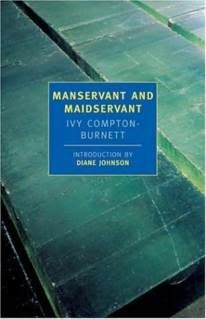
Manservant and Maidservant by Ivy-Compton-Burnett
Manservant and Maidservant by Ivy Compton-Burnett (1947, 309 pages)
Mrs. B of The Literary Stew and Honey of Coffeespoons are jointly hosting a great event this week, The New York Review of Books week. Participants are asked to read a book published by The New York Review of Books, post about it and leave a comment on the host blogs. The New York Review of Books Publishing company has a world wide reputation for quality productions of sometimes neglected classics.
Ivy Compton-Burnett (1884 to 1969-London) wrote her first novel in 1911 and her last was published (after her death) in 1971. Her most famous and most still read work, Manservant and Maidservant was published after WWII in 1947. To me she should be classified as a "between the wars" British writer even though she her work extends well beyond that era because her sensibilities are really quite Edwardian.. This puts her in the company of Katherine Mansfield , Virginia Woolf, and Ford Madox Ford. The consensus is to see her as a writer of the second order behind the truly great writers of the era. She came from what seems to have been a very troubled family. One of her brothers was killed in WWI and two of her sisters died together in a suicide pact. Of her and her 12 siblings no one had a child. All of the children of her parents were educated at boarding schools.
Manservant and Maidservant reads almost like a play. The vast majority of the book is taken up with conversations between the members of the family of Horace Lamb and its mirrored image in the conversations of the man-servants and maidservants of the family. The conversations feel "odd" for reasons I will try to explain. In my post read research on this book I found that many readers have a hard time really liking the book. It is hard to figure out who is talking at times and the cooks and maid talk as if they had been to Cambridge. The conversations were to me very enjoyable for the cleverness and obvious high authorial intelligence. Maybe part of the pleasure of the book comes form imaging a world where people actually talk the way those in the novel do.
Homer Lamb is an incredible cheapskate. He married a woman with some money and made it his lifetime work to be as cheap as possible. In the middle of a London winter he begrudges the use of enough coal to heat the house to even a minimally comfortable level. He is also a martinet of correct speech and spend much of his time correcting the grammar and diction of his children. He does not at all listen to what they say for its content but merely for what opportunity of criticism there imperfect speech may afford him. He is completely cold in his relationship with his wife who does seek comfort elsewhere.
I think one of the very underlying themes of Manservant and Maidservant is the difficulty in speaking the exact truth. Speech involves selective perception which gets only partially at the truth, by necessity.
The servants in the book, in the USA it was originally marketed with the title Bullivant and the Lambs to bring out that the family structure is recreated among the servants with the head servant in the role of pater-familias. In the end the pain Homer Lamb causes his family, of course, comes back on him in an unexpected way. When there is prose in the book not devoted to conversation it is very well done and clearly the product of a very cultivated author.
I would recommend this book to those who enjoy well done conversations in the works they read and are willing to accept that they will have to follow the book closely at times to figure out who is speaking. The book looks back to a world that was coming to an end when it was written. The days when middle class English women had servants came to an end during WWII. In some ways Compton-Burnett is considered a modern writer in that she allows the action of the book to carry the plot and she "shows rather than tells us" what is happening but the sensibilities and concerns of the book seem to me to harbor back to the immediate post WWI era.
It is hard for me to say generally if I would recommend this book to someone I did not know. I can see those who like more action being bored with the books lack of action (two big things do happen or maybe almost happen). I can see some seeing the book very much as a period piece. If you do not like BBC theater TV dramatizations of classic English novels you will probably not like this book. If you like a beautifully written book with a lot of subtle points I think you might like Manservant and Maidservant. I am glad I read it.
I wish to thanks Mrs B and Honey for their hard work in hosting this event.
Mel u
Subscribe to:
Posts (Atom)
Featured Post
Imperial Reckoning: The Untold Story of Britain’s Gulag in Kenya by Caroline Elkins - 2005 - 701 Pages
Imperial Reckoning: The Untold Story of Britain’s Gulag in Kenya by Caroline Elkins - 2005 - 701 Pages 2006 Pulitzer Prize Winner From...
-
Buriedinprint.com This year, Buried in Print, a marvelous blog I have followed for over ten years,is doing a read through of the short sto...
-
Book Blogger Appreciation Week Sept 13 to Sept 17-2010-Giveaway- Katherine Wish by Linda Lappin Leave a comment to win! Open to all f...
-
Nothing Can Destroy the Faith and Strength of the people of the Philippines -Mel u, November 10, 2013- comments welcome. "How My B...