Showing posts with label The Reading Life Yiddish Literature Project. Show all posts

Saturday, October 15, 2022

Moshkeleh the Thief - A Novela by Sholom Aleichem - 1913- translated from the Yiddish with an Introduction by Curt Leviant- 2021 - 61 pages


Moshkeleh the Thief - A Novel by Sholom Aleichem - 1913- translated from the Yiddish  with an Introduction by Curt Leviant- 2021 - 61 pages 


“This almost-forgotten novel by one of the greatest Jewish writers of all time is revelatory, vividly depicting an all-too-rarely-seen side of Yiddish literature and Jewish life; its rendering here, by one of Jewish literature’s greatest translators, provides a crackling energy befitting its material. Don’t start it too late in the evening; you won’t be able to put it down.” —Jeremy Dauber, Columbia University professor and author of The Worlds of Sholem Aleichem 


a very informative conversation with Curt Leviant on Moshkeleh The Thief


This was The first work of Yiddish literature focused on criminals.


Sholem Aleichem


1859 Born in The Ukraine, then part of the Russian Empire


1916 Dies in New York City.  His funeral is attended by 250,000


To most people, certainly me a few years ago, Yiddish writers were divided into two categories, Sholom Aleichem and a bunch of authors I have never heard about whom I would never have read were it not for Yale University Press giving me a full set of The Yale Yiddish Library.  These nine volumes, introduced by top authorities in Yiddish Studies, include some of the great classics.


Among the works were two totally marvelous novels  by Sholom Aleichem.  All of the works were pre-Holocaust, written in Eastern Europe and Russia.  All were by men.  As Yiddish speakers left Europe, mostly to NYC then Toronto and Montréal women writers like Blume Lempel and Chava Rosenfarb began publishing in Yiddish.  I have talked a bit about the history of Yiddish Literature (running from around 1875 to maybe 2004 with the passing of the last of the emigrated writers) in prior posts.  My perception is most seriously into Yiddish Literature, a huge treasure trove of Short Stories, are “heritage readers” seeking ties with the world of their ancestors in Eastern Europe.  Behind it is also a powerful message to those who would destroy Jewish Culture, you lose, we win.  I read in this area because it is an incredibly wonderful literature.  The stories range from heart breaking to funnier than a Mel Brooks movie.  Yiddish scholarship has very strong support and thanks to the internet, and maybe especially The Yiddish Book Center, interest is  growing.  YouTube has lots of good videos and readings of stories.


Sholom Aleichem is by far now most known Yiddish writer.  He is most famous from the movie Fiddler on the Roof based on his Tevye Cycle, centering on a Russian dairyman and his relationship with his daughters. 


Moshkeleh the Thief, set in a small mixed community, centers on a famous horse thief.  Moshkeleh came from a respectable Jewish family.  He was sent to traditional schools to study the Torah but instead he met accomplished thieves.. We learn about the various kind of thieves. There were pick pockets, House burglers, strong arm robbers, kidnappers, informers for hire, experts at bribing officials and horse thieves.  Thieves have their own argot. 


The work was first published as a serial in a popular journal, Moshkeleh Ganev, Warsaw. so there are lots of exciting events to draw readers to buy the next issue. Moshkeleh wanted to get married.  Marriages were mostly arranged and no decent Family wanted him for a son in law.  He became  

 enamored with a teenage girl, following her around until he realized it was futile.


In an interesting subplot, a Young Jewish woman runs away from her home to marry a Gentile.  Her parents hire Moshkeleh to kidnap her.


The introduction by Curt Leviant

details the publication history of the work.


Curt Leviant is the prize-winning author or translator of more than twenty-five books. Besides Sholom Aleichem, other Yiddish writers he has translated include Chaim Grade, Isaac Bashevis Singer, and Avraham Reisen.


Moshkeleh the Thief is a very valuable edition to translated Yiddish.


Mel Ulm


Thursday, August 25, 2022

Dineh- An Autobiographical Novel by Ida Maze - 1939-translated from the Yiddish by Yermiyahu Ahron Taub - 2022 with “Russia and Beyond: On the Art and Life of Ida Maze” An Afterword by Yermiyahu Ahron Taub


Dineh- An Autobiographical Novel by Ida Maze - 1939-translated from the Yiddish by Yermiyahu Ahron Taub - 2022

with “Russia and Beyond: On the Art and Life of Ida Maze” An Afterword by Yermiyahu Ahron Taub


Gateway to Yiddish Literature on The Reading Life 


Dineh was completed in 1939 but first published in 1970 in Yiddish 


The Jewish Women’s Archive Biography of Ida Maze


Ida Maze


Ida Zhukovsky

July 9, 1893

Ugli, Belarus, Russian Empire


In 1907 with her family she emigrated to New York City, in 1908 they relocated to Montreal where she spent the rest of her life.


Died June 13, 1962 in Montreal


Dineh- An Autobiographical Novel by Ida Maze - 1939-translated from the Yiddish by Yermiyahu Ahron Taub - 2022

with “Russia and Beyond: On the Art and Life of Ida Maze” An Afterword by Yermiyahu Ahron Taub


Dineh was completed in 1939 but first published in 1970 in Yiddish 


Ida Maze


Ida Zhukovsky

July 9, 1893

Ugli, Belarus, Russian Empire


In 1907 with her family she emigrated to New York City, in 1908 they relocated to Montreal where she spent the rest of her life.


Died June 13, 1962 in Montreal


Dineh is set in what Is now Belarus in the 1910s.  Told in the first person it Is a bildungsroman of a young girl growing up in a Jewish community.  It is deeply felt account of her love for her family, nature and expanding her knowledge of Jewish tradition, normally more considered a subject for boys.  


In a way it Is a tale of dreams and dread of emigration to America.  Things get increasingly worse for Jews with pograms, a ban on landownership.  The turning of some toward anti-Tsarist ideology leads to executions, Siberia and ever increasing fear of the future.  One tragic thing after another does happen.  People emigrate to New York City, some prosper, some hate living there and return home.  Letters from emigres are a very big factor in the novel.


“Born Hayeh Zukofsky in 1893 in the village of Ugli, White Russia, Ida Maze emigrated ca. 1907 and eventually settled in Montreal, Quebec. She was renowned for her work on behalf of other Yiddish writers. In addition to Dineh, Maze authored four books of poetry, A mame (A Mother; 1931), Lider far kinder (Poems for Children; 1936), Naye lider (New Poems; 1941), and Vaksn mayne kinderlekh: muter un kinder-lider (My Children Grow: Mother and Children's Poems; 1954), which was awarded the prize in children's literature by the Congress for Jewish Culture in 1955. Ida Maze died in 1962.


Yermiyahu Ahron Taub is the author of The Insatiable Psalm (Hershey, Pa.: Wind River Press, 2005). His English and Yiddish poems, one of which was nominated for a Pushcart Prize,have appeared in numerous publications, including The Forward, Kennesaw Review, Lily, and Prairie Schooner. He was honored by the Museum of Jewish Heritage as one of New York's best emerging Jewish artists. A longtime resident of Brooklyn, New York, he now lives in Washington, D.C. “ from   Amazon 


Dineh is a valuable edition to Yiddish literature.


Mel Ulm


Saturday, December 12, 2020

My Quarrel with Hersh Rasseyner by Chaim Grade - first published in Yiddish in 1952 - Translated by Ruth Wisse December 2020 - published in Mosaic - First published in The 1952 in the Rosh Hashanah Issue of issue of the New York Jewish monthly Yidisher kemfer (“The Jewish Militant”)


My Quarrel with Hersh Rasseyner  by Chaim Grade -  first published in Yiddish in 1952 - Translated by Ruth Wisse December 2020 - published in Mosaic - First published in The 1952 in the Rosh Hashanah Issue of issue of the New York Jewish monthly Yidisher kemfer (“The Jewish Militant”)


My Quarrel with Hersh Rasseyner » Mosaic


Chaim Grade,in the image above with his second wife, his first was murdered by Germans, Inna (née Heckler) Grade


Born April 4, 1910 in Vilna, Lituania 


1932 begins to write Short Stories in Yiddish


He spends WWII in Russia


1948-moves to New York City, where he will live from then on, after a couple of years in Paris


Dies April 26, 1982 in The Bronx, New York


Chaim Grade is considered one of the greatest of Yiddish writers.  He wrote plays, several novels considered Master works, learned treatises about how the Holocaust should be understood in Jewish tradition but I think it  his Short Stories and Novellas depicting life in Vilna, Lituania that are most now read.


Mayn krig mit hersh rasseyner” is situated in Paris where Grade briefly lived after the war. His first published work of prose, it appeared in the 1952 Rosh Hashanah issue of the  Jewish Militanf. 


In her introduction Professor Wisse says some scholars see the work as an essay on post Holocaust reactions by Jews debating the meaning of the Holocaust to surviving Jews.  Wisse classified it as a story as many Yiddish Short Stories are structured as two people, in most cases men, having an argument about how The Talmud dictates earthly events should be viewed.


There are three time and location segments in this work, Reading time is about one hour.   In 1937 two  friends debate Talmudic issues.  They were classmates at a yeshiva , a Talmudic school. Now seven years have gone by and one is now himself a teacher. They debate how different readings of the scriptures and commentaries would see worldly events.


“In 1937, I returned to Bialystok, seven years after I had been a student in the Novaredok Yeshiva of the Musarists, a movement that gives special importance to ethical and ascetic elements in Judaism. When I came back, I found many of my old school friends still there. A few even came to the literary evening when I spoke. Others visited me secretly; they did not want the head of the yeshiva to know. I could see on their unshaven faces that their poverty had brought them suffering and that the fire of their youthful zeal had slowly burned itself out. They continued to observe all the laws and customs meticulously, but the weariness of their spiritual struggles lay upon them. For years they had tried to tear the desire for pleasure out of their hearts, and now realized they had lost the war with themselves. They had not overcome the evil urge”


The two ex-Class mates meet again in 1939, in Novaredak.  The narrator,with same first name as Grade, is now a well know writer, his old Classmate, launches into a direct attack on him:


“Chaim Vilner, you will remain a cripple. You will be deformed for the rest of your life. You write godless verses and they pinch you on the cheek for it like a ḥeder child. To add to the blasphemy, you come to spread your godlessness in the very city where you once studied. Now they’re stuffing you with praise as they stuff a goose with grain, and spoil you like an only child! But later you’ll see, when you’ve begun to go to the school of those pork-eaters, oh, won’t they beat you! Oh, how they’ll whip you! Which of you isn’t hurt by criticism? Is there really one of you so self-confident that he doesn’t go around begging for some authority’s approval? Is any one of you prepared to publish his book anonymously? The main thing for you people is that your name should stand on the cover, at the very top!”


Of course Chaim counter attacks.


By far the longest segment takes place in Paris in 1948.  Chaim assumed his friend died in the Holocaust so he was totally shocked to spot him on a bus in Paris.  Hersh Rasseyner tells him how he survived in the camps.  While there he risked execution to teach young men scripture.


Chaim tells him how can you love a God that would allow send six million Jews to be murdered in the Holocaust.  They begin an extended  very learned passionate debate on this issue.


Professor Wisse says My Quarrel with Hersh Rasseyner  by Chaim Grade is the most profound treatment of Jewish theological and historical interpretations of the Holocaust ever written.


I am very grateful to Mosaic for placing the new translation and Professor Wisse’s essay online.  These are very valuable works.


Sunday, May 24, 2020

“In the Bedroom” - A Short Story by Rokhl Bernshteyn writing Under The Pen Name of Yehudis - 1908 - translated from Yiddish by Jordan Finkin in 2020 - published by The Yiddish Book Center


 “In the Bedroom” - A Short Story by Rokhl Bernshteyn writing Under The Pen Name of Yehudis - 1908 - translated from Yiddish by Jordan Finkin in 2020 - published by The Yiddish Book Center 

You may read this story here 

Yehudis (pseudonym of Rokhl Bernsteyn)

Minsk -1869

Minsk - 1942

The Yivo Encyclopedia of Eastern European Jews article 
on her is here.

Yehudis was born into an intellectual Minsk family.  She wrote short stories, dramatic pieces and poems. After the Russian Revolution she wrote articles for Soviet Yiddish language publications.  The article on her in The Yivo Encyclopedia of Eastern European Jews says she is today virtually forgotten.  This story appears to be the first of her works to be translated into English. I offer my thanks to Professor Finkin for allowing those not literate in  Yiddish to read this really quite amazing story.

As “In The Bedroom Opens” two young women, Mirel and Gine, are talking from their beds.  Mirel shares some gossip:

“Mirel crooned quietly to herself and then burst out laughing. “Gine, are you asleep? Get this, Sarah just found someone to surrender her sanctum to, her innocence which she was guarding so daintily. Till her hair turned grey, ha! Oh, what a virtuous soul!”
            “Why are you laughing, Mirele? You think old people can’t love?”
            “Oh, no, I don’t think that. Just the opposite. I like to think of her first hot breaths, and for him—oh, the unfortunate man—hot breaths, wild kisses, and moldy innocence, ha-ha!”

This opens the women up to a conversation about their own sexuality.

“Gosh, the way you talk.” Gine scolded
            “Do my words shock you? Not so elegant? You prefer holy talk!”
“So you’ve got a fiancé yourself, Mirel?”
            “A sweetheart? Yes, no harm in that. A sweetheart for a while,” Mirel laughed.
            “Stop talking nonsense.”
            “It’s not nonsense. Love’s only worth it for a while; longtime love is sad. You see, love spoils when it lasts too long, it turns sour, moldy.”
            “How old are you, Mirele?”
            “You’re worried about my innocence? Too late. I lost that a long time ago.”
            “What do you mean by that?” Gine asked as she sat down.
            “Don’t be afraid, my little kitten, a pair of fine strong arms took it from me. An electrical current passed from those arms right through me. I felt something new. I stared so searchingly into those eyes, as if I might discover the secret of my new feeling.”
            “What play is that from? What role are you playing?”
            “My own. I’m being serious.”
            “You loved? And now?”
            “Did I love, you ask? Yes, I loved. Myself. You see, I loved myself, my feeling, my pleasure.”

From here they begin to dicuss whether sexual passion reauires the sanction of marriage, on sexual feelings for other women and self gratification.  As conversation goes on women open up more about their own experiences.

For 1908 in Jewish culture in Minsk this must have been very shocking.  I hope Professor Finkin will bring out a collection of her work.

I could not find an image of her online, if you can Help with this please contact us.

Jordan Finkin is Rare Book and Manuscript Librarian at the Klau Library of Hebrew Union College in Cincinnati. A specialist in modern Jewish literatures, he is the author of several books as well as numerous scholarly essays and articles. His most recent book, Exile as Home, explores the work of the Yiddish poet Leyb Naydus. He is also the director of Naydus Press, a non-profit publisher of Yiddish literature in translation.


Wednesday, May 6, 2020

The White Bear - A Short Story by Arn Meyer - 1927 - translated from Yiddish by Shopia Shoulson

You can read today’s story here 


Sophia Shoulson in her introduction to this really marvelous story, characterized it as a perfect fable for 2020 when many feel a sense of dread, a fear of the future in a world out of control.  Once again I see the great depth and breadth of the culture of Eastern European Jewish immigrants to America.  This post is in observation of Jewish American Heritage Month.  Arn Mayzl did not begin his literary work until he moved to America.

This story could easily be a fable from Kafka or Robert Walser.  It Is about a polar bear trapped on an ice flow in surrounded by near blinding whiteness.  She feels a desperate sense of isolation. She longs to escape but is terrified of the world beyond her isolation.

“ Everything else was endless, white and endless. A vicious dread would overcome the white bear, her blood boiling with a fervent desire to blast through the maelstrom and run far away. Through the blinding whiteness of the blizzard, through the mountains and along distant trails, far from her solitude, from her colorless melancholy, from the dead stillness, from her frozen kingdom of ice, and into another world.
And one day, on just such a stormy night of pandemonium, the white bear did not resist: she leapt up, unthinking, from her lonely ice floe and let herself run—chased, suddenly, by her fear and pain into the wide, wide world . .”


This is a very powerful work.  Maybe it is how millions feel about their lives now.  

“The White Bear” is the eponymous first story in Arn Mayzl’s 1927 anthology titled Der vayser ber un andere dertseylungen (The White Bear and Other Stories). Arn Mayzl, or Aaron Meisel, was born in the Minsk region of Belorussia in 1890. He immigrated to the United States in 1911, where he became a teacher for the Workmen’s Circle schools and, along with publishing several of his own books, contributed writing to numerous periodicals, including Morgn-frayhayt and Der hamer. 

Sophia Shoulson is the 2019–2020 Richard S. Herman Fellow at the Yiddish Book Center, where she has worked in bibliography for the past two years. Sophia graduated from Wesleyan University in 2018 and is an alumna of the Center’s 2017 Steiner Summer Yiddish Program. At Wesleyan, she double majored in German studies and Wesleyan’s interdisciplinary College of Letters, and she completed a senior thesis on the Yiddish folklore collected by Y. L. Cahan and Shmuel Lehman. Sophia discovered Yiddish by roundabout way of a Jewish day school education followed by her German studies and a semester abroad in Hamburg. She didn’t begin to study Yiddish formally until the summer of 2017, but has been making up for lost time ever since. 

Tuesday, April 14, 2020

An Exchange of Letters Between America and the Old Country - A Short Story by Sholem Aleichem (Story probably written 1910) Translated by Curt Leviant from Yiddish


An Exchange of Letters Between America and the Old Country - A Short Story by Sholem Aleichem (Story probably written 1910)
Translated by Curt Leviant from Yiddish

You can read the story here.


Published Summer 2019 in Pakn Treger, The Magazine of the Yiddish Book Center

Sholem Aleichem

1859 Born in The Ukraine, then part of the Russian Empire

1916 Dies in New York City, then part of The U.S.A.  His funeral is attended by 250,000

To most people, certainly me a few years ago, Yiddish writers were divided into two categories, Sholom Aleichem and a bunch of authors I have never heard about that I would never have read were it not for Yale University Press giving me a full set of The Yale Yiddish Library.  These nine volumes, introduced by top authorities in Yiddish Studies, include some of the great classics.
Among the works were two totally marvelous novels  by Sholom Aleichem.  All of the works were pre-Holocaust, written in Eastern Europe and Russia.  All were by men.  As Yiddish speakers left Europe, mostly to NYC then Toronto and Montréal women writers like Blume Lempel and Chava Rosenfarb began publishing in Yiddish.  I have talked a bit about the history of Yiddish Literature (running from around 1875 to maybe 2004 with the passing of the last of the emigrated writers) in prior posts.  My perception is most seriously into Yiddish Literature, a huge treasure trove of Short Stories, are “heritage readers” seeking ties with the world of their ancestors in Eastern Europe.  Behind it is also a powerful message to those who would destroy Jewish Culture, you lose, we win.  I read in this area because it is an incredibly wonderful literature.  The stories range from heart breaking to funnier than a Mel Brooks movie.  Yiddish scholarship has very strong support and thanks to the internet, and maybe especially The Yiddish Book Center, interest is rapidly growing.  YouTube has lots of good videos and readings of stories.

Anyway Sholom Aleichem is by far now most known Yiddish writer.  He is most famous from the movie Fiddler on the Roof based on his Tevye Cycle, centering on a Russian dairyman and his relationship with his daughters.  

Letters between America and "back home" were a very important part of  the emotional support systems for Yiddish speaking immigrants to America.  Of course most immigrants paint a glowing picture of America.


The story is told through two letters, one sent from New York City by Jacob (formerly Yenkl, the Americanizing of his name is a very big matter) to his close friend Yisrulik back in the "old country" and his friend's answer. His friend lives in Russia.. The time period of the letters is in 1905.  Sholem Achleim's first readers would have known this from the events described by Yisrulik.  (In his very well done introduction Curt Leviant provides us with the background we need.)

Here is the start of the letter from America, notice the American slang expressions such as "blue funk" and "eating our hearts out".   "Mr. Krushevan, that damned anti-Semite and president of the Fourth Duma" referred to was a journalist responsible for widely circulating the codicils of the elders of Zion and inciting anti - Jewish violence.  He was not in fact ever executed.


"To my dear friend Yisrulik, may you and your wife and children be inscribed for a year of health and happiness, and may God’s blessings come upon all Israel, amen.
We’ve been worried stiff because you haven’t written us any letters. We’ve been walking around in a blue funk ever since that period of revolution, constitution, and pogroms began back home in the old country. We’re literally eating our hearts out. If the papers here in America aren’t bluffing, then those revolutionaries have probably made mincemeat of half the world already.
Every day we get wind of another sensational event. Last night I read a cable that they strung up Mr. Krushevan, that damned anti-Semite and president of the Fourth Duma. Let me know if that isn’t a lot of hot air. And write me about your business. Are you still working for someone or are you on your own? And how’s Khane-Rikl? What’s Hershel doing? And how is my cousin Lipa? And how about Yosl, Henikh’s boy! And Bentsi and Rokhl? Zlatke? Motl? And the rest of the tailors? Are you thinking of coming to America? Fill me in on all the details in your next letter.

Of course he relays the news of his family:

"The only thing we miss is . . . home. We’re homesick something awful. My wife, Jennie (we don’t call her Blume anymore), doesn’t leave me alone for a minute. She keeps nagging me to take a trip back to Russia and visit our beloved, dear ones in the cemetery. You’d never recognize Jennie. She’s a regular lady, rigged out in hat, gloves, and all the trimmings. I’m en­closing a snapshot of her and the rest of the family. What do you say to my oldest boy? That’s Motl. Now he’s called Mike. He’s an “alrightnik.” He works in a factory and earns ten, twelve dollars a week. If only he wouldn’t gamble, he’d be a topnotch alrightnik.
My other boy, Jack, used to work in a factory too. He managed to pick up a bit of English and is now a bookkeeper in a barbershop. My third rascal, Benjamin, is a barroom waiter. He doesn’t get wages, but he brings home between six and eight dollars a week in tips. My fourth boy, the one in the picture wearing a cap, is a loafer. He doesn’t want to go to school but hangs around outside on the street day and night playing ball.
The girls are okay too. They work in shops and have some cash in the bank. The only trouble is that I see neither hide nor hair of them. They step out whenever they like, go wherever they like, and with whomever they like.
America’s a free country. You’re perfectly free to keep opinions to yourself. You can’t even tell your own daughter who to marry".

The letter from the old country is written in a classic fashion readers  of Sholem Aleichem will recognize.  Start with humour, then relay in a matter of fact way some terrible events, deaths, murders in pograms and then close with humour.

His friend says America sounds like a place he wants nothing to do with.

"An Exchange of Letters Between America and the Old Country" is a miniature master work, readable in under five minutes.  It would make a good first work by Sholem Aleichem.

Mel u


Sunday, March 3, 2019

Friends - A Short Story by Hersh Dovid Norberg- first published in The Forward February 24, 1912 - translated from Yiddish by Seymour Levitan


I read "Friends" by Hersh Dovid Norberg in the anthology, Have I Got a Story for You: 100 Years of Stories From the Forward, edited by Ezra Glints with an introduction by Dana Horn.  There are 41 stories in this collection, with a very good introduction and consise well done biographies of each author.  This book is a valuable resource to all into Yiddish literature and would serve as a good first book for those interested in this great reading life area.

Hersch Dovid Norberg

1876 - Wszchzonous, Poland

1927 - Warsaw, Poland

Hersch Dovid Norberg was a very prolific author and a  world traveler.  With the encouragement of I. L. Peretz, he began to write in Yiddish. He was fluent in Russian, Polish, German as well as Hebrew.  

(See the article linked below from The Yivo Encyclopedia of Jews in Eastern Europe for information on his career and life history.


There are three characters in "Friends", a married couple and the husband's close friend of many years.  We see how deeply the husband loves his wife.  He has not seen his friend since he married and he insists on an extended visit.  He  soon becomes concerned his wife and his friend are having an affair.  He has no proof but he is consumed by jealousy.  The ending is very moving and takes us many years into the future.  Some will say the story is a bit schmaltzy, certainly worth the ten minutes reading time.

Mel u


Sunday, August 12, 2018

“The Road of No Return” - A Short Story by Rachel Korn - translated from Yiddish by Mariam Waddington


Ghosts love Yid­dish — they all speak It


“The Road of No Return” by Rachel Korn, set in a World War Two Jewish Ghetto is a deeply moving story about love, hope, sacrifice, in a time of great suffering, massive murders by the Germans.  

Yiddish writers who are Holocaust survivors as was Rachel Korn for the rest of their lives tried to capture vignettes of the Holocaust in their stories.  Many, as did Rachel lost many family members, suffered survivors guilt and a deep loneliness from which there was no way out.

The Germans liked to cause mental pain as much as physical.  In today’s story they have posted notices saying one person from every family must present themselves for transportation to a concentration camp, all knew this meant death.  If a family did not comply by the deadline, everyone in the family would be transported.

At dinner the father, obviously shaken to the core, tells his family of the sign. There is two youngsters, a fourteen year old daughter and a 21 year old son, the father and mother plus an ancient grandmother.  The four older family members say it cannot be the father as he supports all, the mother is the care giver, the girl just becoming a woman.  The 21 year old son volunteered to go, the guilt of making the logical choice of the grandmother is too overwhelming,the grandmother remains silent.  

Everyone thinks she does not understand what is going on and they do not include her in the conversation on who will go.

Then they notice the grandmother is gone.  Looking out the widow, they see her, carrying the one allowed one small bag, walking to turn herself into the Germans.

A beautiful story. 

A read this in Found Treasures: Stories by Yiddish Women.


RACHEL KORN (1898 –1982) Born in 1898 near Pokliski in East Galicia, Rachel Korn grew up among farmers and peasants. At a time when nearly all European Jews lived in cities or sbtetls, her family had owned farmland for several generations. The great love and understanding of nature so prominent in Korn’s poetry can be attributed to her childhood experiences.  Korn learned to read and write in Yiddish as an adult, taught by her husband. Though her first publications were in Polish, she chose to become a Yiddish writer because of the pogroms that followed the First World War. Soon thereafter the Yiddish literary world recognized her talents. The powerful vibrancy and boldness of her nature imagery were a new phenomenon in Yiddish literature. When the nazis invaded Poland, Korn fled to Uzbekistan in the Soviet Union with her young daughter. Her husband was killed by the Germans as were most other members of her family. After the war, Korn returned to Poland, resuming her literary career in Lodz where she was elected to the executive of the Yiddish Writers’ Union. In this capacity she attended a PEN conference in Stockholm. Korn never returned to Poland, spending some time in Sweden before immigrating to Montreal in 1949. Here she remained productive as a Yiddish writer of poetry and short stories. As a Holocaust survivor, she often wrote about her grief and isolation. Though she had lost her family, her social context and most of her Yiddish readership, she continued to write poetry and short stories of great eloquence and poignancy in the language of her youth. In the course of her writing career, Korn wrote nine volumes of poetry and two of short stories. Her works have been translated into a variety of languages including English, Hebrew, Polish, Russian, German and French. Two collections of her poems have been published in English: Generations and Paper Roses. Korn’s short stories appear in translation in Canadian Jcwish Short Storics and Canadian Yiddish Writing. She was awarded numerous literary prizes, including the prestigious Manger Prize for Yiddish Literature presented to her by the State of Israel in 1974. —from Found Treasures:Stories by Yiddish Women 


A very informative article 


Mariam Waddington was also a highly regarded writer who emigrated from Russia to Montreal.


Mel u


Thursday, August 9, 2018

AT THE RICH RELATIVES by Celia Dropkin, a Short Story, Translated by Faith Jones


Why Read Celia Dropkin by Faith Hill - from The Yiddish Book Center


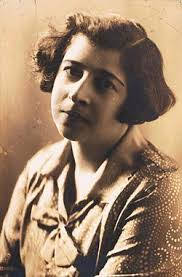
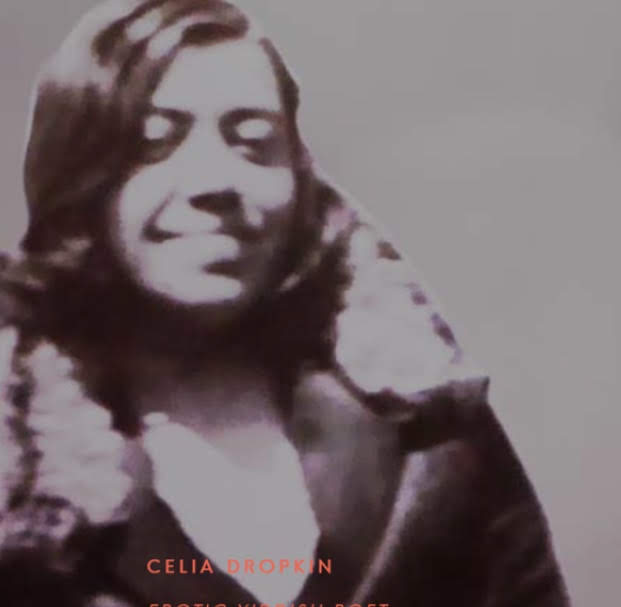
Another Yiddish woman poet was Celia Dropkin (1887-1956). An eager student, she was formally educated for most of her youth in Belarus. She began writing poetry in Russian at 

age 10 and was encouraged to keep writing by Uri Nissan Gnessin, a Hebrew poet who she became close with. After getting married, Dropkin immigrated to New York. She began 

translating her Russian poems into Yiddish and published them in several leading Yiddish 
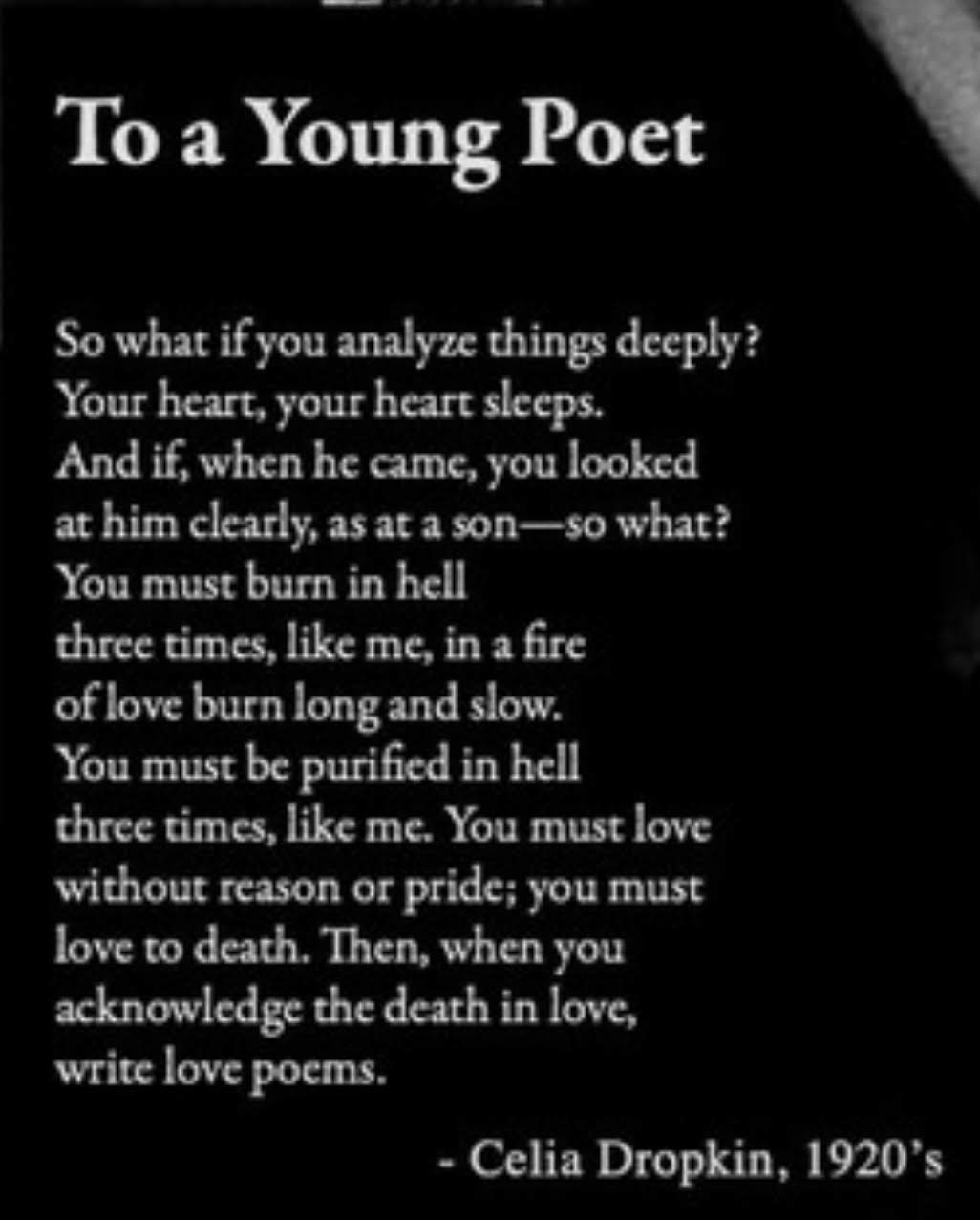
literary magazines. While some of Dropkin’s works were about her life experiences and children, she is famed for her passionate poetry about sex, eroticism, love, and relationships, themes that resonate with readers today. In the early 1900s, most people thought that Jewish women only wrote tkhines, Yiddish prayers often concerning domestic matters and child-rearing; Dropkin challenged that. While a number of critics felt that her works were too personal and too overtly sexual, her contemporaries were generally positive about her writings. Modern-day Yiddish enthusiasts have not forgotten Dropkin’s contributions to Jewish literature, as her poems have been published in several contemporary Yiddish anthologies and set to song by klezmer bands.. From The 
Jewish Women’s Archive Blog 


“At the Rich Relatives” by Celia Dropkin, translated from Yiddish by Faith Jones, from Beautiful as the Moon, Radiant as the Stars:Jewish Women in Yiddish

“At the Rich Relatives” is set in late Tsarist Russia.  A widow and her 14 year old daughter recently lost there house in a fire started during a pogram.  Their rich relatives have invited them to come stay on their estate.  The daughter initially resists, saying her rich cousins look down on her.  They make the move anyway.  Just as the daughter worried, she feels inferior to others in the family her age.  They have much better and many more clothes.  The rich families income comes from a factory about a mile away.  The workers live in shacks near the factory and are barely paid enough to live.  One of the cousins has a fire for social justice.  He tells the family their luxurious life comes from the misery of others.  

He begins to talk to the girl about communist ideologies.  Mingling a romantic feeling, they become bonded in their love for justice.

Dropkin very well develops the characters and her descriptions of the property of the rich and their splendid diet in contrast to that of the poor have the power of Zola.

I have access to a few more stories by Dropkin and will be posting upon them.

My thanks to Faith Jones for her elegant translation


FAITH JONES is a short-story writer and translator and a researcher of book and library history. Her work has been published in anthologies and in scholarly and literary journals such as Canadian Jewish Studies, Lyric, Bridges, Fiddlehead, and Geist. She is a librarian in the Dorot Jewish Division of the New York Public Library and is active in Yiddish, feminist, and peace organizations.

Mel u


Featured Post

Imperial Reckoning: The Untold Story of Britain’s Gulag in Kenya by Caroline Elkins - 2005 - 701 Pages

  Imperial Reckoning:     The Untold Story of Britain’s Gulag in Kenya by Caroline Elkins - 2005 - 701 Pages 2006 Pulitzer Prize Winner From...