Friday, May 7, 2010

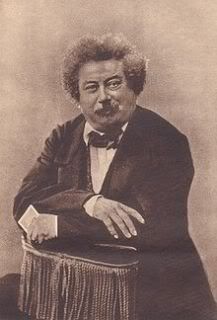
"Georges" by Alexandre Dumas

Georges by Alexandre Dumas (1843, translated from French by  Tina Kover 2007, 294 pages)

I am a bit late in posting this for the Classics Circuit, my Internet provider has been up and mostly down for the last few days.   
I choose to read Georges for the classics circuit for several reasons.     It deals with colonialism in a European colony  in the Indian Ocean.    I have already posted on George Sand's idiosyncratic but brilliant novel, Indiana set on the then French colony of Reunion Island.    I really enjoyed Amitav Ghosh's Sea Of Poppies set in colonial India in the 19th century and the colonial islands of the Indian Ocean.    I even suggested in that post that Sea of Poppies almost reads like a cliff hanging novel by Dumas.    Georges also has a brand new translation.   The cover says it is the only book of  Dumas that really deals with the question of race relations.    It is not 1000 pages long like has two most famous works The Count of Monte Cristo and The Three Musketeers and I admit this is one of the reasons I choose it.     It is not nearly as widely read as his big books and as  far as I could see there are no other blog posts on the work.

Dumas (1802 to 1870) was a very prolific and popular author in the France of his day.   Many of his books were written with the help (sometimes quite substantial help) of assistants and collaborators.   Dumas' maternal great grandparent father was the descendant of African slaves  and Dumas' consciousness of racial issues had a personal note because of this.  (He was actually on his death denied burial in The Pantheon of Paris where great figures of French culture were buried-including writers of much less imminence at the time of their death than Dumas-because of his racial heritage.    He was reburied there in 2002 by order of the president of France who made an apology for his prior exclusion).

Georges is set on the island of Mauritius (in the Indian Ocean about 1200 kilometers east of Africa.  It is about 200 kilometers from Reunion Island, the setting for Indiana).   The book does make use of terms for the racial mix of its characters that are no longer politically correct but as to leave them out would miss much of the flavor of this novel so  I will use them.   

Georges  is named for its central character.    George is a mid-twenty year old son of a very wealthy mulatto who has a large plantation diverse business enterprises and is the owner of several hundred slaves.    Georges' father through sheer hard work and applied high intelligence made himself wealthy.   As the narration of the book makes clear, the father is known for his human treatment of his slaves.   As you read this book you will see that Dumas is very sensitive to the ways that being regarded as inferior by the accident of your racial mix can deeply scar someone and even shape their destiny.   That being said, we have to ponder if  Georges is itself properly viewed as a racist work.    Here is a description of a festival during which slaves did not have to work:

The blacks had wasted no time in beginning their three day holiday.   Primitive and uninhibited by nature, they worked and played with equal fervor, and danced until they often dropped from exhaustion.
There are at least a dozen sentences just like that in the work.   On the other hand, Dumas does do a brilliant job in telling us in a few lines how racial prejudice effects the father of Georges and Georges.  (It is almost as if Dumas can go as far as suggesting a mulatto can have the exact same feeling and a superior mentality to a European but he stops short at attributing full humanity to the slaves)    In a central episode of the opening of the novel the island is invaded by English troops.   A battle starts and Georges' father offers to join in the battle along with the French.   A French man way below the economic or intellectual level of the father or Georges (way inferior in terms of wealth and education to Georges and his father) says he does not want a mulatto fighting along side him.   The father then forms his own troop of black and mulatto troops who he leads with great bravery against the English.   Georges, fight along side his father captures the flag of the English (a very big thing).  Here is what a very powerful Frenchman says to Georges:


Give me that flag boy.   "Sir it was I who captured the flag from the British" murmured Pierre Munier.   "I am aware of that--but I won't have it known a mulatto dared to argue with me.  
Georges' father takes the flag from the hand of his son and gives it to the French men (the same man who had said he would not allow George and his father to fight along side of them) out of fear of what would happen to his son if he disobeyed the French men.  


Here is a powerful passage:


It was truly painful to see a man of such deep and noble character yield to so vulgar a bully, but it was.   Even worse, his actions surprised no one.   That sort of think occurs everyday in the colonies.   Brought up since infancy to regard white men as a superior breed, Pierre Munier had allowed his proud spirit to be crushed without even attempting to resist.....Georges had remained stoic as his own blood ran down his cheek, but now he burst into tears empty handed before his father..he clenched his fists with fury and swore that someday he would get his revenge on all white men.
There is a lot of lush description of the island and its culture.   I think the colonial islands of the Indian Ocean must have seemed very exotic and far away in Europe in the 1840s.   


About the first half of this book was a bit slow moving for me.   It is told in a melodramatic way and the characters are a bit wooden at times and seem more written to embody a type than  a whole person. The lead  female character is completely unrealized.    There is a romance in the book but it is not well done.  However I did begin to get caught up in the action as the second half and I did find it pretty exciting in places.   There is a slave revolt on the island which is lead by Georges which is just a brilliant set piece that I enjoyed tremendously.   


I think Georges is worth reading especially if you are a  fan of his big books or are interested in seeing one of the first attempts to deal with race relations in a novel.    Once I got caught up in the action I was interested and entertained.   I think Dumas probably wrote this book very rapidly and was just at the start of his career and not yet the writer he was to become in a few years.   It is the second of his novels and the big books are years away.   Like them it was originally published as a serial.   I think if I had been reading it as a serial I might have been bored with the opening pieces but would have eagerly awaited the publication of the end sections of the book.   


I think many will find elements of this novel to portray racial attitudes that seem are now very unacceptable.   That is just a fact of life for a 19th century novel.   Maybe giving full humanity to a mulatto (itself a term from a racist mentality which is used throughout the book) is all Dumas can do.   I would say if you are a big Dumas fan, an avid reader of the 19th century novel or interested in an early literary treatment of racism to consider reading this book.   It is fun and entertaining and it is also even though it attacks prejudice it is  a racist book.  


If others have read this book I would be very interesting in your opinions as to whether or not I am correct in seeing the book as racist.


I thank the organizers of the Classics Circuit for their great work and I am sorry I was late due to internet issues.

Wednesday, May 5, 2010

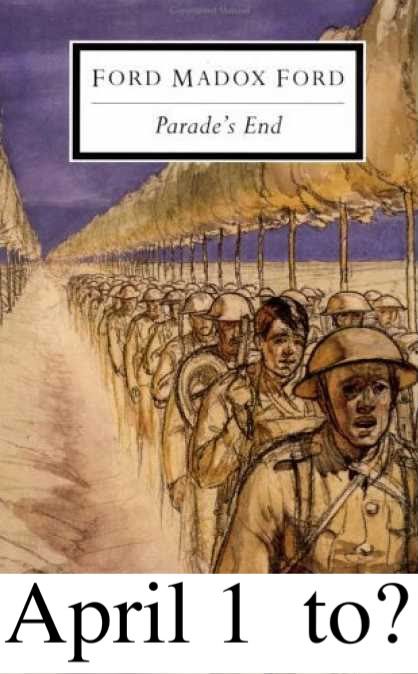
"A Man Could Stand Up" by Ford Madox Ford


A Man Could Stand Up by Ford Madox Ford (1926, 174 pages)

A Man Could Stand Up is part three of Parade's End  Ford Madox Ford's (FMF) tetrology set in the World War I era (1914 to 1918) in England and in the trenches in France.   I have already done posts the first two works as well as a general post as to whether or not Parade's End should be treated as an encyclopedic narrative.    

Parade's End and A Man Could Stand Up are about a lot of things.    It is a love story of sorts, a war story (some say it is the best English language war story)and  a story of class in Edwardian England.    It is about partial knowledge (I think a more knowledgeable person than I on such matters could relate it to some of the  visual  art of the period), it is about the nature of history, the causes of war (some of the reflections that come from the very upper class central character  Christopher Tietjen's are quite radical), the effect of war on the close up combatants (FMF had first hand knowledge of Trench Warfare-he volunteered for combat even though he was above the draftable age).    There are a lot of very interesting references to literature and art of the 19th century and way beyond.   It is about how memory effects our perceptions.    I should note that as I read on in Parade's End I see the real difficulties in precisely knowing what the plot action of the novel is (and there is a lot going on, it is not a novel strictly of the wealthy having endless conversations about matters of interest only to those in their closed circles) as a reflective of the deeper themes of the work.   I hate to say this but if one see Parade's End as an easy read then you have missed the point of it fully.   

Dwight of A Common Reader has done a great job setting on the time frame and action in A Man Could Stand Up.   It opens on Armistice Day in London (November 11, 1918).   We enter the stream of consciousness of Valentine Wannop (unconsummated -we think?) romantic interest in the married Tietjens (Parade's End is also a great account of a marriage in perpetual crisis and of the state of the relationships between men and women among the Edwardian gentry) as she reflects on her life and life post World War I.   Another theme (yes there are this many and more) is the effect of the destruction of old values caused by the war.   Leaders lead the people into a near meaningless war over petty quarrels and dynastic squabbles that cost millions of people their lives.   To those who reflected on this it seems like a break in history or the opening up of the doors of chaos to a world without values.   (In this way Parade's End does remind me of some post WWII Japanese works).   Valentine has contact with the wife of an old friend of Tietjens which leads to some interesting interaction.    From here A Man Could Stand Up begins a flash back to Tietjens in the trenches.   The often charring quick flash writing style of this section almost evokes the feel of explosions in the trenches.   We can feel Christopher struggling to keep his sanity in the structure of the prose in this part of  the book.   The final section of A Man Could Stand Up sees Christopher back in England shortly after Armistice Day.   He and Valentine are trying to deal with and in fact find out what their feelings for each other are.   Each has a confused in part notion of what the other wants and thinks.   Tietjens mind has been effected by the war in ways we do not fully understand.   There was nothing in his upbring to prepare him for trench war even though in part one he did say it would be people like him that would win the forthcoming war.   Tietjens is a deeply cultured man (I can think of few if any books that do a better job showing the interior life of a very intelligent and deeply read man than Parade's End) and he is a bit of a class snob.   He looks out for his men while feeling it is not right for the "lower classes" to have political opinions.   He does not get along well with his superior as they are men inferior to him that in a proper world order would have no authority over him at all.

Parade's End is an incredibly well constructed and crafted novel.   Just the pleasure of the many epigrammatic observations of Tietjens on literature are enough to make the book worth reading!   We need to keep our wits fully about us as we read this work-the narrator may seem omniscient but he is not.   Even some of the literary observations of Tietjens are wrong (he attributes something from Henry James to  a Russian author-there may well be other errors I have missed also, of course).   Everything in Parade's End is deliberate.   It is not journalism turned into a novel.

I took a break between Part Two and Three of  Parade's End as I felt I needed some time to reflect on what I had read.   I will begin the final section, The Last Post soon.   I will do a post on it and then at least one over all post on Parade's End.   

All of those in the read along have posted multiple times on Parade's End.   I have profited greatly from their posts.    I also think there are a couple of others who may have read Parade's End also along with who have not yet posted on it.   I do find posting on the book intimidating

Here are links to the posts of the participants I am aware of in the read along

Dwight of A Common Reader -Dwight also has a very good resources Page on FMF.

Hannah of Hannah's Book Blog

Nicole of Bibliographing


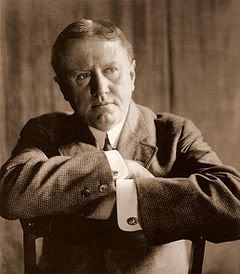
"The Gift of the Magi" by O Henry


"The Gift of the Magi" by O Henry (1906-3 pages, read via Dailylit.com)

O. Henry (pen name for William Porter-1862 to 1910-North Carolina, USA) is best known as the author of some 300 short stories.   "The Gift of the Magi" may well be the most assigned to be read short story in American schools.     O Henry led a trouble life.    Wikipedia has a good article about him.   One interesting trivial pursuit item I learned from it was that O Henry created the term "banana republic" to describe the country of Honduras (where he was hiding from charges of bank embezzlement-for which offense he did serve five years in prison) and it has now entered the common language to mean a small unstable tropical country in Latin America.   

"The Gift of the Magi" turns on a twist or surprise ending as it seems do many of his short stories.    The story opens in the early 1900s at the small very modest apartment of a young married couple, Jim and Della.   The setting is a large American city.   O Henry does a very good job of making us able to visualize the apartment.   We can see the Jim and Della very much love each other.   Christmas is coming and each one of them very much wants to give the other a wonderful present.    Anyone who has ever been short of money at Christmas with loved ones for whom you cannot really buy  the gifts you long to will directly relate to this story.  I do not want to spoil this story for those who may have not yet read it.   The style is somehow relaxing.   Perhaps his stories do depend to much on the surprise ending and cynics would say they have a schmaltzy feel but this one was fun to read and the time invested was worth it for sure.    

Here is a sample of his prose style:

The magi, as you know, were wise men--wonderfully wise men--who brought gifts to the Babe in the manger. They invented the art of giving Christmas presents. Being wise, their gifts were no doubt wise ones, possibly bearing the privilege of exchange in case of duplication. And here I have lamely related to you the uneventful chronicle of two foolish children in a flat who most unwisely sacrificed for each other the greatest treasures of their house. But in a last word to the wise of these days let it be said that of all who give gifts these two were the wisest. Of all who give and receive gifts, such as they are wisest. Everywhere they are wisest. They are the magi.
I am glad I read this story and think most readers of my blog would find it a pleasant easy read.  

Tuesday, May 4, 2010

"The Shot" by Alexander Pushkin


"The Shot" by Alexander Pushkin (1831, read on line at The Literature Network, 15 pages)

Since posting on Alexander Pushkin's short story "The Queen of Spades" I have done a bit of reading on Pushkin and his place in Russian culture. If you ask a reader of Russian literature who reads no Russian who the most influential Russian authors are the answer will for sure be Tolstoy or Dostoevsky. I think now if you asked a well read Russian the same question the answer would for sure include Pushkin and he would be listed first. In my post on "The Queen of Spades" I wrote a bit on why Pushkin is not more read outside of Russia. All the greats of Russian literature from Pushkin's good friend Gogol on down to Nabokov (who struggled by his own admission with the translation of Eugine Onegin) pay extreme tribute to Pushkin.

Like "The Queen of Spades", "The Shot" deals with Russian military officers and gambling. It is a look at what appears to be the life of the lowest level of gentry in Russian society.

As the story proceeds the narrator learns to his amazement that the mysterious civilian, Silvio, is an incredible
marksmen with the pistol. A deeply layered in meaning series of events occur involving an unintended insult to Slvio by a brash young officer, a beautiful woman, a country estate and a mysterious set of bullet holes in a painting.

I really hope others may be motivated to begin reading Pushkin with this story so I will not give away
any more of the plot. The characterization is very well done. The description of the country estate makes you feel you can see it and I could not help but laugh when I visualized all the young  officers looking on Silvio as ancient at 35.

Pushkin is credited as beginning Russian Literature. He was reinvented during the Soviet eraas a great cultural icon. Pushkin has a near sacred status in Russia.

I hope others may begin to get to know Pushkin through "The Shot" and "The Ace of Spades".  They are both very well done short stories and are a pleasure to read.   I am very glad to have begun my education on Pushkin.

I am requesting suggestions as to additional English language reads of Pushkin.

.

Monday, May 3, 2010

"The Artist of the Beautiful" by Nathaniel Hawthorne

"The Artist of the Beautiful" by Nathaniel Hawthorne (1844, 25 pages, )

Nathaniel Hawthorne (1804 to 1864-born Salem, Massachusetts) is by far best known for his classic novel about adultery, The Scarlett Letter  (1850).   The Scarlett Letter was one of the very first mass produced books in America and was a best seller upon publication.   I read it a long time ago.   Most of his works are set in the New England region of the United States and many are related to issues revolving around puritanism.   

Recently I was browsing through some of the short story selection on Dailylit.com and I saw there were a number of selections by Hawthorne.   There was one story I recalled having read in school, "The Artist of the Beautiful".   The plot of the story was still pretty fresh in my memory somehow so I decided to read it again to see how it looked to me now.   

"The Artist of the Beautiful" is a classic tale of the seeming conflict of the artistic temperament with the practical mentality.    A tale of the conflict of the lover of beauty and the advocate of pure practicality.    It is a battle of a watch maker and his apprentice.       I do not want to give away much of the plot of the story.  

In this story we do not see a simple conflict between a hyper sensitive artist (recall this is in the height of the romantic era in Europe) and a brutish craftsman.   The artist is not swooning over a daisy while the watcher maker toils away with out a thought in his blank mind:

But it was always for purposes of grace, and never with any mockery of the useful. He did not, like the crowd of school-boy artisans, construct little windmills on the angle of a barn or watermills across the neighboring brook
To some extent Hawthorne may be mocking the  overly lush prose of some of his contemporaries in this passage.   The watch maker's apprentice seemingly spends far to much time on the projects he is given and is out touch withe fact that time equals money and it is profit that runs a business


One of his most rational projects was to connect a musical operation with the machinery of his watches, so that all the harsh dissonances of life might be rendered tuneful, and each flitting moment fall into the abyss of the past in golden drops of harmony. If a family clock was intrusted to him for repair,--one of those tall, ancient clocks that have grown nearly allied to human nature by measuring out the lifetime of many generations,--he would take upon himself to arrange a dance or funeral procession of figures across its venerable face, representing twelve mirthful or melancholy hours

Purely for his own pleasure the artist creates a mechanical butterfly of marvelous beauty:

It has been delicately wrought," said the artist, calmly. "As I told you, it has imbibed a spiritual essence--call it magnetism, or what you will. In an atmosphere of doubt and mockery its exquisite susceptibility suffers torture, as does the soul of him who instilled his own life into it. It has already lost its beauty; in a few moments more its mechanism would be irreparably injured." 

We see here a clear portrait of the artist as tortured soul.   The last lines of the story are kind of an  artistic credo in terms of a Romantic Era reading of Plato's theory of ideas

When the artist rose high enough to achieve the beautiful, the symbol by which he made it perceptible to mortal senses became of little value in his eyes while his spirit possessed itself in the enjoyment of the reality. 


April Reading Life Review and May Plans


April 2010 was an interesting and enjoyable reading life month for me.   I lost a few reading days on a family trip to Palawan Island, about one hour by air from Manila.    We stayed in Puerto Princessa in a  beautiful resort over looking The South China Sea.    I did get in some reading time in one morning in the restaurant.       The view is awesome and the open air restaurant was cooled by the ocean breezes.   I was reading The God of Small Things.   The owner of the restaurant (and a friend of my wife also) spotted the book and said she was reading it too!-

In April I did my first Classics Circuit read, Nana by Zola.   I achieved one of my 2010 blog objectives.   I started a read along of Ford Madox Ford's Parade's End and feel very fortunate in the high caliber of the participation in this read along.   I read a number of short stories and have now overcome a life long aversion to the form.   I will be reading short stories and blogging on them on a regular basis from now on.   There are 1000s of short stories available on line on  various free web pages.   Here is what I read and posted on in April (so far this year I have posted on everything I have read):


  1. South of the Border, West of the Sun by Haruki Marakami
  2. The Diving Pool (a collection of three novellas-each reviewed) by Yoko Ogawa
  3. Some Do Not by Ford Madox Ford
  4. "Heaven and Hell" by Jhumpa Lahiri (short story)
  5. "A Doctor's Visit" by Anton Chekhov (short story)
  6. "A Respectable Woman" by Kate Chopin (short story)
  7. No More Parades by Ford Madox Ford
  8. "The Dance of Death" by Gustav Flaubert
  9. Train Man by Hitori Nakano
  10. "The Yellow Wall Paper" by Charlotte  Perkins
  11. "The Man with Two Left Feet" by P G Wodehouse
  12. Nana by Emile Zola
  13. Grotesque by Natsuo Kirino
  14. The God of Small Things by Arundhati Roy
  15. "The Masque of the Red Death" by Edgar Allan Poe
  16. Diary of a Mad Old Man by Junichiro Tanizaki
  17. The Tobacco Monopoly in the Philippines 1766 to 1880 by Edilberto C de Jesus
  18. "The Dead Alive" by Wilkie Collins
The best books I read this month were those by Ford Madox Ford, Junichiro Tanizaki, and Emile Zola.   The worst was Train Man by Hitori Nakano and even that was kind of a fun book in a new format, the message room novel.     I discovered some new to me writers I will be reading more of also.    P G Wodehouse for his style and his humor, Arundhati Roy for her wisdom and insight into India and beyond,  Yoko Ogawa for the almost dream like quality of her work,   Pushkin who I really want to read more off (expect another Pushkin post very soon), Jhumpa Lahiri has written three books and I will hopefully read them all  and Kate Chopin whose The Awaking I am in the process of reading via Dailylit.com.   
                                                                                

May Plans

On May 5 I will be participating for a second time in the Classics Circuit in a post on Georges by Alexander Dumas.    I also plan to post on the longest works by Kenzaburo Oe and Huruki Murakami.   I will do three more posts on Parade's End.   I hope to post on four to eight more short stories.   Short stories are also a very good way to kind of "check out" an author.    I am considering also reading Pale Fire by Nabakov once I complete and process Parade's End.

As always I thank the readers of my blog.    I appreciate all   comments and reading suggestions.  

Mel u 

Sunday, May 2, 2010

"The Queen of Spades" by Alexander Pushkin


"The Queen of Spades" by Alexander Pushkin (1834-6 pages)

Alexander Pushkin (1799 to 1837-Moscow) is a greatly revered Russian writer and was a powerful influence on all  subsequent  Russian literature and opera.   He is not widely read in English as his most famous works are said to be  very difficult to translate poems.    I recall I first heard of Pushkin when I was in my early teens and reading the first edition of Clifton Fadiman's  Life Time Reading Plan.   Fadiman  said in his section on poetry that people he respected said Pushkin was a greater poet than any of the dozen or so canon writers he listed but he could not verify that by reading the translations.  I have always pretty much accepted the famous line of Robert Frost "Poetry is what is lost in translation".   The only translated poetic works I have read in the last twenty years or so (but for brief sections in an article) are Robert Fagles translations of Homer and Virgil.   

I was so happy to find on line a translation of Pushkin's famous short story, "The Queen of Spades".    The story opens in a private  casino. in Paris in the house of wealthy Russian army officer living in Paris.    The central character in the story, Hermann is an officer in the Russian Imperial Army ( for what it may matter politically at the time, he was a German).   He watches his fellow officers gamble on many occasions but never indulges himself.   One night one of his fellow officers tells him about his grandmother.   The grandmother had lost a fortune at cards.   She won it all back with a secret of using three particular cards of the deck to guarantee a win.   She learned the secret from a French count.   Hermann becomes totally obessed with learning this secret.   He finds out the now 87 year old grandmother is living still and begins to send love letters to her female ward to give him an excuse to visit.   He does visit and he threatens the elderly lady with a pistol while demanding to know here secret.   The story is short and can be read in a few minutes so I will not relay more of the plot as the ending is a bit of a twist.

The pleasure in this masterful story for me was in the depth of characterization Pushkin was able to achieve in such a short work and is his creation of a very full enviorment.    Here is a sample of the story to give you a feel for flow of the prose:
At the house of Naroumov, a cavalry officer, the long winter night had been passed in gambling. At five in the morning breakfast was served to the weary players. The winners ate with relish; the losers, on the contrary, pushed back their plates and sat brooding gloomily. Under the influence of the good wine, however, the conversation then became general.
"Well, then, listen to it. To begin with, sixty years ago my grandmother went to Paris, where she was all the fashion. People crowded each other in the streets to get a chance to see the 'Muscovite Venus,' as she was called. All the great ladies played faro, then. On one occasion, while playing with the Duke of Orleans, she lost an enormous sum. She told her husband of the debt, but he refused outright to pay it. Nothing could induce him to change his mind on the subject, and grandmother was at her wits' ends. Finally, she remembered a friend of hers, Count Saint-Germain. You must have heard of him, as many wonderful stories have been told about him. He is said to have discovered the elixir of life, the philosopher's stone, and many other equally marvelous things. He had money at his disposal, and my grandmother knew it. She sent him a note asking him to come to see her. He obeyed her summons and found her in great distress. She painted the cruelty of her husband in the darkest colors, and ended by telling the Count that she depended upon his friendship and generosity.


The Wikipedia  article on Pushkin  relays a life story as interesting as any 19th century novelist could create.   One of his ancestors was a black servant at the court of Peter the Great.   Pushkin at about age 15 begin to gain great recognition for his writings and became a frequent visitor at court.   He died at age 37 in a duel he fought with a man who was thought to be a lover of his wife.   She was at the time of her marriage at 16 to Pushkin considered one of the great beauties of the court.    The Wikipedia article details well his huge influence on Russian literature.     


I read the this story on line at http://www.readbookonline.net/.    There is no translator credited. My guess is that the translator was Constant Garnett.  Many will have heard of this work through the production as an Opera by Tchaikovsk.   Russian writers from Gogol to Tolstoy paid homage to him and were heavily influenced  by his work.    On this story, I would just suggest it is an easy way for us to read at least something by a great writer that we will never probably be able to come close to knowing.   Victor Nabokov attempted a translation of Pushkin's most famous work, Eugine Onigen.   Here is what Nabokov (who was given to hyperbole) said of this work (which he has translated into English with an extensive commentary).


 The English form has been instrumental in producing a quantity of admirable short poems but has never achieved anything approaching, either in sheer length or artistic importance, a stanzaic romance comparable to Eugene Onegin.


Edmund Wilson says of Pushkin "No poet surpasses Pushkin—not even Dante—for the speed, point, and neatness of his narrative".      


I think "The Queen of Spades" is very worth the time of anyone who wants to learn something about this hugely influential writer while enjoying a good story at the same time.   The feel of the story is similar to Edgar Alan Poe's "The Masque of the Red Death".    I will investigate other ways to read Pushkin soon.   


Dwight of A Common Reader has a very informative post on  Pushkin.  


Mel u


Featured Post

Imperial Reckoning: The Untold Story of Britain’s Gulag in Kenya by Caroline Elkins - 2005 - 701 Pages

  Imperial Reckoning:     The Untold Story of Britain’s Gulag in Kenya by Caroline Elkins - 2005 - 701 Pages 2006 Pulitzer Prize Winner From...