Saturday, May 15, 2010

" Open Window" by Saki


"The Open Window" by Saki

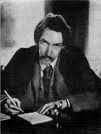
 "The Open Window"   by Saki-aka Hector Munro (4 pages, 1911)


Hector Munro (1870 to 1916)  writing under the pen name of Saki is considered a master of the very short story (under 5 pages)and is often mentioned as an English O Henry.   Saki was born in Burma (I prefer the old name) in 1870 where his father was serving as inspector general for the Burmese police.   Burma was part of the British Empire at that time.   At age two Saki is sent back to England to be raised by his grandmother when his mother died as a result of an incident with a cow.   His father later retired to England and he and Saki appeared to have had an amiable relationship as perhaps indicated by Saki also joining the office of the Burmese police inspector at age 23.   Saki caught malaria at age 25 and returned to England where he would become journalist.   He worked for a couple of years as foreign correspondent in Russia where he witnessed the infamous bloody Sunday episode.   He also gave that up and for about the last ten years of his life he was not formally employed on a regular basis  and was supported by family wealth.   It is during this period that he wrote most of his work.
Saki is famous for his satires of the upper classes in Edwardian England.   The two stories  (I also read "The Philanthropist and the Cat" and may post on that also) of his I read did remind me of P G Wodehouse's "The Man With Two Left Feet" in that both have the same subject matters and are writers of what can be see as light works of short fiction written in a very refined gentle  mannered style about the foibles of humanity in a way that allows us to see the flaws in the characters of the subjects of the stories without invoking contempt for them.  Saki, based on the two stories I read, also seems to rely on the use of a twist at the end to conclude his stories.    There is a wicked edge to Saki that may not be in Wodehouse and his writing does have a more educated tone than O Henry.


I choose to read "The Open Window" as it is considered one of the most highly regarded of Saki's many short stories.   Some consider it his best work and it did contribute a wonderful catch phrase to English.


"The Open Window" is narrated by Mr  Framton Nuttell who has been ordered by his doctor to take a rest in the country.    His aunt has given him letters of introduction to several members of the gentry and he is making a round of visits.   Mr Nuttell is waiting in the parlor of one of the houses he is visiting with the 15 year old niece of the family he  is visiting and has not yet met.   The niece points out to him the open widow in the parlor and says he is probably wondering why they keep a window open in the middle of October (a cold period in England).   The niece explains it to him:

"Out through that window, three years ago to a day, her husband and her two young brothers went off for their day's shooting. They never came back. In crossing the moor to their favourite snipe-shooting ground they were all three engulfed in a treacherous piece of bog. It had been that dreadful wet summer, you know, and places that were safe in other years gave way suddenly without warning. Their bodies were never recovered. That was the dreadful part of it." Here the child's voice lost its self-possessed note and became falteringly human. "Poor aunt always thinks that they will come back someday, they and the little brown spaniel that was lost with them, and walk in at that window just as they used to do" 
When he meets the aunt and she tells him she is expecting her husband and his hunting party friends to return through the open window at any moment he essentially humors her but is aghast by her madness.  He turns with surprise when the Aunt says in a very matter of fact way with no surprise at all in her voice she sees her husband now.  Here is what then happens:

Framton grabbed wildly at his stick and hat; the hall door, the gravel drive, and the front gate were dimly noted stages in his headlong retreat. A cyclist coming along the road had to run into the hedge to avoid imminent collision.
     "Here we are, my dear," said the bearer of the white mackintosh, coming in through the window, "fairly muddy, but most of it's dry. Who was that who bolted out as we came up?"      "A most extraordinary man, a Mr. Nuttel," said Mrs. Sappleton; "could only talk about his illnesses, and dashed off without a word of goodby or apology when you arrived. One would think he had seen a ghost."      "I expect it was the spaniel," said the niece calmly; "he told me he had a horror of dogs. He was once hunted into a cemetery somewhere on the banks of the Ganges by a pack of pariah dogs, and had to spend the night in a newly dug grave with the creatures snarling and grinning and foaming just above him. Enough to make anyone lose their nerve."
I said at the start of my post that this story created a catch phrase.   Here it is


     Romance at short notice was her speciality. 


I think I prefer the style of Saki to O Henry but I see the similarities as will all who read them.   Saki also wrote a novel and a history of Russia modeled on Gibbons' Decline and Fall of the Roman Empire.   At age 43 (way over the age at which he could be drafted -Ford Madox Ford did the same thing) he volunteered for service in WWI and was killed in combat.   He was gay but because of  the repressive laws of the era (remember what happened to Oscar Wilde who went to jail when Saki was 25) he kept this side of his life in confidence.

I really enjoyed this story.  I read it on line at a very interesting new to me web page I found recently Short Stories:  East of the Web .   They seem like a great resource for on line reading of short stories.   I prefer I must say the presentation of the material on Dailylit.com but I will be checking East of the Web on a regular basis-they constantly add new stories.  

Mel u

Thursday, May 13, 2010

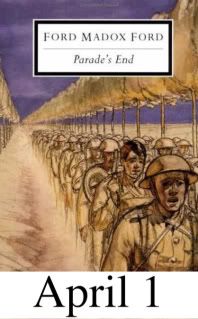
"The Last Post" by Ford Madox Ford

The Last Post by Ford Madox Ford  (1928, 159 pages)

The Last Post, named for a traditional British Army bugle call to commemorate a fall compatriot, is the final book in Ford Madox Ford tetralogy set in the WWII era in England and France.     The prose in the opening chapter of this book seems to have a quieter less dissonant feel to it than one finds in the parts of the book that deal directly with Tietjens's  WWI experiences.   It is as if the book is itself calming on winding down to mirror the effects of armistice.   

As The Last Post opens we get to know a lot better Mark Tietjens, brother of Christopher our central character, and his mistress.   His mistress is French and has a back ground in the theatrical arts.   A good bit of the opening parts of the Last Post passages through her consciousness and her concerns over her failure to get the unmarried Mark to make her his wife.   Perhaps this is meant as a not too funny play on the state of post war French-English relationships.   She is also reflects upon what seems to her the passing of an era of civilized values into one of anarchy:

They had only to read in the papers of the deeds of assassins, high way robbers, of the subversive and ignorant who everywhere seized the reigns of power.
One of the themes in Parade's End is the feeling among the characters that the world they know is coming to an end.   As I read the lines above (and many similar reflections in Parade's End on the post WWI world) I could not help but have come to mind these lines from W. B. Yeats (1919)


Turning and turning in the widening gyre
The falcon cannot hear the falconer;
Things fall apart; the centre cannot hold;
Mere anarchy is loosed upon the world,
The blood-dimmed tide is loosed, and everywhere
The ceremony of innocence is drowned;
The best lack all conviction, while the worst
Are full of passionate intensity.
Surely some revelation is at hand;
Surely the Second Coming is at hand.
The Second Coming! Hardly are those words out
When a vast image out of Spritus Mundi
Troubles my sight: somewhere in the sands of the desert.


I think the historical lesson, if we can use this word, the Ford is conveying is that what seems like an end is merely a transformation.   The terrible changes that some of the characters in The Last Post   speak and think on are in fact them inflating a set of changes that disadvantages them into a social apocalypse in which all values are swept away.   


It seems to me the narrator in The Last Post becomes somehow odder and manifests his social prejudices more openly than before.   It is as if the narration of the book (done in a seemingly but hardly in fact omniscient way) is having increasing difficulty with the social changes brought on by WWII.   We see this in the numerous unfavorable references to Americans, to the French and the disturbing way middle eastern Jews are characterized.   Here is the purpose in life of a minor character, Mrs de  Bray Pape:


The lady said it was precisely giving lessons in history to  the dissolute Aristocracy of the Old World that was her mission in life.


Here is very interesting few lines from the conscious of the General who is involved with Sylvia and was at times the commander of Christopher:


Christ was a sort of  an Englishman and  Englishmen did not as a rule refuse to do their jobs.   They had not used to, now they no doubt did...perhaps Christopher was a symptom of how the English were changing.


The Last Post has some very interesting things to say about the relationship of the sexes.    It seems Sylvia is making a crasser than ever effort to make her husband Christopher's life miserable with no real intention of leaving a man she seems to hate.   We also learn some to me surprising things about the treatment of the returning British soldier by society at large.    Overall, a lot can be learned from Parade's End on an amazing range of topics.    I know longer view it as an encyclopedic narration of sorts and I am starting to see it, as reflected in the narrative method (Tietjens hobby of finding errors in the Encyclopedia Britannica kind of-but maybe too obvious-clue to this) kind of statement to the effect that an era has begun which does not lend it self to encyclopedic narratives has begun.   There is a lot more I would like to say on The Last Post but I am still struggling with the work thematically and will do a final over all post on Parade's End very soon.   For sure it is a supreme work of art, if a maddening one at times.   I will try to go more into my over all impressions soon.  


I am very grateful for the very high quality of posting from the other participants in the read along.


Dwight of A Common Reader -Dwight also has a very good resources Page on FMF.   


Each has done multiple postings on the work and each has very insightful things to say.

I think a few others may soon post on it also and look forward to reading their thoughts.

I will do one more overall post.


Wednesday, May 12, 2010

"Doctor Jekyll and Mr Hyde" by Robert Louis Stevenson


Doctor Jekyll and Mr Hyde by Robert Louis Stevenson (1886, 78 pages-read on line at Dailylit.com)

Robert Lewis Stevenson (1850 to 1894-born Edinburgh, Scotland) three most famous works are Treasure Island (1883), Kidnapped (1886) and what I think is his most famous work of all, Doctor Jekyll and Mr Hyde.

Doctor Jekyll and Mr Hyde created a character (or characters) that are known to millions who have never read the book and probably have never heard of  the author.   It has been made into several movies and I think I recall seeing a cartoon version of it on TV.   In this work Stevenson has tapped into something universal in the human experience almost everyone can relate to-dealing with dualities of good and evil within yourself.  

If one had never heard of Doctor Jekyll and Mr Hyde before reading it I think you would be totally in suspense and not at all see what is coming before the story line reveals events.    The writing style is the work of a wonderful craftsman who truly knows how to tell a story.   I almost forgot I knew the plot as I was reading as it is so well told.

The narrator is an attorney and friend of Doctor Jekyll named Gabriel John Utterson.  Here is how Utterson describes himself

"I incline to Cain's heresy," he used to say quaintly: "I let my brother go to the devil in his own way." In this character, it was frequently his fortune to be the last reputable acquaintance and the last good influence in the lives of down-going men. And to such as these, so long as they came about his chambers, he never marked a shade of change in his demeanour.


   As the story begins to unfold a friend of Utterson's tells him an amazing story.   A horrid looking man assaulted in some fashion a young girl (in the streets of London) and her family is paid off with a check drawn on the bank of Dr. Jekyll, a friend and client of Utterson.    It is quickly revealed that Utterson has drawn up a will for Dr Jekyll leaving all his estate to Mr Hyde.    The story  unfolds as Utterson tries to find out what the connection between the very refined modestly behaving Dr. Jekyll and horrid appearing and worse acting Mr Hyde could be.   I hope people will not have the feeling that there is no pleasure to be obtained from reading this story as they already know the plot (maybe that is why I have not read it before now) as I completely enjoyed it.    I did find it very suspenseful to see exactly how the mystery would be unraveled.  

The story does a very good job of creating the atmosphere of London after dark.   We go from the refined drawing rooms of Dr Jekyll to the sordid venues of Mr Hyde.   Thematically the work  is clearly a study of the duality of man.    Mr Hyde is given to some sort of sexual vice (all this is evoked rather than shown) that we never have fully explained.   I would think that those with serious problems relating to addiction to drugs will be able to relate strongly to some of the cravings of Dr Hyde for the transforming medicines he takes and their increasing hold on him.   

It is the wonderful prose (I am at a loss how to describe it) that makes this novella so marvelous a read.   Here is a description of Hyde given after the first face to face meeting between him and Utterson:

Mr. Hyde was pale and dwarfish, he gave an impression of deformity without any nameable malformation, he had a displeasing smile, he had borne himself to the lawyer with a sort of murderous mixture of timidity and boldness, and he spoke with a husky, whispering and somewhat broken voice; all these were points against him, but not all of these together could explain the hitherto unknown disgust, loathing, and fear with which Mr. Utterson regarded him.


The city as seen through the world of Mr Hyde is very alien to the upper class London of Dr Jekyll and Mr Hyde:


The dismal quarter of Soho seen under these changing glimpses, with its muddy ways, and slatternly passengers, and its lamps, which had never been extinguished or had been kindled afresh to combat this mournful re-invasion of darkness, seemed, in the lawyer's eyes, like a district of some city in a nightmare. The thoughts of his mind, besides, were of the gloomiest dye; and when he glanced at the companion of his drive, he was conscious of some touch of that terror of the law and the law's officers, which may at times assail the most honest. 
We come to understand what Mr Hyde means to Dr Jekyll in this incredible passage:

This was the shocking thing; that the slime of the pit seemed to utter cries and voices; that the amorphous dust gesticulated and sinned; that what was dead, and had no shape, should usurp the offices of life. And this again, that that insurgent horror was knit to him closer than a wife, closer than an eye; lay caged in his flesh, where he heard it mutter and felt it struggle to be born; and at every hour of weakness, and in the confidence of slumber, prevailed against him and deposed him out of life. The hatred of Hyde for Jekyll, was of a different order.
Stevenson lead a very interesting life.   The Wikipedia article on him is fascinating.    


Amateur Reader of Wuthering Expectations has several very good posts on Stevenson.  I am reading this work in observation of his Scottish Reading Challenge.   

Tuesday, May 11, 2010

"Sputnik Sweetheart" by Haruki Murakami

Sputnik Sweetheart by Haruki Murakami (1999, translated by Philip Gabriel from Japanese, 229 pages)


Sputnik Sweetheart is to me a really enjoyable very worthwhile read.    Sputnik Sweetheart is the 5th work by Murakami that I have read and blogged on.    It is fun, smart, uninhibitedly sexy in its depiction of  the dawning lesbian feelings of one of the characters, in its description of the bodies of the female characters and in the sex scenes, it is fast moving, has some cliffhangers and lets us see the real life of the three lead characters.   As a bonus from the perspective of my blog, all of the central characters love reading and are into the reading life.   In some novels the reading life of the characters is not quite credible,  Murakami has for sure overcome this.

There are basically only three characters in Sputnik Sweetheart.   The narrator, a young man whose name we never learn, works hard at fitting himself into a society that stresses and enforces conformity at the cost of expressing or even feeling his true emotions and thoughts while working as an elementary school teacher.   The narrator is good friends with a woman named Sumire.   Sumire has always had negative feelings toward sex but she begins to develop strong sexual feelings toward the third character in the novel, Miu.   Miu is in her late thirties and is beautiful but does not seemingly return the feelings of Samire.   (All of the women in the works of Murakami are very described almost as if they were works of art.)   Samire is put through significant stress by her feelings for Samire as they are not the kind of feelings society expects her to have.

SH of Books, Quote Poetry made a very perceptive comment on my post on The Wild Bird Chronicles, namely that there are recurring things in the novels of Murakami.   In reading just four of his novels and six of his short stories I can see recurring falls down wells, sheep, trips to Greek Islands with beautiful women, a preoccupation with prostitutes, a central character without a real world adult job (I am assuming that a male elementary school teacher is as uncommon a figure in Japan as it is in the Philippines and the USA), conversations with girls below 18 about sex  and a lots of cats.    I do not want to give away much of the plot of Sputnik Sweetheart as I think a lot people will read this book in time.   Some shocking things happen and there are interesting side plots along the way.   The section devoted to the Ferris wheel is really well done.

Sputnik Sweetheart can be very much enjoyed for the fun of the narrative, the sex scenes, a mystery at the heart of the book and the trip to the Greek Islands.   Murakami is also what I have called "a bookish books writer" in that a lot of what he writes about plays into the fantasies of male readers.   For example, in Sputnik Sweetheart a beautiful woman offers to fly the elementary school teacher for free to Greece.   The novel centers around themes of loneliness and the inability to really bond with others caused in part by the demands of society.    The use of the term "Sputnik" evolves from a misunderstanding of an English word but the image of a satellite revolving in isolation around a central figure with which it has no real contact can be seen as a kind of a summery  for the themes of the book.  

Sputnik Sweetheart was a very enjoyable read.    I recommend it without reservation.

I am debating what Murakami to read next and would be happy to get some suggestions.


Mel u

Monday, May 10, 2010

"The Cloven Viscount" by Italo Calvino


The Cloven Viscount by Italo Calvino (1952, translated from Italian by Archibald Colquhoun, 70 pages)

 The Cloven Viscount by Italo Calvino  (1923 to 1985) was originally written as a stand alone work but subsequently became part of his highly regarded Our Ancestors trilogy which also includes Baron  in the Trees and The Non-Existent Knight.   During his life time Calvino was the most translated contemporary Italian writer and was often mentioned as a possible Nobel Prize winner.   

The Cloven Viscount is set in Italy somewhere in the late middle ages.  (The title "viscount" was used in a number of ways in Europe and Italy but the over all usage seems to indicate a minor nobility, on the level of the 4th son of a duke).  The Viscount goes into battle against the Turks (probably with a bit of research you could pin down the exact time frame of the story) and is cloven into two parts in battle.  The story is narrated by his younger nephew.  Both parts of the Viscount survive and come to exist as distinct entities with their own personalities.   The work feels like a mixture of Borges (to whom Calvino paid great tribute) and Cervantes.


We must accept that an absurd in fact impossible event has happened and is now to be accepted without seeming odd.   Given our acceptance of this, the creator of the story is then free to go beyond the restrains of realism to spin his fantasies.   The pleasure in this story is in all of the fanciful inventions along the way.   One half of the Viscount becomes a figure of great goodness, beautifully dressed , admired by all for his learning and welcome among all citizens.  The other half of the viscount begins to roam the country side dressed in rags doing malicious small evil actions where ever he goes.   Much of the time the of the good viscount is spending correcting the evil deeds of his worse half.   For example, the evil viscount uses a cross bow to shot swallows but not so as to kill them but to cripple and leave them to live out a miserable life.   The good viscount tends to the wounds of the injured swallows and soon birds with splints on their legs are seen throughout the area.   

For some time the Viscount's crossbow had been used only against swallows, but in such a way only to stun and wound them not kill them.   But now were seen in the sky swallows with legs bandaged and wings stuck together and waxed:   a whole swarm of swallows so treated were seen prudently flying around together, like convalescents from a bird hospital
Throughout the story Calvino makes use of a seemingly very realistic almost prosaic mode of narration to convey fabulous events and happen stances.    One of the themes of the story is about the unification of the personality.   The Cloven Viscount does, as befits a story in the picaresque mode, ramble about in its narrative structure but there is a distinct brought to a conclusion plot to it which I will leave interested readers the fun of discovering on their own.   We do feel like we are back in the middle ages.  


There is a very interesting Wikipedia article on Calvino.   He was very far from an ivory tower intellectual.   Calvino was a very prolific writer, a renown interpreter of the classics and very active in political organizations including the Italian Communist Party.    He fought against the Nazis in WWII in Garibaldi Brigade for almost two years.   I think he is most read now for his non realistic fictions like those in Ancestors and for his essays on the classics.    The Cloven Viscount was a fun,  easy read and made me  think a bit.   I will in time read the two other works included with Ancestors and am very interested in his literary criticism.   


Mel u

Sunday, May 9, 2010

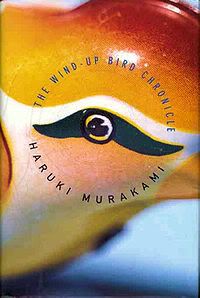
"The Wind Up Bird Chronicles" by Haruki Murakami


The Wind Up Bird  Chronicles by Haruki Murakami (1997, trans. by Jay Rubin, 607 pages)

The Wind Up Bird  Chronicles is my fifth work to read and post on by Haruki Murakami (1949- Kyoto, Japan).     It is one of the "big books" of the post WWII Japanese novel, literally at 607 pages and in terms of the place of esteem it occupies in that body of literature.

There have been a number of recent blog posts on this work.   In The Spring it is the Dawn began a read along some time ago (which I missed out on as I had other items I was reading) which generated a lot of really good posts which cover a lot of the themes of the book.    Given this I will just say a bit about the book and explain what I like about it and make a random observation or two.


The book centers on an unemployed (he quit an OK job because he did not enjoy it) man, Toro, whose cat has disappeared.    He begins a search for his cat and then his wife disappears also.   Toro meets a lot of very interesting characters in his search for his wife and his cat.       He employs a female medium to help him find his cat and his wife.   Her sister was a prostitute at one time and is now a psyche prostitute of sorts.   I noticed in Dance Dance Dance that one of the themes of what I called "Bookish Boys Lit" (as a play on chic lit) is a central character who has no real adult world job (like Toro had and quit).   One of the near defining marks of a bookish boys lit book is the appearance in the story line of  beautiful prostitutes who seemingly fall for the lead male character and provide him with super high quality free sex.   In Dance Dance Dance the adult male lead character also has extensive conversations of a sexual nature with a female under 18, just like Toro does.   I am not making a negative value judgement in seeing this as a bookish boys book.   Here is the genre (I think I made up this category but maybe I read it years ago somewhere) in a nutshell: male character with no adult job who does not like the adult world, beautiful women   who fall for no reason one can see for the lead character, picaresque adventures and secret wisdom gained or revealed.

The book revolves around  the adventures Toro has on his search for his wife and his cat.   A lot of the book is taken up with stories by characters he meets along the way.   I thought the parts of the book that were devoted to the experiences of a now elderly ex soldier about his experiences in the Japanese Army while serving in China were a complete marvel, simply a master piece of narrative exposition.   I for sure felt like I was getting an honest account of the ex-soldiers experiences.   There is a kind of emotional disconnect in the mind of the lead character (hence the preoccupation with prostitutes) but he is deeply moved by the story of the ex soldier
  

I liked The Wind Up Bird  Chronicles a lot.   In fact I am already 1/2 way through another one of Murakami's books now, Sputnik Sweetheart.  The Wind Up Bird Chronicles  is a good adventure story and keeps us reading with cliff hangers throughout the book.   I do not mean to suggest this a light weight book.   There are some very deep themes in this work.   I am trying to keep my posts shorter and I lot of people have posted on this book in the last year so I will simply say I enjoyed it a lot and hope to read all of his novels in the next year or so.


Mel u


Saturday, May 8, 2010

"The Awakening" By Kate Chopin

Chopin and her children
The Awakening by Kate Chopin (1899, 102 pages-read on line at Dailylit.com)

One of the benefits of my recent venture into the short story genre is it allows me to "try out" a writer prior to attempting a longer work and see if I might enjoy or appreciate  their longer works.   Last month I read and posted on Kate Chopin's (1850  to 1904) short story, "A Respectable Woman".   I was completely taken by her prose style and thought she did a very good job of creating a believable full world in just a few pages.   Her work is mostly set in late 19th century Louisiana in the southern USA where Chopin spent most of her life.    I have gone a bit into her background and literary import in my prior post on Chopin.

The Awakening has attracted a good bit of attention among book bloggers in the last year.    It is a story about a woman married to a decent successful man, with healthy happy children.   There is something missing in her life.    I think I can say this without spoiling the story for potential readers who will already know this as it is on the back cover of some of the editions.    She begins an affair with a man in her circle.    Chopin does a good job expressing the frustration of the woman.   We can feel the sensual void in her life.   To me the lead female character, Edna, seemed selfish and wallowing  in surface sensuality.   I know not everyone will agree with me.  My reaction to her (and there is not a suggestion  at all in the book that Chopin endorses the actions of Edna  for which a terrible price will be paid) attitude toward her children turned me against her. I did not find the character of the man she loved, Robert, especially well done and we have no sense of his feelings.   The consensus seems to be that her short stories are the best of her work.    This is not to say that this book cannot be completely enjoyed for its wonderful prose.   Here is a sample of some sections I especially liked:

In short, Mrs. Pontellier was not a mother-woman. The motherwomen seemed to prevail that summer at Grand Isle. It was easy to know them, fluttering about with extended, protecting wings when any harm, real or imaginary, threatened their precious brood. They were women who idolized their children, worshiped their husbands, and esteemed it a holy privilege to efface themselves as individuals and grow wings as ministering angels.
Mrs. Pontellier was not a woman given to confidences, a characteristic hitherto contrary to her nature. Even as a child she had lived her own small life all within herself. At a very early period she had apprehended instinctively the dual life--that outward existence which conforms, the inward life which questions.
The sentiment which she entertained for Robert in no way resembled that which she felt for her husband, or had ever felt, or ever expected to feel. She had all her life long been accustomed to harbor thoughts and emotions which never voiced themselves. They had never taken the form of struggles. They belonged to her and were her own, and she entertained the conviction that she had a right to them and that they concerned no one but herself.
On Chopin, I would say start with her short stories and if you love the prose style go on to The Awakening.
Dailylit.com has several of her short stories on line as well as The Awakening.    For those of us who live where there are basically no public libraries web pages like Dailylit.com are super valuable.

Things Mean a Lot has an very perceptive post on The Awakening and links to a number of other blog posts on it.   Other readers of the work have been more in sympathy with the central character Edna than I am.  I will read more of her stories.   

Featured Post

Imperial Reckoning: The Untold Story of Britain’s Gulag in Kenya by Caroline Elkins - 2005 - 701 Pages

  Imperial Reckoning:     The Untold Story of Britain’s Gulag in Kenya by Caroline Elkins - 2005 - 701 Pages 2006 Pulitzer Prize Winner From...