Thursday, May 20, 2010

"The Garden Party" by Katherine Mansfield


"The Garden Party" by Katherine Mansfield (12 pages, 1922 read at Dailylit.com  )

After reading "Miss Brill" (1920) by Katherine Mansfield (1988 to 1923) I did a book blog search on her to see  if any bloggers I am familiar with have recently read any of her stories.   There have been a lot of book blog posts on her in the last year.    The consensus among bloggers seems to be that "The Garden Party" was one of her very best stories.    Dailylit.com has it on line so I decided to read another of her stories right away.

As "The Garden Party" opens Laura Sheridan under the supervision of her mother is planning a garden party.   Readers in the 1920s in England and New Zealand would be aware that a garden party was meant to be a prestigious near formal occasion and an affair that was found only among the upper classes.   One of the most coveted English society invitations was to the annual Garden party at Buckingham Palace.   Laura is supposed to be in charge but we can quickly see her mother is a bit overbearing.  Mansfield sets the atmosphere of the anticipation of the event masterfully:
And after all the weather was ideal. They could not have had a more perfect day for a garden-party if they had ordered it. Windless, warm, the sky without a cloud. Only the blue was veiled with a haze of light gold, as it is sometimes in early summer. The gardener had been up since dawn, mowing the lawns and sweeping them, until the grass and the dark flat rosettes where the daisy plants had been seemed to shine.
I knew I was going to like the story as soon as I read those opening lines.   Rather near the home of the Sheridan's there is what the Sheridan family views as a wretched squalid community.   Right before the party is set to begin they learn one of the workers for  their party who lives in that area was killed in an accident.   Laura wants to stop the party but her mother will not hear it.   


A whole social history can almost be reconstructed from the conversation below between Laura and her mother over whether or not the death of the worker requires the cancellation of the party:


"But, my dear child, use your common sense. It's only by accident we've heard of it. If some one had died there normally--and I can't understand how they keep alive in those poky little holes--we should still be having our party, shouldn't we?"


Laura had to say "yes" to that, but she felt it was all wrong. She sat down on her mother's sofa and pinched the cushion frill.
Mother, isn't it terribly heartless of us?" she asked.
Is mother right? she thought. And now she hoped her mother was right. Am I being extravagant? Perhaps it was extravagant. Just for a moment she had another glimpse of that poor woman and those little children, and the body being carried into the house. But it all seemed blurred, unreal, like a picture in the newspaper. I'll remember it again after the party's over, she decided. And somehow that seemed quite the best plan..

After the party the mother has a jolly good charitable idea.   Why not pack up all the left over party food and take it to the family of the man that was killed?  (Of course with no thought to the fact that the cottagers had never eaten food like that all their lives.)   Laura goes into the area where the cottages are located.    Mansfield is such an artist that you can feel Laura's fear as she goes into this area.   It all seems dark and evil and ever so wretched.    Laura goes into the cottage and views the body of the deceased.   It is Laura's reaction to the body of the  man and the multiple interpretations that can be made of this that seem to give this story its power and lasting appeal.
There lay a young man, fast asleep--sleeping so soundly, so deeply, that he was far, far away from them both. Oh, so remote, so peaceful. He was dreaming. Never wake him up again. His head was sunk in the pillow, his eyes were closed; they were blind under the closed eyelids. He was given up to his dream. What did garden-parties and baskets and lace frocks matter to him? He was far from all those things. He was wonderful, beautiful. While they were laughing and while the band was playing, this marvel had come to the lane. Happy...happy...All is well, said that sleeping face. This is just as it should be. I am content.
Mansfield does not tell us what to make of this.   Is Laura just a silly rich girl who did not know that the poor have lives too or does she experience some kind of revelation when she sees the body?   Is this a mockery of  accepted views of death or is it a celebration of  them?   There is a a bit more to the story but I hope some may want to read it so I will not tell more of the plot.


I really enjoyed this story.   A lot, maybe all, of her stories can be read on line as they are now in the public domain.   For sure I will be reading more of her work.


If anyone has any suggestions for other short stories to read  please leave them in a comment.  

Mel u


Wednesday, May 19, 2010

"Miss Brill" by Katherine Mansfield

"Miss Brill" by Katherine Mansfield (5 pages, 1920)


The Reading Life Katherine Mansfield Project


KM, Husband and
Brother in Law


Katherine Mansfield (aka Kathleen Mansfield Beauchamp Murry 1888-1923-New Zealand) is considered one of the great short story writers of the early 20th century.   She was a friend of D. H. Lawrence and Virginia Woolf.  D. H. Lawrence based the character of Gunden in Women in Love on Mansfield.   (As Mansfield traveled in some of the same circles as Ford Madox Ford in London I checked the net but I was not able to verify that she had any contact with him professional or otherwise.)

Short Stories:   East of the Web is turning out to be a great resource for me in my still beginning interest in the short story.     I admit I have never read anything by Katherine Mansfield before "Miss Brill".   I knew vaguely, I thought, that she was an important writer of the early 20th century (though below the status of the giants) that I probably should have read something by a long time ago.   As soon as I saw her story "Miss Brill" was one of the stories of the day on East of the Web I read it.   A bit of research validated it is one of her most highly regarded short stories.   

Miss Brill, a teacher of English is a seaside vacation town in France, goes to the park every Sunday by herself, her only company being a fur wrap (in the style of the time with the animals'  head still on the fur).   Miss Brill likes to see the people in the park as actors in a play arranged for her amusement.   She has a special seat she always occupies where she listens to the conversations of those around her.   The story is told in the third person in a kind of detached observing from on high mode.   I find her style a little hard to describe.   I prefer it to the other three short story writers of this era I have recently reviewed, P G Wodehouse, O Henry, and Saki as all of these writers, even though I liked each one a good bit, have a style that can be described as almost cute and near pandering to market needs of works published in popular magazines.   Here is the description of Miss Brill's' observations on one Sunday

 Only two people shared her "special" seat: a fine old man in a velvet coat, his hands clasped over a huge carved walking-stick, and a big old woman, sitting upright, with a roll of knitting on her embroidered apron. They did not speak. This was disappointing, for Miss Brill always looked forward to the conversation. She had become really quite expert, she thought, at listening as though she didn't listen, at sitting in other people's lives just for a minute while they talked round her.

Miss Brill delights in projecting lives on the people she sees in the park and passing condescending judgements on them.     As we quickly realize, this is how she derives her sense of self worth.    Nothing is said but with the mastery of Mansfield we quickly see Miss Brill's life is rather empty.   Miss Brill delights in objectifying the people she sees.   She likes to tie up the lives of the people she observes in the park in a neat little package that she can play with and laugh at.

Two young girls in red came by and two young soldiers in blue met them, and they laughed and paired and went off arm-in-arm. Two peasant women with funny straw hats passed, gravely, leading beautiful smoke-coloured donkeys. A cold, pale nun hurried by. A beautiful woman came along and dropped her bunch of violets, and a little boy ran after to hand them to her, and she took them and threw them away as if they'd been poisoned. Dear me! Miss Brill didn't know whether to admire that or not! And now an ermine toque and a gentleman in grey met just in front of her. He was tall, stiff, dignified, and she was wearing the ermine toque she'd bought when her hair was yellow. Now everything, her hair, her face, even her eyes, was the same colour as the shabby ermine, and her hand, in its cleaned glove, lifted to dab her lips, was a tiny yellowish paw. Oh, she was so pleased to see him - delighted! She rather thought they were going to meet that afternoon.

Miss Brill likes to talk to her fur (to visualize it recall that in the 1920s fox furs with heads on them were all the rage).    She sees nothing odd about this at all.   The fur seems to be her best friend almost.    One day an attractive young couple (we never learn any background information on Miss Brill such as her age, how she got to France, does she have a past of any kind etc) sit very near Miss Brill in the park.  Miss Brill is happy to see them as she thinks they will be an interesting part of the play in the park which she directs and writes for her great amusement.   I think it must have been the literary convention of the time to have sort of an ironic ending to short stories.   There is a depth and a sadness in the close of this story that will stay with me for a long time.


Just at that moment a boy and girl came and sat down where the old couple had been. They were beautifully dressed; they were in love. The hero and heroine, of course, just arrived from his father's yacht. And still soundlessly singing, still with that trembling smile, Miss Brill prepared to listen.


     "No, not now," said the girl. "Not here, I can't."

     "But why? Because of that stupid old thing at the end there?" asked the boy. "Why does she come here at all - who wants her? Why doesn't she keep her silly old mug at home?"

     "It's her fu-ur which is so funny," giggled the girl. "It's exactly like a fried whiting."

     "Ah, be off with you!" said the boy in an angry whisper. Then: "Tell me, ma petite chere--"

     "No, not here," said the girl. "Not yet."


On her way home she usually bought a slice of honey-cake at the baker's. It was her Sunday treat. Sometimes there was an almond in her slice, sometimes not. It made a great difference. If there was an almond it was like carrying home a tiny present - a surprise - something that might very well not have been there. She hurried on the almond Sundays and struck the match for the kettle in quite a dashing way.
     But to-day she passed the baker's by, climbed the stairs, went into the little dark room - her room like a cupboard - and sat down on the red eiderdown. She sat there for a long time. The box that the fur came out of was on the bed. She unclasped the necklet quickly; quickly, without looking, laid it inside. But when she put the lid on she thought she heard something crying. 
For sure Mansfield has created a world in this story.     Some may read this story and see it as exemplifying why they find short stories "leave them hanging".   We get interested in Miss Brill, we wonder about her life, we come to feel sympathy for a character we may not have initially felt any bond with at all then we are abruptly expelled from her world.  


I am very glad I have read my first Katherine Mansfield story.   She lived an very interesting and far too short life.   There is a wonderful web page that gives a lot of information about Mansfield and her circle  here.     Mansfield  was the daughter of a  chairman of the Bank of New Zealand and was largely supported by her father throughout her life.   A lot of her work can be read on line.     Her strongest influence as a short story writer was Chekhov.    I will be reading  more Mansfield.


Mel u

Tuesday, May 18, 2010

"Metropolis" by Crystal Gail Shangkuan Koo


"The Metropolis" by Crystal Gail Shangkuan Koo (7 pages, 2006)

Yesterday I was looking through what is fast becoming one of my favorite web pages for finding short stories to read on line, Short Stories:   East of the Web and happily discovered a 2007 prize winning story by a University of the Philippines graduate, Crystal Koo (Manila- 1985) on line as one of the top featured stories.    Ms. Koo was raised and educated in Manila schools and is now a professor at a university in Hong Kong.   She has won several awards for her writings and is published in several places on line and in print.   She is another new to me writer found via East of the Web (the first was Fernando Sorrentino, an Argentine short story writer).   

Ms Koo's story, "The Metropolis" is told in the first person by female narrator in her twenties living in Beijing.   I do not know if Koo has ever lived in Beijing but the story has an autobiographical feel to it.   As the story begins the narrator thinks back to her grandmother who fled Beijing 60 years ago to move to Manila.  There is feel of truth in the opening lines it is hard not to respond to about what Manila was once like and what it has now become:

I had flown to China with a postcard in my hand. My grandmother didn't want me to. Why should I go back to the place she had taken so many pains to run away from sixty years ago to get to Manila? The Philippines was glamorous then, before it melted in its own torpor. Europe and America creolized in Asia,Què hora es? A las ocho y media, sir, good morning, how d'ye do, how d'ye do? because the sun never sets in the Western empire. Before I left for the airport, my grandmother told me to be careful in the mud alleys.
 The narrator has to face the dilemma in Beijing of looking neither quite Filipino or quite Chinese.   

I met my language partners every Friday in the school library, two local girls who wanted to practice their English with me, but they frequently slipped back to Mandarin because there were too many interesting questions to be asked. How can you be Chinese? How can you be Filipino? How can you speak English? You speak Filipino too, right? How do you say, 'How do you do?'


     I taught them to say kumusta, simplest thing in the world, contraction of como esta, consonants crunchy and hard, vowels wide and open. Back in the Philippines, some people would be so surprised with my speaking Filipino that they would forget to stop speaking English with me. Would you have to marry a Chinese too? You speak a little Chinese too, right? How do you say, 'How do you do?'

Koo has an acute eye for details that make a world come alive.   In one passage  I was very much reminded of the  story I read last year by 
Ryunosuke Akutagawa ( one of pre- WWII Japanese masters of the short story), "Mandrians" .  In that story an elite man who cannot really see the humanity of the poor has a revelation on a train.   Here is Koo's beautiful handling of a thematically similar matter:


I once read in a magazine in Beijing about a man aboard a train who had been accosted by an old woman when the train stopped at a station. Through his window she tried to sell him cold bottles of mineral water, but he didn't want to buy any because he knew she would slink away without giving back his change. As she coaxed him noisily through the window, he grew more and more revolted by her presence until he resigned himself and pulled a note out to buy himself some silence. As she handed him a bottle, the train began to roll. The old woman had his change in one hand and she tried to run after his open window, her arm outstretched.Your change, your change! He was entranced by the sight. In her haste the old woman tripped and fell, and when she raised her head he saw a trickle of blood on her forehead.

There is a world in this passage.    To me Koo has a very original direct style.    I will be following her work form now on and hope she will go on to write longer works.    Like millions of other talented Filipinos she has left the country in order to make best use of her skills and education.   In time Koo may well grow to be as good a writer as Akutagawa.
Koo's home page has more information about her and small additional samples of her work.

Mel u

Monday, May 17, 2010

"Cardboard:A Woman Left for Dead" by Fiona Place

Cardboard: A Woman Left for Dead by Fiona Place (386 pages, 2010-second edition)

When Fiona Place contacted me and offered me a free copy of her book I was flattered and happy to get a free book.    Of course before I accepted the book I studied the title on Goodreads.com and Amazon.com to see if it was fair of me to accept the  book and if it  might be worth my time.   Over all the rating are quite high.   I discovered the first edition of the book (1989) won the Australian National Book Council Award for best book by a new writer.

Cardboard is narrated in the first person by Lucy, the main  character of the work.    She suffers from anorexia, an extreme aversion to food.  ( I will admit this is a hard disease for me to relate to as I love food.)

 As I read on in Cardboard I came to realize Place was intentionally  making brilliant use of a hard for most of us to understand disease (or psychological problem-semantic issues here)  as a metaphor for the effects that the inability to be in control off our lives can have on our ability to accept the pleasures of the human condition.     The writing is done in a very conscious of itself manner and its role in relaying the story manner blends elegantly with the themes of the book.   

As the story opens Lucy is on a tour.   She gets weaker and weaker as she refuses to eat.   The tour leader leaves her in a hotel in country where she does not speak the language.   Lucy returns to a country that speaks her language and ends up in the hospital.   The doctors are at a loss to explain the cause or discover a cure for her illness.   At first Lucy comes to see her essence as that of a "sick person".    Some of the doctors and nurses are very professional, some are uncaring and seem immune to the feelings of their patients.    The novel then begins to show us why Lucy has the issues she does.  I began to feel real pride in Lucy as she embarked on the solution to her problem, a problem she could only really solve herself.   It is also a very perceptive study of the ways hospitals control and regard their patients, especially those with diesease that annoy or bore the hospital staff.    It was a pleasure to see Lucy grow and become empowered.   

Some of the novel is written as the near stream of consciousness of Lucy.   Part of the novel is in verse.   In a memo in the novel from an imminent authority on the causes of anorexia it is suggested that it may have its roots in the inability of the sufferers to pick up double meanings in language.     It is this idea that is in play in the many experimental uses of language by Place.   As Lucy begins the process of healing, the language of the book becomes less childlike and admits of more nuances of interpretation.    

On Fiona Place's web page you can learn a lot more  about her and her work.  

Mel u

"The Spirit of Emulation" by Fernando Sorrentino

"The Spirit of Emulation" by Fernando Sorrentino (6 pages, 1972, translated from the Spanish by Thomas Meehan)

Fernando Sorrentino (1942-Buenos Aires) is a well known Argentine writer of short stories and children's books.   He has six collections of short stories published in Argentina and his works have been translated into numerous languages.   I must admit last week I had never heard of him.    I am getting into reading short stories after a lifetime avoidance of them (I like to sort of escape into the world of the books I read and short stories up until recently just sort of left me hanging).  Most of my reading of short stories  is of works that are on line.    There are 1000s of short stories on line that  you can read for free.   A lot of them are older stories in the public domain but there are some very good web pages that feature stories by known contemporary writers.   One web page I discovered recently Short Stories at East of the Web has a lot of contemporary and classic short stories on line.    One of the features I like on the web page is that every day they spotlight a new story.   Yesterday it was "The Spirit of Emulation" by Fernando Sorrenttino.   I decided to read it and I am glad I did.

To be an Argentine short story writer is to be in the shadow of Jorge Borges (1899 to 1986).   You are either a disciple or in rebellion against him.   This is just a fact of literary live  life.    Fernando Sorrentino seems firmly a follower, at least in this story.    Borges wrote many stories in a seemingly realistic mode which ask us to accept an absurd premise or the  acceptance of the bending of the rules of common sense or science.   Many are broadly satirical of the faults and vanities of mankind.

"The Spirit of Emulation" is narrated in the first person by a man living in a modern high rise apartment in a comfortable part of Buenes Aires.    The residents of the apartment complex are all into competing with each other and striving to at least emulate and hopefully surpass any material possessions others in the building have.     The narrator is a perfectly normal person.   His only quirk is that he has a pet spider.  One day a neighbor drops by and sees the spider.   Here is the result this one little incident begins to produce:

The next day he came by to show me the scorpion he had just bought. In the hallway, the maid of the people who live in 7-D overheard our dialogue on the life, habits and feeding of spiders, scorpions and ticks. That very afternoon her employers acquired a crab. 


then, for a week, there was nothing new of note. Until one evening when I happened to be on the elevator with one of the neighbor women on the third floor: a languid, young blond with one of those vacant stares in her eyes. She was carrying a big, yellow purse, the zipper of which was partially broken: every little while, through one of the breaks, there would poke out the tiny head of a golden yellow lizard.
Soon one of his neighbors acquires an ant bear only to be outdone a few days later by a neighbor who takes delivery of an American brown bear.    The man's wife then begins to be completely humiliated by the pets of her neighbors and tells the man he must do something soon or she will leave him because of this shame he has brought on her by his failure to provide her with her basic needs.   He borrows all the money he can and buys a beautiful leopard.   All is well with him for a while until he and his wife observe one of their neighbors walking a jaguar down the hall.    The man deeply loves his wife and to keep her happy he sells everything he owns and buys a giant anaconda.   For a few days he is the hero is the building.   Then all conventions break down:

My anaconda boa broke every dike, it destroyed every sense of moderation, it brought down the most respected conventions. In all the apartments there now multiplied lions, tigers, gorillas, crocodiles ... Some even had black panthers, those panthers they don't even have in the municipal zoo. The whole building resounded with roaring, howling and chattering. We spent the nights awake; it was impossible to sleep. The intermingled odors of felines, quadrumanes, reptiles and ruminants turned the atmosphere unbreathable. Huge trucks brought tons of meat, fish and vegetables. Life in the building on Paraguay street became a little dangerous. 
The ending of the story is very well done and completely believable once we give ourselves over to the logic of magic realism.   I will leave the ending as a surprise for anyone who takes a few minutes to read this story.  Sorrentino did a very good job creating a believable narrator.   You really felt like you were inside the apartment building as you were reading the story.   It is a funny story that gently mocks the vanity of man without being mean spirited.  


Mel u

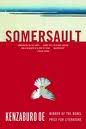
"Somersault" by Kenzaburo Oe


Somersault by Kenzaburo Oe (570 pages, 1999, translated from the Japanese by Philip Gabriel)

Somersault is the 11th work of Kenzaburo Oe (1935-) on which I have posted since I first discovered him last year.   Oe won the Nobel Prize in 1994.    He is a towering figure in contemporary Japanese literature.   In a revealing scene in Norwegian Wood by Haruki Murakami (which I am currently reading) the lead character says his family owns a simple neighborhood book store that sells popular books, not "Tolstoy or Oe".

Somersault is Oe's longest book by far, being twice as long as most of his prior novels.  (The Japanese novel as a rule seems shorter than typical American or English works.)    I think it is not nearly as widely read as some of his earlier books.   The reviews of it on Goodreads.com are more mixed than those for nearly all his other works.    As far as I could find there are no prior book blog posts on it.    Unlike many of his other works, there is little of an autobiographical nature in this book.   

Somersault is a strange kind of book.   I think most of those who do not like or "get" it are trying to hard to see it as a novel purely in the European tradition and this causes a failure of understanding.   I have talked about a similar matter in my post on The Sailor Who Fell From Grace With the Sea by Yukio Mishima.  
To get the flavor of this work, imagine Samuel Beckett writing a Kabuki play about the origin of religion with characters with names like "Patron", "Guide" and "Dancer" intended for an audience as cultured in the Japanese tradition as James Joyce and Ford Madox Ford are in the western.   Then your throw in some sex scenes (hetro and otherwise) worthy of Henry Miller just for fun.   Add in a terrorist plot and you get a bit of the idea.  

The book centers on a religious cult led and begun by Guide and Patron.   Ten years ago they did what is referred to as a somersault in which it was announced that the fundamental provisions of the religion which they then advocated and created were a deliberate fraud and that their religion was created for purely self seeking reasons, among them to have sex with adoring believers.   Now it is decided to revamp the religion (many of its thousands of followers-the figure is given as about 30,000) never accepted the literal truth of the somersault and saw it as a kind of revelation.    The religion of Guide and Patron is not an offshot of Christianity but they make use of Christian imagery in describing their beliefs.   Some try to see Guide and Patron as Antichrists-the response (one wonders if the play on words is as close in Japanese) is that they are antechrists.   They are making the way for the true God or his earthly representative.   The suggestion is there must be many antechrists and the true Christ will come only after there are many anti and ante Christs.   The leaders of the religion feel they will do best (some of the leaders are at least partially venal in their motives, others are true believers) if they can create a state of terror and chaos in society through terrorists acts.   They plan a spectacular act of terrorism that reminds us of the subway attacks in Tokyo.   A lot of Somersault is about the nature of religion and how religions get started.   Meaning to offend no one, it can almost be seen as a a fun house mirror account of the origins of several of the worlds major religions.  We have Guide who receives what some see as hallucinations and others see as divine revelations.   He is surrounded by followers of varying degrees of devotion and he dies a kind of martyr's death.   His word is then spread by Patron, sort of the Peter of his religion.   I think Oe choose to model his religion on that of Christianity as the way in which Christianity originated is central to the reasons to believe it.   Somersault can be see as a mockery of religion in general.    I recall in Oe's non-fiction work Hiroshima Notes his tremendous admiration for an elderly female bomb survivor who was badly injured and who lost many family members in the blast.  Oe saluted her for her ability to face what happens strongly without the crutch of a faith to prop her up.   

I recommend Somersault to those who have read at least 5 of his other works first and really liked them.   I would not advise anyone to make it their first Oe.    I understand why some do not like it, mainly for the fact that none of the characters are really developed much (this again comes from it being seen wrongly  as a purely European Novel).   Some will see it as a general attack on religion  and are probably right in thinking this.    I see Somersault as a very serious powerful  work and one of the major books of the post WWII Japanese novel.    

Sunday, May 16, 2010

"Parade's End" by Ford Madox Ford

Mrs Ford-
Parade's End by Ford Madox Ford (1924-1928, 836 pages)

Violet Hunt-role model for Sylvia
Parade's End is Ford Madox Ford's (FMF)  WWI  tetralogy set in England and France in the period of around 1914 to 1918.    It was published as four parts but should be viewed (as FMF certainly did) as a unified work.   I have already 
posted on the four individual works, Some Do Not, No More Parades, A Man Could Stand Up, and The Last Post.   Each of  the participants in the Read A Long, Dwight, Nicole, and Hannah have also done multiple posts on the work which have helped me understand the book a lot.   Dwight has an excellent resources page for those interested in more background information on FMF. 

About 40 while in the Army
Parade's End is a not just a great novel, it is a great work of art.    It is very carefully constructed, what seem like errors or lapses by the narrator (not everyone agrees with this) and characters are part of the structure of the work.   Parts of the work read like a play of the period, parts are brilliant explorations of the streams of consciousness of very diverse persons.   It is also, in its central character Christopher Tietjens, a superb portrait of a man deeply into the reading life.    It experiments with numerous writing styles.  While our lead character is in the trenches in France in WWI we can feel the extreme discordance in the consciousness of Tietjens reflected in the strident  prose of the work.    When some of the more vapid characters in the book converse over silly self-centered matters the prose seems like that of an Edwardian play.   Throughout the work there are 100s of marvelous epigrams and pronouncements on history, marriage, art, literature and the 18th century that alone made the book worth reading for me.   

As I was reading this I somehow had a flashback to a class on early modern art that I took many years ago.   One of the themes of Parade's End is the nature of knowledge, memory, and the construction of history.   In a way, Parade's End, like The Wave by Virginia Woolf which I am now reading, is almost doing in a novel what the Cubists tried to do in their movement (time frame 1907 to 1921.)   This quote from Wikipedia is very useful:

In cubist artworks, objects are broken up, analyzed, and re-assembled in an abstracted form—instead of depicting objects from one viewpoint, the artist depicts the subject from a multitude of viewpoints to represent the subject in a greater context. Often the surfaces intersect at seemingly random angles, removing a coherent sense of depth. The background and object planes interpenetrate one another to create the shallow ambiguous space, one of cubism's distinct characteristics.

This is very much what FMF is doing in Parade's End.   I would alter the quotation to say social reality and maybe all reality comes from the point at which the most points of  view intersect.  (In this I see it as similar  to Woolf's The Waves  published in 1930.)  Part of the point of the massive number of cultural references is to suggest that culture increases our ability to depict internally a rich universe and from that internal projection we enrich the collective socially constructive aspects of reality.  

Parade's End is a super rich book with many themes.   It is a great portrait of a marriage which seems to make little sense until we think about it a bit then we realize there is much more to the marriage of Sylvia and Christopher than meets the eye.   It is a great story of a culture in massive transition.    It is not an encyclopedic narrative as I once thought it might be  and in fact in the heart of its meaning it seems to undercut the very notion of such a possibility.

I tremendously enjoyed Parade's End.    A lot can be learned just from unraveling  the references and allusions in the work.  (That is one of many ways the Internet has enriched our ability to read.   For example, I thought a literary reference made by Tietjens as from a Russian novel was really from Henry James and with the Internet I found I was correct in very short period of time.   In the pre-Internet days I would have just had an uneasy feeling about the passage.)

With a brief internet search you will see that FMF was a very controversial figure and was greatly disliked by many who knew him well.    Jean Rhys (with whom he had a romance) wrote a novel in which FMF is one of the central characters.   He is depicted as a predatory man who preys on women whom he sees as having as their place to serve his genius.   FMF did have about 30 relationships with women in the arts and literature (many of these women ended up hating him but, like Sylvia for Christopher, did not want to let another woman take their place).    FMF was incredibly well read.   I have on order his 800 plus page work The March of Literature and am very much looking forward to learning from FMF.  FMF helped many people like Joyce, Pound, Lawrence, Rhys, and Hemingway become  writers and is now probably less known or read than any of them.    I also think there may be a backlash of sorts against Ford now in some circles due to the perception that he had a predatory attitude toward women.

Parade's End is a not a work we can lollipop our way through (Ok, I like the Edwardian slang I learned from the book).        It sets a standard few books can match.   I really do not think there are ten books written in the 20 century more worth reading than Parade's End.

I think there are a few others now reading Parade's End and I am very much looking forward to their posts.


Mel u

Featured Post

Imperial Reckoning: The Untold Story of Britain’s Gulag in Kenya by Caroline Elkins - 2005 - 701 Pages

  Imperial Reckoning:     The Untold Story of Britain’s Gulag in Kenya by Caroline Elkins - 2005 - 701 Pages 2006 Pulitzer Prize Winner From...