Thursday, June 17, 2010

The Dead by James Joyce-read in observation of Bloomsday

"The Dead" by James Joyce (1914, in his The Dubliners, 45 pages, read  at Dailylit.com)

Ulysses by James Joyce (1888-1941 Dublin) takes place on June 16, 1904.    Every year for a long time now Bloomsday (Leopold Bloom was the central character of the book) is observed in Dublin and elsewhere by oral readings of parts or even all of Ulysses in marathon sessions.       In observation of this day I decided to read his story, "The Dead".    I have also started to read Ulysses on dailylit.com.   At the pace I have set for myself it should take about sixty days.   I read it once long ago but I want to experience it again in the context of my recent readings of Woolf, Ford, and Mansfield.

Whether or not Ulysses is the greatest novel of the 20th century is a matter of literary taste.   Vladimir Nabokov, whose Lectures on Reading I am now being edified by, says it is.    If you love it, if you hate it, or if you see it as  a work that can be read only by those with a serious literary education and lots of reading time,  it cannot be denied its place as the most influential novel of the 20th century (and so far nothing has come along in the 21th century to threaten this position).    About two months ago I began to overcome a life time misguided aversion to the short story as a literary form.   As I began to read various authors I decided I would read the very best short stories first so I would have something to compare others with.    In doing a lot of Google searches on "best short stories of all time" in numerous variation, James Joyce's "The Dead" came up over and over.  

"The Dead" is not written in an experimental style that you  need a hypertext guide to follow. It has a plot, a beginning and end.     It is set in 1904 at a party given every year by the Moran sisters.   The central character is Gabriel Conway.   Gabriel seems fairly well read, he likes Robert Browning, he is self conscious, reflective and seems a good man.   He is also tentative and does not quite feel comfortable in the company of others.   In his conversations with others at the party, most of whom seem his social inferiors in his eyes, he uses the standard bits of Irish nationalism to come up with something to say.     His wife Gretta came to the party with him but he did not seem to pay much attention to her.   He sees an attractive looking woman sitting on the stairs and it takes a moment for him to realize it is his wife deep in thought.    I do not like spoilers myself so I will stop here but Gabriel does achieve an epiphany that may change the rest of his life and his marriage.   I will quote from the opening of the story to give a glimpse of his style:


He was undecided about the lines from Robert Browning, for he feared they would be above the heads of his hearers. Some quotation that they would recognise from Shakespeare or from the Melodies would be better. The indelicate clacking of the men's heels and the shuffling of their soles reminded him that their grade of culture differed from his. He would only make himself ridiculous by quoting poetry to them which they could not understand. They would think that he was airing his superior education.

He would fail with them just as he had failed with the girl in the pantry. He had taken up a wrong tone. His whole speech was a mistake from first to last, an utter failure.

As the story advances  the prose becomes increasingly  more and more beautiful until the last few sentences in which Gabriel achieves his epiphany and we read some of the most beautiful lines in the English language.    It is as if the progression of the prose is pushing us to our own epiphany.    The story ends in the snow as Gabriel requires the cold now as maybe we readers do also.   

In summery,  do not think this story is "hard' or readable only by the seriously over-educated.    "The Dead" is an open work, enjoyable to read and it is fun to feel you are at a country party in Ireland in 1904.   I think once I have completed reading the short stories of Mansfield and Woolf I will then read the rest of the stories in The Dubliners.  

I thank DS of Third Story Window  for suggesting I read this story.    If anyone has any  suggestions as to short stories I might like please leave a comment-thanks

Mel u

Wednesday, June 16, 2010

Katherine Mansfield -Four Tales from Bliss and Other Stories


Four Tales from Bliss and Other Stories -1923
By Katherine Mansfield


"Je Ne Parle Pas Francais" -54 pages
"Bliss"--21 pages
"Wind Blows" 7 pages
Psychology" 12 pages

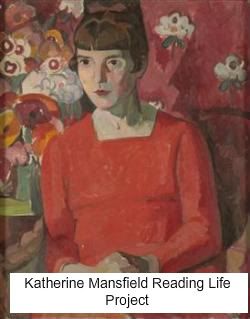
In continuation of The Reading Life Katherine Mansfield Project I am posting on four more  of her short stories, all from the 1920 collection Bliss and Other Stories.  Most of these stories were published in literary journals  prior to their inclusion in this volume.   (Bliss and Other Stories was first published in 1920, edited by her husband John Middleton Murray and reprinted in 1923 after her death in a revised edition.)

I have already done some more detailed posts on Katherine Mansfield.    I am nearly ready to declare that she is the best female writer of short stories  but I will wait until I have completed all the stories of both her and Virginia Woolf before making this decision.    This post will be more in the form of a reading journal than an attempt to say a lot about the stories -for practical reasons I deemed it not a good idea to write long post on all 60 or so stories!-  I will do individual posts on the stories I like most and upon completion of the project-hopefully by the end of July, I will sum up and list her five best stories.   All of her stories, much of her journals, notebooks, and letters can be read on line.   I will give the best web page I have found for her reading her work at the end of the post.   

"Je Ne Parle Pas Francais" is one of Mansfield's longer stories.   The central character this story is a Frenchman named Raoul who fancies himself a writer who will one day be proclaimed a genius. 

My name is Raoul Duquette. I am twenty-six years old and a Parisian, a true Parisian. About my family—it really doesn't matter. I have no family ; I don't want any. I never think about my childhood. I've forgotten it.

  He tells us he is rich, has never had a real employment or any contact with women.    He becomes friends with another man in the cafe.   Nothing untoward happens between them.   The interest in the story is in the passing observations of Raoul and his relationship with the other man and his girlfriend.    There is strange passage in the story when Raoul recalls his childhood relationship to the family laundress which almost seems like an account of a molestation:

When I was about ten our laundress was an African woman, very big, very dark, with a check handkerchief over her frizzy hair. When she came to our house she always took particular notice of me, and after the clothes had been taken out of the basket she would lift me up into it and give me a rock while I held tight to the handles and screamed for joy and fright. I was tiny for my age, and pale, with a lovely little half-open mouth—I feel sure of that.

"Bliss" is one of most widely read stories.   Really is a meditation on the experience of bliss, not a traditional story with a plot.


What can you do if you are thirty and, turning the corner of your own street, you are overcome, suddenly, by a feeling of bliss—absolute bliss !— as though you'd suddenly swallowed a bright piece of that late afternoon sun and it burned in your bosom, sending out a little shower of sparks into every particle, into every finger and toe ? . . .
Oh, is there no way you can express it without being " drunk and disorderly " ? How idiotic civilization is ! Why be given a body if you have to keep it shut up in a case like a rare, rare fiddle ?
 "Wind Blows" is about a country house in New Zealand and the thoughts the narrator has as the wind shakes the house.   It is beautifully written and made me feel I was in the house.

"Psychology" is about the small pleasures of life, about minute domestic observations:
birds sang in the kettle ; the fire fluttered. He sat up clasping his knees. It was delightful—this business of having tea—and she always had delicious things to eat—little sharp sandwiches, short sweet almond fingers, and a dark, rich cake tasting of rum
All of these stories and much more can be read at the New Zealand Text Center
Mel u

Tuesday, June 15, 2010

On Parole by Akira Yoshimura


On Parole by Akira Yoshimura (1988, 254 pages, trans. from the Japanese by Stephen Snyder, 1999)

This is the second work by Akira Yoshimura (1927 to 2006-Tokyo) that I have read.   I read back in  2009 his One Man's Justice about the  life in post World War II Japan of an Imperial Soldier who served time as a war criminal for executing an American POW after the Japanese had surrendered.   Yoshimura wrote over 20 novels (sadly only three seem to have been translated) and was  president of the Japanese writer's union.   

On Parole is an extremely well done story of a man who spent 15 years in prison for murder.   The story begins with his routine in prison and  goes on to his parole.   In every way the lead character seems the model of a rational prudent hardworking man.   We are very confused as to why he wound up in prison until it is shockingly and vividly revealed to us.   I learned a good bit about how the justice system works in contemporary Japan.    We get an inside look at how prisons are run in Japan and we learn how people on parole are managed.  I also learned a lot about the chicken business in Japan after the released prisoner got a job working at a chicken ranch.   His biggest fear was that his coworkers would find out he was a released prisoner.   

I thought the portrayal of the parolee, Kikutani was really brilliant.   The scenes in the chicken and egg farm give us enough detail so we feel like we know what it was like to work there.    I really felt like I was being given a good look at the life of a humble simple man whose life was destroyed in a few crazy moments of madness.   

On Parole is a very good book, easy to follow and keeps us wondering what will happen next.   It may seem a bit of a cold book but that is in part as the character of  Kikutani seems cold on the surface.   I recommend it to anyone interested in the Japanese justice system.   I have one problem recommending this book to first time readers of Yoshimura.   On Parole is good but his One Man's Justice is great, a true master work that should be read by anyone interested in the post WWII Japanese novel.     I would suggest that one new to the Japanese novel first read One Man's Justice, then read at least 10 other Japanese novelists then go back to On Parole.    Some may find the subject matter of the book does not interest them all that much and at first I sort of felt that way but as the book went on I overcame my initial disinterest and I am very glad I did.   One of the signs of the great skill of Yoshimura is that he is able to make us feel in sympathy with people we have every reason to greatly dislike and have contempt for.   

The translator, Stephen Snyder, is a professor at Middlebury College in Middlebury, Vermont and is one of the highest regarded translators of the Japanese novel into English.   

I am reading this book in association with the Japanese Literature 4 Challenge hosted by Dolce Bellezza.   I urge anyone who has the time to join her challenge, all you have to do is read just one book.   

Mel u

Sunday, June 13, 2010

Short Stories by two great New South Wales, Australian Authors-Henry Lawson and Andrew 'Banjo' Paterson

"The Dog" by Andrew (Banjo) Paterson -1917-9 pages

"The Drover's Wife" by Henry Lawson 1892-7 pages

The Reading Life Outback Tales Project

                                                            
Two Wonderful Stories from New South Wales

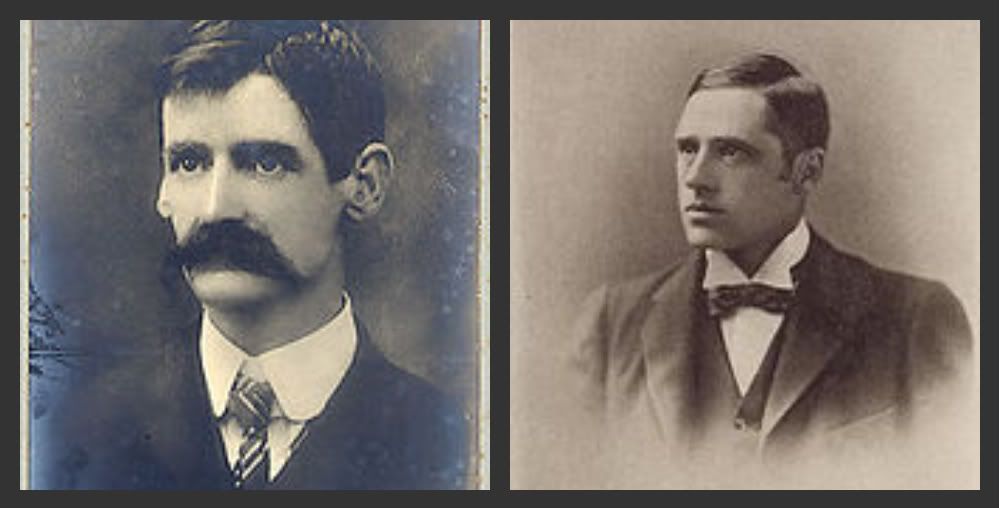
One of the best things about my new found interest in the short story is that it has allowed me to discover some great new to me writers without making the     larger commitment to read a novel.    This week I read my first works by two authors from New South Wales Australia, Henry Lawson (at the left above) and Andrew Paterson.   I really enjoyed at admired their stories.   

Henry Lawson (1867 to 1922-New South Wales, Australia) is considered one of the very first Australian authors to write about life in "The Bush" or "The Outback"  in a realistic fashion.    His mother was a well known advocate of women's rights in Australia.   His father was an immigrant from Norway who came to find gold.    At 14 Lawson lost his hearing (he never regained it).   He married a prominent Australian Socialist but his marriage was not happy.   His writing style is laconic, has a dry wit and a keen eye for small details.    He celebrates the hero in the ordinary person struggling against the hardships of country life.    His most famous short story is "The Drover's Wife", first published in 1892.   (A drover is one employed in driving large herds of cattle or sheep to the market.  In Australia as in the American west it often involved being away from home for months.)    The story focuses on the wife of a drover whose husband has been away for months.   She is left with their children and a great  dog to run the family farm in the bush country.    Lawson does not really tell us as lot about her, rather he shows us what her life is like.   The main focus of the story is on the efforts of the wife and her dog to protect the family from a dangerous snake that has crawled under their house.   Lawson's description of the life of the wife is perfect:


She is not a coward, but recent events have shaken her nerves. A little son of her brother-in-law was lately bitten by a snake, and died. Besides, she has not heard from her husband for six months, and is anxious about him.
     He was a drover, and started squatting here when they were married. The drought of 18-- ruined him. He had to sacrifice the remnant of his flock and go droving again. He intends to move his family into the nearest town when he comes back, and, in the meantime, his brother, who keeps a shanty on the main road, comes over about once a month with provisions. 
     She is used to being left alone. She once lived like this for eighteen months. As a girl she built the usual castles in the air; but all her girlish hopes and aspirations have long been dead. 
The story is exciting, real and kept my interest to the end.    I hope I will be forgiven this but as I was reading this story I imagined Katherine Mansfield, D. H. Lawrence and Crocodile  Dundee having a drink together and finding they all liked the work of Henry Lawson.   At his death Lawson was given a state funeral.   "The Dover's Wife" can be read at East of the Web: Short Stories


Andrew (Banjo) Paterson (1864 to 1941-New South Wales, Australia) is best remembered as the author of the unofficial Australia national anthem,  Waltzing Matilda.  Like Henry Lawson Paterson wrote stories about the lives of people in the outback, the bush country of Australia.   "The Dog", notice both stories partially center on outback working dogs, was  first published in 1917.    Paterson grew up in the outback and attended rural schools.   In time he became licensed as a solicitor with a law firm.   Paterson wrote poetry as an avocation and broke into print when one of his poems was published in a newspaper.   Paterson was an ardent supported of independence for Australia.   He became a war correspondent during the Boer Wars in South Africa (1899) and this brought him his first measure of fame.   He served in France in WWI as an ambulance driver.   Upon his return he began to writer stories, songs and poems and is so highly regarded in his native country that his picture is on the Australian ten dollar bill.


The style of "The Dog" has more of a self consciously literary feel to it than Lawson's "The Drover's Wife".    "The Dog" is kind of a paean to the Australian working dog.   Neither writer has any time for pomp or pomposity.   Both right in a straight forward easy to follow fashion.   Here is a sample of the prose of Paterson:


The dog is a member of society who likes to have his day's work, and who does it more conscientiously than most human beings. A dog always looks as if he ought to have a pipe in his mouth and a black bag for his lunch, and then he would go quite happily to office every day.
A dog without work is like a man without work, a nuisance to himself and everybody else. People who live about town, and keep a dog to give the children hydatids and to keep the neighbours awake at night, imagine that the animal is fulfilling his destiny. All town dogs, fancy dogs, show dogs, lap-dogs, and other dogs with no work to do, should be abolished; it is only in the country that a dog has any justification for his existence
 "The Dog" can be read at Classicreader.com.


I enjoyed both of these short stories a lot and hope to read more works by Henry Lawson and Banjo Paterson in the coming years.   


Mel u


Saturday, June 12, 2010

The Waiting Years by Fumiko Enchi


The Waiting Years by Fumiko Enchi (1971, trans. from the Japanese by John Bester, 203 pages)

Fumiko Enchi (1905 to 1986-Tokyo) was the daughter of a famous scholar of classical Japanese literature.   She acknowledged as one of her strongest literary influence the work of Junichiro Tanizaki  which I did  see.    During a bombing raid in WWII the house of her and her husband was destroyed along with all their possessions.    She was educated at home by tutors and at 13 was reading Oscar Wilde, Edgar Alan Poe,  and classical Japanese literature.    She was very much into the reading life.

The Waiting Years took Enchi nearly eight years to write.   It is a wonderful basically flawless work of art.   The novel is set in the home of a Samurai family in late 19th century Japan.   The husband is a middle level, maybe a higher at times, government official.   The family is quite comfortable and can afford several servants but they are not among the truly rich or elite.    The novel's center is Tumo, the wife, about ten years younger than her husband.   One day the husband comes to her with some instructions for her to carry out.   He wants her to find a new maid for the household that will also serve as his concubine.    She suppresses her anger and jealousy as he explains to her it is simply that a man of his standing is expected to have at least one concubine and if he does not it casts doubts on the families financial status and looks bad for him to his peers.   There were functionaries whose served the needs of those who sought out concubines/maids and Tomo went to one of them with the money her husband had given her.    She tries to control her emotions as she imagines her husband sleeping with the various girls she interviews.   These girls were basically offered for sale by their families.   Once funds were paid for them they were more or less slaves and certainly had no right to leave their masters.   It was a bit shocking to learn that the typical age of these girls was 13 to 15.   The girls trained in household duties and most also service the sexual needs of the master of the house.   We see Tomo and the girl develop a relationship even though they have every reason to dislike and distrust each other.   It is not openly stated but the husband  seems to be very brutal in his relations with both his wife and the new maid.   

The novel covers at least 40 years in the life of the family.   In each chapter we are given a view of a different aspect of their developing lives.   Soon the husband feels a need for a second then a third concubine.   All of the women are bought as young girls and live in the household.   We see the tensions between the wife and the concubines.   One of the concubines seems to have some power over the husband and they urge her to have the wife, who has now lost her looks and is quite heavy,  displaced from the household.   

Along the way we meet their children and grandchildren.   I could not help but laugh when I found out who the real father of the children of one of the concubines really was.   We see the shifting relationships of the women over time.    We see that  the women have no power other than what ever emotional hold they have over the husband.   

   The Waiting Years is a very subtle, cerebral work that takes us deeply into the lives of the women (and the husband) in a late 19th century Samurai family.     I hope to post on another of her novels in July, Masks.  She wrote many novels all of which center on female characters trying to find away towards self-actualization in a male dominated society.   Sadly only  three of her novels have been translated into English.   I recommend this book with the only reservations that if you find Jane Austin, The Brontes, Tanizaki or George Sand boring you may have the same reaction to this book.

The translator, John Bester (1927-) is one of the foremost translators of the Japanese novel into English-having translated over a dozen works.   He is a graduate of the London School of African and Oriental Studies.   (From now on I will try to post a bit about the translators of the works I read.)

Mel U


Friday, June 11, 2010

Ambrose Bierce-Three Stories-


"A Psychological Shipwreck"  (1893-5 pages)
"A Diagnosis of Death" (1909-6 pages)
"Occurrence At Owl Creek Bridge" (1891-7 pages)-All by Ambrose Bierce

Ambrose Bierce (1842 to 1914-Ohio) is probably best known now as the subject of a 1989 movie Old Gringo staring Gregory Peck which was about Bierce's involvement with Pancho Villa and the Mexican Revolution.   Bierce, in his 70s, disappeared while covering the revolution for the Hearst Newspapers and was never heard from again.    He fought on the Northern side, starting at age 19, in some of the bloodiest battles of the Civil War and was decorated for extreme bravery.    After the war he stayed in the army for a while and ended up in San Francisco.   He then embarked on a career as a journalist for San Francisco news papers and had for the rest of his life a working relationship with the Hearst Company and was greatly admired by William Randolph Hearst.   He is in the tradition of American War time journalist turned author that includes Stephen Crane and Ernest Hemingway.   

I decided to read one of his stories by accident.   Almost everyday since I got interested in short stories I look at East Of of The Web:   Short Stories to see what their stories of the day are.    The story of the day was "A Psychological Shipwreck" by Ambrose Bierce.   I had vaguely heard of him and recalled seeing his one famous book, The Devil's Dictionary,  in book stores.   I did a bit of quick research and I saw he was actually pretty famous.   One of his stories had been made into one of the most popular episodes of the long running American TV shows, The Twilight Zone.   I ended up reading three of his stories as I liked the first one so much.

"A Psychological Shipwreck"  opens aboard ship.    The central character has booked passage on a freight schooner across the Atlantic as he wants a long cruise to allow him to calm his mind after seeing terrible events in a war.   There are really only two passengers on the ship, him and an attractive woman.   The prose is the spare clean athletic prose of  a political and war  correspondent but one who spent a life time reading the best books he could find.   I was able to verify Bierce was very into the reading life.   The atmosphere is dark and sinister.   There is a surprise twist type of horror movie type ending and I will not spoil it.   I think if you read this story you well might read more, as I did.   I want to quote one passage from this story so you can see his style:

In an instant my mind was dominated by as strange a fancy as ever entered human consciousness. It seemed as if she were looking at me, not with, but through, those eyes -- from an immeasurable distance behind them -- and that a number of other persons, men, women and children, upon whose faces I caught strangely familiar evanescent expressions, clustered about her, struggling with gentle eagerness to look at me through the same orbs. Ship, ocean, sky -- all had vanished. I was conscious of nothing but the figures in this extraordinary and fantastic scene. Then all at once darkness fell upon me, and anon from out of it, as to one who grows accustomed by degrees to a dimmer light, my former surroundings of deck and mast and cordage slowly resolved themselves. Miss Harford had closed her eyes and was leaning back in her chair, apparently asleep, the book she had been reading open in her lap. Impelled by surely I cannot say what motive, I glanced at the top of the page; it was a copy of that rare and curious work, Denneker's Meditations, and the lady's index finger rested on this passage.
"A Diagnosis of Death" is a short simple tale with a strange twist.   I liked it but not as much as the other two I read.

"Incident at Oak Creek" is by far his most famous story and is, according to my research, often listed among the best 19th century American short stories.    It has been dramatized on French TV and was also the basis for a  Twilight Zone TV show.     A man, during the American Civil War (circa 1864) is on a bridge.   He is going to be executed by hanging.   The execution is being preformed by Union Soldiers.   We not not learn why he is being executed.   As  I read the story I could  hear Rod Sterling (creator and voice of the Twilight Zone TV Series (began 1959-156 episodes in all) setting in his marvelous voice for us the setting of the story. To tell any of the plot would spoil it but the story is just wonderfully done.   It not high literary art but it is fun and their is real intelligence behind it.  

I think you will be pleasantly surprised by these three stories as I was and they are for sure worth the small amount of time it takes to read them.   If  you have time or want to read just one read "Incident at Oak Creek".  

If anyone has any suggestions as to short stories I might like, please leave a comment.   I am pretty much reading all of my short stories online.   This also allows anyone who might want to read one of the stories I have blogged on to read it for free just as I did.  

Mel u

Thursday, June 10, 2010

"Prelude" by Katherine Mansfield


"Prelude" by Katherine Mansfield (first published 1918-republished in Bliss and Other Stories, 1923, 60 pages)

Katherine Mansfield (1888 to 1923-New Zealand) is a wonderful short story writer.    I almost ready to say that she is the best  female short story writer of all time but I want to read all of Virginia Woolf's shorter fiction before I do make such a declaration.     I am in the process of reading all Mansfield's fiction (it comes to about 600 pages or so) and posting on some if it as I go.   I recently read her first collection of short stories, In A German Pension.   All of the stories center on goings on at a luxury boarding house in Germany where people stay while taking various cures at a spa famous for its healing waters.   Mansfield's mother send her to  a spa like that to be "cured" of a sexual interest in women.   The stories in there are all great gems.   They are not stories in the Saki/O Henry model, most have no real plot in the traditional sense.    

"Prelude", the lead story in Bliss and Other Stories.   It is set in Mansfield's native New Zealand, near her birth place of Wellington.   The Brunell family, husband, wife and two young daughters,  is moving out of their city house to realize the father's dream and the wife's dread of living in the country.   The story opens with moving day:
THERE was not an inch of room for Lottie and Kezia in the buggy. When Pat swung them on top of the luggage they wobbled; the grandmother's lap was full and Linda Burnell could not possibly have held a lump of a child on hers for any distance. Isabel, very superior, was perched beside the new handy-man on the driver's seat. Hold-alls, bags and boxes were piled upon the floor. " These are absolute necessities that I will not let out of my sight for one instant," said Linda Burnell, her voice trembling with fatigue and excitement.
Mr Brunell is depicted as a kind and loving father and husband who takes good care of his family.   There seem no negative undercurrent in their relationship.    Mrs Brunell has her disturbing thoughts that rush in on her invited:
 And then, as she lay down, there came the old thought, the cruel thought—ah, if only she had money of her own.
A young man, immensely rich, has just arrived from England. He meets her quite by chance. . . . The new governor is unmarried. . . . There is a ball at Government house. . . . Who is that exquisite creature in eau de nil satin ? Beryl Fairfield. 
Mrs. Brunell is not happy in her new home.    She feels insolated and she looks down on the few neighbors she has.   (Mansfield has a wonderful eye for the nuances of class-maybe better than Woolf).

We have got neighbours, but they are only farmers—big louts of boys who seem to be milking all day, and two dreadful females with rabbit teeth who brought us some scones when we were moving and said they would be pleased to help.
We try to sympathize with Mrs Brunell but it is not easy when see how she things about those not as affluent as she is.


I will close my comment with this passage.   Read it carefully and we will see that Mrs Brunell is thinking about her beloved dog and husband simultaneously.
For she really was fond of him ; she loved and admired and respected him tremendously. Oh, better than anyone else in the world. She knew him through and through. He was the soul of truth and decency, and for all his practical experience he was awfully simple, easily pleased and easily hurt. . . .
If only he wouldn't jump at her so, and bark so loudly, and watch her with such eager, loving eyes. He was too strong for her ; she had always hated things that rush at her, from a child. There were times when he was frightening—really frightening. When she just had not screamed at the top of her voice: " You are killing me." And at those times she had longed to say the most coarse, hateful things..


I will be posting on other stories in the collection  and will at least comment briefly on all of them.  "Prelude" is one of her longer stories.   It gives us a good look into the live and soul of a woman in New Zealand in 1918.    Nearly the full body of her work relates to issues in The Women Unbound Challenge.


All her published work can be read on line at the New Zealand Electronic Text Center.


Mel u


Featured Post

Imperial Reckoning: The Untold Story of Britain’s Gulag in Kenya by Caroline Elkins - 2005 - 701 Pages

  Imperial Reckoning:     The Untold Story of Britain’s Gulag in Kenya by Caroline Elkins - 2005 - 701 Pages 2006 Pulitzer Prize Winner From...