Sunday, July 18, 2010

"A Haunted House" by Virginia Woolf

"A Haunted House" by Virginia Woolf-(6 pages, 1921)

I have known I needed to read Virginia Woolf (1882 to 1941)  for a long time.    I  am so glad I have now begun to read her work.   So far I have read and posted on two of her novels, The Waves and Jacob's Room, three short stories, and  two essays.    Probably I will never finish it but I have begun the Reading Life Virginia Woolf Project in which I will undertake to read all her fiction.   I take my reading projects quite seriously and I try to acquire background information that may increase my enjoyment and understanding of what I read.    After reading the normal web pages I knew I needed and very much wanted to read Virginia Woolf by Hermoine Lee.   I read her Edith Wharton in late 2008 and I knew that her biography on Woolf would be superbly well written and quite authoritative.   It is also long enough (893 pages) to give Lee space to say what she wants.   I am a bit more than half way through this book (I will attempt a post on it when completed) and I really love it.    Lee talks a lot about the houses Woolf lived in and Woolf's feeling for the history of the places she called her home.   In this context, she speaks of one of Woolf's short stories, "A Haunted House".   As I said earlier, I see the short stories of Woolf as kind of a training ground for reading her longer works of fiction and I am in the process of deciding if she or her best female friend and worse female rival Katherine Mansfield is the best female writer of short stories ever.   As a writer and cultural icon Woolf towers above Mansfield (who did live a very short life) and  all other 20th century women writers in any language.

"A Haunted House" is a ghost story and a three way love story.    Two of the partners are a man and woman, now ghosts, who clearly loved each other very much and had a very long relationship.   There is a third party in their relationship, the house where they lived together.   The ethereal couple walk hand and hand through the house being very careful not to wake the couple sleeping in the bed.   The house is hundreds of years old.    The story begins with these heart breaking lines about going on after death of your love:

 Death was the glass; death was between us; coming to the woman first, hundreds of years ago, leaving the house, sealing all the windows; the rooms were darkened. He left it, left her, went North, went East, saw the stars turned in the Southern sky; sought the house, found it dropped beneath the Downs. "Safe, safe, safe," the pulse of the house beat gladly. "The Treasure yours." 

"Death was the glass.."-No one has said what this means better.     I think anyone who has a partner they deeply love and know they will be with from now on has to think about the one who will be left behind.

The thoughts of the couple as they wander the house are near heart breaking (especially knowing what I do about the  life of Virginia Woolf based on Lee's book) to me:


Here we slept," she says. And he adds, "Kisses without number." "Waking in the morning " "Silver between the trees " "Upstairs " "In the garden " "When summer came " "In winter snowtime " "The doors go shutting far in the distance, gently knocking like the pulse of a heart. 
"Safe, safe, safe," the heart of the house beats proudly. "Long years " he sighs. "Again you found me." "Here," she murmurs, "sleeping; in the garden reading; laughing, rolling apples in the loft. Here we left our treasure " Stooping, their light lifts the lids upon my eyes. "Safe! safe! safe!" the pulse of the house beats wildly. Waking, I cry "Oh, is this your buried treasure? The light in the heart.
"A  Haunted House" is a beautiful story about love, death and history.   It is short and I will admit I read it three times.    Upon completion of Lee's biography I will begin Mrs Dalloway.

If anyone has any suggestions as to how I should proceed with my Virginia Woolf reading project, please leave a comment.    I know many of the readers of my blog know a lot about Woolf and I would appreciate some guidance in this project.   thanks

It can be read on line HERE.   


Mel u


Friday, July 16, 2010

Katherine Mansfield-Four More Stories from Bliss and Other Stories

Four Concluding Stories from Bliss and Other Stories (1920) by Katherine Mansfield

"A Dill Pickle" -11 pages
"The Little Governess" -23 pages
"Revelations" -10 pages
"The Escape"-7 pages

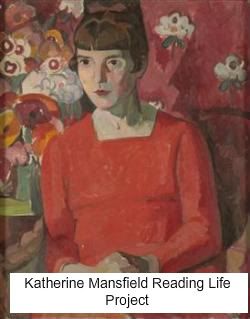
On May 19, 2010 thanks to one of my favorite online reading web pages, East of the Web:Short Stories I read my first Katherine Mansfield short story, "Miss Brill" when they selected it as their short story of the day.    I am embarrassed a bit to admit I had until then never heard of Katherine Mansfield.     After reading this story I knew at once I had discovered a new to me writer that I wanted to learn more about.    A bit of research led me to two  of her most famous stories, "The Doll House" and "The Garden Party".    By then I had begun to research her online and discovered, among other things, that she was the only writer whose talent made Virginia Woolf jealous.    Katherine Mansfield (1888 to 1923-New Zealand) had a fascinating but far too short a life (I have  talked a little bit about it in my prior posts) in which her published output was around 75 short stories.    Recently I read five short stories written in the last two years by finalists and winner of the Caine Prize for African Literature.    All of these stories are very good works well worth reading.    If I could presume to offer one bit of advice to these five writers it would be "read the stories of Katherine Mansfield".      I am now about 1/3 way through my project of reading all the short stories of Katherine Mansfield.   Almost all of the stories have been collected in four books edited by Mansfield's husband, John Middleton Murray.    The wonderful New Zealand Electronic Text center has all of these four books online in an easy to read format and a lot more also including some great pictures and large selections form her journals, notebooks, and letters.     

"The Little Governess" is really a small masterpiece of the narrative art.   ( Many, maybe most serious readers, say they do not really enjoy short stories as they do not construct a complete world into which they can enter.    This feeling kept me from reading short stories for many years.     I have now seen I was not correct (for me at least) in my regard toward the short story.   I am coming to think more and more that the widespread aversion to the short story comes almost from a laziness on the part of the reader and a strong desire to escape through reading.)       It is about a young woman traveling by sea (of course LOL as no planes or chunnel then!) from England to Germany to be the governess for the children of the German baron and his wife.     The young woman is very naive in the ways of the world and she receives an expensive crushing education on her trip.    We in just a few pages go deeply into the world of the young woman and several people she encounters.   I do not want to give away the plot but it really is a sheer delight.   Yes, I will admit it left me very much wanting to learn more about what would happen to the little governess  and that was very stimulating to my imagination.    "The Little Governess" is just a wonderful story that would be hard to over praise.     One might concede that Germans are not portrayed favorably in Mansfield's stories (her brother died in WWI during a training exercise).

"A Dill Pickle" is about the chance meeting in an outdoor cafe (Mansfield and her circle spent a lot of time  in cafes and restaurants and they figure in a lot of her stories-she did not work in the ordinary sense and had a lot of leisure time) of a man and woman who six years ago seemingly had a fairly intense relationship but have since been apart.   The exact nature of their relationship is not spelled out.    That is one of the pleasure of Mansfield's stories in that we get to be active in the construction of the world of the stories we read.    Both characters are bit detached it seems, especially the man.    In the case of the man, it almost seems he has been sitting in the cafe for the last six years watching the world go by.     Both the man and woman are lonely and this story helps us understand the causes of loneliness.    The last few lines are simply brilliant.

"Revelations" is about a thirty three year old woman who seems to have thought herself into a  very precarious mental state and an early old age.    We also get a look at the effects of her mental issues (called simply nervousness) has on those in her life.    Here are some simply marvelous lines I cannot help but quote:

It is the loneliness which is so appalling. We whirl along like leaves, and nobody knows—nobody cares where we fall, in what black river we float away. The tugging feeling seemed to rise into her throat. It ached, ached ; she longed to cry. " That will do," she whispered. " Give me the pins." As he stood beside her, so submissive, so silent, she nearly dropped her arms and sobbed. She couldn't bear any more.
"The Escape" centers on a couple on a train.   (Mansfield spent a lot of time traveling.)   In just a few pages we can see deeply into the dynamics of the relationship between the couple on the train.   As I read the opening lines I felt Mansfield had beautifully captured the thoughts of a man who tries to keep the peace by agreeing with everything his wife says.   He thinks they are happy until he sees how another woman treats her husband.

I will next begin to read the stories in the collection, Something Childish and Other Stories published posthumously by her  husband.    These are largely her early stories.     There are 26 stories in this collection and I expect to do five or six posts on these stories.     There are 20 stories in The Doves Nest and Other Stories.    So far I have read and posted on 27 of her stories which leaves me 46 to go.   There are also a few stories not included in the four collections and some unpublished stories.    Of course there is the larger world of her letters and journals but my reading project focuses on her published fiction.      


Mel u


Thursday, July 15, 2010

"The Death of Oliver Bescaille" by Emile Zola

"The Death of Oliver Bescaille" by Emile Zola (23 pages-read through Dailylit.com)


I recently read and posted on Emile Zola's (1840 to 1902-Paris) Nana for the Classics Circuit.   As soon as I saw that Book Bath and Thyme For Tea were hosting an event dedicated to French culture,  Paris in July,  I knew I wanted to participate.    A few months ago I began to overcome a life time aversion to the short story so I decided I would read and post on a couple of short stories by canon status French authors for the event.    I enjoyed Nana (some who read it find it takes a very harsh a view of people) and my favorite on line reading web page Dailylit.com had "The Death of Oliver Bescaille"  one of Zola's short stories on line  so I decided to read it.   Dailylit.com does not normally give either the translator or date published information on its choicies and I was unable to find this information in a quick search.   My guess on the publication date is from 1864 to 1880.

Oliver Bescaille, the central figure and narrator of "The Death of Oliver Bescaille" suffers from syncope.   Victims of this disease blackout so deeply that they are often thought to be dead but they can be in fact aware of what is going on around them.    At the time of the story (set in Paris) this disease was unclassified by doctors and when Oliver has an attack the doctor called  by his wife pronounced him dead.   Oliver can hear and see everything that is going on but his eyes appear glazed over and he cannot move or speak and his body feels cold. 

It was on a Saturday, at six in the morning, that I died after a three days' illness. My wife was searching a trunk for some linen, and when she rose and turned she saw me rigid, with open eyes and silent pulses. She ran to me, fancying that I had fainted, touched my hands and bent over me. Then she suddenly grew alarmed, burst into tears and stammered:   "My God, my God! He is dead!"
I heard everything, but the sounds seemed to come from a great distance. My left eye still detected a faint glimmer, a whitish light in which all objects melted, but my right eye was quite bereft of sight. It was the coma of my whole being, as if a thunderbolt had struck me. My will was annihilated; not a fiber of flesh obeyed my bidding. And yet amid the impotency of my inert limbs my thoughts subsisted, sluggish and lazy, still perfectly clear.   

Oliver is left in the parlor in this condition for several days.    He hears what all those who come to pay their respects say about him, good and otherwise.   Oliver was basically a decent husband and father, no big accomplishments but no major faults either.    In a few days Oliver is taking to the cemetery  and placed in  the family tomb.    He comes out of his attack and is able to open the tomb door and after escaping it he closes the door behind him.    Oliver realizes he is now a free man, of sorts.    He begins to roam the city of Paris dressing in rags as befits the living dead.     A year or so passes and he returns to his old place of residence to see how his family is doing.     What happens then is much the point and interest of the story so I will not spoil it.  

"The Death of Oliver Bescaille"  is worth reading for a sample of the work of Zola.   It is a well plotted and thought out tale if not a first rank example of the short story.    I hope to post on a short story by Guy Du Maupassant next week.  

Mel u


Tuesday, July 13, 2010

No Longer Human by Osamu Dazai

No Longer Human by Osamu Dazai  (1948, translated by Donald Keene, 176 pages)

Osamu Dazai (1909-1948-Japan-pen name for Shuji Tsushima) was born into a wealthy family.   He lived a life of considerable dissipation funded by his family money.   He studied French literature in college where he met Masuji Ibuse (author of Black Rain) who helped Dazai begin to get his writings published in literary journals.   He was not drafted into WWII because he had tuberculous.    No Longer Human is the second best selling Japanese novel of all time, behind Kororo by Natsume Soseki.   

No Longer Human is largely narrated as if it were the  note books of a man named Oba Yozo.    The novel has strong autobiographical elements.   Oba is virtually unable to relate to to other people in his real personality so he adopts the pose of a happy laughing all the time person.    Inside he is deeply alienated from his wealthy  father  (and all of proper society)  who is appalled by his degenerate life style centering around drinking and prostitutes    His only seeming friend is man way below him in intellect, culture and family background who is kind of his guide to the darker side of life in Tokyo.    Women find Oba very appealing.   He learns how to seek out highly nurturing and supportive women that can see that he has the potential to be a great artist if he could shape his life in another direction.      He cares nothing for them and exploits them to avoid working.   He does get in very serious trouble at one point and luck and family money get him out of trouble.   Oba is very intelligent and insightful.  In time he does begin to pursue a marginally successful career  of sorts as an artist.   He knows very well there are lots of things wrong with himself but he cannot find any reason to work to rise above his problems.      The novel is divided into three sections which cover sections of Oba's life several years apart.    No Long Human is a brilliant account of the mind of a very alienated man who is a spectator at his own life.    I will not convey the ending so as to avoid spoilers but is very well done and completely sound artistically.    I recommend this book without reservation with the observation that it is a bit (ok quite a bit) grim.   Given its extreme popularity (over 12 millions copies have been sold) I think anyone interested in the Japanese novel at some point needs to read No Longer Human 


Mel u

Monday, July 12, 2010

Silence by Shusaku Endo

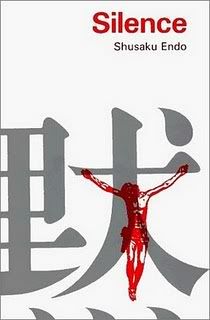
Silence by Shusaku Endo (1969, trans. from the Japanese by William Johnston, 201 pages)

Shusaku Endo (1923 to 1996) is a very highly regarded post WWII Japanese novelist.    He studied French literature in college and was raised as a Catholic, a very rare thing in Japan.    There is a very good background post on Endo on In Spring it is the Dawn, which is hosting a discussion of Silence.   There are links to several very good posts that cover the thematic details and talk about the historical period the book is set in, Japan in the 1600s on that web page.   Given this I will just make a few observations on the work.   

Silence is about the horrible persecution of the early Christian Missionaries (Catholics from Portugal) in Japan by the authorities.    As the religion began to take a hold, those who had become Christians  also could be subject to horrible punishments.    To be a Christian was basically a criminal act in Japan in the 1600s.    A good bit of the book, and the current discussion on it, revolves around the courage shown by most of the missionaries and the betraying of clandestine converts by others for payment.     I was intrigued by conversations in the book concerning the relationship of Jesus to Judas.    I found the descriptions of the tortures of the Christians very well done and, as all would, I felt great admiration for those who kept their faith while being tortured.   I learned some interesting things about life in Japan in the 17th century from this book.  

As I was reading Silence I began to imagine the Japanese sending missionaries to Portugal to convert the natives there to forms of religious belief and practices current in 17th century Japan.   The Japanese missionaries might have the best of intentions (even if those who financed them had other uses in mind for their work) but they would have been met with exactly the sort of reception the Christian missionaries got in 17th century Japan, if not worse.     Leaving aside any spiritual considerations, the missionary is the tool of the colonizer in almost all cases.   A missionary in 17 century Japan, The Philippines or Brazil might and often did have wonderful intentions and did his best to help those who he tried to convert but their efforts were financed by those interested in commerce and empire building, and not in saving souls.   In many cases or even most, the missionary may have no idea why his mission is really being funded.    This use of missionaries as a colonial tool is not just a European matter.    Sometimes in reading Silence (which is in part about the seeming silence of God) I felt that there was a silence over these matters in the narrative.

Silence is a well written historical novel.    The introduction by William Johnston is very good.    I think some readers appreciate this book almost as a religious text more than as a work of art.    I am glad I read this book and think others will enjoy it also.

Mel u


Saturday, July 10, 2010

The Mysterious Flame of Queen Loana by Umberto Eco

The Mysterious Flame of Queen Loana by Umberto Eco ( 1985, trans by Geoffrey Brock, 445 pages.)

In March this year I read and posted in Umberto Eco's (1932-Italy) The Name of the Rose.     I enjoyed The Name of the Rose and learned a good bit about life in a medieval monastery in Italy from it.  The Name of the Rose is by far his most read  book.   Yesterday I finished his The Mysterious Flame of Queen Loana and I  enjoyed it a lot also.    I really liked the subject matter of the novel as it deals directly with the role of books and remembered reading in the lives of book centered people, in theory the theme of my blog.

The main character and narrator of the book is a dealer in antique books in his sixties.   All of his remembered life he has loved books, literature and reading.    He has a stroke and he can remember nothing but the contents of the 1000s of books plus magazines and newspapers he has read.    He does not know his own wife, etc.    His wife fills him in on the bare outline of his life but there are still huge holes in his memory.   He goes to the ancestral country house of his family, a sprawling old mansion, and he finds a huge treasure trove of books, magazines, and newspapers along with all sorts of posters and such.   He begins to reread all of the books he appears to have read in his youth as well as magazines and newspapers from the 1930s and 1940s.   From these papers he is able to reconstruct the image of Fascist Italy.    He begins to reconstruct his own life from the books.    It is fascinating to see how Eco depicts this process.    

The book is  a love story about literature.    Many of the works referred to in the book are beyond my frame of reference but what matters is we can see the how literature shaped and enriched the man's life.    

This is a rich book with lots in it to entertain and edify us. Eco knows a really lot and it shows. The novel  is profusely and beautifully illustrated with all sorts of art works and poster reproductions that are integral to the story.      I would not classify it as a light read but I think those who give it the respect it deserves will be glad they read it.      I will, I hope, read more of his books.


Mel u

Friday, July 9, 2010

The Four Short Listed Runner Up Short Stories of the 2010 Caine Prize-African Short Stories

The Short List Runner Ups for the 2010 Caine Prize For Best African Short Story

"Worm" by Ken Barris, 2009 (South Africa)
"How Shall We Kill the Bishop" by Lily Mambura, 2008 (Kenya)
"Manzunga"  by Namwali Serpell, 2009 (Zambia)
"Soul Mates" by Alex Smith, 2009 (South Africa)

Yesterday I posted on a really great short story, "Stick Fighting Days" by Olufremi Terry (Siera Leone) which won the 2010 Caine Prize for best short story by a writer from an African country.    (There is a link to the award page on my post on "Stick Fighting Days" and also an explanation of the great import of the Caine Prize).    The short story was chosen as the literary form of choice for its continuation of the tradition of the story teller in African culture.   The Caine Prize is considered the most prestigious African literary award.   It was named for Sir Michael Caine who was chairman of the Booker Prize management committee for twenty five years.    All three of the African Nobel Prize winners for literature are patrons of the award (J. M. Coetzee and Wole Soyinka and Nadine Gordimer) which comes with 10,000 British Pounds.      Three out of the four stories dwell on very violent themes.    Two of the writers are now American academics.


"Worm" by Ken Barris  

Ken Barris is a professor at Cape Peninsula University in Cape Town South Africa and also a professional writer.   "Worm" is a very interesting story about a man living in Cape Town South Africa with his seemingly near psychotic dog, Worm.    The man (the story is narrated in the first person) is very concerned about crime and his personal security.   His house has a  security system, his doors and windows are heavily bolted at all times and his best source of protection is his dog Worm who is completely vicious to any intruder.   Here is a very interesting detail that will give a sense of the prose style of Barris and sort of gets to what I see as the heart of the story:

If I can only detach Worm, make him open his jaws
somehow, we will walk on, leaving the spaniel behind us. There will be no consequences. I am
filled with a grim satisfaction, which I do not really understand. It is a relief, however, a kind of
pleasure. I stand holding Worm’s leash, hoping he will soon let go.
Worm has just killed a cocker spaniel on the street.   The narrator did nothing to prevent it and he sees the event as perfectly normal.    I think we are meant to be drawn to reflect on a society so violent where life is held so cheaply that one can walk a killer dog down the street and no one thinks anything of it.   Imagine walking your dog down the streets  of Tokyo, San Francisco, Singapore or Paris only to have him kill a cocker spaniel and you, the owner of the dog, will just walk on as if nothing has happened with no attention to the dead dog.   In many places one can be arrested or fined for not cleaning up after your dog and in the world we enter in "Worm" nobody cares or thinks anything of it.   This is a very good story that takes us a long way into the mental state that living in a very violent place can induce.

"How Shall We Kill the Bishop" by Lily Mabura

Lily Mabura is from Kenya and is working on her PhD at the University of Missouri.   "How We Shall Kill the Bishop" centers around a group of priests.    Unlike "Stick Fighting Days" or "Worm" this story relies on expository telling rather that showing.    It centers on the lives of a group of priests who are unhappy with their bishop.   One of them proposes that they kill him and the story revolves around the consideration of this idea.    There are some stylistic tics in the story I was also puzzled by such as use of very nonstandard English sentence construction in some of the exposition.   Maybe this was meant to project us into a consciousness that does not see the world in University approved late Victorian prose but it did not seem to work.  (I am quite sensitive to the use of the Victorian novel prose model as a tool of suppression and spoke on this matter in my post on Wide Sargasso Sea by Jean Rhys).    "How Shall We Kill The Bishop" is  well written story worth your time to read.


"Mazunga" by  Namwali Serpell


Namwali Serpell is from Zambia and an Assistant Professor in the English Department of the University of California at Berkeley.   "Manzunga" is about a young girl, Isabella, who is the daughter of affluent Europeans living in a city in Zambia.    Isabella's parents are completely caught up in the social world of other expats


Her parents had settled into life in Zambia the way most expats do. They drank a lot. Every weekend was another house party, that neverending expatriate house party that has been swatting mosquitoes and swimming in gin and quinine for more than a century.   
I found this story to make use of stock characters in his portrayal of the characters in the work.

The Colonel sat in his permanent chair just beyond the shade of the veranda, dampening with gin thatch protruding from his nostrils, occasionally snorting at some private or overheard joke. 
The story does make interesting use of a lot of details of things that could be seen from a child's point of view, kind of naturalistic observations.

"Soul Mates" by Alex Smith

Alex Smith is from South Africa and is a professional writer, having published several novels.    "Soul Mates" is the only historical work, set  some time in the period of Dutch Colonial rule in parts of South Africa.    The story centers on a mail order bride of a Dutch Boer settler who is married to a completely brutal man.   All of her intimate contacts with her husband feel like rape to her and she comes to have  a deep hatred for her husband who is depicted in the story as a complete brute.    There are phrases in Dutch in the story.   Using the power of Google, I found all of these phrases in Dutch were prayers of the woman for relief from her horrible domestic situation.   If I did not have the resources of Google I would not have understood this portion of the story and I actually did not see how this use of Dutch benefited the narration or artistic qualities of this story and might have been annoyed without Google to help me here.    A very dramatic turn of events takes place and I will not give away more of  the plot.

All four of these stories are decent well written  and worth your time to read works.     For sure the judges made the right decision (I heard it was unanimous) in selecting "Stick Fighting Days" as the winner.    The Caine Prize has been awarded for the last ten years.   Every year there are from 10 to 4 other stories that are shortlisted for the prize and all of them can be found on the official web page.   This comes to around 75 stories or so.   I did a little bit of research and only a  few of these stories can be read online (one cannot blame the authors or publishers for preferring to keep the stories off line).  

I am very glad I found these stories (I owe it  to a Tweet of one of the great people I follow on Twitter).    I will be reading more Caine Prize winners and short listed stories in the future, I hope.  
The official web page also tells how to submit a story for the 2011 award along with the rules of eligibility.

All of the stories can be linked through the official web page.

Mel u


Featured Post

Imperial Reckoning: The Untold Story of Britain’s Gulag in Kenya by Caroline Elkins - 2005 - 701 Pages

  Imperial Reckoning:     The Untold Story of Britain’s Gulag in Kenya by Caroline Elkins - 2005 - 701 Pages 2006 Pulitzer Prize Winner From...