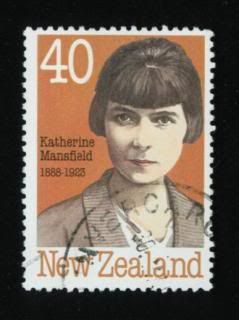
Monday, October 18, 2010

" Life of Ma Parker" by Katherine Mansfield

"Life of Ma Parker" by Katherine Mansfield (1921, 12 pages)


"Life of Ma Parker" by Katherine Mansfield (1888 to 1923-New Zealand) was included in the collection of her work, The Garden Party and Other Stories published in 1922, after first being published in 1921.

"Ma Parker" is a very dark work,   the darkest of Mansfield's stories I have yet read (out of about 40 so far).   Ma Parker seems a very ancient (no doubt very  much old before her time) woman.   She has given birth to twelve children half of whom are already dead.    Her eldest daughter is a widow in early 20s with one child.   

Every Tuesday Ma Parker cleans the house of a man described simply as a "literary gentleman".    He knows that her only grandchild has been sick so he inquires after his health and is told he has passed away since her last cleaning day.    He feels he must say something to condole her before going back to his morning paper.

“Oh, dear me! I’m sorry to hear that,” said the literary gentleman in a shocked tone. He was in the middle of his breakfast. He wore a very shabby dressing-gown and carried a crumpled newspaper in one hand. But he felt awkward. He could hardly go back to the warm sitting-room without saying something—something more. Then because these people set such store by funerals he said kindly, “I hope the funeral went off all right.”
We can see how little the "literary gentleman" knows about people and his inability to see Ma Parker as a full person in this fatuous remark.     The literary gentleman lives alone and makes no efforts to keep his place clean during the week.   When his friends asks him about his housekeeping methods here is his response:
 "“You simply dirty everything you’ve got, get a hag in once a week to clean up, and the thing’s done."


As Ma Parker leaves the man's house after completing her work she wants to cry for her last grandson.    Here we see Mansfield's supreme artistry in  painting for us the world of Ma Parker:


She couldn’t go home; Ethel was there. It would frighten Ethel out of her life. She couldn’t sit on a bench anywhere; people would come asking her questions. She couldn’t possibly go back to the gentleman’s flat; she had no right to cry in strangers’ houses. If she sat on some steps a policeman would speak to her. wasn't  there anywhere where she could hide and keep herself to herself and not be  not disturbing anybody, and nobody worrying her? Wasn’t there anywhere in the world where she could have her cry out— at last?     Ma Parker stood, looking up and down. The icy wind blew out her apron into a balloon. And now it began to rain. There was nowhere.
"Life of Ma Parker" is a powerful disturbing work.

This story can be read online at the New Zealand Electronic Text Center.    

Mel u


Sunday, October 17, 2010

"The Model Millionaire" by Oscar Wilde- Happy 156th Birthday

"The Model Millionaire" by Oscar Wilde (6 pages, 1881)

"What was a butterfly to do among bulls and bears?"


Greetings to the many readers from Chisinau-your comments on the story and general reading suggestions are very welcome-Mel u-Editor of the Reading Life

Yesterday was the 156th birthday of Oscar Wilde (1854 to 1990-Ireland)  .    Google brought this to the attention of the world by placing on its search page a doodle image inspired by his only novel, The Picture of Dorian Gray.    A few months ago I read and posted on two of his fairy tales, "The Selfish Giant" and "The Happy Prince    This morning as I was reading through the new posts in my Google Reader I found a very interesting post on Zee's Worldly Obessions entitled "Ten Things You Should Know About Oscar Wilde".    Long ago I read The Picture of Dorian Gray  and loved it.     I wanted to post something in honor of his birthday.    Lately I have been reading a lot of short stories so I decided I would read one of Wilde's traditional (non-fairy tale) short stories.

"The Model Millionaire" reminded me of Picture of Dorian Gray in its tone and setting.   ( It is not as wicked a work but then what would be?)    The central character in this story is  Hughie, a young man who lives from the 200 pounds a year his aunt left him:   "He had tried everything. He had gone on the Stock Exchange for six months; but what was a butterfly to do among bulls and bears?"   Hughie has a young lady he wants to marry but her father will not allow it until Hughie can show him he has at least 10,000 pounds.    Who but Wilde could describe a character like that and make us love him.   One day Hughie goes to visit the studio of an older friend of his who is a very successful and prosperous because of it society portrait painter.

The painter is doing a portrait of what seems a tramp dressed in ragged unwashed for a long time clothes.  Hughie asks the painter how much an artist model gets paid and is shocked by the small amount.     He then asks the artist how much he will sell the painting for and  learns it will be sold for an amount  ten times greater than Hughie's annual income.     When the artist steps out for a moment Hughie gives the portrait sitter all of the coins he has in his pocket.   This means Hughie will not be able to go anywhere by cab for a month so it is a real gesture.    When the seeming tramp leaves the painter tells Hughie that the model is very taken by him.   The painter reveals that he has told the man all about Hughie including where he lives and that he needs 10,000 pounds to marry.   Hughie is concerned the tramp may show up at his door.    The painter reveals to Hughie the identity of the model.


'What I say,' said Trevor. 'The old man you saw to-day in the studio was Baron Hausberg. He is a great friend of mine, buys all my pictures and that sort of thing, and gave me a commission a month ago to paint him as a beggar. Que voulez-vous? La fantaisie d'un millionnaire! And I must say he made a magnificent figure in his rags, or perhaps I should say in my rags; they are an old suit I got in Spain.'
     'Baron Hausberg!' cried Hughie. 'Good heavens! I gave him a sovereign!' and he sank into an armchair the picture of dismay.

"The Model Millionaire" is a surprise ending short story (not a real shocking surprise) so I will not tell any more of the plot than I have.   The fun in this story is in the tone and the turns of phrase.  It is easy to read and follow.   It is a traditional story.      You can read it in just a few minutes online here .  

Mel u


Saturday, October 16, 2010

84. Charing Cross Road by Helene Hanff

84, Charing Cross Road by Helene Hanff  (1970, 94 pages)

84, Charing Cross Road by Helene Hanff (1916 to 1997-USA) is a charming epistolary novel.    The correspondents are Ms Hanff herself and various members of the staff of a London Book Store Marks and Co. located at 84 Charing Cross Road.    The letters begin when Ms Hanff sees an advertisement in the Saturday Review of Literature indicating the store specializes in out of print and antiquarian books.   Ms Hanff sends them her "want list" and says she is willing to spend up to $5.00 for the books on the list.   The first letter was sent in October of 1949 when London is still under  rationing as a result of the war time austerity programs.     Three weeks later the book store sends her an answer saying they had found one of the volumes on the list and if she agrees to the asked price they will send it to her.   From this modest start a 20 year correspondence begins in which Ms Hanff  becomes  friends with the employees at the small store.   As they supply her with the books she wants she sends them small gifts.    The staff of this store actually know and love books.    It is the shared love of books that allows the friendship to develop.    Ms Hanff often speaks in her letters of  accepting the invitation to visit London but sadly she never does.   We share the excitement as she becomes a successful writer for American television.    I  enjoyed seeing the friendship develops over the years of letters.

As I read this book I thought that this is about a part of the reading life that will be pretty much unknown to future generations of book lovers.    It is great to be able to go online and download all sorts of old works but there is a special excitement searching for months or even years for a special title and at last reading it.   Maybe the love of books as physical objects may one day be something only felt by specialized collectors but the reading life will be the poorer for it.    

84, Charing Cross Road is a charming heart warming book.    There is a movie based on it.    Maybe it is about a bygone world but in this book we can at least imagine it.    I am really glad I read this book.   Imagine a book store where the employees can talk about Elizabeth Bowen or Ford Madox Ford instead of Twilight!

Mel u

Friday, October 15, 2010

The Uncommon Reader by Alan Bennett

The Uncommon Reader by Alan Bennett ( 2006, 121 pages)


The Uncommon Reader by Alan Bennett (1934, UK) has been on  my TBR list ever since I first heard of it last year.     When I started my blog I intended to focus on books that  deal with the lives of reading centered people.   I had a list of 50 or so books I wanted to read and post on that dealt directly with that topic.   The Uncommon Reader was on this list and I am very glad I have now read this insightful, witty and above all else fun novel about the reading life of Queen Elizabeth II of England.    

As the novel opens Queen Elizabeth has discovered that a mobile library comes periodically to a spot behind the palace.    The Queen has never been much of a reader.   Her "handlers" have always provided her all the information she needs to perform her Royal duties.    She goes into the mobile van and as she feels it would be good to encourage reading among the public and to be polite to the page that takes her to the mobile library she checks out a book.    We see the Queen get more and more interested in reading and reading more serious books.     Anybody into the reading life will be able to relate when the Queen begins to find her duties a burden as they cut into her reading time.    Things that were once of great importance to the Queen such perfection in her appearance no longer matter so much to her.    She begins to ask those she meets what they read.    As a long standing weekly ritual (Elizabeth has been Queen for over 50 years) she has a weekly meeting with whoever is currently Prime Minister.  In the past these conversations have been more or less formalities designed to be sure the Queen saw events as the government of the time wanted her too.   Then the Queen began to ask the Prime Minister and other handlers what they were reading.   The government officials become alarmed when they see  that her reading is giving the Queen a mind of her own and try to find ways to stop her reading.   The Queen begins to think about how reading affects peoples'  lives.   We see her reading powers develop from being unable to read a novel by Ivy Compton-Burnett to reading and talking about Proust.   (I will be posting on her Manservant and Maidservant for  NYRB Reading Week from November 7 to 13.     I urge my readers to consider joining in this project hosted by The Literary Stew and Coffeespoons.   There will be international giveaways. )

The tone of The Uncommon Reader is like a young adult work.  The title is meant to make us think of Virginia Woolf and Samuel Johnson.    The page who helps Elizabeth with her reading is gay and we see how this effects his life.    There is also a really purely gratuitous use of x rated language that seems out of place in this near fairy tale like work.    Without this line I would say the book could be read by middle school children.   

I liked this book.    The short length of the book fits its fairy tale like feeling.    The book has a lot of really nice observations on books and the reading life.    The development of the Queen into a reader in her later years is very well done and quite believable.   

The Literary Stew has an excellent review of this book.     I endorse this book fully with the caveat to parents about the x-rated language.

Mystica also has an excellent post on The Uncommon Reader

Mel u

Wednesday, October 13, 2010

A Wrinkle in Time by Madeline L'Engle

A Wrinkle in Time by Madeline L'Engle (1962, 232 pages)

A Wrinkle in Time by Madeline L'Engle (1918 to 2007-New York City) won the very prestigious Newberry Award for best children's literature in 1962.    You will also find it mentioned by many book bloggers as among their very favorite books of their youth.    I have been wanting to read it for some time now and I was very happy to find it in National Book Store in Trinoma Mall.    It is very much a "feel good book".    

A Wrinkle in Time is a cross between science fiction and a Christian fable.    It plays with the conventional notions of time and space and solid objects.    It takes us to strange planets (places besides earth at least) and  introduces us to aliens with names like "Aunt Beast", "Mrs Who",  "Mrs Whatsit" and "Mrs Which".   They may look strange but in the end they are kind of like alien Mary Poppins.   

There is an excellent post at Things Mean a Lot  that goes into detail about the plot and the themes of the book.    There are links on that post to other reviews.    

A Wrinkle in Time is a book for children but it also has the power to make adults think.    It is well written and easy to read.    With the qualification that this is almost a child's book rather than a Young Adult book, I would recommend it for adults who like an occasional Young Adult book.    I would be happy to see my 12 year old daughter reading this and I think she would like it a lot.    A Wrinkle in Time supports the kind of values a parent of almost any creed or religion would like to see their children learn.  


Mel u


Tuesday, October 12, 2010

"The Young Girl" by Katherine Mansfield

"The Young Girl" by Katherine Mansfield (1920, 8 pages)

The Reading Life Katherine Mansfield Project

"The Young Girl" by Katherine Mansfield  (1888 to 1923-New Zealand) was first published in 1920 and was included in a the 1922 collection of her work, The Garden Party and Other Stories.   

I  found "The Young Girl" entrancing for the  juxtaposing of characterless beauty of a young girl 

In her blue dress, with her cheeks lightly flushed, her blue, blue eyes, and her gold curls pinned up as though for the first time—pinned up to be out of the way for her flight—Mrs. Raddick’s daughter might have just dropped from this radiant heaven 
with the mystery and apparent ugliness of an older woman as she enters a casino
The ancient, withered creature, wearing a green satin dress, a black velvet cloak and a white hat with purple feathers, jerked slowly, slowly up the steps as though she were being drawn up on wires. She stared in front of her, she was laughing and cackling  to herself; her claws clutched round what looked like a dirty boot-bag.
The only plot action of the story involves one of the central characters leaving the young girl, her daughter, with a friend so she can go inside the casino as they do not allow children inside.    There is no resolved ending to the story and in fact we are left kind of wondering exactly why the young girl is really being left in non-parental care.   The conversations are well done and the characters quite credible.   I see in this story as in others a certain prejudice against older persons or perhaps this is meant to be a projection of the thoughts of the characters in the story.

Mel u

Monday, October 11, 2010

"Mr and Mrs Dove" by Katherine Mansfield

"Mr and Mrs Dove" by Katherine Mansfield  (1921, 12 pages)


"Mr and Mrs Dove" by Katherine Mansfield (1888 to 1923-New Zealand) was first published in 1921 then republished in 1922 in a collection of her short stories, The Garden Party and Other Stories.

As the story begins Reginald (who seems in his mid-twenties) is getting ready to go back to his post as a colonial administrator in Rhodesia.  (As I read that I was brought to mind that Ida Baker had Rhodesian roots.)   Today is his last day in England.   He goes to the home of a family friend, Colonel Proctor,  to take his leave.    What he really wants to do is to ask to Anne Proctor, daughter of the Colonel, to marry him and go to Rhodesia with him.    The idea of a young man having to go to or return to a colonial post is a frequent entity in English literature between the wars.    It was often the lot of second sons.    It could if one was lucky smart and opportunistic be quite lucrative but it might also damaging to your health.    

As Reginald arrives at the house he finds Anne is home alone.    He makes a very weak attempt to get Anne to commit to him.   He spends most of his time telling her what a bad idea it would be for her to accept him.
The actions of the doves kept by the Proctors is a kind of metaphor for all of this.   Anne tries to tell Reginald something very important through talking about the doves but Reginald appears too thick to pick it up.

"Mr and Mrs Dove" is a very well told and written story.   I am glad I took the time to read it.


Mel u

Featured Post

Imperial Reckoning: The Untold Story of Britain’s Gulag in Kenya by Caroline Elkins - 2005 - 701 Pages

  Imperial Reckoning:     The Untold Story of Britain’s Gulag in Kenya by Caroline Elkins - 2005 - 701 Pages 2006 Pulitzer Prize Winner From...