Sunday, October 31, 2010

Kafka on the Shore by Haruki Murakami

Kafka on the Shore by Haruki Murakami (2002, 612 pages, translated by Philip Gabriel)


Kafka on the Shore is the 9th work by Haruki Murakami (1949-Kyoto, Japan)  that I have read in the last year.      Obviously I greatly enjoy and appreciate his creations.    Some of his work, including Kafka on the Shore is in the tradition of magic realism.    He is a great story teller who explores the deeper themes of post WWII Japanese culture mixed in with surrealistic episodes, sexual encounters, history, reflections on literature, philosophy and popular culture that have made him a best selling author world wide.     His books are  all a lot of fun but they will make you think about broader issues and they do not shrink from the horrors that underpin  the sunlit world of consumer Japan and the world beyond it.    Many of the books, for sure including Kafka on the Shore, have symbolic themes and puzzles that those so inclined can have fun unraveling.    

As soon as I read on the back cover of Kafka on the Shore (brilliant book title) that one of the central characters was a man who could speak to cats I knew I would like it.   (There are a terrible few pages of violence against cats which I admit I skipped.)    There are two central characters in this book.   Kafka is a 15 year old runaway seeking his mother and sister.     He ends up being sheltered in a marvelous private library run by a beautiful older woman (there is a " bookish boy's fantasy" theme found throughout the work of Murakami).    Kafka begins to read the corpus of the great early 20th century writer Natsume Soseki.   It is exciting to see young Kafka try to find his place in the world while living in a library curated by a beautiful older woman.

The second major character is Nakata, an older man who cannot read but who can speak to cats.   He receives a small disability check from the government but his main income comes from his work as a tracker of lost cats.  The story about how he lost a large portion of his intellectual capacity at age 16 is a great side story taking us back to WWII.    Nakata had never been more than a few kilometers from his home until his most recent cat track assignment took him way outside the area he was comfortable in.    He is befriended by a truck driver who helps him in his quest.

There are a number of philosophical references in the work.     One of the minor characters is a beautiful prostitute who calms down  excited customers by talking about philosophical issues.   There are a lot of references to western music, from Beethoven to the Beetles.   

Kafka on the Shore is a fun read.    Murakami has a wild imagination. .    There is really a lot to enjoy in this book and little to dislike.    Parts of the book are very explicit sexually.     You can tell Murakami really enjoys the physical beauty of women.  The sex scenes are very erotic though told very much from a male point of view.  

My next Murakami will be Hard-Boiled Wonderland and the End of the World.  

Mel u  


Saturday, October 30, 2010

"Taking the Veil" by Katherine Mansfield

"Taking the Veil" by Katherine Mansfield (1922, 7 pages)


"Taking the Veil" is one of the last few stories written by Katherine Mansfield (1888 to 1923-New Zealand).   Her husband, John Middleton Murry, included it in a collection of her stories he published in 1923, The Dove's Nest and Other Stories.

How could anyone dislike a story that begins its second paragraph with these lines

Perhaps even Edna did not look quite as unhappy as she felt. It is not easy to look tragic at eighteen, when you are extremely pretty, with the cheeks and lips and shining eyes of perfect health. Above all, when you are wearing a French blue frock and your new spring hat trimmed with cornflowers.

The night before Edna and her boyfriend Jimmy had been at the theater.   Edna took one look at an actor in the play and she was in love!   The feeling was not at all pleasant to her and in fact it cast her into despair.   Jimmy and Edna had known they would be married since age ten but now Edna has lost all interest in this idea.      I really do not want to say a lot more about this story.   To me it is just brilliant.    Mansfield takes what at first seems like an overly melodramatic typical teenage cliche and turns it into beautiful story about the true meaning of love.   


This story can be read on line at the New Zealand Electronic Text Center.   

Mel  u


Friday, October 29, 2010

Welcome to all Book Blog Hoppers

Welcome to all Book Blog Hoppers


I will follow back all who follow me-

Every Friday Jennifer of Crazy For Books hosts The Book Blogger Hop-The Book Blogger Hop is a great chance to meet new to you bloggers, find some new blogs to follow and gain some great readers for your own blog.   Every week about 200 or so bloggers from all over the world participate.    I have found some excellent new blogs this way and gained some wonderful readers.    I follow about 500 book blogs  and am always happy to find more.   If you follow me I will follow you.

Here is Jennifer's question for this week:

"What is the one bookish thing you would love to have, no matter the cost?"

To buy the apartment next to ours and turn it into a reading room/ sanctuary!

   My blog for the last few months has been one third Asian literature, one third classics and one third short stories but I do read contemporary fiction also and even some YA once in a while.    I have various reading projects I am working on also.    My latest one is short stories by Australian writers of the 19th century and I also just read  five stories by African writers in competition for the Caine Prize.    I am very into Katherine Mansfield and Virginia Woolf.  

If you visit me please leave  a comment so I can return the visit-

I will follow all who follow me-

thanks

Mel u.

"A Cup of Tea" by Katherine Mansfield

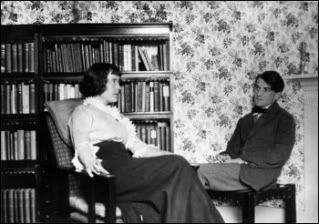
Mansfield and her brother Leslie
"A Cup of Tea" by Katherine Mansfield (1921, 12 pages)


"A Cup of Tea" by Katherine Mansfield (1888 to 1923-New Zealand) is included in the 1923 collection of her work, The Dove's Nest and Other Stories edited by Mansfield's husband, John Middleton Murry.    There is a very moving introduction to this collection in which Murry lets us know details about the next ten stories his wife was going to write.   There is a temptation in reading Mansfield to see her work as artistically peaking in 1921 and 1922 given that we know these are her last stories.   I sense a rapid growth in her artistic depth during this period but it is a feeling of a writer just starting to find her true power not of a writer at her zenith.  

I really like "A Cup of Tea" a lot.    It, among other things, does a brilliant job of depicting matrimonial jealousy and insecurity.    Our lead character is a very wealthy young woman, Rosemary, seemingly recently married.    Her time is largely taken  up with looking for  ways to spend money.    As the story opens she has just bought a small box in an exquisite shop, the cost is about six months pay for an ordinary working man of the time.  (No doubt it is at least a year's pay for a young female servant.)    There is a world in these few lines:

One winter afternoon she had been buying something in a little antique shop in Curzon Street. It was a shop she liked. For one thing, one usually had it to oneself. And then the man who kept it was ridiculously fond of serving her. He beamed whenever she came in. He clasped his hands ; he was so gratified he could scarcely speak. Flattery, of course. All the same, there was something...
" You see, madam," he would explain in his low respectful tones, " I love my things. I would rather not part with them than sell them to someone who does not appreciate them, who has not that fine feeling which is so rare..." And, breathing deeply he unrolled a tiny square of blue velvet and pressed it on the glass counter with his pale finger-tips.
Rosemary has been reading Dostoevsky  lately and when she is approached by a very bedraggled looking young woman asking for the price of a cup of tea she is at first put off but then she decides to have a bit of an adventure.    She invites the girl to come home with her.     The girl is so hungry she overcomes her fear at talking with someone so far above her station in life and agrees to go with Rosemary.  

The story is not long and the psychological depth of the work is great so I will not tell any more of the plot action.   As I was reading this, I thought that maybe Mansfield in "A Cup of Tea" is gently (or maybe not so gently!) mocking or satirizing the world Mansfield's wealthy parents (her father was the Chairman of the Bank of New Zealand) wanted her to live in.  

I love the opening description of Rosemary and her world:


ROSEMARY FELL was not exactly beautiful. No, you couldn't have called her beautiful. Pretty ? Well, if you took her to pieces . .. But why be so cruel as to take anyone to pieces ? She was young, brilliant, extremely modern, exquisitely well dressed, amazingly well read in the newest of the new books, and her parties were the most delicious mixture of the really important people and... artists—quaint creatures, discoveries of hers, some of them too terrifying for words, but others quite presentable and amusing.
Rosemary had been married two years. She had a duck of a boy. No, not Peter—Michael. And her husband absolutely adored her. They were rich, really rich, not just comfortably well off, which is odious and stuffy and sounds like one's grandparents. But if Rosemary wanted to shop she would go to Paris as you and I would go to Bond Street. If she wanted to buy flowers, the car pulled up at that perfect shop in Regent Street.

This is just a near perfect story.   Thanks to the wonderful New Zealand Electronic Text Center  you can read it online.  


Mel u

Thursday, October 28, 2010

"Honeymoon" By Katherine Mansfield

"Honeymoon" by Katherine Mansfield, (1922, 10 pages)


"Honeymoon" by Katherine Mansfield (1888 to 1923-New Zealand) appears to be the second from the last story Mansfield completed.     It included in the collection of her work, The Doves' Nest and Other Stories,  published by her husband, after her death, in 1923.   

"Honeymoon" is a wonderfully done story that in a few pages describes a few hours on the Mediterranean sea coast honeymoon of George and Fanny (it is interesting how names used in a work can sometimes date it).     In the delicate pages of this story we are projected a life time but only if we give ourselves over to the mastery of Mansfield.   I wondered as I read this how one partner's ability to see beauty where the other sees nothing will shape the future of the couple.   We sense their union is permanent.   

"Honeymoon" can be read online here

Mel u


Wednesday, October 27, 2010

"The Lady's Maid" by Katherine Mansfield

"The Lady's Maid" by Katherine Mansfield (1920, four pages)


"The Lady's Maid"   by Katherine Mansfield (1888 to 1923-New Zealand) was first published in 1920.    It is the final story in the 1922 collection of her work, The Garden Party and Other Stories.    The story is told in the first person by  Ellen,  who has worked as a lady's maid for the same family for many years.  Unlike many of her contemporary writers from very comfortable family backgrounds (Mansfield grew up with servants-her father was the Chairmen of the Bank of New Zealand) Mansfield is able to convincingly speak through the consciousness of a completely uneducated servant without condescending to the character.    

In large portions of the world, servants are now something only for the rather wealthy.   Literature centering on women sitting around talking about their servants seems like a throw back to Edwardian times to most, I think.    For better or worse, servants are a part of ordinary life here in the Philippines and often work for the same family for many years.    You can hear things like "Oh we treat our helpers like part of the family" while at the same time more is spent  on the family cats than the helpers are paid.     Many of the students at the private elementary school that my youngest daughter attends  at age 12 still now have their own personal servants, called a "YaYa".   Many have had personal servants all their lives.      There was even a very popular TV show and movie about YaYas in which they were treated as country bumpkins of the worst sort. 
Mansfield  depicts in this short work how the master-servant relationship can  shape the attitudes of both parties.     

"The Lady's Maid" can be read online here    

I will now move on to the stories in her collection, The Dove's House and Other Stories (1923, edited by her husband after he death) which contains some of her most highly regarded works.


Mel u


"An Ideal Family" by Katherine Mansfield

"An Ideal Family" by Katherine Mansfield (1921, 11 pages)


Reading and the Weather?

"An Ideal Family" by Katherine Mansfield (1888 to 1923-New Zealand) was included in the 1922 collection of her work, The Garden Party and Other Stories after first being published in 1921.    It is not a traditional short story with a plot and a surprise ending.    I almost wanted to call it a snapshot of a family but really it is more an x-ray.   

The father, in the mind of his adult children, is far enough on in life that he needs to turn the running of his family business over to his son.    The father fears the son does not have the ability to run the business well enough to support the comfortable life style all have come to enjoy.   With a little bit of text Mansfield lays out years of under the surface conflict.

I found this to be a beautifully written story.   The opening sentences concerning the aging of the father seemed very moving to me.

That evening for the first time in his life, as he pressed through the swing door and descended the three broad steps to the pavement, old Mr. Neave felt he was too old for the spring. Spring—warm, eager, restless— was there, waiting for him in the golden light, ready in front of everybody to run up, to blow in his white beard, to drag sweetly on his arm. 
Mansfield has issues with aging which come out over and over in her stories.   It is hard to forget   while reading her wonderful 1921  stories that  she has little time left.


Later in the day I began to wonder how readers who have never experienced a change of seasons can relate to imagery like this.   If a reader has experienced winter and spring only as images on TV, how will  prose like that I quoted move them?    Mansfield was a writer from  a world with four seasons.   The harshness of life can be seen as the harshness of winter, spring like a rebirth, fall to be enjoyed for its transient beauty and summer to be savored knowing it will soon end.     Mansfield never dreamed  of a world where many of her readers have never experienced the changes of the season and can relate only in a cognitive fashion to seasonal imagery and references.  Seasonal imagery is at the very roots of western literature.     If any one has any thoughts on that please leave a comment.

"An Ideal Family" can be read here

Mel u


Featured Post

Imperial Reckoning: The Untold Story of Britain’s Gulag in Kenya by Caroline Elkins - 2005 - 701 Pages

  Imperial Reckoning:     The Untold Story of Britain’s Gulag in Kenya by Caroline Elkins - 2005 - 701 Pages 2006 Pulitzer Prize Winner From...