Monday, April 11, 2011

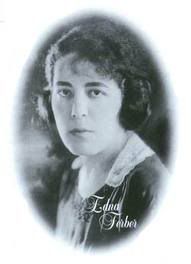
"The Homely Heroine" by Edna Farber

"The Homely Heroine" by Edna Farber (1911,  7 pages, 22 minutes as audio book)


As I have said before (and will say again)  short stories have helped me learn about a lot of new to me authors.   


I had heard of Edna Farber (1885 to 1968-Michigan, USA) but never read any of her works.    I think like most people I saw her as the author of  Show Boat, the basis for the famous Jerome Kern movie (and  remake in 1951 by George Sydney).    Farber worked as a journalist before beginning her very successful career as a writer.   She won the Pulitzer Prize in 1924 for her novel, So Big.


"The Homely Heroine" is a tremendously  fun story, heart warming, totally entertaining and much wiser than it at first may seem.   I just complete Elizabeth Gaskell's Cranford and this story felt like it could be part of a Midwestern American version of the mythical town of  Cranford.   I think it would be a great story for use in literature classes for students 12 and above.     


As the story opens the narrator is talking to a friend about  a story she she is working on.   She wonders why the heroines in stories all have to be beautiful.    I liked when she said even in stories about an Irish girl, she always about half way through the work, turns out to beautiful once you change her from her frumpy look.


The narrator wants the lead character of "The Homely Heroine" to be ugly.   Farber goes out of her way to describe her as being very heavy and not any any kind of Reubenesque kind of way at all.    She works as a stenographer in a hotel that caters to traveling businessmen.   She types their letters for them.   Unlike the other young women who work in the hotel, she never has to worry about any of the men being fresh with her.   She lives with her mother.   She has been given one wonderful talent.   (I really like the Ferber's relaxing prose style and am quoting a bit below so you can see it for yourself.)


But if the gods had denied Pearlie all charms of face or form, they had been decent enough to bestow on her one gift. Pearlie could cook like an angel; no, better than an angel, for no angel could be a really clever cook and wear those flowing kimono-like sleeves. They'd get into the soup. Pearlie could take a piece of rump and some suet and an onion and a cup or so of water, and evolve a pot roast that you could cut with a fork. She could turn out a surprisingly good cake with surprisingly few eggs, all covered with white icing, and bearing cunning little jelly figures on its snowy bosom. She could beat up biscuits that fell apart at the lightest pressure, revealing little pools of golden butter within. Oh, Pearlie could cook!


Pearlie gets to be friends with one of the traveling businessmen.    She invites him over for Sunday Dinner with her mother.    The food is to die for-I found myself  crying out "marry this girl, you idiot" to the traveling business man.    I loved what happened next and I think most everyone who reads the story will also.   I do not want to spoil the great and really shocking in gentle totally great way ending so I will tell no more of the plot.   It is not a twist ending story it just closes great!.   


You can both listen to it and read it HERE.    This is very much a "feel good story"!  And yes why does the heroine always have to be beautiful??


as always please send me any suggestions you might have for short stories


Mel u


The Cage at Cranford" by Elizabeth Gaskell

"The Cage at Cranford" by Elizabeth Gaskell (10 pages, 1863)

Just a few days ago I posted on Elizabeth Gaskell's (1810 to 1865-UK) thoroughly wonderful novel Cranford.   Oxford World Classics, publisher of the edition I read, has very kindly included in the same volume a short story also set in the mythical town of Cranford  (as well as an interesting looking essay I have not yet read  "The Last Generation in England").  You can read it online HERE if you do not have the book.

"The Cage at Cranford" (published in Charles Dickens's publication All Year Round) is a totally fun follow up ten years later look at some of the ladies of Cranford.   The story is sort of centered on Jessie Brown, who married her love Major Gordan and was in the process transformed from  poverty to relative wealth.    She and her husband love to travel and are currently in Paris.     Mrs Gordon has promised the narrator a present from Paris, the height of  high fashion and glamour.     Of course all of Cranford is abuzz over this exciting news.

Mrs Gordan has said in a letter that she bought herself a wonderful cage and decided that she will get the narrator one also as they are so much nicer than anything she could get in Cranford or even London.   At first everyone is a bit confused then it is decided it must be a cage for a pet bird.   How thoughtful!.

The gift is a cage but not quite what was expected.    I will leave the rest of the plot untold.

Cranford can also be read online if you like.    Read it first then "The Cage of Cranford".   If you are like me you will be looking for more Gaskell to read after these two works.    I think for now I will read a few of her short stories and would appreciate suggestions in this area.

Mel u

Sunday, April 10, 2011

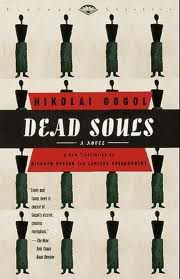
Dead Souls by Nikolai Gogol

Dead Souls by Nikolai Gogol (1842, 402 pages, translated by Richard Prevear and Larissa Volokonsky, 1998)

Dead Souls  by Nikolai Gogol (1809 to 1852, Russia) is a book I have known I should have read by now for a long time.   (It is funny, it seems the more you read, the more books there are that you should have read by now!)    I first heard of it as a young very bookish boy in Clifton Fadiman's  Life Time Reading Plan.     Dead Souls is a very high canon status novel.    Its influence is simply tremendous.    Think of all the novels about a lead figure on a journey through a mad land.     Dead Souls looks back to Don Quixote.   There is a big difference though.   In Don Quixote it is the quester who is insane,  in Dead Souls it is the world.  

As the novel opens, we are on a journey through the provinces of Russia with Chichikov.   We stop at small inns and meet people of all sorts.   I loved the descriptions of the inns and the foods and people in them.    I get the feeling Gogol loved to feast on a giant Russian sturgeon.     The rich descriptions reminded me of Dickens at his best.    Even the most minor people in the story are brought totally to life.    I was glad to see Chichikov was a lover of the reading life.

Chichikov is on an odd quest.    In Russia every year land owners are taxed on the serfs the census says they own.   Censuses are very irregular and can be years apart.   The problem is if a serf dies in 1830 and there is no new census until 1838, the landowner has to pay taxes on the "Dead Soul" all those years.   Chichikov offers to purchase dead souls from all the land owners he meets.   Everyone is very confused as to why he wants to do this.   The different reactions of land owners to this proposal are brilliantly handled.     For a long time we are kept in suspense as to why he wants them but once we find out it makes perfect sense.

Dead Souls is an unfinished book but in a way that is almost a good thing!    The unclosed nature of the book mirrors the world it depicts.    Parts of it are very funny.    The sections in the inns are simply a great wonder.     I really felt I was along for the ride through darkest Russia.     Somehow it seems a prediction of a walk through a world whose total destruction is near.     I could at times feel the vast darkness of the Russian night.

Somehow I see Dickens looking at the misery of the poor in England and creating a world of sympathy and I see Gogol looking at the poor in Russian and letting us seem them as real people.   I love Dickens but I would only say now that Dickens weeps and Gogol laughs.     One is divine tears the other laughter.   Maybe we need both.

Dead Souls is not a hard, difficult to follow book.   It really only has one central character.    I found it fun to read, not a chore to get done so I could check it off a lifetime list.    Maybe I need to read it again soon or read Nabokov's commentary, but I liked part one better than part two.   I think maybe you should read his "The Overcoat" first as a kind of Gogolian (imagine that said in the accent of old St Petersburg)  training ground.   Actually I think "The Overcoat" belongs as firmly on a canon list as Dead Souls.   


Dead Souls is kind of like a great salt lake, it is easy to swim along the top but very hard to get to the bottom!
It would make a good first Russian novel also, I think.    All the Russian masters genuflected to him.

Amateur Reader  and all, do you still regard this as the best novel written from 1800 to 1850?    In my limited reading, I can see only the two big novels of Stendhal as challengers.    If pushed to vote I would put Stendhal first most days but on days when the world seems too absurd for words I would pick Gogol.    Gogol will probably speak to more people than Stendhal.  


Mel u


Friday, April 8, 2011

The Follow my Book Blog Friday Hop

This is my first time to particpate in Follow My Book Blog Friday.    I have been noticing that at least 50 of the  500 or so book blogs I follow join this event every week so I decided why not try it myself.   It seems to be a very friendly event to help book bloggers discover each other and to help everyone build up their follower numbers.


To those new to my blog mostly I post on short stories, Asian Fiction (I am in the Philippines) and classic fiction.    I recently hosted Irish Short Story Week and I am very open to events of all sorts.   I loved reading and exchanging reading ideas.    I love to discover new to me writers.  

This week the host of the hop, Parajunkee, gives us a question-this week it is -Do you judge a book by its cover?    My answer is yes for sure I do-huge amounts are spend on book design to induce us to buy and sometimes it works on me.


I will happily return all follows-if you follow me from the hop please leave a comment to be sure I follow you back-if you just hop by leave a comment so I can return the visit.

Flannery O'Connor: Two Short Stories


"Revelation"   and "Everything That Rises Must Converge"  both by Flannery O'Connor (1955)


Flannery O'Connor (1925 to 1964, Savannah, Georgia, USA) is best known for her novel, Wise Blood and her short stories.     Connor's work and life was very rooted in the American South, in a time when racial prejudice was just beginning to be challenged.    (I have previously posted on her short story "A Good Man is Hard to Find" and there is some additional background information on O'Connor in that post).   "Revelation" and "Everything that Rises Must Converge" deal directly with the hatred and contempt that white people in Georgia had for blacks.     The stories are about two things which O'Connor weaves together:   the consequences of racial prejudices and the playing out of Catholic theology in the events in the life of characters in  the story.    O'Connor's stories unfold through conversations between the people in the stories.    With just a few words, O'Connor can  bring a character totally to life.  

To help readers relate, if like me you like the HBO TV series True Blood  then the local town characters in the series are straight out of world of O'Connor.     You need to project yourself into the USA South circa 1952 to relate to these stories.     Maybe once you go below that they are universal.    Each story does make a lot of use of horribly offense expressions to refer to African Americans.

"Everything That Rises Must Converge" (which can be read HERE) is about a woman and her adult son, in his early twenties.    I will just give a brief account of the story as I hope some will read it.    As the story begins we can see the mother and her son have had a long running argument about the mother's prejudices and her use of racial insults.   The son is  a college graduate.    The mother  worked very hard to put him through college.    The only problem is there do not seem to be a lot of jobs where they live that call for college degrees.    Under the continual acrimony between the mother and son I sensed a very strong bond and a great emotional mutual dependency.   The son is constantly abusing his mother for her racial views.   O'Connor's stories are all about guilt and something terrible does happen that will send the son into a well of guilt from which he will not escape in this life.


"Revelation".  (The story can be read HERE.)    The action of the story takes place in the waiting room of a doctor.    Keep in mind when reading the story,  that the races had their own doctors.     In this world one of the worst insults a white person can give to another is to say they act like black people.   All sort of attitudes are played out in the doctor's office and afterwards.    This story also deals with the class structure of the society.    There is an amazing action scene also.   The story also has heavy religious underpinnings.    I will leave the plot pretty much unspoiled other than to say it is a lot of crazy fun.    It is also very much involved with Catholic tenants.    The title comes from contemporary Catholic theology.

The great Irish writer, Edna O'Brien said she could relate to short stories about small towns in the American south as the ignorance and prejudices of the people in these stories reminded her of her life in small town Ireland.

These are two good stories, really quite good.    Some people may find the world in these two stories to remote from their own to relate to the people in them.   But really how difference is the hatred in these stories from a million stories played out in real life around the world every day?

I will be posting soon on four more stories by O"Connor.  

O'Connor is on most  lists of best American short story writers.   Once and while you will see her on lists of world's best.      I accept the first listing but not the second.    It maybe her stories will turn out to be  period pieces mainly.  


Mel u

Thursday, April 7, 2011

"Ghosts" by Edwidge Danticat

"Ghosts" by Edwidge Danticat (2008, 5 pages,)

Edwidge Danticat (Haiti-1969) moved to New York City at age 12 to join her parents.    From a very early age she showed an interest and talent for writing.    Upon graduation from college she taught creative writing at New York University and The University of Miami.    In 2009 she received the MacArthur Foundation Genius Award.   Her novel Breath, Eyes, Memory was a selection of Oprah's book club in 1998.    Her short stories have been published all over the world and translated into twenty five languages.

"Ghosts" is set in one of  poorest parts of Port-au-Prince, the capital of Haiti.    Haiti is one of the poorest countries in the world.   To place matters in perspective, The World Bank lists the USA as the richest country, followed by China and Japan, then European countries.    The Philippines is number 35 on the list and Haiti is number 136.    "Ghosts" gives us a look at the life and hopes of some young people in the worst part of Haiti.

The story opens with an account of a nation wide art show for children 10 to 13.   100s of children depicted in their drawings young soldiers (I guess there are no old ones) holding M16 rifles or headless bodies.

Our lead character is a young Pascal.

Pascal’s parents were shop owners and restaurateurs in Bel Air. They had a slightly larger yard than most of their crammed-in neighbors, so they had closed it off with sheets of rusty corrugated metal, and there, at four long wooden tables beneath a string of light bulbs which dangled from a second-story clostra-block window, they served up to thirty customers per night, if the turnover was fast. They sold rice and beans, of course, and fried plantains and cornmeal, but their specialty, for a long time, was fried pigeon meat.
The area where Pascal and his family live is more or less controlled by a gang of young men.   The story is about the very brave struggle of the parents to give their children a change to rise above the horrible poverty and early death or drug addiction that is the fate  of many of the young people.   We see his father rise up in status as he acquires a pick up truck.    We feel the very strong atmosphere of fear created by the domination of the gangs.  

Some positive things happen for Pascal.    The story can be read in just a few minutes and I think most readers will be glad they experienced it.    "Ghosts" is a very good story about the power of the human spirit.   It is for sure worth the few minutes it will take you to read it.  

It can be found in the archives of The New Yorker HERE


Mel u


Wednesday, April 6, 2011

"Disguised" by Issac Bashevis Singer

"Disguised" by Issac Bashevis Singer (1986-heard on The New Yorker podcast-24 minutes)


I have said several times that one of the great "side benefits"  of short stories is that they can give you an entree into the work of a new writer.   "Disguised" by Issac Singer did not just introduce a new to me writer, it opened up what seems to  be a vast new area of literature that is also largely new to me, Yiddish literature.   Yiddish (my information here comes from some quick research on Yiddish in Wikipedia)   Yiddish is a language that was developed in the middle ages in Jewish Communities along the Rhine river in Germany.   From the Rhineland it spread to central and eastern Europe.    It is a mixture of German, Hebrew, Aramaic, and Slavic languages and is written in Hebrew.   It was the language of many of the victims of the Holocaust and of Russian progroms.

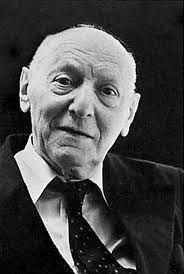
Issac Singer (1902-1901-born Poland) won the Nobel Prize in 1986 for the full body of his work.   He is best known to the public as the author of Yentil,  the basis for a very popular movie.   There is a good article on his life and work here.     Singer's, even though he left Poland in 1935 because of the rise of the Nazis, work is very rooted in the culture in which he was raised.  He became an American citizen.    Singer died and is buried in Florida.    Singer was very into the reading life.   He indicated his biggest influences as a short story writer were Anton Chekhov and Guy de Maupasssant.  

"Disguised"  was originally published in The New Yorker.     As the story is not in the public domain, I am thankful to the magazine for including it among its pod casts.  (I will include link to this at the end of the post.)   It is perfectly read by Nathan Englander.  

"Disguised" is set in Poland, circa 1925 or so.    As the story opens we are at the wedding of a young couple. It was, as was the custom, an arranged wedding and the groom was paid a dowry.    Along the way I learned some of the cultural background about weddings and marriages.     This is a very powerful almost shocking story.    All seems to be going more or less normal in the marriage and then one night the groom simply leaves.   He leaves behind almost all the dowry money.  He disappeared in the night.   He was living in the home of his bride.     Everyone is very much shocked by this.   The bride, from a comfortable very traditional family,  is quizzed by the other women in the family about the marriage.    Things are left a little vague.     It appears the bride was not given any information  about the physical relationship involved in marriage.   We are left not really knowing what the problem might be.  

Against her parents wishes the bridge goes in search of him.   She begins to be exposed to aspects of life she never knew about.    She is exposed to a world outside the very sheltered home of her parents.     She encounters the poor.    She must learn to speak up for herself.   We can feel her gaining wisdom and maturity as she travels.    Everywhere she goes she asks if anyone has seen her husband.   To make matters worse for her, she  cannot remarry unless he grants her a divorce.   She begins to fear maybe he has left Poland for America.   Then one day behind her comes the sound of her husband's voice, ordering some vegetables in the market.   When she whirls around she sees someone dressed as a woman, but with some peach fuzz on her face.   The person at first insists he is not her missing husband then he breaks down and admits that yes he is her husband.    The shocked woman demands to know why in violation of custom, he is dressed as a woman.   She wants to know for whom he is buying the vegetables.

I will not tell more of the plot.    Maybe as the end approaches you could see it coming but at the start and middle we cannot.

I highly recommend "Disguised".     There is a good before and after discussion on the pod cast.    Lovers of the short story owe a deep debt of gratitude to The New Yorker.   Singer published a lot of stories in the magazine but I think only subscribers can read them online.

As always I am looking for suggestions for short stories.

Mel u


Listen or download here


Featured Post

Imperial Reckoning: The Untold Story of Britain’s Gulag in Kenya by Caroline Elkins - 2005 - 701 Pages

  Imperial Reckoning:     The Untold Story of Britain’s Gulag in Kenya by Caroline Elkins - 2005 - 701 Pages 2006 Pulitzer Prize Winner From...