Saturday, June 10, 2017

Word Counts in The Short Stories of Katherine Mansfield- with comparisons to contemporaries


An Article I Contributed to  The Journal of The Katherine Mansfield Society, republished here with their permission, April 2013, Issue 14. - with new introduction by myself

Having recently read Gerri Kimber's wonderful new book, Katherine Mansfield The Early Years I was motivated to look at a word count spreadsheet on the short stories of Mansfield i dida few years ago.  Kimber let me see a young woman never really at home where she was born, Wellington New Zealsnd.  Her mother was a bit emotionally remote and her father did not accept her idea of being a professional writer, both were agast at her open bisexuality.  Neither really could truly relate to her.  From 1903 to 1906 she attended college in London.  She returned to Wellington in 1906 but London called her back.  In 1908 she moved back to London, never to return in London.  In London, and in her Continental travels, she was basically rootless, moving often, changing lovers, marrying
dubiously and never having a permanent home.  In London she began in her fiction to write stories inspired by her childhood, drawing on the beauty of New Zealand.  To me Kimber showed me a woman who had no real sense of home.  In her longed for new home in London she struggled to survive, provided with a begrudged small allowance by her father, entered in a one day marriage before eventually marrying John Middleton Murry.  She sought out "guru like men" and increasingly was frought with health issues.  She seemingly had few close women friends, besides a strange relationship with Ida Baker who was totally in love with KM.  KM exploited her and used her as a servant.

To me this craving for a home is strongly brought out in my word counts.  The results were more striking that I expected.


My Post on Katherine Mansfield The Early Years by Gerri Kimber- contains links to important Mansfield related webpages


Introductory Note in Orginal Article

KM chose her words very carefully, once insisting that she check the proofs of ‘The Man Without a Temperament’ for before its publication in Art & Letters: ‘Every word matters. This is not conceit—but it must be so. ... I cant afford mistakes. Another word wont do. I chose every single word’ (To JMM February 2nd 1920, Letters: III, 204). Words certainly matter in KM’s writing, as is amply suggested by the preliminary research undertaken by Mel u (editor of the blog rereadinglives.blogspot.com) detailed below. Mel has begun to examine the frequency with which certain words recur across a selection of short story collections, including KM’s collected stories, and we’re sure you’ll agree that it has raised some fascinating questions! - introductory note by The Editor of The Journal of the Katherine Mansfield Society, Gerri Kimber


I am the editor and founder of The Reading Life, a literary book blog I began four years ago. About three years ago I read my first Katherine Mansfield short story when it was selected as a story of the day on a webpage I follow. It was ‘Miss Brill’. At that time I had never heard of Katherine Mansfield. I went on to post all of the short stories by Mansfield I could find online. I began to get hits on my blog from all over the world reading my posts. I went on to post on Kathleen Jones’ biography of Mansfield and Linda Lappin’s novel based on her last years.


For those interested my blog gets about 100,000 hits a month. I will begin tracking where readers of my Mansfield posts live. I often see a sudden jump in readerships in a cer- tain area and I know a university there is teaching her work. Because I watch my blog stats very closely, I know that Mansfield is read in a much wider venue than most people might think, far beyond the traditional English language high-end literary world. I am going to try to track her readership. My assumption is almost anyone seriously interested in a Mansfield short story, certainly most students, will google the story and they will often be lead to my blog.



Thursday, June 8, 2017

Katherine Mansfield The Early Years by Gerri Kimber (2016, Edinburgh University Press


The Katherine Mansfield Society - Your First Resource

Edinburgh University Press

Website of Linda Lappin- author of Katherine's Wish, a wonderful historical novel based on last years of Mansfield

Homepage of Kathleen Jones - author of The Story Teller A Biography of Katherine Mansfield- highly recommended

The Reading Life Guide to Getting Started in Katherine Mansfield


Born - Wellington, New Zealand, October 14, 1888

Died -  Fontainebleau, France January 9, 1923 (of Tuberculosis)


1903 - sent by wealthy parents to attend school in London1903 to 1906 -  travels Europe, especially Germany

1906 - returns to New Zealand

1908 - returns to London, never to go back to New Zealand, begins trying to live as a professional writer, partially supported by her father, chairman of the Bank of New Zealand who disapproved of her profession and life style

1911 -  first collection of short stories published, In a German Pension

1911 - meets John Middleton Murry whom she will marry in 1918

1915 - her beloved brother is killed in a training accident in France while serving in the  New Zealand Army.  Mansfield begins  to write of her childhood in New Zealand


I was deeply moved when I learned that Katherine Mansfield's Note book was the last work Irene Nemirovsky read before she was transported to Auschwitz


When I first began The Reading Life almost eight years ago, I had never heard of
Katherine Mansfield.  I had the common place prejudice against short stories, thinking I needed something I could "sink my teeth into".  Over a long year period of continuous reading, I might have read ten short stories.   In a short story of the day webpage I followed, "Miss Brill" was recommended.  I ended up reading all of the short stories in her four collections, two books about her and even ended up doing an article for The Journal of the Katherine Mansfield Society.  Every day people from all over the world log onto my blog to read my posts.

Some readers say they are not interested in learning about the lives of authors, only about their stories.  To me this is deeply misguided, why read a writer with any real effort unless you think they can add to your understanding of life? .


Why would you not want to know the well springs of  their creativity?  This is not an endorsement of biographical interpretation, nor do I reject it, as perhaps long ago I did.  Literature belongs to each reader.

Katherine Mansfield The Early Years covers her life from her birth in 1888, detailing her family history in New Zealand, up to 1908, when she left New Zealand for the second time, never to return.  Kimber lets us see how the early life experiences of Mansfield shaped her fiction.  We learn a lot about life in Wellington during the last years of the 19th century up to 1908.  The poor and the rich lived in close proximity.  There were not enough people affluent enough to send their children to private school so Katherine and her siblings mingled with children from all classes. We see a treatment of the poor kids in what many consider her best story, "The Doll House".  Kimber lets us see New Zealand was very much a country of emigrants, even the
Richest residents grandparents left England seeking better circumstances.  Kimber lets us see his this produced a more open society than England.


 Kimber goes into detail about Mansfield's early romantic and sexual involvements, with men and women.  It was fascinating to learn of her affair with a rich beautiful Maori princess.  One of her uncles was married to a Maori woman.  Learning of the relative comfortable intimacy with the Maori helped me understand the story, "The Kidnapping of Pearl Button".

Mansfield was a lonely child, not really fitting the pattern her parents wanted, graduate from school and marry a nice young man from upper crust Wellington society, have kids and run a house.  Part of Mansfield's problem was that she was simply too smart, too curious, overly rebellious to settle into such a role.

In 1903 her father sent her to live in London while going to Queen's college.  London was at first a great cultural shock.  She met lots of literary and artistic people, had some more romances.  She tried her hand at writing stories and became enamored with becoming a professional writer.


After three years in 1906 she returns to Wellington.  She realized right away she did not want to spend the rest of her life there, bohemian London called out.  Her parents tried to fix her up with nice young men but this never worked out.  Kimber ends her wonderful narrative in 1908 when Mansfield returns to London.  The rest is the stuff of legends.

Kimber has studied the work of Mansfield for many years.  I greatly enjoyed her tying in of various stories to events in Mansfield's life.  We see her early closeness with her brother Harold.

There are many images of the natural world in her stories.  In the backstreet rooming houses and hotels in which she lived in London and Europe these must have been very fond memories.  There is a great deal of spectatorship, train and ship trips.

Katherine Mansfield The Early Years is a marvelous example of a literary biography.  Kimber had access to conversations with survivors, previously unused in biographies correspondence as well as fragments of stories not included in her four official collections.  There are a good number of previously unpublished photos that alone will make this a must have for Mansfield lovers.


Mansfield was one of the founders of the modern short story, the story of her early years tells how she came to write her very influential stories.

I highly recommend this book to all interested not just in Mansfield, who really must read this book, but in the development of the modern short story.  To those who have an overview of Mansfield's remaining years, this book will help you understand her life path, her involvement with John Middleton Murry (I would love to read an account by Kimber of this relationship) and her strength to struggle with her health and financial difficulties.

The prose is elegant, the documentation impeccable without being overly academic

Gerri Kimber, Visiting Professor in the Department of English at the University of Northampton, is co-editor of the annual yearbook Katherine Mansfield Studies, and Chair of the Katherine Mansfield Society. She is the deviser and Series Editor of the four-volume Edinburgh Edition of the Collected Works of Katherine Mansfield (2016) and the author of Katherine Mansfield: The View from France, and A Literary Modernist: Katherine Mansfield and the Art of the Short Story. - from Edinburgh University Press


Mel u


.


Tuesday, June 6, 2017

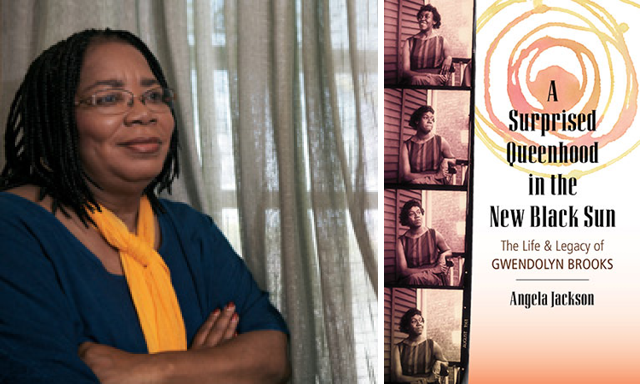
A Surprise Queenhood in the New Black Sun- The Life and Legacy of Gwendolyn Brooks by Angela Jackson (2017)


Gwendolyn Brooks - Born Topeka, Kansas 1917, died Chicago 2000

1950- became first African American to win a Pulitzer Prize

1968 to 2000- Poet Laureate of the state of Illinois

1985 to 1986 Poet Laureate Consultant to The Library of Congress

A Surprised Queenhood in the New Black Son- The Life and Legacy of Gwendolyn Brooks by Angela Jackson is a captivating biography of one of the most famous literary chroniclers of the experiences of African Americans.  Most of her poems and fiction is set in Chicago, where she grew up in a loving and culturally nourishing home.  Her father, into the reading life as was his daughter, gave up his dreams of medical school to work as a janitor to support his family.  Her mother, portrayed as not overtly highly affectionate by Jackson, strongly encouraged Brooks to become a poet, writing of the experiences of African Americans in inner city Chicago.

Jackson tells us how the Outbreak of World War II, America joined in 1939, opened up lots of jobs in Chicago for African Americans.  Thousands came up from the south to take these jobs, hoping to build better lives.  They faced then not illegal discrimination in housing, they could only live in certain parts of Chicago, and jobs and were often made to carry within a sense of inferiority.  Brooks brilliance shown through early in her life, she may have been personally sheltered but she observed the lives of the neighbors in the building her family lived in for a long time while she was growing up.  She saw the problems of women, struggling to feed their children, often working as maids themselves while trying to cope with their often less than reliable husbands.

Jackson shows us the literary career path of Brooks, starting out writing for newspapers aimed only at African Americans, going on to have her work published by major houses to winning many awards, winning the Pulitzer Prize, which completely changed her life.  Brooks became a highly sought speaker, a mentor to many young writers, sponsoring awards with her own money.  She also became an English and Poetry teacher in a Chicago college.

Through it all she was a dedicated mother to her two children.  Her marriage was sometimes strained by the stress of financial problems before she became famous and this caused a separation for a year but over all she had a good marriage to a Man himself a first rate Poet who worked at a variety of jobs to support the family.

Jackson's depiction of the  trip of Brooks and her husband to African was very interesting.  She went to Ghana and Kenya, as the guest of the government.  Brooks was a bit surprised when the residents of these countries saw her not as a returning African but just as an American.  She made an emotionally disturbing visit to places that were used as debarkation stations for slaves bound for America.

Jackson elegantly presents Brooks as a great artist, a person with wonderful values, loved and highly respected by all.  One could only call her a genuinely good and decent person.


Jackson explicates her major works and quotes generously from her work. Jackson shows how the poetry and prose, she wrote some experimental novels also, arose from and rose above the early life experience of Brooks.


The book could easily be read by young adults.  Brooks is a frequently taught poet in America.

A lot of her work can be found online so I Hope she would not mind if I Shared the poem below with my readers.


"To Those Of My Sisters
Who Kept Their Naturals"
-- never to look a hot comb in the teeth
by Gwendolyn Brooks

Sisters!

I love you.
Because you love you.
Because you are erect.
Because you are also bent.
In season, stern, kind.
Crisp, soft-in season.
And you withhold.
And you extend.
And you Step out.
And you go back.
And you extend again.
Your eyes, loud-soft, with crying and with smiles,
are older than a million years,
And they are young.
You reach, in season.
And All
below the rich rouch right time of your hair.
You have not bought Blondine.
You have not hailed the hot-comb recently.
You never worshipped Marilyn Monroe.
You say: Farrah's hair is hers.
You have not wanted to be white.
Nor have you testified to adoration of that state
with the advertisement of imitation
(never successful because the hot-comb is laughing too.)
But oh the rough dark Other music!
the Real,
the Right.
The natural Respect of Self and Seal!
Sisters!
Your hair is Celebration in the world!  - end

In the interest of full disclosure I was kindly given a copy of this book for review purposes.

School libraries should include this book.  Teachers will find material students to which their students can relate.  Literary Biography lovers will be very glad they read this work.

Mel u


Monday, June 5, 2017

"Life Will Be Better" - a very perceptive short story by Farah Ahamed (2015)


"Life Will Be Better" by Farah Ahamed

A Very Interesting Interview with Farah Ahamed

"Dr Patel" by Farah Ahamed

"Thin Air" - a poem by Farah Ahamed occasied by the kidnapping of Nigerian School Girls by Boko Haram


Five Hundred Years Ago London was home to the world's greatest writers, in the 19th century to writers who will live on as long as people read, the daily bombing for years in World War Two only strengthened the spirit of Londoners, Virginia Woolf and an immigrant, Katherine Mansfield opened up new ways of writing still shaping literature.  Five hundred years from now London will still be the city of the world's greatest writers.  I dedicate this post to the people of London

"Life Will Be Better" is the second short story by Farah Ahamed I have had the pleasure of reading.  As the story opens a husband and wife are stuck in the heavy traffic of Nairobi.  The air is heavy with exhaust fumes and street hawkers push knockoff dark glasses, flags of Kenya and pictures of the president aggressively on them.  The husband gives one money for a cold drink and the wife buys a pair of dark glasses.  The husband is reading the newspaper as she drives.  She asks him "what is the
news?" He tells her women activists are upset over proposed changes in the new marriage bill just voted into law.  The wife worries that if her husband divorces her, evidently made easier by new laws, she will be responsible to pay the car note and house mortgage.   In just a few lines Ahamed lets us see things were once better between the couple.


A policemen has stopped a black Toyota.  They see the officer take the driver's
 license and then get in the passenger side of the car.  The woman asks the woman in the car if she needs help.  She says the policeman wants a tip for Christmas shopping.  Her husband tells her to drive on, don't get involved.

They arrive at their destination, a trendy boutique built to resemble an African hut.  They are there to buy a dress for the wife for a special occasion.  Ahamed lets us see the man is there to decide what dress his wife will wear as his accessory at the big event.  She tries on a little black dress (as I said in a post long ago the influence of Coco Chanel knows no boundaries) which makes the husbanwhistle but he says the dress is not what he wants her to wear, "not right for us".  As she is looking at other dresses, the woman in the black Toyota and her husband enter the boutique.  The wife says "Nairobi is a small world".  Back in the dressing room she peeks out and sees her husband admiring the woman in the little black dress he said she could not have.  (It takes either a brave, maybe no too bright married man or one who just no longer cares to admire another woman in front of his wife.)

I will leave the very interesting and unexpected close untold.  I will say the other woman ends up


leaving with the dress the wife wanted.

I found of interest that in  the wife was the driver.  In both cases the husband has to give his approval for the dress and give his wife money for it.  The wife is as steamed as tropical heavily polluted Nairobi at noon as she leaves the store with the dress she did not want.

In just a few pages Ahamed gives us a look at the life of an at least upper middle class  woman, she does not seem mistreated but she is frustrated by a life and society that makes her opinions of secondary importance.  You feel like you are there in the car, inside the high end boutique and you wonder what will happen when she gets dressed for the big occasion in the dress her husband imposed on her.  My guess is it will be a revenge by silence night.

"Life Will Be Better" first appeared on DNA/Out of Print-Daily News and Analysis, a very interesting Mumbai based webpage, November 22, 2015.  You can read it on the link above.  I greatly enjoyed this story, which I read four times, to all lovers of the form.


Like "Dr. Patel" it is partially about the traps we fall into trying to impress others.  Ahamed is very skilled at developing character, opening up the people in her stories.

Farah Ahamed is a short fiction writer. Her stories have been published in The Massachusetts Review, Thresholds, Kwani?, The Missing Slate and Out of Print among others. She has been nominated for The Caine and The Pushcart prizes and shortlisted for the SI Leeds Literary Prize, DNA/Out of Print Award, Sunderland Waterstones Award, Asian Writer Award. She was highly commended in the London Short Story Award and joint winner of the inaugural Gerald Kraak Award.


Sunday, June 4, 2017

On Beauty- A Novel by Zadie Smith (2005, 432 pages

Five hundred years ago London was the home of the greatest writer in the world, 500 years from today it still will be.  I dedicate this post to the people of London


A Very Good Review in The Guardian by James Landun

Zadie Smith on The Reading Life


Last month I read Zadie Smith's latest novel Swing Time.  I loved it and decided i wanted to read all five of her novels (I have also read and posted upon several of her wonderful short stories).  I was delighted when I received notice that the Kindle edition of her third novel, On Beauty, was for sale for $1.95.

The Guardian has a very good review of On Beauty (link above) so I will keep my remarks brief.  Bottom line, I'm now aiming at reading her three remaining novels in 2017.  That said, Swing Time is the superior work as Smith gets better at her art. (I am looking forward to the movie based on it.)

On Beauty is set in Massachusetts.  It centers on the Belsep family.  The husband is a professor of art history, his wife was a hospital administrator. He is white, she an African American.  There have two sons, one is a devout Christian, the other an aspiring rapper.  Smith skillfully lets us see the struggles of the sons to stay in touch with their maternal heritage.  It is also a very acute at times hilarious satire of university politics.  The plot, as pointed out in the Guardian review, is loosely structured based on the plot of Howard's End by E. F. Forster.

The depiction of the relationship between the couple, married for thirty years, is really masterful.  The husband has had an affair which infuriated the wife, perhaps more so as the other woman was white.  The passion in their relationship moved me.

I greatly enjoyed this book.

Please share your experience with Zadie Smith with us.


Friday, June 2, 2017

"Dr. Patel" - a wonderful short story by Farah Ahamed (2015)


A Very Interesting Interview with Farah Ahamed

"Dr. Patel" by Farah Ahamed 

Farah Ahamed Joint Winner  of the Inaugral Gerald Kraak Award


"He parked in the empty car park and decided to wait until he saw other people enter the apartment block. He usually made a point of seeing his mistress at a time when everyone was coming home from work. He’d alight from his car holding his phone to his ear, and lean against the door with a pre-occupied air. Initially, the neighbours used to nudge each other and snigger. This gave him much pleasure, while he remained intent on his phone conversation. Now they no longer reacted, but this did not bother him. His reputation as a virile lover had been established."


One of the greatest pleasures of book blogging for eight years has been posting on the work of writers just beginning their literary efforts, seeing them develop their talent and receive recognition.  During June I hope to post upon six wonderful, highly perceptive, elegant short stories by Farah Ahamed.  All of the stories but one can be read online.  As I go on in my posts and hopefully increase the depth of my understanding of her work, I will try to talk a bit about why I admire her work so much and what  I think she may have to tell us.  In my first of these posts, on her "Dr. Patel" I see a masterful depiction of a man completely mired in a deep miasma of self-deception, unable to see how he appears to others, desperately seeking admiration. I will try to show how Ahamed creates a very real man in a well developed social environment in just a few pages.

We meet Dr. Patel on the way to a wedding reception of young man from one of the wealthiest families in Niarobi. I will catalogue his deceptions, of self and others.  Firstly he is not a doctor, either medical or academic.  It is just a title he sort of gave himself and thinks others call him that out of respect.  After twenty years working for Amber Investments he has become Human Resources director.  As anyone who has ever worked in the corporate world knows, this is a job normally reserved for time serving lackeys (W. B. Yeats would call him an errand boy).  Dr Patel is wearing his club tie, with the crest of an elite organization of which he is not a member.


 Many of those at the party have inherited their wealth, Dr. Patel tells himself he did not inherit his position.  At the reception he sits at a table near the family, hoping others will take this as meaning he is a close family friend.  He got the groom a job at Amber Investments at the request of the father of the groom and was short sighted enough to request an "administrative fee" for this, thus reducing himself to a petty dishonest minion where honesty might have made him a true family friend.


In a very acute and funny scene, a couple as Dr. Patel if they can join him at the table.  He tries to impress them by saying it is for family only, the couple exchanges a look that Patel misses that says "who is he kidding".  He makes a big show in front of them of putting money in an envelope along with his business card, which he gives to everyone, it seems.  He asks the woman what is the bride's name, I laughed out loud when she told him and he believed it that her name was "Bindi", a bindi is a cosmetic mark in the center of the forehand, any body with any real culture would know this and the fact that the woman feels secure telling Patel this shows the depth of her contempt for him.

When people at the party he has previously met don't recall him, he attributes it to their weak memories, is there end to his self-blindness?

Dr Patel is a huge man, when he orders just a small salad from the waiter The couple exchange looks like who is he kidding.  They ask him if he has come alone, he says his wife did not come and he thinks how in twenty years she is still not comfortable in high society.

Dr Patel leaves the party, heading for the apartment of his mistress, an employee of Amber Capital.  He wants people to see he has a mistress as a proof of his virility and affluence.  The scene between him and the woman are just masterful.  She comes to the door in a negligee, obvious to all but the oblivious Patel that she is expecting someone else.  We learn all he ever does in her apartment is watch TV news.

I have told a lot about this story but first readers will still delight in the skill of this story.  The close of the story in which Patel has no idea who the young man who emerged from the elevator in front of her apartment reminded me of the moment in Madame Bovary where Bovary sees a man climbing

over the fence of his house, on his way out as he unexpectedly returns home and thinks, "oh, now I know who has been stealing apples from my trees".


Ahamed has brilliantly presented a man completely oblivious to the reality of his life, a shallow fool out of touch with his true nature.  She also presents a sharp picture of social class distinctions

This story first appeared in the Out of Print Magazine, September, 2015


Farah Ahamed is a Kenyan lawyer with a Creative Writing Diploma from the University of East Anglia. She currently lives in the UK. Her short stories have been published by Kwani?, Bridge House, Fey Publishing, New Lit Salon Press and The Missing Slate. In 2014 Zoloft for Everyonereceived a commendation at the Winchester Writer’s Festival, and 1972, was nominated for the Caine Prize for African writing. In the same year, she was shortlisted for the SI Leeds Literary Prize for a collection of short stories. Red is for Later was nominated for the 2015 Caine Prize for African writing and the 2016 Pushcart Prize.


Thursday, June 1, 2017

The Reading Life Review - May, 2016


Blog Stats for May, 2017

There are now 3063 posts online

Since inception The Reading Life has received 4,629,515 page views

The five most viewed posts in May were

"The Assignment" by Saadat Hasan- almost all from India and Pakistan

Pigeon Pie by Nancy Mitford -

"The Blind Dog" by R. K. Narayan - almost all from India

Completed by two classic short stories by authors from the Philippines

Russian Bots.   Why.???

About every two months for a three day period I receive thousands of hits from all over Russia, all under a second on different posts on the blog.  The hits last maybe three days then stop.  During a three day period I got 17,187 such hits.  There is no spam left.  Have other bloggers experienced this level of bot hits?  What are they looking for?

Top home countries of visitors (not from bots)

USA, the Philippines, India, UK, and Germany.  Top USA state is California.  Most common home city is the greater Manila area with London and Los Angeles next.

Novels Read

The Golden House by Salman Rushdie.  a reaction to horror of The trumping of America .  As good as his best

Flood of Fire by Amitav Ghosh. Part three of The Ibis Trilogy, first rate historical fiction

Ways to Disappear by Idra Novey. 2016 Jewish Book of the Year

Smile by Roddy Doyle.  A delight for his legion of fans

Ghana Must Go by Taiye Selasi.  Beautiful work

The Master by Colm Toibin, second reading.  Henry James in London

I almost never do negative posts on novels basically because I don't go far in books I don't like.  Life is to short to read bad books just so you can trash them.

Leonora Carrington

I continued my reading of the work of Leonora Carrington with her acclaimed memoir Down Below and two short stories

Short Stories

Prompted by the sad news of the Passing of Denis Johnson, I read his collection of linked short stories, Jesus's Son.  Great Beyond by ability to speak upon.  Tales of Desolation Row

"Senor Pinedo" by Mavis Gallant.  Part of my participation in the read through hosted by Buried in Print.

I also was very happy to discover two new to me very talented writers of speculative short fiction, Isabel Yap and Allysa Wong, both with strong ties to the Philippines.

Works I read in May but refrained from posting upon

I read only one book I did not post about, The Politics of Opera A History from Monteverdi to Mozart by Mitchell Cohen.  Superbly learned book.  Opera plays a big role in Proust and other European writers, mostly French.  Serious literary and musical autodidacts will love this book. Very learned

I also did not post on a short story by Yiyun Li, "A Small Flame", you can read it for free on The New Yorker

I offer my great thanks to those who take the time and trouble to leave a comment.

To my fellow book bloggers, the greatest readers in the world, don't stop blogging because you feel the forces of ignorance are in an ascending mode.

Mel u
The Reading Life


Featured Post

Imperial Reckoning: The Untold Story of Britain’s Gulag in Kenya by Caroline Elkins - 2005 - 701 Pages

  Imperial Reckoning:     The Untold Story of Britain’s Gulag in Kenya by Caroline Elkins - 2005 - 701 Pages 2006 Pulitzer Prize Winner From...