Saturday, February 10, 2018

“Kola Street” - A Short Story by Sholem Asch - 1948?-translated from Yiddish


Very Comprehensive Bio on Sholem Asch from the Yivo Encyclopaedia of Eastern European Jews


“Sholem Asch discovered new human resources among the east European Jews, his story “Kola Road” becoming famous as a celebration of the proste, the common folk, and the grobe yungn, the vulgar ignoramuses.* -  Irving Howe, from World of Our Fathers:The Journey of Eastern European Jews to America and the World They Made and Found 

“Kola Street” is an unflinching look at the violence and social conflicts within Jewish society in Warsaw in the days between the world wars.  The story begins with an account of the Kola Street Jews, the roughest elements of Jewish society and their relationship to upper class Jews.  The narrator tells us that the rich may scorn the common people of Kola Street but whenever gentile thugs come to attack them they call for the help of Kola Street residents.  When -ever funds are needed to support scholarships for the study of the Torah, the rich ask Kola Street for help.  After a very interesting prelude in which Asch gives a wonderful description of the various aspects of the community, he begins a marvellously lively story about a horrible fight between two Kola Street clans over pigeons. We see the at times violent households in which masters beat their servants and petty quarrels turn into deadly street warfare.

Sholem Asch was Born in Poland in 1880, in 1914 he moved to New York City.  A financially fortuitous marriage left him able to devote full time to writing.  He was very prolific in numerous genres.  Please see the link above for more details.

The run time of this podcast is 43 Minutes. It read by Ron Lieberman, introduced by Leonard Nimoy and was translated by Norman Gueterman.

I hope to post upon his famous novella, The Jewish Soldier this year.


Friday, February 9, 2018

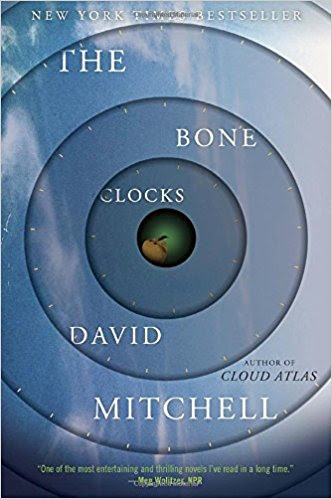
The Bone Clocks by David Mitchell - 2014


The Bone Clocks is the first work by David Mitchell I have had the great pleasure of reading. For sure I hope it will not be the last.  It is a super creative amazing set of six interrelated narratives all connected by Holly Sikes and two duelling sets of immortals.  We first meet Holly when, age 15, she runs away from home to get away from her domineering mother.  Holly hears voices sometimes. The year is 1984.She has a 25 year old boyfriend and her plan is to move in with him.  Upon arrival at his house, she finds him in bed with her best friend.  She takes off for parts unknown. She encounters a strange old woman who asks her for asylum.  Holly takes her for mad but she is an immoral.  Her younger brother disappeared from home right after she left.  This disappearance has a key part in the narrative. 

There are five more narrative lines, one set in Cambridge in 1991.  The third section is about the trials and tribulations of a one time literary superstar now struggling with debt and writer’s block.  The fourth section is about a war correspondent. The fifth section is a really fun pure fantasy world narrative about the two battling groups of immortals. Both use humans, the Bone Clocks, to live on.  One is reborn over and over and the outer drains souls.  The final section is set in Ireland in 2043.  Holly Sikes, who became a famous writer, is trying to survive in a dystopian world brought on by climate change and political upheavals.

There are nit picking reviews online.  Ok I concede it is not perfect but it was a lot of fun, the fantasy element was intriguing, the people real, and there are lots of exquisite sentences and concepts.  All the narratives are tied together and it was exciting to see what develops.

David Mitchell is the award-winning and bestselling author of The Thousand Autumns of Jacob de Zoet, Black Swan Green, Cloud Atlas, Number9Dream, Ghostwritten and The Bone Clocks. Twice shortlisted for the Man Booker Prize, Mitchell was named one of the 100 most influential people in the world by TIME magazine in 2007. With KA Yoshida, Mitchell co-translated from the Japanese the international bestselling memoir, The Reason I Jump. He lives in Ireland with his wife and two children... from Davidmitchellbooks.com

I hope  to read Cloud Atlas this year.  

Mel u


Thursday, February 8, 2018

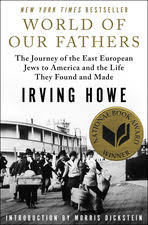
World of Our Fathers:The Journey of Eastern European Jews to America and the World They Made by Irving Howe - 1976


World of Our Fathers:The Journey of Eastern European Jews to America and the World They Made by Irving Howe is a very valuable, highly interesting book. It is a social, cultural, and economic history of the migration of two million     Eastern European Jews to America.  All arrived at Ellis Island in New York.  More than half the immigrants settled in New York City.  In 1880 there was an estimated 60,000 Jews in the city, by 1914, there was about 1.1 Million. World War One and the Russian Revolution ended this wave of immigration.

The massive immigration began in 1880 when the liberal Czar Alexander II was assassinated. Shortly after this the government allowed
Anti-Jewish pograms all over Russia.  This sparked a desire to move to what was seen as a near promised land, America.  Most arrived with little more than a few rubles and the clothes on their backs.  All spoke Yiddish and most also spoke Russian.

Howe begins his narrative with a description of life in an Eastern European Shetl.   We see the terrible oppression, the lack of opportunity, the violence directed against Jews.  Unlike some immigrant groups, the Jews came largely as families. We see how hard it was to pay for their passage.  We are given a very vivid account of  arrival in New York City, from the much feared medical screenings at Ellis Islands to the dishonest agents waiting to fleece them. We see families settling into crowded tenement apartments in poverty stricken areas.  The men at once went to work,often in the garment industry working at least 12 hours a day for very low wages.   Women and children often worked in factories.  Howe goes into a lot of detail on the labor conditions.  I was moved when he told how most factory workers brought books to read on their breaks.

Quickly it is realised one must know some English to get anywhere in America.  Education for the young is a top priority.  

There is really a lot covered in this book, everything from diet changes, child rearing, like everywhere the young learn English much faster.  Howe tells us about the thriving Yiddish Press and writes very illuminatingly on Yiddish Literature in America.  He covers novelists, poets and the very important Yiddish theatre.  We learn how Yiddish heritage performers highly impacted American movies and the start of television.  We see the children and grandchildren of garment workers become lawyers, doctors, famous intellectual theorists and move way out of the tenements. They were normally very liberal in their politics and Howe shows us the impact of Yiddish activism on Labor Laws.

This is a very rich information loaded book.  Anyone interested not just in Jewish history in America but in American history will love this book.

Howe tells us Yiddish began to become a Language with fewer and fewer speakers. We learn how the immigrants reacted after WW II when they learned of the Holocaust and the devotion to Israel.

If a merit test had been put on the two million Yiddish speaking immigrants nearly none would have been admitted.  American would be a much poorer place if this had happened. 

“Howe was an emblematic New York Jewish intellectual, a man of modest origins who rose to pre-eminence in the serious study of ideas, literature and politics. He was known for many things, including a large, steady output of essays on culture and literature, the advocacy of democratic socialism and chronicling the Jewish experience in America. National Book Award Winner
Perhaps his most famous and widely read book was "World of Our Fathers," a history of Eastern European immigration to the United States that won the National Book Award in 1976.
Dissent, the magazine he founded and edited for nearly four decades, was for most of that time a leading journal of a certain kind of American politics. It was deeply critical of the abuses of capitalism and what its writers sometimes saw as the paranoia of this country, but it was even more repelled by leftist totalitarianism, in the Soviet Union, Cuba or elsewhere.” from the New York Times Obituary 

1920 to 1993

Mel u


Sunday, February 4, 2018

“Platonic Love” - A Short Story by Yenta Serdatsky (1948) - translated from Yiddish by Jessica Kirzane


Last month I posted upon two very moving translated from Yiddish short stories, both centred on an isolated lonely Eastern European woman  immigrant now living in a  America.  After reading these two stories by Yente
Serdatsky I was delighted to find her story “Platonic Love”, wonderfully translated by Jessica Kirzane posted online (at the link above).  

“Rosh Hashanah” is about a very lonely socially isolated Jewish immigrant woman who on the culturally very important holiday Rosh Hashanah, feels an almost overwhelming sense of longing for the old days back home, surrounded by family.  She knows she hurt her mother badly when she abandoned her faith in God.  Her American friend, a woman she works with, takes her out on the town to raise her spirits.

“Two Heads”, I like this reading life story so much I placed a quote from it in my side bar, is about a young immigrant woman living in a big city rooming house.  Her only joy in her life is in Reading.  The long empty next door apartment has just become occupied.  She cannot help but wish it is a man who loves books as much as she does.  The ending is really powerful.

“Platonic Love”  centers on a lonely Russian woman, now living in America (I think the reader may assume these stories are set in New York City.). She is highly cultured and lived with her aunt.  She is separated from her husband, back home. She works in a bookstore.  She gets off work at noon on Saturday but she has gotten into a habit of meeting an American married man for intellectual conversation at a cafe.  This has now been going on for years.

You can read this story in just a few minutes so I will just provide a brief sample of the story:


“The other patrons of the café knew that there was “nothing” going on between the two of them, and this made them all the more curious to know what the unseen bridge was that linked these two lives, these two souls, for a few hours every week.

She was a wealthy young woman, born in Russia. In her home country she had gone to school, and after she graduated she went on to study in Switzerland. There she learned philosophy and all kinds of other academic pursuits, but no trade or profession.

While she was learning she had been very happy. She had made many friends among the students, and clambered over the tall Swiss mountains with a large shawl wrapped around her arms. For a little while she learned how to ride a horse and a bicycle.

Her beauty and athleticism made her very popular and many of the young students were in love with her. She had loved one of them in return and they were married. She had his child, who died after a year. A while later she split up from him and they went their separate ways.”

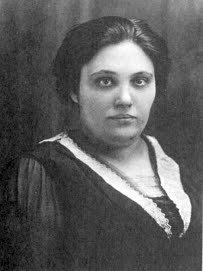
Yente Serdatsky (the author), neé Raybman (1877-1962) was born in Aleksat, near Kovne (Kaunas), Lithuania. Her first story, “Mirl,” appeared in the Warsaw periodical Der Veg in 1905. Serdatsky immigrated to America in 1907, initially living in Chicago and then New York, where she published stories, one-act plays, and sketches in many Yiddish periodicals across the political spectrum. She served on the staff of the Forverts, and her writing appeared regularly in its pages until 1922. Serdatsky’s selected writings were published in book form in 1913. After a 27-year hiatus, Serdatsky’s work appeared in the Nyu Yorker Vokhnblat from 1949 until 1955. Her fiction and dramatic works often focus on the loneliness experienced by radical intellectual women and are notable examples of feminism in Yiddish fiction.

Jessica Kirzane (the translator) is a PhD Candidate in Yiddish Studies at Columbia University. She holds a BA in English Literature and Jewish Studies from the University of Virginia (2008) and an MA in Yiddish Studies from Columbia University (2011). Her scholarly interests include the representation of marriage in American Jewish fiction and the concept of race in Yiddish fiction. Her translations have appeared in Pakn Treger and The Trinity Journal of Literary Translation.

There is a deep loneliness in these stories, informed by the knowledge you will probably never see your loved ones back home again.  


I offer my great thanks to Jessica Kirzane for this sensitive and elegant translation.  I hope to read more of her work going forward.

Mel u


Saturday, February 3, 2018

The Name of Death by Klester Cavalcanti -nonfiction- 2006- Translation forthcoming 2018


The Name of Death by Klester Cavalcanti tells the life story of Julio Santana, the world’s most prolific professional killer, with 457 kills.  Santana  grew up in a very poor village on the banks of the Amazon, in Brazil.  His famiy had no electricity and much of their food was caught in the river or killed by Santana using his expertise with a rifle.  He lives with and is very close to his parents and younger brothers.  One day his uncle tells him he needs to employ Santana to kill someone.  Santana does not really want to do this but the uncle talks him into it.  In just a few minutes he can earn six times the wage of most workers in his area for a month. After this Santana, a devout Catholic, tells himself he does not want to kill anyone else.  But soon he is helping the army track and capture communists.  He is revolted by the torture used by the army and national police. The uncle begins to tell him he can become rich as a professional killer.  Several of the killings are depicted very vividly.  He prefers to shoot his victims in the head up-close with a 38.  

Many of the killings are over land disputes, some are personal issues being solved, some are political. He becomes quite a well known killer.  After every killing he says ten Hail Marys, his uncle told him God will forgive him. In a very well done sex scene, he loses his virginity, as does his fourteen year old girl friend, not an improper relationship in rural Amazonia. He later marries another woman and stays faithful to her. They have a very solid relationship.  The only issue is the wife hates what he does for a living.


He keeps a journal of his hits, 457 in all.  The journal Includes the name of the victim, who hired him and why they wanted the killing and how much he was paid.  He killed 47 women.  He did have some rules he learned from his uncle.
He does not rob his victims bodies, after all he is not a thief.  He does not kill someone while the sleep, as that would be cowardly.  He does not kill pregnant women.

I learned a lot about life in the poor villages where Santana grew up.  

Perhaps the most powerful aspect of this story is that Santana seems like a decent person.  He takes no pleasure in the killings.  

The translation was done by Nicholas Caistor

This is an exciting book.  It rings true for me. I have visited an Amazonian river village and spent some  time in Rio de Janeiro and this made the book all the better for me.


Klester Cavalcanti is one of the best investigative reporters in Brazil and has worked in the country’s largest vehicles, such as Veja, Estadão, and IstoÉ. Born in 1969 in Pernambuco, Brazil, he has received national and international awards, such as Best Environmental Report in South America, given by Reuters and the ICUN (The International Union for Conservation of Nature), and the Natali Prize, the most important Journalism for Human Rights Award in the world. He also received the Vladimir Herzog Human Rights Award and is three times winner of Jabuti Literature Prize, the most respected award in Brazilian literature – with the books WIDOWS OF THE LAND (VIÚVAS DA TERRA), 2004; THE NAME OF DEATH, 2006; and DAYS OF HELL IN SYRIA (DIAS DE INFERNO NA SÍRIA), 2012. 
1x1-pixel.png
 The latter two titles and THE NAME OF DEATH are being made into films. The Name of Death is a super production from Globo Films and Fernando Meirelles (director of City of God and the opening of Rio Olympic Games), with Henrique Goldman as director and a great cast, scheduled for release in mid-2017 and aiming the international market. A fourth book THE LADY OF LIBERTY (A DAMA DA LIBERDADE), the biography of a woman dedicated to free contemporary slaves in Brazilian agriculture industries, is also being adapted to the movies under the direction of Bruno Barreto.

I was kindly given a review copy of this book

Mel u


.


.


Friday, February 2, 2018

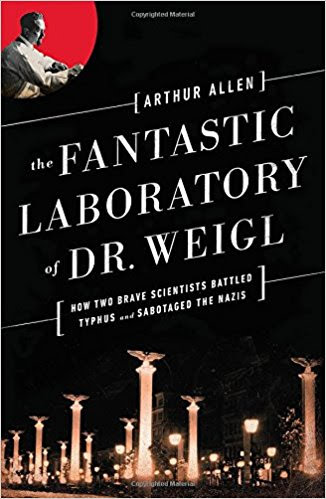
The Fantastic Laboratory of Dr. Weigl: How Two Brave Scientists Battled Typhus and Sabotaged the Nazis by Arthur Allen - 2012


The Fantastic Laboratory of Dr. Weigl: How Two Brave Scientists Battled Typhus and Sabotaged the Nazis by Arthur Allen is a fascinating book. A must read for those interested in the impact of Nazi Germany on the medical profession, especially as regards the tremendous impact of the search for a typhus vaccine.  Typhus is a disease of crowded conditions like refugee camps, ghettos, and for the  great concern of the Germans, in their army on the Eastern Front.  Typhus is spread by lice.  It causes extreme high fever, hallucinations, terrible headaches and sometimes death.  The German high command put high pressure on the Nazi medical division to develop an effective vaccine.  They turned to a famous Polish zoologist, a Christian, Rudolph Weigl, whose Laboratory in Lviv, Poland had deveopled a vaccine. 

Lviv had a high percentage of Jewish residents who the Germans were under orders to liquidate, either through shooting or shipping to concentration camps.  Producing the typhus vaccine required large numbers of what were called “Lice Feeders”, people whose blood was fed to the lice.  

The book goes into a lot of very interesting detail about how
these lice are used to produce a vaccine.  Jewish scientists, doctors, academics and ordinary Jews who worked in his laborotory had a measure of protection from The Nazis.  At great personal risk, Weigl smuggled vaccine into the Ghetto and gave the German army a watered down vaccine.

One of his employees was a World famous immunologist.  He was Jewish and he was taken to Buchenwald where the Nazis wanted him to replicate the vaccine.  There were lots of Jewish doctors to work on the project and it was a great break for an inmate to be selected as a “lice feeder”.  The Nazis needed them healthy so they were not subject to the worse cruelties of the camp.  The camp lab was under the control of a sadistic Nazi doctor.

There is a lot of information about the running of the lab in the camp. We see the degradation of the German medical system.  

You will leave this book knowing a lot about lice and with a great admiration for two brave Polish scientists.

Reading this book, in partnership with The Pharmacist of Auschwitz by Patricia Posner,  is highly recommended.  

Arthur Allen has written for the New York Times Magazine, the Washington Post, The Atlantic, the Associated Press, Science, and Slate. His books include Vaccine: The Controversial Story of Medicine’s Greatest Lifesaver. He lives in Washington, where he writes about health for Politico.


Mel u


Thursday, February 1, 2018

The Reading Life Review - January, 2018

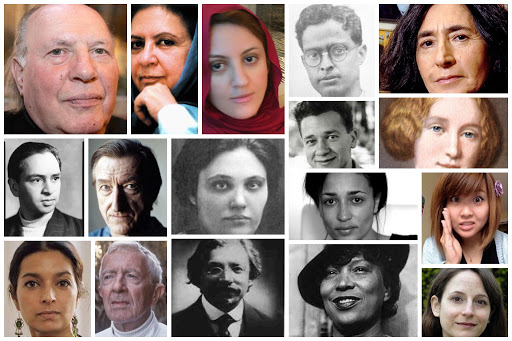
January Authors


I offer my great thanks to Max u for the provision of Amazon Gift Cards

From the Left, Column One

  1. Imre Kertesz - Hungry- Nobel Prize Winner
  2. Mulk Raj Amand - India - author Untouchable
  3. Jhumpa Lahiri - USA - Pulitzer Prize Winner

Column Two

  1. Goli Taraghi - Iran - author The Pomegranate Lady and other Stories
  2. Julian Barnes - UK - Booker Prize Winner
  3. Paul Bowles- USA

Column Three

  1. Riham Adlay - Egypt - Award Winning Short Story Writer
  2. Yente Serdatzky - Lithuania- Yiddish Short Stories 
  3. Sholom Aleichem- Ukraine 

Column Four

  1. R. K. Narayan- India
  2. Tadeusz Borowski - Polish - Holocaust Short Stories 
  3. Zadie Smith - UK
  4. Zola Neale Hurston -  USA

Column Five

  1. Francine Prose - USA
  2. George Eliot - Uk
  3. Alyssa Wong -  USA - Multi-Award Winning Fantasy Writer
  4. Karen Russell -USA

Men 7, Women 10

Dead 9, Living 8

Included are a Nobel, Pulitzer and Booker Prize Winners

There are six Americans, two from India, three from the UK, two from 
Poland, and one each from Iran, Egypt, Lithuania, and the Ukraine

Four writers were featured for the first time, thirteen are old friends, the most frequently featured of this month’s writers is R. K. Narayan with 24 Posts.  For sure he should have won the Nobel Prize 


The Autodidactic Pick of the Month 

This month I’m urging all my fellow literary autodidacts to consider reading Untouchable by Mulk Raj Amand, 1935, a look at one day in the life of a young Dalit man in his late teens.  In just a few hours you can get a very good sense of what life was like at the bottom of the Caste System, not just for the young man but his abusive at times father, his mother who works as a maid for a Brahmin and probably services him sexually and his beautiful younger sister.  His dream in life is to get a position cleaning up after a British regiment.

I hope to add this as an ongoing feature in which I recommend at least one work to serious literary autodidacts in my month end reviews.  


Blog stats 

Since inception, July 7, 2009, there has been 5,055,375 pages views 

The five most viewed posts are all on pre WW Two Short Stories by authors from the Philippines. 

The top ten countries are The Philippines, USA, India, UK, France, Spain, Canada, Indonesia, Russia, and Germany.  

There are currently 3204 posts The Reading Life.

Future Plans and Hopes


Basically much like before.   I will Year long be reading Yiddish Literature, mostly short stories. In March I will return to the Irish. I will also be reading more Indian Short Stories.  I will continue, I hope, to read nonfiction, mostly history and literary biographies.  

Review Policy

I have no real fixed policy.  I look at all the books I receive, from services, agents and writers.  I will review serious academic history and biographies as well as literature.  

To my fellow Book Bloggers

You are the among the greatest readers in the world.  Keep blogging, in hard times slow down but don’t quit.  I imagine how great it will be if young book bloggers starting now can one day look back on fifty years of posts. 

To those who leave comments I give my humble thanks, sometimes I do feel I am posting into a vast void and you help keep me going.

Mel u


Featured Post

Imperial Reckoning: The Untold Story of Britain’s Gulag in Kenya by Caroline Elkins - 2005 - 701 Pages

  Imperial Reckoning:     The Untold Story of Britain’s Gulag in Kenya by Caroline Elkins - 2005 - 701 Pages 2006 Pulitzer Prize Winner From...