Tuesday, March 6, 2018

“On the Eve of Battle” - A Short Story by David Bergelson, 1923, translated from Yiddish by Ellen Kellman


A Ukrainian War of independence  Story by The
Author of The Best of Everything 
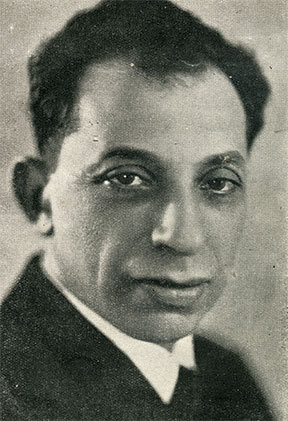


1884 Born in Ukraine

1913 Publishes  The Best of Everything - Classic  Work of Yiddish Modernism

1921 Emigrated to Berlin, begins to write for Forward

1934 - concerned over rise of Nazis to power, moves to Berlin, then Soviet Union

1949 - arrested, imprisioned for two years and ultimately tortured to death by Soviet Secret Police for writings preceived as anti-Soviet


A few years ago Yale University Press initiated my interest in Yiddish literature with a very generous gift of books, including The Best of Everything by David Bergelson. In my post from January 14, 2014 I said 

The End of Everything by David Bergelson (1913) is considered one of the masterworks of Yiddish literature.   It centers on the lives of newly rich Russian Jews trying to preserve their cultural identity in a country in great turmoil, Tsarist Russia.  Bergelson's title is itself a chilling prophecy of what was to happen to most of the people the novel is about.  

The central character is Mirel Hurvits, a beautiful educated woman who tries to rebel against an arranged marriage while staying within the confines of her culture.  The novel goes deeply into social and marriage customs, economic realities, family life and sex roles of the period.   Mirel is more or less forced by her parents into a marriage of convenience to a man that revolts her.  We see her disintegration as the story line progresses.

The Ukranian War for Independence, 1917 to 1921, had only ended a few years before “The Eve of Battle” was published.  Bergelson used this setting for several Short Stories published in Forward, all centerjng on a Young Jewish soldier.  There were several competing armied in this war.  There were Ukraine troops seeking independence from Russia, German and Austrian Forces, White Russians, and Bolsheviks.  In part the Ukraine was a battle ground in a war dervived from The Russian Revolution.  The Jewish character joined with The Bolsheviks as they were not preceived as as anti-semetic as the others, and they would feed him.  Plus he plans to desert once the army gets near where his fiancé lives. White Russians were known for vicious anti-Semitic 
pograms.  In the story we can see how little the soldiers cared about ideologies.  

I read this story in s wonderful anthology of Yiddish short fiction,
Have I Got a Story for You - More than a Century of Fiction from the Forward edited by Ezra Glinter with an introduction by Dana Horn was a 2016 finalist for the Jewish Book of the Year.   Founded in New York City in 1897, Forward was the most renowned Yiddish newspaper in the world. For generations it has brought immigrants news of their homelands, recipes, as well as lots of information about how to get along in America.  It also published many works of Yiddish language fiction by some of the greatest writers in the language.  

(You can learn about the history of Forward on their website 


Monday, March 5, 2018

“Grace”. - A Short Story by James Joyce from Dubliners - 1914


Born 1882 Rathgar, Ireland

Died 1941 Zurich, Switzerland 

Dubliners 1914

A Portrait of An Artist as a Young Man 1916

Ulysses 1922

Finnegen’s Wake 1939

One of my goals for Irish Short Story Month, VIII is to complete posts on those stories from Dubliners I did not previously read.  After posting yesterday on “The Boardinghouse”, there were five left.  Today’s story, “Grace”, as does yesterday’s story, shows us the impact of extreme alcoholism  on Irish family life.

The story opens with the central character passed out on the floor of a pub, he bit of part of his tongue in the fall.  Others in the pub, including a constable, get him to his feet. A friend takes him home.  We learn about his family through his wife.  She tells his friends he is not “The worse husband in the world”.  Three of his friends conspire to take him to a Catholic retreat in the hope this will help him abate his drinking.  They get into an interesting and funny debate about The Catholic Church, especially the doctrine of Papal infalibility.

You can listen to a dramatic in Irish accents reading of “Grace” on YouTube

Mel u
The Reading Life 


Sunday, March 4, 2018

“The Boarding House”. - A Short Story by James Joyce, from Dubliners, 1914


Irish Short Story Month, VIII


Born 1882 Rathgar, Ireland


Died 1941 Zurich, Switzerland 

Dubliners 1914

A Portrait of An Artist as a Young Man 1916

Ulysses 1922

Finnegen’s Wake 1939

March has been Irish Short Story Month on The Reading Life since 2010.  Of the    3200 posts on my blog, 628 are about Irish Literature, mostly short stories.  Dubliners by James Joyce, first published in 1914,is the most influential short story collection of all time.  The stories focus on the realities of middle class life in Dublin in the early years of the 20th Century.  There are fifteen stories in the collection, over the eight past years of Irish Short Story Month I have 

posted on nine of them.  This month I am hoping to read and post on the remaining six. (Dubliners can be downloaded for free on Amazon and on YouTube there are readings of a number of the stories.)


“The Boarding House” opens perfectly, the very model of how a short story in the hands of a master, can express so much in just a few sentences.


“MRS. MOONEY was a butcher’s daughter. She was a woman who was quite able to keep things to herself: a determined woman. She had married her father’s foreman and opened a butcher’s shop near Spring Gardens. But as soon as his father-in-law was dead Mr. Mooney began to go to the devil. He drank, plundered the till, ran headlong into debt. It was no use making him take the pledge: he was sure to break out again a few days after. By fighting his wife in 


the presence of customers and by buying bad meat he ruined his business. One night he went for his wife with the cleaver and she had to sleep in a neighbour’s house. After that they lived apart. She went to the priest and got a separation from him with care of the children. She would give him neither money nor food nor house-room; and so he was obliged to enlist himself as a sheriff’s man. He was a shabby stooped little drunkard with a white face and a white moustache and white eyebrows, pencilled above his little eyes, which were pink-veined and raw; and all day long he sat in the bailiff’s room, waiting to be put on a job. Mrs. Mooney, who had taken what remained of her money out of the butcher business and set up a boarding house in Hardwicke Street, was a big imposing woman. Her house had a floating population made up of tourists from Liverpool and the Isle of Man and, occasionally, artistes from the music halls. Its resident population was made up of clerks from the city. She governed her house cunningly and firmly, knew when to give credit, when to be stern and when to let things pass. All the resident young men spoke of her as The Madam.”


Joyce lets us see the strength of Mrs Mooney.  One of the major themes of Irish Literature is that of the weak or missing father.  I have illustrated this theme as it appears in numerous works.  This can be seen as a legacy of colonialism.  For sure it is exemplified in “The Boarding House” with the ruined by drink figure of Mr. Mooney.  

Mrs Mooney’s lively pretty 19 year old daughter Polly lives with her in the boarding house.  Mrs Mooney has a keen eye and is not above some scheming.  Of course she wants her daughter married well.  She notices
one of the boarders, Mr. Doran, seems to be having a romance with Polly.  He is thirty five and has a decent long term job with a major wine merchant.  Mrs Mooney figures he must have some money put away. The age difference was not the scandal it would be now and it appears they have not been fully intimate.  Mrs Mooney wants them to marry.  She knows Mr Doran’s employer may actually fire him if he learns he has been trifling with the affections of a young girl.  She also knows Mr. Doran will know and fear this.  She lets Mr. Doran trap himself.

It was interesting and fun to see Polly had learned her mother’s methods of emotional manipulation.   

I will leave the close untold.  

The remaining five stories I hope to post upon are, A Little Cloud, Clay, Mother, Grace and Ivy Day in the Committee Room.  

I also hope to post upon a few Irish Short Stories by writers new to me as well as some from the past.

Mel u


Saturday, March 3, 2018

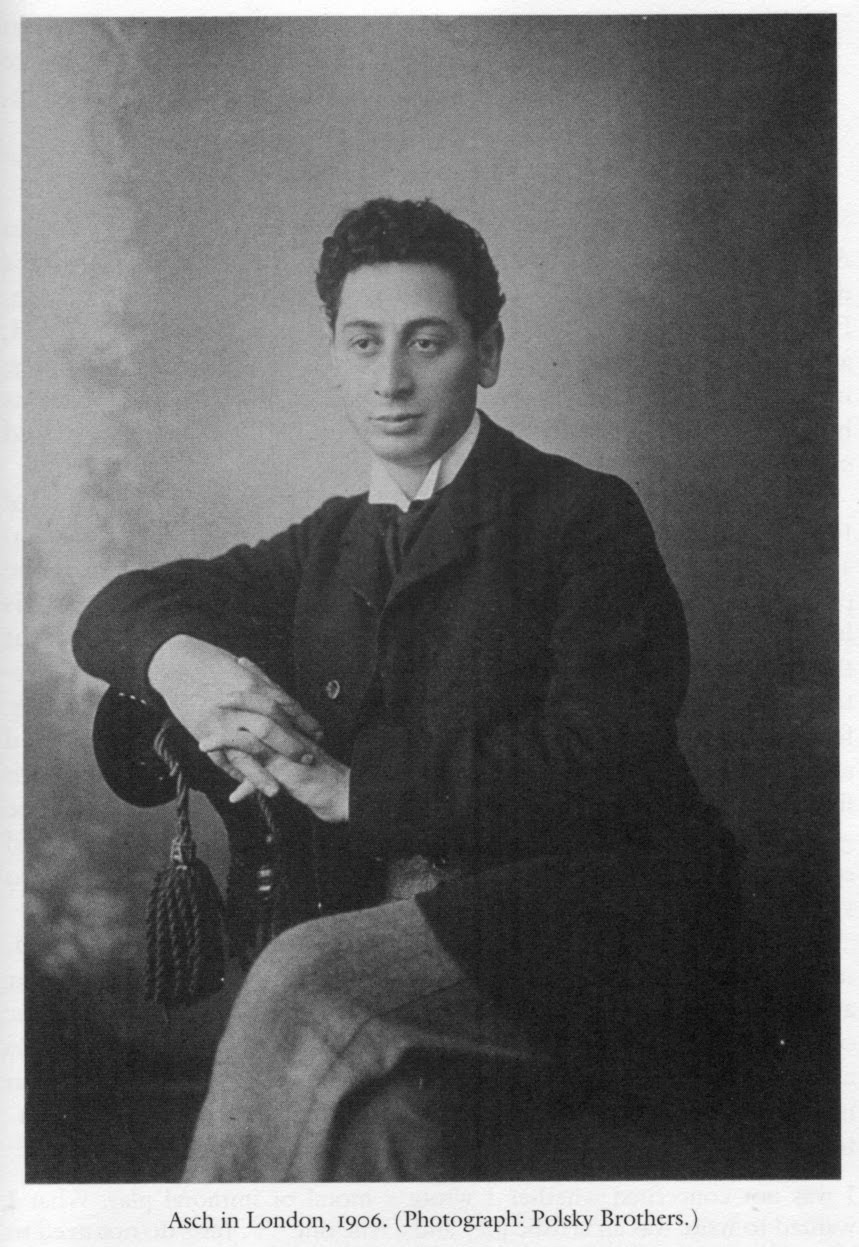
“The Jewish Soldier”. - A Short Story by Shalom Asch - 1914 - translated 2016 from Yiddish by Saul Noam Zaritt


1880 - Born in Poland

1910 - moves to U.S.A, becomes a citizen

A financially fortuitous marriage allowed him to devote all his energied to his writings.  

1957 - died London

(There is an excellent brief biography on Yivo, there is a link at the close of this post.)

“The Jewish Soldier”, originally appearing in Forward in December, 1914, is the third short story by Shalom Asch upon which I have posted.  In April of last year i read his very moving story set in a concentration camp, written in 1948, “Jew’s Eye”.   Last Month I posted on his well known set between the wars in Warsaw story “Kola Street” about social conflicts among Jews.  (My post has a link to a podcast.). Today’s story, “A Jewish Soldier” is truly a masterpiece.  

One day in 1914 or so all the young men of a small Polish town are, without notice, drafted into the Russian Army, to flight for the Czar against the Germans and Austrians.  They receive uniforms but no training.  Jews were discriminated against legally and subject vicious treatment by Russians.  The central character and narrator sees a group of Russian soldiers trying to force a Jewish soldier to eat pork.  The young man rescues him.  He falls in with other Jewish soldiers.  One is an intellectual and tells the others that Jews are actually stateless with no reason at all to die for Russia or any other country.  He tells them they are being used by the Czarist state which cares less than nothing about them.

Like all soldiers before the battle, they think about their fsmilies or girlfriends. Asch does a brilliant job creating the pre-battle atmosphere.  As they march forward, they pass through a battle ground, they must step over dead bodies and dying men.  The narrator tries to comfort a badly wounded soldier who begs him to get word to his mother with his dying words.  He begins to hear cannon fire, all around him men are being blown to bits.  In an amazing sequence, brought on by patriotism and religious impulses, he grabs a flag from a fallen man and charges the enemy.  He winds up a hero. To me Asch’s depiction of battle from the point of view of the foot soldier is on a par with The Red Badge of Courage ond All Quiet on the Western Front.  

I do not wish to deprive other first time readers of the great power of the close of this thstory.  It is a great classic anti-war story.  Published in Poland or Russia in 1914 instead of in Forward in New York City it would have earned Asch a trip to Siberia.

I resd this story in s wonderful anthology of Yiddish short fiction,
Have I Got a Story for You - More than a Century of Fiction from the Forward edited by Ezra Glinter with an introduction by Dana Horn was a 2016 finalist for the Jewish Book of the Year.   Founded in New York City in 1897, Forward is the most renowned Yiddish newspaper in the world. For generations it has brought immigrants news of their homelands, recipes, as well as lots of information about how to get along in America.  It also published many works of Yiddish language fiction by some of the greatest writers in the language.  

(You can learn about the history of Forward on their website 

This story alone is worth the cost of the book for anyone into quality short fiction, not just Yiddish culture.  


From the Yivo Encyclopaedia of Eastern European Jews 

There are three other stories in the collection about Jewish soldiers and I hope to read them this month.  


.

Friday, March 2, 2018

A House on the Hill” - A Short Story by Kadya Molodowsky, 1962 - translated from Yiddish by Katherine Hellerstein


Born Belarus 1894

Moved to New York City - 1935

Died in Philadelphia in 1974

“A House on the Hill” by Kadya Molodowsky, widely considered a leading 20th Century Yiddish language poet, is a nostalgic fun to read story about a family back in Belarus before World War One.  As brief story opens we meet the father, a very small small scale fish merchant.  In fact he is the only male seller of fish at the market.  Our narrator tells us that without his daughters he would never have risen above poverty.  His oldest daughter, Gitele, starts her own fish stall.  Unlike her father, she is very smart and industrious. Soon she has a much bigger stall than her father.  She sells only the freshest fish.  Soon the richest gentiles and Jews come to her for fish.

Gitele wants to buy the family, she has two sister, a nice house near the market where richer people live.  They live on The Hill now and it is very squalid.  Her mother is totally against this idea.

Molodowsky brilliant presents the scene very visually:

“The daughters wanted to leave the squalid hill, and Gitele proposed to pay installments on a house that was for sale in the market. Areh nodded his head and said, “Nu, when you come up in the world, God forbid, you don’t sink again. Why not?” But Feyge-Tsipe pointed at the ceiling with her hand and said, “This roof has been lucky for me. My daughters were born here, and they grew up here, and thanks be to God, now we’re the equals of respectable people. I’m not going to leave here. People will be jealous of us if we puff ourselves up and move to a house in the market. And in a city, when the tongues start wagging, God protect us from what can happen.” When she saw that Shimen the broker was coming to speak with Areh about the house in the market, she grabbed the doorframe and shouted: “I’m not leaving here! They’ll have to drag me out!” Shimen the broker was intimidated by such talk and fled. Areh ran after him and replied: “Nu, so now you see what kind of a woman she is, my Feyge-Tsipe, she’s attached herself to the house.” Returning, Areh tried to persuade Feyge-Tsipe. “For the sake of making matches for our daughters, you need to do this. What kind of a matchmaker will come to you up here on the hill? And what better kinds of bridegrooms will be brought to you down there!” But Feyge-Tsipe held her own. “If a good match is meant to be, it will come here too.” All the neighbors on the hill knew the story and rejoiced. “Feyge-Tsipe doesn’t want to leave the hill.”

I thought the husband would pursuade her with the line about the match maker but no luck.

The story takes a very happy turn.  I will tell the final close.  Gitele meets a very nice young man who soon comes every day to buy fish.  It turns out his father is very rich and they marry.

Overall a very enjoyable five minutes.  As I’m learning, a stock character in Yiddish fiction is the domineering wife, carrying on to get her way.

I resd this story in s wonderful anthology of Yiddish short fiction.

Have I Got a Story for You - More than a Century of Fiction from the Forward edited by Ezra Glinter with an introduction by Dana Horn was a 2016 finalist for the Jewish Book of the Year.   Founded in New York City in 1897, Forward is the most renowned Yiddish newspaper in the world. For generations it has brought immigrants news of their homelands, recipes, as well as lots of information about how to get along in America.  It also published many works of Yiddish language fiction by some of the greatest writers in the language.  

(You can learn about the history of Forward on their website 


There is a very detailed biography of Kadya Molodowsky on The website of The   Vivo Encyclopedia of Eastern European Jews.


Mel u
The Reading Life


Thursday, March 1, 2018

The Reading Life Review - February 2018 - Autodidactic Corner - Future Plans


I offer my great thanks to Max u for the Amazon Gift Cards ♦️ 


February 2018 Authors


Of the 14 authors in my February collage, 9 are dead, 5 living.  Featured were 8 women and 6 men.  9 were featured for the first time.  The authors most frequently posted upon in prior months   are Zadie Smith then Farah Ahamed.  

In terms of nationalities we have

England 4
U.S.A 3
Poland 3
Ukraine 1
Sri Lanka 1
Lithuania 1
Kenya 1

Row 1, left to right

  1. Saul Bellow - U.S.A - Nobel Prize - 1976
  2. Blume Lempel - Ukraine, emmigrated to U.S.A. Yiddish Short Stories 
  3. Sarah Hamer-Jacklyn - Poland, emigrated to USA, Yiddish writer 
  4. Sholem Asch - Poland, emigrated to U.S.A, prolic Multi genre Yiddish writer
  5. Leyb Rashkin - Poland, murdered in Holocaust, author of The People of Godlbozhits

Row 2

  1. Irving Howe - USA, award winning historian
  2. David Mitchell - England
  3. Amanthi Harris - Sri Lanka, award winning short story writer and visual artist
  4. Barbara Comyns, England, author Our Spoons Come from Woolworths 
  5. Yente Sandatsky, Lithuania, emigrated to USA, Yiddish writer

Row 3

  1. Beth Underdown - England, debut novel The Witchfinder’s Sister
  2. Zadie Smith
  3. Delmore Schwartz- The Orpheus of New York City 
  4. Farah Ahamed - Kenya, multi-award winning short story writer 

Blog Stats

R L has received since inception 5,102, 970 page Views

The most viewed posts are all about older Short stories by writers from The Phillipines, followed by those on Indian Short Stories.

The top visitor home countries are the U.S.A, The Philippines, India, UK, Canada, France, Spain, Germany and Indonesia.  

There are currently 3,281 posts online.


The Autodidactic Corner


Last month I started what will be a recurring feature, The Autodidactic Corner, in which I suggest books to my fellow Autodidacts imbued with a passion for great literary art and history, based on my recent reading

  1. Bloodlands-Europe Between Hitler and Stalin by Timothy Snyder - very illuminating work, must Reading for those into Holocaust studies, and Russian and Eastern European History

  1. World of Our Fathers- The Journey of Eastern European Jews to America and the World They Found and Made by Irving Howe, National Book Award Winner.  essential Reading 


Future Hopes and Plans

By and large it will be more of the same.  In March I will refocus as I have done for eight years, on Irish Short Stories.  I hope to finish one day my read through of Balzac’s Comedie Humaine.  I am over 90% done.  I will keep posting on Yiddish Short Stories and novels.  I am currently reading two serious books on Jewish history and hope to complete them soon.  I am always looking for works by relatively new short story writers and quality historical fiction.  My prime interests are listed under my blog header collage.  

Final Words 

I offer my great thanks to all who leave a comment.   To my fellow book bloggers, the world’s greatest readers, keep blogging on through good times or bad.  


Featured Post

Imperial Reckoning: The Untold Story of Britain’s Gulag in Kenya by Caroline Elkins - 2005 - 701 Pages

  Imperial Reckoning:     The Untold Story of Britain’s Gulag in Kenya by Caroline Elkins - 2005 - 701 Pages 2006 Pulitzer Prize Winner From...