Monday, October 8, 2018

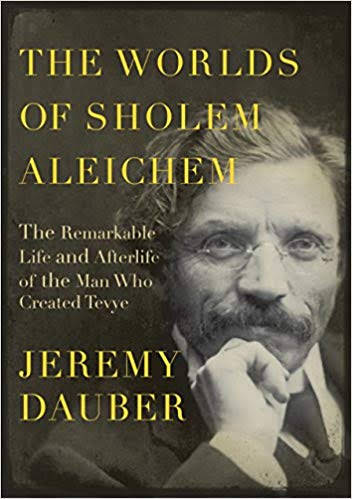
THE WORLDS OF SHOLEM ALEICHEM The Remarkable Life and Afterlife of the Man Who Created Tevye by Jeremy Dauber - 2013


THE WORLDS OF SHOLEM ALEICHEM The Remarkable Life and Afterlife of the Man Who Created Tevye by Jeremy Dauber - 2013

This is the first ever comprehensive biography of Sholem Aleichem, one of the greatest short story writers.

1859 Born in The Ukraine, then part of the Russian Empire

1916 Dies in New York City, then part of The U.S.A.  His funeral is attended by 250,000

To most people, certainly me a few years ago, Yiddish writers were divided into two categories, Sholom Aleichem and a bunch of authors I have never heard about who i would never have read were it not for Yale University Press giving me a full set of The Yale Yiddish Library.  These nine volumes, introduced by top authorities in Yiddish Studies, include some of the great classics.
Among the works were two totally marvelous novels  by Sholom Aleichem.  All of the works were pre-Holocaust, written in Eastern Europe and Russia.  All were by men.  As Yiddish speakers left Europe, mostly to NYC then Toronto and Montréal women writers like Blume Lempel and Chava Rosenfarb began publishing in Yiddish.  I have talked a bit about the history of Yiddish Literature (running from around 1875 to maybe 2004 with the passing of the last of the emigrated writers) in prior posts.  My perception is most seriously into Yiddish Literature, a huge treasure trove of Short Stories, are “heritage readers” seeking ties with the world of their ancestors in Eastern Europe.  Behind it is also a powerful message to those who would destroy Jewish Culture, you lose, we win.  I read in this area because it is an incredibly wonderful literature.  The stories range from heart breaking to funnier than a Mel Brooks movie.  Yiddish scholarship has very strong support and thanks to the internet, and maybe especially The Yiddish Book Center, interest is rapidly growing.  YouTube has lots of good videos and readings of stories.

Anyway Sholom Aleichem is by far now most known Yiddish writer.  He is most famous from the movie Fiddler on the Roof based on his Tevye Cycle, centering on a Russian dairyman and his relationship with his daughters.  So far I have read only one story in the series, “Chava”.  For sure I agree with those who see it as great literature, perhaps high art.  

THE WORLDS OF SHOLEM ALEICHEM The Remarkable Life and Afterlife of the Man Who Created Tevye by Jeremy Dauber is a very delightful literary biography.  Dauber very much brings Sholom Aleichem to life.  He presents the Life of the author almost as if were a Yiddish novel.  Every chapter title refers to him as “our hero”.  Dauber does a wonderful job of blending cultural history, an account of a very event filled life along with commentary about his writings, stories, novels, and plays.  He skillfully shows us how his life experiences influenced his work.

Sholom Aleichem married rich, lost a fortune, at times he made very good money from his works.

Dauber helped me understand the economics of the Yiddish Publishing in the period.  Aleichem was not just a writer, for a while he published a journal and he when he could supported other writers.  We follow him as he moves around in Russia, inspite of Tsarist sponsored anti-Semetic laws and pograms, Aleichem never lost his fondness for Russia, travels all over Poland, then onto New York City.  He idolized Charles Dickens and like him he turned to lectures and Public readings to support his family.  We see a very complex publishing business in NYC and Warsaw, some publishers were honest and generous, some published his work without permission or compensation.  In a good year he made about, in 2018 money, $125,000.  

Aleichem in his final years was a super star of the huge New York City and Warsaw Yiddish world.  Toward the end of his life efforts were initiated by major main stream publishers to go big time with English translations of his work. 

Dauber treats us to ten accounts of the impact of his work, from right after his death up to the story behind the production of the plays and then the Fiddler on     the Roof movie.  I wished he could have basked in the glory.  


Sholem Aleichem, the pseudonym of a Russified Jewish intellectual named Solomon Rabinovitz (1859–1916), created many of the most enduring works of modern Yiddish fiction. Born in Pereyaslav, Ukraine, he received a traditional education and lived in Kiev and Odessa before immigrating to New York City. Upon his death in 1916, the New York Times published a front-page obituary, memorializing him as “the Jewish Mark Twain.” More than 100,000 people attended his funeral procession, making it the largest New York City had ever seen. His humorous representations of the rhythms of Yiddish-speaking Eastern European Jewish life have had a lasting influence on modern Jewish literary traditions... From The Yiddish Book Center

JEREMY DAUBER is a professor of Yiddish literature at Columbia University, where he also serves as director of its Institute for Israel and Jewish Studies and teaches in the American Studies program. His previous books include In the Demon’s Bedroom: Yiddish Literature and the Early Modern and Antonio’s Devils: Writers of the Jewish Enlightenment and the Birth of Modern Hebrew and Yiddish Literature. He lives in New York City. From Penguin Books.

I give my total endorsement to this book.  If you are into Yiddish Literature you will be fascinated.  If you are not yet a reader, maybe if you are lucky and open to new experiences you will be started on a  life time reading experience in Yiddish Literature.


A great resource


Saturday, October 6, 2018

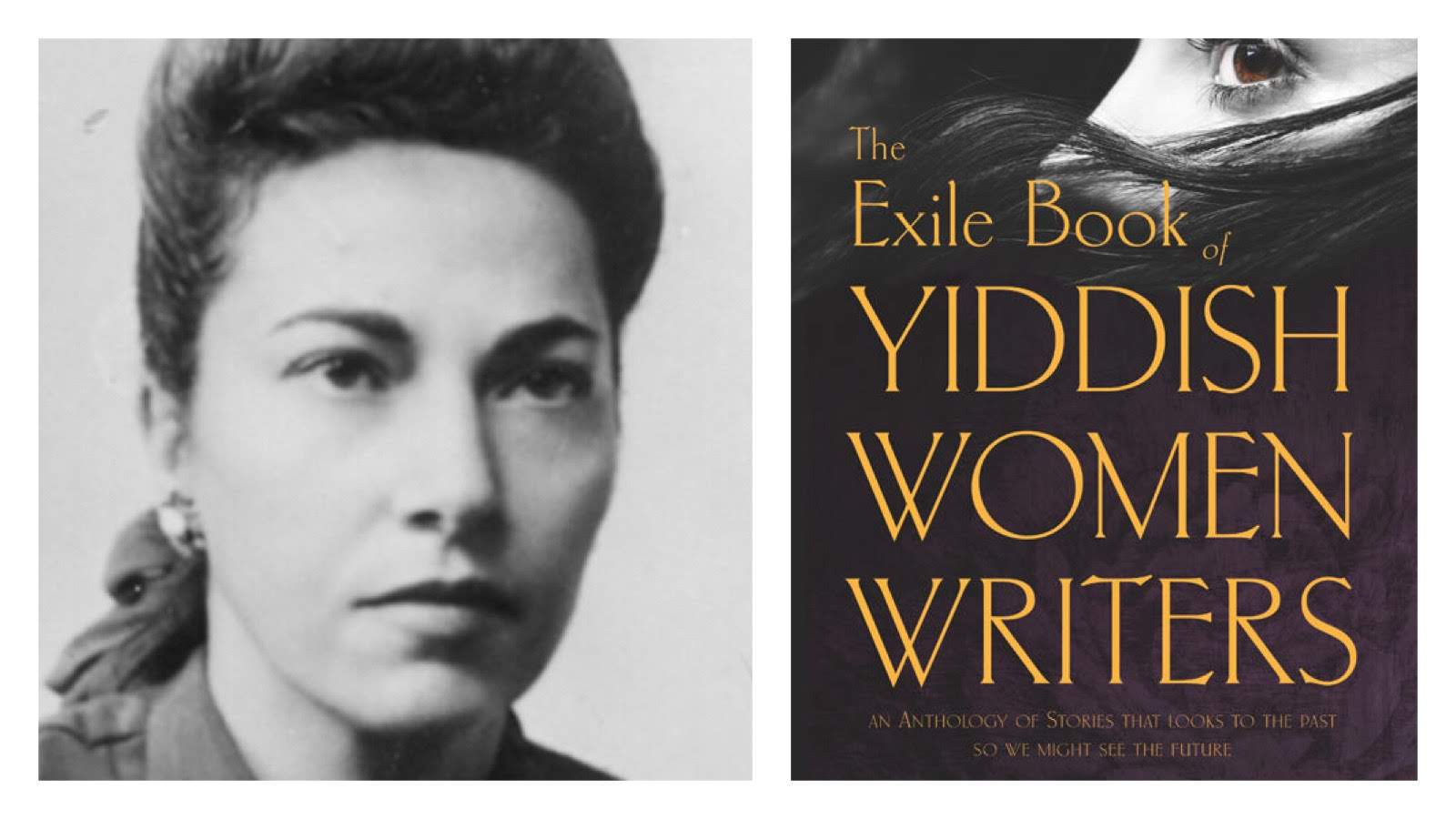
“The Sprite” - A Short Story by Blume Lempel - 1981- first published in Yiddish


“A year later, lying in a haystack, Chayale told her four-footed friends how fate had brought her here. She spoke to them half in animal talk and half in Yiddish.”

“The Sprite” ~ A Rege Fun Emes (A Moment of Truth), I.L.Peretz Publishing House, Tel Aviv, 1981 - first publication data 

Translation by Alisa Poskanzer with Judy Nisenholt

I read this in The Exile Book of Yiddish Women Writers,   Edited by Frieda Johles Forman, a delightful collection.

(This story is not included in Oedipus in Brooklyn Stories by Blume Lempel, translated and introduced by Ellen Cassedy and Yermiyahu Ahron Taub)


Blume Lempel

Born 1907 in The Ukraine

Moved to Paris in 1929, to be near her brother who lived there.

While in Paris she worked as a furrier and attended night school.


1939- having married and had two children, her Family moved to New York State, out of concern over rising anti-Semiticism.  Many in her extended Family died in The Holocaust as would she and her Family had they not left.  In 1942 French authorities in a compromise with the Germans, agree to arrest and turn over to the Germans all foreign born Jews. 

1943- begins to publish with a Short Story, all her writings were in Yiddish.  In part this was her way of defying those who wanted the magnifcient Yiddish Cultural tradition destroyed.

In 1950 the Family locates permanently in Long Island.

1999 passes away.

“The Sprite” is a unique story, written almost as a fable from the darkest days for Jews during World War Two in the Ukraine.  When Chayale was born, maybe 1929,  she seemed to her parents a not quite human girl.  The doctor and her mother felt. as they already had boy and a girl, she should be killed.  Her father ruled that they must love whatever God sends.  Chayale grew up with a second sight, an ability to bond with the wild animals of the forest.  I will give a sample of the story:

“Chayale was ten years old when the Germans took over her district . She sensed the danger even before the murderous news reached their village. Chayale got her big brothers to dig a hiding place in the forest. Her mother and father thought this was foolishness. “The forest is for animals, not for people,” said her parents. Behind their parents’ backs, Chayale and her brothers carried carried clothes and food to the hideout. When it became dangerous for her brothers to be out in the street, Chayale undertook the task on her own. She took over beans, peas, flour, sugar, salt. She sneaked through all dangers, ran on her fleet little feet, low to the ground, just like a sprite. Her fantasized friends told her whom to avoid and whom to trust. She could feel the danger, whether near at hand or at a distance, and could vanish in an instant. That is how the first winter passed. Right after Passover, new edicts were announced, among them the cruel expulsion orders. Chayale stubbornly insisted that she would not go. She would not be tricked to wait for the butcher like a goose in a cage. Her father’s pleas and her mother’s tears didn’t help. Chayale stood her ground. She would not go with eyes open into a ready-made trap”

The gentile peasants begin to thing she is supernatural.   A very evil thing happens, maybe Christians will be perplexed by the close, all should be.

The ending is heartbreaking.  I don’t have the ability to convey the depth of this story.  To me it shows an another aspect of the vast talent of Blume Lempel.  This would be a perfect story for discussion in a class for advanced college students.  

I love this story.  I read it three times.


Wednesday, October 3, 2018

A short story by Chaim Grade “Grandfathers and Grandchildren” - first appeared in January 1973 in The Forward


'


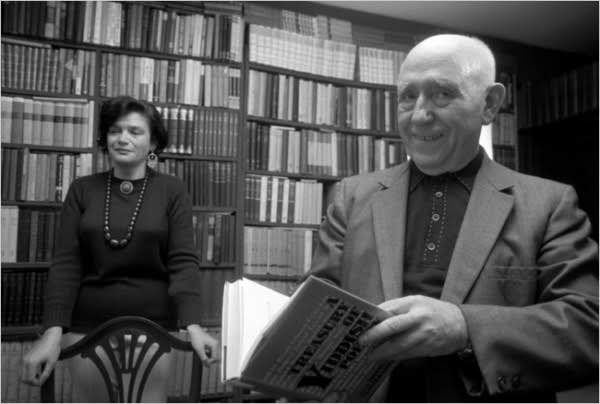
Chaim Grade,in the image above with his second wife, his first was murdered by Germans, Inna (née Heckler) Grade

Born April 4, 1910 in Vilna, Lituania 

1932 begins to write Short Stories in Yiddish

He spends WWII in Russia

1948-moves to New York City, where he will live from then on, after a couple of years in Paris

Dies April 26, 1982 in The Bronx, New York

Chaim Grade is considered one of the greatest of Yiddish writers.  He wrote plays, several novels considered Master works, learned treatises about how the Holocaust should be understood in Jewish tradition but I think it  his Short Stories and Novellas depicting life in Vilna, Lituania that are most now read.

He was a contributor to the Sunday Literary section of the NYC Yiddish Newspaper, The Forward.  Today’s story, some would classify it as a novella, was first published in Forward.  It is now translated for the first time ever by Curt Leviant and is included in a very valuable anthology, Have I Got a Story for You: More than a Century of stories from The Forward.  This is from the preface 

“ the Forward soon became associated with the most talented Yiddish writers of the day, from Sholem Asch and Avrom Reyzen in its early decades to Isaac Bashevis Singer and Chaim Grade in later ones. Under the leadership of Cahan and his successors, the newspaper became home to serialized novels and novellas, humor sketches and one-act plays, “high literature” and sensational potboilers. Often the paper would be running two or three novels at once, in addition to short fiction, belles-lettres, and poetry. For more than a century the Forward produced an immense trove of literature, most of which remained untapped—until now.”

“Grandfathers and Grandson” is set in Vilna between the wars, in the days when it was called “The Jeruseleum of Europe”, home of the highest regarded traditional schools.  The story begins with a lyrical description of Vilna in the Winter.  The story begins in a group of elderly men, the grandfathers.  In rapidly secularizing world they see their grandchildren being educated as if they were gentiles, with no grounding in the Torah.  They have been made to feel, by their children and their spouses, as if the  traditions that once they would have passed down are just to be trotted out on Holiday Holy Day Dinners.  One day a young Boy wanders into their gathering.  It turns out his deceased great grandfather was a highly revered Vilna Torah scholar.  Sadly the boy is getting only a secular education.  The grandfathers basically bribe him and soon his friends with food treats to let them teach boys Jewish tradition.  We see how both sides gain from this.

Grade does just a wonderful job with this story, taking his time creating the feel of Vilna, individuating the different personsalities of the grandfathers and the Boys.  Of course there is some drama, we meet mothers of some of the boys, we listen in as the men kvetch about their wives.  I found this a delightful story.

Vivo Institute Article on Chaim Grade

An interesting human interest story about Chaim Grade from The New York Jewish Week.


I want to read more of his work.  There are Kindle editions available but they are way over priced at $30.00 or more.  Nothing seems in print otherwise.


Tuesday, October 2, 2018

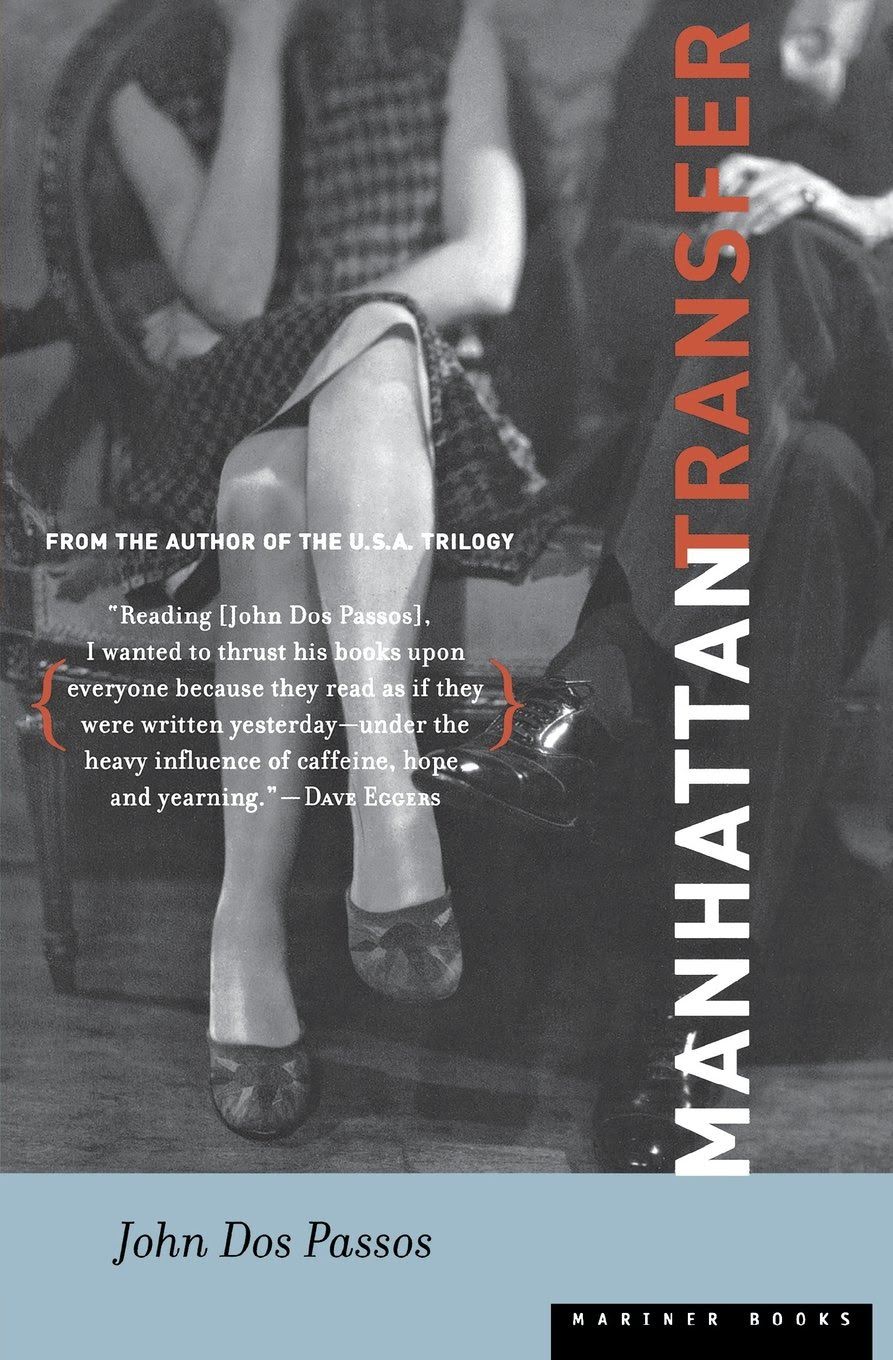
Manhattan Transfer by John Dos Passos - 1925. - 352 pages


John Dos Passos

January 14, 1896. Chicago 


September 28, 1970 Baltimore 

As I see it, John Dos Passos is a first rate second level American writer overshadowed by his one time friend Ernest Hemingway.  Dos Passos does not appear much read anyone.  In classes in American literature centering on the first half of the 20th century he gets left out.  If I should teach such a class to undergraduates I would probably not include him in a three month long class. 

Not long ago I received notice of a flash Kindle edition sale of his 1925 set in New York City novel  Manhattan Transfer offered at $1.95.  Having recently read a number of set in New York City short stories by Yiddish writers and the classic novel of Jewish immigrants to the city, Call it Sleep by Henry Roth and after looking at the description as well as the ratings on Amazon I hit purchase now,hoping to get an “American” take on NYC in the first two decades of the 20th century.

I throughly enjoyed Manhattan Transfer.  It is kind of a literary collage stiching together vignettes of the lives of residents of Manhattan Island. We sit in on lots of conversation, many on an urban railroad, The Manhattan Transfer.  We meet poorest immigrants, rubes moved up from the rural south, the really rich and the phonies, hard working family people to con artists.  Dos Passos tries to present the speech patterns of different ethnic groups.  I found this to be an interesting attempt, done Ok but better by others.  His Jewish immigrants start sentences with “Oy”, Italians sound to me way over done, almost comically so. Maybe I am overreacting but his descriptions of African Americans came across offensively.

I am glad I read Manhattan Transfer.  I like collages, visual and literary and this is very much a collage.  Dos Passos studied art and you can easily see the influence of collage artists.  My post read research said he was influenced yo
by James Joyce.  Manhattan Transfer is easy to read.


Maybe if Ulysses is the collage of Dublin in this period and Berlin Alexanderplatz, a 1929 novel by Alfred Döblin, a collage of that city then Manhattan Transfer is the best NYC collage of this period you will find.  The Kindle Edition is back to $9.95, you can get a used hard back for $0.53 plus shipping.  Those wishing to expand their knowledge of American Literature of the period should add this to their one of these days list.


Monday, October 1, 2018

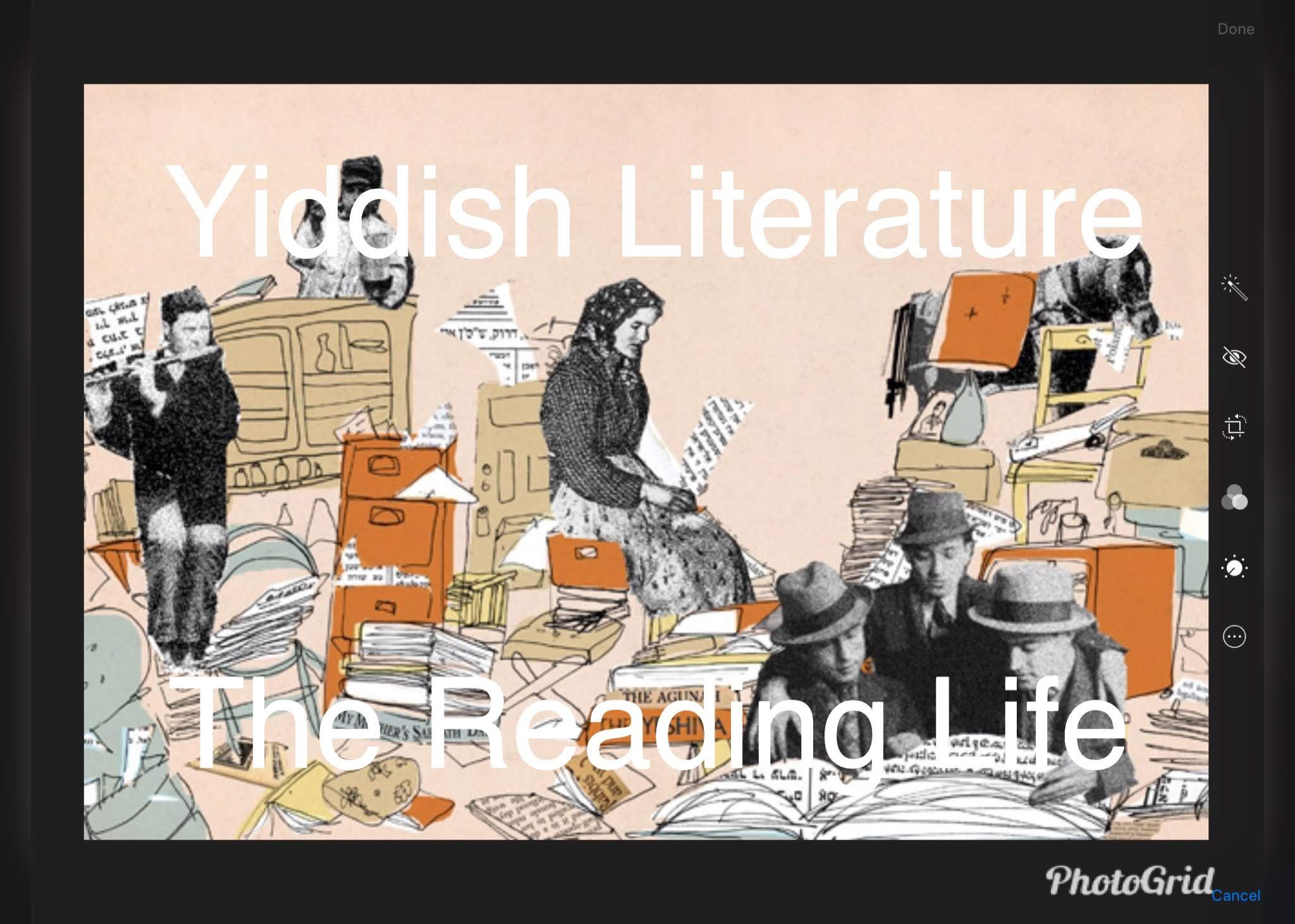
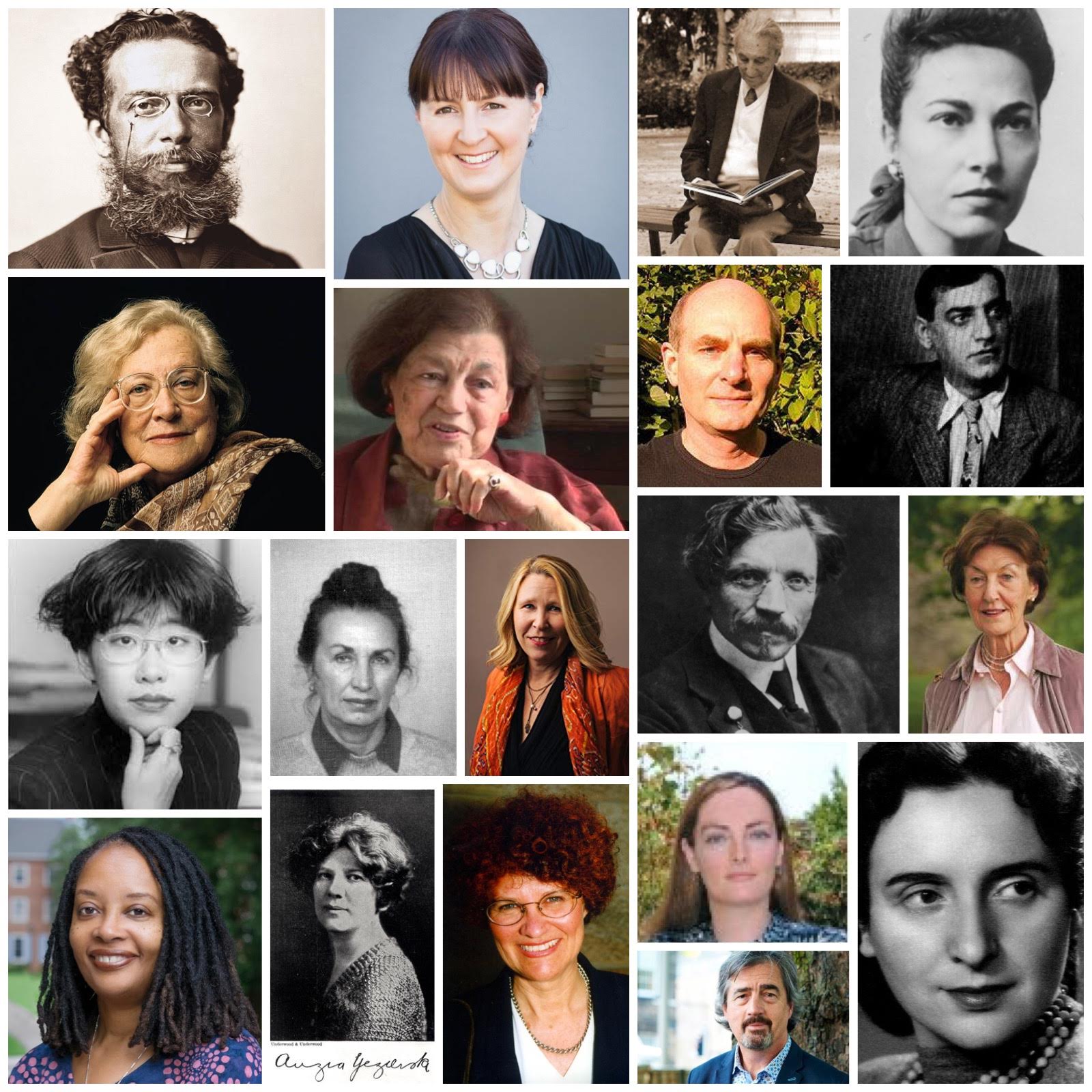
The Reading Life Review - September 2018

September Authors 


By Rows, left to right

Row One

  1. Machado de Assis -  Brazil - by consensus leading author, chronicler of Rio de Janeiro in the early 20th century

  1. Orla McAlinden - Ireland - Author of The Flight of the Wren, an amazing debut novel as well as an award winning collection of short stories, The Accidental Wife

  1. Abraham Karpinowitz - born Vilna, Lithuania, spends WW Two in Russia, in 1949 he moves to Israel.  Best remembered for his stories about Vilna.  Wrote in Yiddish 

  1. Blume Lempel - born in the Ukraine, moves to Paris for then years, then in 1939 to New York City. Author of many great short stories.  She was fluent in English, Russian and French but she wrote in Yiddish to defy those who would destroy Jewish Culture.

Row 2 

  1. Ida Fink. - born in Poland, after WW Two moves to Israel.  Prolific writer in Yiddish

  1. Mavis Gallant - Born in Canada, moved at age 28 to France

  1. Peter Chapman- born in London, author Bananas: How the United Fruit Company Shaped the World. A must read for autodidactics

  1. Ephraim Kaganovski (variations on spelling)- born Warsaw, spends Seven years in Post Revolutionary Russia then moves to Paris.  Best remembered for his stories about Warsaw Between The Wars. Wrote in Yiddish 

Row Three

  1. Banana Yoshimoto - Japan. Prolific author

  1. Rosa Palatnik - born in Lublin, Poland - after a stay in France moved to Rio de Janeiro. She was a very prolifc Yiddish language author.

  1. Nina Lichtenstein - Denmark, author Seraphadic Women’s Voices: Out of North Africa.  New book Destined to be a classic

  1. Sholem Aleichem- born in the Ukraine, then Russia, died in New York City. By far most famous now Yiddish writer.  His work was the source for Fiddler On the Roof.  I hope to begin reading much more of his work soon.

  1. Shirley Hazzard. Born Australia, world traveler, died in New York City. Author The Great Fire, Transit of Venus and much more 


Row Four

  1. Valerie Boyd - U.S.A - author of very good bio on Nora Zeale Hurston

  1. Anzia Yezierska.- born in Poland, with her family as a child moves to New York State.  Very successful writer, sold a novel to Hollywood and became a screen writer.  Wrote in English 

  1. Kate Grenville - Australia- author seven novels including the Secret River Trilogy, wonderful novels about early Australia 

  1. Elizabeth McDonald.  Ireland. Author of marvelous Short Stories 

  1. Sebastian Barry. Ireland. Highly regarded author.

  1. Chava Rosenfarb (9 February 1923 – 30 January 2011) (Polish: Chawa Rosenfarb, Yiddish: חוה ראָזענפֿאַרב‎) was a Holocaust survivor and Jewish-Canadian author of Yiddish poetry and novels, a major contributor to post-World War II Yiddish Literature. Rosenfarb began writing poetry at the age of eight. Moved to Toronto after WW Two.   You will see her again.

Featured were 6 men and 13 women.

Eight are living, 11 not so much.

Half were featured on my blog for the first time.

Birth Countries 

Poland 6
Ireland 3
Ukraine 2
Australia 2
Canada 1
U.S.A 1
Japan 1
Denmark 1
Lithuania 1
Brazil 1

Because of the anti-immigrant hysteria gripping the U.S.A and much of Europe. I have begun to track Immigration by authors i feature.

All nine of the Yiddish language writers featured immigrated. Move or die were their options. 

Mavis Gallant and Shirley Hazzard left their homelands for their own reasons.


Blog Stats

Page views to date

5,399,641

There are 3416 posts online.  

Top visitor countries

U.S.A, The Philippines, India, Germany, Canada, Russia, Indonesia, France and the Ukraine 

Books I read but did not post upon.

  1. Exile at Last:Selected Poems by Chava Rosenfarb 

  1. The New Joys of Yiddish by Leo Rosten

  1. Born to Kvetch:Yiddish Language and Culture in All its Moods by Michael Wex

  1. One for the Books by Joe Queenan 

  1. Seraphadic Women’s Voices: Out of North Africa. By Nina Lichtenstein


Future Plans.  I will be doing a post on my reading plans for the next few months soon.


I offer my thanks to Max u for his kind provision of Amazon Gift Cards

To those who leave comments, you help keep me going.


Featured Post

Imperial Reckoning: The Untold Story of Britain’s Gulag in Kenya by Caroline Elkins - 2005 - 701 Pages

  Imperial Reckoning:     The Untold Story of Britain’s Gulag in Kenya by Caroline Elkins - 2005 - 701 Pages 2006 Pulitzer Prize Winner From...