Thursday, February 13, 2020

Disoriental by Négar Djavadi - 2016 - translated from French by Tina Kover - 2018


Disoriental by Négra Djavadi - 2016 - Translated from French by Tina Kover - 2018

Lambda Prize - Best Bisexual Fiction - 2019

Albertine Prize Winner - 2019 - Reader’s Choice for best novel translated from French to English

National Book Award Finalist - 2019

These are just a few of the awards won by Négra Djavadi’s debut novel Disoriental.

The narrator, Kimiâ Sadr, emigrated at age ten, along with her family, from Iran to Paris.  Now age twenty-five, she sits in the waiting room of a fertility clinic in Paris. She is flooded with memories of her families long tangled  history.  Her great grandfather had 52 wives, her parents were strongly opposed both to The Shaw and the clerics who followed him. She has a huge family. She just identifies her six uncles by number.

In a series of flashback like episodes The narrator tells in relays 
The chaos of post World War Two Iran.  The educated elite of Iran, her Family was once quite rich, had Cultural and emotional ties to France, especially Paris where  lots of Iranian expats had homes, fled to Paris to escape extreme clerical rule.  

As history of Iran is unsettlling told, we slowly see the narrator come to accept she is sexually attracted to women not men. Homosexual behaviour, mostly this happened to men, sometimes lead to death sentences. 


The story line skips around a lot in time to contemporary Paris and Tehran to pre-revolutionary days in Iran and her families early days in France.


Technically Didoreintal is a stunning novel.  The characters are very well developed.  

I felt The chaos and sometimes terror of life in Tehran coupled with the strains of adjusting to life in Paris.  To anyone willing to read carefully, I recommend this work.


Négar Djavadi was born in Iran in 1969 to a family of intellectuals opposed to the regimes of both the Shah and Khomeini. She arrived in France at the age of eleven, having crossed the mountains of Kurdistan on horseback with her mother and sister. She is a screenwriter and lives in Paris. Disoriental is her first novel..from Europa Editions.


Wednesday, February 12, 2020

“With the Beetles” - A Short Story by Haruki Murakami - Translated, from the Japanese, by Philip Gabriel - from The New Yorker February 14 and 21, 2020


Home Page For Japanese Literature 13 - JLC13

Link to Today’s Story

On August 9, 2009, I completed my first book for The Japanese Challenge “After Dark” by Haruki Murakami. This novel was also in fact my first venture into Japanese literature.


“After Dark” starts in a Denny’s, a comfortable familiar place in the night world of Tokyo. The characters in the story are at once beautifully individuated with just a few brush strokes.
“She reads with great concentration. Her eyes rarely move from the pages of her book….She just keeps reading her book, lighting an occasional cigarette, mechanically tipping back her coffee cup, and hoping the time moves faster”.

As the book proceeds we are drawn further into the Tokyo night world. We meet a number of interesting people along the way. Like Dickens and Balzac before him Marukami brings to light aspects of the city that fall below the radar of those safely out of the margins.

“The garbage trucks have not yet collected all of the garbage. This a giant city, after all, and it produces a prodigious amount of garbage”.

From this start 11 years ago I went on to read all his translated novels published as Kindles and a number of his Short Stories.  I hope to one day join in the Celebration of his Nobel Prize.

I was delighted to find a new story,”With the Beetles” just published   in The New Yorker, readable online at the link above.  My main purpose today is to let my readers know about the availablity
of this story and to keep a record of my reading.

American and English pop music references abound in the work of Murakami.  “With The Beetles” follows a man living in Tokyo from his final teenage years to his late thirties.  It is 1965 and The Beetles are huge in Japan dominating airwaves and record sales.
His girl friend, the first, loves the Beetles though he is more into American Jazz.

One day he goes to pick her up but only her brother is home.  He invites him in to wait.  The longest segment of the story is devoted to their conversation.  The brother has a rare problem with his memory.  The conversation revolves around that, Mozart and brother’s questions about the man’s relationship to his sister.

We flash twenty years forward as we then catch up with events.

Mel u


Saturday, February 8, 2020

A Thoroughly Modern Ghost of Other Origin - A Short Story by Elaine Chiew - from her Debut Collection - The Heartsick Diaspora - 2020


"A Thoroughly Modern Ghost of Other Origin" by Elaine Chiew, story six in The Heartsick Diaspora


"But a pontianak has more currency somehow, I say. You can be a marker of Singaporean diversity."


In Singapore even the ghosts, spirits of the dead, arise from sundry Diasporas.


During seventh month in the Chinese Calender, demons of various forms are released from Hell, to reap havoc on the living.  Like the citizens of Singapore, the demons have roots in China and Malaysia.  Unlike the last four stories from The Heartsick Diaspora I have posted upon, this story is set in Singapore.  The narrator is a late teenage boy living with his large family and an Indonesian helper.  They are a middle class family. 

Of course he is obsessed with girls.  He also has a unique ability, he can see ghosts. His mother gets upset when discovers him talking to ghosts.  She doesn't want them attracted to her home.  I learned a lot about the ghosts of Singapore in this story.  I admit I used Google to learn about the multicultural demons of Singapore.  Now days the Festival of Hungry Ghosts is an event to celebrate the heritage of Singapore.  

The narrator is in his room when suddenly he sees a Pontianak in his room.  She tells him she is very hungry, she wants blood. Being very freighted, and ok maybe a bit excited by a female in his room who he is not related to, a first, he gets some congealed pig blood from the refrigerator for her.  She returns and demands his blood or his life.

"Here are some facts about the pontianak, a female Malay vampire: • As a human, died during childbirth, and as a result, wants to prey on the blood of men and other helpless folk."


The Hungry Ghosts  of Singapore seem to be mostly female, maybe they are drawn to his burgeoning sex drive, seeking revenge on males.

"A Thoroughly Modern Ghost of Other Origin shows us a different side of life in Singapore, not focused on the rich but on an ordinary family working for a living.  We see the dynamics of the family with the mother very much charge.

This is a very entertaining story, taking us below the glittering affluence of Singapore to ancient beliefs brought in with the various diasporas that built Singapore.

Elaine Chiew


Elaine is a writer and a visual arts researcher, and editor of Cooked Up: Food Fiction From Around the World (New Internationalist, 2015).
Twice winner of the Bridport Short Story Competition, she has published numerous stories in anthologies in the UK, US and Singapore.

Originally from Malaysia, Chiew graduated from Stanford Law School and worked as a corporate securities lawyer in New York and Hong Kong before studying for an MA in Asian Art History at Lasalle College of the Arts Singapore, a degree conferred by Goldsmiths, University of London.

Elaine lives in Singapore and her book, The Heartsick Diaspora, and other stories, will be published by Myriad in 2020..from epchiew.com

Last month I posted upon a Japanese  authored short story  focusing on a related Japanese tradition.  This made me wonder how ancient this tradition might be,  what way back diaspora left this belief about returning ghosts all over East Asia.  Maybe we are being taken into pre-history.


"Waymarkers" by Natsuko Koroda, translated from the Japanese by Asa Yoneda, from Words Without Borders, November, 2015 

I look forward to posting on the remaining eight stories in The Heartsick Diaspora.

Mel u


Wednesday, February 5, 2020

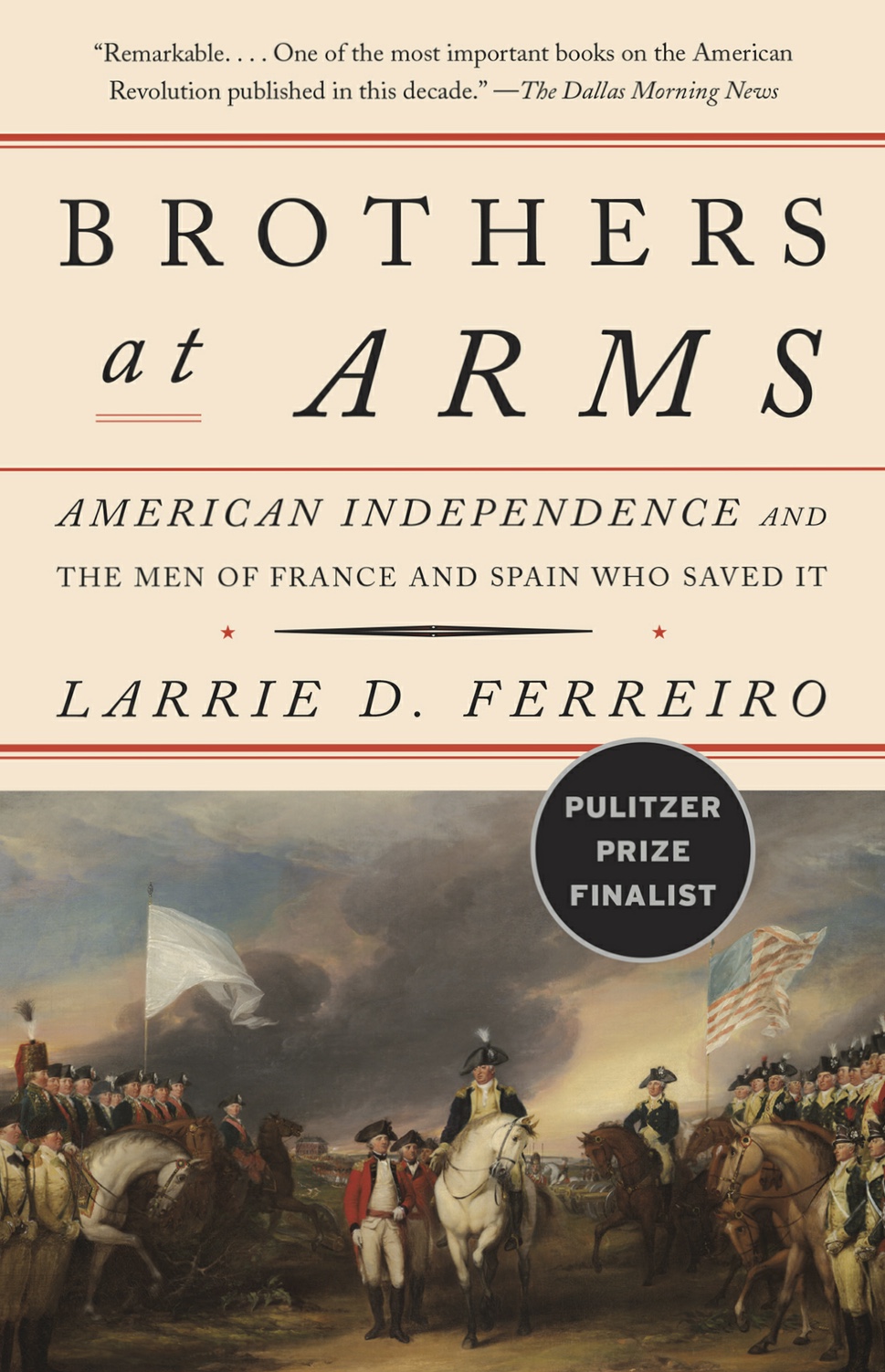
Brothers At Arms: American Independence and the Men of France and Spain Who Saved It by Larrie D. Ferreiro. 2016


Brothers At Arms: American Independence  
 and the Men  of France and Spain Who Saved It by Larrie D. Ferreiro.  2016

Journal of The American Revolution Book of The Year for 2016

A Revolutionary Reading and Autoditactic Corner Selection

If you are interested in learning more about The American Revolution than just the standard Hagiography taught in American schools study  the webpage of The Journal of The American Revolution.  They have a list of the hundred best books on The Revolution, broken into sections so you can follow your interests.  About half of the books are available in Kindle Editions, my preferred mode, and long term I hope to read a number of them. 

Since 2014 they have given an annual Award for best book,  with honourable mentions.  It is here i learned of  today’s book.


Ferriero’s book showed me that very likely without the help of France The Revolution would have failed. The assistance went way beyond officers like  Gilbert du Motier, Marquis de Lafayette serving in The American Army.  Thousands of French soldiers  and sailors fought for the Americans.  The French government supplied rifles,canons, uniforms ships worth in today’s dollar over Thirty   Billion dollars.  The objective of the French government was to undermine the power of England by dragging it into a long war.  With the aid of The Spanish Navy, eventually the British were no longer able to move their troops around.  The French and Spanish had their eyes on the Sugar  Islands and on harrsssing British ships with priveteers. They also stirred up up trouble in India.  All this helped thin out Englsnd’s ability to fighf a revolt  thousands of miles from London. 

Ferriero brings lots of interesting characters on stage.  On returning home many French officers, mostly from the aristocracy, ended up being executed during the French Revolution.  Lafayette spent five years in prison and if not for pleas of George Washington might have died there.  

I give this book my total endorsement.  All into American history, especially teachers should read it.

It was a finalist for The Pulitzer Prize in History in 2016.


From The Publisher

“The remarkable untold story of how the American Revolution’s success depended on substantial military assistance provided by France and Spain, and places the Revolution in the context of the global strategic interests of those nations in their fight against England. 
In this groundbreaking, revisionist history, Larrie Ferreiro shows that at the time the first shots were fired at Lexington and Concord the colonists had little chance, if any, of militarily defeating the British. The nascent American nation had no navy, little in the way of artillery, and a militia bereft even of gunpowder. In his detailed accounts Ferreiro shows that without the extensive military and financial support of the French and Spanish, the American cause would never have succeeded. France and Spain provided close to the equivalent of $30 billion and 90 percent of all guns used by the Americans, and they sent soldiers and sailors by the thousands to fight and die alongside the Americans, as well as around the world” 

Larrie D. Ferreiro is a naval architect and historian who served for more than thirty-five years in the US Navy, the US Coast Guard, and the Department of Defense. An Adjunct Professor of Engineering and History at George Mason University, he is the author of the award-winning Ships and Science (MIT Press) and Brothers in Arms, a Pulitzer Prize finalist in History.

Mel u


 ,.


Tuesday, February 4, 2020

"Lay My Head" - A Short Story by L. Annette Binder - 2012 - from her award winning collection Rise


Lay My Head - A Short Story by L. Annette Binder - 2012

"Her mother patted the headstone the way she used to brush his jacket.  She was smoothing down his 
shoulders and whispering in his ears".

As I read these beautiful deeply moving and disturbing lines I cannot help but see my wife one day doing exactly this one day my headstone.

Yesterday, with a reread this morning, I read a very moving and beautifully sad story by L. Annette Binder, "Lay My Head" included in The O. Henry Prize Stories, 2013 (first published in The Fairy Tale Review).  Inclusion in the long standing series of anthologies of The O. Henry Prize Stories is a great honor.  In order to be elegible a story must first have been published in an American or Canadian literary journal. It is included in her award winning debut collection, Rise.

My earliest reading memories are of being read fairy tales.  Long ago our youngest daughter saw an edition of The Complete Fairy 
Tales of the Brothers Grimm on  my book shelves years ago and asked if she could keep on the shelves in her room. She  still has it booked marked so I know she is reading it.

One of the associations in literature worldwide is that of beautiful people with goodness and unattractive, ugly people with evil.  You see this every where from the latest popular novel to the great works of literature.  I increasingly think this, as it is mostly women who are described as beautiful, represents the deeply pervasive image of women as commodities for men to consume.  This prejuduce runs so far down into our consciousness that most repudiate my idea.  Illness as it changes appearances away from standard notions of beauty is seen as a manifestation of evil within the person, either an ancient curse or inherent malignancy coming out for the "beautiful" people and their admirers to fear.  These  are part of what I see as themes of "Lay My Head".

As the story opens Angela, her appearance badly impacted by illness, is on a plane from Los Angeles to her mother's house, where she grew up.  A small child on the plane is fascinated by her appearance, not yet having learned to fear the different.  I do not wish to spoil this story for potential readers but here are some of the other things it is about- living with a disease, waiting for death, existence in a world gone narcorpoliptic, memories of the dead shading over, loving those gone, maybe loving death.  It depicts a dark world where those with the wisdom to see beyond the prepackaged world cannot escape sadness and loneliness.  

From the authors webpage


I was born in Germany and grew up in Colorado. Like many
immigrant kids, I learned my English from primetime TV and the Saturday morning cartoons. My parents spoke to me in German, and -- to their dismay -- I started answering in English before the boxes were even unpacked. I have degrees from Harvard, Berkeley, and the Programs in Writing at the University of California, Irvine.
My debut collection of stories, Rise (Sarabande Books), received the 2011 Mary McCarthy Prize in Short Fiction (selected by Laura Kasischke).
My fiction has recently appeared or is forthcoming in The Pushcart Prize XXXVI, The PEN/O. Henry Prize Stories, One Story, American Short Fiction, The Southern Review, Third Coast, Fairy Tale Review, Bellingham Review, Beloit Fiction Journal and others. One of my stories was performed as part of NPR's Selected Shorts. I am currently at work on a novel based on my story "Dead Languages," which appeared in The Southern Review.

I hope to read her debut novel The Vanishing Sky soon.  It is set in Germany during the closing days of World War Two.  For readers of Warlight and The Invisible Bridge, it is an 
intimate, harrowing story about a family of German citizens during World War II.

Mel u


Monday, February 3, 2020

Adios Muchachas by Daniel Chavarria - 2001 - translated from Spanish by Carlos Lopez


Adios Muchachas by Daniel  Chavarria - 2001 - translated from Spanish by Carlos Lopez

Born 1933. Uruguay

Died 1918. Havana

Adios Muchachas by Daniel Chavarria has several very X - rated scenes.

If you have ever been into prostitutes or been one at some point in your life, I think you will appreciate Cbavarria's main character, Alicia.  Living in contemporary Havana, she rides a bicycle on the streets in the areas where rich tourists can be found.  

Here is her method of operation:

"When Alicia decided to become a bicycle hooker, her mother agreed to sell a ring that had been in the family for five generations. She got $350 for it, and for $280 they bought an English mountain-bike, one with wide tires and lots of speeds, on which Alicia launched her hunt for moneyed foreigners. It was not until two months later, however, that Alicia perfected her technique. She got rid of the English bike, for which she received $120 and a heavy old Chinese bike on which she developed her “lost pedal” routine. That was when her real success began. The hoax was conceived and executed in the inner courtyard of an old building on Amargura Street. The author was Pepone, a bicycle genius who specialized in “Substitutive Cyclomechanics,” according to the sheet of aluminum lettered in red lead that hung at the entrance to his tenement. For two bottles of aguardiente rum, Pepone fixed the locknut on the pedal with a linchpin that Alicia could easily remove. All she had to do was lean over a little, without stopping her pedaling, and with a slight tug bring about, whenever she felt like it, the spectacular loss of a pedal. The next step in her routine was to clamp on the brakes, which sent her flying into a face-down (ass-up) landing on the pavement. With a good pair of gloves and a lot of practice, Alicia had the fall down to a science and was ultimately able to get through it without a scratch. The accident would always take place about sixty feet in front of some expensive car whose foreign driver had already been entranced by the rhythmic gyrations of that—oh, so maximus!—gluteus churning on the seat she had purposely set much too high on the frame. It was simple. Whenever a car that should have passed her actually reduced speed and fell in behind, it was a sure sign that the fish was on the hook."

A rich foreigner will then offer to take her home, putting the bike in the trunk.  She and her mother, they live in a nice house her mother inherited from father, who worked as a diplomat for Castro, are in on a scheme to fleece the men.  Alicia plays on the vanity of the men like cheap violins, if they offer her money for sex she acts insulted.  Her trick, coordinated by her mother, is to pull an electrical fuse so it seems like her air conditioning unit has broken.  After providing the men with fantastic sex, men end up coming back the next day with a gift of a new air conditioner, which, as soon as the man leaves, she sells on the black market for often $1000.00.  

Alicia has sex down to an art.  She senses what men want, will throw herself into any sort of sex, acting like the man is a great lover, driving her to never before experienced peaks of pleasure.  

At about the midpoint in the book she meets a man with a very shady past who has a plan to start a tourism company exploring old ship wrecks in Cuban waters.  From this an elaborate criminal plot develops.

I found this a fun read.  

"About Daniel Chavarría
DANIEL CHAVARRÍA is a Uruguayan writer with two passions: classical literature and prostitutes. For years he was a professor of Latin, Greek, and classical literature, devoting much of his time and energy to researching the origins and evolution of prostitution. He has won numerous literary awards around the world, including the 1992 Dashiell Hammett Award and the 2001 Edgar Allan Poe Award. His novels include Adios Muchachos, The Eye of Cybele, and Tango for a Torturer."


Saturday, February 1, 2020

"The Heart of Denis Noble" - A Short Story by Alison MacLeod (2011)


"The Heart of Denis Noble" by Alison MacLeod (2011)

(Included in her collection, All the Beloved Ghosts) 
I first read it in Best British Short Stories 2012.  I believe it was was first published in Litmus: Short Stories from Modern Science


"My ability to dowse for the voice of a story or novel, to hear it and trust in it, feels like a gift. Literary craft and technique are vital. Research is often crucial. But the voice of a story is its essence or spirit. I'm its conduit. I'm both less and more myself as I write. At its most powerful, a story, like a fire, eats up all the air in the room. Its life is perhaps the thing that makes me feel alive."  Alison MacLeod


"The Heart of Denis Noble" by Alison MacLeod (UK) is a simply marvelous work of  the story teller's craft by a writer of transcendent artistry and brilliance.   By a series of skip backs in time she tells the life of Denis Noble, a Professor of Cardiovascular Physiology.   Macleod takes us from inside his mother's womb, to his days with his working class parents, through his college days and his first romances to his stream of consciousness as he goes under in preparation for heart replacement surgery.   If the story were simply told in a linear fashion it would be a great story but what makes it so powerful is the way Macleod leaps back in forth not so much in time, anybody can do that, but in Noble's  changing memory of the past as he ages.   We are following his consciousness as he travels back in forth while under the influence of the medication he is given to get him through his operation.   As the story begins, we learn of the heart that is flying on its way to him in an air ambulance.   We learn the procedures for transplanting a heart.   MacLead uses great details to make us feel we are in the operating room.   We then learn through the meandering reflections on his past of Denis what is done with a sheep's heart after it is butchered. He worked at a slaughter house in his  young days.  We learn a little bit about how he became a famous Professor but a lot is left out, a master's touch.  We reflect on the differences between the jobs of the surgeons and the 
"slaughter-men"   The scenes describing the butchery of animals, the occupation of his younger days are an amazing counter point to the operating room.   Going deep enough we know the skills to butcher a sheep and remove its heart intact are historically linked to heart transplants.   In the long ago the heart was removed from sacrificial victims by priests, now the hooded doctors are the priests.

As he begins to drift off under the anesthesiology treatment, he begins to hear the music he selected for his operation, the second movement from Schubert's Piano Trio in E-Flat Major and he thinks of his days as a student in bed with a woman, he hears her voice in his ear 

But when her fingers find him beneath the sheet, they surprise him with a catheter, and he has to shut his eyes against the tears, against the absurdity of age."

There are a lot of wonderful things in this story.   I do not wish to give the full plot as I hope my readers will one day experience this story for themselves.   We are there in 1940, he was four years old, when he returns to perhaps his real first memory, when his family house in England was hit by a German bomb.    Of course this memory is not a pure memory but one reconstructed from years of retelling, first my his parents then by himself.   This story is very much about the ways we remember and reconstruct out past and how small past moments never leave us. 

There are some very interesting remembered conversation between Denis and his girl friend while in college.  She was a literature major.   If one were to attempt to "deconstruct" this story I think in the remark made by the girlfriend to Denis (he remembers best the conversations he had with her while in bed) MacLeod has given us a strong clue - "Every part of a story contain every other part".  There are several distinct subsections of the story, in the operating room, Denis as a child, working in the slaughter house, being with his family and in college.   Each of these stories contains the basic thematic elements (not an expression I like but I will use it) and each informs the other.   

Only three and half real time hours pass in this story but we see sixty plus years of his life, we also skip over huge parts.  On a personal note I felt a shock of recognition  when as he comes back to consciousness after the operation his wife says to him "You came back to me".  Nine  years ago I went into a coma for several minutes with zero visible brain activity after three cardiac arrests caused by a horrible case of pneumonia.   The doctors told my wife to pray as there was little they could do and that almost no one ever comes back after what I have been through.   I emerged from it and the first words my wonderful wife said was "You have come back to me".    I shared this with my wife and we both felt the real power and stark verisimilitude of this.

"The Heart of Denis Noble" is a flawless story.   We travel deeply into the consciousness of the central character.   We know his core experiences in life.   We see them linked to instances of violence as in the bombing and the butchery of the animals or sexuality. 

There is much more in this story and I think anyone who reads it will be glad they did.

This is available as a Kindle Single 

"A fictional recreation of the early career of Denis Noble, a pioneering bio-mathematician who cracked a key mechanism in the working of the human heart (applying mathematical modelling to the function of the Purkinje fibres in the heart cell, a discovery that led to the first mathematical model of the heart. This story imagines the young researcher in love, discussing the ideas of anatomy with a Literature student A short story by the award-winning writer Alison Macleod, with an afterword from Professor Denis Noble himself.". From Amazon.com 


Official Author Biography


Alison MacLeod grew up in Montreal and Halifax. She is the author of two novels, The Changeling(1996) and The Wave Theory of Angels (2005). Her work has won Writers' Awards from both the Canada Council and Arts Council England. In 2008, she was won the U.K.'s Society of Authors' Olive Cook Award for Short Fiction, while her story collection Fifteen Modern Tales of Attraction was long-listed for the International Frank O'Connor Award in that same year. In the UK, it was also named as one of the 'Top Ten Books to Talk About in 2009' in association with World Book Day. Her short stories have been widely published and broadcast in Canada and the U.K. by Prospect, the Ottawa Citizen, Virago, Bloombury, London Magazine and the BBC. Alongside her writing, she is Professor of Contemporary Fiction at the University of Chichester in England. She lives in Brighton and returns home to Canada twice a year.

I read this story in The Best British Short Stories 2012,edited by Nicholas Royle. 

I look forward to reading much more of Alison MacLeod's work in the near and distant future.

Mel u

Featured Post

Imperial Reckoning: The Untold Story of Britain’s Gulag in Kenya by Caroline Elkins - 2005 - 701 Pages

  Imperial Reckoning:     The Untold Story of Britain’s Gulag in Kenya by Caroline Elkins - 2005 - 701 Pages 2006 Pulitzer Prize Winner From...