Wednesday, March 16, 2022

Waiting for the Bullet - The Debut Collection of Madeline D’Arcy - 2014


Waiting for the Bullet - The Debut Collection of Madeline D’Arcy - 2014.


In observation of Irish Short Story Month for 2022.


My Q and A With Madeleine  D'Arcy. Author of Waiting for the bullet 


Madeline D’Arcy is from Cork Ireland. Her deep insights, intense literary craftsmanship are among the numerous reasons I have been following her work since March of 2012.


Waiting for the Bullet, the marvelous debut collection of Madeleine D'Arcy, is a beautifully written highly perceptive set of stories about relationships in times of transition, in periods darked by social and economic stresses and personal crisis.  The stories are set mostly in Ireland but they allow us to see the universal in the particular.  D'Arcy has a keen eye for small nuances in relationships.  She helps us understand the built in paradoxes in relationships that often bring them to an end, the tension between the craving for a partner that excites you, gives you a sense of the edge and one that provided stability and affection.  You can see this strongly in the amazing story "The Fox and the Placenta".  In writing on Irish fiction over the last few years I have been guided by the ideas of Declan Kiberd in terms of a post-colonial reading of Irish literature and I see repeated manifestations of the theme of they weak or missing father in these profound stories.   D'Arcy helps us see the humanity in others, one of the greatest benefits of deep stories.  I think another great story teller from Cork, Frank O'Connor, would have been an admiring reader of Waiting for the Bullet.  


I find reviewing short story collections very challenging.  Often the stories were written not for the collection but simply placed there.  When we read the stories as a group, one impacts the other, stories bleed into each other.  Most reviewers of short stories simply use a few metaphorical terms to apply to the collection and then write a line or two on a few stories.  To me this is not really a much service to potential readers or fully respectful of the artist.  I try to give enough coverage of at least half of the stories in a collection to convey a sense of the work.


I endorse without reservations of any kind Waiting for the Bullet to all lovers of a suberbly crafted short story.  The stories are beautifully written, at times nearly heartbreakingly sad, funny and not without some interesting sexual scenarios.  There is Irish slang in the stories and I enjoyed that a lot.


"Clocking Out"


"Then I see it trailing along behind me, slithering along the foot path like a big slug"


"Clocking Out", the lead story in Waiting for the Bullet, does superbly what first rate fiction at it's best does.  It forces us to see the humanity in people we try not to notice as we make our way around the city.  In just a few masterful pages Arcy takes us deeply into the life of a still young woman, not very smart, not too pretty.  She had a job nobody would take if they could get anything else, working in a factory as an assembler.   She overhears her mother tell someone she is lucky to have the job.  I really don't want to tell more of the plot of the story.  Their is a very visual scene where we are on the tube 

(the subway or city train) with the woman.  She looks at a smartly dressed couple and her thoughts brought me a great feeling of sadness when you feel the inferiority society has forced her to internalize.  

There is a starkly brutal event at the heart of this story, one that made perfect sense.  "Clocking Out" is a wonderful story fully in the tradition, as my limited knowledge sees it, of the Irish short story.


"Hole in the Bucket"


"It's 5.32 PM and I'm going home on the rattaling oxygen starved Piccadily Tube Line"


"Hole in the Bucket" makes an interesting pairing with "Clocking Out".  A good bit of both stories takes place on a London Tube ride, for starters.  "Hole in the Bucket" is about a woman mentally and financially secure people try not to notice on the tube.  "Hole in the Bucket" tells us what happens when Leanne, an office worker who recently ended a long relationship, see a woman she has has not seen for eight years or so.  They were teenagers together.  The other woman is now begging for money in the tube, singing horribly.  Leanne wonders if she should speak to her on slip off the train.  She makes the mistake of speaking and we see how different they now are when her old acquaintance turns on her.


We also sense an emptiness in Leanne's life, both women have their involvements with unreliable men.  Drink is a big factor in the story.  In just a few pages D'Arcy takes us into two very different lives.  


"Salvage"


"Salvage", like the prior two stories, focuses on someone recently out of a relationship and on how the breakup impacts them.   Only in this case our subject is a man.  Vincent's wife was a doctor.  She was not just successful she was beautiful.   At the start of the relationship Vincent made great money as a fire hazard inspector.  He was riding high on the rise in the Irish economy, the Celtic Tiger.  When the construction trade dropped way down, his income collapsed.  His wife basically got tired of paying all the bills and told him to leave. After some looking he finds a place in a  house with a room to rent.  This story is really a slice of a few days of life, not a problem solving life changing story.  Vincent adjusts to life in the house and becomes friends slowly with the land lady.  A cat plays a part in the story and that is a plus.  Alcohol, ever present in Irish literature, plays a part.  "Salvage" is an excellantly done story and the ending is moving.  I liked it a lot.


"Waiting for the Bullet" 


"I told myself that relationships were like economies, that they were cyclical things, with peaks and troughs".  


"Waiting for the Bullet", the title story of the collection, centers on a married couple aged about forty, going through a bit of a recession in their relationship.  You can see reflected in the literature of this century the impact of the decline of the Irish economy on relationships.  The couple are comfortable financially, the husband, the wife narrates the story, is in the building trade.  One day he brings home a very real looking toy gun.  His wife is shocked until she finds it is not real.  It makes a sound like a real gun when fired.   Compressing a bit, one evening they have couple over for dinner, the husband's clients, and the gun becomes the center of focus.   I don't want to tell too much more of the plot but the close  is very powerful.  D'Arcy does a suberb job of letting us see the dynamics of the marriage and gets us inside the mind of the wife.  Like the other stories, alcohol plays a big part in "Waiting for the Bullet".   


"Wolf Note"


"Wolf Note" is a very well done story about a married man cheating  on his wife for the first time.  Eddie is forty and owns his own company.  Christmas is approaching and his wife sends him a text message saying he needs to play Santa at the party for their children.  He and his wife exchange some texts as he doesn't feel like doing it but he agrees to do it to avoid an argument.  In the mean time his bachelor man about  town friend with a reputation as a ladies' man  invites him for a night out with the guys.  He wants to go but of course his wife does not like the idea.  The plot action is very interesting, a bit erotic, and I certainly learned something about cellos I did not know.  The story was a lot of fun to read and it is a good portrait of a marriage that still endures but might have seen better days.  Alcohol helps fuel the action.  


"Housewife of the Year"


"Housewife of the Year" is a fascinating rather frightening story that totally drew me into the world of the narrator, an Irish woman we first meet when she is in high school and with whom we part ways with at twenty nine.  Every year there is an Ireland wide contest for the title of "Housewife of the Year".  Her mother, a widow who runs the family hardware store, pretty much hates her five kids but she puts on a good act on the TV show finals and wins.  As soon as the children can, the narrator is the youngest, they leave home and move either to America or Australia.  The mother tells the narrator she cannot leave but she gets a civil service job, finds a man, and moves to Dublin.  I jus rio not want to spoil this story for first time readers but it takes two and I see a third shocking turn coming.  The very real power in this story comes from the brief undercurrents from which we must try to understand the narrator's actions.  This can be seen as another story about the missing Irish father.  This is a disturbing look at the dark side of family life.  We wonder what terrible memories destroyed so much.


"The Fox and the Placenta"


"The Fox and the Placenta" had me at the title.  There are two main onstage characters, a woman nine months pregnant and due right now and her boyfriend, who may or may not be the father of her baby.  I learned something I did not know from this story, that London has a lot of wild foxes.  The foxes are a nuisance as they knock over garbage bins.  


Marilyn's current boyfriend Brendan is solidly reliable, considerate and decent.  Her old boyfriend Sam was a "bad boy" sort.  We can see Marilyn kind of wishes for a fusion of the two characters.  In a very cinematic scene, Marilyn goes into labor.  I just cannot spoil this story but Brendan kind of becomes a bit of the wilder man Marilyn craves in a conflict with the foxes of maybe Marilyn just sees more into him.


Author Bio from http://www.madeleinedarcy.com/


Biography of Madeleine D’Arcy


Madeleine D’Arcy was born in Ireland and later spent thirteen years in the UK. She worked as a criminal law solicitor and as a legal editor in London before returning to Cork City in 1999 with her husband and son.


She began to write short stories in 2005. 


In April 2010 she was presented with a Hennessy X.O Literary Award 2009 in the First Fiction category for her short story ‘Is This Like Scotland?’ and also received the overall Hennessy X.O Literary Award for New Irish Writer.


One of her stories came joint-second in the William Trevor/Elizabeth Bowen Short Story Competition 2011 and another was short-listed for the 2012 prize. 


She has been short-listed in the Fish Short Story Prize 2008, the Bealtaine Short Story Competition 2008, the Over the Edge New Writer of the Year Competitions 2009 and 2011, the Bryan MacMahon Short Story Competition 2009 and the Bridport Prize 2009 (UK). She received commendations in the Seán Ó Faoláin Short Story Competitions 2009 and 2011.


Publishing credits include: the Sunday Tribune (April 2009); Made in Heaven and Other Short Stories (Cork County Library and Arts Service publication, May 2009); Sharp Sticks, Driven Nails (Stinging Fly Press, October 2010); Etherbooks Mobile Publishing (October 2010); the Irish Examiner (Holly Bough, December 2010); Necessary Fiction (US literary webjournal, March 2011); the Irish Independent (5th October 2011); and the Irish Times (26th November, 2011).


Actors Jack Healy and Cora Fenton have read Madeleine’s stories on stage in Theatre Makers fundraisers in 2011 and 2012.


Madeleine has read her work in Toronto at the 11th International Conference on the Short Story in English (2010), at Cork International Short Story Festival (2009 and 2010), in the Working Man’s Club, Dublin (2010), at Dromineer Literary Festival (2012) and at various other events. She will be reading at Listowel Writers’ Week in May 2013.


Her short film script, ‘Dog Pound’, was a finalist in Waterford Film Festival Short Screenplay Competition 2012.


Her debut unpublished short story collection ‘Waiting for the Bullet’ was short-listed for the Scott Prize 2012 (UK).


Mel Ulm


Monday, March 14, 2022

The Cat Who Saved Books by Sosuke Natsukawa - 2017- translated from the Japanese by Louise Heal Kawai - 2021


The Cat Who Saved Books  by Sosuke Natsukawa - 2017- translated from the Japanese by Louise Heal Kawai - 2021


 Website of The Japanese Literature Challenge 


This is my 13th  year as a participant in The Japanese Literature Challenge hosted by Docle Belleza.  Through this I discovered hithertofore unknown to me writers whom I have added to my read all I can lists.  


The requirements of The Challenge, explained in The Website, are simple. Read one book written by a Japanese author and post a link to your comments on the Website.  The Japanese Literature Challenge opened up a fantastic Multi-Dimensional area of literature to me.  You can also meet others who share your interests and perhaps expand the reach of your website


I was initially drawn to The Cat Who Saved books by Sosuke Natsukawa for a combinations of reasons, I like cats, I like books, the Kindle edition was on sale for $1.95, and it was a best seller in Japan.


 Rintaro Natsuki, a bookish high School student,  is about to close the secondhand bookstore he inherited from his beloved bookworm grandfather. Then a cat named Tiger shows up and insists he assist him in saving books in danger of being lost.  Books need to be read, not just treated as objects.


Tiger and Rintaro enter four mazes.  In one maze we meet a man who leaves his books to perish on a bookshelf, another man who cuts small sections out of books for people to speed read, and a publisher interested only in best sellers. The Final maze leads them into a terrifying confrontation.


I enjoyed this book.  


“SOSUKE NATSUKAWA is a doctor in Nagano, Japan. His first book, Kamisama no karute (“God’s medical records”), a novel drawn from his experiences working as a physician in a small hospital, won the Shogakukan Fiction Prize and received second place at the Japan Bookseller Awards. It sold over 1.5 million copies and was adapted into a hit film in Japan.” From The book


Mel Ulm.


Wednesday, March 9, 2022

The Nakano Thrift Shop by Hiromi Kawakami - 2005. - translated from the Japanese by Allison Markin Powell - 2016


The Nakano Thrift Shop by Hiromi Kawakami- 2005.  - translated from the Japanese by Allison Markin  Powell - 2016


 Website of The Japanese Literature Challenge 


This is my 14th year as a participant in The Japanese Literature Challenge hosted by Docle Belleza.  Through this I discovered hithertofore unknown to me writers whom I have added to my read all I can lists.  


The requirements of The Challenge, explained in The Website, are simple. Read one book written by a Japanese author and post a link to your comments on the Website.  The Japanese Literature Challenge opened up a fantastic Multi-Dimensional area of literature to me.  You can also meet others who share your interests and perhaps expand the reach of your website.


I have previously read and posted upon two novels by Hiromi Kawakami, Prade and Strange Weather in Tokyo.


In July of 2021  I read Hiromi Kawakami’s delightful novel Strange Weather in Tokyo.   Strange Weather in Tokyo centers on the very slowly developing relationship between a single woman in her late thirties,Tsukiko, and one of her former high school teachers, Sensei,at least thirty years her senior. They run into each other in a bar by accident.  They have frequent unarranged meet ups at the bar, which serves great food along with Saki and beer. She assumes he is a widower.


As time passes a shared love of food, proximity and their history brings them into a more intimate relationship.


This is a very subtly developed story line.  Each character keeps things in reserve.  Both are deeply lonely.


The Nakano Thrift shop is not an expensive antique shop, more a place for curios.  Each of the twelve chapters is named after an item sold in the store, how it got there and who buys the item. 


The shop is owned by Mr. Nakano.  The narrative thread on the relationship between Hitomi and Takeo, the  thrift shop’s pickup and delivery driver and buyer.  Hiromi, the narrator of the novel feels an attraction for Takeo but as in Strange Weather in Tokyo it is very subdued and only partially returned.


Mr. Nakano often has lovers.  Hiromi and Takeo share an interest in spying on him, partially for his sister.  She has her own live in boyfriend.  Hiromi and Takeo begin to see each other outside the store.  He tells her he is not especially into sex.


There are lots of food references, facts about the antique business in Japan as well as interesting side characters.


The characters are very interesting.  They have issues forming intimate bonds.


Hiromi Kawakami is one of Japan’s most acclaimed and successful authors. Winner of numerous prizes for her fiction, including the Akutagawa, Ito Sei, Women Writers (Joryu Bungako Sho), and Izumi Kyoka prizes, she is the author of The Nakano Thrift Shop, a Wall Street Journal Best New Fiction pick, Strange Weather in Tokyo, Manazuru, among

others. Her short fiction has appeared in The Paris Review and Granta. She lives in Japan.. from Europa Publishing


Monday, March 7, 2022

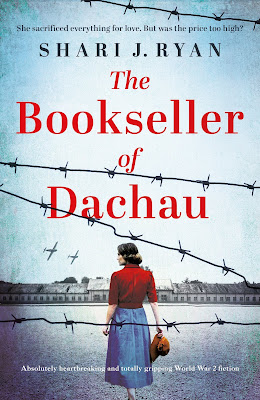
The Bookseller of Dachau by Shari J. Ryan - 2021 - 278 pages - A Novel


The Bookseller  of Dachau by Shari J. Ryan - 2021 - 278 pages - A Novel


There are two closely related narratives in The book Seller of Dachau.  One thread is set in Germany in the 1940s, one in 2018 to 2019, starting in New York City and ending in Dachau.  The older plot line centers on a teenage girl,Matilda, in love with a Jewish boy.  The contemporary thread focus on Matilda’s granddaughter Grace, in her late twenties, single working as an architect in Manhattan who has inherited a book store in Dachau.


As the story opens, Grace has received a letter from a law firm in Dachau saying she has inherited property from her grandmother.  Grace is completely shocked.  Her mother arrived in  America as an infant with no papers about her family, sent to escape the Holocaust.


Grace decides on impulse to go to Dachau to learn more about her inheritance. It turns out she has inherited a book shop there from a grandmother of whom she knew nothing.  


The story line then turns to 1939, Hitler is in power, spewing his hatred for Jews on the radio.  Her parents are not Jewish and have been friends for many years with a Jewish family renting another set of rooms in the same house.  Matilda falls in love with their son Hans.  One day his father is taken away while his mother and younger sister flea.  Matilda hide Hans in their attic.  


Events alternate in chapters.  For Matilda her father commits an unforgivable act, tied into the family making Matilda Grace’s grandmother.  Matilda curses her parents and leaves on her own.  She goes to Dachau thinking Hans may have been taken there.  In a very moving sequence of events, she meets the owner of a bookstore there.  This will change  her life, Grace’s and even that of Hans.  The bookstore owner has a son who is a guard at Dachau.  


2018, the bookstore is still open.  Grace cannot read and can only barely speaks German.  The book store’s manager, whose father became very close to Hans when both were inmates in Dachau, helps Grace read a series of letters Matilda wrote detailing her life.  They become close.  Grace relays her experiences to her best friend back in NYC.


The people in this work seem completely real.  The close was very gratifying to me in both time sequences.  It is an exciting very moving book.


I greatly enjoyed this meticulously researched novel.


“Shari J. Ryan is a USA Today Bestselling Historical Fiction writer. Her desire to write stories revolving Jewish livelihood during World War II stems from being a descendant of two Holocaust survivors. After the passing of Shari’s grandmother, she pursued an active interest in learning more about the inherited stories she yearned to understand better.


Shortly after earning a bachelor’s degree  from Johnson & Wales University, Shari began her career as a graphic artist and freelance writer. She then found her passion for writing books in 2012. In 2016, Shari began writing her first Historical Fiction novel, Last Words, a story about a lifelong journey through the eyes of a Holocaust survivor. With two character related books to follow, Shari quickly found a new passion to share untold World War II stories with a fictional setting. “ from sharijryan.com


I hope to read more of her work soon.


Melvin Ulm


Saturday, March 5, 2022

The Auschwitz Photographer: The Forgotten Story of the WWII Prisoner Who Documented Thousands of Lost Souls Kindle Edition by Luca Crippa and Maurizio Onnis


The Auschwitz Photographer: The Forgotten Story of the WWII Prisoner Who Documented Thousands of Lost Souls Kindle Edition by Luca Crippa and Maurizio Onnis - 2021 -378 Pages - translated by Jennifer Higgins from Italian 


There were two important factors that helped people survive in Auschwitz.  One was being part of  a network of connected fellow inmates willing to make sacrifices and take risks for each other.  Another was having a skill that was useful to the Nazis.  If you were a locksmith, a carpenter, a diamond cutter, a doctor, a skilled dressmaker,an accountant or as seen in today’s book, a highly skilled photographer  you had a much better chance of survival than an unskilled laborer.  Working inside was a huge advantage.  Plus The Nazis wanted inmates they came in close  contact with clean, free of lice. You also had much better food.  As in all stories of camp life, the search for food was never ending.  The camp guards were corrupt, stealing from camp supplies.


In 1939 Walter Brasse, a professional photographer is deported from Poland to Auschwitz brcause he refuses to swear allegiance to Hitler.  His mother was Polish, his father German, under German race laws he was an Aryan.  


The Nazis wanted three photographs of every new inmate.   Walter Brasse was assigned to take identity pictures of arriving inmates.  Soon camp employees are asking him to take pictures of them to send home.  He is very skilled at making people look good.  Over five years he will photograph over 50,000 inmates.  The notorious Doctor Mengele’s victims, including sets of dwarfs, were among his subjects.  He brings in more inmates to help him, saving their lives.


The Auschwitz Photographer is a stark reminder of the horrors of the camp.  Anyone interested in Auschwitz will be captivated by the story of Walter Brasse.


The close of the narrative was very gratifying to me.  We learn of the punishments given to the Germans who supervised Brasse’s work, as well as those who suffered no consequences.  


Melvin Ulm


Friday, March 4, 2022

The Yellow Wife by Sadeqa Johnson - 2021- 278 Pages

Yellow Wife by Sedeqa Johnson - 2021 - 278 Pages - A Novel


Set largely in Virginia from 1857 to 1874 is based on a true story about the life of a woman born into slavery, her mother was a plantation slave, her father the White plantation owner.


As the story open Phelby Brown becomes a house slave when another slave dies.  This puts her in frequent close contact with owner’s wife, who greatly resents her and who will send her to a slave’s jail to be sold when her husband is gone for a few months.  Phelby had been promised she would be given her freedom and sent to School in Massachusetts. 


Phelby, light skinned as was prized for Young girls sold as sex slaves, catches the eye of the jail owner.  Phelby enters into a relationship with him, pretending to love a man she despises, to stay alive and gain better treatment and status.  They have five children.


There are very vivid scenes of horrible whiippings  in Yellow Wife.  Slave owers sent their slaves to The Jail to be punished.  On one occasion a public beating of a captured runaway is turned into a Festival for whites and object lessons for enslaved persons.


Phelby knows she and her children are in spite of their light skin are totally at mercy of the jail owner.  He biggest fear is that her children will be sold and sent away never to be seen again.


Yellow Wife is a fast pased book with captivating plot turns.  The characters are very well realized.


The close was very gratifying.  


I highly recommend Yellow Bird.


“Sadeqa Johnson is the internationally best-selling author of four novels. Her accolades include being the recipient of the National Book Club Award, the Phillis Wheatley Award and the USA Best Book Award for best fiction. She is a Kimbilo Fellow, former board member of the James River Writers, and a Tall Poppy Writer. Originally from Philadelphia, she currently lives near Richmond, Virginia, with her husband and three children.”  From The authors website.  Sadeqajohnson.net


Mel Ulm


Tuesday, March 1, 2022

The Reading Life Review - February 2022

K

Row 1 - 


  1. Eric Larson - USA - author of five non-fiction best sellers
  2. Lucy Adlington- UK - Author of The Dress Makers of Auschwitz- fashion historian - first blog appearance 
  3. Madeleine Miller - USA - author of Circe and The Loves of Achilles 


Row 2


  1. Joseph O’Connor - Ireland - author of 11 novels
  2. Hiromi Kawakami - Japan- best selling author.


Only one author was featured for the first time, all are living, two are men, three women.


Home countries of February Authors


  1. USA - 2
  2. UK - 1
  3. Ireland- 1
  4. Japan 1


Blog Stats


Since inception our posts have been viewed 

6,620,632 times 


There are 4,043 posts currently on The Reading life


  I read three non-fiction but did not post upon them 


  1. The British Raj and the Conquest of India by Jon Wilson - 2016
  2. The Last Mughal by William Dalrymple -2006
  3. White Trash - The Four Hundred Year Untold History of Class in America by Nancy Isenberg - 2021


These are all very good works I would recommend to anyone with an interest in their subjects 


Top home Countries for visitors


  1. USA
  2. India
  3. The Philippines 
  4. Germany 
  5. Netherlands 
  6. Canada
  7. Turkey
  8. UK
  9. Pakistan 
  10. Russia 


Since the Ukrainian-Russia War began, the volume of Russian visits have fallen by ninety percent.


The top ten most viewed posts for February were all on short stories.  Posts on pre World War Two short stories by authors from India and the Philippines are consistently the most read of our posts


In March I will continue our long tradition of focusing on Irish Short Stories 


The year 2022 has been for our family one of great darkness.  My life will never be the same.


Mel Ulm


Featured Post

Imperial Reckoning: The Untold Story of Britain’s Gulag in Kenya by Caroline Elkins - 2005 - 701 Pages

  Imperial Reckoning:     The Untold Story of Britain’s Gulag in Kenya by Caroline Elkins - 2005 - 701 Pages 2006 Pulitzer Prize Winner From...