Sunday, May 23, 2010

"The Mark on the Wall" by Virginia Woolf

"The Mark on the Wall" by Virginia Woolf  (10 pages, 1917)

I am in the process now of reading Virginia Woolf's (1882 to 1941) The Waves (1931) so when DS of Third Story Window responded to my request for short stories worth reading with "The Mark on The Wall" also by Woolf I decided it would be a good idea to read it.   It is also one of the earlier works of Woolf so it might give me a little bit of a chance to see her development in the 14 years between these two works.   These are the first two works of Woolf I have read and I will say more of my experience of reading her in my post on The Waves but as I see it now I think it is best on opening readings to sort of let the words flow over you (I resisted the urge to say in waves).    The language even in her very early story is strikingly beautiful and some of the text reads as if was from the narrator's stream of consciousness.  

In a way "The Mark on the Wall" is a kind of satire or mockery of intellectual pretensions and the posing of those who think they have real knowledge of the world.    To me it really does not matter too much what we see it as about as it is so gorgeous.  The story begins when the nameless first person narrator begins to try to fix in her mind the first time she noticed a mark on the wall in one of her rooms.

PERHAPS IT WAS the middle of January in the present year that I first looked up and saw the mark on the wall. In order to fix a date it is necessary to remember what one saw. So now I think of the fire; the steady film of yellow light upon the page of my book; the three chrysanthemums in the round glass bowl on the mantelpiece. Yes, it must have been the winter time, and we had just finished our tea, for I remember that I was smoking a cigarette when I looked up and saw the mark on the wall for the first time.

When the narrator ponders the dust in her room she is brought to mind the dust of Troy.   I said in my last post on Parade's End that that work was kind of a Cubist novel.    I think this is what is being relayed to us in this passage (and even if I am completely wrong it is a wonderful passage)

As we face each other in omnibuses and underground railways we are looking into the mirror; that accounts for the vagueness, the gleam of glassiness, in our eyes. And the novelists in future will realize more and more the importance of these reflections, for of course there is not one reflection but an almost infinite number; those are the depths they will explore, those the phantoms they will pursue, leaving the description of reality more and more out of their stories, taking a knowledge of it for granted, as the Greeks did and Shakespeare perhaps but these generalizations are very worthless.

When I see you I see you reflecting back to me in an infinite regression of mirrors.    I think that view point on the construction of knowledge (I am deliberately not saying discovery) is part of why there are references to events from the dawn of known history in this story.    It is also part of the reason for so many cultural references in Parade's End  and Ulysses.   The lines below are to me worth reading 100s of pages of oblique prose to discover:

No, no, nothing is proved, nothing is known. And if I were to get up at this very moment and ascertain that the mark on the wall is really what shall we say? the head of a gigantic old nail, driven in two hundred years ago, which has now, owing to the patient attrition of many generations of housemaids, revealed its head above the coat of paint, and is taking its first view of modern life in the sight of a white-walled fire-lit room, what should I gain? Knowledge? Matter for further speculation? I can think sitting still as well as standing up. And what is knowledge? What are our learned men save the descendants of witches and hermits who crouched in caves and in woods brewing herbs, interrogating shrew-mice and writing down the language of the stars?

We find out at the end of the story what the mark really is and I will not spoil it for those who have not yet read it.

I do not claim to understand this story and I think those who do claim that have missed the deeper meanings of the story.  Sometimes it is harder to not understand something than to try to impose a meaning.    I for sure loved reading it and will read more of her short stories.   I will try to post more on the extreme importance to Woolf to world literature in my post on The Waves.


If anyone has any suggestions as to short stories I might like please leave them in a comment.  I prefer and need stories that can be read on line.  thanks

Mel u

"A Good Man is Hard to Find" by Flannery O'Conner

"A Good Man is Hard to Find" by Flannery O'Conner (8 pages, 1955)

Flannery O'Conner (1925 to 1964-Savannah, Georgia, USA-southern region) is best known for her 32 short stories and her two novels, Wise Blood and The Violent Bear It Away.   In a recent posting I asked readers to suggest short stories I might like that I could probably read on line.   DS of Third Story Window (whose blog I have happily followed for a long time) suggested I look at Flannery O'Conner.   I had heard of her and knew she was from the American South and was highly regarded as a short story writer as I have seen her work on a number of "Best Short Stories" type lists but I have never read any of her work.       I did find one of her more famous, according to the interesting Wikipedia article on her, on line, "A Good Man is Hard to Find".   In fact I learned from Wikipedia that the story title comes from a well known song first recorded by Bessie Smith in 1928.

As the story opens a family is debating where to go on a little trip.

The grandmother didn't want to go to Florida. She wanted to visit some of her connections in east Tennes- see and she was seizing at every chance to change Bailey's mind. Bailey was the son she lived with, her only boy. He was sitting on the edge of his chair at the table, bent over the orange sports section of the Journal. "Now look here, Bailey," she said, "see here, read this," and she stood with one hand on her thin hip and the other rattling the newspaper at his bald head. "Here this fellow that calls himself The Misfit is aloose from the Federal Pen and headed toward Florida and you read here what it says he did to these people. Just you read it. I wouldn't take my children in any direction with a criminal like that aloose in it. I couldn't answer to my conscience if I did."

In the phrase "seizing at every change" we at once see the family structure if we look a bit.  Some of her stylistic devices and charm can be seen in this passage:


"A good man is hard to find," Red Sammy said. "Everything is getting terrible. I remember the day you could go off and leave your screen door unlatched. Not no more."
He and the grandmother discussed better times. The old lady said that in her opinion Europe was entirely to blame for the way things were now. She said the way Europe acted you would think we were made of money and Red Sam said it was no use talking about it, she was exactly right. 

Somehow this suggests intelligence wasted and the universal  yearning of the old for the good old days.   We also wonder why the grandmother sees Europe as to blame for everything.    It also seems like a conversation that they have had many times!    The road trip begins very badly with an accident when the cat the grandmother did not want to leave behind gets out of his box and sinks his claws into the driver's neck.   I could for sure visualize the wreck through the marvelous prose of the 3rd person narrator:


Then he got out of the car and started looking for the children's mother. She was sitting against the side of the red gutted ditch, holding the screaming baby, but she only had a cut down her face and a broken shoulder. "We've had an ACCIDENT!" the children screamed in a frenzy of delight.
"But nobody's killed," June Star said with disappointment as the grandmother limped out of the car, her hat still pinned to her head but the broken front brim standing up at a jaunty angle and the violet spray hanging off the side. They all sat down in the ditch, except the children, to recover from the shock
After reading this we come to realize there is something grotesquely wrong with the family when we ponder why the children are screaming in delight and why the daughter is disappointed that no one has been killed.   The prose has a kind of disconnected feel and now we are starting to learn why.   The family then encounters The Misfit as the escapee from the Federal Prison is called.   At first the family is terrified of him so the grandmother tries to engage him in a conversation in the hopes he will not kill them (he has two confederates with him):


"Jesus was the only One that ever raised the dead," The Misfit continued, "and He shouldn't have done it. He shown everything off balance. If He did what He said, then it's nothing for you to do but throw away everything and follow Him, and if He didn't, then it's nothing for you to do but enjoy the few minutes you got left the best way you can by killing somebody or burning down his house or doing some other meanness to him. No pleasure but meanness," he said and his voice had become almost a snarl.
"Maybe He didn't raise the dead," the old lady mumbled, not knowing what she was saying and feeling so dizzy that she sank down in the ditch with her legs twisted under her.


There is a theology lesson in this.  From a biographical stand point it may be useful to know O'Conner was a devout Catholic living in a very Protestant area.   This story can be read in just a few minutes.   I do not want to give away the ending but it was very savage.   O'Conner had far to short a life.   She graduated from The Iowa Writers Workshop.   Her father died young also of Lupus which also took her life.   She never married and as far as I could find in several on line biographies I read of her, never had any known romantic relationships.   Her life may have been sheltered and tragically short, but if "A Good Man is Hard to Find" is any proof, she knew a lot about life.   She was  very much into the reading life and supported herself it appears from the sales of her books, grants, speaking fees and fees for book reviews.

It appears there are a few more of her stories on line (If anyone knows where or if all her stories are on line please leave a comment) and I will read some more soon.    Maybe she is not on the level of Katherine Mansfield (I mean not everyone can intimidate Virginia Woolf) but I really liked this story.   In a few pages she not only brought the lead characters to life but recreates a culture, the rural American South of the early 1950s.   Maybe we would not  have wanted to live there but it is enjoyable to read about it.   She also avoids making  the characters seem like buffoons which a less talented writer would have done.
Here is the link to the story


Saturday, May 22, 2010

"The Doll House" by Katherine Mansfield

"The Doll House" by Katherine Mansfield  (1922, 5 pages)


Greetings to all our visitors from Muscat-please feel free to make a comment or just say hello-Mel U

"The Doll House" is third short story by Katherine Mansfield (1888-1923-New Zealand) that I have read this month.   Obviously I like her a lot.   I first read "Miss Brill" and then what some do consider her best work, "The Garden Party".   I was pondering what to read next when I saw that Joann of Lakeside Musings really liked Mansfield's "The Doll House" so I decided to read that next.    I can begin to see that one of the themes of Mansfield's work is the blindness of the upper classes to the humanity of those below them.   In "The Garden Party" the central female character has the very nascent near Buddha leaving the palace moment when she visits a poor family but she seems to pull back from opening a door that was there for her briefly.

The action in the story is quite simple.   A neighbor gives a fancy doll house to the Brunell children and they enjoy showing it off to their friends and school chums.   The story seems to me set in a rural part of New Zealand (though it might be anywhere) where there is only one school so sadly the children from elite families must mix in with children of the lower classes.    There is one problem at the school.   I will let Mansfield tell it as I love her prose:


For the fact was, the school the Burnell children went to was not at all the kind of place their parents would have chosen if there had been any choice. But there was none. It was the only school for miles. And the consequence was all the children in the neighborhood, the judge's little girls, the doctor's daughters, the store-keeper's children, the milkman's, were forced to mix together. Not to speak of there being an equal number of rude, rough little boys as well. But the line had to be drawn somewhere. It was drawn at the Kelveys. Many of the children, including the Burnells, were not allowed even to speak to them. They walked past the Kelveys with their heads in the air, and as they set the fashion in all matters of behaviour, the Kelveys were shunned by everybody. Even the teacher had a special voice for them, and a special smile for the other children when Lil Kelvey came up to her desk with a bunch of dreadfully common-looking flowers.


They were the daughters of a spry, hardworking little washerwoman, who went about from house to house by the day. This was awful enough. But where was Mr. Kelvey? Nobody knew for certain. But everybody said he was in prison. So they were the daughters of a washerwoman and a gaolbird. Very nice company for other people's children! 

Everybody hears at the wonderful doll house and everyone wants to see it.   One of the Brunell sisters decides the Kelvey's are not worthy to see the doll house.    One of the sisters and two of her friends begin to make fun of the Kelvey children for their low social status.   We know they got this from the adults in their lives and we know it is the class structure perpetuating itself.  One of the daughters sort of realizes there is something not right in refusing to allow the Kelvey girls to see the doll house.   Mansfield's description of the interaction of the children with each other and their real fear of the Kelveys (after all who knows what diseases they could have) is perfect.     In the hands of a lesser writer, the story might have come to a definite conclusion.   

I will read more of her stories regularly and post on them.   I think I will also read a couple more short stories by Kate Chopin (1850 to 1904) also.   Of the two, I see Mansfield as the greater artist but I also like Chopin a lot.     Nearly all of Mansfield's short stories can be read on line.    

If anyone has any suggestions as to good short stories please leave them in a comment.   I prefer stories I can read on line.   Thanks

Mel u


Friday, May 21, 2010

"The Rocking Horse Winner" By D. H. Lawrence

"The Rocking Horse Winner" by D. H. Lawrence (1926, 10 pages)

It has been a long time since I have read anything by David Herbert Lawrence (1885 to 1930).   I have read most of his major novels.   In fact I was once lucky enough to visit his range home in Taos, New Mexico, USA (now a museum) where Lawrence lived for two years after leaving England for a kind of odyssey. His most famous, though not most highly regarded, novel is Lady Chatterley's Lover which is still on the banned list in some places.   Several  things sort of stimulated me to want to read his perhaps most famous short story "The Rocking Horse Winner".   In doing a bit of research on Ford Madox Ford for my read along I discovered that FMF helped Lawrence become established as a writer and had a great regard for his talent.   Additionally I have been reading some wonderful stories by Katherine Mansfield and I learned she had a relationship with D. H. Lawrence which may have been a romantic one,  in which his wife Frieda had a part.   Mansfield was the model for one of the characters in Women in Love.   I am also in the process of discovering for myself the short story as a literary art form.    A few days ago I did a Google search on "best short stories of all time".   Of course I got lots of hits.   On a Manchester Guardian (culturally a better read than the London or NY Times-IMO) article on 10 top stories this one was listed.   I found a web page where I could read it on line so I decided to make it my next short story.

"The Rocking Horse Winner" is set in England in the 1920s in a middle class home, back in the days when the middle class had servants.   The atmosphere of the family seems to be what in the day might have been called "genteel poverty".   The expenses of the family often outrun the income of the father and a constant anxiety over money permeates the household.   As the story opens we see into the mind of the mother of  the family:
There was a woman who was beautiful, who started with all the advantages, yet she had no luck. She married for love, and the love turned to dust. She had bonny children, yet she felt they had been thrust upon her, and she could not love them. They looked at her coldly, as if they were finding fault with her. And hurriedly she felt she must cover up some fault in herself. Yet what it was that she must cover up she never knew. Nevertheless, when her children were present, she always felt the centre of her heart go hard. This troubled her, and in her manner she was all the more gentle and anxious for her children, as if she loved them very much. Only she herself knew that at the centre of her heart was a hard little place that could not feel love, no, not for anybody. Everybody else said of her: "She is such a good mother. She adores her children." Only she herself, and her children themselves, knew it was not so. They read it in each other's eyes.
The son in the family, Paul, begins to obsessively  ride a wooden rocking horse, almost as if he is possessed or is trying to drive the voices in the house out
And so the house came to be haunted by the unspoken phrase: There must be more money! There must be more money!
There is a local horse racing track near the family home and one of his uncles is an enthusiast.   Somehow the names of the winners of soon to be held horse races come to Paul as he rides the horse.   He rides himself almost into a trance, rocking back and forth as if in contact with another world.   Here is what he would do after his ride:


When he had ridden to the end of his mad little journey, he climbed down and stood in front of his rocking-horse, staring fixedly into its lowered face. Its red mouth was slightly open, its big eye was wide and glassy-bright.
"Now!" he would silently command the snorting steed. "Now take me to where there is luck! Now take me!"
And he would slash the horse on the neck with the little whip he had asked Uncle Oscar for. He knew the horse could take him to where there was luck, if only he forced it. So he would mount again and start on his furious ride, hoping at last to get there.

The family comes into a 5000 pound inheritance (very quick research puts this as well over 100,000 pounds today (about 6.5 million Filipino pesos).   Sadly this made things even worse in the house

The voices in the house suddenly went mad, like a chorus of frogs on a spring evening. There were certain new furnishings, and Paul had a tutor. He was really going to Eton, his father's school, in the following autumn. There were flowers in the winter, and a blossoming of the luxury Paul's mother had been used to. And yet the voices in the house, behind the sprays of mimosa and almond-blossom, and from under the piles of iridescent cushions, simply trilled and screamed in a sort of ecstasy: "There must be more money! Oh-h-h; there must be more money. Oh, now, now-w! Now-w-w - there must be more money! - more than ever! More than ever!"
This is not the end of the story.   I will let interested  readers discover it themselves.    When you read the last paragraph read the first one again.


I read that some place Freudian interpretations on this story.   Maybe  because of the reputation of Lawrence they see a sexual element in the riding of the wooden horse.   I think this is pushing things but I concede it might be an approach one could take.  I think this may also come from this being a frequently read in school by  young adults short story.   For sure the story is an attack on a society in which self esteem comes from what you own.   I enjoyed reading it and endorse it.   I do not see it as truly great literature and think in part its enduring popularity comes in part from its "teach- ability".     I could see students and others trying to figure out the what is really going on with all that obsessive hobby horse riding!    It is worth the short amount of time it will take to read it for sure.

Thursday, May 20, 2010

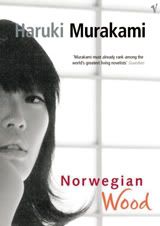
Norwegian Wood by Haruki Murakami

Norwegian Wood by Haruki Murakami (1987, 296 pages, translated from the Japanese by Jay Rubin, 2000)


Please Leave a Comment 

My Other Posts on Murakami

Japanese Literature on the Reading Life


I am developing quite a fondness and admiration for the work of Haruki Murakami.   Murakami (1949-) is for sure the best known outside of the country Japanese novelist writing today.   Perhaps he is not regarded with the reverence that Kenzaburo Oe is (winner Nobel Prize 1994) but millions of people world wide are devouring his books.   So far I have read (in this order), After Dark,  Dance, Dance, Dance, South of the Border West of the Sun, Sputnik Sweet Heart, and The Wild Bird Chronicles.    So far I think the scenes set in WWII in The Wild Bird Chronicles are the most masterfully written of his work and I think Sputnik Sweet Heart is the most fun of the works.   That is until I read Norwegian Wood.  There are common themes and artifacts in all of these works.   I have posted on them in my other  posts on his novels so I will just post briefly on Norwegian Wood.   

Norwegian Wood was Murakami's first multi-million copy book.   A lot of people say it is their favorite of his works.   I liked it a really lot also.   It kept my attention throughout.   I felt I came to know the lead characters and I felt sympathy for them.   I have said before (and explained this is not a derogatory label) I see Murakami as kind of writing bookish boys fantasy books.   Norwegian Wood, set in the 1960s and full of American and British pop culture references and well as references to serious novels (Japanese and Western) read by the college student male character is for sure a fantasy book, among other things, for bookish boys and the men they become.    To give a bit of an example a beautiful female friend of the male character constantly talks to him about sex (but he will not get involved with that with her as he has a girl friend of sorts) and tells him she really wishes she had a way to learn about oral sex.   A very erotically described 13 year old lesbian seduces a woman who has never had a same sex encounter in a vivid passage.    In a bookish boys' book the male lead does not have an adult world job (the lead is college student in the 1960s), beautiful women throw themselves at him (Murakami is very good at describing women) and he sees through the corruption of the world of grown ups.    Norwegian Wood  lacks the magic realism element found in some of his other works.    

Obviously I really enjoy reading the work of Murakami.   I think I will read Wild Sheep Chase for my next of his works next as it  is a prequel to Dance, Dance, Dance.     There are deep themes about loneliness etc that are part of all of his novels but this is a book you can enjoy without a lot of heavy thinking.   If it were made faithfully into a movie it would be x rated and some would scream over the scenes with the 13 year old lesbian.

Mel u

"The Garden Party" by Katherine Mansfield


"The Garden Party" by Katherine Mansfield (12 pages, 1922 read at Dailylit.com  )

After reading "Miss Brill" (1920) by Katherine Mansfield (1988 to 1923) I did a book blog search on her to see  if any bloggers I am familiar with have recently read any of her stories.   There have been a lot of book blog posts on her in the last year.    The consensus among bloggers seems to be that "The Garden Party" was one of her very best stories.    Dailylit.com has it on line so I decided to read another of her stories right away.

As "The Garden Party" opens Laura Sheridan under the supervision of her mother is planning a garden party.   Readers in the 1920s in England and New Zealand would be aware that a garden party was meant to be a prestigious near formal occasion and an affair that was found only among the upper classes.   One of the most coveted English society invitations was to the annual Garden party at Buckingham Palace.   Laura is supposed to be in charge but we can quickly see her mother is a bit overbearing.  Mansfield sets the atmosphere of the anticipation of the event masterfully:
And after all the weather was ideal. They could not have had a more perfect day for a garden-party if they had ordered it. Windless, warm, the sky without a cloud. Only the blue was veiled with a haze of light gold, as it is sometimes in early summer. The gardener had been up since dawn, mowing the lawns and sweeping them, until the grass and the dark flat rosettes where the daisy plants had been seemed to shine.
I knew I was going to like the story as soon as I read those opening lines.   Rather near the home of the Sheridan's there is what the Sheridan family views as a wretched squalid community.   Right before the party is set to begin they learn one of the workers for  their party who lives in that area was killed in an accident.   Laura wants to stop the party but her mother will not hear it.   


A whole social history can almost be reconstructed from the conversation below between Laura and her mother over whether or not the death of the worker requires the cancellation of the party:


"But, my dear child, use your common sense. It's only by accident we've heard of it. If some one had died there normally--and I can't understand how they keep alive in those poky little holes--we should still be having our party, shouldn't we?"


Laura had to say "yes" to that, but she felt it was all wrong. She sat down on her mother's sofa and pinched the cushion frill.
Mother, isn't it terribly heartless of us?" she asked.
Is mother right? she thought. And now she hoped her mother was right. Am I being extravagant? Perhaps it was extravagant. Just for a moment she had another glimpse of that poor woman and those little children, and the body being carried into the house. But it all seemed blurred, unreal, like a picture in the newspaper. I'll remember it again after the party's over, she decided. And somehow that seemed quite the best plan..

After the party the mother has a jolly good charitable idea.   Why not pack up all the left over party food and take it to the family of the man that was killed?  (Of course with no thought to the fact that the cottagers had never eaten food like that all their lives.)   Laura goes into the area where the cottages are located.    Mansfield is such an artist that you can feel Laura's fear as she goes into this area.   It all seems dark and evil and ever so wretched.    Laura goes into the cottage and views the body of the deceased.   It is Laura's reaction to the body of the  man and the multiple interpretations that can be made of this that seem to give this story its power and lasting appeal.
There lay a young man, fast asleep--sleeping so soundly, so deeply, that he was far, far away from them both. Oh, so remote, so peaceful. He was dreaming. Never wake him up again. His head was sunk in the pillow, his eyes were closed; they were blind under the closed eyelids. He was given up to his dream. What did garden-parties and baskets and lace frocks matter to him? He was far from all those things. He was wonderful, beautiful. While they were laughing and while the band was playing, this marvel had come to the lane. Happy...happy...All is well, said that sleeping face. This is just as it should be. I am content.
Mansfield does not tell us what to make of this.   Is Laura just a silly rich girl who did not know that the poor have lives too or does she experience some kind of revelation when she sees the body?   Is this a mockery of  accepted views of death or is it a celebration of  them?   There is a a bit more to the story but I hope some may want to read it so I will not tell more of the plot.


I really enjoyed this story.   A lot, maybe all, of her stories can be read on line as they are now in the public domain.   For sure I will be reading more of her work.


If anyone has any suggestions for other short stories to read  please leave them in a comment.  

Mel u


Wednesday, May 19, 2010

"Miss Brill" by Katherine Mansfield

"Miss Brill" by Katherine Mansfield (5 pages, 1920)


The Reading Life Katherine Mansfield Project


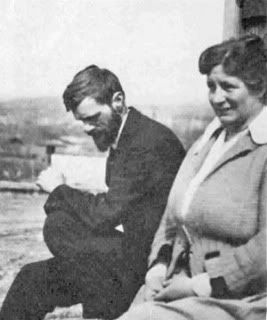
KM, Husband and
Brother in Law


Katherine Mansfield (aka Kathleen Mansfield Beauchamp Murry 1888-1923-New Zealand) is considered one of the great short story writers of the early 20th century.   She was a friend of D. H. Lawrence and Virginia Woolf.  D. H. Lawrence based the character of Gunden in Women in Love on Mansfield.   (As Mansfield traveled in some of the same circles as Ford Madox Ford in London I checked the net but I was not able to verify that she had any contact with him professional or otherwise.)

Short Stories:   East of the Web is turning out to be a great resource for me in my still beginning interest in the short story.     I admit I have never read anything by Katherine Mansfield before "Miss Brill".   I knew vaguely, I thought, that she was an important writer of the early 20th century (though below the status of the giants) that I probably should have read something by a long time ago.   As soon as I saw her story "Miss Brill" was one of the stories of the day on East of the Web I read it.   A bit of research validated it is one of her most highly regarded short stories.   

Miss Brill, a teacher of English is a seaside vacation town in France, goes to the park every Sunday by herself, her only company being a fur wrap (in the style of the time with the animals'  head still on the fur).   Miss Brill likes to see the people in the park as actors in a play arranged for her amusement.   She has a special seat she always occupies where she listens to the conversations of those around her.   The story is told in the third person in a kind of detached observing from on high mode.   I find her style a little hard to describe.   I prefer it to the other three short story writers of this era I have recently reviewed, P G Wodehouse, O Henry, and Saki as all of these writers, even though I liked each one a good bit, have a style that can be described as almost cute and near pandering to market needs of works published in popular magazines.   Here is the description of Miss Brill's' observations on one Sunday

 Only two people shared her "special" seat: a fine old man in a velvet coat, his hands clasped over a huge carved walking-stick, and a big old woman, sitting upright, with a roll of knitting on her embroidered apron. They did not speak. This was disappointing, for Miss Brill always looked forward to the conversation. She had become really quite expert, she thought, at listening as though she didn't listen, at sitting in other people's lives just for a minute while they talked round her.

Miss Brill delights in projecting lives on the people she sees in the park and passing condescending judgements on them.     As we quickly realize, this is how she derives her sense of self worth.    Nothing is said but with the mastery of Mansfield we quickly see Miss Brill's life is rather empty.   Miss Brill delights in objectifying the people she sees.   She likes to tie up the lives of the people she observes in the park in a neat little package that she can play with and laugh at.

Two young girls in red came by and two young soldiers in blue met them, and they laughed and paired and went off arm-in-arm. Two peasant women with funny straw hats passed, gravely, leading beautiful smoke-coloured donkeys. A cold, pale nun hurried by. A beautiful woman came along and dropped her bunch of violets, and a little boy ran after to hand them to her, and she took them and threw them away as if they'd been poisoned. Dear me! Miss Brill didn't know whether to admire that or not! And now an ermine toque and a gentleman in grey met just in front of her. He was tall, stiff, dignified, and she was wearing the ermine toque she'd bought when her hair was yellow. Now everything, her hair, her face, even her eyes, was the same colour as the shabby ermine, and her hand, in its cleaned glove, lifted to dab her lips, was a tiny yellowish paw. Oh, she was so pleased to see him - delighted! She rather thought they were going to meet that afternoon.

Miss Brill likes to talk to her fur (to visualize it recall that in the 1920s fox furs with heads on them were all the rage).    She sees nothing odd about this at all.   The fur seems to be her best friend almost.    One day an attractive young couple (we never learn any background information on Miss Brill such as her age, how she got to France, does she have a past of any kind etc) sit very near Miss Brill in the park.  Miss Brill is happy to see them as she thinks they will be an interesting part of the play in the park which she directs and writes for her great amusement.   I think it must have been the literary convention of the time to have sort of an ironic ending to short stories.   There is a depth and a sadness in the close of this story that will stay with me for a long time.


Just at that moment a boy and girl came and sat down where the old couple had been. They were beautifully dressed; they were in love. The hero and heroine, of course, just arrived from his father's yacht. And still soundlessly singing, still with that trembling smile, Miss Brill prepared to listen.


     "No, not now," said the girl. "Not here, I can't."

     "But why? Because of that stupid old thing at the end there?" asked the boy. "Why does she come here at all - who wants her? Why doesn't she keep her silly old mug at home?"

     "It's her fu-ur which is so funny," giggled the girl. "It's exactly like a fried whiting."

     "Ah, be off with you!" said the boy in an angry whisper. Then: "Tell me, ma petite chere--"

     "No, not here," said the girl. "Not yet."


On her way home she usually bought a slice of honey-cake at the baker's. It was her Sunday treat. Sometimes there was an almond in her slice, sometimes not. It made a great difference. If there was an almond it was like carrying home a tiny present - a surprise - something that might very well not have been there. She hurried on the almond Sundays and struck the match for the kettle in quite a dashing way.
     But to-day she passed the baker's by, climbed the stairs, went into the little dark room - her room like a cupboard - and sat down on the red eiderdown. She sat there for a long time. The box that the fur came out of was on the bed. She unclasped the necklet quickly; quickly, without looking, laid it inside. But when she put the lid on she thought she heard something crying. 
For sure Mansfield has created a world in this story.     Some may read this story and see it as exemplifying why they find short stories "leave them hanging".   We get interested in Miss Brill, we wonder about her life, we come to feel sympathy for a character we may not have initially felt any bond with at all then we are abruptly expelled from her world.  


I am very glad I have read my first Katherine Mansfield story.   She lived an very interesting and far too short life.   There is a wonderful web page that gives a lot of information about Mansfield and her circle  here.     Mansfield  was the daughter of a  chairman of the Bank of New Zealand and was largely supported by her father throughout her life.   A lot of her work can be read on line.     Her strongest influence as a short story writer was Chekhov.    I will be reading  more Mansfield.


Mel u

Featured Post

Imperial Reckoning: The Untold Story of Britain’s Gulag in Kenya by Caroline Elkins - 2005 - 701 Pages

  Imperial Reckoning:     The Untold Story of Britain’s Gulag in Kenya by Caroline Elkins - 2005 - 701 Pages 2006 Pulitzer Prize Winner From...