Saturday, August 21, 2010

"Mrs. Dalloway" by Virginia Woolf-On Learning to Read Woolf

Mrs. Dalloway by Virginia Woolf (1925, 195 pages)
I decided to read Mrs Dalloway as my third Woolf novel primarily because it is the novel most often mentioned in Hermione  Lee's wonderful biography of the author.    My first Woolf novel was The Waves, followed by Jacob's Room.    I also read and posted on two of her short stories and two of her essays on reading.    The Waves was my first ever encounter with Woolf and it was enough to make me start The Reading Life Virginia Woolf Project in which I will try to read all her short and long fiction.    Just prior to reading The Waves I read Ford Madox Ford's Parade's End which I had come to see as a kind of cubist novel in which reality is constructed socially from many points of view and this is sort of a way into Woolf.   The Waves and Jacob's Room to a lesser extent are novels of the stream of consciousness of the characters.     It is not easy on first reading to get the "action" straight in your mind and I think that is not the real pleasure in Woolf anyway.     A Woolf novel to me is not a puzzle to figure out.    The value to me lies in seeing how far we can enter into the stream of consciousness of the characters.   I love the many literary references in these works and the passing asides about the reading life are wonderful.     I have decided to let Woolf teach me to read Woolf though I totally endorse the Hermione Lee work.    My pleasure in Woolf is also personally reinforced by her association with Katherine Mansfield.   

Mrs Dalloway is about one day in the life of the lead character, Mrs Dalloway.    Most of her time and thoughts are taken up with the planning of a party.    The events also run sort of in tandem with the last day in the life of a war veteran.        I would not say I understood all the action nor did I worry over what I missed -what I took into my own stream of consciousness  will well reward my efforts.   Reading Woolf can be done very much for the beauty of the prose and the marvelous bits of streams of consciousness that can emerge when least expected.    At times the concerns of Mrs Dalloway some how brought to mind to me Eliot's "The Love Song of J Alfred Prufrock".   I hope my next long Woolf work will be Orlando though I may read some shorter works along the way soon.    

I am open for suggestions as how to approach Woolf.    As of now I plan to read the acknowledged master works first and short works sort of at random.    Please leave any ideas also as to very good secondary works on Woolf and her circle.

Thanks

Mel u

Friday, July 30, 2010

"At The Gate" by Myla Jo Closser

" At The Gate" by Myla Jo Closser-8 pages-circa 1915

I just read a short story that I liked so much I want to share it with those who read my blog. Any dog (or pet lover) will really love this story, I think.   Almost every day I at least look at the story of the day on East Of the Web:Short Stories.     The story today was "At the Gate" by Myla Jo Closser.     There is sparse biographical data available on Myla Jo Clossser.    There is no Wikipedia article on her.    She has only one published work that is known and that is this story.   She was born in 1880 but  I could not find a date of death or place of birth   I think it is safe to assume she was American.   She was married to Tarkington Baker who was it seems quite successful in the early days of the motion picture business.    He was at one time the general director of Universal Films which became in time the still existing Universal Studios.     I am assuming that this meant she had a comfortable and affluent life style.     She was cousin by marriage with the Pulitzer Prize winning author Booth Takington who was persuaded to writer for the movies by Closser's husband.   (I would like to know more about Myla Jo Closser and if anyone has any information please leave a comment).

"At The Gate" answers the question every child with a beloved dog has asked a parent, "Do dogs go to heaven?".     It is a simple story that would be a great read aloud for young children.  Anybody that has a bit of the child left in them will like this story.   The style has a simple hard to resist beauty.    As it opens a big Airedale, our lead character, is running through an unknown to him but very friendly seeming woods.    He is driven north by a smell.

The scent of the dogs grew very strong now, and coming nearer, he discovered, to his astonishment that of the myriads of those who had arrived ahead of him thousands were still gathered on the outside of the portal. They sat in a wide circle spreading out on each side of the entrance, big, little, curly, handsome, mongrel, thoroughbred dogs of every age, complexion, and personality. All were apparently waiting for something, someone, and at the pad of the Airedale's feet on the hard road they arose and looked in his direction.
At first the dog does not understand why all the other dogs ignore him as in his former home area dogs were all very interested in each other.   He sees there is a large gate and he wonders why the dogs are not trying to get through the gate and he is even more puzzled when it looks like the gate is open.    Why do not the other dogs go through the gates to looks for their human family?     He becomes friends with a bull terrier and we learn some of the dogs have been waiting at the gate for a long time and some have to wait just moments.    I do not want to tell any more of the plot this story other than just to say it will lift your spirits for sure.  

"At the Gate" is a really enjoyable read.    I admit personally in my mind I imagined cats at the gate!-    Your children will love this story also.   You can read it in under five minutes HERE.

If anyone has any suggestions for short stories I might like (and can read online) please leave a comment and if anyone has more data on Myla Jo Closser please leave  comment.

Thursday, July 29, 2010

"A Confession" by Guy de Maupassant

"A Confession" by Guy de Maupassant 1887-five pages-trans. unknown

July in Paris is almost over.     When I saw that the story of the day on East of the Web:Short Stories was "A Confession" by Guy de Maupassant I decided to read it.    I have already post on two of his works, Pierre Et Jean his  highly regarded novella and "A Father's Confession".     Having read only three of his works now it already appears family secrets and confessions of old sins are among the dominant themes of de Mausassant.   

Guy De Maupassant  (1850 to 1893-France)  was a very successful and highly productive writer.  He wrote six short novels, over 200 short stories and a vast amount of journalism.       He was a protege of Gustav Flaubert.   Guy De Maupassant made a very good amount of money from his writings.   He served in the Franco-Prussian War in 1870.   For ten years after the war he was a civil service clerk.   Flaubert, who knew his mother, encouraged him to pursue his literary interests.   One of his first short stories, about a prostitute during the Franco-Prussian, war was proclaimed a masterpiece by Flaubert and was hugely popular.   From the success of this De Maupassant began a career as a professional writer.   Through Flaubert he became friends with Zola and Turgenev.   (I will post soon on the story set in the Franco-Prussian War, "Duex Amis" -"Two Friends"-some of his works even when translated are still commonly referred to by their French titles)

"A Confession" is about two sisters who spent all of their lives together.     As the story opens the youngest sister is on her death bed and tells her older sister she has something she must confess in her presence.    I will tell a little of the plot.    The older sister had a true love who died when she was twenty five.    The woman put on widows clothes and mourned for the rest of her life.    Her younger sister, then twelve,  promised never to marry and never to leave her sister.    De Maupassant brilliantly creates a life in a few words:

They lived together all the days of their life, without ever being separated a single time. They went side by side, inseparably united. But Marguérite seemed always sad, oppressed, more melancholy than the elder, as though perhaps her sublime sacrifice had broken her spirit. She aged more quickly, had white hair from the age of thirty, and often suffering, seemed afflicted by some secret, gnawing trouble.
It is the cause of that trouble that is the subject of her confession.     I found the ending of this story very moving and powerful.   The story can be read in only a few moments and it might stay with you for life.     In just a few pages de Maupassant creates a world in miniature.    Some who do not like short stories may bemoan the fact that we do not have the details we would have in one of the behemoths of the 19th century novel and they are right.     We are given the freedom to create our own details by the genius of de Maupassant.  

This story can be read online here

If anyone has any suggestions as to other short stories I might like (an preferably can read online) please leave a comment.  

Thanks

Mel u


Wednesday, July 28, 2010

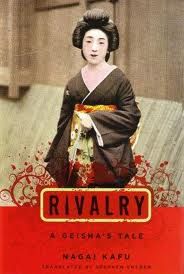
Rivalry: A Geisha's Tale by Nagai Kafu

Rivalry:   A Geisha's Tale by Nagai Kafu (1918, trans. by Stephen Synder 2007, 164 page)

Nagai Kafu (1879 to 1959-real name Nagai Sokichi) wrote about the world he lived in and loved, Geisha girls, exotic dancers, and prostitutes.    Maybe he is not among the immortals of Japanese literature of his period.     He was not an man of extreme culture and erudition like Ryunosuke Akutagawa .     He did not write a dozen novels  like Junichio Tanizaki that belong in the canon.     His face did not wind up on Japanese currency like Natsume Sosoki but he lived out the adage that one should write about what you know and love.    Here is a quotation from the  Japan Times in which Kafu kind of sums up his life:  "in Tokyo and even in the Occident, I have known almost no society except that of courtesans."      

Kafu attended a university but did not graduate, he studied French Literature as so many Japanese writers have.    He began to sell his short stories at age 19.    In 1903 his family sent him to Tacoma Washington (USA) to stay with family friends in hopes he would be turned away from his obsession with the pleasure quarters of Tokyo.    From there, I do not know why or how, he ended up in college in Kalamazoo Michigan (USA).    He then worked briefly for a Japanese bank in New York City.      While in the USA his only real interest was touring as many brothels and disreputable bars as he could.       Given the choice between living in a fancy area of New York City and a very poor area he choose the poor area to be close to the cheapest brothels.   Back in Japan he had two marriages that lasted less than a year each, lived for a while in a Geisha house, went to France for a year or so and published a collection of short stories on his trip to the USA and one on his trip to France.    Both of these collections were banned in Japan shortly after publication as they focused on the world Kafu knew and loved, brothels, bars and the poor side of town.    I think he wrote the only Japanese account of a visit to cheap American and French brothels prior to WWI.     

Rivalry:    A Geisha's Tale is set in the pleasure quarters of Tokyo.     One of the questions often asked in discussions on Japanese literature is whether or not a geisha should be seen as a kind of prostitute.    In Rivalry:   A Geisha's Tale  they  are treated as enterprising women who take a bit of cultivation but they are seen as basically prostitutes.      There is no negative value judgement made on the women in the life.  Kafu spent as much time and money as he could in the pleasure quarters.  That and writing his stories was his life   He never married again after his two youthful marriages and had no children.    I could not help but wonder if maybe his two wives were both unable to live up to the standards of the professional women Kafu knew.    We get a good look at  the day to day business of the life of a geisha.     We see the  varying status of the women in the profession.    We see that the Geisha try to find wealthy patrons or even husbands to set them up in their own geisha or tea house.    In one very well done scene a woman who used to be part of the scene returns for a visit  to lord it over her old coworkers now that she is married to a wealthy former client.   A tea house in the world of the pleasure quarter is a place where a Geisha and a customer could go for a liaison.  Some of the lower class tea houses were also brothels.    As a geisha aged and found no patrons she would often become more or less a woman on demand prostitute.     The geisha may have been trained to create an illusion of culture and refinement but they had no delusions about what their clients ultimately wanted from them.      The pleasure quarter is a too be expected entity in a society which expected women to be virgins at marriage and men to be experienced.   Made into a movie this book would have an R or maybe even an X rating.      We also learn about the men who live off the earnings of the geisha ladies, tea house girls and dancers.    They are referred to as the "parasites of the quarter".    We also learn a bit about the theater of the time.      Geisha girls all wanted to have the most famous actors of the time as their clients.    

Rivalry:    A Geisha's Tale is a an enjoyable read with well developed characters.    It gives us an open eyed look at life in the pleasure quarters of Tokyo in the 1910s.   It does not feel like a near 100 year old novel (of course it is a brand new translation by one of the highest regarded translators  of Japanese literature.)   I would endorse it to anyone interested in older Japanese novels.    I took a quick look at the Wikipedia list of novels published in 1918.    I have read only a few of them but I am quite sure Rivalry:    A Geisha's Tale would shock many of the original readers (and authors) of these books.     I am glad I read Rivalry:    A Geisha's Tale.   I sort of think of Nagai Kafu as the Japanese literary match for Henri de Toulouse-Lautrec.     It it also reminded me of a work I recently read for the classics circuit, Nana by Emile Zola which was set in the pleasure quarters of 19th century Paris.     The attitudes of Zola and Kafu to the world of the demimonde are very different.     

Mel u 

Tuesday, July 27, 2010

Katherine Mansfield-Four Stories-1911 to 1913


Four Early Katherine Mansfield Stories from Something Childish and Other Stories (1924)

"A Truthful Adventure" 6 pages, 1911
"New Dresses" 12 pages, 1912
"The Woman at the Store"  9 pages, 1912
"Ole Underwood"  5 pages, 1913

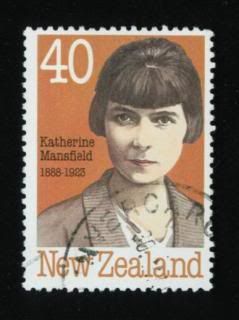
After Katherine Mansfield (1888 to 1923-Wellington, New Zealand) died her husband, John Middleton Murry anthologized her early short stories in two collections.    (There were already two collections of short stories published prior to her death.)     Some of the stories in this collection focus more on New Zealand life than those of her stories I have previously posted on.     Some of the stories in this collection could be compared (in terms of subject matter) to the works covered so far in The Reading Life Australian Bush Writer Project.    

"A Truthful Adventure"  is about a young woman, named Katherine, on a tourist trip to Burges, Belgium.   Burges was a beautiful town right across the English channel full of beautiful old buildings and museums with great Flemish master paintings.    It proximity to England made it a frequent short holiday destinations for people from London.     Katherine goes to check in at a local hotel and is informed the only place she can stay is in a private home owned by the hotel owner.   I have noted there is a lot of traveling in the stories of Mansfield just as there was a lot of traveling in her life.     I enjoyed very much the depiction of the relationship of Katherine to the porter in the hotel.    Part of this story is an acceptance of being along and the pleasure of traveling alone.   I think one of the larger differences between the work and lives of Woolf and Mansfield (and for that matter Kate Chopin and Jean Rhys) is how they related to being alone.   

"New Dresses"  starts right in the middle of a marital disagreement  over expenses.    As I read this I wondered if this was a flashback to Mansfield's New Zealand childhood (her father was  very successful banker).     The argument is well done enough to be painful to anyone who has ever had such a conversation with their spouse.    We also have to accept that it is a satire on the middle class as the story was written in a time and place where "bourgeois bashing" was very trendy.   

"The Woman at the Store" is a brilliant account of the effects of the loneliness on a woman left by herself in a remote New Zealand store.     The central characters in the story are an educated a bit affluent couple traveling through the back country of New Zealand and a woman who runs a store they stop at in their journey.       The travelers ask the woman if she is alone and she says yes her husband has gone shearing and she volunteers that in six years of marriage she has lost four children to a miscarriage.   One of the things this story is about is the relationships of members of different social classes to each other and the inability of the educated couple to really understand the woman left alone in the store.   I must quote this passage in part to show how Mansfield brings the New Zealand back country to life:

"There is no twilight in our New Zealand days, but a curious half-hour when everything appears grotesque—it frightens—as though the savage spirit of the country walked abroad and sneered at what it saw. Sitting alone in the hideous room I grew afraid. The woman next door was a long time finding that stuff. What was she doing in there? Once I thought I heard her bang her hands down on the counter, and once she half moaned, turning it into a cough and clearing her throat. I wanted to shout “Buck up!” but I kept silent."

There is nothing "youthful" or artistically immature about "The Woman in a Store".    .     The ending will shock you a bit by  its sheer power as it forces you into the mind of the woman traveler as she tries to come to terms with her experience.   

"Ole Underwood"   is another story set in the New Zealand back country.   The story is dedicated to Anne Estelle Rice, an illustrator for the journal edited by Middleton and a close friend of Mansfield.    Ole Underwood is a crazy old man wandering the back country.    One has the feeling that such figures were not unusual.   He murdered a man that killed his wife.

"In one corner sat a stranger. He pointed at Ole Underwood. “Cracked!” said one of the men. “When he was a young fellow, thirty years ago, a man 'ere done in 'is woman, and 'e foun' out an' killed 'er. Got twenty years in quod up on the 'ill. Came out cracked.”
“Oo done 'er in? “asked the man.
“Dunno. 'E dunno, nor nobody. 'E was a sailor till 'e marrid 'er. Cracked!” The man spat and smeared the spittle on the floor, shrugging his shoulders. “'E's 'armless enough."

Mansfield does make use of the prevalent speech patterns in her bush stories and I am glad she did as it makes the stories and characters more real for us.

I am  about one third way through Mansfield's short stories now.    I  also intend to read her notebooks and the standard biographies of Mansfield.   I hope this project will be largely completed by the end of September.    So far I have posted on thirty six of her stories  with some of the most famous ones sill to come.    


Mel u


Friday, July 23, 2010

Four Early Katherine Mansfield Stories

"Silhouettes" 2 pages, 1907
"The Tiredness of Rosabel"-9 pages, 1908 i
"The Journey to Bruges" 8 pages, 1909  
"How Pearl Button Was Kidnapped"  9 pages, 1910

Katherine Mansfield is either the best or the second best (to Virginia Woolf) female writer of short stories.   Mansfield's stories (I have now read and posted on 30 of them) are wonderful works of art that manifest enough intelligence to see through a dozen masks at once.  

Mansfield (1888 to 1923-New Zealand) first began to publish and be paid for her stories at age 18 while still living in New Zealand.     I think "Silhouettes" (1907) is her first published story.    Thankfully it is online at the Katherine Mansfield Society Web Page .    (Their web page is great resource for anyone interested in Mansfield.)    After her death Mansfield's husband John Middleton Murray published a collection of her earliest stories, Something Childish and Other Stories (1924).     Mansfield first met Murray through publishing one of her stories in a journal he edited.    The great New Zealand Electronic Text Center has the full text online.    There are twenty six stories in the collection.  

"Silhouettes", one of her very first published stories, is very brief and is of interest partially because she wrote it.       It does show her descriptive power and reflects already the sensuous quality of her latter work.


And I, leaning out of my window, alone, peering into the gloom, am seized by a passionate desire for everything that is hidden and forbidden. I want the night to kiss me with her not mouth

Say what you want about the prose, this is not something too many 18 year old women wrote 102 years ago.

"The Tiredness of Rosabel"   (1908) begins to show the power of Mansfield.     Based on my limited reading so far,   Mansfield seems better able to develop working class characters than Woolf.    Rosabel is a sales clerk in a fancy hat shop.   Most of the clientele who come in look down at her and she accepts this as natural.   One day a very handsome young man comes in with a lady friend about the same age as Rosabel and no better looking than her.    The woman is clearly very spoiled and difficult to  please but at last agrees to accept as a gift hat costing more than a month salary for Rosabel and she promises the man she will wear it at least once.    As Rosabel leaves work for her small forth floor walk up apartment she begins to imagine she is the girl friend of the man after he asks her on  the sly if she had ever been painted.    Mansfield enters beautifully into the fantasy world of Rosabel as she creates an elaborate vision of a society wedding.  

"How Pearl Button Was Kidnapped" (1910) is a strange story in that  left me initially puzzled as to what happens to Pearl Buttons.    Upon a bit of reflection on the use of the name "Pearl Buttons" I think we are to see Pearl as very young Maori girl who was kidnapped by slavers.     It was the custom in New Zealand at the time to give "comic names" to Maoris that were used as house or field servants and I think this would have been common knowledge by readers of this story.    Mansfield shows a keen awareness for colonial issues in this story (and elsewhere).

"The Journey to Burges" (1909) is the story of a young woman traveling alone on a short sea voyage from England to Burges in Belgium.     A young woman traveling alone is the frequent lead character in Mansfield's stories.   The fun in this story is in the passing observations on the fellow passengers.     Mansfield could be wicked!

I am perhaps one third of the way through my first reading of Mansfield's short stories.    Some of  the most highly regarded of her stories are yet to come.   I have also read some of her notebooks and her very neglected poetry.   Latter I will probably read at least Claire Tomalin's biography of Mansfield and perhaps others as well.

Mel u


Virginia Woolf by Hermione Lee

Virginia Woolf by Hermione Lee (1996, 893 pages)

Virginia Woolf by Hermione Lee (1948-England) is a great literary biography.    My only complaint on the book was that it was too short (and this for a book with 765 pages of small print-the rest is foot notes and index).   I felt sad when the book was over and I met a lot of people I want to learn more about in its pages.
I really want to learn more about Vita Sackville-West!

Not to long  ago I started The Reading Life Virginia Woolf Project in which I will be reading and posting on a lot of her fiction.    So far I have read The Waves, Jacobs Room, three short stories and two essays.   In part I was motivated to read Woolf for the first time by her relationship with Katherine Mansfield.   (Lee has a beautiful chapter devoted to Katherine Mansfield and her relationship to Virginia Woolf).    

In early 2009 I read Lee's biography of Edith Wharton so I knew in advance her book on Virginia Woolf would be an extremely well written and intelligent biography that would help to prepare me to read Woolf.   I totally endorse this book to any one with more than a casual interest in Virginia Woolf and her circle and times.  

Virginia Woolf is often, even though she died nearly 70 years ago, taken as the first modern woman writer.   From Lee's biography I was left with a picture of a woman in transition.   In many ways her life was very late Victorian.    She clearly did not like being alone and needed to have a very large cultural  and social anchor.   I think part of her ambivalent relationship with Katherine Mansfield comes from the fact that the sensibilities of Mansfield are more of a woman alone in the world cut from her roots whereas Woolf clung to her ancestry and her crowd all her life.

I plan to learn to read Woolf by reading Woolf.    I am now reading Mrs Dalloway (that is the work Lee speaks of most often).    I will read her short fiction as I can work it in and an essay occasionally.   I am open to any suggestions as to ideas of how to read Woolf (other than starting with her first novel and reading from there!).   I want to read her acknowledged best works first.   I plan in a few months to read Quentin Bell's biography of his aunt.  

Mel u

Featured Post

Imperial Reckoning: The Untold Story of Britain’s Gulag in Kenya by Caroline Elkins - 2005 - 701 Pages

  Imperial Reckoning:     The Untold Story of Britain’s Gulag in Kenya by Caroline Elkins - 2005 - 701 Pages 2006 Pulitzer Prize Winner From...