Sunday, April 21, 2019

Cold Atlas by David Mitchell - 2004


Cold Atlas is the fifth novel by David Mitchell I have had the pleasure of reading.  For sure it is the most challenging, highest retarded of his works.  There are six story lines in Cold Atlas.  The reader's first challenge is to ascertain what these stories of six different people in widely diverse places and times have to do with  each other and how they work together. (Wikipedia has a good summary article.)

I am behind in my posting so this post is going to be very brief.

Please share your experience with David Mitchell with us.


DAVID MITCHELL is the award-winning and bestselling author of Slade House, The Bone Clocks, The Thousand Autumns of Jacob de Zoet, Black Swan Green, Cloud Atlas, Number9Dream, and Ghostwritten. Twice shortlisted for the Man Booker Prize, Mitchell was named one of the 100 most influential people in the world by Time magazine in 2007. With KA Yoshida, Mitchell translated from the Japanese the internationally bestselling memoir The Reason I Jump. He lives in Ireland with his wife and two children. davidmitchellbooks.com Facebook.com/ davidmitchellbooks Twitter: @david_mitchell

I hope to read Number9Dream in May.


Saturday, April 20, 2019

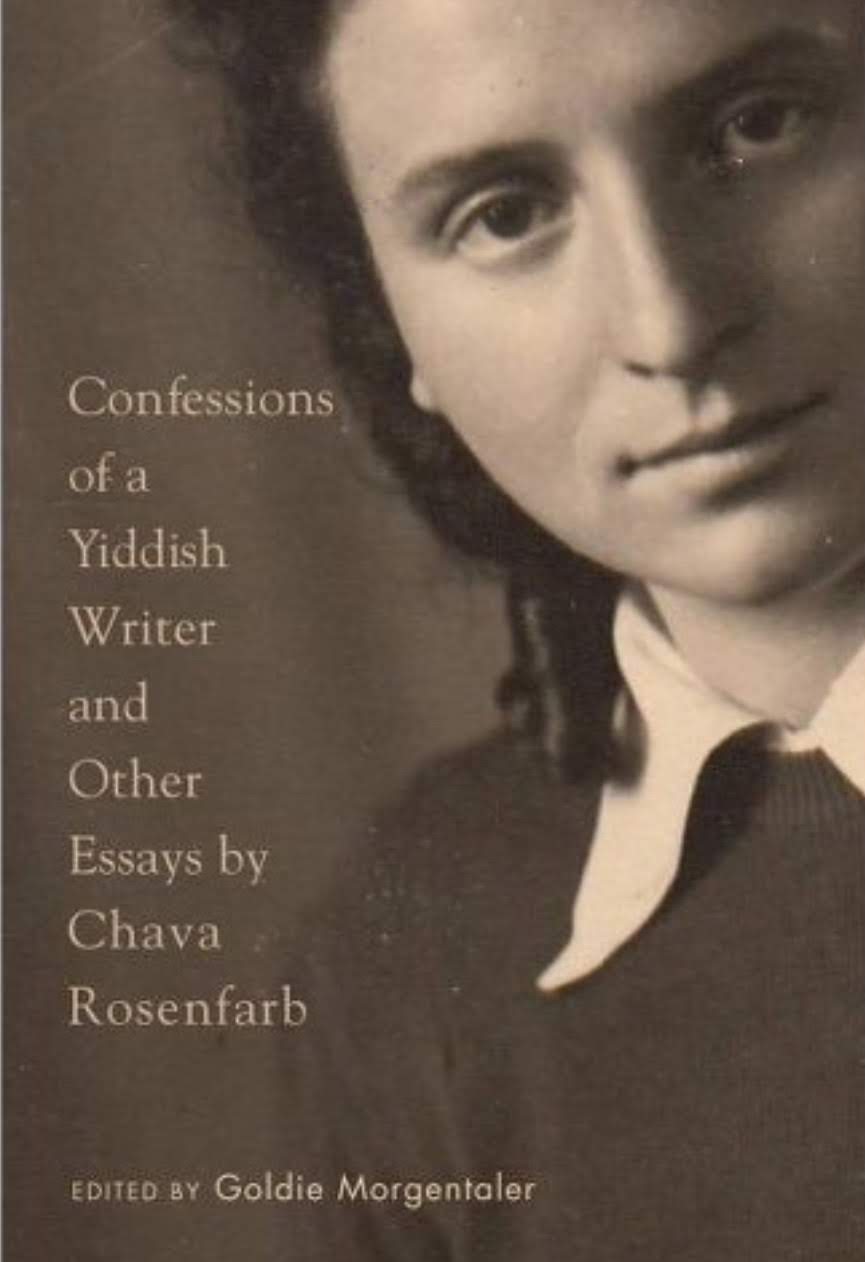
"Teaching I.L. Peretz’s Story 'Miracles on the Sea’ To Children Who Are Sentenced to Die" - An Essay By Chava Rosenfarb - circa 1942


Essential Resource on Chava Rosenfarb


 "Teaching I.L. Peretz’s Story 'Miracles on the Sea’ To Children Who Are Sentenced to Die"  - An Essay By Chava Rosenfarb - date of composition not given.  


Translated from the Yiddish by Goldie Morgentaler. Reprinted from Confessions of a Yiddish Writer and Other Essays, by Chava Rosenfarb, edited by Goldie Morgentaler, available this June. Copyright © 2019 McGill-Queen’s University Press.

"Springtime, when I see the carefree children of Montreal chasing each other in the parks, kicking balls in the alleys, or speeding by me on their bicycles; when their boisterous shouts and laughter rise from the yards and street corners to echo against the walls of my workroom, I am reminded of the children of the Lodz ghetto. Most often, my memory picks out the beautiful face of one dark-haired boy with large, coal-black eyes. Once, long ago, the radiance of those eyes, filled as they were with the infinite longing for spring, illuminated the oppressive gray of a classroom located in the attic of a factory building in the Lodz ghetto. The face was that of my favorite pupil, Shloymele."


There are images of five writers on the side bar of my blog, Chava Rosenfarb's is the most recently added.  She is one of the highest regarded 20th century Yiddish language writers.  In reading once again her biography I cannot help being shocked that she was sent to Auschwitz at age 21, along with her younger sister then 17 and their mother in her mid forties.  All survived.  

The essay featured today "Teaching I.L. Peretz’s Story 'Miracles on the Sea’ To Children Who Are Sentenced to Die"  is about her experience as a teacher in the Lodz Ghetto, she was about nineteen teaching Yiddish literature to boys in their early teens.  Rosenfarb very movingly describes what it was like teaching boys sure to soon be murdered in the Holocaust.  I cannot help but be in awe of the depth of strength this must have required.  

I first began reading Yiddish Literature in November 2012 when the Yale Press gave me the ten volume Yale Yiddish Library.  Reading on I began to see Yiddish culture as one that very deeply respected all forms of reading, not just that of the Torah.  (I highly recommend the essays in Adam Kirsh's Who Wants to be a Jewish Writer, forthcoming from Yale University to understand the importance of textual study.). I came to see the Holocaust as a war on a culture deeply into the reading life.  Upon liberation from a concentration camp, many asked for something to read before food or clean clothes.  

Teaching I.L. Peretz’s Story 'Miracles on the Sea’ To Children Who Are Sentenced to Die" deals with Rosenfarb's time in the Lodz Ghetto where she was a teacher in an illegal school for Jewish children.  Most all the children were doomed to be murdered and everyone, including them, knew this.  We can see the tremendous valuation given to education in the culture.  Most would just say why bother teaching literature to children who will soon be sent to a death camp?

"For these working children of the ghetto, illegal schools were organized in the buildings of the ressorts where they were employed. I worked as a teacher in one such school at the Metal-Works RessortNo. 2. My subject was Yiddish and Yiddish literature. The classroom was located in the loft of the building and was furnished with a few tables, benches, and a blackboard. The loft, though drafty and bitterly cold during the winter, was nevertheless spacious and bright. Beyond and below the small windows lay the ghetto, and beyond the ghetto, the city of Lodz could be seen spread out as in a bas-relief.  From that perch it was also easy to see German military vehicles stopping in front of the factory to unload the members of an army commission on their way to conduct an inspection.  In such an event, we all made ourselves scarce, sneaking down the back stairs of theressortand into the street.

My students were 11- to 12-year-old boys, since only men were employed at the Metal-Works ressort. Some of the boys barely looked their age, while others resembled withered old people. They climbed the stairs to the loft directly from their work stations, their faces and hands smeared black with machine oil and dirt. Disciplined and solemn, adult expressions imprinted on their faces, they slid into their seats on the long benches. There was not a trace in their conduct or demeanor of the playfulness or mischief characteristic of 11- or 12-year-old boys. Learning was serious business in the ghetto. With passionate greed they devoured the meager crumbs of knowledge that the teachers managed to put before them during the limited hours allotted for the lessons.
Shloymele, my favorite student, lived all alone in the ghetto. The rest of his family had been caught during a raid. On the morning of the raid he had left home to fetch the family’s turnip ration at the vegetable distribution place. While he was gone, his parents and siblings had been loaded onto trucks and transported to the train station. But Shloymele’s life had been temporarily spared."

I strongly urge all to read this powerful essay.  

I looked for Peretz's story in the books I have and online but could not find it.  


"Chava Rosenfarb was one of the most important Yiddish novelists and writers of the second half of the twentieth century. Her primary subject was the Holocaust; she was a survivor of the Lodz ghetto, Auschwitz, and Bergen Belsen.

She was born in Lodz, Poland in 1923. When she was a child, her father encouraged her to write about her experiences and to think about being a writer. In 1939, when she was 16, the Nazis invaded Poland – and her life was changed forever.  

She and her family were incarcerated, along with the rest of the Jewish population of Lodz in the Lodz ghetto. In the ghetto she wrote poems during those days of constant terror. She wrote about  the ongoing struggle to endure—writings she lost and later recreated from memory.

In 1944 when the Lodz ghetto was liquidated, Chava and her family were transported to Auschwitz and later to Bergen Belsen, before being liberated by British forces in 1945. After spending several years homeless and stateless in Europe, she came to Canada in 1950 and settled in Montreal.". From chavarosenfarb.com 

She died in 2011

There are other nonfiction writings online linked to this story.

Mel u


Thursday, April 18, 2019

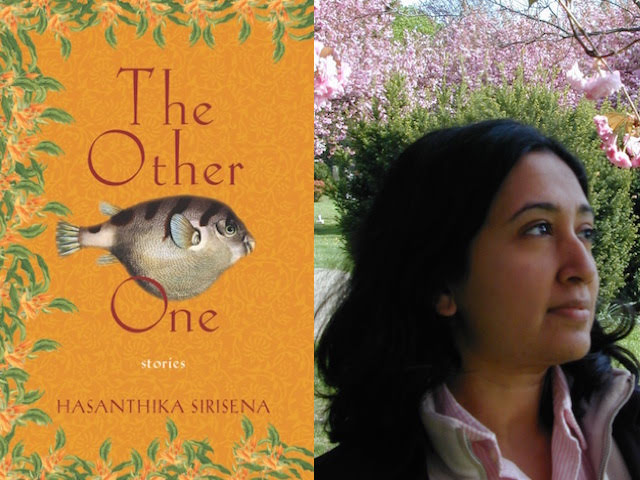
The Chief Inspector’s Daughter - A Short Story by Hasantika Sirisena - 2016


A Very Good Background Article on the causes of ethnic violence in Sri Lanka

I found this article very helpful in understanding The historical basis for the conlict in Sri Lanka between those of Singalese heritage and Tamils which has resulted in over 100,000 deaths.  This is the legacy of British Colonialism, 
going back over 200 years. Today's story arises from this history.


“Sri Lanka is a paranoid country. Twenty years of civil war makes us jump at our own shadows. Everyone has stories like Siva’s. Stories of cars and vans that come in the day or in the middle of the night." - from The Chief Inspector's Daughter


Today's story is set in the capital city of Sri Lanka, Columbo.  Narrated by a nineteen year old Singalese woman, a medical student and the only child of the chief inspector of the police department.  He was a widower who has seemingly no interest in remarrying.  They are very close and it expected she will take care of him in his old age.  Her boyfriend, also a medical student is from a wealthy Tamil family, a relationship unacceptable to both their families.


“We speak English to each other because I do not know Tamil, and he does not speak Sinhala unless he must. There are other things that divide us—different gods, different history—but Siva and I also have at least one thing in common. I want to urge him to find somewhere else we can drive to. I want nothing more than to ease the burning I feel whenever I am near him. The pure physical need that overcomes me too often these days


One night they are parked in a secluded area. Four Tamil men and a prostitute are found the next morning murdered execution style near the spot where they parked.  The woman asks her father if this could be the work of the Singalese Army or the police. She knows people have been tortured at the station where her father has an important job.  Her boyfriend begins to fear his family will be targeted, maybe murdered.  The daughter leaves the house one night, just walking around.  Two of her father's police officers find her and bring her home.

Things go terribly wrong between her and her father.  

I will leave the rest of the plot untold.  Hasanthika Sirisena brings out the impact of the ethnic hatred on a personal level.  A family is badly damaged.  Maybe the two medical students could have made a good marriage, bringing grandchildren for the widower.  His daughter tells him she hopes he dies alone.

This story appears in the debut collection of Sirisena, The Other One. This is a powerful story and for sure more of her work will be featured on The Reading Life.


Hasanthika Sirisena’s essays and stories have appeared in The Globe and Mail, WSQ, Narrative, The Kenyon Review, Glimmer Train, Epoch, StoryQuarterly, Narrative and other magazines. Her work has been anthologized in Best New American Voices, and named a distinguished story by Best American Short Stories in 2011 and 2012. She is a recipient of fellowships from the MacDowell Colony and Yaddo. In 2008 she received a Rona Jaffe Writers’ Award. She is currently an associate fiction editor at West Branch magazine and a Visiting Assistant Professor at Susquehanna University...from her website

This story is part of The Short Stories by South Asian Women Project.

From the author's Website

"Set in Sri Lanka and America, the ten short stories in this debut collection feature characters struggling to contend with the brutality of a decades-long civil war while also seeking security, love, and hope. The characters are students, accountants, soldiers, servants. They are immigrants and strivers. They are each forced to make sometimes comic, sometimes tragic, choices. What they share, despite what they’ve endured, is the sustaining power of human connection."

Oleander Bousweau


Monday, April 15, 2019

“Of Durians and Vipers” - A Short Story by Damyanti Biswas - The Griffith Review -2015


You May Read Today’s Story Here


“Of Durians and Vipers” by Damyanti Biswas

“Of Durians and Vipers” is set on a Durian plantation in Bali Pulau on Penang Island, Malaysia.  The plantation is owned by Rick, a Canadian expat, who has lived longer on Penang Island than his native Canada and his wife.  He is married to a Chinese woman, the daughter of a plantation owner.  His In Laws did not initially approve of him.


They have a sixteen year old Chinese-Canadian daughter Connie. Rick’s wife was the one who built up the plantation, ran the household, the durian business and got them on The Durian Plantation Tour program.  Now that his wife is very ill, Connie runs the tours.  Rick feels more than a little lost.  The tourists love to feast on Durians.  

Penang is a prime tourist spot for residents of Manila, Singapore and of course Kuala Lumpur.  It is a World Heritage destination for the architectural remains of the pre-World War Two era and has lots of beautiful beaches, five star resorts and such.  It is also famous for Durians.  Durians are but they smell horrible, so horrible airlines ban them.  Black and Yellow Vipers live in the trees.  We learn their bite is nasty but not normally fatal.  Of course nobody wants snakes in the house so Rick’s wife used to make sure the maids kept them out.  They do keep down rats and such so they have value.

Rick’s wife is now almost a complete invalid, rarely getting out of bed.  They employ two women as nurses, one an Indian and the other Chinese.  Rick is very involved in her care. Biswas does a brilliant job letting us see the impact this has on Rick. His wife used to totally take care of everything.  We see Rick oscillating from guilt to resentment.  Still a young man, he is deeply ashamed of his first ever act of adultery, with his wife’s Indian nurse.  I sort of got the feeling she was hoping when the wife passes, to play a role in Rick’s life.

Snakes are all over plantation, even entering Rick’s dreams.

The close is opening ending.  Has Rick found a solution to his problem?

“Of Durians and Vipers” is a first rate short story, in just a few pages Biswas shows us years of a marriage, lets us get an inside look at a Durian Plantation, and skillfully develops her characters.

I hope to read more of the work of Damyanti Biswas. There are links to other stories on her website.

This story Is part of The Reading Life Short Stories by South Asian Women Project.  

Oleander Bousweau 


Friday, April 12, 2019

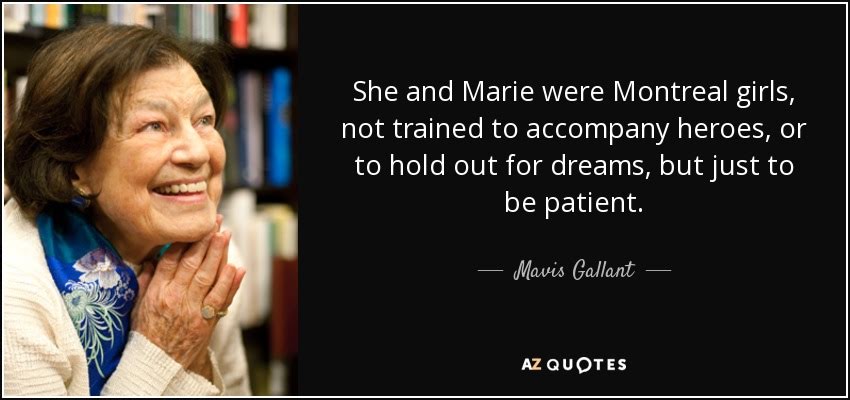
Varieties of Exile - A Short Story by Mavis Gallant - first published in The New Yorker - January 11, 1976


"Like every other form of art, literature is no more and nothing less than a matter of life and death. The only question worth asking about a story — or a poem, or a piece of sculpture, or a new concert hall — is, Is it dead or alive?".. 

Mavis Gallant

April 11, 1922 - Montreal

1950 - moves to Paris

September 1, 1951- publishes, in The New Yorker, her first short story.  She would go onto publish 116 stories in The New Yorker. ( I greatly enjoy looking at the covers of the issue in which a story was published.)

February 18, 2014 - passes away in her beloved Paris

Thinking about the quote from Gallant with which I began this post, all her stories past her test-she can put so much life in just a few pages.

“Varieties of Exile” is included in the collection Home Truths. It is one of six linked stories centering on Linnett Muir. (I learned from Buried in Print’s post on this story that Gallant wrote six linked stories about Linnett.) The first story in the series, “In Youth there is Pleasure” introduces us to a young woman moving back from New York City to her home town in Montreal.  I knew I was going to like her when I learned she was reading Sylvia Townsend Warner.  (If you have not read her Elfin Kingdom stories you are in for a real treat.  Like Gallant, Warner published many stories in The New Yorker.). She is maybe 18 and on her own emotionally and financially.

As “Varieties of Exile” opens World War Two has just started.  Montréal is inundated with European exiles.

“In the third summer of the war I began to meet refugees. There were large numbers of them in Montreal–to me a source of infinite wonder. I could not get enough of them. They came straight out of the twilit Socialist-literary landscape of my reading and my desires. I saw them as prophets of a promised social order that was to consist of justice, equality, art, personal relations, courage, generosity. generosity. Each of them–Belgian, French, Catholic German, Socialist German, Jewish German, Czech–was a book I tried to read from start to finish. My dictionaries were films, poems, novels, Lenin, Freud. That the refugees tended to hate one another seemed no more than a deplorable accident. Nationalist pig-headedness, that chronic, wasting, and apparently incurable disease, was known to me only on Canadian terms and I did not always recognize its symptoms. Anything I could not decipher I turned into fiction, which was my way of untangling knots. At the office where I worked I now spent my lunch hour writing stories about people in exile. I tried to see Montreal as an Austrian might see it and to feel whatever he felt. I was entirely at home with foreigners, which is not surprising the home was all in my head.”

As i read this, knowing Gallant wanted so much to leave Canada forever, if this is drawing at all on her life history.  I admit as i read the Canada based stories i look for her reasons for leaving.

All of her coworkers are older men.  Most married but they advise her against marriage.  She meets a man on a train.  She calls him an “English Remitance Man”.  A remitance man lives on money from home, sent on condition he live 
forever in Exile.  Usually he did something his father did not like at all so he paid him to leave.  As Linnett tells the story, the remitance man never really grows up, saved but cursed by his father’s money.  Linnett develops some feelings for him but he is married and her feelings were weak.

Linnett lives a Reading centered life.  She experiences things through her resding.  She makes a reference to Stefan Zweig.  I find this very interesting.  Zweig was driven into exile by his vision of a collapsing European culture.  Even though he made a fortune from his writings, he was kind of a remitance man.  His family wealth freed him to write, travel, and collect objects de art.
He was an Austrian Jew who tried to define himself as Austrian, in exile from his Ashganazi roots.  I saw that Linnett was reading “The Russians”, she is getting more into Central European Literature. 


As the story progresses Linnett marries.  As you read the Linnett stories keep in mind they are her looking back on the past.  She sees her past as part of a plot leading to her present.  


Thursday, April 11, 2019

A Tadge to Your Left - A Short Story by Janet H Swinney- 2019


Janet H Swinney on The Reading Life


Website of Janet H Swinney


“A Tadge to Your Left” is the sixth short story by Janet H Swinney to be featured on The Reading Life.  My posting on so many stories is the result of the high esteem I hold for her work.  Her stories range in setting from Indian to England.  (All of the stories I have featured can be read online, just go to my link above.)

“A Tadge to Your Left” tells two stories, in alternating paragraphs, a very interesting technique.  We first meet Hooter, a man teaching biology in an English High School. Here is our introduction to him:

“He wasn’t an old man, but he wasn’t fanciable either. There wasn’t one of them who would have volunteered to have anything to do with him. Chalky, the Maths teacher, on the other hand, or Blinker who taught music…

he was about thirty or forty. Neat, innocuous, straight up and down. Shit coloured trousers and a snot-green shirt. Spectacles that sat at the top of a long nose that he blew frequently on a khaki handkerchief. A wide, formless mouth with a moist lower lip. Straps of oily, no-colour hair plastered across the top of his head. Sometimes he wore a lab coat that made him look like a storeman in the Co-op. He’d only been there a couple of weeks when he got his nickname – Hooter.”

Our second character is Derek, a factory worker:

“She stirred in her bed. It was only Derek. Home late after a long shift at the Caterpillar factory.”

We learn a lot about their very different sex lives.  

I really do not want to give much detail of the plot involving Hooter.  He is a thoroughly nasty man who preys on his female students.  Once you realize what the title denotes you will feel a mixture of laughter and disgust.  Swinney does a great job presenting him and the atmosphere of the school.

In the thread of narrative on Derek we see a young couple in a financial struggle, wondering if they should have their first baby.

For sure “A tadge to Your Left” was a lot of fun to read.  

Maybe the common thread is both men are frustrated sexually, maybe Derek will remain a wage slave and Hooter wind up in prison.  Their
 lives are dominated by their feelings toward women. I can see a connection to the kind of schooling they probably had.

I look forward to following Janet H Swinney for many years.

About the author
Janet H Swinney was born and grew up in the North East of England, got her political education in Scotland and now lives in London. She also has roots in India, and her experience of life there has influenced her work.
Ten of her stories have appeared in print anthologies. The Map of Bihar was published both in the UK (Earlyworks Press) and in the USA (Hopewell Publications), where it appeared in ‘Best New Writing 2013’ and was nominated for the Eric Hoffer prize for prose. The Work of Lesser-Known Artists was a runner-up in the London Short Story Competition 2014, and appeared in ‘Flamingo Land’ (Flight Press, 2015). The Queen of Campbeltown appeared in ‘The Ball of the Future’ (Earlyworks Press 2016).
Several of her stories have been published by online literary journals, including the Bombay Literary Magazine, Out of Print, Joao Roque and the Indian Review.
Janet has had commendations and listings in the Fish International and Fabula Press Nivalis competitions, among others. A Tadge to Your Left was shortlisted in the Ilkley Literature Festival 2017. She is currently working on a play based on the stories of the Indo-Pakistani author, Saadat Hasan Manto. When she isn’t writing, she teaches yoga.

Mel u


Featured Post

Imperial Reckoning: The Untold Story of Britain’s Gulag in Kenya by Caroline Elkins - 2005 - 701 Pages

  Imperial Reckoning:     The Untold Story of Britain’s Gulag in Kenya by Caroline Elkins - 2005 - 701 Pages 2006 Pulitzer Prize Winner From...