Showing posts with label Japanese short stories. Show all posts

Thursday, December 21, 2017

“The Gourmet Club” - A Short Story by Junichiro Tanizaki- 1920 - translated by Anthony Chambers


Junichiro Tanizaki (1886 to 1965) is one of my “read all I can” writers.  Were he writing now, his every new  novel would be a bestseller, made into an international movie.  I have been reading his work for years.  Among my favourite of his novels are Naomi, Some Prefer Nettles and his most now read book, The Makioka Sisters, about four upper Class Japanese sisters in search of a husband, Austen fans love this book.  (Viking Press has very recently published his The Maids, told from the point of views of the maids of the four sisters.  As soon as this is out on Kindle I will read it!). 
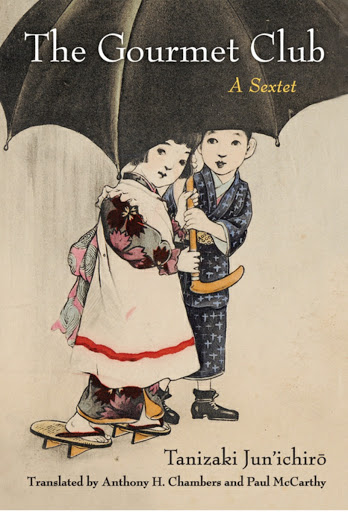


“The Gourmet Club”  gives us a fascinating look at high end dining by the rich in Tokyo during the 1920s.  The Gourmet Club has five members, all idol rich men bonded by their love of sybaritic dining, with an occasional exquisite prostitute as a side interest.  A man, known as “The Count” is the head of the group, which meets at his mansion.   They roam the city looking for Gourmet delights.  One day The Count is out scouting around alone.  He smells something wonderful cooking from a simple Chinese restaurant in a new to him part of Tokyo.  This turns out to be a wonderful source of traditional Chinese food, lovingly described by Tanizaki, who had a reputation as a gourmet himself.  It is a magic place.  The story is very worth reading just for the very detailed descriptions of the menus.  I will leave for your imagination the recipe for and the rituals associated with “Fried Korean Woman”.

As far as I know this story can only be read in the collection pictured above.  I was kindly given a copy of this book, which is a great edition to Japanese Literature in Translation.


Jun'ichirō Tanizaki

Born
in Nihonbashi,Tokyo, Japan
July 24, 1886

Died
July 30, 1965

Genre

Influences


Jun'ichiro Tanizaki (谷崎 潤一郎) was a Japanese author, one of the major writers of modern Japanese literature, and perhaps the most popular Japanese novelist after Natsume Sōseki. 

Some of his works present a rather shocking world of sexuality and destructive erotic obsessions; others, less sensational, subtly portray the dynamics of family life in the context of the rapid changes in 20th-century Japanese society. 

Frequently his stories are narrated in the context of a search for cultural identity in which constructions of "the West" and "Japanese tradition" are juxtaposed. The results are complex, ironic, demure, and provocative.  From Goodreads.


Mel u


Friday, December 2, 2016

"Delilah" By Hitomi Kanehara (2011, included in Digital Geishas and Talking Frogs, Best Japanese Short Stories of the 21th Century )


                                                                                      Hitomi Kanehara


When I first participated in Dolce Bellezza's Japanese Literature Challenge  in July of 2009 I had just begun my blog.  After Dark by Haruki  Murakami was  my first Japanese authored work.  From this start I went on to read numerous works by Japanese authors, participating in Japanese Literature Challenge  for eight years.  I have come to see the post World War Two Japanese novel as one of the great cultural treasures of literary history.  After a while I came to see much of Japanese literature as involved with an attempt to depict the cultural  consequence of Japan's loss.  They did not just lose a war, as the Germans did, the very foundation of their belief system, their culture and religion was destroyed when the Emperor told his subjects he was not a god.  This is very clear in the works of the two giants of the genre, Kenzaburo Oe and Yokio Mishima.  This year's challenge runs until at least the end of the year.  The challenge web page has lot of great reading ideas.


Pico Iyer in his very elegant and erudite introduction to Digital Gieshas and Talking Frogs Best 21th  Century Japanese Short Stories sees the stories as evolving from the destruction of the authority of Japanese father figures, from the Emperor who is a false god to the grandfathers who came home defeated, to the youths raised with no foundation of values.  Samurais were just figures in magna and cartoons, women in Geisha attire worked at car shows. The young lived in a semi tribal style,reveling in western music, video games and sex,   Hitomi Kanehara is one of the greatest chroniclers of the lives of the disaffected young, especially that of women,focusing on their sexual activity and relationships.

My main purpose here is to let those interested in Japanese literature know about the collection below.  (your first venture in this genre should be The Oxford Book of Japanese Short Stories).


Table of Contents:

  • The floating forest / Natsuo Kirino
  • The bonfire / Toshiyuki Horie
  • Ikebukuro West Gate Park / Ira Ishida
  • To Khabarovsk / Yoko Tawada
  • As told by a nocturnal witness / Jungo Aoki
  • Super-frog saves Tokyo / Haruki Murakami
  • The diary of a mummy / Masahiko Shimada
  • The female novelist / Maki Kashimada
  • Tsunami / Keichiiro Hirano
  • The sea / Yoko Ogawa
  • The no fathers club / Tomoyuki Hoshino
  • Delila / Hitomi Kanehara
  • My slightly crooked brooch / Noboru Tsujihara.

"Delila" by Hitomi Kanehara centers on a young  rootless Tokyo woman who has just gotten a job in a small bar.  She ends up having sex with the two men working there, there is no pretension of emotional connection.

Hitomi Kanehara was born in Tokyo in 1983. She dropped out of high school at the age of 15 to pursue her passion for writing, with the support of her father, Mizuhito Kanehara, a literary professor and translator of children’s literature. She wrote her first novel Hebi ni Piasu (‘Snakes and Earrings’) at the age of 21. The novel won the prestigious Akutagawa Prize and the Subaru Literary Prize. Her other works include Autofiction (Shueisha Publishing Co., 2006), and Hydra (Shincho Publishing Co., 2007).
from Comma Press

Mel u

Monday, July 8, 2013

The Japanese Literature Challenge 7. "The No Fathers Club" by TomoyukiHoshino (2006)


In July 2009 I first participated in Dolce Bellezza's Japanese Literature Challenge.   I am happy to be participating for the ffifth year.   If you are interested in learning about this marvelous reading area, the  Japanese novel is one of the greatest post WWII cultural treasures, then you will find lots of great ideas on the challenge web page.   Aside from the intrinsic pleasure it will bring you, knowing the literature of more than one countrynwill help you understand others, including what you may consider your literary home.

 In my several hundred posts on Irish literature, I have often said, following ideas of Declan Kiberd, Edward Said, and Franz Fanon, that one of the dominant themes of modern Irish literature is that of the weak or missing father.   In his very interesting introduction to Digital Geishas and Talking Frogs - The Best 21th Century Short Stories of Japan Pico Iyer says the title for the collection might well be Absent Fathers and Lost Kids.   Iyer says the theme of the weak or missing father dominates many of the stories in the collection.   Japanese literature, in my opinion, is still working out the consequences of the destruction of the belief system of their culture brought on by their defeat in WWII.    It is not hard to see the connection between this and the theme of the weak or missing father.    

"The No Father's Club" by Tomoyuki Hoshino  (1968) is a very interesting story set in contemporary Japan.   As the story begins a group of boys are paying soccer, only there is no ball.  They supply one with their imaginations.    Soon the boys find they have something else missing in their lives, a father.  Some of their fathers are dead, some just left, and some were just passing strangers.  The boys and girls of the neighborhood form a No Fathers Club.   The only strict requirement is that you have no father.   Soon they are all intensely talking about their imaginary fathers.   A strange couple is formed who propose their fathers should meet.   I found this a very interesting story.  

Author Bio


Born in Los Angeles in 1965, Tomoyuki Hoshino returned to Japan with his family before his third birthday and spent the next twenty-three years living in the greater Tokyo-Yokohama area.  After graduating with a degree in literature from Waseda University in 1988, he worked for two years as a journalist for the conservative Sankei newspaper.  He left that job and Japan to study abroad in Mexico from 1991-92.  After briefly returning to Japan, he received a Mexican government scholarship and resumed his studies in Mexico, where he stayed until August of 1995.  From 1996-2000, he tried his hand at writing subtitles for Latin American and Spanish films.

His debut novel The Last Gasp was published in 1997 and awarded the Bungei Prize. His second novel The Mermaid Sings Wake Up was published in 2000 and awarded the Mishima Prize. In 2003, he was awarded the Noma Bungei award for Fantasista, a collection of three novellas. His other book-length works include Naburiai (1999), The Poisoned Singles Hot Springs (2002), Lonely Hearts Killer (2004), Alkaloid Lovers (2005),A Worussian-Japanese Tragedy (2005), The Tale of Rainbow and Chloe (2006), We, Kittens (2006), The Examination Room for Plants (2007), Dokushin (2007), Mugendô(2007), and Suizoku (2009).
From 2004-2007, he taught creative writing at Waseda University.  He continues to write short stories, novels, and novellas, as well as essays and guest commentaries for newspapers and journals on topics ranging from sports to politics.  In 2006, the literary journal Bungei dedicated a special issue to Hoshino's writing that includes interviews, commentaries by other writers and critics, and the short story “No Fathers Club.”
In addition to his time in Mexico, Hoshino has traveled widely throughout Latin America, as well as Spain, Taiwan, Korea, the U.S., England, and India.  He has participated in Writers' Caravans with authors from India and Taiwan, and he continues to forge ties with his literary counterparts elsewhere in Asia in particular.  His fiction has won him the admiration of notable figures such as the celebrated Korean poet Ji-woo Hwang, who urged Hoshino to continue writing literature with "great depth of feeling."
Hoshino is also an avid soccer fan and amateur player whose commentaries on the game (including the politics of the 2002 FIFA World Cup co-hosted by Korea and Japan) have attracted a following independent of his fiction.


Mel u

Friday, September 21, 2012

"The Hole" by Ikujirou Ran

"The Hole" by Ikujirou Ran (1938, translated by Geoffrey Ivar)

I was so happy recently to find an anthology of older Japanese short stories on sale at a very fair price as an Ebook on Amazon.   A Collection of Japanese Short Stories, Vol I, (2011) edited and translated by Geoffrey Ivar includes ten short stories, all new to me writers.  Ivar's translations read beautifully and his brief author biographies are very well done.  

Ikujirou Ran (1913 to 1944, Tokyo) studied electrical science at the Tokyo Technical College.   His mother loved science fiction and he began to publish in science fiction magazines while still in college.  He died in an airplane crash in 1944.   I could find no other information on Ran online, in English at least, and I would really like to know if he served in WWII and if his death was war related.  If you know or have more information on him please leave a comment.

"The Hole" is told in the first person by a man who works as a guard in a Tokyo train station.  It is hard boring thankless work.    He and his supervisor are in the guardhouse, he is looking at the condensation on the windows, he is so bored.  Then the phone rings and his supervisor says 'Hm?  What?  A junk, eh, where?  Yes we're going"  My first thought is what is a junk?   A junk is the body of a person killed by the train.   Just about the worse part of their is jobs picking up dead bodies, sometimes they have to search a long time to find all the parts.   Every time they see a body, they think about the person.  Some are pretty obviously suicides.   One woman is found with her hands clutching her kimono, keeping it from riding up even as the train approaches.    Whenever someone is killed there is always an investigation.   The story lets us feel what is was like to be a guard and how disturbing it was to clean up after someone is killed by the train.   The story takes an interesting possibility paranormal turn that is perfectly done but I will leave rest of the story untold.

Geoffrey Ivar has done those interested in the Japanese short story who do not read Japanese a great service by providing translations of numerous older stories.  Most of the authors included in this story can be read nowhere else.  It is great to have a way to read so many pre-WWII short stories.  

More about Ivar work can be learned from his very interesting blog.

Mel u


Tuesday, September 13, 2011

The Oxford Book of Japanese Short Stories

The Oxford Book of Japanese Short Stories Edited by Theodore Goossen (1997, 452 pages)


A Wonderful Collection of Short Stories

A Good Starter Book on Japanese Literature
I have already posted on several of the stories in this collection.    Most of the "big names" of Japanese literature are among the thirty- five stories included in the anthology.   The translators include Donald Keen and Jay Rubin.   The stories range from the beginnings of "Western style" short  stories in Japan up to works by Haruki Murakami and Banana Yoshimoto.


Two of the most famous short stories by Japan's two Nobel prize winners for literature are  included.     Perhaps the most famous of all Japanese short stories "The Grove" by Ryunosuke Akutagawa is part of the collection.    A wonderful story by Yukio Mishima, "Onnagata" takes us deeply into the life behind the stage at a Kobe theater.   There are also two excellent WWII stories.   There are good stories about the darker side of the Tokyo nightlife and a look at the life of an old geisha.   


Theodor Goossen has done a great job with this book.   His short introduction is very useful and helped me a lot.   He also includes a short biography of each author,  a list of films made on their works, and a publication history.   


I read all these stories and there is not a bad one in the book!    Some are funny, some are sexy, some are very dark and several are world class masterworks of the art of the short story.   You can learn a lot about Japanese culture and history from these stories.


This book is also very useful as it lets you "sample" the writings of thirty five different artists.   There were a lot of "new to me" writers in this anthology that I hope to read more of in the future.


If you like short stories and/or Japanese literature, you will love this book.     This book might be the perfect first Japanese literature book for those who do like short stories.   


In his introduction Goossen says in Japan prior to WWII the short story was considered a "purer" form than the novel (meaning less Westernized).


I also have The Oxford Book of Short Stories edited by William Trevor and, leaving aside the question of the quality of the stories, Goossen has done a better job with his book.   


Mel u


Tuesday, August 30, 2011

"Onnagata" by Yukio Mishima

Onnagata" by Yukio Mishima (1957, 19 pages, translated by Donald Keene)

Behind the Kabuki Mask


A Yukio Mishima  (1925 to 1970) story translated by Donald Keene, this is as much of a guarantee of sublime quality as you are going to get anywhere.

Mishima (some times he is listed Mishima Yukio as he is in The Oxford Book of Japanese Short Stories) is a very complicated writer and man.   If someone were to ask me which Japanese fiction writer will teach you the most about Japanese culture, I would  answer "Mishima".    He is on my read everything that has been translated list.   (There is some background information on him in my prior posts on him.)

One question that should be asked in talking about national literature is what do the writers from the country have in common besides where they live and the language they speak?    For example Irish Short Story writers all have to define themselves with reference to James Joyce.   Their literary tradition demands a very high level of learning and intellect  from their writers.   They all at some point have to deal with the consequences of British colonialism and the disputes between Catholics and Protestants.   They all work in the background of great historical suffering combined with tremendous national pride.   All of their potential readers know that Ireland produced the most important novelist, poet and playwright of the 20th century and beyond.  

In Japanese literature one of the common characteristics (this  begins to fade out as one reads works written much after 1975 or so) is that an author can assume his readers know the very ritualized conventions of Japanese theater as well as the symbolic meaning of flowers, trees and animals.   This allows him to add layers of meaning to his story.   

An onnagata is a male actor who plays a female part in a Kabuki theater.   (There is a very interesting article here on the history of the onnagata )   Homosexual relationships were often depicted in Kabuki performances.   Just as in Sparta, an apprentice samurai was expected to accede to the sexual requests of his master.   This was not seen as a sign of a lack of masculinity but as a mark of respect.  

Our story centers on the life of a onnagata.   It is expected that in order to be at his best on stage that he will live his life as if he were a woman.   As such they are considered more feminine than ordinary women because they deliberately decide to act in accord with stereotypes.   Mishima does a wonderful job with notions of the blurring of the genders.   This is a beautiful brilliant story.

The story does a great job in taking us into the life and mind of the onnagata.   There is a tradition of theatrical prostitution and it was considered a near rite of passage for a young Japanese man of noble background to have this experience.

There is a historical irony here.  It is said that when Czar Nicholas II went on a tour of Japan (prior to ascending the throne) with his good friend Prince Youssoupon they visited a Japanese brothel in which the employees were all men dressed as Kubuki characaters.   From this the Russian leaders were said to have concluded that all Japanese men were like this so they felt they could easily beat them in a war.   Thus they lost the Japanese Russian War which helped set into motion the events that lead to the downfall of the Czar.  

Mel u


Friday, July 1, 2011

"Patriotism" by Yukio Mishima

"Patriotism" by Yukio Mishima (1966, 17 pages, translated by Geoffrey Sargent)


The Reading Life Japanese Literature Project


"Patriotism" is a horrifying deeply disturbing work.   It adds a coda to the famous lines from Keats

"Beauty is truth, truth beauty,- that is all

Ye know on earth, and all ye need to know."

The greatest beauty lies in a pure death.      Some might see the laughter of the  Gods in this story,   I see no laughing, not even Pan's, in the vision behind this story.  
   
"Patriotism" is an erotically charged death driven story that either glorifies or shames horribly a very old revered way of life, that of the samurai.    Or perhaps it does both at the same time, which is where its true power arises.


I have posted on several of Mishima's novels and five of his plays.    (You will find background information on Mishima -1925 to 1970-Japan in my five prior posts on him),     Mishima is firmly on my read everything that is translated list.     Mishima's work has a great deal to teach us about Japanese culture, for better and worse.     In my opinion the samurai culture that helped lead Japan into WWII is a under all the beauty and ritual a slave's religion.     Of course, I take the additional step that this is overall a  horrible flaw in the belief structure, whereas a believer feels that it is mandated by God that all obey God's overlord on earth, the Emperor.    From duty to the Emperor an entire superstructure of obedience follows.   It does not matter whether we like it or not.   A true God  Emperor does not require the affection of his subjects, only their obedience.


The story takes place in 1936 in the home of a 31 year old military officer deeply into the Bushido code of the Samurai and his 23 year old wife.    They are recently married and feel great passion and love for one another.    Mishima's depiction of their feeling for each other is very erotic and moving.   I felt the heat and you will too, I think.    The story opens with a caption on a commemorative photograph which tells us that a young army officer  has been deeply shamed because some of his colleagues in the army have been involved in a mutiny against their commanders.   He took no part in this episode but because other officers in his regiment did so it is now mandated that he commit ritual suicide.     It is further mandated that his wife must also accept her death.    Normally the husband will kill his wife before killing himself in order to insure she will in fact die.   In this case the husband shows great trust and love for his wife by allowing her to witness the beauty of his own self disembowelment (very graphically described) and then kill herself with a special dagger used for female suicides.    As I read this, I wondered what is the fate of children in cases like this (this couple is newly married and childless).   I am assuming it is the duty of the father to kill his children before his own death  but I am open to correction on this.


The story lets us see the real love the couple have for each other.   I felt no cruelty in the motivation of the husband to have his wife die with him, only a very powerful love, carnal as well as deeply spiritual.

There is an unblinking account of what it feels like and the personal and physical power it takes to kill yourself by disemboweling.   We are made to feel the knife slice through his entrails, we see the blood everywhere.   In a very powerful scene both man and wife ritually bathe themselves before committing suicide.     In a very very sad scene, we see the young wife putting on her makeup so she will have a proper appearance in the after world.    You can feel the love as the wife thrusts the knife into her neck (it is not proper for a Samurai wife to die by self disembowelment -to put it delicately, it can be a very messy way to die.)   She is concerned over the terrible mess others will have to clean up when their bodies are found.

There are no "punches pulled" in this story.     It is a glorification of ritual suicide.

It is the things we love most that will  ultimately destroy us.   The only escape from this is a life without passion or love.

"Patriotism" is a deep intense very serious short story.    "Patriotism" is, to me, a great work of art.

Mel u

Tuesday, June 14, 2011

"Granny Long Tongue" and Reading Japanese Short Stories Online

"Granny Long Tongue" by Chiba Mikio (2004, 4 pages)


Reading Japanese Short Stories Online
plus
An Ancient Japanese Monster  Story with a Modern Lesson


There is not a great deal of Japanese literature in translation online.   This is largely due to the fact that most of the translations even of older works are still not in the public domain.   Happily I know of at least one online literary magazine, Words Without Borders that has a number of translated short stories online (no fees  or registration required) including stories by some   famous highly regarded authors as well as works by lesser known authors.   Dolce Bellazza wants to make her Japanese Literature 5 challenge as inclusive as possible so if you simply read and complete a post on one short story you can list the challenge as complete.   I know, as I have been there, that a lot of  people like to complete reading challenges just for the fun of it (and to support the book blogging community) so you can participate in JL5 without spending any money or even leaving your home!

Here is the link to read Japanese Short Stories (maybe 15 in all) .   I also have a link to some short stories from prior to 1920 and I will post it soon.  

Chiba Mikio  (1941, Miyagli, Japan)is a scholar of Japanese mythology focusing on monsters and a highly regarded author of children's stories.   Monsters play a big role in Japanese art  (think about all those horror movies with the monster destroying Tokyo!) and "Granny Long Tongue" is kind of a children's story rewrite of an ancient myth with a modern lesson.   Here is the attention catching opening of the story:

"This story is set in the time when monsters were still living up there in the mountains and down here in the forests. Granny Long Tongue and Red Ban the Ogre lived high up on Mt. Okuyama, at Okumata Pass. The woman's tongue was longer than a snakevine, stronger than a stable boy's whip. Red Ban's face was broader than a cottage window, and when he bared his tusks and moved his face up close to yours, he was so scary that even the mountain bears rolled their eyes in fright."

Granny Long Tongue and Red Ban were the best of friends and they loved to scare people who came up on their mountain.    But they begin to notice that fewer and fewer people are coming.   Granny and Red are not really mean they just like to have a little fun.   Granny, riding on Red Ban, decides to go down from the mountain to see what is wrong.    They notice that  all the trees in the once beautiful forest have been cut down.  Granny tells Red Ban that the next rainy season there will be bad floods because of this and she is very upset.     Granny sees all the once  fertile top soil is washed away and at first they can find no people to scare (Red Ban is a monster and Granny has a 20 foot tongue.)  When they do find people they are too weak even to be scared!    They tell Granny they barely have enough to eat and lack the power to run from her and Red Ban.     The people tell Granny that the river where they used to get their water from is blocked by fallen logs.    The people ask Granny if she and Red Ban can help them.   At first Red Ban says the job of a monster is to scare people not help them but Granny tells him in times of crisis all must work together if any are to survive.  Soon the balance of nature is restored, the people have learned a lesson and Granny and Red Ban enjoy seeing their friends when they come up the mountain but not before they have scared them first!.

"Granny Long Tongue" is a simple reworking of ancient monster tales into a story made all the more moving by the recent tragic natural events in Japan.    It was translated by Michael Emmerich.


If you have any sources for reading Japanese Literature online that you can share please leave a comment.-thanks
Do you have a favorite Japanese short story?

I hope a lot of readers of my blog will sign up for Jl5 so I can learn from your posts!-

Mel u

Wednesday, June 8, 2011

Junichiro Tanizaki: 谷崎 潤一郎 Two Short Stories about Professors

"The Little Kingdom" (1918, 32 pages)
"Professor Rado" (1925, 36 pages)

Two Very Different Professors
by Junichiro Tanizaki
谷崎 潤一郎 


My Posts on Junichiro Tanizaki


The Japanese Literature Five Reading Challenge


I really like Junichiro Tanizaki an awfully lot.   Prior to today I have posted on 12 of his novels.    He is on all lists of best Japanese novelists and the venerable Harold Bloom includes his The Makioka Sisters  in his list of canon status works.   Juninchiro Tanizaki  (1886 to 1965-Tokyo, Japan-there is some background information on him in my prior posts) is also a lot of fun to read.    I think I have now read all of his translated novels and novellas and I am now happy to be starting on his short stories (I have texts of ten of his Short stories).  

Both "The Little Kingdom" and "Professor Rado"  are about teachers.    (Both stories were translated by Paul McCarthy.)    Both of the stories are well done and worth reading but I do not think they are quite up to the standards of his best work.

One think I have not found in my readings in the pre-WWII Japanese literature is a lot of interest in the lives of the poor, who would have been the vast majority of the citizens.    "The Little Kingdom" is the first work of Tanizaki where he focuses directly on people struggling on a day to day basis to survive.    The professor in this story has relocated from Tokyo to a smaller town in the provinces in the hopes that his expenses will be lower.  He supports his wife, seven children and his mother.    He teaches 5th grade boys  and is a highly regarded professional.   The scenes inside the class room are very well done.   Tanizaki does a great job of bringing the class room to life with his depiction of the personalities of  the boys and the professor.   There is an interesting development toward the middle of the story. I will leave the rest of the story untold.   I found this to be a good, though not great, short story.

"Professor Rabo" is a very different story.    As I read it I was pretty close to shocked by its depiction of a sexual fetish.   I admit I laughed out loud at some of the scenes.   Professor Rabo is a distinguished scholar and a  cultural magazine has sent  over a writer to interview him.    The reporter cannot get the professor to open up about anything.   He does notice something odd.   The 15 year old chambermaid has a sort of arrogant attitude for her station in life.  (The ages of some of the women in the works of Tanizaki and others give us trouble now.   In the times these works were written I think laws and attitudes were different.   Teen age girls were often sold by their parents as combination maids/concubines.)   The reporter comes for a second interview and hears some noises from the professor's study.   The door has been left open a bit and he sees the professor laying face down on his desk with his pants pulled down, the chambermaid is sitting on him and has a riding crop and beats him with it and sticks her hand in his mouth.    It is not explicit but the professor seems to have an orgasm during this experience.     The reporter is shocked.   He really wants to write an expose on this but his editor tells him he cannot.    One day the reporter sees the professor at a show that features a number of women in outfits that reveal their legs.   The reporter goes back to the professors house.   The professor asks the reporter to get him information on one of the women that he really is taken by.   The woman never seems to speak and always keeps her feet covered.   Now things get real strange, the professor begins to get data on the woman that makes him think she has leprosy, which is depicted as deforming the feet.   He assumes that is why the woman covers her feet at all times.    (spoiler alert.)  To telegraph things a bit, the reporter loses track of the professor until he hears he has married.   He goes back to his house.   He meets the chamber maid and she has lost her haughty demeanor.    Once again he hears some sounds from the study and peers through the door.   The woman's feet are deformed by leprosy and the professor has her big toe in his mouth and is also talking to the woman in baby talk.   When she responds she either has a bad speech defect or is meant to be a mentally challenged person.

Both of these stories were included in the Harper Collins Flamingo press edition of    A Cat, a Man, and Two Women.  

Mel u

Friday, June 3, 2011

"Sansho the Steward" by Mori Ogai- My Plans for The Japanese Literature 5 Reading Challenge

"Sansho the Steward" by Mori Ogai (1915, 28 pages, trans. by J. Thomas Rimer)

An Interesting Story about Slavery in Japan
My Plans for The JL5 Reading Challenge


This is my 3rd year in the Japanese Literature 5 challenge.    To participate you only have to read one book.    The challenge host, Dolce Bellezza, always does a great job supporting the challenge and provides us with lots of reading suggestions. Last year I participated in 50 reading challenges.   There are a lot of great challenge hosts but none better than Dolce.    

This year I hope to read The Lake and Asleep by Banana Yoshimto, two early novels by Kenzaburo Oe,  and the IQ84 by Hurakami Murakami when it is published in English in late October.   I think there is a good chance Dolce and I will be co-hosting a read along of IQ84 (it will be close to 1000 pages) and will announce details on this as we develop our plans.

This challenge year I will be focusing on Japanese short stories.    In a forthcoming soon post I will provide some links where you can read Japanese short stories online for free by classical as well as 21th century writers.   There are not a lot of  Japanese Short Stories online because most of the translations are fairly recent.    (All of the links I will provide are to legally online works.)

"Sansho the Steward" by Mori Ogai-1862 to 1922- (sometimes he is called "Ogai Mori") gives us a startling look at the 19th century practice of slaving in Japan.    Slavers operated in rural Japan, capturing who they could, mainly travelers, and selling them into slavery.   (I have provided some background information on the author in my post on his 1909 novel,  Vita Sexualis which is a shocking near autobiographical look at his sexual history which was got him censored by his superiors in the Japanese Army Medical Corps-he was a doctor.)

As the story open a mother,30,  her son  12 or so and daughter 14 along with a long time family helper, 40, are embarking on a trip to see the husband.   He left their area some two years ago to seek employment.   They know where he said he was going.   This is what would be called the opening exposition of the story.   This is followed by some drama when a seemingly ever so kind and helpful stranger warns them to be aware of slavers operating in the area and offers to shelter them for the night and help them on their way for the next day.   This is all done very well.   I was very much in sympathy with the small family and worried about them and I was wondering about the kind stranger.    Then there is a big development, the kind stranger turns out to be a part of the slaving operation and the two children are sent to be sold as slaves and we do not at this point know what has happened to the mother.    Ogai does a great job of building up suspense and made me feel just what a lawless place Japan once was.    I was horrified when I thought the two children were going to be branded on their foreheads as runaways.   Ogai really bring everyone to life and makes us see how slave labor was part of the economy.

Up until this point this is just a perfect wonderfully done story.   Then the author kind of gives in to the need to have it end happy in a sort of predictable not really exciting way.   It is not easy to bring a short story to a strong conclusion.   R. K. Narayan is a master of this.

"Sansho the Steward" is very much worth reading.   It is an excellent short story that brings an alien world to life for us.   It falls short of greatest because of the week ending.  

This work is the lead story in The Oxford Book of Japanese Short Stories, edited and introduced by Theodore W. Goossen. I will talk more about this wonderful anthology in future posts.


Mel u

Featured Post

Imperial Reckoning: The Untold Story of Britain’s Gulag in Kenya by Caroline Elkins - 2005 - 701 Pages

  Imperial Reckoning:     The Untold Story of Britain’s Gulag in Kenya by Caroline Elkins - 2005 - 701 Pages 2006 Pulitzer Prize Winner From...