Showing posts with label Penelope Fitzgerald. Show all posts

Sunday, August 28, 2022

The Bookshop by Penelope Fitzgerald - 1978 - Introduction 2014 by David Nicholls - Preface by Hermione Lee


The Bookshop by Penelope Fitzgerald - 1978 

  • Introduction 2014 by David Nicholls - Preface by Hermione Lee

Earlier this Month I posted on At Freddie’s, Penelope Fitzgerald’s novel set in a Children’s theater in London.


Prior to this month The Beginning of Spring was the fourth novel by Penelope Fitzgerald which I have had the great pleasure of reading.   I have posted on her Offshore, then her acknowledged by all masterwork, Blue Flower based on the life of Novalis, one of her numerous short stories, as well as a novel, Human Voices set at the BBC during 1940.  I also read Penelope Fitzgerald:A Life by Hermione Lee.


The Bookshop is set in the imaginary small English Seaside town of Hardborough,said to be a thinly disguised version of Southwold.  Florence Green, a middle aged widow, has decided to open a book store. She picks as her location an abandoned building said to be haunted by a poltergeist.  We go along as she applies for a bank loan, overcomes lots of obstacles and at last opens.  For a year she does well, steadily building clients, starting a lending library, establishing relationships with wholesale book vendors and even hires a teenage helper and a part time bookkeeper. We get glimpses of the lives of numerous village residents.  Basically if your family has not lived their for at least two hundred years you are considered a  new arrival.


Then the very influential wealthy Mrs Gamart decides she wants to start a cultural center using the bookstore property. Her nephew, member of parliament for the area, gets a bill passed which allows the town to force Mrs Green to sell her property to be used for the cultural center. Sadly Mrs Green is evicted.


The novel focuses on class differences, snobbery and micro aggressions perpetrated on Mrs Green as well as the love of some residents for her store and for books.  It was a lot of fun learning what happened when she displayed Lolita in the window of her store.


The Bookshop  was short listed for The Booker 

Prize.


I greatly enjoyed the Bookshop . It is for sale as a Kindle for $1.95.


PENELOPE FITZGERALD (1916–2000) was one of the most elegant and distinctive voices in British fiction. She won the 

Circle Award in fiction for The Blue Flower, the Booker Prize for Offshore, and three of her novels—The Bookshop, The Gate of Angels, and The Beginning of Spring—were short-listed for the Booker Prize.


Tuesday, August 16, 2022

At Freddie’s by Penelope Fitzgerald- 1981 - 192 pages. With a preface by Hermione Lee and an introduction by Simon Callow - 2013


At Freddie’s by Penelope Fitzgerald- 1981 - 192 pages. With a preface by Hermione Lee and an introduction by Simon Callow - 2013 


Prior to this month The Beginning of Spring was the fourth novel by Penelope Fitzgerald which I have had the great pleasure of reading.   I have posted on her Offshore, then her acknowledged by all masterwork, Blue Flower based on the life of Novalis, one of her numerous short stories, as well as a novel, Human Voices set at the BBC during 1940.  I also read Penelope Fitzgerald:A Life by Hermione Lee.


PENELOPE FITZGERALD (1916–2000) was one of the most elegant and distinctive voices in British fiction. She won the 

Circle Award in fiction for The Blue Flower, the Booker Prize for Offshore, and three of her novels—The Bookshop, The Gate of Angels, and The Beginning of Spring—were short-listed for the Booker Prize.


At Freddie’s is set in London in 1962 centered on a theater for children.  Freddie is the long time manager.  The theater focuses on plays by Shakespeare even though the greatest demand for child actors is for commercials, TV and movies.  Freddie, a woman past her youth but still quite formidable, fends of bill collectors, male actors with egos, unions, theater critics, benefactors and deals with her employees. Freddie, Freddie Wentworth, is completely devoted to the theater.  


She lives at the theater in a dusty room that smells of moth balls She never married, has no children and as far as we know has never had any romantic entanglements . The theater gets help from adult actors and other theaters.  The staff includes an unskilled handy man, a dresser that may possibly have some malevolent tendencies.  English law requires that students enrolled at the theater have a certain amount of class room teaching.  Freddie hires two teachers, both from Northern Ireland.  The young students are egomaniacal and mendacious, lying being a theatrical necessity.  


At Freddie’s shifts between despair and comedy.  I very much enjoyed the narrative observations.  I felt I was there at Freddie’s theater backstage. 


I hope to read her novel The Bookshop this year.


Mel Ulm


Saturday, April 17, 2021

Innocence by Penelope Fitzgerald - 1986 - 324 Pages


 Innocence by Penelope Fitzgerald  - 1986 - 324 Pages


“Writers, over the long run, are judged by the truths they detect about the human condition, and the artistry with which they represent those truths.

Penelope Fitzgerald’s Innocence will last as long as mature and careful novel-readers continue to exist.”  Julian Barnes

2013


With a preface by Hermionne Lee and an Introduction by Julian  Barnes


Innocence is sixth of the nine novels wriiten by Penelope Fitzgerald.  It is my fifth of her works.  She also wrote three biographies. Innocence is set in Florence about 1952, just recovering from Mussolini.  


The opening chapter is a minature masterpiece of surrealism.  It goes back to the 14 century ancestors of a lead character.  A daughter is born, a midget.  Her Family shields her from her status by hiring midget helpers,making her think it is midgets who are normal.  From here we jump to Florence in 1950s.


Innocence is a comedy of manners centering on the marriage of a doctor focusing on neurlogical problems, to a significantly younger woman in Love with him.  The doctor has only a little money so her parents her not crazy for the match.


Fitzgerald wonderfully develops the characters, Major and Minor. Much of The novel focuses on conformity to tradition. A thirty something single doctor is expected to have a mistress and his is a seamstress, also a tradition.  The scene with her is just perfect.  She has no innocence about her place and quickly disrobes  and offers him sex when he visits. She shocked says “you do not want it?”


He tells her he is getting married soon and Will not be able to see her anymore. She shrugs.  Something hilarious that will enrage her husband when post marriage he discovers it will occur:


“In the following year, after she had left school for good, Chiara asked her father for ten thousand lira and went to a small dressmaker, recommended (as a relation by marriage) by the barber in the courtyard. Even here she met with some opposition.”


There is a lot on the Domestic lives of everyone involved. They do eventually get married.  There is a count, an English couple who love to host visitors, Land sales, hospital politics and much more. 


PENELOPE FITZGERALD (1916–2000) was one of the most elegant and distinctive voices in British fiction. She won the National Book Critics Circle Award in fiction for The Blue Flower, the Booker Prize for Offshore, and three of her novels—The Bookshop, The Gate of Angels, and The Beginning of Spring—were short-listed for the Booker Prize. - from The publisher.


I hope to do a full read of her works.


Saturday, December 16, 2017

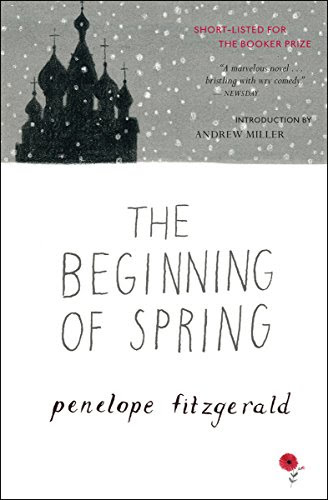
The Beginning of Spring by Penelope Fitzgerald- 1988

R


The Beginning of Spring is the third novel by Penelope Fitzgerald which I have the great pleasure of reading.  Prior to today I have posted on her Offshore, her acknowledged by all masterwork, Blue Flower based on the life of Novalis, one of her numerous short stories and Penelope Fitzgerald:A Life by Hermione Lee.

When I was recently learned the Kindle edition of her The Beginning of Spring was on sale for $2.95 i pushed in a happy decision the buy now button.  

The Beginning of Spring takes place  in Moscow in 1913.  The British born wife of an Englishman, himself born in Moscow, has suddenly abandoned him and her three children.  He thinks she probably hated living in Russia and has headed back to London.  

The man owns a moderate size print shop.  His business requires his hands on direction so his first priority is to find someone to take care of his three young children.  

To me the wonder of this novel is in the many small details.  We see the mass of regulations, each one hiding someone looking for a bribe, his business must deal with.  We learn lots about the many Human Resources challenges his business faces.  We are along for his search for a nanny.  

To me I greatly admired how Fitzgerald let us somehow feel tidal wave of destruction coming to Russia on the eve of the Russian Revolution without belabouring things.  People sense danger but they try to remain hopeful.  In one brilliantly done scene a prime minister who had promised to help the peasants and avoid a revolution is assassinated.  

Interesting things happen the kids and the nanny.  We wonder why his business manager is pushing a nanny on him, a beautiful young woman.  A mystery about her disappearance is subtly revealed toward the close of the novel.

There are beautiful descriptions of the Russian countryside, especially lovely at the start of Spring that evoked Chekhov and Turgenev for me.

I enjoyed reading this novel and hope to read more of her work.  The average estimated Reading time is under three hours, well worth the time.

From Manchester Guardian 

 Penelope Fitzgerald, that quiet genius of late-20th-century English fiction, who was born during the Great War at the end of 1916, began to publish in 1975. Over the next quarter of a century, she wrote the nine novels, three biographies (of Edward Burne-Jones, Charlotte Mew and the Knox brothers, her father and uncles), and the many essays and reviews that brought her such critical acclaim and a devoted following. In 1995, her haunting masterpiece, The Blue Flower, made her famous in her 80s. Since her death in 2000, the publication of her stories (The Means of Escape), essays (A House of Air) and selected letters (So I Have Thought of You), brought out by her executor and son-in-law, Terence Dooley, and by HarperCollins, have sustained her posthumous reputation.


Wednesday, March 19, 2014

Penelope Fitzgerald A Life by Hermione Lee (2014)


Penelope Fitzgerald A Life by Hermione is the second best literary biography I have read in many years, the best being Katherine Mansfield The Story Teller by Kathleen Jones.  I have read and posted on two of Fitzgerald's novels, The Blue Flower and The Book Store as well as one of her wonderful short stories. 

Lee's book is not just a very detailed, lovingly rendered account of the very long life of Fitzgerald (1916 to 2000, UK) who is now considered one of the finest of the last centuries writers.  She came from a very cultured literary, though hardly rich family.  Her uncles, the Knox brothers on whom she wrote a joint biography were very involved with Punch for many years.  It is fair to say her family nearly epitomized English brilliant shabby genteel literary eccentrics.  Fitzgerald did not begin her writing career until she turned sixty.  She is certainly an inspiration to all those sixty plus who want to try writing but wonder if they still can.  

I don't want to give a capsule version of Fitzgerald's life (you can just google her for that).  I will just talk about a few of the things I relished about this book.  A lot of the book is taken up with decades in which Fitzgerald struggled to raise her children under near poverty.  Her husband Desmond, who she often called, "The Irish Soldier" suffered horrible trauma in World War II, mostly from his having killed hundreds of people (he used to wake up screaming for years).  He worked as a travel agent when he lost his license to practice law due to fraud.  He worked as a travel agent and became a terrible alcoholic.  Their marriage was a far from happy one but it endured.  He died at fifty six.  The grinding poverty took a toll on Fitzgerald.  Even when she began to become secure financially she still was reticent to spend.

I really enjoyed the accounts of her relationships with her publishers, her work as an award judge, and a reviewer.  She was a very dedicated grandmother and mother. ,it was fascinating to see the kind of books she liked. 

I really felt I knew a good bit about Fitzgerald after reading this book.  It will help a lot if you have read at least her major books before you read this.  

This is a first rate literary biography and I am very glad to have read it.  I was given a free copy by the publisher.


Mel u
 

Thursday, October 17, 2013

"Desideratus" by Penelope Fitzgerald. 1978


From Manchester Guardian 

 Penelope Fitzgerald, that quiet genius of late-20th-century English fiction, who was born during the Great War at the end of 1916, began to publish in 1975. Over the next quarter of a century, she wrote the nine novels, three biographies (of Edward Burne-Jones, Charlotte Mew and the Knox brothers, her father and uncles), and the many essays and reviews that brought her such critical acclaim and a devoted following. In 1995, her haunting masterpiece, The Blue Flower, made her famous in her 80s. Since her death in 2000, the publication of her stories (The Means of Escape), essays (A House of Air) and selected letters (So I Have Thought of You), brought out by her executor and son-in-law, Terence Dooley, and by HarperCollins, have sustained her posthumous reputation.

Penelope Fitzgerald (1916 to 2006) is the author of The Blue Flower, set in Prussia in the 18th century and centering on Novalis, one of the greatest German Romantic poets.  It is the best historical novel I have read since I began my blog in July, 2009.  I was very glad to see three of her short stories are included in an anthology of short stories I recently acquired.  

"Desideratus" is set in the late 17th century, probably in England.  It seemingly simple story with
some baffling turns.  A boy in his teen from a large poor family has one great treasure, a medal
his late grandmother gave him.  He takes it everywhere and one day he loses it.  He finds it in a
pond under a foot of ice.  He tries to break the ice but he can't so he realizes the ice will met in a day or so 
so and he decides to wait.  He goes back and it is gone.  He sees a pipe leading to a manor
house so reasons it might be near the house.  I will tell one of the mysteries, leaving the odder
deeper one untold.  He knocks on the door and a man tells him he is the family tutor.  He asks him 
how many children are living there.  He is told there are none and have never been any as the master
of the house did not reproduce himself.  We, as was the boy, are perplexed by why a tutor is needed.  
Then something deeply strange happens.

This is a quietly wonderful story.  No one will ever list it among the world's greatest but I think it
will stick in my mind for a long time.  I will return to her work soon, I hope. 


Featured Post

Imperial Reckoning: The Untold Story of Britain’s Gulag in Kenya by Caroline Elkins - 2005 - 701 Pages

  Imperial Reckoning:     The Untold Story of Britain’s Gulag in Kenya by Caroline Elkins - 2005 - 701 Pages 2006 Pulitzer Prize Winner From...