Thursday, December 10, 2020

The Man Who Hated God - A Short Story by Winifred Holtby - lead work in her collection Truth is Not Sober and Other Stories - first published 1934 - Blackthorn Press has republished this collection with a very informative introduction by Jack Bliss


The Man Who Hated God - A Short Story by Winifred Holtby - lead work in her collection Truth is Not Sober and Other Stories - first published 1934 - Blackthorn Press has republished this collection with a very informative introduction by Jack Bliss


Winifred Holtby


Born June 23, 1898 - Rudston, England


Died - September 29, 1935 - London


1936 - Her highest regarded work South Rising was published posthumously 


Winifred Holtby was a tireless campaigner for the rights of women,  minorities and was deeply disturbed by the rise of Fascism. If she were living now living in America she would be a supporter of the progressive ideas of Bernie Sanders.  Jack Bliss goes into depth on her politics.  She spent time in South Africa and was appalled by the treatment of Africans.


The opening lines in “The Man Who Hated God” without a doubt draw you in:


“ONCE upon a time there lived a man who hated God. He was quite impartial in his detestation. He hated Jehovah and Allah, and Christ and Brahma, and Buddha and Vishnu, and Siva and all their prophets. He hated them for really excellent reasons. The idea of God was, he considered, responsible for the great evils which men endured upon earth. Believing in the existence of another world, they made no effort to improve their life in this one.”


The man had a very good heart and began to make it his life work “to set free his fellow countrymen from their abominable superstitions.”.  He gave up his happy life to try to help others.  Everywhere he talked of how religious dogmas have been used through history to get people to accept being dominated by the upper classes.  Gradually he became so admired that he became the leader of his country with millions of followers.  


One day he finds himself in a boat with the Buddha, Visnu, Jesus,  and a few others.  He did not understand where he was.  Then somehow the boat passes a country with statues all over of him.  School children are required to memorize his sayings, and anyone who does not have a picture of him in their home can be shot.  To his horror he has been transformed into what he most hated “A God”.


The story can be read in under five minutes.  It reads for me in the style of a fable.


There are thirty five stories in the collection of 198 pages. For sure I will read them all.  I acquired the Kindle edition for $2.95


In his introduction Jack Bliss highly endorses the biography by The Clear Stream by Marion Shaw.  Luckily that is also available as a kindle for $2.95.  


Tuesday, December 8, 2020

The Witch - A Short Story by Tarasankar Bandopadhyay - first published 1940 - translated from Bengali by Aruna Chakravarti - 2020-published in The Borderless Journal


The Witch - A Short Story by Tarasankar Bandopadhyay - first published 1940 - translated from Bengali  by Aruna Chakravarti - 2020-published in The Borderless Journal


You may read today’s story here


I was initially made aware of this very valuable edition to translations of pre-idependence Sub-Continent Short Stories by  Mitali Chakravarty,  in a Facebook Post


The Witch tells a harrowing story of how a young woman of the Dom caste went from being just a girl wanting to marry the boy she loved to becoming an old crone living alone in a very harsh landscape with deadly supernatural powers.  During the British Raj period Doms were legally classified as not just Untouchables but as members of a criminal caste.  Doms were even after Independence required to register with the police for special monitoring.  Of course Doms could not marry outside their castes.  


Bandopadhyay starts the story with a powerful description of the region.  


“No one knows who gave the tract of land its name. Or when it was given. Those facts have been lost and buried in the annals of history. But the name has survived to this day as a vibrant reminder of its past glory. Chhati Phataar Maath — the field of the bursting chest.

There is no water here. Nor a speck of shade. No trees. Only a few thorny bushes of seyakul and khairi. The land stretches to the horizon in a shimmering sheet at the end of which the clumps of trees that signify the existence of villages appear as a dark blur. Looking on it the heart grows heavy; the mind listless. Travellers walking from one end to another are apt to lose their lives, their chests bursting from thirst, by the side of some ancient water body dead and dry for centuries.

The number of deaths increase in the summer months. In this season it seems as though Chhati Phataar Maath springs into a new unholy life. Its tongue slavers for the taste of blood and it exercises all its powers to attain the dimensions of a mighty pestilence. Dust, dense as smoke, rises in swirls from the ground, higher and higher, till it meets the sky. Burning heat and the stench of death hit the unwary traveller’s senses. But he sees nothing for the thick pall hanging in the air renders Chhaati Phaatar Maath invisible to the human eye.”


Then we are introduced to the witch:


“To its east is a marshy tract which the locals call Daldalir Jalaa. Daldalir Jalaa had been a shallow bog of slime and rotting vegetation, the size of a lake, till the Sahas of Ramnagar bought theland, drained it and planted mango saplings.  In time these grew into fine trees. But alas! Forty years ago, an old witch with fearful powers of destruction took possession of the orchard and made her home there.

People are still afraid of going near her for her ruthlessness is well known. Children see her at a distance and run for safety. Yet everyone can describe her. Her matted hair, crooked limbs and, best of all, her eyes. Those eyes, they say, have not blinked in forty years.

Beneath one of the mango trees is an earthen hovel. It has only one room with a dawa, a veranda thatched with straw, jutting out of it. The witch sits here all day long her body still as a statue. Her unwavering gaze is fixed on Chhati Phataar Maath.”


I am quoting at length to show the highly cinematic skill of the author.


As the story line unravels we learn of her past.  We see how the caste strictures she was born with have filled her with hatred.  There are several very interesting episodes and plot lines.


The Witch took me into a very dark place.  The powerless, outcasts have often turned from main stream beliefs to the occult.  In some ways millions of Indians were powerless legally little more than human garbage.

The rule by the British Raj enforced this.  They used the caste structure to keep people down.


The Witch is a great short story.  It took me into a world far from my own.  It is exciting and more than a bit scary.


Tarasankar Bandopadhyay (1898-1971) was a renowned writer from Bengal. He penned 65 novels, 53 books of stories, 12 plays, 4 essay collections, 4 autobiographies, 2 travelogues and composed several songs. He was awarded the Rabindra Puraskar(1955), the Sahitya Akademi Award(1956), the Padma Shri(1962), the Jnanapith Award(1966) and the Padma Bhushan(1969) in India.


Anna Chakravarti (India) has been the principal of a prestigious women’s college of Delhi University for ten years. She is also a well-known academic, creative writer and translator with fourteen published books on record. Her novels, The Inheritors, Jorasanko, Daughters of Jorasanko, have sold widely and received rave reviews. Suralakshmi Villa is her fifteenth book. She has also received awards such as the Vaitalik Award, Sahitya Akademi Award and Sarat Puraskar for her translations.

From The story link.  


I offer my thanks to  Mitali Chakravarty  for Publishing  this story


She is the founding editor of the Borderless Journal.


Mitali Chakravarty has been writing from the age of eight. She started her professional career as a journalist in The Times of India.  Her bylines have appeared in The Statesman, The Times of India, The Hindustan Times, The Pioneer, The Daily Star and more journals. Her poetry and prose have been published online and as part of numerous hardcopy anthologies. Some of her poetry has been translated to Nepali and German. Mitali also translates from Bengali and Hindi to English. She has published a humorous book of essays on living in China where she spent eight years, In the Land of Dragons . From borderlessjournal.COM 


I took a long look at The Borderless Journal.   It already has lots of Short stories i hope to read and much more in just a few months of publication .


Here is their  Mission Statement


“Borders were drawn through history dividing mankind into smaller more manageable divisions that could be ruled and led. Borderless is a celebration of the human spirit that soars exploring and developing links beyond all the borders that exist in today’s world. 

It is a literary journal to connect all writers and readers beyond the bonds of money, nationality, rituals and cultures… to a world of ideals. We look for any positive input — humour, poetry, prose. There are no boundaries to human imagination and thought and that is what we are set to explore”


Mel u


Monday, December 7, 2020

“Foxtrot in Fulham” - A Short Story by Janet H Swinney - - published in the Hyderabad Review —October 2020


“Foxtrot in Fulham” - A Short Story by Janet H Swinney - - published in the Hyderabad Review —October 2020


You may read today’s story here


Gateway to Janet H Swinney on The Reading Life 


Website of Janet H Swinney


“Foxtrot in Fulham” is the eighth  story by Janet H Swinney to be featured on The Reading Life in addition to her marvelous debut collection, The Map of Bihar and other stories.


  I find her stories a consistent delight, elegantly developed with very credible characters in interesting situations.  She skillfully makes use of small details to draw us into the lives of her characters.


 Following a contemporary short story writers work closely is my strongest form of endorsement, which I give to Janet H  Swinney without the slightest qualification.


“Foxtrot in Fulham”,set in London in 1967, follows Perm, from The Punjabi State in  India, as he tries to adjust to Life in London. Upon arrival he is shocked by how clean and orderly London was:


“Of all the things that could have caught his attention on arrival in his new country, the one that had mesmerised him was the state of the streets. The earth between the interminable rows of houses was tamped down with tarmac and sealed along the edges with paving stones. The Mother Country’s filthy underwear was firmly under wraps. You could walk along the pavements without risk of breaking a leg, the traffic stayed on the allocated side of the road and behaved itself, and there were signs telling you what to do and lights telling you when to do it. There were no bullock carts, and no dogs with mange and the only animal that left ordure in the streets was the milkman’s horse. He liked it. He felt he could certainly get along here.”


He has a enough  money from family to get a shared room with snother  recent Indian emigrant.  Perm has a College degree as an engineer.  I had an embarrassed laugh when a government eployment office clerk listed him as “laborer, unskilled”.


He secures a job as a mess hall helper for an army unit.  It is not what he wanted of course but he thinks he can at least tell his 

family that he was working for the British Army which he figures they would accept.


He ends up getting fired, he was such a perfectionist his work was to slow.


Then he moves up through a bit of luck to head of a lost and found office for the Railroad. He does a very good job and secures a raise.  He gets a better residence.


He has a cousin and a friend who invite him to a Dance type event where they tell him he can meet English women.   At first he is reluctant but then he says “why not?”  They tell him just ask one you fancy to Dance then out for coffee and “who knows what might happen”.


He ends up liking the lessons and he does meet an English woman, 23, single living with her parents.


Now the story draws us into Perm’s slowly developing relatiinship.


We have already see the prejudice Indian men face from White Brits they Face.


  But now John Bull rears his  very ugly face.


I enjoyed this story very much, just  like I thought I would.


Janet was born and grew up in a mining area in the North East of England and was the first member of her family to go to university. She got her political education in Scotland where she lived and worked for thirteen years and now lives in London where she has lived and worked for considerably longer. She shared her life for forty-five years with the Indian-born composer, Naresh Sohal. Her longstanding connections with India have deeply influenced her writing. She worked for many years in post-16 education, ultimately as a government inspector. During this period, she produced a wide range of teaching and training materials, often commissioned by government departments. She also wrote features articles for national newspapers and journals including Observer Scotland, The Times and The Guardian. In 2008, she was a runner-up in The Guardian’s International Development Journalism competition in the professional class. From 2009, she turned her attention exclusively to fiction. Since then, her stories have appeared in print anthologies and online journals across the UK, India and America. Earlyworks Press have published much of her work in the UK, while in India, it has appeared in a number of online literary journals, including the Bombay Review, Out of Print and the Lakeside International Review of Literature and Arts as well as in the academic journal Postcolonial Text. Her story The Map of Bihar was nominated for the Eric Hoffer prize for prose 2012 and was published in Best New Writing 2013 (USA). In 2014 she was a runner-up for the London Short Story Prize. She has had work listed in many competitions. Her story The House with Two Letter-Boxes was longlisted for the Commonwealth Writers’ Prize 2019. In 2020 she was a guest of the Kala Ghoda Arts Festival in Mumbai, with a specific remit to talk about India as seen through the lens of the short story. Her first collection of short fiction, The Map of Bihar and Other Stories, was published in 2019 by Circaidy Gregory Press and was well reviewed by the Irish Times. She has just completed her second collection, from which Foxtrot in Fulham is the title story, and a play based on the short stories and vignettes of Saadat Hasan Manto.


Saturday, December 5, 2020

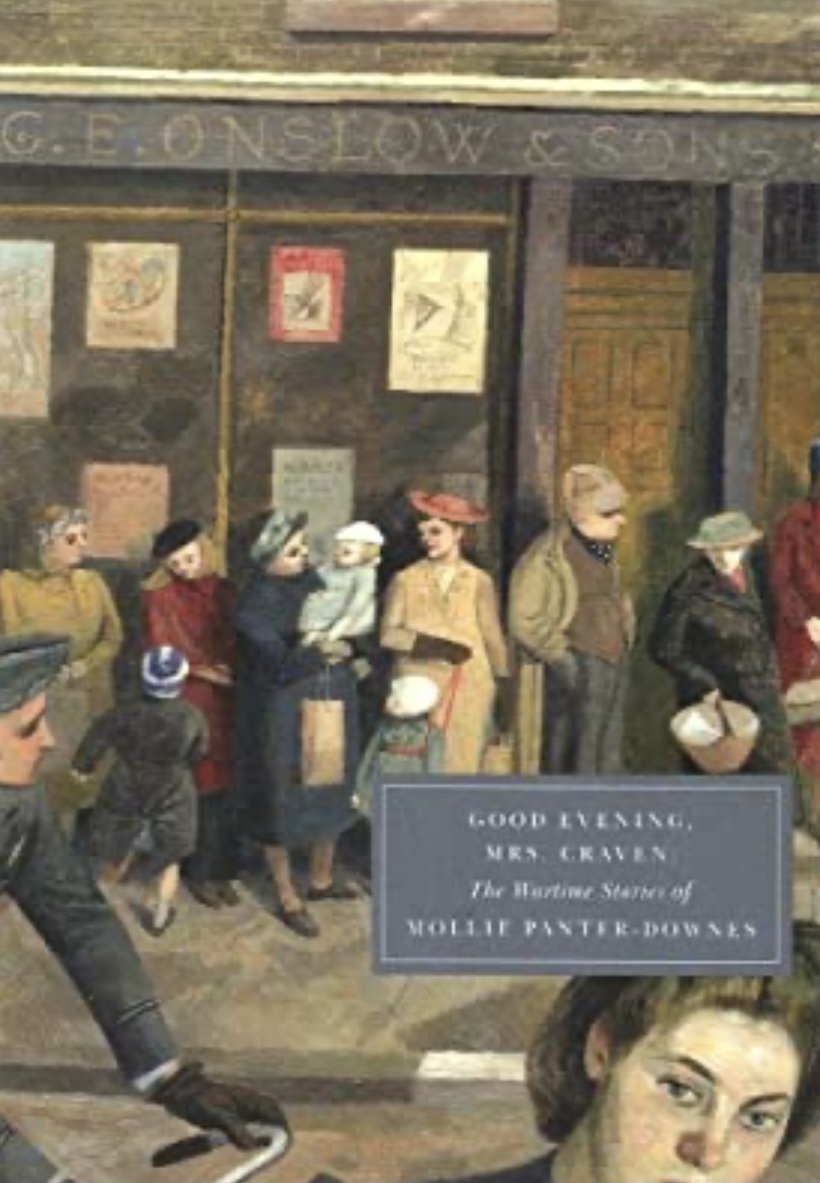
“Date with Romance” - A Short Story by Mollie Panter-Downes - first published October 14, 1939 in The New Yorker - lead story in Good Evening, Mrs Crave - The Wartime Short Stories of Mollie Panter-Donnes - published by Persephone Books 1999


“Date with Romance” - A Short Story by Mollie Panter-Downes - first published October 14, 1939 in The New Yorker - lead story in Good Evening, Mrs Crave - The Wartime Short Stories of  Mollie Panter-Donnes - published by Persephone Books 1999


“Time now seemed to have receded, to be an enormous empty room which she must furnish, like any other aimless woman, with celluloid shadows of other people's happiness, with music that worked one up for nothing.” 

 Mollie Panter-Downes, Good Evening, Mrs Craven: The Wartime Stories of Mollie Panter-Downes


Mollie Panter-Downes 


Born August 16, 1906


At age 16 writes a best selling novel The Shoreless Sea


1927 - Marries


In August 1938 she begins to write for The New Yorker.  From 1939 to 1945 she was their London Correspondent. All of The Short stories in this collection were published there.  The New Yorker had first refusal on her work.  Ultimately she would publish 852 items in The New Yorker.   


September 3, 1939 England declares war on Germany 


January 27, 1997 - Surrey, England - dies 


As today’s story opens Mrs Ramsey is getting ready for a lunch date with 

Gerald Spalding, an old romance.  Five years has gone by since they have seen each other. He has just returned to London from Malaysia.  I love these lines describing her preparations:


“Mrs. Ramsay dressed for her lunch with Gerald Spalding in a mood of fine old nostalgia, well crusted on the top and five years in the wood.”


I was left wondering what “well crusted” exactly means and i am thinking “five years in the wood” refers to Gerald’s time in English colonies in South East Asia.


I cannot help but share these lines when Mrs Ramsey is at Gerald’s club waiting for him for their lunch date.  Of course this is a class marker.  Also I think men met women at their club that they might not want to be seen to much with in public.


“Mrs. Ramsay felt that it would be tragic for Gerald to sit in Malaya for five years thinking about a woman in London who looked as though she were protected by invisible cellophane and then be faced with someone limp as a wilted lettuce in crumpled chiffon. The hat was a bit of a problem. Used to women skulking about under double terais, Gerald would possibly shy back in alarm from an old love glimmering at him like a submerged oyster through layers of chenille fishnet or making an Ophelia-like entrance under a haystack of pansies.”


Just ponder is there a 21st century writer or even many readers might understand The Opehila allusion.


Parker-Donnes is a Master at creating verbs and unexpected adjectives to convey volumes in a few words.


Take a look at these wonderful lines


“At Gerald’s club, the hall porter informed Mrs. Ramsay, in discreet confidential tones which made her feel like a naughty Ouida lady visiting a man’s chambers, that Mr. Spalding had not yet arrived. The porter then came out from his dog kennel and smuggled her into a room full of imitation Chippendale furniture and genuine Sheraton members uneasily entertaining female period pieces to a glass of sherry.”


I had to use Google to learn what an “Ouida Lady” was and ponder “Dog Kennel” and “female period pieces”, which does sound a bit harsh, dare one say “catty”?


I must share one of her  verbs with you, “retriever patting” which Gerald does to Mrs Ramsey under the table.  Not just  dog patting mind you.


When I read of Gerald fumbling with his gas mask of course I thought of our masks now.


There are twenty other stories in the collection.  I hope to read them all.  Gregory LaStage conveys in his preface and afterword valuable information about her life and her relationship to The New Yorker.

Friday, December 4, 2020

Harbour of Grace - A Short Story by Catherine McNamara - from The Lonely Crowd - Special December 5, 2020 Edition


Website of The Lonely Crowd


Harbour of Grace - A Short Story by Catherine McNamara - from The Lonely Crowd - Special December 5, 2020 Edition


My Post on Pelt and Other Stories - The Debut Collection of Catherine McNamara


My Q and A with Catherine  McNamara


Catherine McNamara's haunting stories map landmarks of psychological encounter. Hers is an international canvas, marking the points where contemporary lives cross with sensuality and finesse. Beautiful work.”  - Hilary Mantel.


The Lonely Cloud, in Observation of their fifth year is Publishing a special edition with fiction, poetry and additional items from cutting edge writers.  I was very happy to see that two writers I have followed closely for years, Catherine McNamara and Ethel Rohan have Short Stories included in the special commeratory issue.


Below is the Table of Contents and a link through which you may place your order.


“Celebrating five years of the literary journal, The Lonely Crowd, this special edition features a wealth of new fiction, poetry and criticism.


Edited by Dr John Lavin.


Published on December 5th, the issue is now available to pre-order here.

And Her Father Niamh MacCabe / Tin Nuala O’Connor /Two Poems Hisham Bustani / Repossession Mary Morrissy

Five Poems Breda Spaight / Pieces Lisa Harding / Six Poems from The Ars John Goodby

Hannah Rensenbrink’s Postcards from Qasigiannguit Richard Smyth / Two Poems Laura Wainwright / Foot and Mouth Laura Morris


An Interview with Will Johnson Angela Graham / Euro 2040 Fiona O’Rourke / Two Poems P. C. Evans


Badlands Fergus Cronin / Four Poems Tracey Rhys / Space is a doubt Fiona O’Connor / Animal Macabre Stephen Payne


Tenderness Justine Bothwick / The Unwanted Ethel Rohan /Three Poems Marcella L. A. Prince / P.O. Box 37864 Craig Austin


An Interview with Bernard O’Donoghue Martina Evans / The Skink Aoife Casby / Through Fire and Ice Matthew M. C. Smith


Where the Dawn Takes Us Mike Fox / Two Poems Tony Curtis / Our Names into the Sea Eamon McGuinness / Three Poems M. W. Bewick


Free Love Lauren Mackenzie / Two Poems Angela Graham / Araiyakushimae Deirdre Shanahan / Two Poems Jackie Gorman


Plainsong Mark Blayney / Kintsugi Claire Hennessey / Goosey Cath Barton / Four Poems Sue Burge


A Prolonged Kiss Jonathan Gibbs / The Lonely Crowd Essay: Poetic Champions Compose Gerald Dawe


I’m 108 Lines Jake Hawkey / The Words He Said Elizabeth Baines / Three Poems 


Harbour of Grace Catherine McNamara / On Seeing His Shoes Niamh MacCabe”


“Harbour of Grace” by Catherine McNamara takes us from Paris to Sydney and back again.  Frances moved from Sydney to Paris years ago.  She moved there to marry and is now back trying to reconnect with her past.  Her friend Adrienna since she left has become a barrister, putting criminals behind bars.  Adrienna has ignored her E mail messages but they run into each other by accident.   Erin, Adrienna’s younger sister, and Frances were once very close until their marriages drove them apart. Their  husbands were socially incompatible.


In Frances we see a Middle aged woman trying to rebuild her life after a shattering divorce, left behind by old friends who don’t need drama she brings.


Harbour of Grace is an acutely observed story, the characters are very real.  We see How time and distance can change relationships.


I greatly enjoyed this story.


Catherine McNamara grew up in Sydney, ran away to Paris to write, and ended up in West Africa running a bar. She was an embassy secretary in pre-war Mogadishu, and has worked as an au pair, graphic designer, gallery manager, teacher, translator and shoe model. 

Praised by Hilary Mantel, her short story collection The Cartography of Others (May 2018, Unbound) was a Finalist in the People’s Book Prize 2019-20, was awarded Grand Prize in the Eyelands International Book Awards (Greece) and listed on the Literary Sofa’s Best of 2018 Reads. Her book Pelt and Other Stories (2013) was long-listed for the Frank O’Connor Award and semi-finalist in the Hudson Prize. Her short stories and flash fiction have been Pushcart-nominated and published widely in the U.K., Europe, U.S.A. and Australia. Her flash fiction collection Love Stories for Hectic Peopleis out in autumn 2020. 

Catherine speaks Italian and French and lives in Veneto, Italy, where she hosts summer retreats for writers and artists in her African-art-filled farmhouse. She is an online writing mentor and coach


The special edition of The Lonely Crowd would make an excellent for any reader on your list.


Mel u


Wednesday, December 2, 2020

Joseph Roth: A Search for the Wandering Jew by Dennis Marks - 2011 - 140 pages


 Wandering Jew:  The Search for Joseph Roth by Dennis Marks -2011


Born: September 2, 1894, Brody, Ukraine

Died: May 27, 1939, Paris, France


Spouse: Friederike Reichler (m. 1922–1939)

Partner: Irmgard Keun


His works 

  The Spider's Web (Das Spinnennetz) (1923, adapted in 1989 into a film of the same name)

 - from Wikipedia 


Marks starts his book by telling us it is not a biography of Joseph Roth, rather it is an attempt to understand his place in Europe between the wars.  It is very far from a panegyric, a subtitle might be “what was Roth trying to mask in his fictions and in his lies to so many people”.  It is also an account of what being a Jew from 

Mitteleuropa, (meaning Middle Europe, is one of the German terms for Central Europe) meant to Roth.  Mittleleuropa, in better days this included much of the Austro-Hungarian Empire, was a terrible place to be a Jew during Roth’s life.  He left Austria in just as Hitler took over and moved to Paris.  For years he was the best paid journalist in Europe but he preferred to live in “flea bag” hotels, squandering his income in cheap bars, and prostitutes.  His very rich Friend Stefan Zweig often had to get him out of trouble with never paid back loans.


Marks book is a personal story of his attempt to understand Roth beginning with explaining why Roth would give differing accounts of where he was born and of the social background of his parents.  Marks traveled to the places Roth resided, trying to find traces of his existence.


I have read all of Roth in translation and available as a Kindle,11 novels and the collections of essays available. Roth is as smart they come.  Marks tells us that The Radetzy March is for sure Roth’s masterpiece.  My sentimental favorite is The Hotel Savoy.


Dennis Michael Marks, was head of music at BBC Television in the 1980s and from 1993 to 1997 was general director of English National Opera. He was also a maker of television documentaries, broadcaster and author. Wikipedia
Born: July 2, 1948, Harrow, United Kingdom
Died: April 2, 2015, London, United Kingdom

Featured Post

Imperial Reckoning: The Untold Story of Britain’s Gulag in Kenya by Caroline Elkins - 2005 - 701 Pages

  Imperial Reckoning:     The Untold Story of Britain’s Gulag in Kenya by Caroline Elkins - 2005 - 701 Pages 2006 Pulitzer Prize Winner From...