Friday, August 13, 2021

.”The Temptation of St. Anthony” A Short Story By Donald Barthelme. First published in The New Yorker, May 26, 1972.


 .”The Temptation of St. Anthony” A Short Story By Donald Barthelme. First published  in The New Yorker,  May 26, 1972.


Today’s story was published in his 1972 collection and in The 2021 Collected Stories published by The Library of America


Donald Barthelme


Born April 7, 1931 - Philadelphia,Pennsylvania,USA


Died July 23,1989 - Houston, Texas, USA


“Barthelme’s was a specifically urban melancholy, related to that look of immunity to joy or even surprise seen in the faces of cab drivers, bartenders, street dealers, city editors, a wearily taken vow to persist beneath the burdens of the day and the terrors of the night. Humor in these conditions leans toward the anti-transcendent — like jail humor and military and rodeo humor, it finds high amusement in failure and loss, and it celebrates survival one day, one disaster, to the next.”.  Thomas Pynchon


Short story lovers owe The Library America thanks for Publishing all 145 of his Short Stories in one volume. (1004 Pages.). They also have presented us a dilemma.  How do we approach this marvelous work, do we read it through one story at a time, starting today you should finish January 4, 2022. Do we do some Research and read only  his seemingly most admired stories?  Do we pick stories with interesting titles?  A read through at a faster pace might be a suitable pandemic lockdown project for some of us.


I decided to start my exploration with “The Temptations of Saint Anythony”.  The title intrigued me. I have seen the painting.


I have after Reading just two stories, decided to read them all.


“The Temptation of Saint Anthony” is about a friend of the narrator, not an ancient icon.  The question is what makes Anthony a saint?


“Of course some people went around saying that he “thought he was better than everybody else,” and you had to take these people aside and tell them that they had misperceived the problem, that it wasn’t a matter of simple conceit, with which we are all familiar, but rather something pure and mystical, from the realm of the extraordinary, as it were; unearthly.”


People were jealous of him.  They tried to look into his apartment when he was not around hoping to find something bad or st least ordinary about him.


He is a saint.  He goes back to the desert.  The narrator’s gift to Anthony was to treat him as near ordinary, a friend.  Others wanted “dirt on him”.  In one sequence an aristocratic beauty is sent to get a reaction.  She claims he put his hand on her leg.


It seems Anthony’s greatest temptation my just to be ordinary.


The final lines befuddled snd delighted me:


“There really was something to that. In the world of mundanity in which he found himself, he shone. It was unmistakable, even to children. —————— Of course they were going to run him out of town, by subtle pressures, after a while. There is a lot of anticlericalism around, still. We visit him, in the desert, anyhow, once or twice a month. We missed our visits last month because we were in Florida.”


I also read the lead story in the collection, “Francis Green turns 81”.  I am looking forward to 143 more.


In the interests of full disclosure The Library of America gave me digital copies of this and three other books this week.




Thursday, August 12, 2021

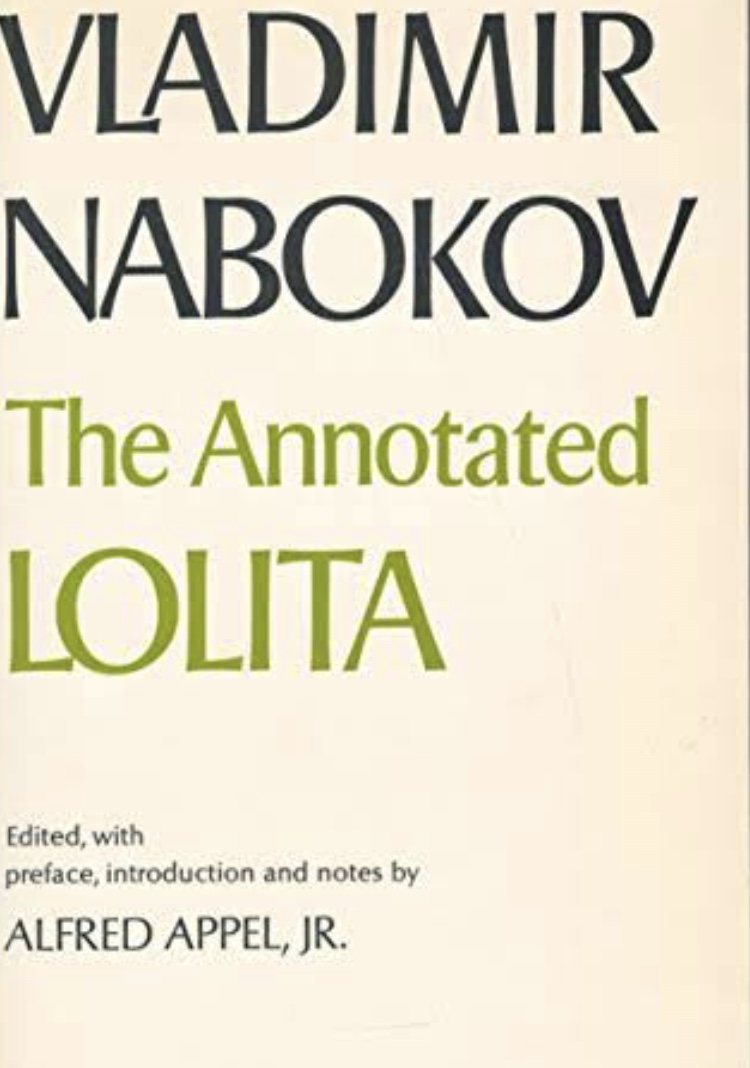
Lolita by Vladimir Nabokov -1955 - The annotated Lolita / Vladimir Nabokov; edited, with preface, introduction, and notes by Alfred Appel, Jr. - 1970


 Lolita by Vladimir Nabokov - 1955 - The annotated Lolita / Vladimir Nabokov; edited, with preface, introduction, and notes by Alfred Appel, Jr. - 1970


Vladimir Nabokov


Born - April 22, 1899 - St Petersburg, Russia


Dies - July 2, 1977. - Montreux, Switzerland 


“This was a lone child, an absolute waif, with whom a heavy-limbed, foul-smelling adult had had strenuous intercourse three times that very morning.” And here she is, in the passenger seat of his car, “complaining of pains,” he tells us. She “said she could not sit, said I had torn something inside of her.”  - Humbert Humbert describing his actions.


The annotated Lolita / Vladimir Nabokov; edited, with preface, introduction, and notes by Alfred Appel, Jr. - 1970


“For me a work of fiction exists only insofar as it affords me what I shall bluntly call aesthetic bliss, that is a sense of being somehow, somewhere, connected with other states of being where art (curiosity, tenderness, kindness, ecstasy) is the norm.  There are not many such books.” - Vladimir Nabakov .Lolita is for sure such a work.  The only other work of fiction I have read this year that I would apply this without hesitation upon in The Master and Margarita by Michail Bulgakov, both have deep Russian roots.


Clifton Fadiman, in The Life Time Reading Plan, back around 1960, first put Lolita on my to be read list.  He says he is the greatest English prose stylist of our period.  I would for sure place it on The Reading Life Time Plan list were I ever to create one.  Lolita May superficially have an ugly plot line but for sure it belongs in Susan Sontag’s category of high art. 


I read this in the annotated Lolita edition.  The annotations are very learned but I would have found them more useful as notes at the bottom of the page rather than at The end 


This is in no way easy or comfortable read.  The narrator is a monster. Many contemprary feminists feel it should not be taught in schools. Ok, few could now days teach it I fear.


Tuesday, August 10, 2021

“The Return” - A Short Story by Alistair MacLeod - 1971- included in The Collected Stories of Alistair MacLeod


“The Return” - A Short Story by Alistair MacLeod - 1971- included in The Collected Stories of Alistair MacLeod


Join in iwith Buried in Print for A read along through The Short Stories of Alistair MacLeod. 


Schedule for the Alistair MacLeod Read along


My post on his story, “The Boat”


For almost four years i read along with Buried in Print through The Short Stories of Mavis Gallant. I was able to read and post on about half of her two hundred or so stories.  It was a great Reading Life experience which also gave me a sense of accomplishment.  Plus it was a lot of fun to folllow along with Buried in Print. Now we begin a new read along on a writer new to me, Alistair MacLeod. This Will be my fourth  post on his work.


Alastair MacLeod


July 26, 1936 - North Battleford, Canada


April 20, 2014 - Windsor, Canada


As the story opens Alex, age ten when it happens, is on his way back to Cape Breton with his parents.  Cape Breton was then a rough place to live, with most men working as fishermen, a dangerous occupation. Residents looked down on outsiders who come as tourists to see the beautiful coast. His father left the family home there a long time ago to become an attorney in Montreal.His in laws paid for his schooling. The mother regards Cape Breton people with contempt,seeing them as drunken and uneducated.  We can see her angst in this:


“When we are seated on the new train I see that my mother is very angry. “Ten years,” she snaps at my father, “ten years I’ve raised this child in the city of Montreal and he has never seen an adult drink liquor out of a bottle, nor heard that kind of language. We have not been here five minutes and that is the first thing he sees and hears.” She is on the verge of tears.”


Of course now her husband is dreading the face to face encounters when he arrives.


For an affluent woman from Montreal Cape Breton seems like a very squalid place.


We are quick to see the bad blood between father and oldest son:


““You have been a long time coming home,” he says to my father. “If you had come through that door as often as I’ve thought of you, I’d’ve replaced the hinges a good many times.” “I know, I’ve tried, I’ve wanted to, but it’s different in Montreal, you know.”  


The father picks up his attack:


““Yes, I guess so. I just never figured it would be like this. It seems so far away and we get old so quickly and a man always feels a certain way about his oldest son. I guess in some ways it is a good thing that we do not all go to school. I could never see myself being owned by my woman’s family.” “Please don’t start that already,” says my father a little angrily. “I am not owned by anybody and you know it. I am a lawyer and I am in partnership with another lawyer who just happens to be my father-in-law. That’s all.” “Yes, that’s all,” says my grandfather and gives me another sip from his glass. “Well, to change the subject, is this the only one you have after being married eleven years?”


The Young man is taken out by his cousins.  He is exposed to things way rougher than Life in Montréal.  To me this seemed almost like his Grandfather’s revenge on his son.  The older man works as a miner,hard dangerous work at 76.


To me this is the grandfather’s revenge 


““And did you have a good day today, Alex?” asks my grandfather as we stop before his locker. And then unexpectedly and before I can reply he places his two big hands on either side of my head and turns it back and forth very powerfully upon my shoulders. I can feel the pressure of his calloused fingers squeezing hard against my cheeks and pressing my ears into my head and I can feel the fine, fine, coal dust which I know is covering my face and I can taste it from his thumbs which are close against my lips. It is not gritty as I had expected but is more like smoke than sand and almost like my mother’s powder. And now he presses my face into his waist and holds me there for a long, long time with my nose bent over against the blackened buckle of his belt. Unable to see or hear or feel or taste or smell anything that is not black; holding me there engulfed and drowning in blackness until I am unable to breathe. And my father is saying from a great distance: “What are you doing? Let him go! He’ll suffocate.” And then the big hands come away from my ears and my father’s voice is louder and he sounds like my mother. Now I am so black that I am almost afraid to move and the two men are standing over me looking into one another’s eyes. “Oh, well,” says my grandfather turning reluctantly toward his locker and beginning to open his shirt.”


To me this seems shameful and cruel, hurting the grandson for revenge.


MacLeod brought out well the emotions of the different parties. The grandson is clearly confused.  


Mel u


Sunday, August 8, 2021

Excellent Women by Barbara Pym - 1952 - A Novel - with an introduction by A. N. Wilson - 225 pages


 Excellent Women by Barbara Pym - 1952 - A Novel - with an introduction by A. N. Wilson - 225 pages


“I suppose an unmarried woman just over 30, who lives alone and has no apparent ties, must expect to find herself involved or interested in other people’s business,” Miss Lathbury goes on, “and if she is a clergyman’s daughter then one might really say that there is no hope for her.” Mildred Lathbury - from Excellent Women, regarded as Barbara Pym’s best novel.


Barbara Pym 


Born - June 13, 1913 - Oswestry, England


Died - January 11, 1980 - Oxford, England 


Barbara Pym is among the best chroniclers of a now lost, maybe lost when she was writing, world of curates, vicars and women whose lives are bound up the social world of post World War Two England, with rationing, the return of service men and endless meeting for tea. No one has children out of wedlock, of course. Many have small “private incomes”.


“Excellent Women” is a  tag attached to unmarried women who preform household 

duties for unmarried Vicars and Curates.


Knowing The difference betwen a Vicar and a Curate is important in world of Excellent Women.  A vicar is a priest of the Church of England who receives a stipend.  A curate is his assistant, often in time to become a Vicar.  Central to the novel, both can and are expected to marry.  A Vicar’s wife or Widow is a high status person. An unmarried Vicar was a figure of great interest.  First there is the quiet question of why he is unmarried and secondly who among the Ladies would be a good match.  


Vicars set the tone of the community but we do meet nonbelievers and even more shocking Roman Catholics.


Having tea with someone is part of the glue of society.  “Tea” appears 167 times in Excellent Women.  References to gray comes

up 27 times.  Many food stuffs are still rationed.  People serve “meat” of an unidentifiable sort.


Housing is in short supply, exacerbated by the return of men from the service.  As the novel opens, a married woman is  moving into a flat.  Mildred is thrown into a bit of a tizzy when she sees the woman in town with another man.  There are numerous literary references, all squarely within the lending library scope. A society for amateur anthropology students plays an important part.


Mildred does enter into a relationship of sorts with one Everard Bone, she starts working on the index for his forthcoming book.


There are several subplots involving romances. In this world women are helpers waiting for men to explain things to them.


I enjoyed this book quite a bit.  It looks like she has six more novels and I hope eventually to read through them.


If you like Jane Austen you will be happy with Excellent Women, if you don’t you probably will find her work a bit too gray 


Friday, August 6, 2021

Writers & Lovers by Lilly King - 2020


Writers & Lovers by Lilly King - 2020 - A Novel


Set in 1997 in New England, the central character is Cssey Peabody.  She is a trying very hard to finish her first novel for the last six years.  She is bogged down by $73,000 in student loans and credit cards bills.  She is overwhelmed with grief for the unexpected death of her mother. 


She lives in her landlord’s garage.  She walks his dog for a discount on rent.  She works as a waitress.  A lot of the novel is devoted to her work place.  No body wants to make working there a life time career and this area of her life is well pottrsyed.


Casey is, when we first meet her, involved in a love affair with a famous writer she met at a workshop. It is not what she needs. She has been unlucky in love. Her father is far from perfect.


Her friend Muriel takes her to a book signing where she meets to more romantic interests.  One an older writer, Oscar,with three popular novels and a young poet, a student of the writer.  We see Casey struggle to either pick one or stay single.


The book shows how hard it can be to focus on finishing a novel. The book does take an exciting turn when she at last finishes the novel, mails it off and gets a very positive response.


I would have liked to have been taken future into Casey’s future than we were.


There are numerous very well done bookish conversations I really enjoyed. If it had been set just a few years in the future the internet would change everything for aspiring writers.


New York Times, 100 Notable Books of 2020

Washington Post, 10 best books of 2020

NPR’s “Fresh Air,” Maureen Corrigan's Top 10 Books

NPR, Best Books of 2020

People, Top 10 Books of 2020

Los Angeles Times, 10 best books of 2020

Amazon, Best literature and fiction of 2020

Kirkus Reviews, Best Fiction Books of 2020

Electric Literature, Favorite Novels of 2020

Chicago Public Library, Best Books of 2020: Top 20

New York Public Library, Best Fiction Books of 2020

Guardian, Best books of 2020 – picked by our acclaimed guest authors

Times (UK), Best Fiction Books of 2020

Exile in Bookville Bookstore, Favorite Books of 2020 


https://lilykingbooks.com/bio


Her website has a bio and details on her other books. 


 I hope to read more of her work.

Wednesday, August 4, 2021

Passing by Nella Larsen


 Passing by Nella Larsen - 1929


Nella Larsen


Born April 13, 1891 Chicago, Illinois 


Died March 30, 1964 Brooklyn,New York


“If someone was “Passing” in the slang of African Americans in the 1920s and 30rds it meant they were pretending to be white, hiding their full heritage.  This was a period of massive migrations from The American South by descendents of slaves to big Northern cities and California.  In The south it was very hard to pass as your ancestors were known.  The two lead characters in Passing are women of African heritage who “look white”who live totally as if they were in fact white.


As the story opens two women, out alone, are caught in a bad rain storm in Chicago The knew each other before they migrated but have not seen each other in years.    By coincidence they both seek refuge in the tea room of an elite “no colored allowed” hotel.  They get reacquainted and laugh over how they are fooling the hotel.


Irene 


The story is told by Irene Redfield, a mixed race woman living in Harlem. Irene gets a letter from Clare describing the incident and suggest they get together.  Clare’s father was white and when both her parents passed at an early age she went to live with her white grandparents. Clare lives primarily in Europe with her rich husband who does not know her heritage and their daughter.  Clare is temporarily in New York City and does reluctantly agree to socialize with Irene and her friends.


Irene goes to Clare’s town house for tea, along with another bi-racial friend from long ago.  Clare’s husband shows up and begins a long racist rant.  The friends decide Clare will be in danger if her husband learns her secret and decide to break off contact.


But things are not so simple.  A complex series of events cause Clare’s husband to discover her secret.  He goes into a wild rage, saying both his wife and his daughter are niggers.  Clare dies in a fall down the stairs, it looks like her husband pushed her.


The prose is very elegant.  Larsen wrote one other novel, 

Quicksand I hope to read.


From Wikipedia 


“Nellallitea "Nella" Larsen (born Nellie Walker; April 13, 1891 – March 30, 1964) was an American novelist. Working as a nurse and a librarian, she published two novels, Quicksand (1928) and Passing(1929), and a few short stories. Though her literary output was scant, she earned recognition by her contemporaries”


Tuesday, August 3, 2021

The Warmth of Other Suns- The Epic Story of America’s Great Migration by Isabel Wilkerson - 2010 - 622 pages


 The Warmth of Other Suns- 

The Epic Story of America’s Great Migration by Isabel Wilkerson - 2010 - 622 pages 


“They did what human beings looking for freedom, throughout history, have often done. They left.”

— Isabel Wilkerson, The Warmth of Other Suns


“Toni Morrison calls the book "profound, necessary, and a delight to read". Tom Brokaw praises it as "an epic for all Americans who want to understand the making of our modern nation" - Wikipedia 


Between 1915 and 1970 millions of African Americans left the states of the south in America, where their ancestors were slaves, to relocate to big Northern Cities like Chicago (over 2 million), Detroit,NYC and Washington DC.  Millions more moved to California, especially Los Angles and Oakland.


People moved to escape the pervasive racism of Crow laws meant to keep African Americans in their place at the bottom of the system. There was no leader, often married men moved  alone and after getting settled sent for their families.  People moved to where relatives were or to places in which  others in their former community were settled.  Old timers helped new arrivals.  


Wilkerson worked on the book for 15 years, interviewing over 1000 migrants.  She ended up giving a very detailed account of the lives of three migrants.  She shows us why they moved, and what happened after they did.


One was from CHICKASAW COUNTY, MISSISSIPPI, LATE OCT

IDA MAE BRANDON GLADNEY who left in October 1937. She moved to Chicago to join her husband.  Married very young, she had no choice but to take the train to Chicago.  Wilkerson follows her life their through fifty tumultuous years.  She ends up in apartment looking down on a street full of drug dealers.


ROBERT JOSEPH PERSHING FOSTER had a medical degree from a prestigious all black Georgia medical school.  He served as doctor during WW Two but when he came home he was not allowed to have any white patients.  He married the daughter of the college president and could have joined his brother’s medical practice and done very well. Instead he moved alone to Los Angeles where a friend with an established practice got him started .  He was a brilliant doctor who loved his patients , all African American migrants, He moved because he did not want to raise his daughters in The South.  As soon as he could he moved his family out.  In time he would have a mansion and his wife was a leader of African American Society.  His patients loved him back. He would have parties serving food from back home. He developed a passion for gambling  at The track and Las Vegas.


“George Swanson Starling came from the featureless way station of citrus groves and one-star motels between the Georgia border and Orlando, Florida, a place of cocksure southern sheriffs, overworked pickers, root doctors, pool hustlers, bootleggers, jackleg preachers, barely a soul you could trust, and a color line as hard as Mississippi’s. It comes back to him, one image after another, how Jim Crow had a way of turning everyone against one another, not just white against black or landed against lowly, but poor against poorer and black against black for an extra scrap of privilege. George Starling left all he knew because he would have died if he had stayed. His face is long and creaseless. He was handsome in his day, a basketball player in high school, good with numbers, a ladies’ man. He holds out a crate of Florida oranges like the ones he used to pick and offers you one, says, even after all that picking and all that it cost him, they’re better than the ones from California. A smile lifts his face at the absurdities of the world he left, and which, in some ridiculous way, he still loves. Then his eyes well up over all that they have seen.”  - i just want to share The marvelous prose Style of Wilkerson.  


His story begins in Eustis, Florida in 1931.  Working picking oranges he starts a labor dispute demanding higher wages.  The account of work in The groves was brilliant.He crosses a vicious racist sheriff know for killing African Americans who got out of line and he had two choices, migrant or be lynched..He has cousins in New York City and catches a train. He gets a job as a porter on trains, he was assigned at first to The all black cars until the rules changed .  He works on the train for over forty years. From his story we see what the ride north was like for migrants.


Wilkerson explains the social forces at work in America. During WW Two Detroit factories needed new workers. They sent Recruiters down south. They were taking their lives in their hands.  


This is narrative non-fiction at the highest level 

.

Her website has a detailed bio


https://www.isabelwilkerson.com/


Featured Post

Imperial Reckoning: The Untold Story of Britain’s Gulag in Kenya by Caroline Elkins - 2005 - 701 Pages

  Imperial Reckoning:     The Untold Story of Britain’s Gulag in Kenya by Caroline Elkins - 2005 - 701 Pages 2006 Pulitzer Prize Winner From...