Friday, July 22, 2011

Ark Sukura by Kobo Abe 安部 公房

Ark Sukura by Kobo Abe (1984, translated by Juliet Carpenter)

As Strange a Book as I have Read in a Long Time


Woman in the Dunes by Kobo Abe (1924 to 1993-Japan) is one of the "Big" books of the post war Japanese novel.    It is on almost all lists of the ten most important Japanese novels (for sure it is on mine)  of all times.    (There is some background information on Abe in my prior post on him.  He has a medical degree but never practiced.)     I really enjoyed reading it but there are those who were turned off by its reduction of humans to the conditions of insects (and Kobe Abe has a "thing" for insects)  and found it to bleak for their liking.   Forgetting these issues,  Woman in the Dunes  is must read for anyone who wishes to seriously read in the Japanese novel.   It is taught in universities around the world as an example of the Existential novel in the tradition of Albert Camus.   Kenzaburo Oe said Abe should have been given the Nobel prize instead of him.

Ark Sukura (I have also seen it called The Ark Sukura) is about Mole, 250 or so pounds,  about five foot six and near blind in the sunlight from living underground.    Mole is a nick name he took for himself as he lives in an abandoned underground warehouse where he is building a concrete ark for a coming apocalyptic flood or/and for a shelter in case of a nuclear explosion in Tokyo (something feared as a  real possibility from terrorists organizations).   Mole has a number of tickets he plans to give to potential crew members for his ark who he sees as  the re-builders of the human race.    He lives underground but once and a while he goes to the surface to look in the malls  and the markets for candidates worthy to be on his ark.


As the story opens Mole is at a street market of some sort.    He spots someone selling insects.      He wants to buy one as soon as he sees a man with an attractive woman go crazy with joy when they buy one.    The insect (something Abe made up) is kind of a metaphor for Mole's view of  the state of his own life and maybe Abe's darker side's view of humanity.   The insect eats exclusively its own waste products.   (Think of the Japanese horror movies about monsters born in garbage dumps).   Mole eventually figures out that the couple are shills working with the vendor.  

After a confrontation, Mole invites the shill and the woman to join his crew (which so far is just them) underground to work on his ark/bomb shelter.   The woman is treated in a very objectified way.   Mole spends a lot of time looking at her body parts.  (One has to assume there has never been a Mrs Mole!)    All sorts of bizarre (and funny if you are a bit warped!) things happen.     Mole gets stuck in a giant toilet which is designed to be used should the ark ever go to sea.    (This is not a book for those squeamish about reading about human waste.)   Mole is looking for about 300 people to join his crew.   He has totally thought through this project.   I was fascinated to learn about some of the details of the ark.

There is just so much in this book.   Some readers will say it shows the influence of French Absurdist theater on Japanese literature (after reading Ubo Roi by Alfred Jarry I see this as very pervasive) of Becket with his characters out of the wastes of the world, and Camus.   I think it also has to be seen in part as an "anti Yokio Mishima work" with Mole as a farcical version of his heroes trying to reclaim days of glory.

A very important theme in much post WWII Japanese literature concerns finding a way to live an authentic valuable life in a world in which all of the values you were taught to believe in have been exposed as hollow lies.

Mel u

Lake by Banana Yoshimoto よしもと ばなな Win A Copy

The Lake by Banana Yoshimoto (2005, 188 pages, trans. by Michael Emmerich, 2011)

My New Favorite Banana Yoshimoto Novel
よしもと ばなな


The Reading Life Japanese Literature Project

Most everyone says Kitchen is their  favorite Banana Yoshimoto (1964, Japan) novel.   Kitchen, her first novel, sold millions of copies and propelled her to super star status.   I like Kitchen a lot but my favorite of her work has always been the wonderful Goodbye Tsugumi.   I totally loved the last twenty pages of Goodbye Tsugumi and I wished it could have been 1000 pages longer!.   I hate to admit this somehow, but I think The Lake might now be my favorite Yoshimoto read (out of six so far.)    The deep gentle wisdom of Yoshimoto is wonderfully wrought for us in The Lake.

The central character in The Lake, as is very normal for Yoshimoto, is a young woman struggling with her feelings about the death of someone very close to her.   A typical Yoshimoto persona is caught between the world of adulthood and the freedom from responsibility many have in their late teenage years.

Chihiro recently lost her mother, who owned a bar for men which featured table dances and such by partially clothed women.   Chihiro spent a lot of time in the bar growing up.    She never participated in any of the things that went on in the corners  of the bar but she knew about them.  We sense Chihiro feels a little ashamed of her mother's past.    Her parents separated years ago and she has an uneven relationship with her father.   Chihiro by profession is a mural painter.   She is pretty successful and has commissions all over Japan.   Yoshimoto does a wonderful job in letting us see how Chihiro deals with the feelings her mother's death creates for her.

Chihiro meets and develops a relationship with a young man,  Nakajima.    Chihiro senses a deep sadness kept hidden by him.    The longer she knows him the more she becomes obsessed with trying to understand what could  have caused this sadness.  I for sure was taken up in this central mystery of  The Lake and I very much wanted to understand it.

The mystery unravels beautifully when the couple visit two of Nakajima's old friends who live a very simple isolated life in a cabin by a lake.   This section of the novel is just perfectly told.    The atmosphere is deeply spiritual.

I do not want to tell more of the plot of this novel.   The pace is fast and there is always something happening to keep us totally interested in the action.   The characters are  made to come to life for us in a subtle highly intelligent fashion.

I totally endorse  The Lake to all readers of my blog.   It is not hard to follow at all.   It would make a good first Japanese novel or a good 100th one.  

I was provide a free copy of this book by the publisher for which I am very grateful.  They also have provided me a copy of The Lake to give to one of my readers.   If you are interested please complete this form by July 26.


Mel u


Thursday, July 21, 2011

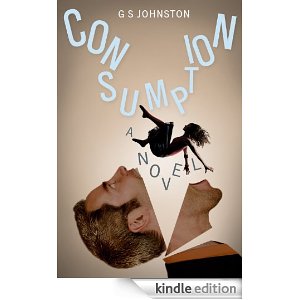
Consumption: A Novel by G. S. Johnson

Consumption:   A Novel by G. S. Johnson (2011, 197 pages-Kindle edition)

Long Term Friendships Between Men and Women
High Adventure in Hong Kong and Sydney

A few days ago I read a historical work of fiction set in Hong Kong in the 1940s during the Japanese occupation.    I have now been lucky enough to read a very exciting beautifully written work, Consumption:  A Novel by G. S. Johnson (Australia) set in Hong Kong and Sydney in the 1990s.     I have spent some time in Hong Kong (only about 1.5 hours away by air from us) so that draws me to books set there.

Consumption:  A Novel is a very intense plot driver work with very believable characters as its leads.   The  human interest of the story revolves around a man and a woman who as children were as close as brother and sister.    They are separated  for a long time but they eventually begin a romance.   We see the extreme difficulty of doing this especially for two such very different people as the ones we find in Consumption:  A Novel.   The male lead is an interior director to the rich and famous or infamous in Hong Kong.    The female lead has just ended a long term relationship.    The woman wants to simplify her life but the man's just keeps getting more and more twisted.

There are lots of exciting plot descriptions.   The two cities come alive for us.   The characters in this work are faced with difficult moral decisions.  Some seem to decide well, others may not win your approval.

One thing you will for sure not be reading Consumption:  A Novel  is bored.   I found it an exciting escape from the everyday world read.

I was provided a free E Book by the author.

You can learn more about the book at the author's web page


Mel u


Angela A Nwosu-Two Powerful Short Stories by a Nigerian Writer

"Mindscape"  (2010, 5 pages)
"A Ship Anchored in My Dreams" (2009, 8 pages)


Angela Nwosu from Nigeria
Two Powerful New Short Stories
Some Blog Policies 

Before I talk about these great short stories by a new to me author from Nigeria, Angela Nwosu, I want to explain my policy on review requests by new authors.    I am more than happy to read and post on short stories by relatively new writers.   All I require is that you have at least one story published online that readers of my blog can read if they wish.   I would also urge all potential writers to start their own webpage.

Yesterday I read two very interesting and exciting short stories by Angela Nwosu. from Nigeria.    Both of these stories can be read online (there are links at the end of this post).


"Mindscape" is about, among other things, the Nigerian diaspora.   The central character is the daughter of a once affluent businessman.    She now lives and works as a waitress in the northwestern portion of the United States.    Nwosu makes no overt mention of it but one of the things this story made me feel was the huge impact the climate change had.   In a way it feels like the lead character has moved from a chaotic heritage rich and dangerous envirornment to a, in her experience of it, a cold world in which she loses herself when she is cut off from her heritage.    Not long ago I read somewhere that the very last thing an immigrant to a new country will give up is their food.   You will give up your language, your religion even your clothes long before you accept the loss of your ancestral foods.   The more that the food of your home is  unique to your culture the more you  will feel this.   This is beautifully conveyed in "Mindscape" in this passage (which will also give you a feel for the marvelous prose of Nwosu):


"I began to eat in my dreams. My country’s cuisine came to me in different forms. First came ofe onugbu with nni ji. I ate ravenously, and my family’s grave opened up and my ancestors came out with scrolls and taught me who I was. But I looked at them without my eyes and heard them without my ears. One of them stood up and brought me another kind of food – obe ewedu and amala. I savored the food, and my great-great-grandmother taught me that the ingredients for both meals were basically the same even though they are different. Hunger ravaged me again and tuwo shinkafa and a variety of other foods came up, with each naming itself: “I am okodo.”
 “I am ukpo.” “I am acha.” “I am abacha.” “I am fufu.” “I am ojojo.” I ate them all. Then I saw my father and he told me that I was all that food and all that food was me."

There is a lot more in "Mindscape" including some very well done relationships.   Nwosu makes everyone in her story come to life.


"A Ship Abandoned in My Dreams" is a very interesting story.    It is also narrated in the first person.    We find ourselves in a large group of people running.   We are in the central part of a large city.    Our narrator does not know why the crowd is running but knows  that is a good idea, maybe even a survival need, to run with the crowd.    Soon we notice there are all sorts of unaccepted encounters to be had in the crowd.   Many seem to be church goers of some sort.   Soon we encounter a talking cat.    The ending is really opened ending in its interpretation and I thought it was really quite brilliant.

I look forward to watching Angela Nwosu's writing career develop.   Here is a bit of her biography:

Angela Amalonye Nwosu has worked as a teacher, a book editor, a romance writer, a freelance journalist, and a literary critic. “Feminique,” a column she maintained in the Sunday Vanguard (a prominent Nigerian newspaper) for four years, was devoted mainly to issues concerning women. She has published a collection of poems, Waking Dreams


You can read "Mindscape"  HERE.


You can read "A Ship Anchored in Dreams" HERE


Mel u

Wednesday, July 20, 2011

Mulk Raj Anand-Two Brilliant Short Stories About Life in India Under the British Raj

"The Lost Child"   (1940, 5 pages)
"The Tractor and the Corn Goddess" (1938, 6 pages)

Two Short Stories by Mulk Raj Anand
A Pioneer Anglo - Indian Author


There is no literary tradition with roots older than that of India.   I will always admire Edmund Burke (Anglo-Irish-1729 to 1797) for telling the English Parliament that England had no right to rule a country with a culture much older than their own.    

Mulk Raj Anand was a founding father of the Indian novel in English.    He along with R. K. Narayan (on whom I have already posted), Ahmed Ali and Rajo Rao was one of the first writers from India to gain an international readership in English.    Anand (1905 to 2004-99 years-Peshanar, India) after graduating from college in India went to England to receive his PhD.     While at Cambridge (the university of choice for Bloomsbury) he became friends with people like E. M. Forester  and George Orwell.   He was a passionate admirer of Gandhi and a strong supporter of the movement for Indian independence.   His first novel, Untouchable (1935) brought him world wide acclaim as the Charles Dickens of India.   He was a friend of Pablo Picasso.    His literary output was very large including several novels, lots of poetry and numerous highly regarded short stories.   He was a strong force for good in the world. 

In April I read and posted on two of Anand's short stories, "The Price of Bananas" and "Old Bapu".   I really enjoyed both of these stories.   Anand's stories brought life in rural India during the reign of the Britisth Raj to life for me and as a bonus were very entertaining and beautifully written.   


"The Lost Child" is, I think, one of the most read and taught of Anand's short stories.    It is set at a religious festival celebrating Shiva.    The crowds are huge, overpoweringly large.    The people in the story are a married couple and their young son, maybe eight or so. The parents are devout followers of Shiva.  Like any child he wants everything   for sale by the many vendors.    In the crowd there are 1000s of devotees to Shiva dressed in ritualistically correct  Orange Robes.     There is a merry go round set up at the festival.   The boy is very attracted to it and runs to ride it.   I am assuming the merry go round is meant as a symbol for the wheel of life.   Every parents worst nightmare   happens (and this is in the days with no cell phones etc to track children).   I will leave the rest of the plot unspoiled.    Anand did a great job of making me feel  what it would be like to be at the festival.

"The Tractor and the Corn Goddess" is a fascinating story that tells us a lot about how the ordinary Indian felt about his English rulers and the coming of western technology to rural India.   I really liked the treatment of the conflict of Indian religious traditions and the British Raj.    It also shows the very conservative attitudes of many that in effect worked to keep the British in power.    I will tell a bit of the background setting and the plot but I really hope this story will be widely read.    As the story opens, the leading landlord in the area has died.    His oldest son, who has been in Europe studying (in theory!) and falling into what the residents of the area see as decadent ways is now the major land owner.    He proposes something very radical.   That he will give most of the land to a collective owned by the people who work the land.    The richer people in the area are all totally opposed to this idea and horrified by the suggestion of large scale social change.   The people in the area really get upset when the son buys a tractor.     Everyone is at first horrified by it and sees its plowing as a blasphemy toward the Corn God.    Also they are concerned with the long term implications for the livelihood of the people in the area when they learn it can do the same amount of plowing in one day that it would take 100 men using the traditional methods.     There is a lot in this story I have not relayed.


You can read both of these stories at Google Books.   Just do a search for Mulk Raj Anand:   A Reader and you can read both of these stories and a number more online.   

I hope to read in the not too distant future his two most famous novels, The Untouchable and The Private Life of an Indian Prince.   

Please share your experience with Anand.  Or any South Asian short story author!


Mel u

Tuesday, July 19, 2011

Journey Across the Four Seas - A Chinese Woman's Search for Home by Veronica Li

Journey Across the Four Seas - A Chinese Woman's Search for Home by Veronica Li (2007, 298 pages)

Journey Across the Four Seas - A Chinese Woman's Search for Home by Veronica Li is a wonderfully done look at the life of the author's mother, Flora Li.   The story opens a few weeks before the Japanese attack Pearl Harbor and declare war on the USA and on England.    Flora Li was living in the British Crown Colony of Hong Kong (1941) when war broke out and there were immediate rumors of a Japanese invasion of Hong Kong.    The citizens knew of the horrible way the Japanese had treated the citizens of Nanking,  China killing 100,000s of thousands of unarmed soldiers and civilians.   They also made rape a terror tactic of the war.   They knew Hong Kong had no army ready to defend it and they would be captured.

Veronica Li does a wonderful job of recreating the atmosphere of Hong Kong in 1941.   Her mother was a student at Hong Kong University and did not really have a care in the world.    Flora Li had light skin, a very attractive feature, and was considered quite pretty.    Once this was a great source of joy and pride to her family.   Now her female relatives rub soy sauce all over her face and arms to make her appear darker and ugly in the hopes she could avoid being raped or sent to a Japanese  Army brothel.    In time she realizes she needs to escape Hong Kong for the parts of China that are not controlled by the Japanese.     As the story progresses I saw how much connections, family first then school and regional ties determined to a large extent who survived and who did not, who prospered, and who married who.

This is not an all dark book.   I really enjoyed seeing Flora's joy in finding her old co-students and fellow Cantonese in a remote part of China.   With the help of some new and old friends she starts school.    We learn of her first crush, a tall handsome young man destined for the military.   The romance does not endure and Flora Li moves on a wiser young woman.   She will always, I think, kind of pine for the one that got away (but that is just because she never married him-if she had there would have been other issues).

There is a lot in Journey Across the Four Seas - A Chinese Woman's Search for Home.    We see life inside the household of an affluent business man's house.    We get to travel to Bangkok with the now married and pregnant Flora Li after the war.    She made what seems on the surface to be a good marriage (to a body builder-it was interesting to learn about body building magazines and contests in China in the 1950s or so).    I learned of the great reverence in which Chiang Kai-Shek and his wife were held and  I felt a real sense of impending disaster.   I saw the great regard in which Chinese of the time held The USA and most dreamed of immigrating there.   In many cases the husband would go first and sometimes live there alone for years sending all he can back home.

The book showed me a lot about the life of women and girls in China in the 1940s and beyond.    Boys were very much favored by parents, in a way that in fact in many cases ended up making them weaker than they could have been as men.   Girls were some how raised to be tougher than boys even though they were expected to embody total femininity.   There is a lot wisdom and social history compressed in these beautifully written lines:

"A daughter has another advantage—access to information. While my brothers walked around in a fog, I always had an older woman to light my way. Sometimes she was Mother, other times she was Sam-Koo or some other mahjong auntie. One of them would warn me of the hazards ahead. My brothers, however, had no idea of the disasters that hit them, either before or after. The unique position I had as the only daughter would greatly influence the next stage of my life".

There is a lot more in this book than I have conveyed.   I think anyone interested in 20th century Chinese history would really enjoy it.   It is a very positive uplifting book I greatly enjoyed.

When I received an E mail from Veronica Li asking me if I would be interested in reviewing her book I was of course interested.   (Everyone likes to have their opinion sought.)   Lately I have been swamped with requests for reviews so I have to be selective.   I decided I wanted to read her book because I am very interested in WWII in Asia and for a personal reason.   A branch of my family has their ancestral home (going back 100s of years) in Northern  Luzon in the Philippines quite near the infamous Batan Death Camp.    How residents were treated in the Philippines was in part a matter of the temperment of the local Japanese milirary governor.    All were very harsh.    Some areas were ruled in a business like way, others in a savage brutal fashion.   Northern Luzon was one of the worst areas to live in under the Japanese.   A few members of our family (80+) still remember those years but as is perfectly normal the younger people have no time for their stories.

I commend Veronica Li for having written such a wise and beautiful tribute to her mother.

You can learn more about Veronica Li (and how to buy her books) at her webpage.

Here is part of her description of her career:


"After obtaining my master's degree in International Affairs, I went to work for the Congressional Quarterly. Six months later, the World Bank hired me as a “Young Professional,” the title for a management-track recruit. At the time, China had just become a member of the World Bank. My Chinese proficiency was an advantage.
For six years, I traveled to my home territory, East Asia, to assess Bank-financed projects. In a spurt of adventurousness, I transferred to East Africa, specifically to work on Somalia. The excitement that awaited me went far beyond my expectations. I watched the country explode into civil war, some say despite western aid, others say because of it. The Somali tragedy moved me deeply, and I began searching for answers."

I endorse this book without reservation and will, I hope, soon read her book based on her time in Somali.

This book is available via a Kindle edition also.

Mel u


Monday, July 18, 2011

Some Very Erotic Short Stories by Mitzi Szereto

Silk Sheets:   Collected Stories of Mitzi Szereto by Mitzi Szereto (2008, 87 pages)


Some Erotic Short Stories

Silk Sheets:   Collected Stories of Mitzi Szereto is a totaly fun, very adult, very erotic often x-rated collection of short stories by the author of Pride and Prejudice:  Hidden Lusts and In Sleeping Beauties Bed:   Erotic Fairy Tales.   I recently read and totally enjoyed both of these books.    I found them to be very well written and pure escapist fun.   In Sleeping Beauties Bed:   Erotic Fairy Tales is also a seriously erudite and educational work about the history of the  fairy tale.

There are fifteen stories in this collection.   The stories range from stories about love in exotic places (to most of us) like Kyoto and Dubai. Some of the works, they are pretty much all told from a female point of view, are about the loves of the prim and proper finally allowed to run free to tales of sexual slavery and decadence  that would win the approval of Flaubert, Turgenev, or Guy de Maupassant after a tour of the brothels of Cairo.   One of the stories helped me to understand Jean Rhys a bit better.   The sex in the stories is either man and woman or lesbian.   A couple of the  stories involve forcing reactions from bound women.   No one is hurt or really compelled to do something they do not wish to  but there are elements of erotic domination of women in the stories.

One of my favorite stories is "Moonburn" about a woman who walks the night having sex with random strangers.    Some of the men assume she must be a prostitute and she takes their money, some  celebrate the encounter almost as it were a supernatural and others just see it as a stroke of good luck.    As I read this story, I was made to think of Jean Rhys and I thought I understood a bit of what drew her to prefer walking the streets of London or working the Apache Bars of Paris to working at a government job.  I felt the woman was empowered not degraded by her activity.    It was almost as if she were a priestess in a cult that lost out to the dominant religions  long ago but still has its power.  This description of the central character of "Moonburn" will give you a good feel for the prose of the stories:

"She is neither young nor old. It would even be difficult to say whether she can be defined as beautiful, since nobody bothers to focus on her face. The knee-length khaki trench coat that doesn‟t quite conceal her customary uniform of seduction remains unbelted and open in the front, placing on deliberate display a pair of long, black-stockinged legs with diamond-patterned seams snaking up the calves, which stay shapely from so much nocturnal walking. Midway up the thighs the tops of these stockings terminate in the hooks of a red garter belt."

More information about Mitzi's books can be found on her WEB PAGE.  (She also has written several very well regarded novels under the name M. S. Valentine.)  This book is available only as a Kindle publication.  


Here is her official biography


"MITZI SZERETO is a bestselling author and anthology editor of multi-genre and erotic fiction and non-fiction, blogger for the popular ERRANT RAMBLINGS: MITZI SZERETO'S WEBLOG (http://mitziszereto.com/blog), and the creator/presenter for the internet TV channel MITZI TV (http://mitziszereto.com/tv), which offers a quirky take on London.
Her published titles include PRIDE AND PREJUDICE: HIDDEN LUSTS; RED VELVET AND ABSINTHE: PARANORMAL EROTIC ROMANCE; IN SLEEPING BEAUTY'S BED: EROTIC FAIRY TALES (solo short story collection); THE NEW BLACK LACE BOOK OF WOMEN'S SEXUAL FANTASIES (non-fiction/survey); GETTING EVEN: REVENGE STORIES (crime/multi-genre); DYING FOR IT: TALES OF SEX AND DEATH (erotica/multi-genre); WICKED: SEXY TALES OF LEGENDARY LOVERS (erotica/romance/historical); the EROTIC TRAVEL TALES anthology series (erotica/romance); THE WORLD'S BEST SEX WRITING 2005"…

Mel u

Featured Post

Imperial Reckoning: The Untold Story of Britain’s Gulag in Kenya by Caroline Elkins - 2005 - 701 Pages

  Imperial Reckoning:     The Untold Story of Britain’s Gulag in Kenya by Caroline Elkins - 2005 - 701 Pages 2006 Pulitzer Prize Winner From...