Monday, August 19, 2013

The Sea and the Silence by Peter Cunningham


Author bio

PETER CUNNINGHAM is an award winning Irish novelist.
He is best known for the historical novels The Sea And The Silence, Tapes Of The River Delta, Consequences Of The Heart and Love In One Edition, which chronicle the lives of local families during the twentieth century, in Monument, the fictional version of Waterford in south-east Ireland, where Cunningham grew up. His novel, The Taoiseach, which was based on the life of former Irish Taoiseach (prime minister) Charles J. Haughey was a controversial bestseller. Capital Sins, a satirical novel, dealt with the collapse of the Irish economy during the financial crisis that began in 2008.
Cunningham’s work has attracted a significant amount of critical attention and praise. The Sea And The Silence (translated into French as La Mer Et La Silence) was awarded the Prix de l’Europe in 2013. This novel was also short-listed for the Prix des Lecteurs du Telégramme and the Prix Caillou. Consequences Of The Heart was short-listed for the Kerry Listowel Writer’s Prize. In 2011 Cunningham won the Cecil Day Lewis Bursary Award.
His fiction is distinguished by its fusing of political material with psychological realism and a lyrical sensitivity to place and people.
Peter Cunningham is a member of Aosdána, (the Irish Academy for Arts and Letters). He has judged the Glen Dimplex Literary Awards and the Bantry Festival Writer’s Prize.
Under the pseudonym Peter Wilben, he has published the Joe Grace mystery thrillers series.
He is married to Carol, a Jungian analyst, with whom he has six children. He lives in County Kildare, Ireland.
The Sea and the Silence is set in Ireland in the period from the start of W W I I to the early 1970s.  It opens in a solicitor's office.  He has two envelopes.  One of them is labeled "Ismay", for Iz, the woman central to the novel, and the other "Hector", her son.   The solicitor, who has long had a crush on Iz, an English woman who lived much of her life in Ireland, is handling her will.   Iz was married for a long time to an upper class anglo-Irishman, who cheated on her, drank way too much, and was a poor excuse for a husband.   The novel, which goes back and forth in time, shows her trying to cope with the financial irresponsibility of her husband and his affairs, care for her aging parents, and be a good mother.  She was only human and in one very moving and nearly shocking sequence she is abused and abandoned in her own affair by a man who most would have seen was just using her for his own amusement.

The novel also very subtly presents us with a picture of life in neutral Ireland during the World War II years.  We see the scarcities and we sense the final decline of the Anglo-Protestant Ascendency in Ireland.   In Ireland's neutrality we see a country and a people not sure of themselves, without a clear sense of their own identity.  I think much of the very real depth and power of The Sea and the Silence is in the way the ambiguities in the life of Iz mirror the political and social issues of Ireland.  Iz has always obtained her identity through her role as wife and mother, when she begins to lose this we see her lose anchor.  Similarly, Ireland freed of England does not, it seems, quite to know what to do with herself.  I mean no offense here but can one imagine in any possible way how the Irish would have been better of had the Germans won the war?

As the life of Iz develops, she becomes estranged from her husband and is totally devoted to her now grown son Hector who joined the British Army and is stationed in Belfast.  Cunningham shows us the truth in Milton's dictum, "they also serve who only sit and wait".   The war years are brilliantly realized. 

I greatly enjoyed this book both for its treatment of the period, the very interesting structure of the novel, the well done characterizations and the exquisite prose.


I hope to do a Q and A with Peter Cunningham soon so please look for that.

Mel u

Sunday, August 18, 2013

Ulysses by James Joyce (1922)

The most influential novel of all time Don Quixote was published in 1605.   Then we fast forward to 1922 when  the next influential novel Ulysses was published.So far there is not a third candidate in this list.  

I have been reading in Irish literature for about a two and half years now.   I read Ulysses twice several decades ago.  I have done Q and A sessions with about 75 Irish writers.   I read some secondary works on Irish literature, most notably the post colonial work of Declan Kiberd.  I have developed my own theories about Irish literature, half baked at best.   I began to kind of train myself to reread Ulysses.  I read Portrait of the Artist as a Young Man and parts of Dubliners.  I read a brand new biography of Joyce.  Everything I learned screamed out that all of Irish literature was and still is in the shadow of Joyce and Yeats.  About six weeks ago I loaded Ulysses onto my IPAD and began reading it.  I decided I would not at all stress if I felt I was, as of course I knew I would be, missing a lot. My plan was to try to follow Bloom's walk through Dublin, relate to the Homeric structure, and sort of look for post-colonial aspects.  When I found myself lost, I just savored the exquisite language and went on.   I read Ulysses much slower than I normally read.   

I think my favorite section of Ulysses is the Night Town visit, which no doubt reveals more about me than the novel.  

Academics spend decades on Joyce. Besides Kiberd I read another book that really helped me, Joyce's Revenge:   History, Politics and Aesthetics in Ulysses by Andrew Gibson.  I loved reading Ulysses.  I hope to read it at least once more by Bloomsday 2014.    

To those nervous about Ulysses, just try it, maybe read a few articles. Just let Joyce work his magic and get what you can.  To those expert in Joyce, please offer us your guidance.  


 Mel u

Jennifer Mathews A Question and Answer Session with the Editor of Long Story Short


Thanks for including me. I do work for the Munster Literature Centre, which hosts the Cork Spring Poetry Festival and the Cork International Short Story Festival. I'm technically not an organiser--I'm the administrative assistant here. Things are a bit hectic for me at the moment, so I've only been able to answer some of your questions. I hope that's ok. I do appreciate the interview! Here's a little bio note for my work outside the Munster Literature Centre:

Jennifer Matthews writes poetry and book reviews, and is editor of the Long Story Short literary journal. Her poetry has been published in The Stinging Fly, Mslexia, Revival, Necessary Fiction, Poetry Salzburg, Foma & Fontanelles and Cork Literary Review, and anthologised in Dedalus's collection of immigrant poetry in Ireland, Landing Places (2010). In 2012 she read at Electric Picnic with Poetry Ireland, and had a poem shortlisted by Gwyneth Lewis in the Bridport poetry competition. She is currently working on a collaboration with poet Anamaría Crowe Serrano.
Here are the responses to some of the interview questions.
1. Stories that have stayed with me the longest include 'The Sorrow Acre by Isak Dinesen; 'The White Heron' by Sarah Orne Jewett; 'The Birthmark' by Nathanial Hawthorne; 'The Swimmer' by John Cheever; and 'A Good Man is Hard to Find' by Flannery O'Connor. My favourite up-and-coming short story writers are Danielle McLaughlin (Ireland) and Julia Van Middlesworth (USA). Danielle has a rare blend of sharp humour, spot-on perceptiveness about human foibles, along with an immense reservoir of compassion. Her characters are incredibly well rounded, and you are completely drawn in to their world because of it. For me, Julia a spiritual heir of Flannery O'Connor--she's able to create an atmosphere, a darkness of tone, that immerses the reader completely in the world she's created. I suppose if I were to commit to a favourite author--Flannery O'Connor is the end all, be all. She tackles big themes, is a genius with dialogue and description, and does the important work of showing us that the only things we control in this world are our own actions in the face of darkness. Since we're speaking of Irish writers in particular, I'd recommend anything & everything by Frank O'Connor--'Guests of the Nation' is as relevant today as it was when he wrote it. Although it was very specific to Ireland's struggle, I think it could strongly resonate with the current Israeli / Palestinian conflict.

2. To be honest, I can think of scores of important conversations in Irish literature that happen without the presence of drink. Social oppression and the dominance of family and religion are more relevant topics of discussion when considering 'classic' Irish short stories. Think 'Ballroom of Romance' by William Trevor, for example. It's quintessentially Irish. With contemporary stories, themes of concern are changing again to everything from fertility issues to losing money in the economic crash. You also have to consider that Strumpet City was written in the late 60s about the early 1900s. This was a different time--Hemingway, although working a bit earlier than Strumpet City, frequently wrote about boozing. Not to be flippant, but stuff like 'Mad Men' is exploring that drinking culture was more 'acceptable' in the 50s and 60s and not dealt with consciously in the past. Most contemporary and many classic Irish short stories have little to do with drink. To be honest, the whole stereotype of the Irish as a nation of drinkers is a false one in my own experience, having lived here for 10 years. Many Irish would disagree with me, and some participate in perpetuating the stereotype through self-deprecating jokes. Drink is part of the social culture, this is true, but it's true throughout most of northern Europe. I've lived in the UK and they drink at least as much as the Irish. German and Polish friends often chat about the prevalence of drink it their culture. The thing is, meeting in a pub is a social act, not an excuse for getting drunk. As an American, it would be equivalent to meeting friends out for dinner. The real emphasis is on having a decent conversation, in a place that buzzing with social energy. Like any country, there are of course struggles with alcoholism & drink-driving, but it's something contemporary Ireland is very conscious of and working on. Once most folks hit their late 20s they begin to settle down, like everywhere else.  

3. Two contemporary Irish poets I continually return to as 'touchstones' are Mairead Byrne (Lord Nelson and the Huburu Bird) and Anamaría Crowe Serrano (Femispheres and One Colombus Leap). They both are quite masterful at using innovative language and poetic technique, challenging their reader but never abandoning them. They are both emotionally moving in their work, and also provide an aesthetically gorgeous read. As for poets outside of Ireland, I think Ilya Kaminsky is one of the finest living poets. I read his 'Dancing in Odessa' nearly every year, cover to cover. It's rich in imagery, incredibly precise and honed in its phrasing... stunning stuff. Bruce Snider is a new find for me--he writes beautifully about the midwest of the USA, the region I come from. As for my zombie-poet reading, I'd like to bring back Walt Whitman, Elizabeth Bishop, and TS Eliot. I'm resisting saying Emily Dickinson as the poor woman clearly needed privacy in her lifetime and I'd say it'd be traumatic for her to not only be resurrected, but also to be forced to read her work in public. Whitman would be massive craic, and I'd love to chat to TS Eliot about leaving St. Louis (the town we both came from) and chosing a life in Europe. Bishop I just worship, it would have been incredible to hear her read.   

4. The Munster Literature Centre hosts two festivals a year: The Cork Spring Poetry Festival and The Cork International Short Story Festival. During these festivals prizes for poetry and short stories are given, and writing workshops are offered. The readings at the festival bring world class writers to the south of Ireland. We also publish a literary journal called 'Southword', which is free to read online. We have two full-time staff: the Artistic Director, Patrick Cotter, and myself (Administrative Assistant). We've been lucky to have a variety of talented interns and volunteers who help us out as well.

5. I know the 'troubled poet' thing is thought to be a stereotype. And working with writers as I do, you meet a variety of folks in truly varied states of existence. Some seem perfectly well adjusted, others seem to have their personal demons hovering around them at all times. I do wonder if those of us who pursue writing are responding to an early developmental experience that encouraged silence. Some writers seem so desperate to be heard/approved of that any small rejection sends them back into the wounding they clearly experienced at some point. Again, this isn't all folks. But if you look at what we do--we sit alone in a room, writing out what we want to say in isolation. Then we send it out in the world, away from us, and hope someone reads and understands it (us). Writers largely enjoy that bit of distance, whereas musicians, actors, comedians seem to crave that direct interaction, face-to-face. Psychologically, I do wonder what that means.

9. This one I agree with. I'd say Ireland has more literary (and musical) geniuses historically (per capita) than most countries. And game changers too. I mean, between Yeats, Joyce and Beckett alone... I really don't know why this is. I can make guesses (ancient history as a centre of learning, rich oral and mythical tradion), but am afraid I'd come across as a romantic. And nothing irritates the Irish more than a yank being romantic about Ireland!    

10. Again, nothing irritates the Irish more than a yank being romantic about Ireland. I don't believe in fairies, and I get annoyed when Irish people make cracks about my fellow Americans going to look for leprechauns on their Irish vacations. But then the American visitors do ask where the fairies are when they get here and I'm back to being cross and embarrassed.

11. Cork has an active and vibrant literary life. There are so many institutions that contribute to this--besides our own work at the Munster Literature Centre the city library and the Triskel Arts Centre run the World Book Festival; there's a crowd called 'The Avant' that promotes work of innovative poetics, and there's are a couple of weekly events--my favourite being O'Bheal Open Mic Night which draws everyone from teenagers rapping, to professors of the Irish language reading work in translation.

12. I'm a 'behind the scenes' person at our festival helping out with the administrative tasks. It's always great getting a chance to chat with the writers. The highlight for me is discovering authors I hadn't read before, who soon become new favourites. To my embarrassment I hadn't read Karen Russell (author of 'Swamplandia!') before she read at the Cork International Short Story Festival, and now I'm a loyal reader.

13. I find this question a bit unnerving, as I'm not sure what publication or interview you're referring to. Unfortunately last year I had an extraordinarily unsatisfactory experience with a local paper, where the journalist was feeding me their 'angle' on the story rather than asking me questions, largely because she seemed to be uninterested in the topic she was writing about and was attempting to make it more 'exciting'. I was misquoted and misrepresented throughout, but didn't complain for fear of discouraging media coverage of our events. I absolutely do not think academics are degrading the quality of poetry. As someone who went through the MA system myself, the advantages are giving fledgling writers connections to the professional world, and time/space to write. Nothing wrong with that. I do think there's a bit of an ethical concern in that the programmes are so expensive, and statistically can offer their graduates very little earning power once they've graduated. That is, unless the students go on to be teachers in the MA programme. I think they do need to be conscious of how they are shaping writers of the future--but one could say publishing houses have the same power. Writers of extraordinary talent and voice will always be the driving force in literature, whether or not they have an academic qualification. 

16. I hope to write an extensive blog post on this soon. The stories that appeal to me the most as a reader are those that do something beautiful with language. Charles Boyle's 'The Rainy Season' incorporates vivid imagery. Julia Van Middlesworth's 'Misbegotten' is rich in atmosphere. Someone who can write strong characters has an instant advantage with me. Valerie Sirr's 'Balan' is spot on with the tensions between mothers and sons, and she resists any going over the line into exaggeration. Every detail is totally sincere and realistic.  

17. American poet Tracy K. Smith read in Cork last week at the Triskel Arts Centre. I hope she'll forgive me for the paraphrasing so loosely, but she answered this exact question in a beautifully optimistic way. She said she believes utterly in the value of poetry, because the skills needed to engage in the reading and writing it creates a depth and awareness in people that can create a better society. I'm a natural pessimist who is forever battling my own cynicism. I'd very much like to believe as Ms. Smith does in the power of poetry. I suppose if I didn't believe in its power on some level, I wouldn't write it. I want to believe it makes a difference. I sent a poem I wrote with a tongue-in-cheek dedication to the Westboro Baptist Church to them in a Christmas card last year (basically a poetic protest of their fear-mongering and fear-worship). Sadly, I received no response!

27. I'm a poet who's working towards a first collection. I'm also working on a collaborative poetry project with Dublin-based poet Anamaría Crowe Serrano. My love for short stories and my love for poetry developed around the same time as a teenager. There's a 'balancing' effect to my life when I keep my writing life to poetry-only, and my editing life to fiction-only. This may change in future, but I'm quite happy having these parts slightly compartmentalised.

28. I don't know how to recommend only five contemporary Irish poets after Yeats! There's a saying that 'you can't throw a rock in Ireland without hitting a poet'. I suppose if we're going for the modern "cannon" (i.e. the most internationally recognised in the poetry world), you've got the likes of Paul Durcan, Medbh McGuckian, Michael Longley, Eavan Boland, Nuala Ní Dhomhnaill, Eiléan Ní Chuilleanáin, Derek Mahon, Ciarán Carson... I could keep going. If you want to get more adventurous and go beyond the traditional cannon, I'd recommend reading Irish literary journals to discover work by the many contemporary poets publishing here. Publications like Southword Journal, The Stinging Fly, The Penny Dreadful and Cyphers are great places to start. If you're looking for poets who merge performance and 'page' poetry, some strong voices are Maighread Medbh, Dave Lordan and Sarah Clancy.... there are so many more. This is not at all a comprehensive list. Once you start finding your way into Irish poetry, you'll have endless avenues to wander down. 

Well, Mel, I hope this works and very sorry I didn't have time to answer all the questions! Thanks for your support of Irish literature!

Best regards,

Jennifer Matthews

Saturday, August 17, 2013

Richard Murphy - "Sailing to an Island" and Other Poems


Richard Murphy
(Ireland, 1927)   


Richard Murphy was born eighty years ago in the West of Ireland into a Protestant Ascendancy family. He spent much of his early childhood in Ceylon where his father worked in the British colonial service. He was educated at a variety of mostly British private schools and at Oxford where he was tutored by CS Lewis. He later studied at the Sorbonne and taught. In the early Fifties he returned to the West of Ireland where he settled in the erstwhile fishing village of Cleggan. 

Murphy bought a couple of boats and started a modest fishing business because he wanted to write about the sea in a realistic way. He was of the opinion that much writing then about the sea, particularly in poetry, was too metaphorical and the best way for him would be to experience the sea at first hand before writing about it. Cleggan was a village where fishing had been abandoned after a famous sailing disaster. Taking the first-hand accounts of survivors he wove the material into a long tour de force poem which closed his first collection Sailing to an Island, published in the early Sixties by Faber & Faber, at a time when other recent acquisitions to the publisher’s list included Philip Larkin, Ted Hughes and Thom Gunn. 

I am slowly working my way through the magnificent anthology  edited by Wes Davis, An Anthology of Modern Irish Poetry.   I love this book but I do have, so far, two issues with it.   Davis has included a lot of selections from longer poems, I can't stand selections from a full work and think most people will see it as a waste of print space.   Also I would really like to see after every poem, the dead of publication.  If you buy an anthology of poetry, you should not have to Google the poems to see when they were written.  

In my Q and A sessions with Irish writers (75 so far) i asked many authors how they felt the proximity to the sea has impacted Irish literature and the Irish psyche.   The answers ranged from very profoundly, to somewhat, to "I don't know".

Richard Murphy is a poet of the Irish Sea, of Galway Bay.   In a way his poems seem to me about a nostalgia for a fading way of life.   The independent fisherman working in his small boat is being replaced in the early 1960s by factory ships, large boats which require a several man crew and big money support.  

"Sailing to an Island" (1962) is his most famous poem.   It is a very beautiful person account of a man a on his small boat sailing out to an an island of the west coast of Ireland.  The structure of the poem lets us feel the movement of the boat in the water.  This is a very detailed observant poem.  Here is a wonderful fragment

"Encased in a mirage, steam on the water, 

Loosely we coast where hideous rocks jag, 
An acropolis of cormorants, an extinct 
Volcano where spiders spin, a purgatory 
Guarded by hags and bristled with breakers. 

The breeze as we plunge slowly stiffens: 
There are hills of sea between us and land, 
Between our hopes and the island harbour. 
A child vomits. The boat veers and bucks. 
There is no refuge on the gannet’s cliff. 
We are far, far out: the hull is rotten, 
The spars are splitting, the rigging is frayed, 
And our helmsman laughs uncautiously. " 

(If you do a Google search, you can read this online)


"The Last Galway Hooker" is about a kind of boat that people employed in Galway Bay for centuries.   (As I Google searched "Galway Hooker" I imagined myself explaining to my wife what I was looking for).  It is a love song to a boat and a fading way of life. As in the prior poem, you can feel the rhythms of Galway Bay in the form and structure of the poem.   You can feel the love for the sea in this work. 

NEWGRANGE
Brought to a brumal standstill, here I lie 
Obliquely floored, mouth curbed by stones that speak 
In pick-dressed spirals, egghead sucked bone dry, 
Waiting for dawn inside my skull to streak. 

Sungod and riverbride died in my bed 
To live as bead and elkshorn under earth. 
One cairn eye stayed open to feed the dead 
A ray of wintry hope, fixed on rebirth. 

Up a dark passage, brightening from far back, 
A sunbeam seeks my carved leakproof abode. 
As pollen dust ignites my pebble stack 
The tomb I’ve made becomes a vivid road. 

Once a year it may strike me, a pure gift 
Making light work, a mound of greywacke lift.
Mel u


Friday, August 16, 2013

"Untold Hitlers" by Vijay Dan Detha (2003, translated by ChristiMerrill) In Observation of Indian Independence Day, August 15

Image of Vijay Dan Detha
Vijay Dan Detha, shown here with translator Christi A. Merrill, is one of India's leading story writers and among the most eminent writing in Rajasthani today. Winner of a Sahitya Akademi award, he is co-founder with Komal Kothari of the Rupayan Samsthan, an institution that documents Rajasthani folklore, art and music. He is the author of Baatan ri Phulwadi (A Garden of Tales), a fourteen-volume collection of stories that draws on the folklore and spoken dialects of Rajasthan. Several collections of Dan Detha's stories (including Uljhan and Duvidha) have been translated into Hindi by the poet Kailash Kabir, where they have enjoyed wide critical acclaim.  He was considered in 2011 a favorite for the Nobel Prize.

"A picture was left behind them on the road, waiting for expert appraisal. Brain-white smudges on a blood-red background. Shards of broken glass. A man's dead body. White shorts. Bloodied sky-blue undershirt. Mashed dreams. Streams of love. The painting wasn't bad!
But . . . paintings of the two world wars, pictures of Hiroshima and Nagasaki, of Viet Nam, of Bangladesh . . . those are the true masterpieces. Compared to this painting, those are so much more refined, so much more complex. This one doesn't compare. Still, considering it was done by rustics, it wasn't so bad.
Yes, the five were only men. Each man spoke like a man. Each man walked like a man." From "Untold Hitlers"
In Observation of Independence Day, August 15
The more I read on in Indian short stories, the more I feel overwhelmed by the depth and breadth of the reading area.  I know there are so many wonderful writers I will die never having even heard about much less read.   
It takes a certain about of audacity to title a short story, "Untold Hitlers" and I think Vijay Dan Detha (1926, Rajasthan,India) has written a story more than up to the challenge.  It may make us see the Hitler in ourselves.  As the story opens five cousins, all farmers are going into town to buy a tractor. They have been saving for years and they are very confident that it will make them rich men.  The story takes place a around 1950 or so.  
When the cousins get to the tractor dealership they are glad to see the owner himself will attend to them.  He begins to skillfully flatter them about how wealthy enterprising farmers like them have become since Independence. The cousins tell him they want a tractor today.  Like any good salesman, the owner says for men of your importance I will make special arrangements so you can take home a great tractor today, a Massey Ferguson. It is such a thing of beauty and wonder the men embellish it with many garlands and flower and paint a swastika on the front (an ancient Indian symbol). They took the bus to town but they will ride the tractor home, expecting a triumphant greeting by their wives.  
As they ride along, a cyclist is in front of them and he is out racing them.  The men are outraged, how can this man, they call him a "college punk", dare to race a Massey Ferguson tractor. As he gets further ahead, they fire up the tractor to higher speeds.  The man, who planned to marry his sweet heart once he competes in the All India Cycle Race (big prizes for top finishers).  He pushes himself to out run the tractor.  He imagines the face of his love.  A chain on his bike breaks and he pulls aside, the cousins go wild with joy,he will not shame them.   He fixes the cycle and passes the tractor, but he is but a man.  The ending of the story will make you think about why the story is called "Untold Hitlers".

Please share your favorite Indian short stories with us.

Mel u


"The Death of Shaikh Burhanuddin" by Khaja Ahmed Abbas (1962 translated from Hindi by Khushwant Singh)


In observation of Indian Idependence Day.
 
Khwaja Ahmad Abbas (ख़्वाजा अहमद अब्बास) (7 June 1914 – 1 June 1987), popularly known as K. A. Abbas, was an India film director,  novelist, screenwriter, and a journalist in the Urdu, Hindi, and English languages.  He wrote lots of highly regarded short stories.

"The Death of Shaikh Burhanuddin" is an amazing story about the terrible violence that swept over India after 
after the country  was granted Independence by the British in 1947.  Millions were killed because of religious 
hatred.   Much of the hostility between groups was taken out on women,  through rape and
kidnapping.  Once a woman was raped, in many cases they were not accepted by their husbands.  

As the story opens, the blood of Muslims is flowing in the streets of Delhi. The narrator tells us that he hates having a 
blames the Sikhs for this and he hates the fact that he has a Sikh neighbor.  He ridicules the long beards
of the Sikhs, insisting they never wash them. Sikhs were viewed by Hindus and Muslims as long time supporters of the British, making them a target for much hatred.   He even insists the Sikh women, who he acknowledges as very beautiful, would rather be kidnapped and raped by Muslims than be with their husbands.  He says what actually happens is the Sikh women are so taken with the heroism and dashing looks of Muslim men that they leave their husbands and seek out Muslim men. There is some new to me history in the story about what the narrator says is the long term record of anti-Muslim perfidy of the Sikhs. Sikhs were seen as lackeys to the English.
As Sikh mobs rampage through the area, the Sikh neighbor tells the narrator he will try to shield him from the mobs.  The man thinks to himself, "my neighbor will lead them right to my house and help steal everything from our house."   Sure enough a mob shows up and begins carrying out all of the families possessions.    Then the neighbor comes over and tells the mob that he is entitled to a share.  The Sikh and his family carry off as much as they can.   The ending has a powerful lesson for us all in this hate filled world we reside in.  Like many lessons, it comes to late for the narrator of the story.

I would gladly read more stories by Abbas.  

I have five anthologies of short stories, about 140 stories,  from the Indian subcontinent.  I am slowly working my way through them.  

Mel u


Thursday, August 15, 2013

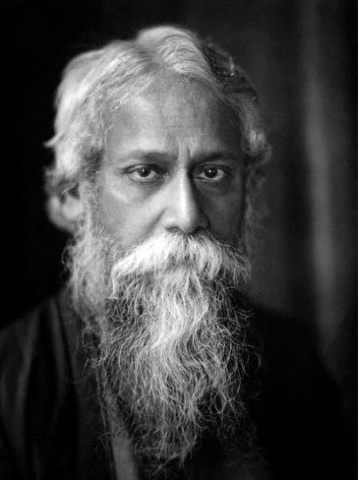
"Cabuliwallah" by Rabindranath Tagore (1938)


Tagore (1861 to 1941) was born in Calcutta,  Indian into a family whose wealth and life style can now only be seen in movies.    His father owned an estate so huge that at one point in his life Tagore traveled through it on a luxurious barge and was met on the river bank by tenants paying token rents to him.   Tagore was raised mostly by servants as his mother died young and his father was very busy administrating the vast estates he owned.   Tagore was educated in classical Indian literature and at age eight began to write poetry and ended up reshaping the Bengali Language.   Later in his life he founded a school and devoted himself entirely to his writing and teachings.   His moral authority became so great that he was able to write the national anthems of both India and Bangladesh, give Gandhi the title of Mahatma (teacher),  and  had a status as a moral leader on a par with  Gandi.   He traveled to the west and met William Butler Yeats, Ezra Pound and other notable literary figures.   This was in a period when western writers were fascinated by Indian thinkers. Yeats wrote the preface for one of his first translated into English books. He wrote largely in Bengali.   His body of work is a great literary treasure.   He was a Hindu Bengali.   He was awarded the Nobel Prize for literature, the first Asian winner and the only winner Indian author to win one to date. 

I have previously posted on ten of his delightful short stories.  In addition to being a deeply wise man, Einstein enjoyed discussing metaphysics with him and Gandhi came to him for moral advise, he was a great story teller.  Yesterday I decided it was a good day to read another one of his stories.

"Cubiliwallah" is narrated in the first person by a man writing a novel.   In his description of the novel in progress Tagore seems to be having some gentle fun at his own expense when he describes a ready for Bollywood epic of ancient heroes.   His work is interrupted often by his five year old daughter who loves talking.   A Cubiliwallah goes door to door selling fruits and vegetables.   They have among reputation as kidnappers of children so at first the family is alarmed when the daughter, Mimi, and the Cubiliwallah become good friends.   They always chat a long time whenever he stops to sell his goods. 
One day the Cubiliwallah got into a terrible fight with a customer who refused to pay him.  He ends up going to jail for eight years as the other man was severely injured.  I hate to spoil the very moving ending of this story so I won't.  


Mel u


Featured Post

Imperial Reckoning: The Untold Story of Britain’s Gulag in Kenya by Caroline Elkins - 2005 - 701 Pages

  Imperial Reckoning:     The Untold Story of Britain’s Gulag in Kenya by Caroline Elkins - 2005 - 701 Pages 2006 Pulitzer Prize Winner From...