Showing posts with label Billy O'Callaghan. Show all posts

Thursday, March 17, 2022

The Boatman” - A Short Story by Billy O’Callagan -from his collection, Ths Boatman and Other Stories


“The Boatman” - A Short Story by Billy O’Callagan -from his collection, Ths Boatman and Other Stories


I have been following the work of Billy O’Callagan since Irish Short Story Month in March 2013


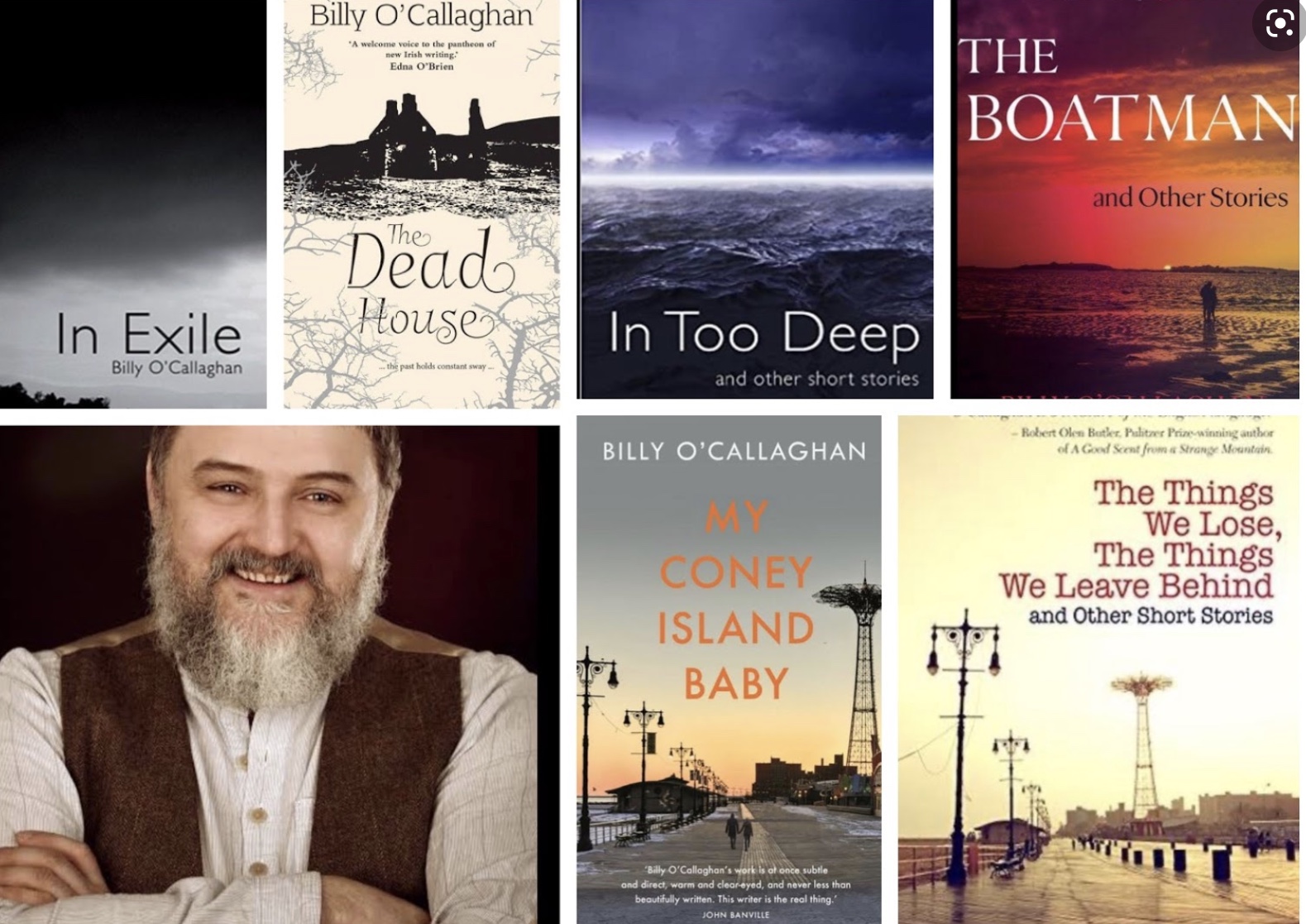
Before speaking about “The Boatman, one of the best stories about dealing with death I have ever read, I want to share my thoughts on one of his prior collections, In Exile and his debut novel The Dead House.


In Exile and other stories


This is the second collection of short stories by Billy O'Callaghan, Cork City, that I  posted on during ISSM3.  I would not have read a second collection if I did not greatly admire the first one, In Too Deep and other short stories (my post is here).    The only book on the short story worth buying is The Lonely Voice - A Study of the Short Story by another man from Cork, Frank O'Connor.  The main contentions of O'Connor was that the modern short story is uniquely, as distinct from novels, about sub-marginalized groups, people who have no one to speak for them.  He also said the short story as a literary genre is uniquely fit to portray loneliness.  I will let more erudite people than I debate whether O'Connor was right or not.  I suspect it is an unresolved dispute but for sure his claims are interesting and illuminating.  O'Callagan's stories are totally in the tradition of the works O'Connor talks about in his book.  In the  stories I will talk about we have an unwed homeless teenage mother, a professional killer, a forty year old fisherman living  alone on a small Irish island, a musician  headed for an early death from heroin, an old man living for his next glass of whiskey, and  a thirty year old man leaving his Irish home tomorrow to work in London know he will probably never see his father again.


The Dead House opens in a fashion that evokes centuries of Irish literature, with the narrator announcing in the prologue that he has a long kept story emerged in his consciousness, he hoped he would never feel he must tell the story but now years later he knows he is so obligated.  


I found the novel immensely captivating for the very visual and mesmerising descriptions of the West Coast of Ireland, dramatic cliffs and isolated villages, the character of the narrator, Michael, a successful happy in  his work fine art dealer, his wife Alison, their poet friend Liz, and the very intriguing a bit fey painter, Maggie, a long time client of Michael.  The characters are very subtlety developed, O’Callaghan draws us into understanding them.  


“The Boatman” is one of the very best works I 

 have read about dealing with the death of your child.  Like many in today, I am being swamped by news of the Corona Virus.  The daughter died of a virus. I have three daughters.


As The Boatman” opens, the young daughter of the narrator has just died.  His wife is prostrate with pain.  He knows he should comfort her but he cannot find the strength for this.  Set in West Ireland, his brother is approaching the house to help dig her grave.  The narrator is thirty, a fisherman.  From his account of thirty being middle aged in Ireland and of the impact of hard physical work on his brother and father, I had a sense of how privileged I am.


The narrator all his life has been sustained by reading.  He has been reading since a child.  No one has directed or guided him. He always as a book with him, even on his fishing boat.  His reflections on his reading history are very moving and profoundly rendered.  


There is another boatman in the story, from a story, a Chinese fisherman who lost his young daughter.  We are there at the burial.  You really need to read this story.  I saw a man without a huge amount of formal education, connecting to ancient traditions far from the doctrines of the Catholic Church, trying to find how to keep going.  


From the Publisher


“A master of the short story.”

John Banville, Irish Times Books of the Year

The Boatman and Other Stories is Billy’s latest short story collection.

“In these twelve quietly dazzling, carefully crafted stories, Billy O’Callaghan explores the resilience of the human heart and its ability to keep beating even in the wake of grief, trauma and lost love.

Spanning a century and two continents – from the muddy fields of Ireland to a hotel room in Paris, a dingy bar in Segovia to an aeroplane bound for Taipei – The Boatman follows an unforgettable cast of characters. Three gunshots on the Irish border define the course of a young man’s life; a writer clings fast to a star-crossed affair with a woman who has never been fully in his reach; a fisherman accustomed to hard labour rolls up his sleeves to dig a grave for his child; a pair of newly-weds embark on their first adventure, living wild on the deserted Beginish Island.

Ranging from the elegiac to the brutally confrontational, these densely layered tales reveal the quiet heroism and gentle dignity of ordinary life. O’Callaghan is a master celebrant of the smallness of the human flame against the dark: its strength, and its steady brightness.”

The Boatman and Other Stories will be released by Jonathan Cape on the 9th January 2020, and will be available in the UK, Ireland and the Commonwealth from Amazon, Hive, The Book Depository and Waterstones.

In the US, it will be published by Harper Collins on the 28th April 2020, and is available for pre-order now from Amazon, Apple Books, Barnes & Noble, Books-a-Million, HarperCollins, IndieBound and The Book Depository.


From the author’s website


“Billy O’Callaghan was born in Cork in 1974, and is the author of three short story collections: In Exile (2008, Mercier Press), In Too Deep (2009, Mercier Press), and The Things We Lose, The Things We Leave Behind (2013, New Island Books, winner of a 2013 Bord Gáis Energy Irish Book Award and selected as Cork’s One City, One Book for 2017), as well as the bestselling novel The Dead House (2017, Brandon/O’Brien Press and 2018, Arcade/Skyhorse (USA)).

His latest novel, My Coney Island Baby, was published by Jonathan Cape (and Harper in the U.S.) in January 2019 to much acclaim.


Billy’s latest short story collection, The Boatman and Other Stories was released in January 2020 (and will be released in the U.S. in April 2020). 


Billy is the winner of a Bord Gáis Energy Irish Book Award for the short story, and twice a recipient of the Arts Council of Ireland’s Bursary Award for Literature. Among numerous other honours, his story, The Boatman, was a finalist for the 2016 Costa Short Story Award, and more than a hundred of his stories have appeared or are forthcoming in literary journals and magazines around the world, including: Absinthe: New European Writing, Agni, the Bellevue Literary Review, the Chattahoochee Review, Confrontation, the Fiddlehead, Hayden’s Ferry Review, the Kenyon Review, the Kyoto Journal, the London Magazine, the Los Angeles Review, Narrative, Ploughshares, Salamander, and the Saturday Evening Post.”


I see coming great success for Billy O’Callagan, I see major prizes and movies.  I am proud to have been following his work for so long.


Mel Ulm

Tuesday, September 15, 2020

Mo Laethanta Saoire: Up In Smoke - A Short Story by Billy O'Callaghan - 2020


Mo Laethanta Saoire: Up In Smoke - A Short Story by Billy O'Callaghan - 2020


Published in The Irish Examiner - September 6, 2020


You may read today’s story here 


Gateway to Billy O’Callaghan on The Reading Life, including two Short stories by Billie O’Callaghan


Billy O’Callaghan loves and is deeply read in the genre.


I am pleased to be able to present his Q and A session to the Reading Life World.


I have been following the literary career of Billie O’Callaghan since March 10, 2013. My main purpose today is to let people know they can have the pleasure of reading a new short story of his recently published on in The Irish Examiner.


Today’s story is set in Cork in 1984 on Bonfire Night.  Bonfire Night has very old roots in Cork, Ireland going back to pre-Christian times, as I learned from Wikipedia:


“On the city of Cork and many rural parts of the Republic of Ireland "Bonfire Night" refers to 23 June, St John's Eve night. It has its origins in a religious celebration and originally featured prayers for bountiful crops. The night is linked to the summer solstice or Midsummer's Eve. Originally fires were lit to honour the goddess Áine as part of a Celtic celebration; the Catholic Church took over the pagan festival and linked it to the birth of St John.In the city of Limerick, "Bonfire Night" is held on May Eve, 30 April, on the eve of the Celtic festival of Bealtaine.”


In 1984 in Cork Bonfire Night is now just a reason to set a huge fire.

Young men spend weeks collecting material for the fire.  The story is narrated by a young man very into preparing for the fire.  Part of the tradition includes a burning man figure.


I love how this story shows us how very old ways still inform contemporary Irish life.  I don’t want to relay much of the plot action but in order to set the stage and give you a feel for the elegant prose of O’Callaghan I will share the opening of the story


“By the time I was nine years old my grandfather's suit, a chocolate-brown pinstripe with big shoulders and baggy legs, had already gone a lifetime past its prime, the elbows and knees turned paper-thin, the cuffs frayed, the seams beginning to split. 

For all its many and obvious flaws, though, it remained his most treasured possession – ripe, he liked to claim, with the flavours of every significant moment he'd ever known, the gloriously sunlit days as well as the most tearful ones.

My mother hated the sight of the suit, and was forever at him about getting rid of it.

“We're the talk of the place,” she used to say, shaking her head in exasperation. “Tramps don't look as far gone as you do. There can't be anything more than dirt holding it together.” 

But such arguments were lost on him. 

He'd worn it to a dozen weddings over the years and to a hundred dances; had it on him the first time he stole a kiss from the woman who'd become his wife, and when each one of his six children (my mother being the last) were dragged into the world, and he'd stood broken-hearted in it at gravesides for the burials of his parents, siblings and friends.”


Billy O’Callaghan was born in Cork in 1974, and is the author of three short story collections: In Exile (2008, Mercier Press), In Too Deep (2009, Mercier Press), and The Things We Lose, The Things We Leave Behind (2013, New Island Books, winner of a 2013 Bord Gáis Energy Irish Book Award and selected as Cork’s One City, One Book for 2017), as well as the bestselling novel The Dead House (2017, Brandon/O’Brien Press and 2018, Arcade/Skyhorse (USA)).

His latest novel, My Coney Island Baby, was published by Jonathan Cape (and Harper in the U.S.) in January 2019 to much acclaim.

Billy’s latest short story collection, The Boatman and Other Stories was released in January 2020.


Billy is the winner of a Bord Gáis Energy Irish Book Award for the short story, and twice a recipient of the Arts Council of Ireland’s Bursary Award for Literature. Among numerous other honours, his story, The Boatman, was a finalist for the 2016 Costa Short Story Award, and more than a hundred of his stories have appeared or are forthcoming in literary journals and magazines around the world, including: Absinthe: New European Writing, Agni, the Bellevue Literary Review, the Chattahoochee Review, Confrontation, the Fiddlehead, Hayden’s Ferry Review, the Kenyon Review, the Kyoto Journal, the London Magazine, the Los Angeles Review, Narrative, Ploughshares, Salamander, and the Saturday Evening Post. 


https://billyocallaghan.ie/en/


I look forward to following the work Billy O’Callaghan for many years.  I predict one day people in Dublin, London, NYC and beyond 

may wonder who was this book blogger who predicted great success for him long ago.  


Mel u


Tuesday, March 17, 2020

“The Boatman” - A Short Story by Billy O’Callaghan from his collection, Ths Boatman and Other Stories, 202


“The Boatman” - A Short Story by Billy O’Callaghan  -from his collection, Ths Boatman and Other Stories, 2020


From here you will find links to my posts on his short story collections as well as 
One of his short stories I was kindly allowed to publish
I have been following the work of Billy O’Callagan since Irish Short Story Month in March 2013

Before speaking about “The Boatman, one of the best stories about dealing with death I have ever read, I want to share my thoughts on one of his prior collections, In Exile and his debut novel The Dead House.

In Exile and other stories

This is the second collection of short stories by Billy O'Callaghan, Cork City, that I  posted on during ISSM3.  I would not have read a second collection if I did not greatly admire the first one, In Too Deep and other short stories (my post is here).    The only book on the short story worth buying is The Lonely Voice - A Study of the Short Story by another man from Cork, Frank O'Connor.  The main contentions of O'Connor was that the modern short story is uniquely, as distinct from novels, about sub-marginalized groups, people who have no one to speak for them.  He also said the short story as a literary genre is uniquely fit to portray loneliness.  I will let more erudite people than I debate whether O'Connor was right or not.  I suspect it is an unresolved dispute but for sure his claims are interesting and illuminating.  O'Callagan's stories are totally in the tradition of the works O'Connor talks about in his book.  In the  stories I will talk about we have an unwed homeless teenage mother, a professional killer, a forty year old fisherman living  alone on a small Irish island, a musician  headed for an early death from heroin, an old man living for his next glass of whiskey, and  a thirty year old man leaving his Irish home tomorrow to work in London know he will probably never see his father again.


The Dead House opens in a fashion that evokes centuries of Irish literature, with the narrator announcing in the prologue that he has a long kept story emerged in his consciousness, he hoped he would never feel he must tell the story but now years later he knows he is so obligated.  

I found the novel immensely captivating for the very visual and mesmerising descriptions of the West Coast of Ireland, dramatic cliffs and isolated villages, the character of the narrator, Michael, a successful happy in  his work fine art dealer, his wife Alison, their poet friend Liz, and the very intriguing a bit fey painter, Maggie, a long time client of Michael.  The characters are very subtlety developed, O’Callaghan draws us into understanding them.  

“The Boatman” is one of the very best works I 
 have read about dealing with the death of your child.  Like many in today, I am being swamped by news of the Corona Virus.  The daughter died of a virus. I have three daughters.

As The Boatman” opens, the young daughter of the narrator has just died.  His wife is prostrate with pain.  He knows he should comfort her but he cannot find the strength for this.  Set in West Ireland, his brother is approaching the house to help dig her grave.  The narrator is thirty, a fisherman.  From his account of thirty being middle aged in Ireland and of the impact of hard physical work on his brother and father, I had a sense of how privileged I am.

The narrator all his life has been sustained by reading.  He has been reading since a child.  No one has directed or guided him. He always as a book with him, even on his fishing boat.  His reflections on his reading history are very moving and profoundly rendered.  

There is another boatman in the story, from a story, a Chinese fisherman who lost his young daughter.  We are there at the burial.  You really need to read this story.  I saw a man without a huge amount of formal education, connecting to ancient traditions far from the doctrines of the Catholic Church, trying to find how to keep going.  

There are eleven other stories in The Boatman and Other Stories.  If I can I will feature one more this month.  For sure in 2020 I will read the full collection and post  on the stories.

The collection will be available as a Kindle on April 28.  If you love short stories, I urge you to acquire this book.


From the Publisher

“A master of the short story.”
John Banville, Irish Times Books of the Year
The Boatman and Other Stories is Billy’s latest short story collection.
“In these twelve quietly dazzling, carefully crafted stories, Billy O’Callaghan explores the resilience of the human heart and its ability to keep beating even in the wake of grief, trauma and lost love.
Spanning a century and two continents – from the muddy fields of Ireland to a hotel room in Paris, a dingy bar in Segovia to an aeroplane bound for Taipei – The Boatman follows an unforgettable cast of characters. Three gunshots on the Irish border define the course of a young man’s life; a writer clings fast to a star-crossed affair with a woman who has never been fully in his reach; a fisherman accustomed to hard labour rolls up his sleeves to dig a grave for his child; a pair of newly-weds embark on their first adventure, living wild on the deserted Beginish Island.
Ranging from the elegiac to the brutally confrontational, these densely layered tales reveal the quiet heroism and gentle dignity of ordinary life. O’Callaghan is a master celebrant of the smallness of the human flame against the dark: its strength, and its steady brightness.”
The Boatman and Other Stories will be released by Jonathan Cape on the 9th January 2020, and will be available in the UK, Ireland and the Commonwealth from Amazon, Hive, The Book Depository and Waterstones.
In the US, it will be published by Harper Collins on the 28th April 2020, and is available for pre-order now from Amazon, Apple Books, Barnes & Noble, Books-a-Million, HarperCollins, IndieBound and The Book Depository.

From the author’s website

“Billy O’Callaghan was born in Cork in 1974, and is the author of three short story collections: In Exile (2008, Mercier Press), In Too Deep (2009, Mercier Press), and The Things We Lose, The Things We Leave Behind (2013, New Island Books, winner of a 2013 Bord Gáis Energy Irish Book Award and selected as Cork’s One City, One Book for 2017), as well as the bestselling novel The Dead House (2017, Brandon/O’Brien Press and 2018, Arcade/Skyhorse (USA)).
His latest novel, My Coney Island Baby, was published by Jonathan Cape (and Harper in the U.S.) in January 2019 to much acclaim.

Billy’s latest short story collection, The Boatman and Other Stories was released in January 2020 (and will be released in the U.S. in April 2020). 

Billy is the winner of a Bord Gáis Energy Irish Book Award for the short story, and twice a recipient of the Arts Council of Ireland’s Bursary Award for Literature. Among numerous other honours, his story, The Boatman, was a finalist for the 2016 Costa Short Story Award, and more than a hundred of his stories have appeared or are forthcoming in literary journals and magazines around the world, including: Absinthe: New European Writing, Agni, the Bellevue Literary Review, the Chattahoochee Review, Confrontation, the Fiddlehead, Hayden’s Ferry Review, the Kenyon Review, the Kyoto Journal, the London Magazine, the Los Angeles Review, Narrative, Ploughshares, Salamander, and the Saturday Evening Post.”

I see coming great success for Billy O’Callagan, I see major prizes and movies.  I am proud to have been following his work for so long.

Mel u


Friday, March 21, 2014

The Things We Lose, The Things We Leave Behind and Other Short Stories by Billy O'Callaghan (2013)


The Things We Lose, The Things We Leave Behind is the third collection of short stories by Billy O'Callaghan (Cork, Ireland) I have so far had the great pleasure of reading and posting about.  Prior to this I read his In Too Deep:  Short Stories of Ireland and his In Exile.  He also contributed a very informative and highly informed Q and A session to ISSM3 last year. He is extremely well read in the short story, as any one who follows his Short Story of the Day Feature on Facebook would agree.  


The more collections of short stories I post about, the more difficult I find the process.  In most cases the stories in the collection were not originally written with the idea of placing it in a collection.  Reviewers, I do not consider myself a reviewer, I just read things and then post on them, tend to write a sentence or two on a few of the stories, then indulge in lyrical metaphorical descriptions of the collection that on analysis often make little sense.  I prefer, and I think it shows more respect for the author and potential collection reader, to post in some detail on a number of stories in the collection.
From that point, I feel open to talking about common themes in the stories.

For those who want the bottom line first, I completely endorse this collection to all lovers of exquisite prose and brilliantly plotted psychologically acute short stories.  I see O'Callaghan rapidly developing as an artist and I hope to read many more stories by him.

At the end of my post I will include a link to his Q and A and to the two short stories he has very generously allow me to share with my readers.

"Zhuangzi Dreamed He Was A Butterfly"

"I wish for the closeness we'd once enjoyed, but life has a way of widening voids, or maybe it was enough to know that we'll love one another until we die". 

One of the things O'Callaghan is very good is letting us see how time and events change relationships between men and women, how a living relationship is fluid, in some ways it will get worse, in others better.   This is a story with a terrible tragedy at the core.  It is about how the death of a totally loved six year old daughter, who had become the heart of their, impacts a marriage upon her death.  It is told by the husband.  The death created a breaking point, a before and after in their relationship.  The man must bear his own pain at that of his wife.   He must listen to others in unshattered worlds, world with before and afters.  He sees how even his memory of Aiko changes, everything is in flux.  He things about his marriage, maybe he mourns the unclouded love they once have.  He knows he shares a bond with his wife he can share with no other.  This is a story that every parent hopes will always just be a fiction for them.  We are made to see how this terrible pain has deepened the wisdom of the husband, we are left in stasis on the wife, only hoping she can sleep through the night again one day. 

"Farmed Out"

"He has never been anywhere, and can barely imagine a world beyond the little he knows, but these books are like fire to his mind".  

Ireland, like a lot of places, is full of young people nobody wants.  In a way, and I accept I am looking for this as I read, is part of the notion that the grand theme of modern Irish literature is that of the weak or missing father, some would add to this the notion of monstrous fathers.  I will leave it open for now if monsters are not masking terrible weakness brought on by their own sense of powerlessness. The story centers on a  teenage boy released from a Christian Brothers School, rightly or wrongly places with bad reputations for abuse, into the care of a farmer. There is a formal arrangement where the boy has to work for the farmer in exchange for room and board.  The farmer tells him do your work and their will be no trouble.  The veiled threat is there to send him back.  The work is very hard, the days are very long but the boy sees it as better than the school.  He lost his mother, we have no idea where his father might be, at an early age.  He has a sister who sends him novels about the old days in the American west.   These stories captivate him.  Much of the power and beauty of this story is it the descriptions of life on the farm.  The ending is as harsh as the Irish countryside can be and as cruel. This is a story of a seemingly pointless life, a boy treated with cruelty by people who know no better for themselves.  


"Are the Stars Out Tonight"

"At nineteen your horizons have not yet burned"

"Are the Stars Out Tonight" is about the last days of a marriage of two decades or so.  The wife very calmly tells the husband the time has come for him to move out, it is what they both want.  There is no surface anger or angst, the wife has been having an affair with a mutual friend.  Nobody hates anybody, all very civilized, maybe repressed.   They have a daughter in college.  O'Callaghan is very good at taking his characters through changes in relationships.  There is still a passion between between them.  The daughter adds much to the story.  One of, as I see it, the theme of the authors is how people come to cope with the loss of the the first hopes of life, of relationships.  
  

"We're Not Made of Stone"


Many people decades into their marriage may find this story more than a little painful. The description of James retreat into reading was a bit close for me!   They both have OK regular jobs, they get along fine, they have sex once and a while.  They long wanted a baby but they accepted it was not to happen.  Then one day she tells her husband she, at forty five or so, is at last pregnant.  The story is how the adjust to this potentially massive disruption in their lives.  Each is watching the other very closely to discover how their partner really feels.  I don't want to tell more of the plot.  One of the frequent leitmotifs in Irish literature seen in  our author's work, is the impact of the long term repression of emotions on relationships.  Neither party understand how to fully express or even understand their feelings for the other.  This is a very acutely observed story.  I felt a deep empathy for the husband, he wants an heir but he loves his routine. N

You can read this great story on The Reading Life


"Goodbye My Coney Island Baby"


So far four of the first six stories have been about marriages with flaws, marriages that endure long after the first reasons for it are over.  "Goodbye My Coney Island Baby, set in New York City is about Peter and Susan.  They have both been married for a long time but not to each other.  They work in the same office building and have been having an affair for seventeen years, meeting for sex in out of the way motels.  Neither really wants to leave their spouse.  The descriptions of the sexual aspect of their relationship was very well done, Susan still acted like a girl friend, even after seventeen years.  Now I am for sure not saying a wife is not preferable to a long time girl friend but a lot of this stories readers will quietly feel the difference.  Of course they feel guilty.  Peter has just told her that his wife has been diagnosed with very aggressive cancer.  You can feel Susan's fear in this but we are not quite sure what it is she is fearing.  In a way, there relationship has not really developed or matured much past the opening stages. 


"Matador"


OK, here is a question for all readers of this story- did you think of Hemingway as you read this story of a matador forced from the bull ring by an injury, and by a bull a clear rank below his level?  It was good to see a story in the collection set outside of Ireland.  Stories about bull fighting in Spain are stories about proving your manhood. This is a very intriguing strory about what suffering a career ending injury does to the psyche of a bull fighter. I liked it very much. 

"Keep Well to Seaward"

"And in those few seconds I saw her as the old woman she'll be one day.

"Keep Well to Seaward" is one of the longer stories in the collection.  It centers on a twenty seven year old Irishman living in Taipai.  He makes his living from his writings, most short stories and he is hundred or so pages into his first novel.   He is there alone.  Of course Taipai seems very exotic to him.  He reads in Lonely Planet Guide to Taiwan of a modestly price restaurant near his place that is supposed to have nontourist Chinese food at low prices.  You have to ponder how he sees his time in Taipai.  Is he Orientaluzing his experience in the "exotic east" or does he just need some serious time away from Dublin to write.   He begins to go regularly to the restaurant and slowly gets to know an attractive but much harder get to know woman his age who waitresses there. Slowly a romance and a sexual relationship develops between them.    Politically main land China, who claims Taiwan, saber rattles while he is there but nothing happens.  He is used to political instability back home.  Slowly they seem to fall in love.  You have to decide for yourself why they love each other.  There is a twist to the plot I totally did not seeing coming, and neither did our Irishman.  The way O'Callaghan ends this story is just great, he deals wonderfully with the impact of time passing on his characters.  I liked the young writer, I felt somehow a reserve of loneliness, a holding back of emotions.  

There are six other stories in the collection, each a great pleasure to read.  

Here is the publisher, New Island Books, description of the collection


The Things We Lose, The Things We Leave Behind

**WINNER OF THE BORD GAIS ENERGY WRITING.IE SHORT STORY OF THE YEAR AWARD 2013**

The Things We Lose, the Things We Leave Behind is a new collection by Billy O'Callaghan that explores everyday existence in the aftermath of cataclysms both subtle and overt. The characters who populate these stories are people afflicted by life and circumstance, hauled from some idyll and confronted with such real world problems as divorce, miscarriage, cancer, desertion, bereavement and the disintegration of love.

From the tale of an institutionalised orphan boy in 1950s Ireland sold into servitude as a farm labourer, to the Sevillian matador who in a single misstep has fallen into a life of obscurity, and on through to the poignant title story of a man returning to his island home to see again the child that he abandoned, these are stories about picking up the shattered pieces and finding among them some glint of value, and some way to survive.

In The Second Coming, Yeats wrote: "Things fall apart, the centre cannot hold." Yet here the reader is offered evidence to the contrary, with the suggestion that the human heart boasts extraordinary resilience and is possessed of an ability to find redemption in the most unexpected of places. In the face of tragedy we re-evaluate ourselves. We bear the guilt, sorrow and regret for the things we have lost or given up, we seek the light, and we endure. These thirteen stories attempt to illuminate the darkness.


I see in this collection a superb handling of how the flow of time impacts relationships.  A marriage is central to many of the stories.  I found his treatment of the relationships very perceptive and subtle.  His prose styling is a joy to read.  There is much pain in these stories, studies of how people want different things out of relationships, sometimes they hide what they want from themselves.  The characters are very well developed though they maintain reserves we cannot easily penetrate. I admit I enjoyed seeing settings outside Ireland.  


A link to my Q and A with the author - I learned a lot from this and am very proud to have it on my blog.

http://rereadinglives.blogspot.com/2013/03/billy-ocallaghan-q-and-session-with.html


A short video of the author speaking at the Irish Short Story of The Year Awards Ceremony.


http://m.youtube.com/watch?v=k0mMWYHqKoM


I hope to be featuring new work by Billy O'Callaghan for many years.  


Anyone who loves a fine short story will be happy they discovered his work, I know I am.


Thursday, March 21, 2013

"We’re Not Made of Stone" a short story by Billy O'Callaghan


March 1 to March 31
A Short Story by Billy O'Callaghan

If you are interested in participating in this event in any fashion, please contact me.   The less ISSM3 is just me blathering away, the better it will be. 


Billy O'Callaghan, Cork, Ireland is the author of two highly regarded collections of short stories, among many other accomplishments.  I recently read and greatly admired (my post is here) his In Too Deep and other short stories.  My post on his collection In Exile is here.   I greatly admire and respect his work, otherwise I would never have read two of his collection back to back during a very busy reading month for me.  I totally endorse his stories to any and all lovers of the art of the short story. 

A Q & A Session with Billy O'Callaghan is here.  I strongly urge anyone interested in the short story or Irish culture and history to read it.  

You can read his superb short story "Waiting" here

Author Data (from his Webpage)


I was born in Cork, Ireland, in 1974, and am the author of two short story collections: ‘In Exile’ (2008) and ‘In Too Deep’ (2009), both published by the Mercier Press.
In 2010, I was the recipient of an Arts Council of Ireland Bursary Award for Literature. My stories have won the 2005 George A. Birmingham Short Story Award, the 2006 Lunch Hour Stories Prize and the 2007 Molly Keane Creative Writing Award, and have been short-listed for many more prizes, including the Sean O’Faolain Short Story Award, the RTE Radio 1 Francis MacManus Short Story Award, the Faulkner/Wisdom Award for the Short Story, the Glimmer Train Open Fiction Award and the Writing Spirit Award. I was also been short-listed in three consecutive years, 2008- 2010, for the RTE Radio 1 P.J. O’Connor Award for Drama.
I am currently at work on my first novel, tentatively entitled ‘Goodbye, My Coney Island Baby,’ and am in the process of compiling a new collection of stories.
Over the past decade, my work has appeared in more than seventy literary journals and magazines around the world, including: Absinthe: New European Writing, Alfred Hitchcock Mystery Magazine, The Bellevue Literary Review, Confrontation, Crannóg, First City Review, Hayden’s Ferry Review, Ireland’s Own, the Los Angeles Review, Narrative Magazine, Pearl, Pilvax (Hungary), the Southeast Review, Southword, Underground Voices, Verbal Magazine (Northern Ireland), Versal (Holland), Waccamaw and Yuan Yang: a Journal of Hong Kong and International Writing. New work is forthcoming in the Fiddlehead.


'We’re Not Made of Stone''

by Billy O'Callaghan


After so long and so much effort, they decided, without discussing the matter, to give up trying. This made life easier, if a little more empty. Margaret took up sewing; James became more serious about his reading with intent toward perhaps writing something himself at some unspecified point in the future. Their apartment, on one of the town’s inclines, was small but cosy, consisting of an acceptably snug bedroom, windowless bathroom and a living/dining room-cum-kitchenette area with a narrow brick balcony feature that afforded views west across staggered rooftops to the remnants of countryside and a fast-receding ribbon of woodland. During their first few years together, the place had worked for them as a love nest, a little safety deposit box against the world where they could snuggle up together and feel safe and even worthwhile. Now, it simply worked as home, though in the smaller definition of the word, an agreeable piece of living space that fit their needs well enough without really fulfilling any cravings. They had a floor above them and three below, and on winter evenings they liked to sit by the fireside, facing one another but only rarely speaking, and when summer came they threw open the doors and let the air in.
Initially, because he’d been rather lax in his reading habits and had lost some muscle in that department, James favoured plot. His tastes were broad but, by and large, hardboiled. He enjoyed stories with guns, and with a lot of running. But later, perhaps by the end of the first year or the middle of the second, he found himself turning increasingly to less hectic and more character-driven work. A natural progression, he decided, not worrying too much about it. And this new devotion to reading replaced many things, for both of them. It encouraged a kind of silent comfort that would otherwise have been pretty difficult to achieve. She sewed, he read. No longer kids, each dreamed their own private dreams.
They had just entered their fourteenth year of marriage when Margaret discovered that she was pregnant. A Sunday morning in early April, with rain pecking at the glass and the light the colour of day-old fireplace ash. The news came as a shock, and then a good shock. They stood for a long time in the kitchenette, holding hands and trying to smile a great deal. James kept one hip pressed against the counter’s edge, so that he could hold himself ever so slightly off balance. Sundays were his lazy days, days when he didn’t have to feel guilty about doing nothing. They stood, smiling and holding hands, and each fancied or imagined that they could see a blush of absurd happiness in the other’s face and so tried hard to match it with a similar blush of their own.
“At least we’ve been sensible,” James said, the words typical of him. He had always been the sort of man who tried to be practical whenever he found himself edging against some moment of particularly torrid emotion. As a trait it was neither a positive or a negative, or perhaps it contained elements of both at once. “We have some savings,” he went on. “Enough to get by if we don’t get too carried away, and we’re pretty well set up, I’d say. Our age doesn’t have to be a downside. At least we’re past the panicking stage, and that must count for something. I’ll bet that a lot of couples would trade their dancing legs to be us.”
Margaret wanted to believe him. She was shaking, but from deep inside. In her bones. “I love you,” she murmured, pressing her face against his chest. Some of it was gratitude, an appreciation of his happiness, but at least a part of it was despair. Because this felt enormous, a life-changing event.
She was not a beautiful woman. Never had been, even on her best day, but at least at eighteen or twenty-five she’d been more presentable than now. The passing years had played a part in her deterioration, but there was more to it than age. Her face was turning grey. Not her hair, her face, her actual flesh. Like something had gone rotten on the inside and was beginning to show through. And her skin felt tight, the way it would after exposure to too much heat. She meant what she said, about loving James, but she was not at all sure that what she meant by love was equal to what the rest of the world meant by the word. And James held her, but didn’t say the same words back. That didn’t matter though. She had long since given up expecting to hear them from him. What they had, what they’d always had, was enough, because it had to be enough.
He was wearing yesterday’s wool shirt, and the fibres held his musk in a way that was not pleasant. She felt an urge to pull back but couldn’t, because his big hands held gentle but secure against her hips. Trapped, all she could do, short of insulting or embarrassing him by making a fuss, was pray that God would grant her the small mercy of not having this stench forever attach itself in her mind to what was supposed to be one of the most special and precious of moments of her entire life. Held in place, she drew back her lips and settled for breathing in little sips through clenched teeth.
She had recently turned forty-one years old. James was older by three and a half years. He worked a steady, unspectacular six-day shift at one of the large Home Improvement warehouses out on the Kinsale Road, a nine-to-five routine of manual labour, but of the bearable, fork-truck variety. She filled some part-time hours with a little light typing and bookkeeping, working from home for a small brokerage house on the South Mall. Neither one of them had longings to set the world alight with their fire. In truth, neither one of them had ever felt much able to muster a significant spark. Without a lot of thought, and without any in-depth discussion, they had dedicated the majority of their fourteen years of marriage to enduring the myriad complications of life. Until this morning’s bombshell, they both believed, and accepted, that things for them had reached something of a plateau.
Over mugs of cocoa, James talked. He had a lot to say, but she knew that few of his words were of a substance that could be relied upon beyond this day, or this week. Talk about how they probably ought to start looking around for a bigger place, how he was going to put in for a promotion down at the warehouse, how at the very least he was long overdue a raise. She knew he meant the things he said, but only in the moment. His voice had a smokiness about it, the way it sometimes got after he’d had a couple of beers. They sat facing one another across the small fold-out table, the one with the sky blue and white speckled Formica veneer that had come as part of the apartment’s original decor and which had been long since ringed by a multitude of too-hot coffee mugs. He held her hands and leaned in so that their faces were only a small distance apart, and wondering just how close he’d need to get before she would be forced to suffer again the acrid reek of his body stench, she brought her teeth together and let him talk, encouraging him with the occasional nod of her head or shrug of her shoulders not because she was interested in what he had to say but because it was easier to do this than to do nothing. And when, after a while, the cocoa had turned cold in her mug and his words lost their smokiness and instead began to take on the tenor of a stone inside a tin can, she gently but firmly pulled her hands back, rose with an apology that needed neither words nor explanation, and fled for the sanctuary of the bathroom. When she emerged, several minutes later, having done nothing more than perch on the rim of their small bath and practice her breathing, he had talked himself out, just as she’d hoped he would. He got up from the table and moved to his armchair in front of the television set, but instead of reaching for the remote control fell headlong into the novel he had going, some middle-period Saul Bellow, with all suns blazing and rules still existing to be broken. She brought him a beer and he thanked her, but in his usual distant way. She set a glass down on the floor beside him, knowing he wouldn’t use it. He cracked open the can, took a deep shut-eyed swallow, then returned to his place in the story.
None of this felt quite real. That night, lying in bed listening to the scrape and rumble of his laboured sleep, she tried to imagine the child inside her body, the size of an orange, perhaps, but made of flesh and blood, and alive. She waited, wanting to feel something, anything that would mark her out as being in some way different from before, from yesterday, or six months ago, or any single day of the last fourteen years. But she was just herself, nothing more.
Three weeks later, she suffered a miscarriage.
It came on suddenly, while she was in the kitchen stuffing a small chicken for dinner. James was at work and not due home for several hours. She felt an urge to vomit, and a series violent cramps twisted her down onto the floor. Her initial instinct was to try and make it to the bathroom, but then something broke inside of her and such thoughts ceased to matter. There was a lot of blood. At first she was too terrified to cry, but after a minute or so the tears came and the details of the day were lost.
She lay on the floor for a long time then, trying not to think about what had happened, and kept her eyes clenched to spare herself the trauma of having to see. But she didn’t need to see. It had all been so fast, like a magic trick, there and then gone.
When she could, she phoned James. Twenty minutes later, he arrived home to find her still sitting in a slump on the cold tiles. She was either still crying or else had begun to cry all over again. The tears came in heaves, like small wet, strangling convulsions, but they found a rhythm that fit well with what had happened. A sense of emptiness pervaded, a degree of desolation for which she felt quite unprepared.
James said and did all the right things. He held and kissed her, told her, in a whisper that sounded strong and assured only because it had been so reduced in scope, that everything would be fine, that he’d look after her now. She was what mattered, he said, only her. It was a lie, but one which was at least well-meant, and she felt unspeakably thankful for that and clung fast to his body. His stench did not matter now. In fact, it carried with it a kind of comfort, an assurance that not everything had changed, that some details remained the same and always would.
When her legs could bear her weight without crumpling, he led her slowly to the bathroom, helped her out of her clothes and gently washed her body. Her skirt was ruined, the bottle green worsted number that she’d saved for two full months to buy and which had been her single most precious item of clothing. “It can always be washed,” James told her, but she just shook her head, knowing that she could never again bring herself to wear it. She stood and let him peel away her garments, and watched as he unbuttoned his own shirt one-handed, clumsily, so that he would not get too wet. Then he helped her into a sitting position in the bathtub and began to douse her body with the spray from the removable shower-head. The water was hot and felt good against her skin. Her inner thighs were coated in a blackish rheum that seemed to bear no relation whatsoever to the little life she’d been carrying for so many weeks. She watched the blackness turn a syrupy red and then pink in dilution and spin in a slow vortex down the unplugged drain. While James’s caressing hands were thoughtful and thorough, helping rid her of the mess, his upper teeth pinched at the flesh of his lower lip in a way that was almost boyish, or would have been, were it not for the weary blueness tincturing the skin around his concentrating eyes. She watched him work until some part of her mind was struck with sudden understanding and then she could no longer bear to look, and so she missed the point when he too began to cry, missed it because of the silent way in which his tears started to flow. And even when she opened her own eyes again, she did not immediately notice, not until he drew his hand away from her leg and wiped his face, first one side of his nose and then the other, with the back of his wrist. By then his hands were clean, the yellowish skin around his hard fingertips had already begun to prune. It was over, or as good as over, though for quite a while afterwards their tears continued to fall.
Forty-one was not particularly old. The doctor who told her this was a young man, early thirties at a push but with the kind of handsome features that kept the years off. He was Indian, though of extract rather than by birth, as his smooth accent readily attested, and he had a bright open face with sallow skin and large, wide honest eyes. His hair was clipped in a jet-black crew-cut style that would have looked okay on a fourteen year old. Margaret listened in silence, understanding that he was, of course, correct in what he said. Forty-one was not old, or did not have to be. The problem, though, was that age had already turned her to mud, age and the turgid lifestyle of all comfortable ruts. The details had for quite some time been keeping an irregular schedule: she’d already been three months along before even fully acknowledging the pregnancy. So while forty-one might not have been considered old anymore, it was still knocking on the door of old the way she wore it.
In that small, anaemically decorated office, James sat beside her, not quite holding her hand but holding himself in a way which seemed to suggest that he either wanted to or felt it was expected of him. She understood. He had always struggled with public displays of affection. His mouth moved around little sighs and he clearly wanted to offer some words of comfort but could not decide quite what to say. So he kept silent.
And in the weeks that followed, that silence held. The doctor had told them that a great many women suffer miscarriages, especially on their first child, and that even at forty-one there was still time for them, more than enough time, actually. Of course, losing a pregnancy was traumatic, and some women found great difficulty in coping, but it was important for them to understand and accept that there was no question of blame. Sometimes such things simply happened.
The emptiest part of the day, the stretch between late morning and early afternoon while James was still at the warehouse, was best for thinking. With James at work she’d sit at the kitchen counter, sipping coffee or a glass of warm milk and very often crying, though not with any great intent. The day of the miscarriage never felt far away, and she’d play out that morning’s scene over and over in her mind, looking for a cause, some mistake she might have made, an inadvertent nudge against the counter, standing too close to the oven or just standing for too long. Anything. And sometimes she pretended nothing had happened and that she was still pregnant, or that it was a year on, or five years, or twenty. Entire worlds opened up to her then, and she’d indulge in fantasising whole lives for the unborn child, boy or girl, with an emphasis on the key notes, the moments of joy, heartbreak and sorrow. Problematic situations drove the fantasy: a daughter seventeen, eighteen, falling pregnant; a son getting in with the wrong crowd, doing drugs, or sitting her and James down at the kitchen table, and breaking the news to them that he was gay.
At first, all of this seemed like harmless indulgence, but as her skill in conjuring them sharpened, the fantasies began to dominate her thoughts. By comparison, her own life felt staid, insipid, empty. Several times a day she’d catch herself laughing aloud or smiling until the muscles of her face ached, and she wept away entire mornings, entire afternoons. The extremes, the black rains, the delirium of laughter, left her hollowed out and weak as a drugged kitten. It worried her, but she couldn’t bring herself to stop.
Finally, she mentioned it to James.
They were beside the unlit fire, late in the evening. A radio was playing, just to keep out the silence. She lay down her sewing. Across from her, James was in a book and took a long time to look up. When he did, finally, he held his place among the pages with an intruding thumb, his way of letting her know that this would be no more than a brief interruption. He was not angry, merely impatient.
“I can’t believe there is any harm in it,” she said, trying to smile but not quite finding one to fit. “In fact, I’m sure it’s quite natural. And I know it’s not real. That’s probably important. Knowing that. Because otherwise, it becomes something else entirely, doesn’t it? But as it stands now, it’s an indulgence. That’s all.”
“It could be delayed shock,” he said, after a dozen seconds. “Or the onset of depression.”
She shook her head. “No. It’s not depression.”
“It could be. Depression comes in many forms. We don’t always realise that. Some people live their entire lives mired in depression without even knowing it. The signs can be subtle. And we’re flesh and blood, you know, Maggie. We’re not made of stone. When something like this happens, we’re bound to feel an effect. Different people deal with things in different ways.”
He eased the book shut, but his thumb still held the place. She was glad of this, the small generosity of the closing gesture but also the fact that he was clearly not preparing to stray too far from the story. A simple stroll was fine, but she felt lazy. She was not ready in her mind to go taking on the mountains. Not this evening. From where she sat, she could see the book’s cover, inverted in his lap. The double R, coupled with the glint of the reading lamp’s cast, caused her a little trouble in deciphering the name, and then suddenly she got it: le Carré. She wondered if his choice of reading was unduly effecting him.
“You’re making too much of this,” she whispered.
He stared at her. She knew what he was looking for. Sometimes she gave away truths by a shift in expression. She wondered if she was giving away anything now, or even if there was anything to give, this time.
“Just the same,” he said, “I think you should see someone. I’d feel better about things if you did. You’re probably right, it’s more than likely nothing at all, just a normal part of the grieving process. But a chat can’t hurt. And if you won’t do it for yourself then do you think you could do it for me?”
That was a twist, like being caught in a snare. Struggling only made matters worse.
So, she went, made a call the following morning to her doctor, received a referral, and eleven days later, on a whitewashed afternoon with a sky too cold to do anything more than glow, took a taxi to a nondescript Western Road address and climbed four floors in a walnut-panelled elevator to lay out her innermost secrets before a total stranger. She’d spent days rehearsing a litany of backup deceptions, but the soft white embrace of the plush, faux-leather reclining chair was designed with abject surrender in mind, and she simply fell into place, too exhausted to put up a fight.
Her psychiatrist sat at a reasonable remove, perched on a edge of a low-slung bucket seat, notepad in hand, silver or perhaps platinum pen at the ready. She was a middle-aged woman in a purple blouse with puffed sleeves and a buttoned-up collar, shin-length navy blue skirt and sensible black patent shoes. Her face was long and slender, full of sheer angles, with small fixated eyes and a mouth like a paper cut, and she wore her hair, which had been bleached a shade so blonde as to be practically stripped of colour, clipped into an expensive-looking but quite ill-suited angled bob with a low split fringe.
“Talk about anything,” she said, not smiling, hardly even appearing to care much, one way or the other. Margaret nodded, but because the whole business seemed quite sordid, this notion of buying an hour of someone’s time, she had some initial difficulty in verbalising her thoughts. But it soon became apparent that this would be strictly a one-way dialogue, and some inner barrier gave. The time passed quickly then. She lay back, closed her eyes and talked away the entire hour, in a voice that felt separate from her own and which, by its intensity discouraged interruption. The fantasies were the problem. Everything else was mere dressing.
“Well?”
James went in and out of his beer can again while waiting for her to say something.
“Well, what?”
“The doctor. How’d it go? Okay?”
Froth lay like feathers on his upper lip, held by a day’s stubble.
“Firstly, she’s not a doctor.”
“No? Where does she get off asking one-eighty a pop then?”
“Some doctors go by Miss or Mister. It’s a rank thing. Don’t ask me why because I haven’t the faintest idea. It didn’t dawn on me to find out, though to be honest, I wish I had now that I think about it. And secondly, it went okay. As okay as can be expected, anyway.”
“Did something happen? Or is this one of those deals where you’re not supposed to say?”
She shrugged. “Nothing happened. And there’s nothing wrong. I told her everything. About us and the miscarriage, about how I’ve fallen into this habit of fantasising. Everything.”
“And?”
“And nothing.”
“For a hundred and eighty Euros? Nothing?”
“Going was your idea, James. Not mine.”
He held up his hands. His surrender gesture. “I know. I’m sorry. I didn’t mean… I just wondered if she was able to offer any advice? Of course, I know it’s only the first session, and some people need years’ of therapy before ______”
“She said I’m fine. Well, maybe not fine but as good as can be expected, given everything that’s happened. She said I might be a little bit depressed but that it’d probably be far worse for me if I wasn’t. And I don’t need years of therapy. In fact, I’m finished. This was strictly a one-shot deal.”
“Who says?”
“We both did. We discussed it and agreed. My shell might have a few dings but it’s not cracked yet.”
James swallowed from his beer can again.
“So you’re really good?” he asked at last.
She smiled. “Better than most and at least as good as the rest.”
It was the truth, but not the whole truth. There had been talk of more appointments, appointments without end, actually, and whatever had broken was not even close to being recognised yet, much less fixed. But sometimes the clichés had it right. Time, that most holistic of approaches, could bring its healing powers to bear on her. It was less expensive and far less invasive.
Not that night, but one of the nights perhaps a week or two later, James moved against her in bed. She’d been on the edge of sleep, that calm place where it was okay to drop off but fine too just remaining awake.
At first, she smiled. She liked his touch, the way his hand slid across her midriff and held her in a snug curl around her ribs. If had been just that, or even just sex, then it would have been all right. She could feel him against her, his hips grinding gently against her thigh. When his face pressed in she closed her eyes and waited for his mouth to meet hers but instead she felt the scrape of his unshaven cheek against her chin and the corner of her lips, and then his breath sighing into her ear: “Let’s try again, Maggie. Let’s make a baby.”
She turned cold. She didn’t speak or try to push him away, but he seemed to sense the change because he stiffened and then drew back. A moment later he was sitting up on his side of the bed. From her place on the pillow she watched him, the way the quilt tented over the poles of his knees, the way his shoulders rounded and his head hung a little forward, silhouetted against the slightly tempered town-lit window.
“I’m sorry,” she whispered, without moving. “It’s too soon. I can’t. Not yet.”
With a kind of wonder, she thought about how much easier lying became with practice. In the space of mere weeks, she had learned the basics and was now ready to explore the limits, maybe even to break them. Beside her, James seemed suddenly very much like a child, like the boy from her fantasies. His innocence and ready acceptance felt incomprehensible to her.
“I’m afraid,” she said, in the same soft hum. “Because what if it all goes wrong again?”
He nodded. “It’s all right,” he told her, whispering. “I understand.”
She reached out a hand and began to stroke his arm from shoulder to elbow and back again. His flesh was cool to her touch, but he didn’t pull away, didn’t react at all. She was surprised to find herself feeling a little sorry for him, and she was struck again by his boyishness, at least in this darkened form. She moved closer and kissed his arm, her pursed mouth jabbing at his skin with little pecks. He had strong arms, toned from hauling boxes all day. His forearms were matted in thin dark hair but above the elbow the flesh was clean and smooth.
The following morning, after he had left for work, she called Dr. Morley for an appointment and had him write her out a prescription for the contraceptive pill. Dr. Morley had been their physician for the past eight years, though until the miscarriage he still needed to read their names from a manila folder in order to know who they were, by condition as well as by name. Since then, her status had been upgraded somewhat. He was a difficult man to age. He could have been forty, or old enough to be her father. Some men had such faces. Too brusque when young, too boyish when old. He wore wire-rimmed glasses, but only to read, or as an affectation. There was something ever so slightly feminine about him, even though he sported a wedding ring. When she entered his office he smiled and called her Maggie, perhaps in an attempt to emphasise their newfound informality. But only James had ever called her Maggie, and to hear it from the doctor felt like trespass.
He sat poised above his pad but took a long moment to consider her request. She met his gaze with stoicism, choosing not to offer anything in the way of explanation. Finally, deciding that it was not his place to press the issue, he scribbled the prescription, folded the piece of paper with meticulous neatness and held it out to her. She reached for the note, thanked him with a nod, then stood and left the room without speaking another word. There was nothing to say, nothing that needed discussing, either with him or James or anyone else. Two nights later, in bed, after they had turned out the lights, it was she who made the first advance. In the darkness, she felt James lurch against an intake of breath and then slowly relax. He didn’t ask for details so there was no need to fill in the blanks, and as long as the lights were out it could be just like before, or like any way they wanted it to be. The pieces and colours could be added, or if not added then at least imagined. Fantasized.
“You’re sure,” he said, not quite asking but still trying, in the best way he knew how, to come across as considerate even as he hurtled toward a brink. She smiled against his cheek and murmured that she was, quite sure. He smiled too then, and there was no reason for him to doubt the illusion that his mind had created, no need to question. She wrapped his body in her arms and lay snug and happy beneath his press, forty-one years old and knowing not for the first time in her life but for the first time with absolute certainty that while forty-one didn’t have to be considered old, neither was it necessarily obliged to be young.
“I love you,” she whispered into the darkness as her husband’s body thrashed and heaved towards its climax, and she settled, with contentment, for silence as a neat and acceptable reply.

End of Guest Post

This story is protected under international copyright laws and cannot be published or posted online without the permission of the author.

I give my great thanks to Billy O'Callaghan for allowing me to publish this story. I will be privileged to post on one more of his works during ISSM3.

O'Callaghan knows a lot about the short story, as an artist and a lover of the form and I hope to follow his career as best I can from the other side of the world.

Mel u

Featured Post

Imperial Reckoning: The Untold Story of Britain’s Gulag in Kenya by Caroline Elkins - 2005 - 701 Pages

  Imperial Reckoning:     The Untold Story of Britain’s Gulag in Kenya by Caroline Elkins - 2005 - 701 Pages 2006 Pulitzer Prize Winner From...