Showing posts with label Jaki McCarrick. Show all posts

Friday, March 25, 2022

The Scattering -A Collection of Short Stories by Jaki McCarrick - A Post in Observation of Irish Short Story Month

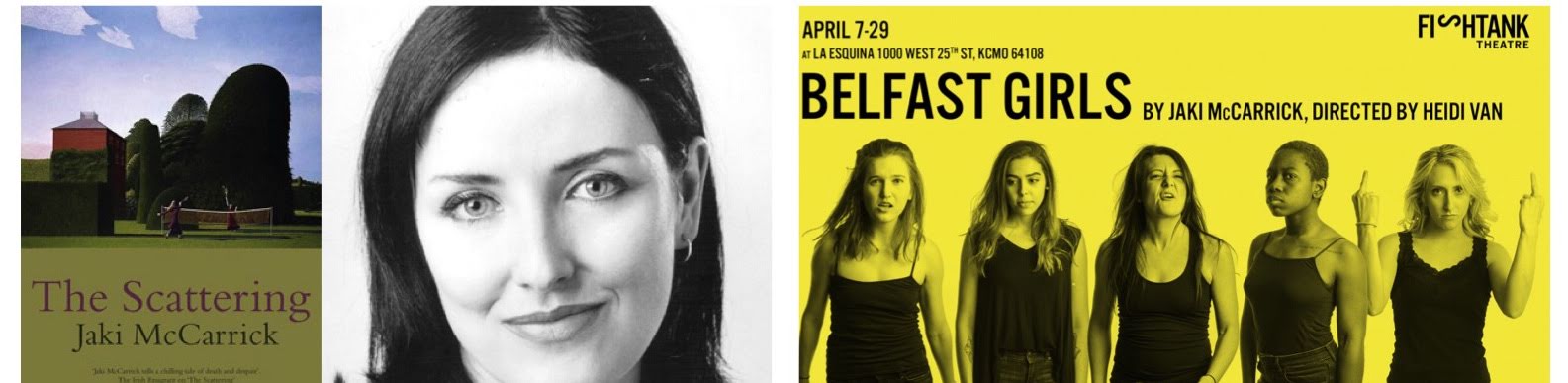
The Scattering - A Collection of Short Stories by Jaki McCarrick (2013, 235 pages)


March 1 to March 31


Jaki McCarrick
Dundalk


Posting on a collection of short stories presents more of a challenge, to me at least, than posting on a novel.    For me I find the best way to write about a collection of short stories, both in terms of assisting  possible readers or buyers of the collection and respecting the writer, is by  posting in some detail on a representative number of the stories and then make some general observations on the collection and offer my thoughts to prospective readers.

  For those in a hurry, I will say The Scattering - A Collection of Short Stories by Jaki McCarrick is an amazing body of work, withing shimmering and incredibly entertaining stories that go deep into the heart of many of the issues facing contemporary Ireland.  This book deserves tremendous success and a very wide readership.  It both confirms and rises above the common elements of the Irish short story I have spoken about this month;; the weak or missing father, the presence of the stage Irishmen, the uneasiness of the relationships of men and women,  the heavy reliance on alcohol, the temptation toward arrogance as a way of dealing with the humiliating consequences of colonialism, the obsession with death, and the false rebellions of posers of all sorts.  

"By The Black Field"

"There were times when Angel thought that the land
communicated with him. He knew that this was irrational, and
probably due to overwork, and to the fact that he had not yet lost
his city-born infatuation with green fields (and also, possibly,
because he’d spent his childhood summers in this place and had
fond and lively memories of it). He imagined that after a few
more years on the farm he’d be as hard nosed towards the land
as every other farmer he knew. Still, he could not dispel the sense
he had that wherever he went on his six acres he was not alone."

"By The Black Field", the lead story, gets this collection of to a marvelous start.  It is set on a six acre farm in Ireland, up near the border with Northern Ireland.  Angel not to long ago inherited the farm and he and his wife not to long ago moved back there from London. Angel loves working the farm but he misses the excitement of London and his wife misses it more than he does.    As the story opens he is building a fence on some wet land and he is thinking maybe he should have built a stone wall.  He and his wife live in an old cottage but all their neighbors live in modern houses.  This is a story, in an oblique way of how a returning exile feels a deeper connection with Ireland than those who never left.  (You can see this some of the better short stories of George Moore also.)  Like any short story  master McCarrick gets us interested in the people in the story (there is something different about them and I loved how this was slipped into the story so subtly), we learn a bit about their life history, a sort of conflict with a neighbor the man does not like, she reminds him of the things he does not like about London, then something big happens. We are left with a mystery as to exactly what did occur but that just makes the story all the better.  "By The Black Field" is a wonderful story, it also give you a kind of feel for what can be the darker side of Ireland, never far from the surface.  Death has been my constant companion this month as I read Irish Short Stories and he is with me today.  I do not mind him so much as I once did.  

"The Badminton Court"

"She says little at breakfast. The evening before she had been
on fire. Rapid, erratic thoughts, unfinished sentences, sentences
that unravelled, ending in lacunae, gibberish. She had been
rude, her inhibitors obstructed by that thing, growing,
multiplying inside her. Tumour talk, Frances calls it."

"The Badminton Court" is a very moving story about a debt repaid through service to seventeen year old Miranda, dying of a brain tumor. It is a story of the memories of twenty two years ago when the narrator never dreamed these would be her happiest times.  Her father is rich and always away on business trips an her mother is simply gone and no one ever speaks of her.  There are two people taking care of Miranda.  One is Francis, a household servant of long standing and the other is the daughter of a man who was in debt to Miranda's father for some dubious business deals and somehow the debt is being paid by his adult daughter being Miranda's final companion.  This is a tale which can only end one way or another in death.  It is also about how happiness comes often from small seized moments of joy as shown in these wonderful lines spoken twenty years after an amazing act of kindness and cruelty is committed.  We never quite know why but that works perfectly.

"Once he asked if I was happy. Before I had the chance to
reply, he said his own life had been good and prosperous, but
hardly happy. Mine was the same, I said. What is happiness? he
asked, as if I knew any better than he. I pondered on this. For
me, I said, happiness is two girls playing badminton under an
azure sky with clouds that are bird-shaped. Those summers
were best, he replied, when I used to watch you play. It occurred
to me then, that for nearly a quarter of a century we had both
been sustained by a few intoxicating memories squirrelled from
our youth. I told him it was high time we lived a little. He agreed
and told me then of his plans to flatten the court."

"The Scattering" 

"Further along the beach he saw a car parked above the dunes.
A woman was standing by the edge of the dunes looking at the
sea. She was holding a blue plastic bag tensely against her
cream coat. He thought of turning back as he was now alone
on this stretch and did not want to alarm the woman, who had
begun her descent to the beach. Suddenly a dog came
bounding towards him. He had seen the exuberant three-legged
collie on the beach many times, always alone, absurdly oblivious
to its missing limb."

"The Scattering", the title story of the collection, like the two prior stories I have posted on have death at its core.  The "plot action", not a phrase I am crazy for, is fairly simple. A man has died and following his wishes his ashes have been scattered in the ocean.  A quick look at images of the Ireland seacoast in Google will reveal lots of dramatic sea shore cliffs that would make an excellent venue from which to scatter ashes in the water.  I suspect this is what often leads to the request.  Maybe it also the fulfillment of a wish while living, to throw oneself in the water.  It is the story of contrasts of two scatterings, one with a large respectable number of people and one with just a woman with a blue plastic jug and a three legged dog for her company.  There is a great deal in this work and I hope you will be able to read it for yourself.  


"The Burning Woman"

"Despite his name, Quigley claimed
no Irish heritage, and John’s Irishness was meaningless to him
as he had left Limerick at fourteen and had never returned. To
find as neighbours two young Irish ‘artists’, was, John told me
later, an enormous relief to him. We gave him hope, he said, that
a gay man with no interest in hurling, in Leinster vs Munster, or
the Irish language, might be able to go home one day without
fear of being strung up. On the basis of our mutual disregard for
any particular nationalism, we four formed a strong friendship,
avoiding Irish haunts in London like the plague despite his name."

I really liked this story.  It begins with an invitation to a funeral.   Sometimes people say they going to someone's funeral means you won and they lost.   The deceased is an artist, from Ireland who moved to London in a time when he had no way to make a living in Ireland.  He made it big time as a painter, living out the dream of the crazy artist, his description makes it seem he looked a bit like Aleister Crowley.  There is just so much to like in this story.  In the figure of the man, who they have not seen or heard from in decades, John, we have the crusty embittered writer raging at the world for its failure to see his genius.  We also have occult elements, pentagrams, paintings of burning women and such.  I do not have a way to talk about what happens in this story without trivializing it so I won't.  It is about exile, about wanting to forget your are Irish, about why Jack Kerouac still matters, about what London means to the Irish, about failure of nerve.  In this  story I came to see the full power of McCarrick, it is deeper, danker and darker than the first three works I spoke about. 

"Blood"

"What are you researching, Lara?’ he asked.
‘Oh. Settlers to this area in the fifteenth century.’
‘From Britain?’
‘No,’ Lara replied, scanning the huge ivory pages. As she did
not elaborate, and as he was afraid to enquire further, Fred
turned to his wastepaper basket and began to sharpen his
pencils. The room seemed to fill with small, intrusive noises:
the trembling chalky sound of the ivory pages being turned, the
pencil shavings hitting the screwed-up balls of paper like rain,
the swish of Lara’s dress each time she moved, her assured slow
breathing."


Like "The Burning Woman", "Blood is in part about an Irish writer.   I have come to see this as kind of a license for eccentric behavior sometimes accompanied by the arrogance mentioned above, almost as if it were on loan from W. B. Yeats and James Joyce to name but a few exemplars.  


One of the characteristics of a society in which the old certainties are dying is a preoccupation with non-standard accounts of history,  occult systems.   One saw this in Ireland when for a time leading figures flirted with the theories of the Order of the Golden Dawn, the Waite Tarot and such.  Knowledge of arcane systems brought with it a feeling of superiority a smugness made all the more annoying as it was parasitic upon the backs, the blood of others for whom they claimed to speak but for whom they had contempt.  There are two on stage characters in "Blood" a simply marvelous, very smart, very funny story that helps explain why vampires are central to Irish culture and why they always seem to be so elitist acting (Carmilla this means you.)  We have Fred, he is a 30 year old who has never done anything but go to school.  His aunt is a world famous researcher into middle Eastern culture  and is often away at international conferences.  She has an incontinent cat and in exchange for taking care of the cat, he gets to live in her mansion.   The mansion contains a library of rare books and manuscripts and Lara has a letter authorizing her to use the library.  She is also female, something Fred has had no personal knowledge of for six years and sees as way to complicated a topic.   He will stick with academia.   Besides the cat, they are the only ones in the mansion so of course they talk.   I want you to read this story (and the whole collection) without it being spoiled for you.   I will just say it is flat out hilarious and you will marvel at the close.  

"Trumpet City"

"There was a danger to what he could smell in the
music, and he liked that. He liked that a lot."

I have recently started reading, after hearing it was chosen as the One City One Book selection for April James Plunket's classic novel set in Ireland in 1913, Strumpet City and I am betting this title is a play on that account of the mean streets of old Dublin.

The crazy musician seeing more in the world than the mundane people of the world do is a standard character in lots if novels and short stories.   This story does a great job with that idea.   The trumpet player dreams of playing in New York City or New Orleans, the holy cities for jazz music.  I believed in his love of music.  The story is also about the changing times in Ireland, the hard times where it is not easy for an aging musician to make a living.   A very good story.   

"The Hemingway  Papers"

"She felt it would be
like reminding him of his enormous failure as a father. That
he’d neither seen to the removal of their furniture from London
to Ireland – nor to the transportation of his own things, that
he’d hung back in London while her mother had reared her and
her siblings alone and that he’d only holed up with them years
later when he’d run out of money. That was the truth of it and
Clare knew that somewhere inside her father, he knew it. But
there was no point in going through all of that again. They had
rowed about it for too many years – about his drinking"

"The Hemingway Papers" is a very good story and almost a text book illustration of the extreme importance of the weak or missing father to Irish literature.  It also is about a man who hid behind drinking and his ability to be a good friend to other men, if not a good husband or father.  Story telling, whether real stories or made up lies also is a big factor in the Irish short story.  Another one is the complications involved in the relationships of adult children to their parents.  In this story the father is in a hospital ward.  For thirty years now he has been claiming he had an extensive correspondence with Ernest Hemingway.  He  had sent Hemingway a number of short stories to read and he had told the father to submit them to his publisher and he will try to help him.  Of course the man never followed up on it and he always told the family he left the letters and stories in a box in an apartment he illegally sublet to somebody when he lived in London.   The daughter somehow tracks down the man who now has the box and she brings it back (spoiler alert) and yes the father was actually telling the truth all those years.  The big story of his life was true. The ending is very suspenseful and I will let you have the pleasure of reading it yourself.

I totally endorse this very Irish collection of short stories with themes that are universal and people that those far from Ireland can see as totally real.

There are eleven  other marvelous stories in this collection, each one a delight to read.   


I want to share the description of the book from Seren Books, the publisher of this and lots of other great books.


The Scattering is a collection of 18 stories, many set on the Irish border, where this London-born author currently lives. These stories explore states of liminality: life on the Irish border, dual identities, emigration, being between states - certainty and doubt, codependency and freedom. Some explore themes of catastrophe and constraint. All explore what it means to be alive in a fraught and ever-changing world. This first collection from prizewinning author and playwright, Jaki McCarrick explores the dark side of human nature, often with a postmodern ‘Ulster gothic’ twist.
One of the stories ‘The Visit’ won the Wasafiri Prize for new fiction, and many have been published to much acclaim in literary magazines.
Author Bio

Jaki McCarrick

Jaki McCarrick lives in Dundalk and studied at Trinity College, Dublin, gaining a Master of Philosophy Degree, Creative Writing – Distinction. Before this Jaki gained a BA Performing Arts, First Class Honours Degree at Middlesex University. She has also completed an RNT Directors Course, 2001.
Jaki is a playwright and short story writer who is also working on a novel. She has won many awards for her work including: Winner of the 2005 SCDA National Playwriting Competition for The Mushroom Pickers; Shortlisted for the Sphinx Playwriting Award 2006, Bruntwood Prize 2006, Kings Cross Award 2007 for The Moth-Hour; Shortlisted for the 2009 Adrienne Benham Award for Leopoldville and the 2009 Asham Award for short fiction for The Congo – in this collection. Most recently her short story The Visit, included in the Badlands collection, won the Wasafiri Prize for New Writing in October 2010 and Jaki was declared the first ever winner of the Liverpool Lennon Paper Poetry competition, which she was awarded by Poet Laureate Carol Ann Duffy. Another story from the collection, Hellbores, was recently shortlisted for both the Fish Short Story award and Bridge House Publishing's World Stopping Event writing prize. Bridge House want to publish that story in a new anthology and it has also appeared in the Irish Pages journal.
Jaki McCarrick's blog jakiscloudnine.blogspot.ie


I hope to read and post on more of her work in the future.  She has kindly agreed to participate in a Q and A Session for Irish Short Story Month so please look for that.

Mel u

Thursday, March 12, 2020

The Emperor of Russia - A Short Story by Jaki McCarrick - A Guest Post

Irish Short Story Month Year Ten


My Q and A Session with Jaki McCarrick


In March 2013 during Irish Short Story Month Three I posted on The Scattering, the debut collection of Jaki McCarrick.  The Scattering - A Collection of Short Stories is an amazing body of work, with  shimmering and incredibly entertaining stories that go deep into the heart of many of the issues facing contemporary Ireland.  This book deserves tremendous success and a very wide readership.  It both confirms and rises above the common elements of the Irish short story I have spoken upon: the weak or missing father, the presence of the stage Irishmen, the uneasiness of the relationships of men and women,  the heavy reliance on alcohol, the temptation toward arrogance as a way of dealing with the humiliating consequences of colonialism, the obsession with death, and the false rebellions of posers of all sorts.
Today I am very pleased and honoured that she is allowing me to share with my readers one of her stories, The Emperor of Russia. (She is the sole owner of this short which cannot be published in any format with out her approval.)
Jaki McCarrick is an award-winning writer of plays, poetry and fiction. Her debut short story collection The Scattering was published by Seren Books and was shortlisted for the 2014 Edge Hill Prize. The collection includes her story The Visit, which won the 2010 Wasafiri Short Fiction Prize and was included in Best British Short Stories (published by Salt), 2012. On the basis of her debut collection, Jaki was longlisted in 2014 for the inaugural Irish Fiction Laureate. Her play LEOPOLDVILLE won the 2010 Papatango Prize for New Writing, and her play THE NATURALISTS premiered in 2018 in New York to rave reviews: "Impeccable, a gift to its actors" New York Times; "Beautifully performed" The New Yorker. Her play BELFAST GIRLS, developed at the National Theatre Studio, London, was shortlisted for the 2012 Susan Smith Blackburn Prize and the 2014 BBC Tony Doyle Award. It premiered in the US in Chicago in 2015 to much critical acclaim and has since been staged widely internationally with recent premieres in Australia and Sweden. In 2016, Jaki was selected for Screen Ireland's Talent Development Initiative and has recently completed the screen adaptation of BELFAST GIRLS. She is currently working on her second collection of short fiction and her first novel, The Family Wolves. Jaki also writes critical pieces for the Times Literary Supplement, Irish Examiner, Poetry Ireland Review and other publications.


The Emperor of Russia - A Short Story by Jaki McCarrick,

(The Emperor of Russia story comes from the 2019 Willesden Herald New Short Story Anthology

I could hear my father singing in the lower field. In between the lines of the poorly-sung Joe Dolan number he would call for me, each time more demanding, though he did not bother to draw near to where I actually was, which was at the back of the house, pegging his newly-washed clothes to the line. I knew I’d give in eventually to his calls, but I wanted him to hurt his voice as much as possible with the screeching. ‘Rose! Come down to the big tree,’ he said, finally, his song ended. When I finished the laundry, I sauntered towards him. Course it was me who let out the loudest screech of all when I got to the lower field, where he stood by the eucalyptus tree in his brown pinstripe suit with its shiny stains and frayed cuffs, leaning on his pellet gun. Hanging from a high branch of the tree was a crow, plump and stiff, and I knew straight away by the white in its feathers that it was Hermione, my brother’s pet, and that my bastard father had killed her. I fell to my knees and cried out, worse than any time when he’d left us first and gone to England.


‘Crows are a dime a dozen, wee one, and you better stop with that whining,’ my father said. There wasn’t an ounce of remorse in his voice.
‘You’d no business doing that,’ I said.
‘I told you what we’d be doing to stop the crop getting took off us from under our noses, didn’t I? A certain measure your mother would have none of.  But she’s not here now is she?’ He was right, of course: he had told me what he planned to do to a crow, and yes, my mother wasn’t around to protest. She’d died in the years he was away, and here he was now, as he’d been this past while, acting as if he knew everything about how to run our farm, when truth was he knew next to nothing about farming. He was just as he was before; all he was good for was guns and shooting and everyone knew it.

Hanging a dead crow from a tree is a practice they used do in the country, in the border areas especially, to ward off other crows from the new barley, wheat, spuds. The belief was that crows, being sensitive, intelligent birds, would spend a week ‘waking’ their fellow (dead) crow, and in that time the crop would be harvested. I’d seen it once before, years ago, a pair of crows hanging from blue rope off the gate to a backwoods field in Omeath.
‘Julian’s been rearing her since she was a chick fell out of her nest,’ I said. ‘The one white wing, the crack in the beak. How could you do a thing like that?’ I went to the ladder lying in the grass by my father’s feet, picked it up and brought it to the tree.
‘What you doing, Rose?’ he said, as I rested the ladder against the eucalyptus.
‘Going burying this bird that’s what. I’ll not have it swinging around for you to poke and swing, and for to call me down from the house to goad at.’ On the third step of the ladder I winced at the grip of his sizeable fingers.


‘You’ll not be burying this bird today,’ he said. I couldn’t help myself then and looked him straight in the eye and said:
‘Well, aren’t you the bastard Ma married.’ He went to slap my face, as he’d done a few times before, though he stopped due to the stern look I gave him. It is hilarious to consider how much respect my father demands from me and Julian. It’s like he thinks that by virtue of the fact of having conceived us he’s the right to the utmost loyalty and respect. Though from where I stood on the ladder, eye-to-eye with him, I could see I had crossed a line, and what’s more it felt bad to cross it, as I too held some weird store in his having conceived me, if even he had done that.
‘ You kill a crow, it keeps the rest of them off your field, and you know why?’ he said.
‘No.’
‘Because the others will wake him.’
‘The bird was a her,’ I said.
‘Because the others will wake her. They’ll screech and croak and they’ll not eat, just go back to the trees and cry for a day. That’s when we harvest. And we’ll not be robbed blind by them then. You see? That’s how it was done in the old days. It’s the crows or us.’
I got off the ladder and paced about on the grass. What was I going to tell Julian? I had so much hope in his recent sense of happiness with Hermione. I was planning to leave home the following May, you see; I’d a job lined up and everything - in a summer camp in New Jersey - so how could I leave Julian here now with our father, who insisted upon running the farm according to rumour and myth rather than sound agricultural knowledge?
‘Haven’t the crows as much right to the crop?’ I said.
‘What you know about anything?’
‘I know I can’t leave our fella here with you the way you are, going round killing innocent animals.’
‘I don’t care what you do,’ my father said, and looked up at the sky, at the slowly
circling crows, who must have been appalled at the sight of one their own tied to a eucalyptus tree like some kind of offering or ‘strange fruit’. My father was certainly the lynching kind after all, except that this was the Irish border and not Alabama, though bar the weather and accents the two places are twins on many levels.


‘They’ll start up now with their waking, and in the morning we’ll reap this harvest and we’ll have what we reap all to our bloody selves,’ he said. I watched him walk off towards the house. When he was out of sight I could hear the front door open, then shut, though I was sure he would watch me from the window in case I’d climb up the tree and cut down the bird: I thought better of doing that.
The following day, a team of men arrived from Bush to help with the harvest. I’d seen some of them before, in town, or in church; Poles and Lithuanians who’d been hired by neighbouring farms for the potato picking. In the yard, where they’d parked their cars, I met them with my father and shook the burly pickers’ hands as he’d instructed me to do. I gave them a few lines about seeing some of them in town and how I’d love to travel to their beautiful countries, which they must be missing in this hole of a place, etc etc. My father quickly took over then and told them about Hermione. As he stood chattering amongst them, I slipped away and went to the house. I’d not had a chance to talk to Julian about her – not alone at least (my Da had watched me like a hawk the night before) and I was waiting for my opportunity.

I threw stones at Julian’s window, which was open a little. The thick lace curtains inside moved gently in the breeze. Julian didn’t answer, and I didn’t want to go inside for fear of my father catching me talking to him and squealing about the bird. He never likes me talking to Julian. He especially doesn’t like squealing; has some weird ‘code’ about it. So I decided that with my father holding court with the pickers, like a big bear or some clownish figure from a Shakespearian play, that I’d talk to my brother from the safety of the front garden.
‘Julian, did you see we’re to have a big harvest, even with the terrible summer and the rain and all?’ I said, but there was no reply.

‘Can you see that the field is almost white entirely with the potato flowers? He’s a whole team over from Bush today to gather them this year. Listen, about Hermione. I think she’s gone, Julian. That’s what crows do, Love,’ I said. I wanted to tell him about my plan, but thought better of shouting it out in case I’d be heard by the pickers or my father. Julian would have understood though, because he knows the whole history of our farm, which is in the district of Grange, in the Cooley Hills, County Louth. This land is old, with dozens of brown information signs to do with the legends of the Táin, the oldest legend in Europe, about Cú Chulainn and Queen Maebh, dotted about the place.
 There are wells and souterrains all over, too, old traps and holes like the ones that’d be in Alice in Wonderland. Only they’re not Wonderland. They’re dark and cold inside, sometimes lined with stone but more often than not it’s just the bog down there, which is much worse, as it’s darker and weirder than stone when all around you. And if you were ever to get stuck down one of those traps or holes you’d never again get out, especially if someone were to block the entrance. The bad thing about our beautiful fields, of course, is that they are so lovely, full of clover and all manner of flowers, the harebells in May, the foxgloves in June, so that you’d never know they are also full of such dangers, such holes. And a person, a man for instance, who’d been away, who’d fecked off, left his wife and children fending for themselves in these hinterland fields with all their hidden dangers, might not be so used to them holes and wells and tunnels and traps, and one day when he’s … But I digress. I did not discuss my plan with Julian, nor had I the heart to tell him the truth about Hermione. Julian was housebound, and unless he stuck his head out his window he’d never see the crow hanging from the eucalyptus tree, so I hoped he would believe me that Hermione had flown away.  My father called out. ‘What you want now?’ I said.


‘We’re starting. Lads are ready. Not a living crow in sight neither. All cleared off into the hazel wood. Stop slacking now, Rose.’ I felt the usual rage at him rise up in me. I wondered why it was he bothered me so much. He should not have had such a hold over me (I hardly knew him after all), but he had. I returned to the window:
‘Julian? I’m serious. I need you to get well and strong and not leave me to that stranger we’ve let back in the house. Treats me like his slave. Like Ma.’ And as I said those words I thought I could hear Julian crying and I began to feel ashamed.
‘Ah sure, I know you loved him. Wasn’t he a funny old Da when we were tiny? Swinging us round the place. But he’s not the same. He’s not. And I need you to get strong, Julian, so we can take steps. Because that’s what we need to do.’
*
He doesn’t know this, my father, whose name is Dan, but I keep a photo of him when he was in his teens, maybe my age now. I keep it under my pillow.  He would be very surprised to find it there, that’s for sure. It’s black and white and as old as Methuselah. In the photo he’s holding a greyhound puppy, and there’s a smile across his face as wide as a sea. One that exudes gushing unadulterated joy. His eyes water with it. His love for the puppy is all over that photograph, like a good sort of stain. Yet whenever I asked him about having a pup or dog as a boy, he would shrug and say he’d never any time for animals when he was young, that he’d never any pets. So, I believe something happened him after he joined the Republican ‘war’, as he calls it, which he joined when he was fifteen. He not only put away childish things, as they say, but he put away the child, and any memory of him. There is something about the photo that helps me exist in the same house as my father, that makes me think he is not a monster. Even though there are others in the vicinity of the border who think differently.
            *
‘You’re taking long enough with that grub, Rose,’ my father said, like the greatest nag that ever lived. I’d made the sandwiches earlier that morning. And I’d been very careful and precise about making them, measured you might say, though I lied to buy time at the window with my brother.
‘I’ve to make it yet,’ I said.
‘Well hurry up about it. Come on.’
‘Coming Da. Coming.’
When I got back to him with the grub, I invited my father to eat with me, away from the pickers, who were gathered now round a long table we’d set out in the yard-cum-car-park. He liked seeing I’d taken care with his lunch and that I’d packed it in a picnic basket along with a check tablecloth. He always likes to be treated nicely, my father, delicately even, like bone bloody china, such is the man’s vanity. I guided him to sit at the edge of the field, where the land is flat. I laid out the cloth and placed the sandwiches and flask and teacups on it. He tucked in immediately. ‘That’s a fine lunch you packed us, Rose. You not having any?’ he said.
‘No.’
‘You’ll make some fella a fine wife one day,’ he said. Did he not see I was far from being interested in men, having had him as a father and therefore a good reason to hate the entire male species?
‘La-la-la-la-la …’ I said.


‘What you la-laing at?’ he said, and stuffed a hunk of bread into his mouth.
‘Making me sick with that kind of talk, Da,’ I said, and sipped on my Diet Coke, watching out of one eye in case any of the pickers came upon us.
‘Only I suppose he’d have to cut your tongue out in order to get through a day in peace,’ he said, and threw back his head and laughed. My father’s jokes are always laced with cruelty, but, annoyingly, they are also told well, and with expert timing.
‘Lovely thing to say to me, Da,’ I said, and sat back on the grass, my feet on the cloth. I looked at him directly and nearly blurted out there and then exactly what I’d put in the sandwiches.
‘Well, it’s true,’ he said. ‘You’ve repelled every fella came gathering spuds and barley here this past two years.’


‘Me and fellas is not your concern,’ I said. There was a period of silence between us then and I felt myself dying to tell him what I’d done but stopped myself in time. ‘So, you like my sándwiches do you?’ I said. He grunted something and nodded. Seeing as he couldn’t speak with the relish leaking out of his gob, I decided to make it even more difficult for him. ‘Which one do you like most?’
‘Most, I like the beef,’ he said, and licked his lips.
‘Ah, the beef,’ I said. ‘Well the beef I knew you’d go for. The beef I knew you’d like. So they’re the ones I paid most attention to.’ I watched him as he sucked carefully each of his fat fingers, probably thinking the only reason I was put on this earth was to serve him, like he was some sort of king or emperor. He’d been the same way with my mother.


‘Well, you’re a good cook anyways. That’s something,’ he said. He swallowed the food, wiped his mouth with his sleeve and made an almighty burp. Then he began to snigger. ‘ I suppose if the fella was deaf you’d be all right,’ he said. ‘Deaf, and fucken half-blind maybe.’ And he rolled about laughing, slapping the tablecloth rapidly as if he’d said the funniest thing.
‘Ah that’s it, you go right ahead. Entertain yourself with your own jokes,’ I said. ‘I’d say you’re very good at that now, entertaining yourself. Seeing as you were gone out of this house almost twelve years roaming the streets of places, sure you must be a grandmaster of entertaining yourself by now.’ He knew where I was going with this, where I always went: berating him for leaving us, all those years before. He lit up a cigarette without offering one to me.


‘I came home not to see you reared without a mother. Because I care. Because I’m your father. And what went on between her and me is not your concern neither,’ he said, sniffily. He stood and looked towards the pickers, who were already back at their work in the fields. We could hear their voices coming close, their fractured laughter floating on the air. ‘ You ask them lads to go from the drills that side?’ he said, perplexed.
‘I did,’ I replied. ‘That’s how we’ve done it all these years. Left to right.’
‘Good to split the work up I suppose,’ he said.
‘I thought we’d start this end now you’re finished eating,’ I said, and showed him the sacks I’d brought for the spuds we were yet to pick.
‘Just this is the rough side, rolls down to ditches and all, and I would have thought you’d have preferred, you know, an easier go of it,’ he said. I shook my head.
‘If you start left we’ll meet the lads coming halfway, you see? I’ll go right,’ I said. We stood and put the picnic things away. We folded up the tablecloth, corner to corner, and I was surprised he remembered how to do it. As we met with the folding of the cloth, I felt a pang of guilt in my heart and tried to shake it off. He saw it of course, the confused flicker of love in my eyes.
‘ I thought of you all the time wee one. When I was away. You and Julian. You been talking to him?’ I nodded and felt the burn of his eyes on me.
‘What does he say now?’
‘Not much. He wants to forget about it. The accident. Who wouldn’t want to forget a thing like that, nearly took your life, made you a ghost of your former self,’ I said. My father nodded and looked out at the land. Before us was Carlingford Lough, blue and flat. I would miss the sight of the Lough in America. The day was bright, the heather on the hills turning a soft aubergine colour. My father seemed fixed on the road towards Carlingford.


‘Down there,’ he said,  ‘the road North. I remember it well. Men in uniform. “Papers, Paddy” – and me not yards from my own farm.’
‘I’ve no memory of those days and I don’t want to have either,’ I said.
‘Well I do,’ he said, and I felt a little ashamed for offering him no understanding on this subject.
‘Why d’you go to England then if you hate it so much?’ I said.
‘We all run back to the colonizer, to the one that hurts us – eventually. Do you not know that, Rose? Didn’t your mother teach you how that game worked? They take something from you, a part of your heritage, your identity, that you need so as to know yourself, and you go always looking for that thing.’ I knew there was something in what my father said. To do with our history here, perhaps. About how the border area, all three hundred twisty-turny miles of it, had been ravaged by the Troubles.  How it had formerly been plagued by checkpoints and police and soldiers. My father knew things. And if I could have removed the bitterness I felt towards him from my heart I might have learned some of them. There was a moment then between us; in fact it was the culmination of many moments, when I felt he was the grand figure, the giant I’d made him into when I was a child. He felt awkward then, I could see it in him, though he quickly lapsed, purposefully it seemed to me, into the crow-killing coward I’d become more used to, as if this were a mask, one behind which he felt safe:  ‘Well, the spuds won’t be lifted by themselves,’ he said, rubbing his hands together. ‘And we better get into it before the crows stop caring.’

As he picked along his drill, I slipped away from him and went back to the house. The window was again open in Julian’s room at the front and I threw stones against the pane for my brother to show himself, but as was his way he did not come. I directed my voice to the window: ‘Julian. You remember when he was gunrunning? Hiding guns all over Ma’s land? Putting us all in danger? Well, he was a bad egg then and he’s bad egg now. So you better hang in there, and stop moaning, sounding so lost and sad.’ I said. ‘Hermione’s a fucken stupid name for a crow anyways. As if I didn’t know where you got it. Look, buck up. Because we’re to be free soon, the two of us, of the stranger we let back in this house when we shouldn’t have.’ I sensed Julian would know what I meant and what I was planning now to do.

When I got back to the meadow I saw my father retching over the white potato flowers. I’d brought another sack with me, flung over my shoulder. I went to him and asked him to lean on me so I could bring him back to the house. ‘Into the meadow here, by the crocus. That’s it, Da,’ I said. I took a few paces with him and stopped. ‘Rest here on this big stone a while. Sit, and I’ll see if I can find you some wild mint that’ll settle your stomach and then we’ll go home,’ I said. As he sat on the stone, clinging to his stomach, I rummaged around in the grass, not for mint at all, as you can imagine. Eventually, I found what I was looking for. My father whined with pain and I did my best not to pay any heed.
‘Oh Rose, I’ve something to tell you, love,’ he said, as he wiped down his sweaty brow.
‘Too late for talk like that, Da,’ I said. ‘I’d save it for Julian. He’s the young one now.’
‘Isn’t it about Julian,’ my father said. He looked about him, his wide eyes darting from rock to bush. ‘This bit of your mother’s land. Ah, we would walk here many’s a time. Looks very familiar. During my “political career” perhaps. Aye, I’m sure this is a place I’ve been to and hidden certain things in.’
‘Much good your politics did you. Much good it did any of us. Had to go to England in the end, left us half-starved most of the time.’ I stood him up and walked him towards where I’d rummaged. He sort of half-hummed, half-sang as he walked: ‘Oh me oh my, oh me oh my, you’re such a good-looking woman.’ I pressed on his shoulder and urged him to stop.
‘Now where’s that mint?’ He said. And with that I pushed him into the hole that had been hidden all these years in the grass. He let out a roar as he fell. I knew all about the holes and souterrains on this land, as I’d farmed it for years without my father’s help. As he cried, I pulled Hermione from the sack I’d brought with me, and threw her down on top of him.


‘There,’ I said to the mouth of the hole, ‘the crows can mourn the two of yez now. Because I won’t, nor will Julian. “Crow’s wake!” This is modern Ireland and we don’t string up crows no more! And if anyone comes looking for you, Da, I’ll say he fecked off to England, as he was wont to do. And I’ll be believed. I’m a young woman with prospects, off to America for a job that’s lined up already, a brother, half-dead from a joy-riding accident, and a feckless father who has nothing to do now there’s peace in Ireland only to tell me how to work my own farm. No one will come looking for you here, Da, because no one will fucken miss you.’
‘Rose, Rose!’ my father screamed. I went to the stone and began to roll it towards the mouth of the hole. It was tough going as over and over I rolled it.
‘I’ll be rolling the stone over now, Da, so you’ll have to shut up,’ I said.
‘Rose, Rose!’ he continued. What did he want to say? That he was sorry for the life he’d made us all lead? The hard work and the poverty, that had undoubtedly caused my mother’s early death? It was too late for apologies.
‘What is it, Da? I can’t let you out. You go stringing things up that people love; you go slapping me and me eighteen years old. You’re no good. And no good for Julian, who is my only friend here at all.’ And then he said the words that deep down I knew were true:
‘Rose, Julian’s dead this two years.’
‘ What are you talking about, you mad bastard?’
‘After the accident, sure you went demented. What with your mother and all.’


‘What’s that?’
‘You started talking to him six months later. And I always thought that somewhere in your mind you must have known Julian wasn’t in that room.’ I cried out then. My hands shook and I retched into the grass though I’d eaten nothing.
‘What about Hermione?’
‘Who?’
‘The crow! The crow down there on top of you. Who reared it from a chick if it wasn’t Julian?’
‘He did. But that was long ago. If this is that bird, it’s come back after a long time away, just like myself. Julian’s dead, daughter, and you better believe it. So, you go rolling that stone over this hole you’ll have no one at all. No Ma, no brother, no Herm…’
‘Hermione.’
‘And no Da! You’ll be an orphan entirely.’ I knew then he was right. Wasn’t he
always? Though I wished he’d said something about Julian before. I was embarrassed to think he knew all along I’d been talking to a ghost.
‘Oh Da,’ I cried, ‘why’d you have to kill that crow?’
‘I’m sorry about it. Oh me stomach.’
‘That’ll be the strychnine,’ I said.
‘The what?’
‘I poisoned the beef.’
‘Oh Rose. Why d’you have to do a thing like that?’
‘You shouldn’t have gone away, Da. That’s when, when it all started.’
‘What Rose, what?’
‘Oh, didn’t I miss you, Da?’ I said, and felt something inside me begin to shatter. What had I done? Bad enough I’d poisoned my own father, but now he was at the bottom of a cold deep pit. I thought about screaming out to the pickers for help. I heard him laughing. I drew closer to the edge. There was the sound of a chest or trunk of some kind being opened, of creaking, rusty hinges, and of the clatter of metal within.


‘What is it, Da, what’s down there?’ I said. I could hear him talking away to himself.
‘They don’t make them like this anymore. Look at the spin on that.’
He shouted my name up at me, his voice full of sorrow and sincerity, like the old Da, the one I’d idolized before he left:
‘The bird, Rose. I’m awfully sorry about him,’ he said.
‘Her Da, her.’
‘Where’d our fella get that name anyways?’
‘He was studying Shakespeare at school. And I was helping him. A Winter’s Tale he took that name from,’ I said, as tears streamed down my face, the memories of our once vaguely-happy family flooding my mind.


‘Right,’ my father said.
‘”The Emperor of Russia was my father.”’
‘What’s that, Love?’ he said.
‘You mustn’t call me that, Da.’ I said. ‘You’re a stranger to me now.’ His voice got quiet then, like a whisper, thin as a goose feather, and I concentrated intently as if it was the last time I might ever hear the tenderness in my father’s voice, which had always been there, I realised, had I bothered to listen for it.
‘Come here to me, Rose. Come to the edge and I’ll see your face just one more time before you roll over that stone, and say again to me the sweet-sounding thing I just heard you say.’ So I did. Who could resist the way my charming father could ask a thing? I went close to the hole, my face hanging over its dark mouth, and whispered:
‘”The Emperor of Russia was my father.”’ It was a line from A Winter’s Tale that I’d always loved. And I meant every soft-sounding syllable.
‘I know, Rose. I know,’ he said, and swiftly he lifted up the long contraption in his hand, and pointed the dark metal end straight at me. His hands shook. Our eyes, which were similar, round and slate-grey, locked for a second, his betrayal of me and mine of him suspended momentarily outside our eye contact, allowing for this rare exchange of pure familial love, before he fired with his trademark expertise.
End of guest post
I hope to follow the work of Jaki McCarrick for a long time.  I urge anyone able to attend a performance of one of her plays to do so.

Mel u


Thursday, May 24, 2018

“Night of the Frogs” - A Short Story by Jaki McCarrick - author of The Scattering A Collection of Short Stories and Belfast Girls


A Wide Ranging Q and A Session with Jaki McCarrick


Today I’m very happy and honoured to present to my readers a short story by Jaki MCarrick, “Night of the Frogs”.   I posted upon her wonderful debut collection of short stories, The Scattering in March of 2013 during Irish Short Story Month III.  Since then I have followed her work closely.

From my post on The Scattering 


The Scattering - A Collection of Short Stories by Jaki McCarrick is an amazing body of work, with shimmering incredibly entertaining stories that go deep into the heart of many of the issues facing contemporary Ireland.  This book deserves tremendous success and a very wide readership.  

It both confirms and rises above the common elements of the Irish short story: the weak or missing father, the presence of the stage Irishmen, the uneasiness of the relationships of men and women,  the heavy reliance on alcohol, the temptation toward arrogance as a way of dealing with the humiliating consequences of colonialism, the obsession with death, and the false rebellions of posers of all sorts.

Jaki McCarrick is an award-winning writer of plays, poetry and fiction. She won the 2010 Papatango New Writing Prize for her play LEOPOLDVILLE, and her play BELFAST GIRLS, developed at the National Theatre London, was shortlisted for the Susan Smith Blackburn Prize and the 2014 BBC Tony Doyle Award. BELFAST GIRLS premiered in Chicago in May 2015 to much critical acclaim (Windy City Times Critics’ Pick) and has since had numerous international productions. The play opens in Australia in May 2018. Reviews: http://www.samuelfrench.co.uk/p/58614/belfast-girls 

Jaki has also recently been selected for the Irish Film Board’s Talent Development Initiative to adapt BELFAST GIRLS for the screen. 
Her play BOHEMIANS was read at RADA on January 18th 2017, starring Imogen Stubbs and Rob Jarvis, and is due to be staged in 2019. Another new play is soon to receive its world premiere in New York. In 2016 Jaki was shortlisted for the St. John’s College, Cambridge’s Harper-Wood Studentship for her short play TUSSY, about Eleanor Marx, a piece she is currently developing for Kibo Productions.

Jaki won the 2010 Wasafiri prize for short fiction and followed this with the publication of her debut story collection, THE SCATTERING, published by Seren Books. The book was shortlisted for the 2014 Edge Hill Prize. Formerly longlisted for the inaugural Irish Fiction Laureate, Jaki is currently editing her first novel and a second collection of short stories (provisionally entitled NIGHT OF THE FROGS) which will include the Pushcart Prize-nominated story, Fogarty.

She has held numerous residencies including Writer-in-Residence at the Centre Culturel Irlandais in Paris & also regularly writes arts pieces for the Times Literary Supplement (TLS), The Irish Examiner and other publications.


Night of the Frogs

‘Myra Hindley, the notorious child murderer, has this evening died of respiratory failure,’ the presenter says. The news fills Mother and I with happiness, but it is also deeply and unexpectedly sad, because of Alfie, my twin. 

Later, I escape Mother’s persistent sobbing by going for a walk to the docks. I walk along the back of the town, on the new path along the Ramparts River. The November evening is grey and misty and there are puddles of rain all over the roads. I stop off at Mullens’ Takeaway and buy a bag of chips, eat them outside on the street, save a few for the swans. I’ve discovered that the swans have a penchant for Mullens’ chips and it makes me smile when I think of this secret I have about them. I walk on, through Seatown. En route, I see numerous yellow-green frogs on the ground, some alive, some dead. I kick at one and it thrashes about in the wet and leaps off. I wonder if perhaps it has rained frogs as there are so many. I wonder if perhaps the frogs are some kind of sign.

When I get to the harbour, I see that it is unusually full of boats. In the middle of a long row of vessels is a cargo ship I’ve not seen before. The ship’s name, Boisterous, reflects onto the dark water, each letter fractured slightly by the current. Its cargo lies scattered in crates on the pier yet there is no sign of anyone on board. I move closer, inch over the yellow strip on the rim of the pier. There are lights on inside but no sound. To the right are three fishing trawlers, festooned in red and pewter-coloured lobster cages. These are familiar to me, and I imagine their owners in the nearby Wine Merchants’ bar, warming their hands by the fire, enjoying a drink. 

I turn to see three figures outside the bar. I wonder if they’ve something to do with the scattered crates. The three are talking, animatedly. I try to listen but can’t make out what they’re saying. They speak at turns in Polish – which I recognize because of Theodore - and in another language, Russian, perhaps. One of the three is short, around Alfie’s height, a child perhaps, and another seems familiar to me, but I can’t be sure who it is in the darkness. As I study this figure, a truck, blaring Elvis, screeches into the yard. It turns by the end of the pier and stops dead outside the tannery. A man jumps out of the truck, walks towards the group. Again there are sentences I do not understand thrust loudly into the air.

Turning from this scene, I look out at the harbour. The moon is a scythe in the charcoal sky, around it a grey corona. The dim light permits no view of the mountains towards the border, allows for an outline only, a sense of there being a buttress, an end-point to the town. This quality of boundary is something I like. It makes me feel safe in a way the open moors of Saddleworth did not. 

As my eyes adjust to the shadowy light, I see that further out the swans are grouped together in the centre of the river, on the long marshy island where they nest. They make no attempt to come to me. I always look forward to feeding the swans when I come to the docks but now there’s no room for them on the crowded pier, and the sadness with which I’d left the house begins to rise up again within me. I shake the cold chips into the water, watch them float out to sea. Suddenly, I see her face in my mind, smiling down from the driver’s seat at Alfie and me. I shake the image free, take a deep breath. I turn to leave the harbour but tread carefully, watching for loose grain on the pier.  Within a few paces, my shoe loosens and I stop to clasp the catch. The newly prescribed shoe has been giving me corns and these put pressure on my foot when I walk. Hunkered down, I hear a cry and turn to see the three figures running after the truck as it speeds from the docks. When it’s quiet I shake grain from my trousers, walk slowly towards the bar. As I approach, I see a man on the ground. Closer, an ink-dark pool with steam rising from it. I touch the stricken man’s face: still, rubbery, cold. As I reach for the shiny object that lies beside him, the door of the Wine Merchants opens. I look up at the horrified face of the owner, Marcus Brown.

It has long been Marcus Brown’s dream to transform the docklands area of the town into a sort of Left Bank district. He’s been featured in many local newspapers stating as much, punches it out like a mantra whenever I’ve been in his bar. Says he has his eye on the tannery next door and plans to turn it into a restaurant. Therefore, I quickly grasp that the horror I see in Marcus’s eyes is due not only to the sight of the bloody corpse - and the knife in my hands – but also to the impact this situation may have on his dream. I know what the publican will ask me to do.
                                      
Theodore and I both check delivery paperwork in the former GNR Customs Clearance Depot, which was established during Partition and is now a distribution point for goods arriving from the northeastern ports. The depot sidings are a colourful, shrub-filled place where foxes roam freely, often in daylight. Behind the depot are fields, several brooks, large detached houses. Whitethorn spills from the fields to the tracks in May. In summer, the line is bordered by honeysuckle, fuchsia, montbretia. Outside, along the Ardee Road, are a couple of factories, a petrol station, a few new bungalows, a row of redbrick houses - one of which is home to Mother and I. 

Theodore is a tall, elegant, slightly pocked-face man of forty. He’s popular at work, and often takes it upon himself to single-handedly check the contents of the crates that come in from the docks. He makes jokes, and once pulled a piece of Polish coal from a crate and ate it, ‘to warm my heart in a cold country,’ he had said. He boasts of a training at Jerzy Grotowski’s Laboratory Theatre in Krakow, and claims a degree in Classical Studies from the University Of Gdansk, though he himself hails from the banks of the Vistula, near Torún – which is the home of gingerbread, Theodore says, and Copernicus. But despite his upbeat and chatty disposition, in repose, Theodore often seems sad. It has occurred to me that perhaps he regrets coming to Ireland, where he’s found little opportunity to implement the peculiar-sounding stage practices he describes to me so passionately. ‘When I’ve saved enough money,’ Theodore says, ‘I will start the Poor Theatre right here in this town.’ 

The stationmaster seems not to like Theodore, however, and is dismissive of the Polish man’s humour, his clever banter, practical jokes. A burly, ashen-faced man, who likes to start each working day with a single shot of rum alone at his desk, the stationmaster is married to my cousin Arlene (who was responsible for putting me forward for the job of clerk once I’d left St. John of Gods) and, despite his controlled alcoholism, he’s a real jobsworth. Arlene often brings her husband his lunch - then stops by my and Theodore’s office to chat. She seems always to enjoy her cultured exchanges with Theodore. Sometimes, I sit in the half-gloom of the shed-like workspace he and I share and think myself the luckiest man alive to have found such a job, be in such company, partake in such good conversation. Arlene, like me, is one of the Manchester Quinlans. After many years in the North of England the Quinlans moved back to Ireland, to the same border town in which my and Arlene’s fathers were reared. Sometimes, when we are alone, we talk about Manchester, and I detect a slight tension between us, as if she blames me, or what happened to Alfie at least, for having changed the course of her life. Though, in truth, what happened to Alfie changed all the Quinlans’ lives.

A few weeks after the incident outside the Wine Merchants bar, the body of a man is found on the swan islet in the river, tangled up in samphire and bulrushes, as is the suspected murder weapon, on which, eventually, are also found my fingerprints. I am called in by the Guards to ‘help with their enquiries’. I help with their enquiries for around nine hours. When the Garda asks why I’d picked up the knife, ‘I don’t know,’ is all I can muster, because it’s the truth. At the time, memories of Saddleworth had flooded my mind.  The lack of closure; all the years of not knowing, for certain, what had happened to my brother had pulled me towards that shiny object like a magnet. I recount my movements that night, all of which I remember clearly because it is the night of Hindley’s death – and the awful night of the frogs. I should not have picked up the knife, I know that. And I tell the Garda as much. The murdered man, the police inform me, had been repeatedly stabbed, and I - though it seems ridiculous given my physical weakness and placid nature - am their only suspect. Eventually, I am released. This is because, during my questioning, Marcus Brown takes it upon himself to walk into the station and inform the Guards that he moved the body - because he had not wanted it discovered on the doorstep of his pub. ‘There would have been too much negative publicity,’ he says. Marcus confirms he asked me to help and I had obliged. He apologies for his stupidity, explains how we moved the man with great care, reverence almost, over to the islet. The publican is conceited enough to think I helped him move the dead man in order to protect him. When I am let go from the station it is impressed upon me just what a serious offence it is to move a body from a crime scene. It’s not as if I don’t know this.

On the Sunday after my questioning, Theodore and I arrange to meet in a bar in town. I don’t tell him about my detainment. We discuss what we’ll do for Christmas and he reminisces about home, describes a city filled with Gothic architecture, surrounded by lakes and forests. ‘You must come with me one day to Torún, my friend,’ he says, and I beam. After a few pints of stout, we walk up the Dublin Road - to a visiting circus, at which we plan to spend the whole afternoon. Halfway there he stops. ‘You’re not yourself, Sean,’ Theodore says.
‘I’ve been thinking about my brother, Theodore, that’s all.’
‘How was your mother with the death of that woman?’
‘Never said much,’ I say.
 ‘You should not keep things all locked up, Sean. Let it out once in a while. The hidden things, they must surface. They will you know, whether you like it or not.’ 
We come then in sight of a row of red-and-white-striped tents pitched in a field. Cheery organ music fills the air. We carry on past the parked caravans, the stands selling toffee apples and candyfloss, a female tattooist, a tarot-card reader. Theodore holds my arm, guides me over the muddy path into the main marquee, towards the wooden benches in front. His touch is gentle and assured. (Sometimes, it seems to me that Theodore alone is able to break through the carapace of shyness I’ve managed to construct for myself since Alfie’s death.) A dwarf in clown’s make-up ushers us to our seats at the end of the bench. There is something familiar about the dwarf, his stance, tone. My heart sinks as I remember where I’ve seen him before. He and Theodore speak in another tongue, which I am almost sure is Russian. I look across the grassy circus floor and see my cousin Arlene waving and smiling, not at me but at a gushing Theodore.

Weeks pass, and I begin to notice how much Mother has brightened, as if Hindley's death has taken an enormous weight off her. I, on the other hand, have become far more morose.  Everyone has commented on it: Theodore, the depot staff, the stationmaster, Arlene. And when the murdered man’s name is finally confirmed, it sends me deeper into my despair. I know that soon the truth will emerge. I hear the first intimation of this announced on the radio: The body of a man found recently in the Castletown River has been identified as Slavic Janecki, a Polish truck driver who had been living in the Seatown area of the town. On hearing this, I am unable to swallow my tea. My toast sticks in my gullet. I am just about able to make it to the bathroom to get sick. I hear Mother pace up and down outside, listening to me cry out to a boy who disappeared off the face of the planet forty years before.      


When I had been in St. John Of Gods, recuperating from surgery on my foot, it was a lonely and bitter time. Unlike the other men in the ward, I received no visitors apart from Mother. I realised something in the four weeks I was there: I was becoming old, though in my mind I was still a boy. I considered that my life had barely moved on since the day our family had left England. I was stuck. In my memories of the moors, in a life that had barely got past childhood, and I felt suddenly annoyed with myself that I’d not made a greater effort to be in the world; to socialise, to forget. It racked me. After all, it was Alfie, and not me, who’d gotten into that car. Alfie had always been the healthy one. But he was always the one, too, to break the golden rule which Mother had drilled into each of us: don’t talk to strangers. I’d pleaded with him not to take the ride with the blonde lady with seagull eyes but Alfie hadn’t listened. Alfie was effervescent, believed in everyone and everything, while I was – and am still - cautious, overly ponderous, sensitive to the darkness in others. She had smiled at us, promised us sweets and a lift home in the front-seat from Friezland School across the stark yellow moors. Yet I knew, even at that age, that she was blackhearted, cold as hoarfrost. Still, it may as well have been me who had taken the ride for all I’d done with my days since. I resolved then to turn my life around - if only for Alfie’s sake. I promised myself (and my twin) that, henceforth, I would exit completely all my comfort zones. I would get out of the house more, find work, make friends.  On my last day of physiotherapy, I walked the length of the male ward, stopped at the Thought For Today picture at the end of the corridor. The caption across the image of two young boys read:
     To have a friend be a friend. 
I realised in an instant that I’d been doing it all wrong.

                                        
By the time I return to work, the stationmaster has been fully informed of what had happened at the docks. I do not mention to him that there are likely to be repercussions for me - having interfered with a crime scene - nor that it was a risk I was willing to take in order to help a friend. For now, I wish to forget the whole bloody affair, return to the comfort of my daily routine at the depot, of feeling I belong. But the news of what appears to be my peripheral involvement in some kind of gangland activity on the harbour docks has traveled fast. It is news the men at the depot find too interesting to ignore. Wisecracks fly around my workplace. These are, or are versions of:
- You’re a dark horse, Sean Quinlan.
- Didn’t know you were thick with them kneecapping smuggling gangsters, Sean.
- Didn’t know they let handicaps in the Ra, Sean. 
- What d’ya be doing at night be the docks with all them sailors anyways, Sean? 
It occurs to me then that I have never been this popular. Though the Guards’ continued presence around the station (despite Marcus Brown’s explanations, there seems to be police on every street corner, sometimes parked right outside the depot) is unnerving: it might lose me my perfect job. And while I am haunted by the fact I’ve contributed to a delay in the trucker’s family knowing his fate, the fact of the matter is, I’ve pieced something together about that night on the docks and I cannot share it. Theodore is right, it is wrong to keep things locked up, but what can I do?

Arlene stands in the lane at the end of the sidings, by the old steam engine. From the window of the office I watch my cousin shake a stone from her shoe. As the stationmaster has gone home, I wonder why she waits outside in the wintry cold. I watch the petite buxom figure pace the stony pathway, her long hair loosened now to her waist. I notice how the silky locks catch and hold the light. I watch her break the branches of the faded honeysuckle, inhale what’s left of its perfume, then stop to stroke Blackie, the depot cat. A lapwing swoops down to the hedge and Blackie skulks into the undergrowth, ready to pounce. Arlene shoos the cat and so saves the bird. I watch Blackie turn his attention then to a yellow-green frog making its scissor-like jumps towards the roadside stream. I smile at this simple scene, my cousin engaging with the sidings’ wilderness - when Theodore emerges from one of the cargo sheds, walks towards her. I back away from the window. He turns, it seems to me, to see if he’s being watched. Arlene flings herself at Theodore, wraps her arms about him. He lifts her high into the air, causing the posy of honeysuckle to scatter onto their clothes and hair. They kiss. The sight of them like this shakes me. Though I am happy for them both, I am keenly aware of the danger they are placing themselves in. And I am jealous: Theodore is my friend, not Arlene’s. The jeopardy I have placed myself in has been all for him, all for our friendship. Has he not understood this?

Suddenly, the sound of sirens closes rapidly on the depot. I leave the office as quickly I can. In the courtyard I see two armed Guards race in through the entrance. They pounce on the couple, walk them forcibly out front. A Garda indicates to me to keep back. I watch as Theodore is handcuffed, stuffed into the back-seat of a squad car parked in the middle of the road, with Arlene bungled into another. I take a moment to breathe, get my bearings. I have feared this day might come ever since the night Myra Hindley died. But Theodore is my best friend, has dreams of making theatre in the town. Surely, I would have jeopardized those dreams had I let it be known that it was he who was the figure in the darkness that night, outside the Wine Merchants, he who had run from the scene towards the red truck? (I had long figured out that the child-like figure who’d spoken in two languages was the circus dwarf.)
As the squad cars speed off, I make a slow trek back to the office. I’ve been the best friend I could to Theodore and still I’ve lost him. The thought of this weighs heavy. The phone rings as I approach the door. I get to the desk, pick up the receiver. It is Mother.  She’s at once talking and crying and yet sounds elated. ‘What is it?’ I say.
‘Are you sitting?’ she says. I want to blurt out all the events of the day, to tell her how tired I feel, that Cousin Arlene and my only friend in the world seem together to be involved in some kind of murderous scam, perhaps to do with smuggling, and that it is now likely the end of our friendship. I want to tell her how low I’ve sunk so as to protect him.
‘Yes Mother, I’m seated,’ I say, and sit down.
‘I’ve just received a call from the Greater Manchester Police,’ she says, ‘they’ve found him, Sean. They’ve found him at last.’ My wrist goes limp – it’s some kind of involuntary response. The receiver clatters to the desk. I hear Mother’s small and bristly voice continuing to explain that almost forty years after he’d gone missing, the remains of eight-year-old Alfie have been found on Saddleworth Moor.  It is undeniably him. The bog has preserved items of clothing: the Friezland blazer, the grey flannel shorts, the black-rimmed spectacles. ‘Sean, Sean are you there?’ I hear her say, over and over.  I pick up the phone, tell her I’ll be home soon. I sit dazedly, in silence, not fully feeling the cold of the room nor hearing the winds pick up in the fields outside. My thoughts swing from the moors - to the docks on the night of the frogs. I am aged eight and watching the white Mini-Traveller speed away with my brother inside – then I’m in a small boat with Marcus Brown bringing the trucker across the river to the swan’s nest. How white and peaceful he looks. The Polish trucker and Alfie: proof that eventually all things hidden will come to light, just as Theodore had said.

End

I offer my great thanks to Jaki McCarrick for allowing me to share this delightful story with my readers.

This story is the sole property of the author and is protected under international copyright laws.

Mel u


Featured Post

Imperial Reckoning: The Untold Story of Britain’s Gulag in Kenya by Caroline Elkins - 2005 - 701 Pages

  Imperial Reckoning:     The Untold Story of Britain’s Gulag in Kenya by Caroline Elkins - 2005 - 701 Pages 2006 Pulitzer Prize Winner From...